Who really pays for your credit card's cash back?

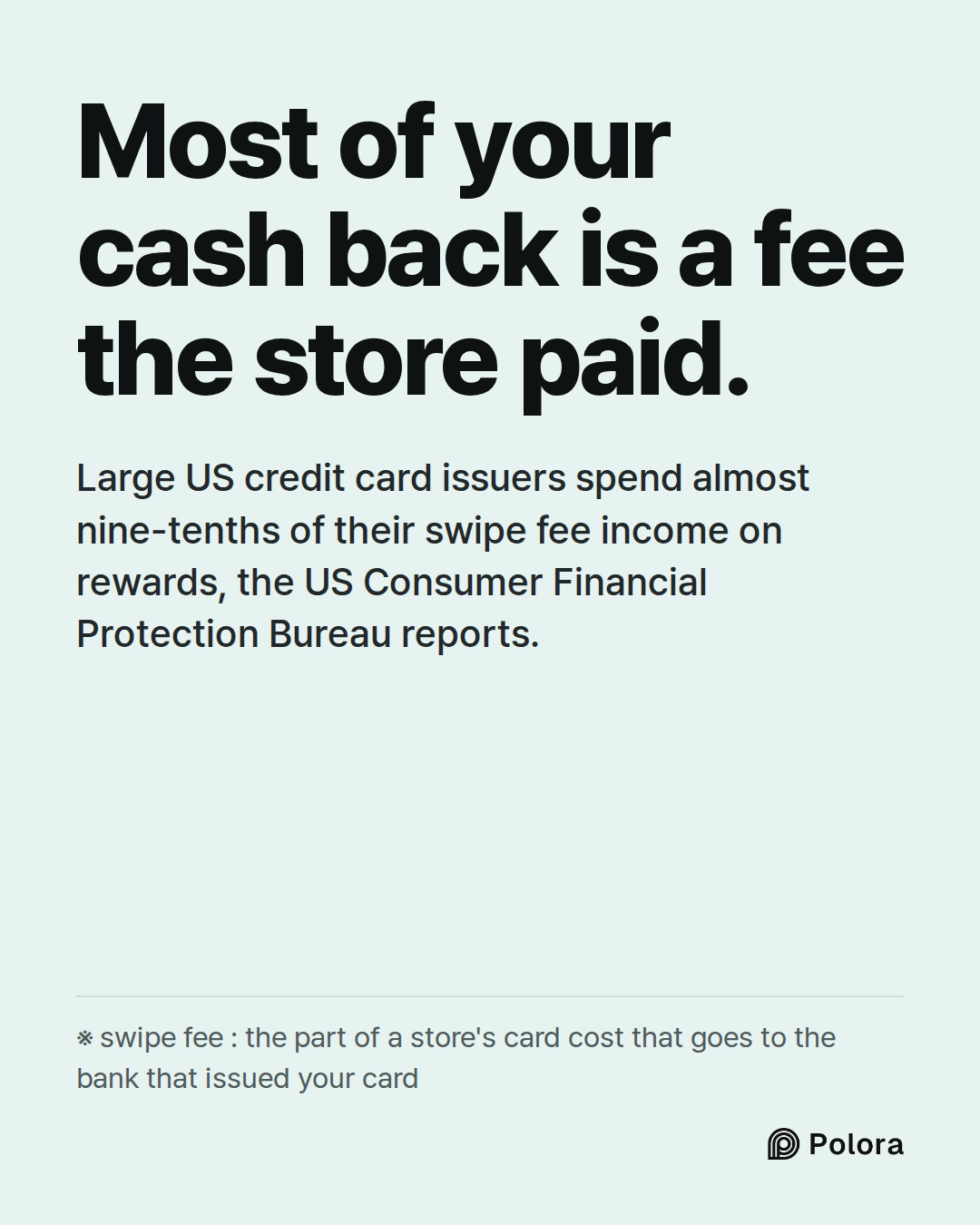
Mostly the stores you shop at, through a swipe fee on each card sale, and often shoppers paying cash or debit too, through prices that build the fee in. US card issuers spend nearly nine-tenths of that fee on rewards, and interest from cardholders who carry a balance is the card business's main income.

Business & Economy · 2026-10-03

Where does your cash back actually come from?

Two percent back feels like the bank being generous. It is closer to a refund of a fee you never see. Each time you pay with a credit card, the store pays to accept the card. The part of that cost that goes to the bank that issued your card is called interchange, or the swipe fee.

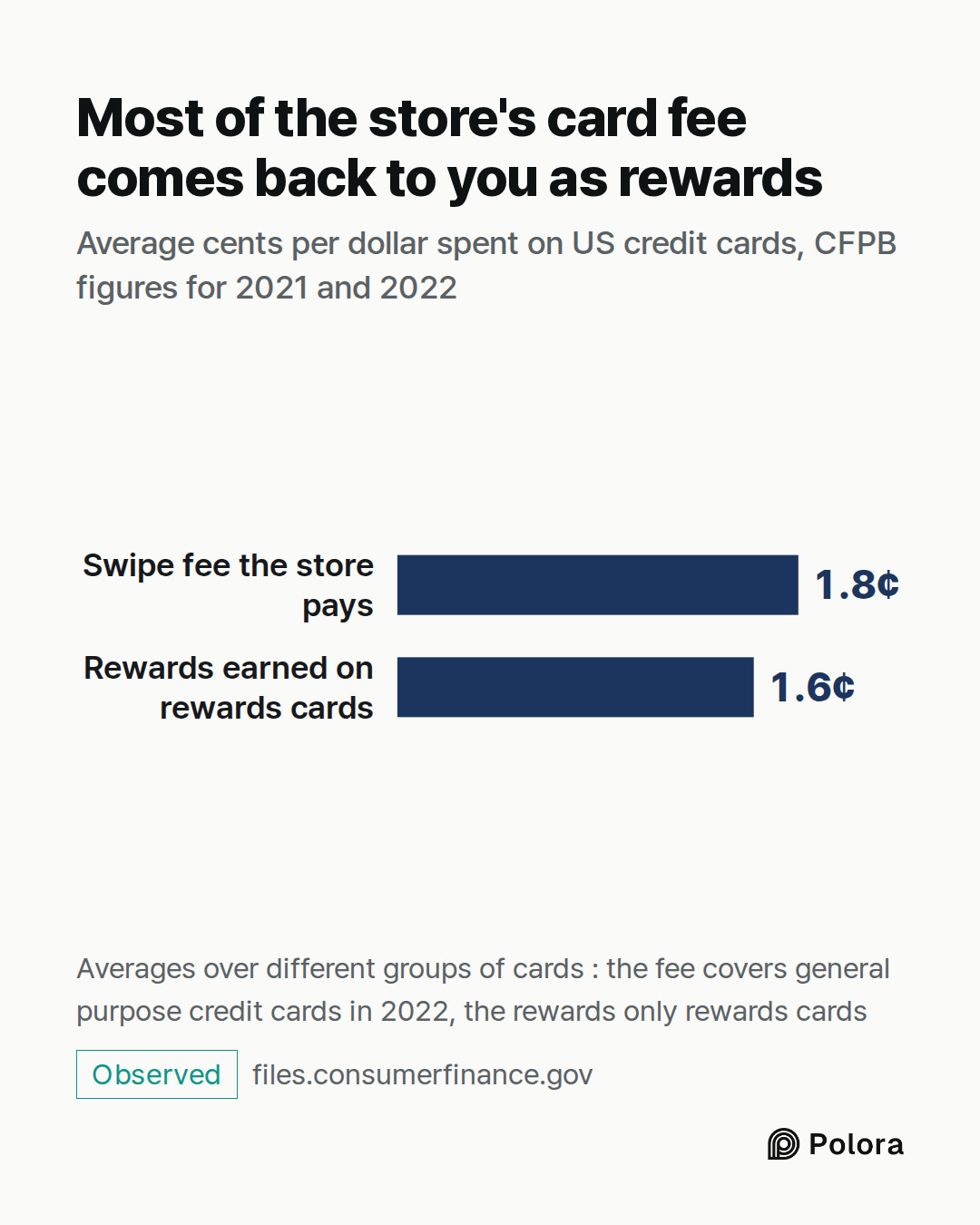
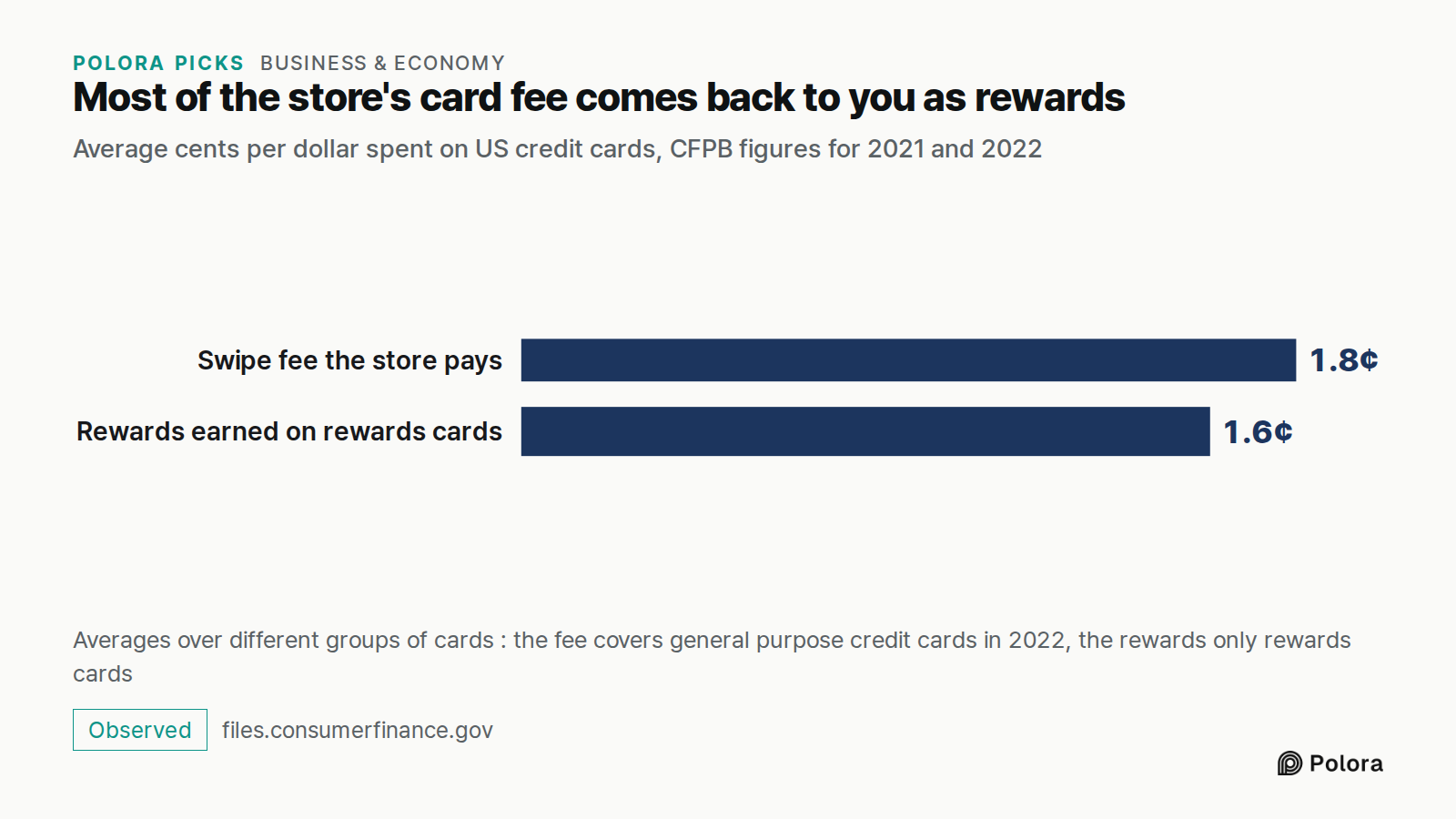
The US Consumer Financial Protection Bureau collects data from the largest card issuers. It put the average swipe fee on general purpose credit cards at 1.8 percent of the purchase in 2022. In the bureau's words, issuers typically fund rewards through interchange revenue, and rewards took almost nine-tenths of it. People with rewards cards earned 1.6 cents in points, miles or cash for every dollar they spent on those cards in 2021 and 2022.

So, roughly, for each dollar spent on credit cards the store pays the bank about 1.8 cents, and on rewards cards about 1.6 cents comes back as rewards. The two figures are averages over different groups of cards, so this is a picture of the whole market, not the accounting of your own purchase. What it shows is that rewards are not paid out of the bank's generosity ; most of the money is a fee the store paid.

The same report found that issuers earn more in swipe fees than they spend on rewards. That gap is not simply profit, though. A Federal Reserve analysis found that rewards and other transaction costs together slightly exceeded banks' swipe fee income, and that lending supplied most of what banks earn from cards.
Most of the store's card fee comes back to you as rewards · Average cents per dollar spent on US credit cards, CFPB figures for 2021 and 2022 · Swipe fee the store pays · Rewards earned on rewards cards · 1.8¢ · 1.6¢ · Averages over different groups of cards : the fee covers general purpose credit c
Average cents per dollar spent on US credit cards, CFPB figures for 2021 and 2022

Why do people paying cash help fund card rewards?

Stores do not always absorb the fee. Many US stores charge one price however you pay, so the cost of accepting cards is spread across all their prices. Where they do, the shopper paying cash or debit pays the same shelf price as the shopper collecting points. Where a store adds a surcharge for credit cards or offers a discount for cash, that link is broken for that store.

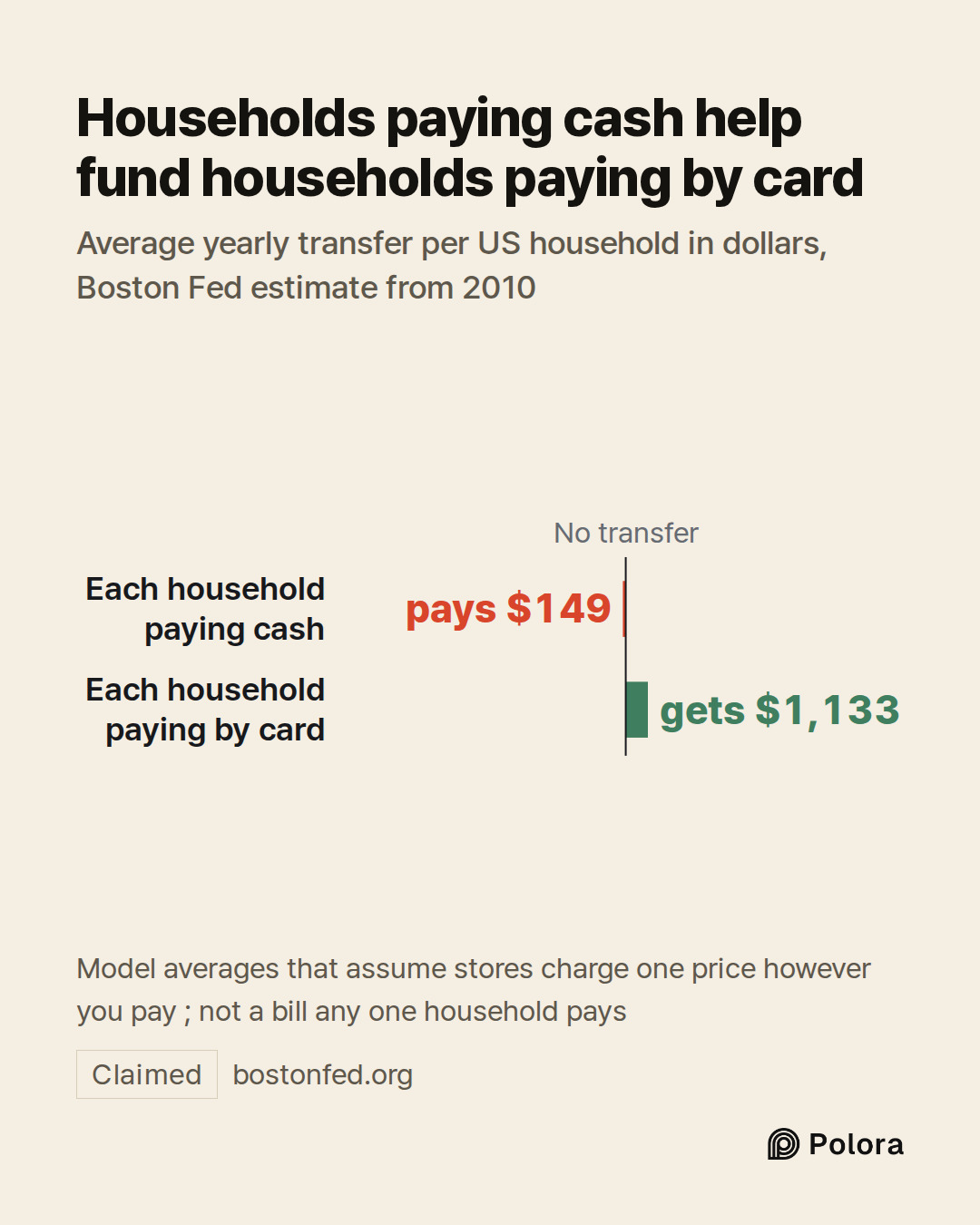
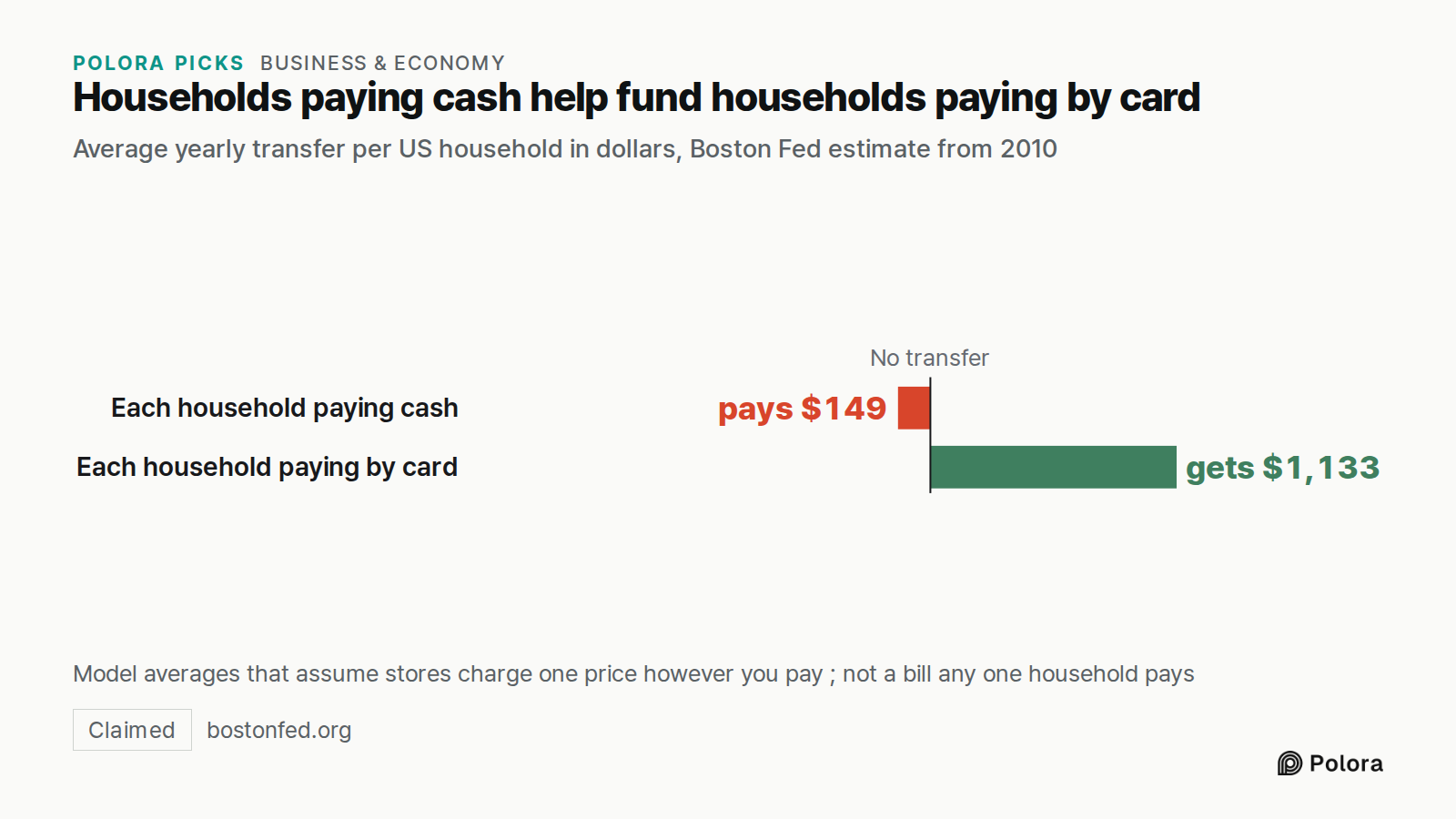
In 2010, three economists at the Federal Reserve Bank of Boston, Scott Schuh, Oz Shy and Joanna Stavins, estimated what this adds up to. On average, they found, each household paying cash transfers $149 a year to households paying by card, and each card-using household receives $1,133. Card spending and rewards rise with income, so the transfer also runs upward. By their estimate, the lowest-income households, earning $20,000 a year or less, pay $21 a year, and the highest-income households, earning $150,000 or more, receive $750.

These figures are averages from an economic model that assumes stores charge a single price, not a bill any one household pays, and they depend on assumptions about how much of the fee stores pass into prices. Later work by Marie-Hélène Felt, Fumiko Hayashi, Joanna Stavins and Angelika Welte, published by the Boston and Kansas City Federal Reserve Banks, points the same way for the US and Canada. Once fees, rewards and the merchant costs built into prices are all counted, the lowest-income group pays the highest net cost as a share of what it spends, and the highest-income group pays the lowest.

A 2026 paper by Egan and coauthors, published by the National Bureau of Economic Research, uses data on individual merchants and still finds that cash and debit users help fund credit card rewards. It also finds the transfer smaller than a simple model in which everyone shops at the same stores would suggest. Cash and card users tend to shop at different merchants, and where they overlap, fees tend to be lower. Together these cut the transfer by about 25 percent from that paper's own simple benchmark. The two studies are not measured on the same basis, so the newer one does not shrink the Boston Fed figures by that amount ; what it shows is that the real transfer is uneven from one store to the next.
Households paying cash help fund households paying by card · Average yearly transfer per US household in dollars, Boston Fed estimate from 2010 · No transfer · Each household paying cash · Each household paying by card · pays $149 · gets $1,133 · Model averages that assume stores charge one price ho
Average yearly transfer per US household in dollars, Boston Fed estimate from 2010

Do people who carry a balance pay for rewards too?

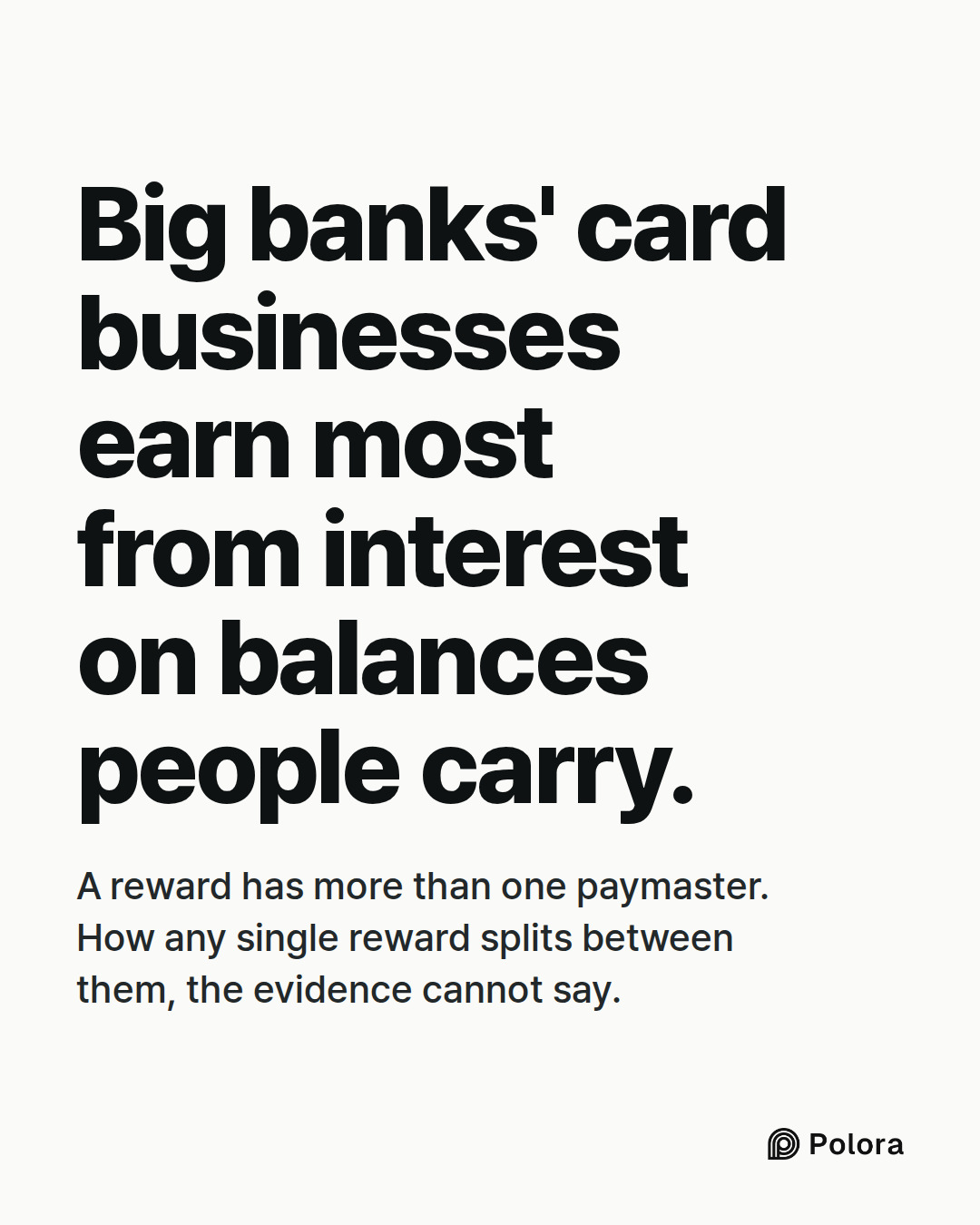
Swipe fees are not the whole story. The CFPB reports that interest, not swipe fees, is the main source of revenue for the card businesses of major banks. Most of that interest comes from people who carry a balance from month to month.

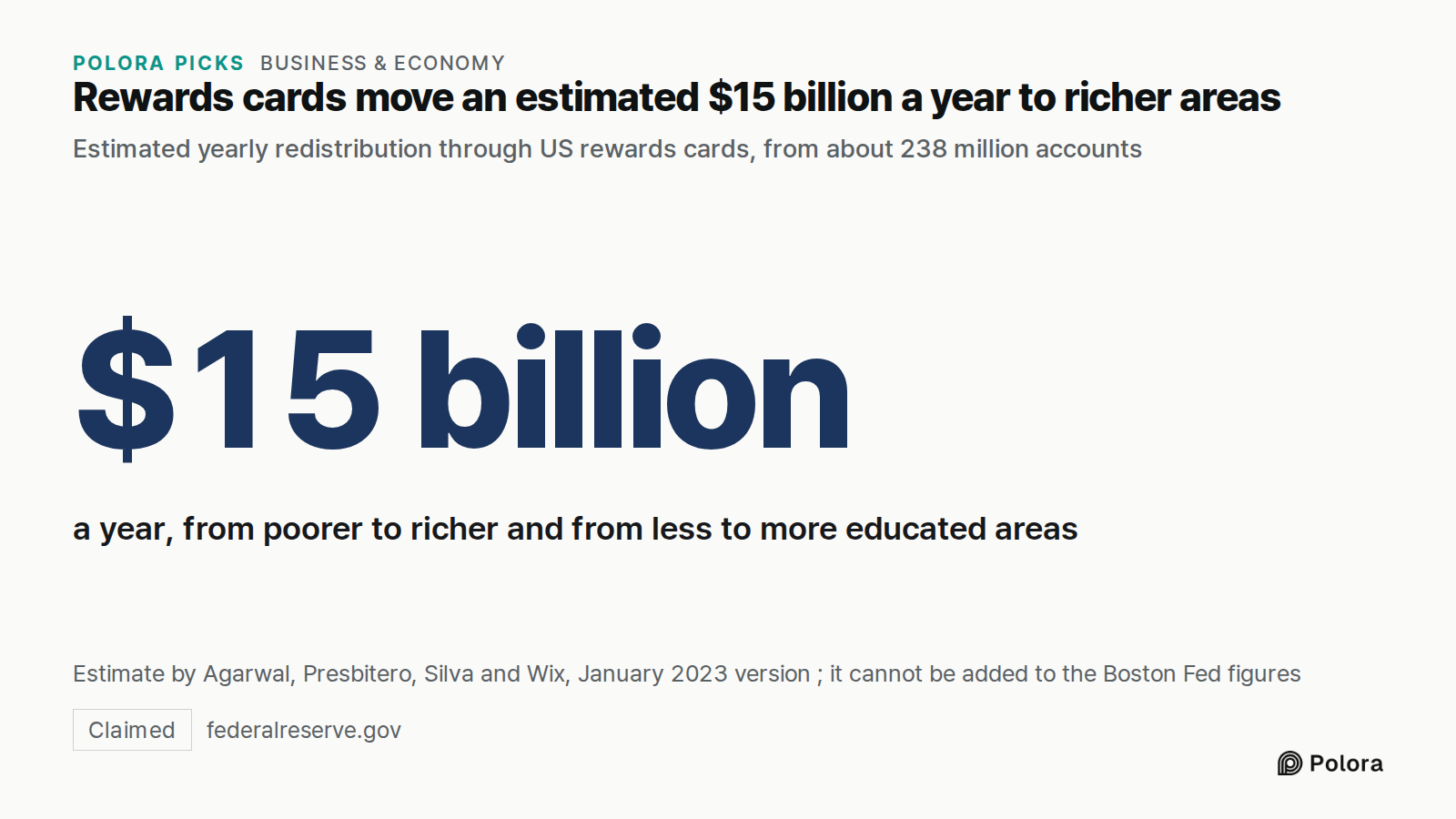
A Federal Reserve working paper by Sumit Agarwal, Andrea Presbitero, André Silva and Carlo Wix looked at about 238 million US credit card accounts. The authors found that people who pay in full profit from rewards cards at the expense of those they call naive consumers. Rewards cards lead everyone to spend more, but only some people end up with larger unpaid balances and the interest that comes with them. In the January 2023 version of the paper, the authors estimated an annual redistribution of $15 billion, from poorer to richer and from less to more educated areas.

That does not mean each person who carries a balance pays a fixed, knowable share of someone else's cash back. Nor can the $15 billion be added to the Boston Fed household figures, because the two studies measure different things.

So a reward has more than one paymaster. The store's fee, which shoppers often cover through prices, pays for most of it, and the interest paid by cardholders who carry debt supplies most of what card businesses earn. How any single reward splits between them, the evidence cannot say.
Rewards cards move an estimated $15 billion a year to richer areas · Estimated yearly redistribution through US rewards cards, from about 238 million accounts · $15 billion · a year, from poorer to richer and from less to more educated areas · Estimate by Agarwal, Presbitero, Silva and Wix, January
Estimated yearly redistribution through US rewards cards, from about 238 million accounts

What happened when the US capped debit card swipe fees?

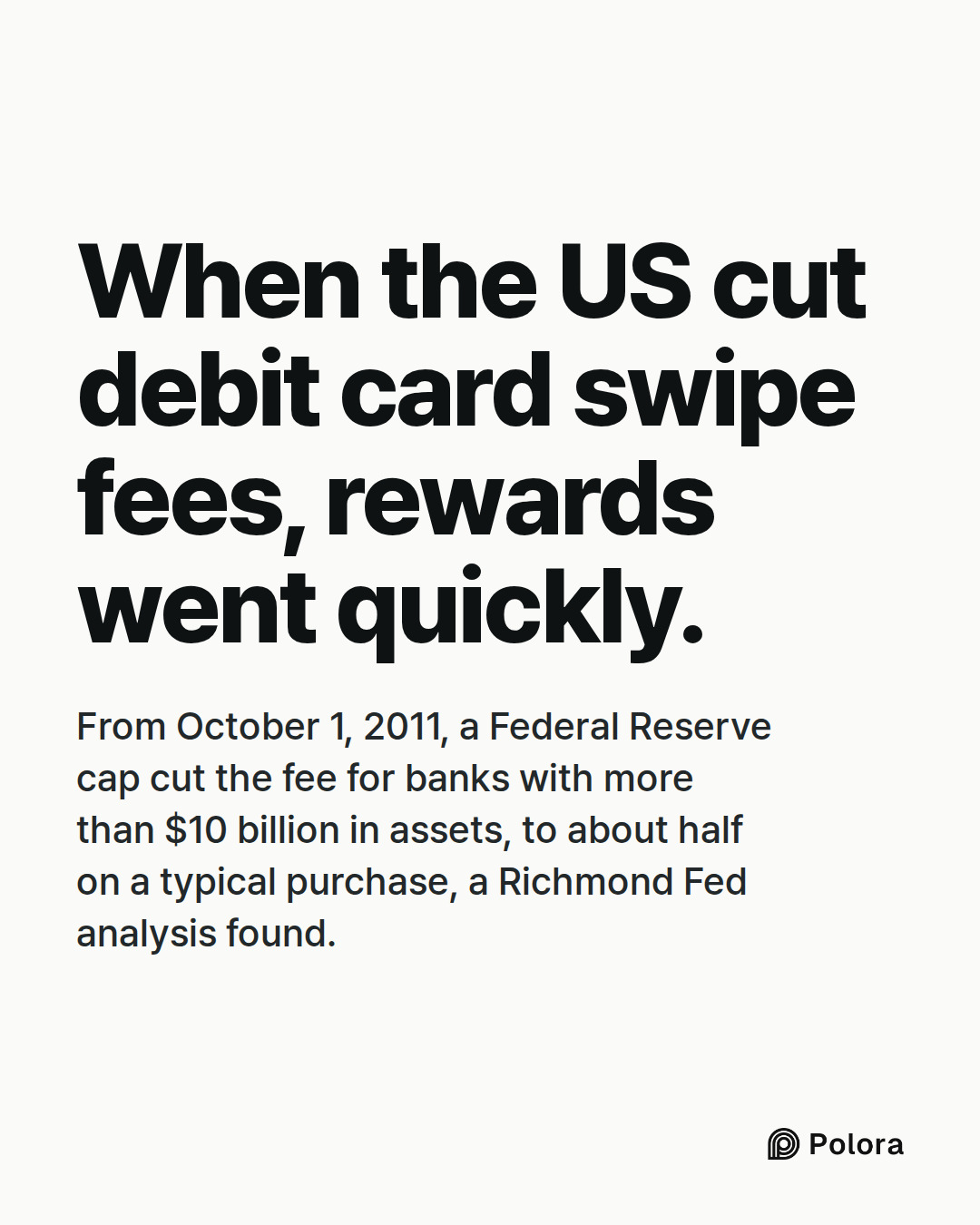
If rewards really come out of swipe fees, cutting the fee should cut the rewards. The US ran that test on debit cards. A provision of the 2010 Dodd-Frank Act, known as the Durbin amendment, led the Federal Reserve to cap debit swipe fees from October 1, 2011, for banks with more than $10 billion in assets. The cap is 21 cents plus 0.05 percent of the sale, with an extra cent for fraud prevention. A Richmond Fed analysis found that for a typical purchase this came to about half the fee charged before.

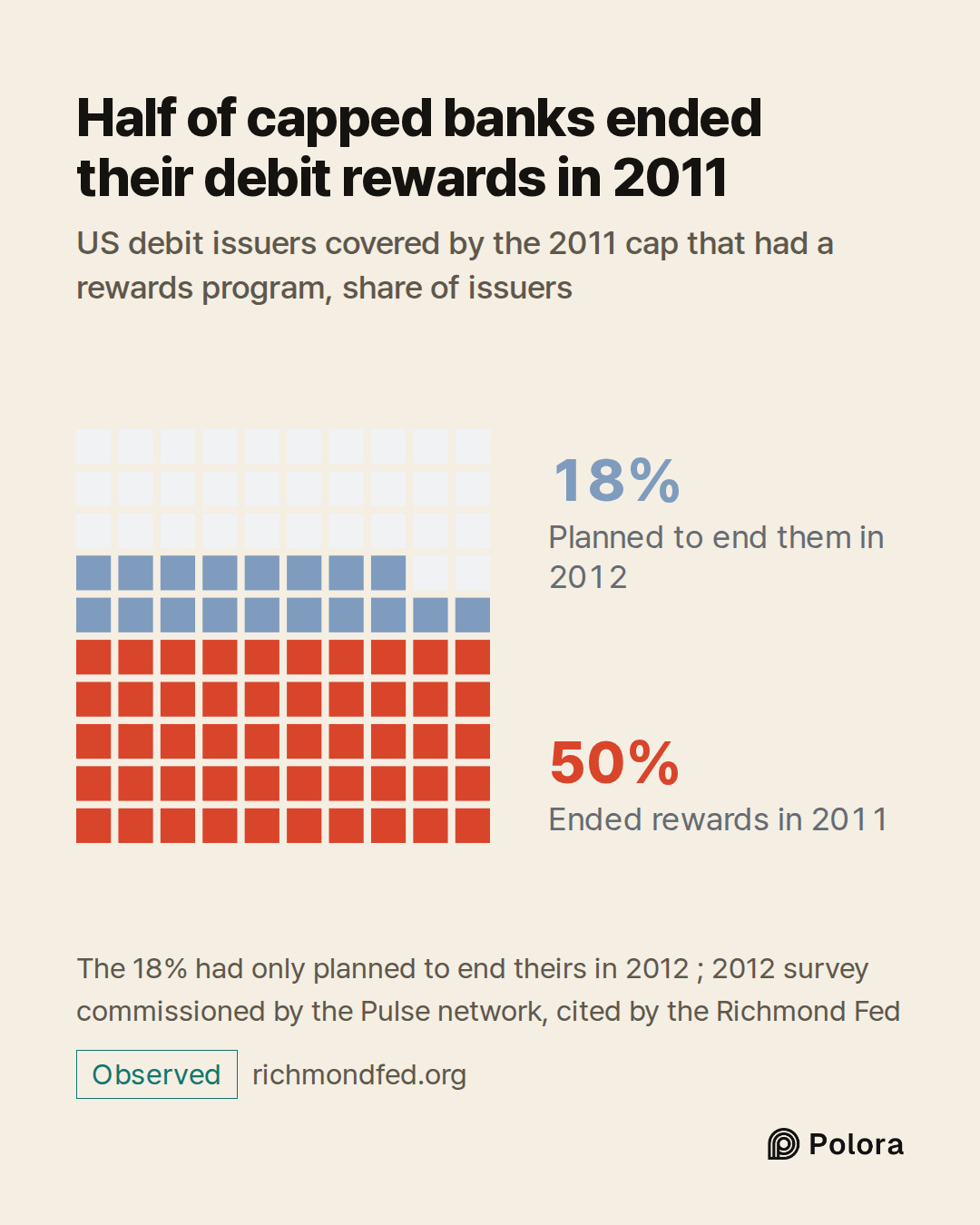
Rewards went quickly. A 2012 industry survey of debit issuers, commissioned by the Pulse network and cited by the Richmond Fed, looked at issuers covered by the cap that had a debit rewards program. Of those, 50 percent ended it in 2011, and another 18 percent planned to end theirs in 2012. The same analysis cites a Bankrate survey finding that the average monthly fee on noninterest checking accounts rose by 25 percent, though that rise cannot be put down to the cap alone.

Banks under the $10 billion line were exempt from the cap, so smaller banks and credit unions could keep earning the higher fee.
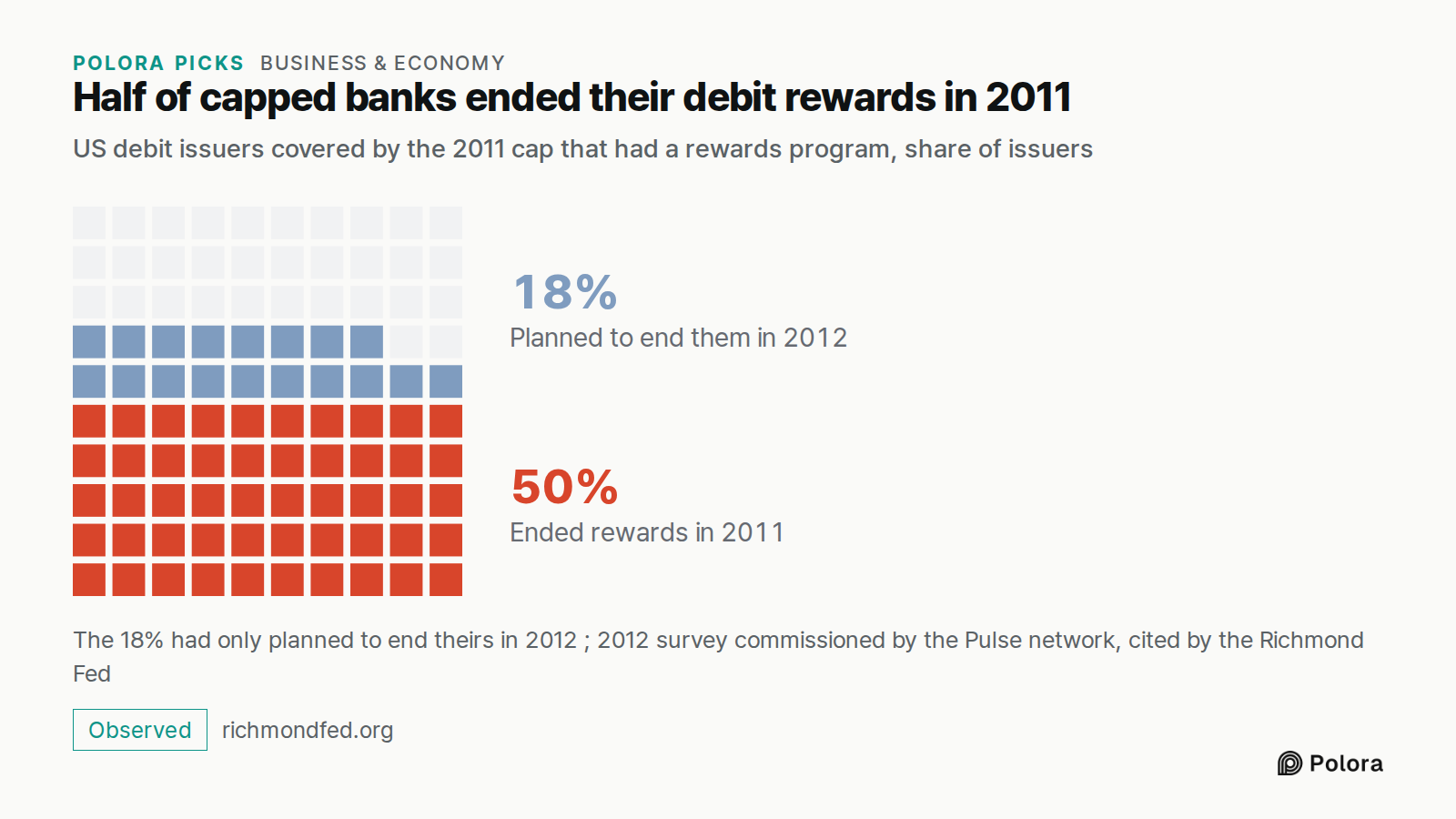
Half of capped banks ended their debit rewards in 2011 · US debit issuers covered by the 2011 cap that had a rewards program, share of issuers · Ended rewards in 2011 · Planned to end them in 2012 · 50% · 18% · The 18% had only planned to end theirs in 2012 ; 2012 survey commissioned by the Pulse ne
US debit issuers covered by the 2011 cap that had a rewards program, share of issuers

Did Europe's fee caps end card rewards there?

Europe gives a less tidy answer. In 2015 the EU capped swipe fees on consumer cards at 0.2 percent of the sale for debit and 0.3 percent for credit, with some exceptions set out in the regulation.

When the European Commission reviewed the caps in 2020, it reported that it could not link them to a systematic rise in cardholder fees, and found no clear change in loyalty programs or in how many cards banks issued. Almost three-fourths of card issuers told the Commission that their card benefits were unchanged or better. Critics of the caps read the same years differently.

Part of the Commission's finding rests on what issuers reported about themselves. Europe is better held as an open question than as proof either way, while the US debit case remains the clearest test.

Where do US credit card swipe fees stand now?

As of October 3, 2026, two efforts to lower US credit card swipe fees are moving, and neither is final.

On June 9, 2026, Judge Brian Cogan of the federal court in Brooklyn gave preliminary approval to a revised settlement between Visa, Mastercard and merchants, in a case that began in 2005. The settlement would cut average swipe fees by 0.1 percentage point for five years and cap fees on standard consumer credit cards at 1.25 percent for eight years. It would also let stores decline premium cards and add surcharges more freely. Preliminary approval is not final approval. According to trade press reports, hundreds of merchants and trade groups have filed objections, the hearing on final approval is set for November 16, 2026, and a convenience store trade group has said it would appeal if the settlement is approved.

In Congress, the Credit Card Competition Act of 2026 (S.3623) was introduced in the Senate on January 13, 2026, and sent to the Banking Committee. It has gained cosponsors since, but has had no committee vote or further step. The bill would require large card issuers to let stores route credit card payments over more than one network.

Whichever way these go, the arithmetic above stays the same. Rewards are paid largely out of the swipe fee, which is why both sides of this fight talk about rewards, and why the one time the US cut a swipe fee hard, rewards were among the first things banks dropped. Europe is a reminder that a cut does not have to end them.
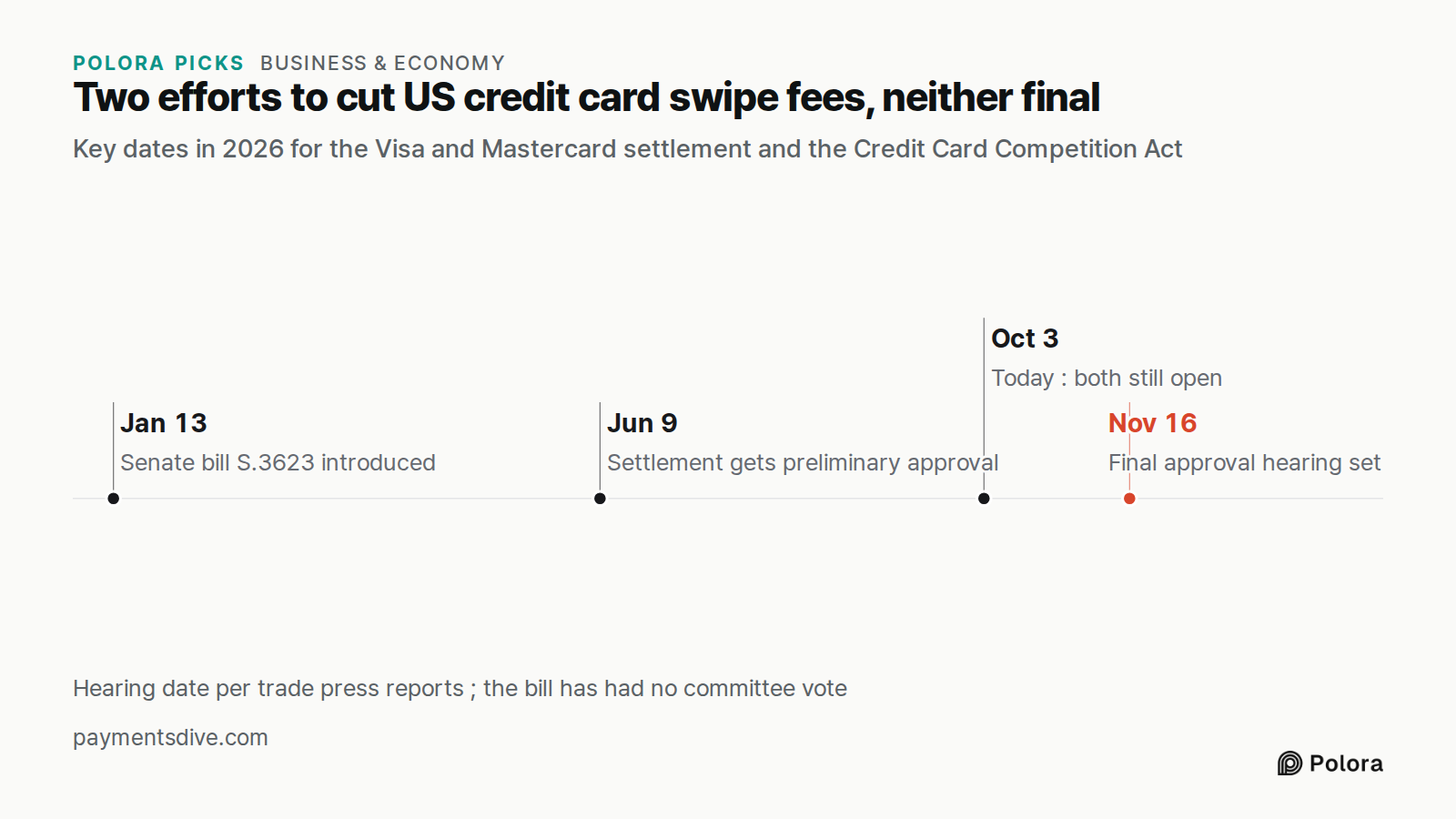
Two efforts to cut US credit card swipe fees, neither final · Key dates in 2026 for the Visa and Mastercard settlement and the Credit Card Competition Act · Jan 13 · Jun 9 · Oct 3 · Nov 16 · Senate bill S.3623 introduced · Settlement gets preliminary approval · Today : both still open · Final approv
Key dates in 2026 for the Visa and Mastercard settlement and the Credit Card Competition Act
Who really pays for your credit card's cash back?Who really pays for your credit card's cash back?Most of your cash back is a fee the store paid. · Large US credit card issuers spend almost nine-tenths of their swipe fee income on rewards, the US Consumer Financial Protection Bureau reports. · ※ swipe fee : the part of a store's card cost that goes to the bank that issued your cardSwipe fee the store pays · Rewards earned on rewards cards · 1.8¢ · 1.6¢ · Most of the store's card fee comes back to you as rewards · Average cents per dollar spent on US credit cards, CFPB figures for 2021 and 2022 · Averages over different groups of cards : the fee covers general purpose credit cNo transfer · Each household paying cash · Each household paying by card · pays $149 · gets $1,133 · Households paying cash help fund households paying by card · Average yearly transfer per US household in dollars, Boston Fed estimate from 2010 · Model averages that assume stores charge one price hoWhen the US cut debit card swipe fees, rewards went quickly. · From October 1, 2011, a Federal Reserve cap cut the fee for banks with more than $10 billion in assets, to about half on a typical purchase, a Richmond Fed analysis found.Ended rewards in 2011 · Planned to end them in 2012 · 50% · 18% · Half of capped banks ended their debit rewards in 2011 · US debit issuers covered by the 2011 cap that had a rewards program, share of issuers · The 18% had only planned to end theirs in 2012 ; 2012 survey commissioned by the Pulse neBig banks' card businesses earn most from interest on balances people carry. · A reward has more than one paymaster. How any single reward splits between them, the evidence cannot say.Sources 16 : files.consumerfinance.gov · CFPB, The Consumer Credit Card Market (2023), federalreserve.gov · Federal Reserve, FEDS Notes on credit card profitability (2022), bostonfed.org · Federal Reserve Bank of Boston, Who Gains and Who Loses from Credit Card Payments (2010) + 13Read the full story at · polora.ai

Who really pays for your credit card's cash back?

Alpha · claude-sonnet-5

Alpha's assessment The manuscript's central arithmetic holds up well under checking, with a few precision points worth flagging. The CFPB numbers check out, with a nuance. The 2023 CFPB report does state what the manuscript claims. Searching corroborates this independently: a 2026 New York Fed staff paper on credit card banking found banks' interchange income is 1.82% of purchase volume on average, while rewards costs are 1.57% — essentially the same 1.8%/1.6% split the manuscript cites, from a different dataset covering 90% of the market. That's a genuine independent confirmation, not just an echo of the same CFPB report. The nuance: CFPB's own 2023 report frames net economics slightly differently than "issuers keep a slice" implies — it describes a net interchange rate of 1.1 percent of average receivables (or 0.3 percent of annual purchase volume), calculated after both interchange expense and rewards expense are netted out, which is a more conservative framing than simply subtracting 1.6 from 1.8. The directional claim — issuers earn more in interchange than they spend on rewards — is confirmed by the source itself. New, stronger evidence has emerged since the manus…

Beta · gpt-6-sol

The premise stands, but the manuscript makes the funding chain sound more exact than the evidence permits. A merchant pays to accept a credit-card purchase; interchange is the portion received by the card issuer, not necessarily the merchant’s entire card-acceptance charge. Issuers commonly use that revenue to fund rewards. When a merchant charges customers the same price regardless of payment method, cash and debit customers can bear part of the cost without receiving the credit-card reward. Borrowers who carry balances supply another important stream of issuer revenue. None of this means the bank simply takes *the fee on your particular purchase* and returns most of it to you. (files.consumerfinance.gov) Here is what I could check against sources, rather than against the manuscript’s assertions: | Manuscript claim | Finding and condition | |---|---| | 1.8% interchange; rewards nearly nine-tenths of it; 1.6 cents per dollar | Supported for the CFPB’s reported populations and years. Its 2023 report gives 1.8% average interchange for general-purpose cards…

Gamma · gemini-3.1-pro

As Gamma, I have reviewed the manuscript, Alpha and Beta's evaluations, and run live searches to verify the outstanding claims—especially those concerning the 2026 legislative and legal events that Beta could not definitively clear. Here is what I found regarding the open questions in the editor's brief, fully verifying the 2026 timeline: The Visa/Mastercard Settlement Timeline and Objections * Preliminary Approval Date: The manuscript's assertion of "June 2026" is correct but imprecise. I confirmed via contemporary trade press (Payments Dive, June 9, 2026) that U.S. District Judge Brian Cogan granted preliminary approval on June 9, 2026. The manuscript should be updated to this exact date. * Final Approval Hearing and Objectors: The manuscript is completely accurate here. The final fairness hearing is indeed scheduled for November 16, 2026. Furthermore, on September 15, 2026, Walmart along with roughly 900 other merchants and trade groups (including the National Retail Federation and the National Restaurant Association) filed formal objections to the settlement, asking the court to reject it or allow them to opt out. * NACS Appeal Pledge: The manus…

Researcher · gemini-3-7-flash

Research Verification & Fact-Check Below is the verification of the specific claims made in the manuscript and debater briefs against live primary and secondary sources. --- 1. Verification of Manuscript Claims & Numbers * CFPB Interchange and Rewards Numbers (1.8% interchange, 1.6% rewards earn rate, ~90% spent on rewards): * Status: Supported as market/portfolio averages. * Source: CFPB Consumer Credit Card Market Report (2023) & CFPB (2025/2024 update). * Nuance: The CFPB reports that across general-purpose credit cards at major Y-14+ issuers, average interchange revenue was approximately 1.8% of purchase volume, and rewards expenses accounted for almost 90% of interchange revenue. The 1.6 cents per dollar ($0.016 / 1.6%) reflects the average earn rate specifically on *rewards cards*, not an entitlement on every individual general-purpose transaction. * Boston Fed Study on Cash-to-Card Cross-Subsidy ($149, $1,133, $21, $750):…

The Arbiter · gpt-6-sol

Round record The central finding is shared, but the size and route of the subsidy need care. Alpha, Beta, Gamma, and the Researcher agree that interchange paid by merchants is a major source of credit-card rewards. They also agree that customers who do not receive rewards can bear some of that cost when merchants use a common price. Beta’s important distinction is that interchange is the issuer’s portion of card-acceptance costs, not necessarily the merchant’s entire fee, and that a reward is not a refund traceable to the fee on one particular purchase. - CFPB arithmetic: Alpha and the Researcher confirm the manuscript’s roughly 1.8% interchange, nearly nine-tenths spent on rewards, and 1.6 cents earned per dollar figures in the CFPB’s 2023 report. Beta identifies a consequential mismatch in the manuscript’s illustrative dollar: 1.8% averages *general-purpose card purchases*, whereas 1.6 cents averages spending *on rewards cards*. Neither is a promise about the reader’s transaction. Beta also disputes that the difference can simply be called a slice the ba…

The Arbiter's Final Verdict · gpt-6-sol

Your cash back is mainly funded by merchants’ card fees—but who ultimately bears the cost depends on how stores set prices. When you buy something with a credit card, the merchant pays a card-acceptance fee; its interchange portion goes to your card issuer. Issuers use interchange revenue to help fund rewards. The bank is not simply giving money away, but neither can a particular reward be traced to the fee on your particular purchase. The CFPB’s 2023 report puts average issuer interchange revenue at about 1.8% of general-purpose credit-card purchase volume and says rewards expense was almost 90% of interchange revenue. Its 1.6 cents earned per dollar figure applies to *rewards-card spending*. Those are different averages, so “the store pays 1.8 cents and you get 1.6 cents” is a useful illustration, not transaction-by-transaction accounting. Any remainder is not automatically bank profit. When a store charges everyone the same price, some card-acceptance cost can be built into that price. Cash and debit customers may then help fund rewards they do not receive. A […