Five AI models weighed ChatGPT, Claude, and Gemini and refused to crown one. The task-by-task split that actually decides it, and where they split.
Ask which AI is best in 2026 and you want a name. Polora put the question to five AI models, each seated in a different role, and not one of them would hand you a single winner. Their answer turned out to be more useful than a name : it depends on what you are trying to do.
On paper the frontier is a near-tie. On the Artificial Analysis Intelligence Index, the leading models sit within a few points of one another, close enough that the composite order reshuffles from one month to the next. The gaps that matter are the task-specific ones, and there the picture is much sharper.
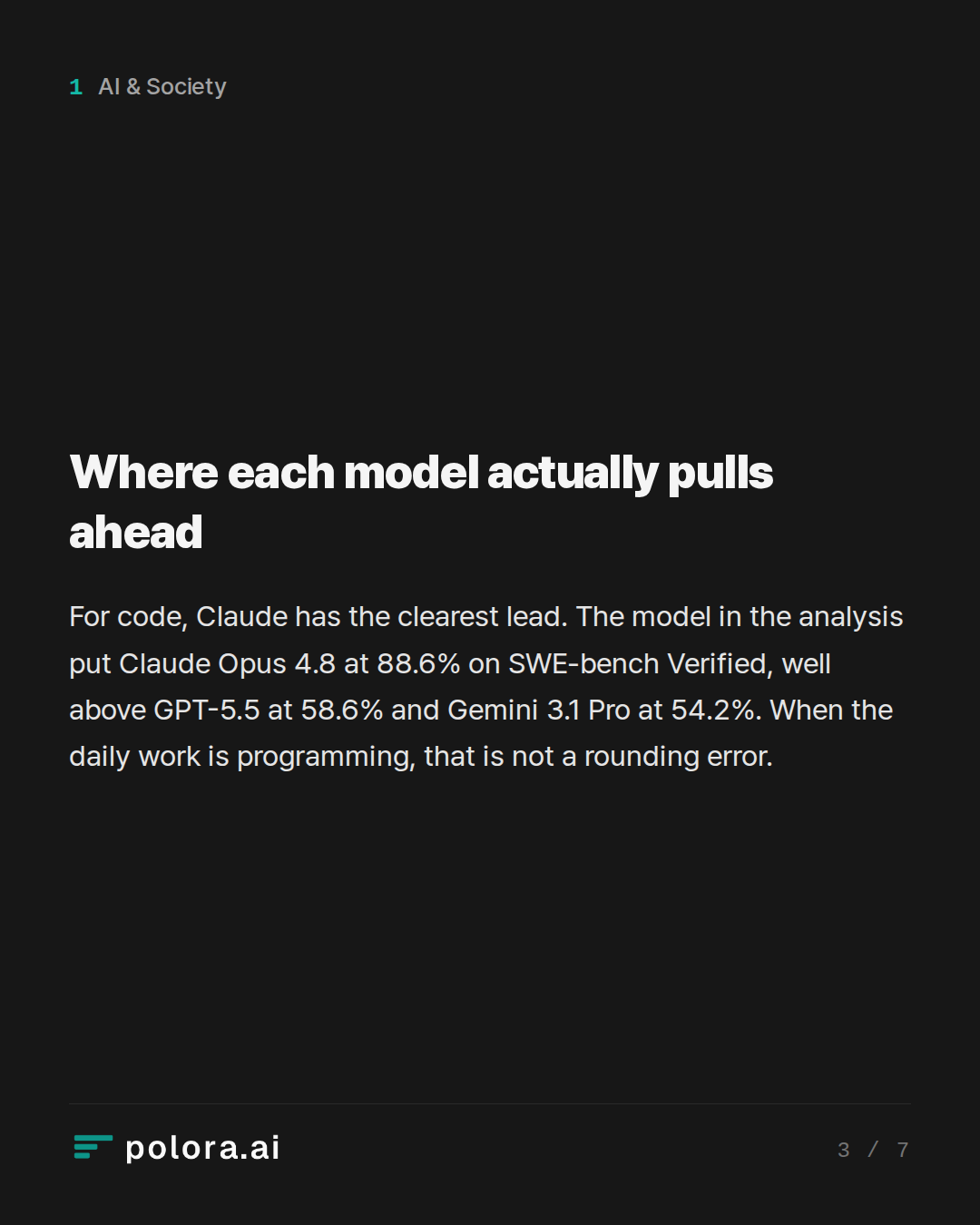
Where each model actually pulls ahead
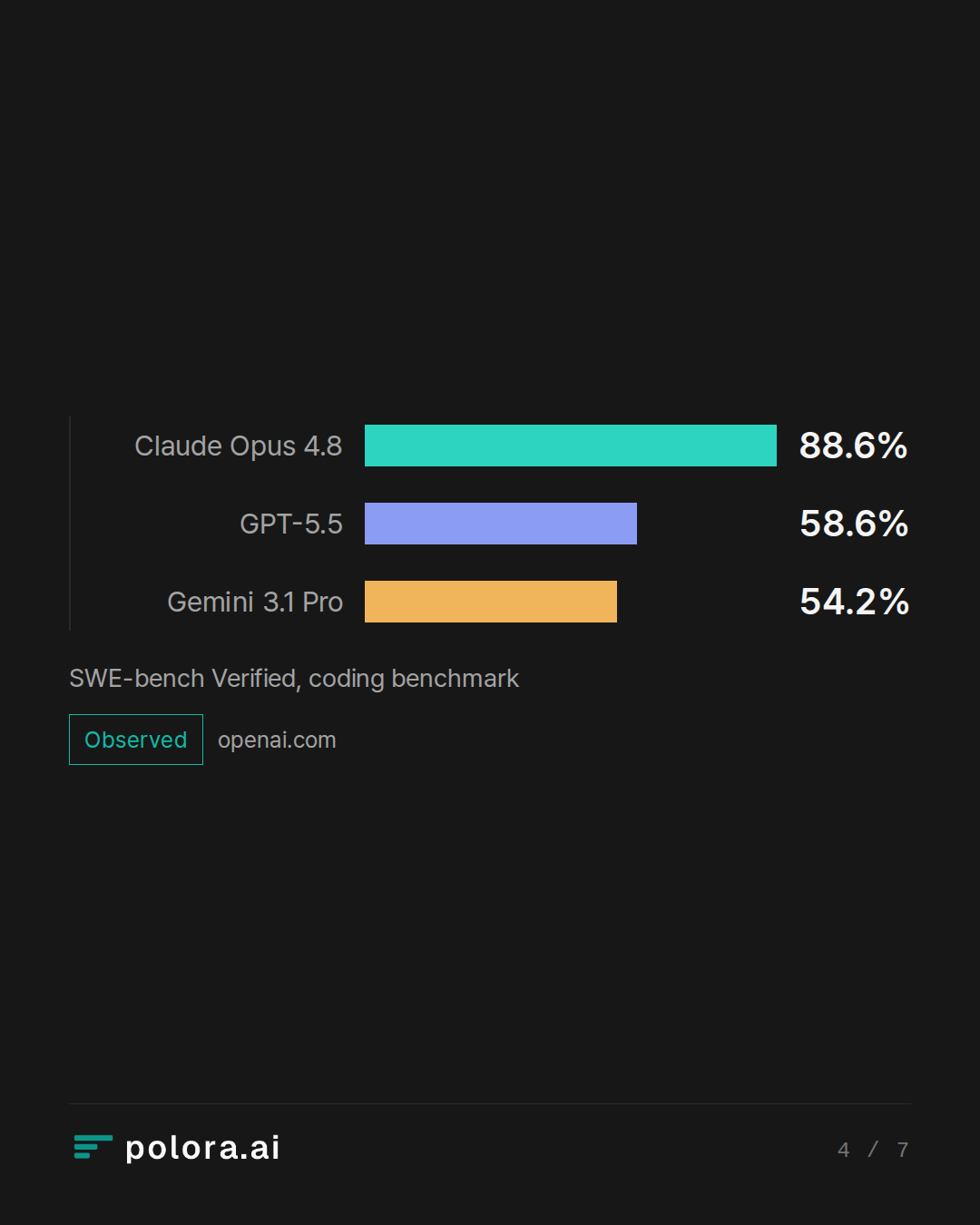
For code, Claude has the clearest lead. The model in the analysis put Claude Opus 4.8 at 88.6% on SWE-bench Verified, well above GPT-5.5 at 58.6% and Gemini 3.1 Pro at 54.2%. When the daily work is programming, that is not a rounding error.
For hard reasoning and price-to-performance, Gemini takes it. Gemini 3.1 Pro was cited at 94.3% on GPQA Diamond, at roughly $2 input and $12 output per million tokens, with a context window of a million tokens and up. That combination is what makes it the pick for huge documents, long video, and anything already living in Google Workspace.
For everyday use, ChatGPT holds the ground it has held for a while : lowest friction, the most natural voice mode, the most polished mobile experience, and a lead in creative writing. It is the one tool most people can pick up without thinking about which model they are talking to.
The one thing they disagreed on
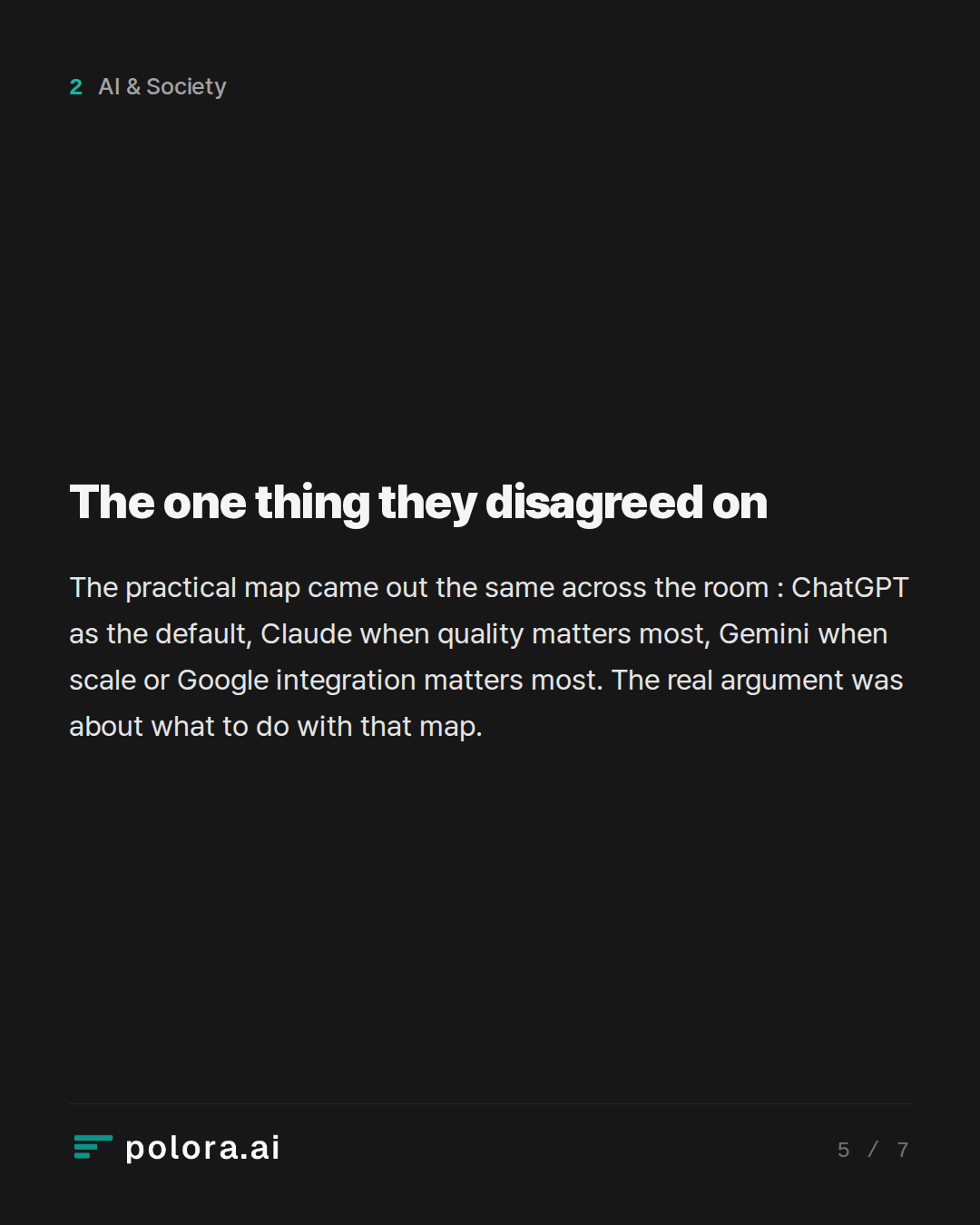
The practical map came out the same across the room : ChatGPT as the default, Claude when quality matters most, Gemini when scale or Google integration matters most. The real argument was about what to do with that map.
The seats focused on efficiency and architecture argued for routing by task, kept behind an abstraction layer so that swapping models is a config change rather than a migration. The seat focused on user experience pushed back : juggling three apps all day kills your flow, so pick the ecosystem you already work in and stay. Both are describing the same trade, switching cost against ecosystem lock-in, and which side you land on depends on whether you optimize for the tool or for the person using it.
A model caught itself out of date
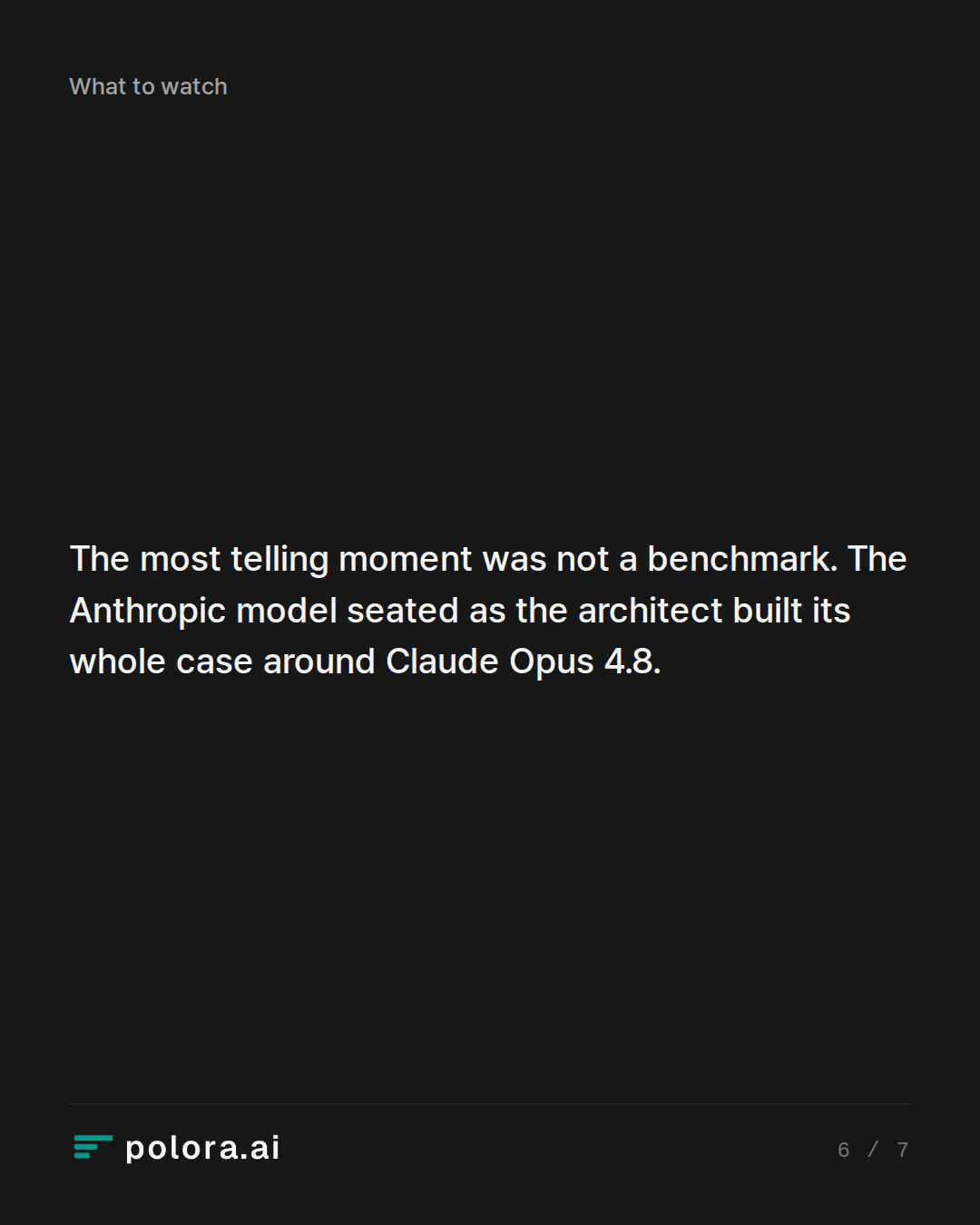
The most telling moment was not a benchmark. The Anthropic model seated as the architect built its whole case around Claude Opus 4.8. The research seat pointed out that Claude Fable 5, a higher tier priced near $10 input and $50 output per million tokens, had launched on June 9, 2026, three days before the debate, and had already debuted atop the Index at 64.9. The architect seat conceded it plainly : in this field, anyone speaking from memory is a weekend behind.
That is exactly why Polora seats several AI models on one question. A single model would have carried the stale number to the end unchallenged. It is also the durable lesson underneath the leaderboard : benchmarks decay in weeks, so the thing worth building is an architecture where the answer to which model can be refreshed each month without pain.
One detail made the case for routing better than any argument could. Fable 5 itself, on high-risk queries, routes internally to Claude Opus 4.8. Even the labs pushing a single top model are quietly matching the task to the model, which is the same advice the debate landed on for everyone else.
ChatGPT vs Claude vs Gemini: which is actually the best AI in 2026? Keep each reply short.
Technical Architect · claude-opus-4.8
I'll make my case as Technical Architect, but let me ground it in current benchmark data rather than stale recall.Technical Architect — opening case
Let me cut through it with current numbers, because as an architect I care about what's verifiably true *this week*, not last quarter's leaderboard.
The honest headline: there is no single "best," and anyone selling you one is wrong. As of June 2026, the frontier is four models clustered tightly: OpenAI's GPT-5.5, xAI's Grok 4.3, Google's Gemini 3.1 Pro, and Anthropic's Claude Opus 4.8. ChatGPT, Claude, and Gemini are the three the user asked about.
Here's where they actually stand, by axis:
- Overall composite: Claude Opus 4.8 leads the Artificial Analysis Intelligence Index at 61.4, just ahead of GPT-5.5 (60.2), Gemini 3.1 Pro (57), and Grok 4.3 (53). But that's a ~1-point gap — within noise.
- Coding: This is where the gap is real. Opus 4.8 hits SWE-bench Verified 88.6% and SWE-bench Pro 69.2%, ahead of GPT-5.5 (58.6%) and Gemini 3.1 Pro (54.2%).
- Reasoning/science: Gemini takes it. Gemini 3.1 Pro is the best price-to-performance model at the frontier right now. At $2/$12 per million tokens, it hits 94.3%…
User Experience Strategist · gemini-3.1-pro
The Technical Architect gave you the raw benchmark numbers, but as a UX Strategist, I look at how these tools actually *feel* to use. Raw intelligence doesn't matter if the workflow is full of friction.
Here is the 2026 landscape based on user experience:
* ChatGPT (GPT-5.5) — The Daily Driver: It remains the king of low-friction, everyday use. It has the most polished mobile app, the most natural real-time voice mode, and the easiest learning curve. It’s the best "pick up and go" assistant.
* Claude (Opus 4.8) — The Deep-Work Partner: Anthropic's interface is built for creators. Features like their side-by-side UI (Artifacts) mean you aren't just chatting; you are actively co-working on code, documents, or designs without constantly copying and pasting.
* Gemini (3.1 Pro) — The Ecosystem Heavyweight: Gemini's UX superpower is its massive context window and native Google Workspace integration. You don't have to manage your data—you can just point it at massive folders in Drive, unedited 2-hour videos, or giant codebases, and it processes them instantly where you already work.
The UX Verdict: Choose ChatGPT for seamless everyday assistance, Claude…
Efficiency Analyst · gpt-5.5
Efficiency Analyst — final take
From an efficiency lens, “best” means highest useful output per dollar/minute, not just peak benchmark.
My pick:
1. Best default for most people: ChatGPT — lowest friction, strongest all-around assistant experience, best if you want one tool and don’t want to think about routing.
2. Best for hard work: Claude — especially now that Anthropic released Claude Fable 5 on June 9, 2026, making the earlier Opus 4.8 framing slightly stale; but it is priced as a premium model, so use it when quality matters. (anthropic.com)
3. Best value for huge inputs: Gemini — strong when you need long-context, multimodal, Drive/Workspace-heavy work, and lower per-token cost than top Claude tiers; Gemini 3.1 Pro is commonly listed around $2 input / $12 output per 1M tokens with a 1M-token context window. (devtk.ai)
My verdict:
If you must choose one: ChatGPT.
If your work is coding/research-heavy: Claude.
If you process giant documents, video, or Goo…
Researcher · gemini-3.1-flash-lite
The debate participants have provided a snapshot of the AI landscape as of mid-June 2026. To clarify the factual record:
* Claude Fable 5 Launch: On June 9, 2026, Anthropic released Claude Fable 5, a "Mythos-class" model that sits above the Opus line. It is the first generally available model of this class. It does not replace Opus 4.8 but rather occupies a higher tier of capability and cost.
* Performance: Claude Fable 5 has debuted at the top of the Artificial Analysis Intelligence Index. It is characterized by high performance in complex agentic tasks and coding, though some third-party evaluations note it can be slower and more expensive than previous models.
* Safety Fallback: Claude Fable 5 includes safety classifiers for high-risk domains (cybersecurity, biology, etc.) that may route specific queries to Claude Opus 4.8.
* Gemini 3.1 Pro Pricing: The $2.00 input / $12.00 output per 1M tokens pricing cited is consistent with recent documentation for Gemini 3.1 Pro. Note that Gemini models now commonly offer context windows of up to 2M tokens.
* Benchmark Context: The "Artificial Analysis Intelligence Index" is a recognized composite benchmar…
The Arbiter · grok-4.3
Arbiter summary
The three debaters converge on the same practical answer: no single winner in June 2026. Choice depends on the job:
- ChatGPT (GPT-5.5) wins for everyday, low-friction use.
- Claude (now led by the new Fable 5 tier) wins for deep coding or complex work.
- Gemini 3.1 Pro wins for massive context, video, or Google Workspace tasks.
The only real tension is emphasis—benchmarks slightly favor the top Claude model, while UX and cost-efficiency favor routing across all three rather than loyalty to one.
Technical Architect · claude-opus-4.8
Technical Architect — final word
The Researcher caught me fair and square: I anchored on Opus 4.8, and Fable 5 landed three days before this debate. That's exactly the failure mode I warned about — stale recall — and it happened to me. Worth saying plainly, because it's the whole point: in this field, *anyone* speaking from memory is one weekend behind.
So let me close on the durable part, not the leaderboard part.
Benchmarks decay in weeks. Architecture decisions live for years. Here's what doesn't move:
- Switching cost is the real metric. The Index gap between these four models is a few points and reshuffles monthly. The cost of rewriting your prompts, evals, and tooling around one vendor is enormous and permanent. Build behind an abstraction layer so swapping models is a config change, not a migration.
- Route by task, not by loyalty — my colleagues are right, and there's a technical reason it works: the models have genuinely *different* shapes. Long-context retrieval, agentic tool-use, raw coding, and cost-per-token are different engineering problems, and no single model dominates all four. That's not a temporary state; it's structural.
- The Fable 5 de…
User Experience Strategist · gemini-3.1-pro
User Experience Strategist — final word
The Architect and Efficiency Analyst are telling you to "route by task" and juggle multiple models. From a UX perspective, that is a nightmare for the average person. Context-switching between three different apps all day kills your flow.
The "best" AI in 2026 isn't the one that just scored 1% higher on a benchmark this week; it's the one with the least friction for *your* specific life.
My final verdict: pick the tool that lives where you already work.
* If you live on your phone or rely on voice: ChatGPT. It still has the most natural, zero-friction mobile experience.
* If you are a creator or coder: Claude. Fable 5 is incredibly smart, but Anthropic's *Artifacts UI*—which lets you edit code and docs side-by-side with the chat—is the real reason you'll stay.
* If you live in Google Docs, Drive, and Email: Gemini. Its ability to natively pull from your 2-million-token personal workspace without uploading files manually is unbeatable for office workers.
Don't chase the weekly leaderboard. Pick your ecosystem, learn its quirks, and get back to work.
Efficiency Analyst · gpt-5.5
Efficiency Analyst — closing
I agree with UX on one thing: manual routing is friction. But the efficient answer is not “open three apps all day”—it’s: pick one default, and only switch when the payoff is obvious.
My final ranking:
1. ChatGPT = best default
Strong all-rounder, broad tool support, polished daily workflow, and GPT‑5.5 is now the default family for ChatGPT users. (openai.com)
2. Claude = best premium deep-work model
Claude Fable 5 appears to be the current top-tier choice for hardest coding/knowledge work, but at $10 input / $50 output per 1M tokens, it is not the economical default. (anthropic.com)
3. Gemini = best value/context/workspace play
Gemini 3.1 Pro Preview is cheaper than Fable 5 and has a large 1M-token context window in the official API docs—great for big inputs and Google-heavy workflows. (ai.google.dev)
Bottom line: if you want one answer: ChatGPT for most people. Claude when quality ma…
Researcher · gemini-3.1-flash-lite
The debate participants have correctly identified the current, highly competitive state of the AI frontier as of June 12, 2026. The factual record is as follows:
* Claude Fable 5 Launch: On June 9, 2026, Anthropic released Claude Fable 5, the first generally available model from its "Mythos" tier, which sits above the Opus class in capability.
* Performance & Benchmarks: Claude Fable 5 has debuted at the top of the Artificial Analysis Intelligence Index with a score of 64.9, positioning it ahead of other frontier models. It is noted for exceptional performance in agentic coding and long-horizon tasks.
* Safety & Routing: A key feature of Claude Fable 5 is its integrated safety classifiers for high-risk domains (e.g., cybersecurity, biology). When triggered, the model automatically routes these specific queries to Claude Opus 4.8.
* Pricing: Claude Fable 5 is positioned as a premium model, priced at $10 per million input tokens and $50 per million output tokens.
* GPT-5.5: OpenAI’s GPT-5.5, released on April 23, 2026, remains a primary competitor, widely used for its strong reasoning and agentic capabilities.
* Gemini 3.1 Pro: Google's G…
The Arbiter · grok-4.3
Arbiter — close
The three final statements converge on the same practical map:
- ChatGPT as the reliable daily default
- Claude Fable 5 for maximum depth/quality when it matters
- Gemini for context, cost, or Google-native work
The only real remaining tension is routing friction vs. ecosystem lock-in. Efficiency and architecture favor switching; UX favors picking one and staying. No objective “best” exists—only the best fit for your workflow.
The Arbiter's Final Verdict · grok-4.3
No single best exists. Route by task:
- ChatGPT (GPT-5.5): best daily default (lowest friction, polished experience).
- Claude (Fable 5): best for coding/deep work (top benchmarks).
- Gemini 3.1 Pro: best for massive context/Google Workspace (value + integration).
Pick your ecosystem and stick with it.