When a country puts a tariff on imports, who actually pays it?

Usually the company bringing the goods in, which pays its own country's customs. In recent US tariffs, foreign sellers barely cut their prices, so the cost stayed at home, split between companies and shoppers.

Business & Economy · 2026-10-03

The refund that went to companies, not shoppers

In February 2026 the US Supreme Court ruled that the emergency powers law behind the White House's broadest 2025 tariffs does not allow the president to impose tariffs. That covered the tariffs on imports from most countries and the ones imposed on Canada, Mexico and China over drug trafficking. Tariffs imposed under other laws, such as those on steel, aluminum and cars, were not affected. The ruling itself did not order refunds. That came in a separate order from the US Court of International Trade, which directed customs to settle the affected imports without those duties. The government appealed that order. Customs filings put the duties collected under the emergency law at about $166 billion, paid by more than 330,000 companies. That is the amount collected, not the amount already paid back.

None of the money the government returns goes to shoppers. US customs says it can refund these duties only to the importer of record, meaning the company named on the customs paperwork, or to a party that company designates. Shoppers who paid more at the till have no claim on the government. Some have sued retailers instead, Walmart among them, arguing under state law that the companies should pass part of their refunds on. No federal customs law requires it. Whether state law does is for the courts to decide.

That gap, between who handed the money to the government and who ended up poorer, is the whole question of who pays a tariff. A company that raised its prices to cover a tariff and now gets the duty back is being repaid for a cost its customers may have carried. The refund shows who paid customs. It does not show who bore the cost.

The question is back in the news. In late September the US and China set out procedures for considering lower tariffs on roughly $30 billion of each other's goods. The document does not itself cut any tariff. Separately, the US has charged 50 percent duties on specified Canadian goods since August 22, and since September 29 it has banned imports of specified Canadian dairy products, packaged beer, wine and motorcycles with engines over 800 cc.
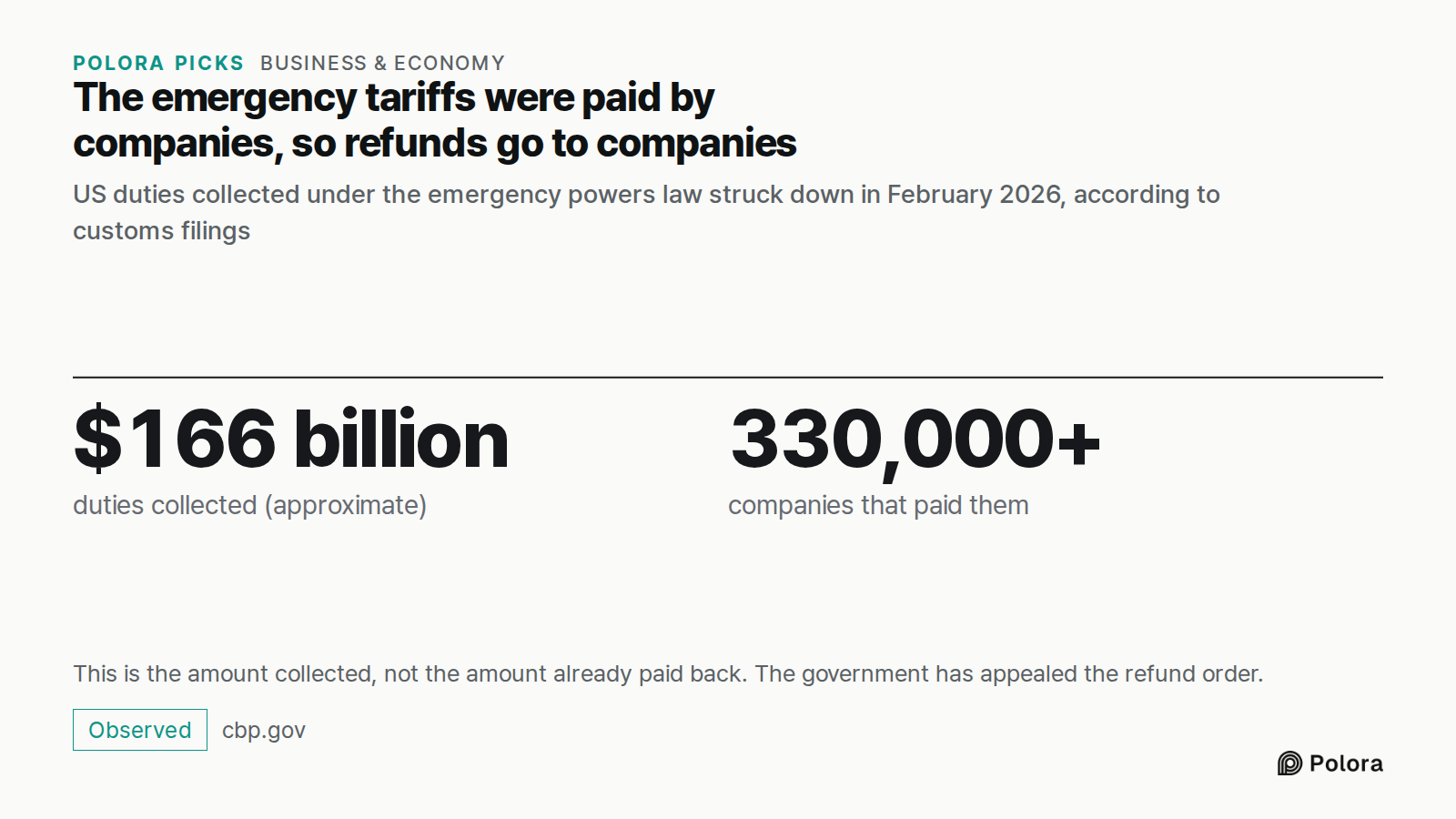
The emergency tariffs were paid by companies, so refunds go to companies · US duties collected under the emergency powers law struck down in February 2026, according to customs filings · $166 billion · 330,000+ · duties collected (approximate) · companies that paid them · This is the amount collecte
US duties collected under the emergency powers law struck down in February 2026, according to customs filings

Step one : the bill is paid at your own border

A tariff is a tax collected by the country doing the buying. When a container of toys arrives from China, the company bringing it in pays the duty to its own customs office before the goods are released. China's government pays nothing. The Chinese factory usually pays nothing directly either. The exception is a foreign seller that registers as the importer itself, as some do when they sell with the duty already included in the price. Then the seller pays customs directly, but a foreign government still never does.

So the question politicians argue about, whether the foreign country pays, has a plain legal answer : it does not. The refund shows this. The money came from importers, so it goes back to importers. The real question is a different one. Does the cost stay with the importer, slip back to the foreign seller, or move forward to the shopper?

Step two : foreign sellers barely lowered their prices

A foreign seller could, in principle, cut its price to keep its customers, quietly taking part of the tariff on itself. Economists can check whether this happened by looking at the price at the border before the tariff is added. For the US tariffs of 2018 and 2019, two separate teams found that it mostly did not happen. Prices of the targeted imports did not fall, so the tariff was added almost in full to what US buyers paid.

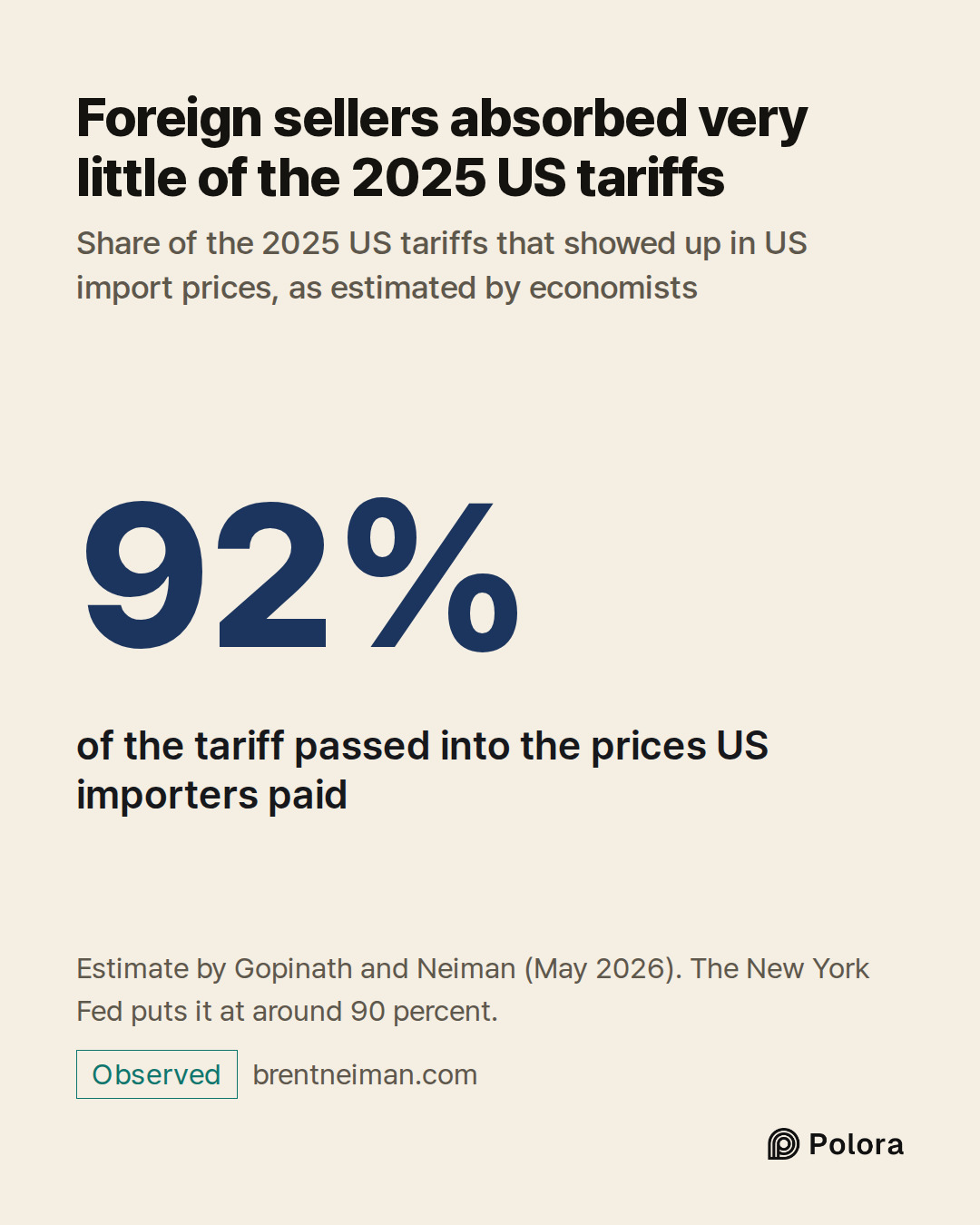
The 2025 tariffs look the same. In the May 2026 version of their study, economists Gita Gopinath and Brent Neiman estimate that 92 percent of the tariff showed up in US import prices. Economists at the Federal Reserve Bank of New York, part of the US central bank, put it at around 90 percent. In other words, of every dollar of tariff, roughly 90 cents stayed in the United States.

There is one notable exception, and it runs the other way. When China hit back at US farm goods in 2018, American exporters did cut their prices, so part of China's tariff fell on US farmers. One shipment of soybeans is much like another, so buyers can easily walk away to a different supplier. Gopinath and Neiman also looked at the seven exporters facing the largest tariff increases in 2025. Only shipments from China saw their average pre-tariff price fall, by 3.1 percent over the twelve months to December 2025. That is an average across shipments, not a cut every Chinese seller made. These cases show that the split is not a law of nature. It depends on how easily buyers can go elsewhere.
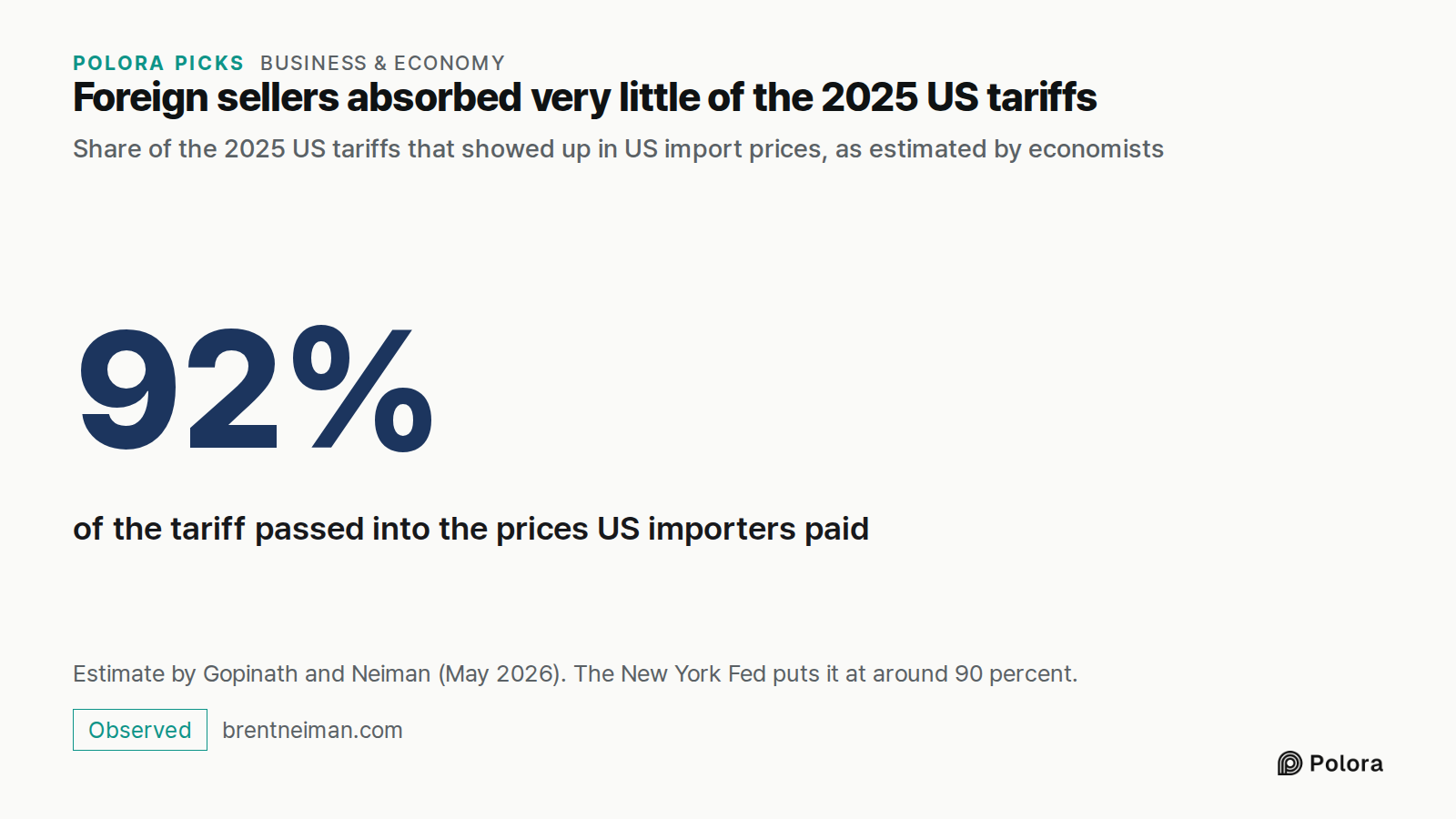
Foreign sellers absorbed very little of the 2025 US tariffs · Share of the 2025 US tariffs that showed up in US import prices, as estimated by economists · 92% · of the tariff passed into the prices US importers paid · Estimate by Gopinath and Neiman (May 2026). The New York Fed puts it at around 90
Share of the 2025 US tariffs that showed up in US import prices, as estimated by economists

Step three : companies and shoppers split the rest

Once the cost is inside the country, it is shared between the companies selling the goods and the people buying them. Shoppers took the smaller share at first. A Harvard team led by Alberto Cavallo tracked daily prices at large US retailers and found that seven months after the 2025 tariffs began, store prices reflected up to 24 percent of the tariff.

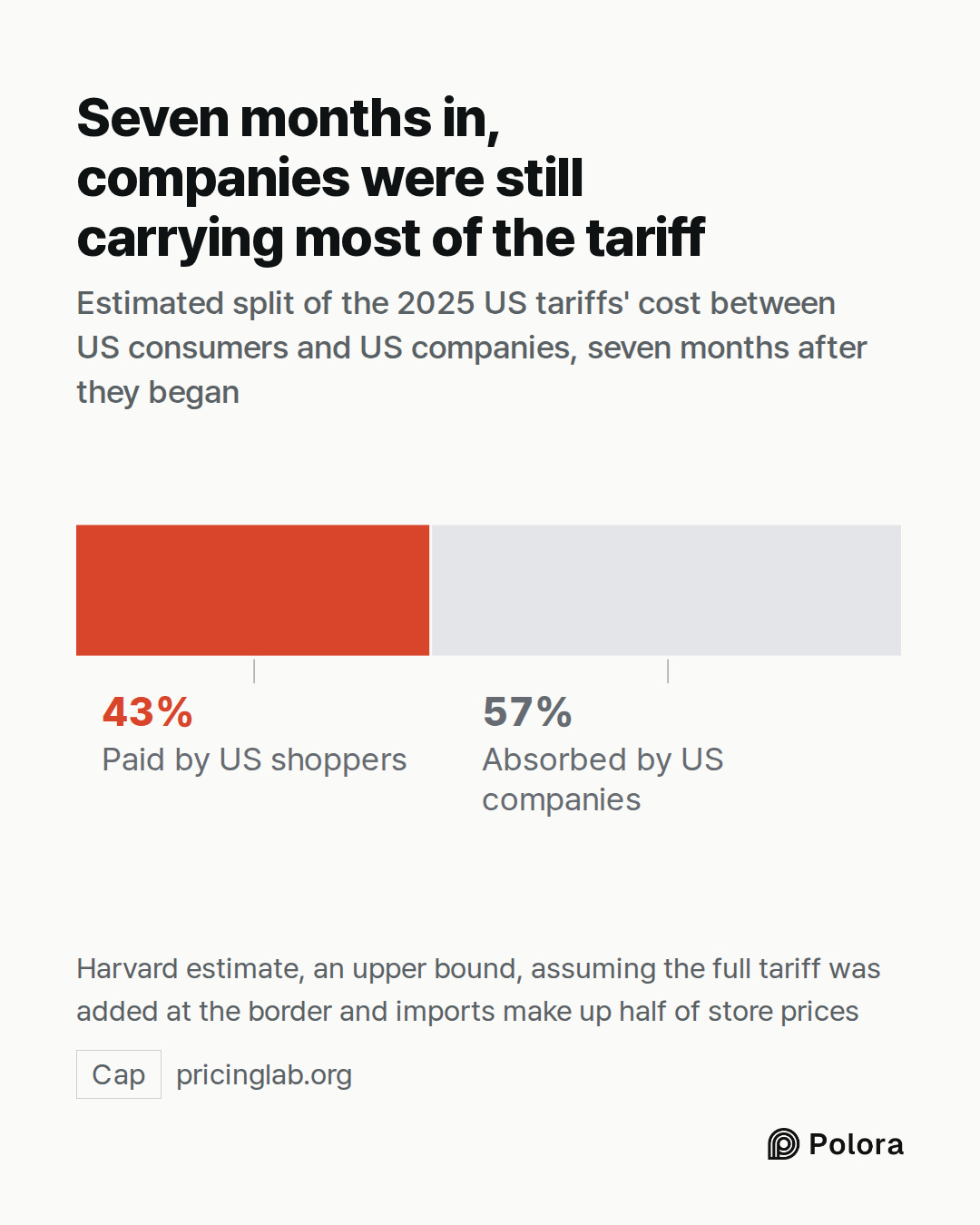
That figure understates the shopper's share, because the imported item is only part of what a store charges. Rent, wages and transport make up the rest. The team assumed that the whole tariff was added at the border and that imports make up half of the store price. On those assumptions it estimates that US consumers had paid up to 43 percent of the tariff's cost by then, and that US companies absorbed the rest, mostly in thinner margins.

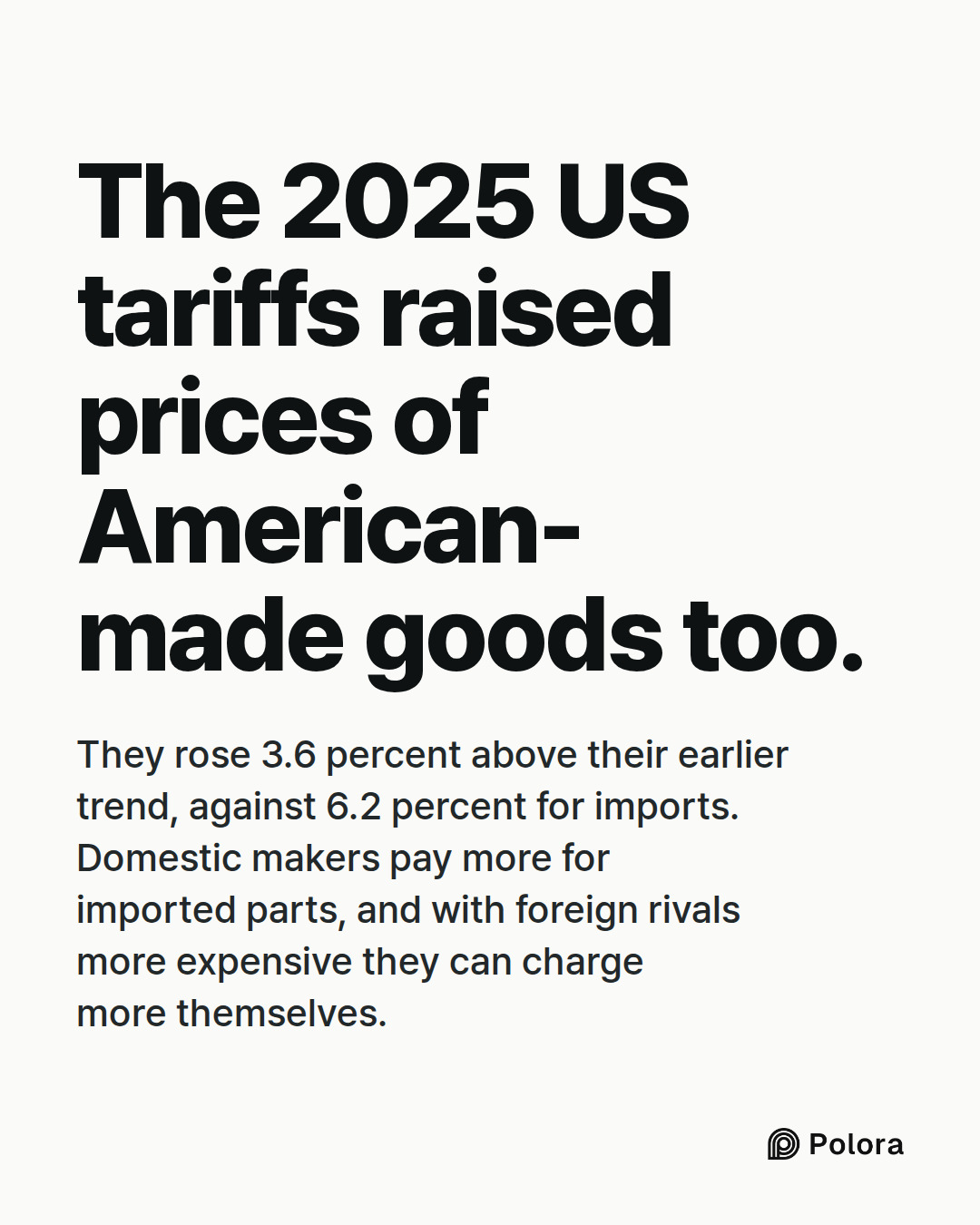
Shoppers also paid in a way that is easy to miss. Prices of American-made goods rose too, by 3.6 percent above their earlier trend, against 6.2 percent for imports. Domestic makers pay more for imported parts, and with foreign rivals more expensive they can charge more themselves. The New York Fed study finds that about a third of the tariff's effect on store prices came through goods made at home.
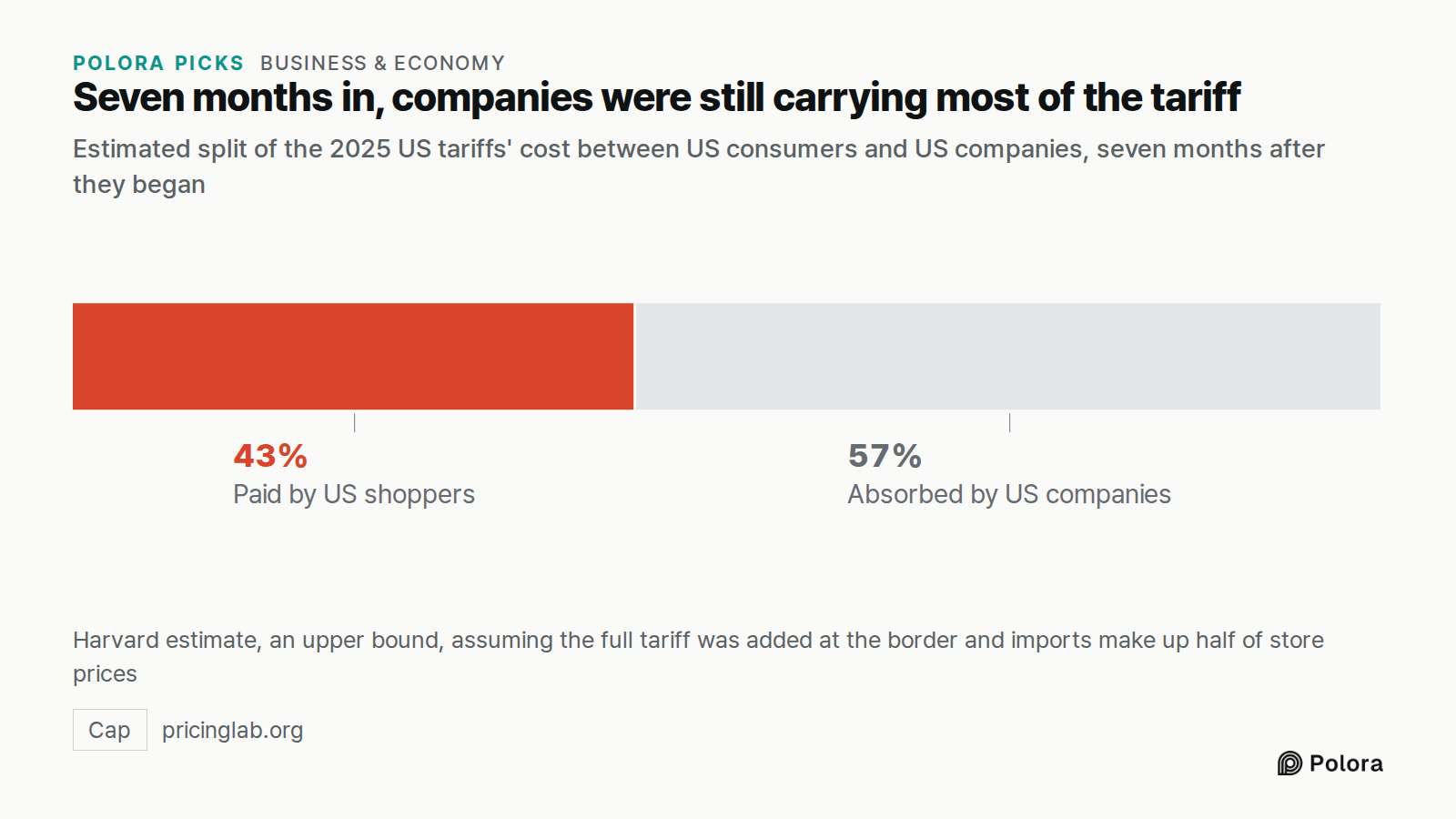
Seven months in, companies were still carrying most of the tariff · Estimated split of the 2025 US tariffs' cost between US consumers and US companies, seven months after they began · Paid by US shoppers · up to 43% · Absorbed by US companies · Harvard estimate, an upper bound, assuming the full tar
Estimated split of the 2025 US tariffs' cost between US consumers and US companies, seven months after they began

What moves the split between company and shopper

Time is the first thing. Imported goods get more expensive almost at once, but the rise in American-made goods builds over nine to twelve months, as higher costs work through supply chains. Over a full year, the New York Fed economists estimate that about 26 percent of a tariff reaches consumer prices, measured against goods less exposed to the tariff. That is a comparison between goods, not a forecast of overall inflation.

Expectations come second. A store that thinks a tariff will vanish next month has little reason to reprint its price tags. Canada offers a clean test. When it put counter-tariffs on US goods in 2025, a Bank of Canada study found that store prices of those goods peaked at about 6 percent, roughly a quarter of the 25 percent tariff. They moved with trade news and fell back quickly once the tariffs were lifted.

The third is surprisingly simple : whether the shelf says so. In the same Canadian study, prices rose more for products that stores labeled as tariffed. The study records the pattern, not its cause. One reading is that shoppers accept a rise more readily when they are told why, but the labeling result alone does not prove it.
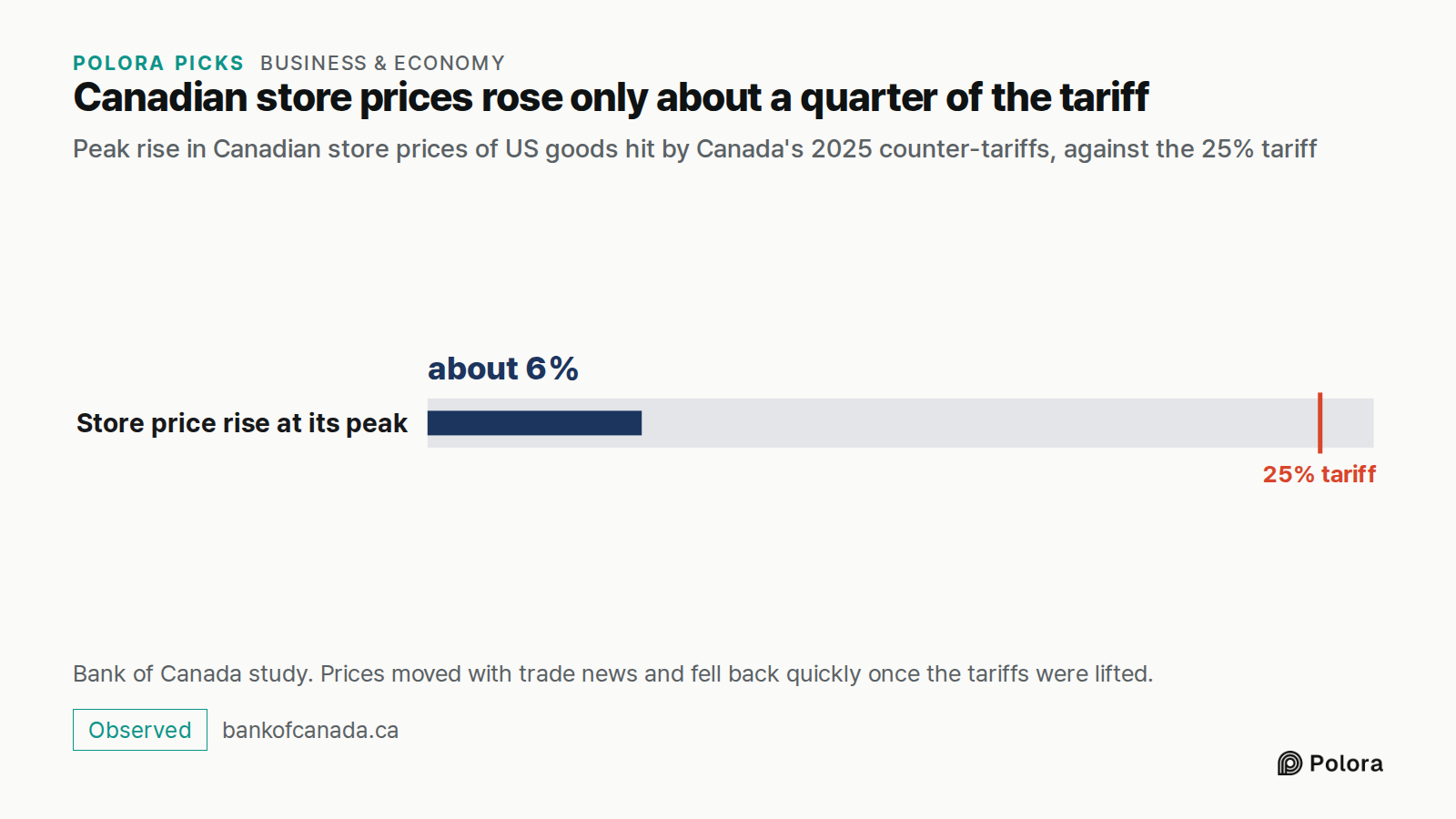
Canadian store prices rose only about a quarter of the tariff · Peak rise in Canadian store prices of US goods hit by Canada's 2025 counter-tariffs, against the 25% tariff · Store price rise at its peak · about 6% · 25% tariff · Bank of Canada study. Prices moved with trade news and fell back quickl
Peak rise in Canadian store prices of US goods hit by Canada's 2025 counter-tariffs, against the 25% tariff

The sentence to keep

A tariff is charged at your own border, and the open question is how the bill is split at home. In the recent US tariffs, almost none of it went back to the foreign seller. Companies swallowed most of it at first, and shoppers took a larger share as the months passed, including on goods made at home.

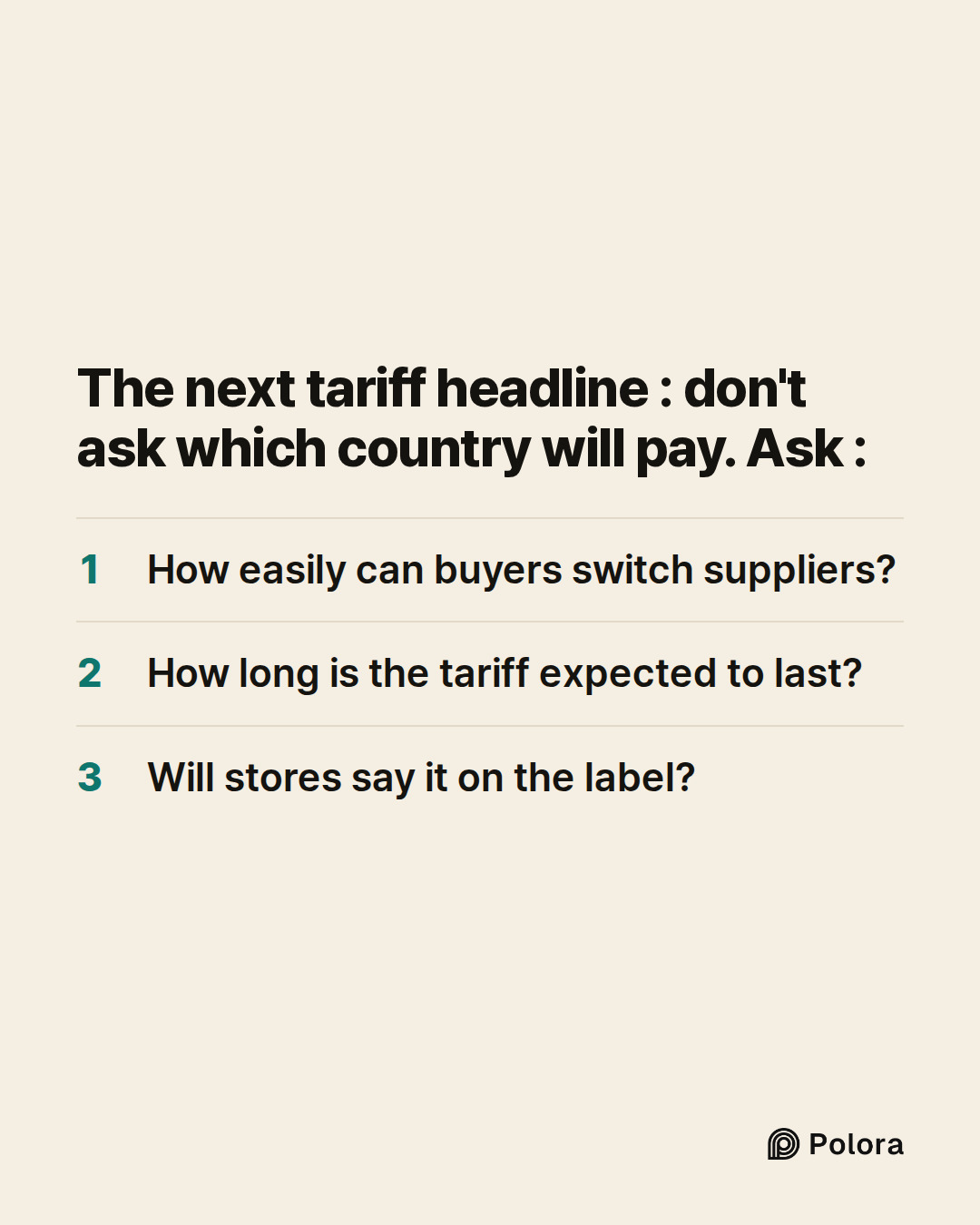
These numbers describe particular tariffs, products and years. They are not a rule for every case, and they say nothing about whether a given tariff is worth its cost. But they give a way to read the next tariff headline. Don't ask which country will pay. Ask how easily buyers can switch suppliers, how long the tariff is expected to last, and whether stores will say it on the label.
When a country puts a tariff on imports, who actually pays it?When a country puts a tariff on imports, who actually pays it?A tariff is paid at your own border, not by the foreign country. · In the recent US tariffs, roughly 90 cents of every tariff dollar stayed in the United States, economists estimate.92% · of the tariff passed into the prices US importers paid · Foreign sellers absorbed very little of the 2025 US tariffs · Share of the 2025 US tariffs that showed up in US import prices, as estimated by economists · Estimate by Gopinath and Neiman (May 2026). The New York Fed puts it at around 90Paid by US shoppers · up to 43% · Absorbed by US companies · Seven months in, companies were still carrying most of the tariff · Estimated split of the 2025 US tariffs' cost between US consumers and US companies, seven months after they began · Harvard estimate, an upper bound, assuming the full tarUS tariff refunds go to companies, not shoppers. · Customs can refund the emergency duties only to the importer or a party it designates. The refund shows who paid customs, not who bore the cost.The 2025 US tariffs raised prices of American-made goods too. · They rose 3.6 percent above their earlier trend, against 6.2 percent for imports. Domestic makers pay more for imported parts, and with foreign rivals more expensive they can charge more themselves.The next tariff headline : don't ask which country will pay. Ask : · How easily can buyers switch suppliers? · How long is the tariff expected to last? · Will stores say it on the label?Sources 15 : cbp.gov · CBP : IEEPA duty refunds, supremecourt.gov · Supreme Court of the United States : Learning Resources, Inc. v. Trump, slip opinion, cit.uscourts.gov · US Court of International Trade : Slip Op. 26-94 + 12Read the full story at · polora.ai

When a country puts a tariff on imports, who actually pays it?

Alpha · claude-sonnet-5

My reading of the manuscript's core mechanism — and where it needs correction The piece's central claim — tariff collected at the importer's own border, with the economic burden then splitting empirically among exporter, importer, and consumer — is correct and well-supported. But several specific numbers and attributions need fixing before publication. The Supreme Court ruling: confirmed, but the piece understates its scope. In a 6-3 ruling, the U.S. Supreme Court held that the International Emergency Economic Powers Act ("IEEPA") does not authorize the President to impose tariffs. This covered both reciprocal tariffs on imports from most countries and the trafficking/fentanyl tariffs on imports from Canada, Mexico, and China related to opioid trafficking. The manuscript's "most of the 2025 tariffs" framing is reasonable, but it should flag — as the checks note — that Section 232 (steel/aluminum/autos) tariffs survived untouched. One correction to the manuscript: the Court's decision was confined to the legal issues and does not address whether or how the Government should refund IEEPA tariffs already paid — the refund obligation came from a *separate* CIT order, not the S…

Beta · gpt-6-sol

The premise stands, but the manuscript is not ready to publish unchanged. The importer of record owes the tariff to customs. That identifies who remits the tax, not who ultimately bears its cost: a foreign seller can accept a lower pre-tariff price, an importing or retail business can accept a lower margin, and buyers can face higher prices. The evidence in the cited U.S. studies points largely to costs borne in the United States, but not to an invariant split. The most consequential corrections are these: - The China news hook says a cut has been agreed when the primary document says a cut is still being considered. The September 27 U.S.–China Board of Trade procedures describe dialogue over goods worth *roughly $30 billion on each side*, “with a view toward” reduced tariff treatment. The September 25 White House fact sheet calls these *recommendations*. Neither establishes that tariffs on $60 billion of goods were lowered on September 28. Replace the claimed agreement to cut tariffs with the narrower, documented proposal; verify any subsequent implementing action separately. ([whitehouse.gov](https://www.whitehouse.gov/wp-content/uploads/2026/09/US-China-Board-of-Tr…

Gamma · gemini-3.1-pro

The premise of the manuscript—that a tariff is a tax remitted at the border by the importer, while the actual economic burden is an empirical question of price pass-through—is fundamentally sound. However, I agree with Beta that the manuscript needs critical surgical edits before publication to avoid turning legal complexities into factual errors. Here is my assessment of the remaining claims and the final verdict on the manuscript's angle: The Consumer Lawsuits and the Refund Mechanism The manuscript claims shoppers have sued retailers like Walmart, Costco, and Amazon, noting that "no law requires [passing the refund on], and the cases are still open." This is an accurate characterization of the current legal landscape. Consumers in cases like *Glase v. Walmart Inc.* are relying on state-level unjust enrichment and consumer protection claims, precisely because federal customs law (19 U.S.C. § 1520) dictates that refunds go to the importer of record. There is no statutory mechanism for CBP to refund consumers. The manuscript’s categorical "not one dollar of it goes to shoppers" from the government is correct. *Source: https://www.cbp.gov/trade/programs-administration/trade-…

Researcher · gemini-3-7-flash

Here is the verification of the specific factual claims, figures, legal mechanisms, and economic studies cited in the manuscript and raised by the debaters. --- 1. Legal and Regulatory Mechanics Importer of Record and Direct Payment at the Border * Claim: The importing company (importer of record) pays the tariff directly to customs at the border; the foreign government or exporter does not remit the payment. * Finding: Confirmed. Under U.S. customs law (19 U.S.C. § 1484 / 19 U.S.C. § 1505), statutory liability to remit duties falls solely on the *importer of record* upon entry of merchandise into U.S. customs territory. * Caveat: Under "Delivered Duty Paid" (DDP) Incoterms, a foreign seller can register with U.S. Customs and Border Protection (CBP) as a non-resident importer of record and remit the tariff directly. However, this is an administrative vehicle; it does not change the fact that foreign governments pay nothing and that statutory border liability is distinct from ultimate economic incidence. * Source: U.S. Customs and Border Protection Guidance (cbp.gov…

The Arbiter · gpt-6-sol

Round record The shared answer is sound: the importer of record remits a tariff to customs, but that does not establish who ultimately bears its cost. Foreign sellers may lower their prices, importing businesses may accept smaller margins, and shoppers may pay more. Alpha, Beta, Gamma and the Researcher agree that the manuscript’s premise stands; their dispute is over how confidently it states particular legal, news and pricing claims. A foreign seller can also serve as a non-resident importer of record, so “the foreign factory never pays customs directly” is too absolute. The May 2026 Gopinath–Neiman paper itself distinguishes legal payment from economic incidence. (brentneiman.com) Address: https://brentneiman.com/research/GN2.pdf The clearest factual correction is the China news hook. Beta found, and the Researcher confirmed, that the September 27 U.S.–China working procedures establish a dialogue about *roughly $30 billion of goods on each side*, with a view toward possible reduced tariffs. They do not establish the manuscript’s claimed September 28 agreement to cut tariffs on “$60 billion of each other’s goods.”…

The Arbiter's Final Verdict · gpt-6-sol

The importer of record pays the tariff to customs. Who ultimately bears the cost is a different question. The importer may absorb it in lower profits, pass it on to shoppers through higher prices, or persuade the foreign seller to accept a lower pre-tariff price. A foreign seller can itself be the importer of record, but a foreign *government* does not pay the importing country’s customs bill. (U.S. customs law) Verdict on the manuscript: its central premise stands, but several claims need correction before publication. Research on the 2018–19 and 2025 U.S. tariffs finds that much of the cost remained with U.S. buyers at the border; it does not establish a fixed split between businesses and shoppers for every tariff. Gopinath and Neiman estimate border pass-through of 81% and 92%, respectively. The retail estimates describe particular goods and periods and depend on stated assumptions—not a universal consumer share. (Gopinath and Neiman; [Cavallo, Llamas and Vazquez](https://www.pricinglab.org/files/TrackingTariffs_Cavallo_Llamas_Vazquez.p…