Why are mortgage rates above 7% when the Fed's rate is under 4%?

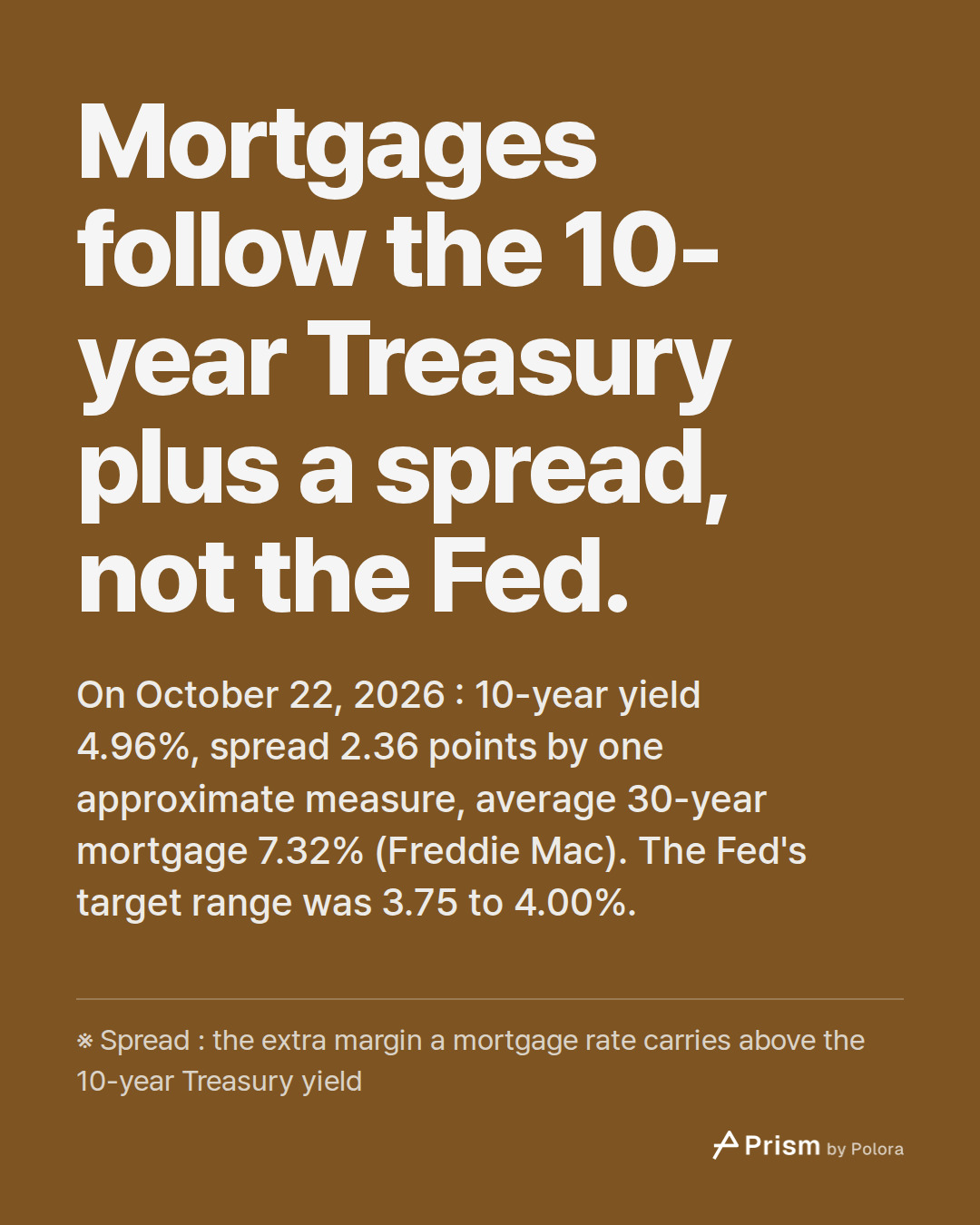
Mortgage rates track the 10-year Treasury yield plus a spread, not the Fed's overnight rate. On Oct 22, 2026 those were 4.96% and 2.36 points.

2026-11-02

Over one year, the Fed's rate fell a little and mortgage rates rose more than a point

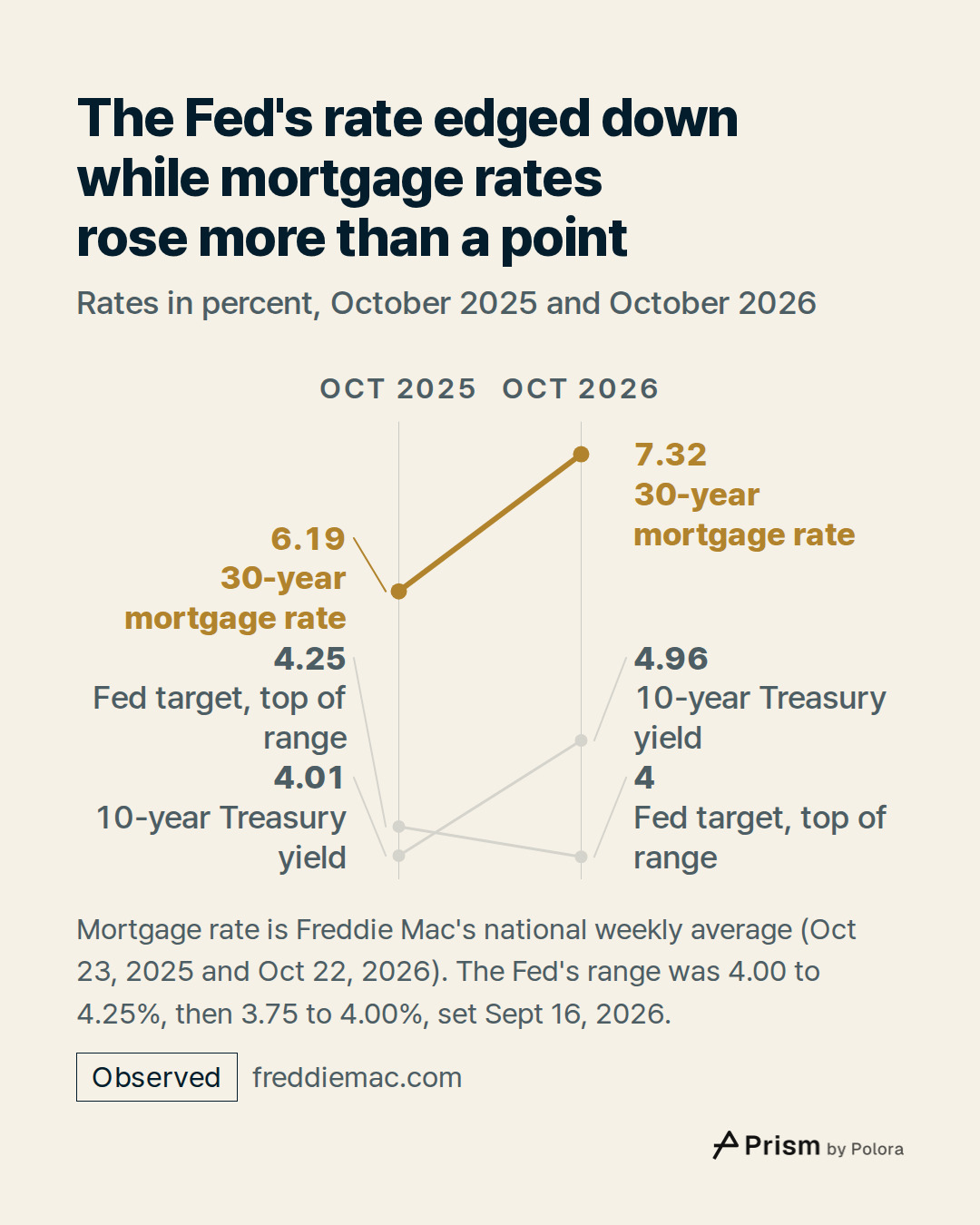
Put two Octobers side by side. On October 23, 2025, the Federal Reserve's target for its overnight rate (the federal funds rate, which banks charge each other to borrow overnight) was 4.00 to 4.25%. Freddie Mac's weekly survey put the average 30-year fixed mortgage rate at 6.19%.

A year later, the Fed's target was 3.75 to 4.00%, a quarter point lower. That is the range the Fed set on September 16, 2026, and the latest one confirmed when this piece was checked on October 28, hours before that day's scheduled announcement. In the survey dated October 22, 2026, the average 30-year mortgage was 7.32%. In the two weeks before that, on October 8 and October 15, it had been 7.40%.

So the Fed's rate fell slightly and mortgage rates rose by 1.13 points. Something other than the Fed's headline rate moved mortgages. Over the same year, the yield on the 10-year US Treasury note rose from 4.01% to 4.96%, almost a full point. Most of the story is in that number.
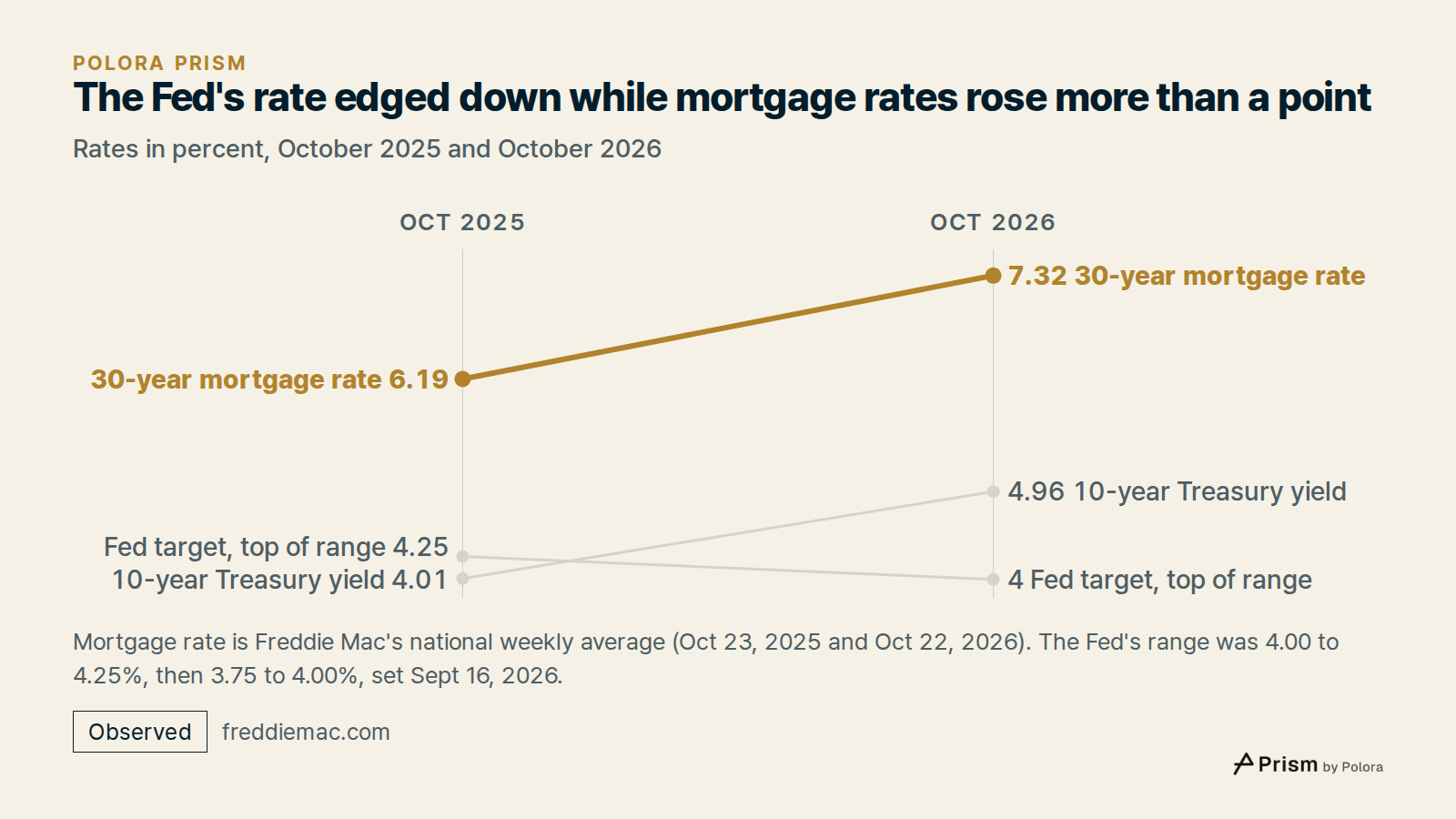
The Fed's rate edged down while mortgage rates rose more than a point · Rates in percent, October 2025 and October 2026 · Oct 2025 · Oct 2026 · 30-year mortgage rate · 10-year Treasury yield · Fed target, top of range · 6.19 · 4.01 · 4.25 · 7.32 · 4.96 · 4.0 · Mortgage rate is Freddie Mac's national
Rates in percent, October 2025 and October 2026

Why a 30-year mortgage follows the 10-year Treasury

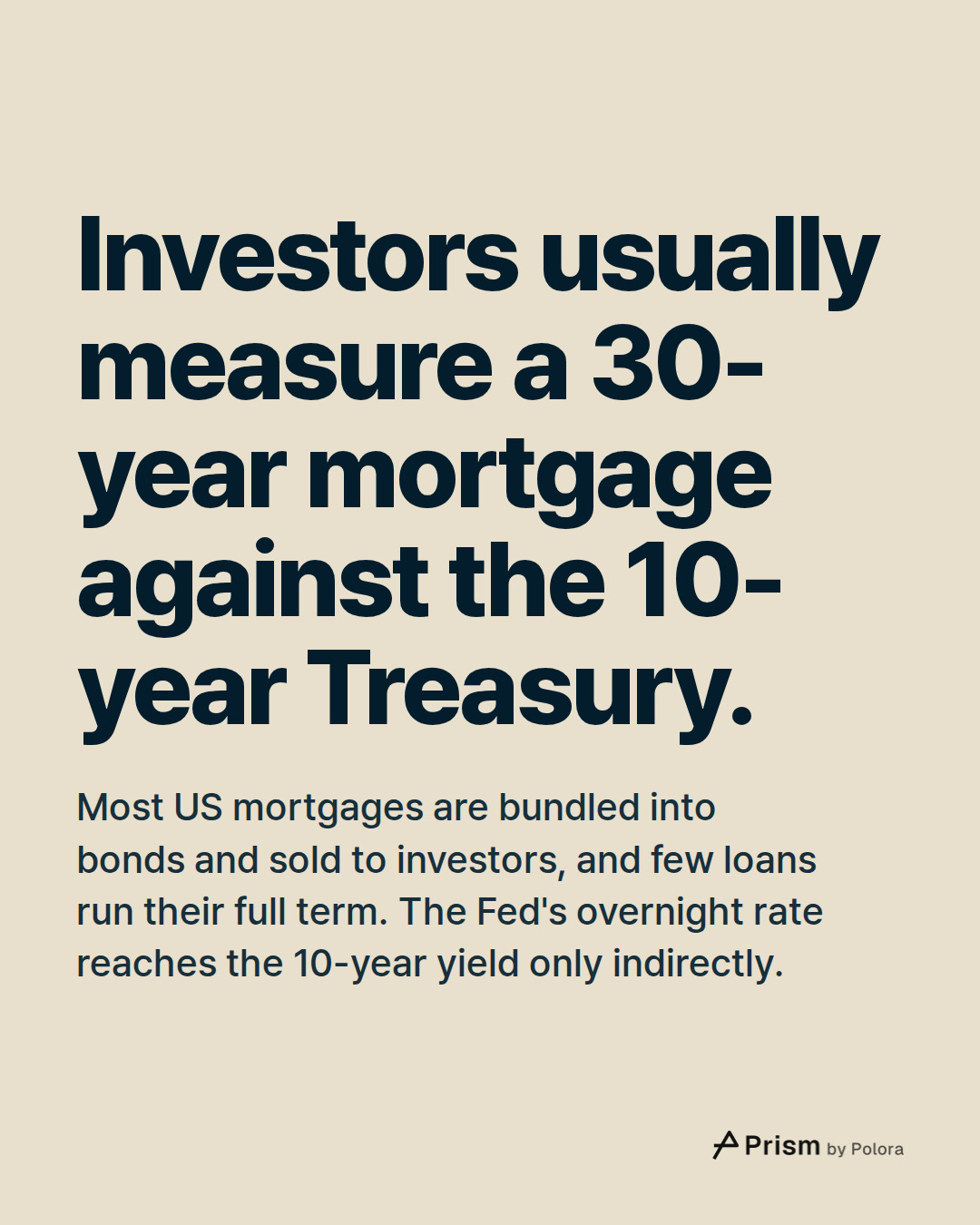
The Fed sets the price of money overnight. A mortgage is a loan for decades, and the bank that writes it usually does not keep it. Most US mortgages are bundled into mortgage-backed securities, bonds paid from many borrowers' monthly payments, and sold to investors. What those investors are willing to pay for such bonds largely sets the rate a new mortgage has to carry.

A 30-year mortgage rarely runs its full term. Borrowers sell the house or refinance, and every monthly payment returns part of the principal. So investors do not compare a mortgage bond with a 30-year Treasury bond. The usual yardstick is the 10-year Treasury note. A 2026 paper from the Federal Reserve Bank of Boston calls it an imperfect one, because a mortgage bond pays back its principal bit by bit and at unpredictable times, carries a different guarantee, and comes with costs of making and running the loan that a Treasury does not have.

That makes the 10-year yield plus a spread, an extra margin on top, a way of explaining mortgage rates, not a formula lenders apply. Mortgage rates also reflect how mortgage bonds themselves trade, the costs borrowers and lenders face, and a prepayment risk that changes over time.

The Fed's overnight rate reaches the 10-year yield only indirectly. That yield reflects what investors expect the Fed's rate to average over the next decade, and what extra they want for tying up money that long, for example to cover the risk of inflation. On October 5, 2026, the 10-year yield closed at 5.31%, its highest close since May 2002, according to Treasury's daily yield data as published by the St. Louis Fed. By October 22 it had come back to 4.96%.

What the gap above the 10-year pays for

A mortgage costs more than the 10-year yield, and the difference is called the mortgage spread. Part of it pays for running the loan. Lenders have costs and want a profit, someone collects the payments each month, and Fannie Mae and Freddie Mac charge a guarantee fee for promising investors they will be paid even if a borrower defaults. How large that fee is depends on what is counted. The Boston Fed paper uses about 0.42 point in building its comparison. The Federal Housing Finance Agency, counting both ongoing and upfront fees on the single-family loans the two companies acquired in 2024, reports an average of 65.2 basis points (hundredths of a percentage point), about 0.65 point.

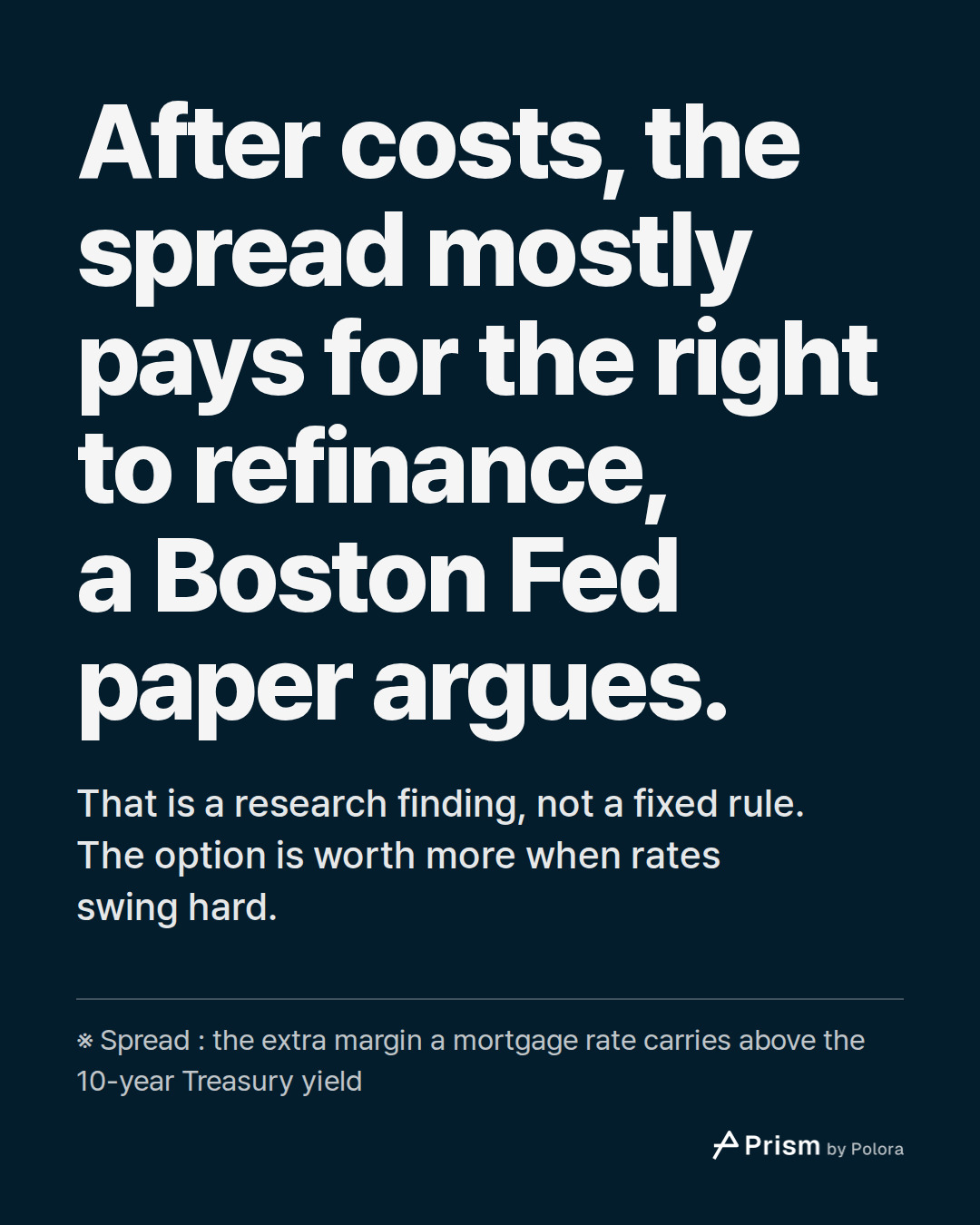
The larger and more changeable part pays investors for one risk. A US borrower can pay off the mortgage at any time without penalty. When rates fall, borrowers refinance, and investors get their money back just when they can only relend it at lower rates. When rates rise, borrowers keep their cheap loans, and investors are stuck with them. The Boston Fed paper argues that this prepayment option accounts for most of the spread that remains after costs. Its analysis finds that expectations about rates, how much rates swing and the cost of refinancing together explain about 80% of how that remainder moves. That is one paper's research finding, not a fixed rule.

That option is worth more when rates swing hard, because big swings make a profitable refinance more likely. The Federal Reserve Bank of Dallas found that in 2022 mortgage rates rose mainly because Treasury yields rose, and that a higher cost of the prepayment option, reflecting wider uncertainty about where rates were heading, amplified the rise.
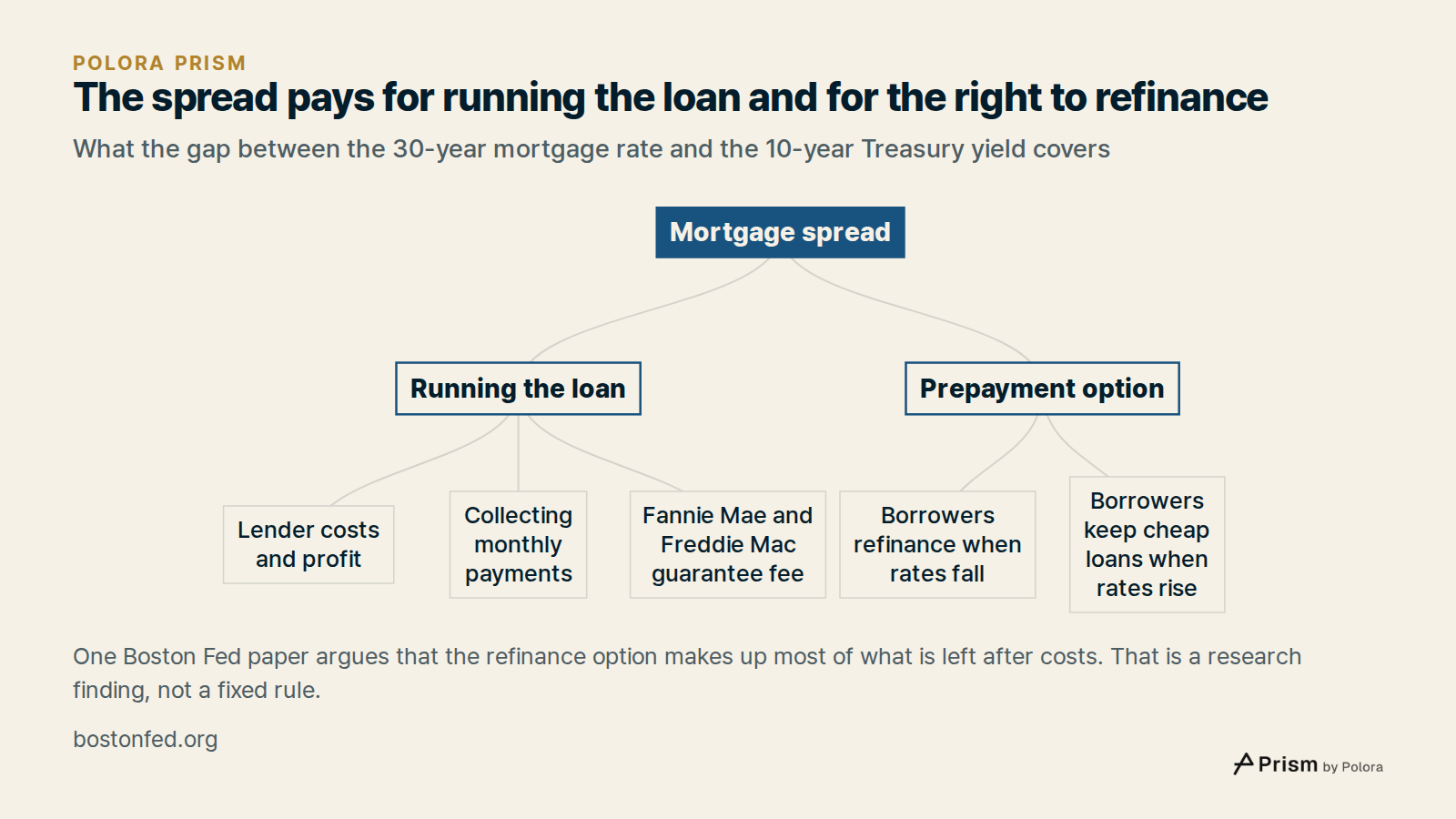
The spread pays for running the loan and for the right to refinance · What the gap between the 30-year mortgage rate and the 10-year Treasury yield covers · Mortgage spread · Running the loan · Prepayment option · Lender costs and profit · Collecting monthly payments · Fannie Mae and Freddie Mac gua
What the gap between the 30-year mortgage rate and the 10-year Treasury yield covers

How wide the gap is now, measured one way

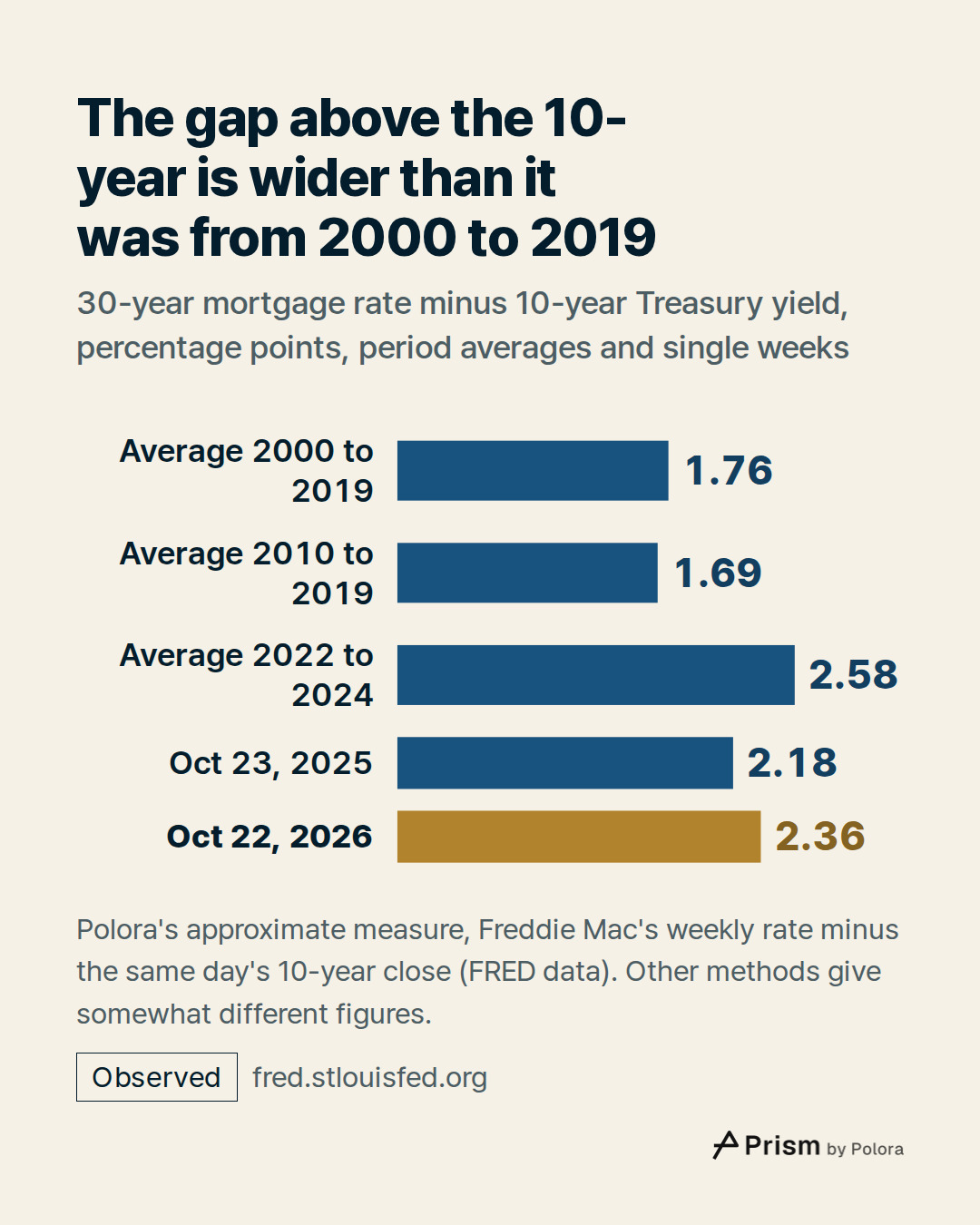
We measured the spread one simple way : each weekly Freddie Mac survey rate minus the 10-year Treasury close on the same day, using public data from the St. Louis Fed (FRED). Freddie Mac's figure averages rates offered from Thursday to Wednesday, so subtracting one day's Treasury close gives an approximate gap, not a quote from a single moment. By that measure, the spread averaged 1.76 points from 2000 to 2019, and 1.69 points from 2010 to 2019. It averaged 2.58 points from 2022 to 2024, years when rates moved violently.

In October 2026 it widened week by week, to 2.18 points on October 8, 2.30 on October 15 and 2.36 on October 22. That is about 0.6 point above the 2000 to 2019 average. A year earlier, on October 23, 2025, it was 2.18.

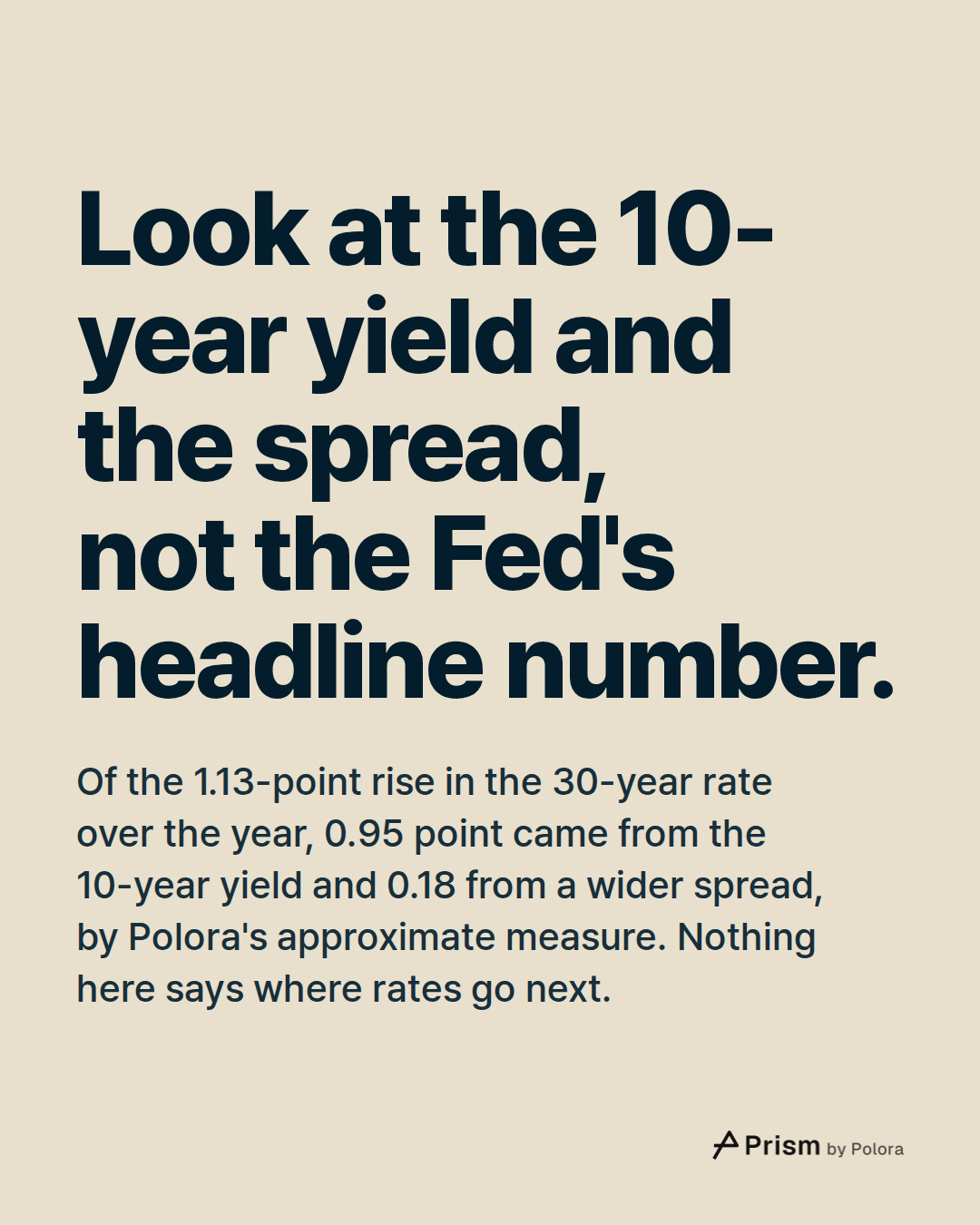
By this measure, of the 1.13-point rise in the 30-year rate, 0.95 point came from the 10-year yield and 0.18 point from a wider spread. Pairing the dates differently or choosing other years gives somewhat different averages, so the exact figures depend on the method.
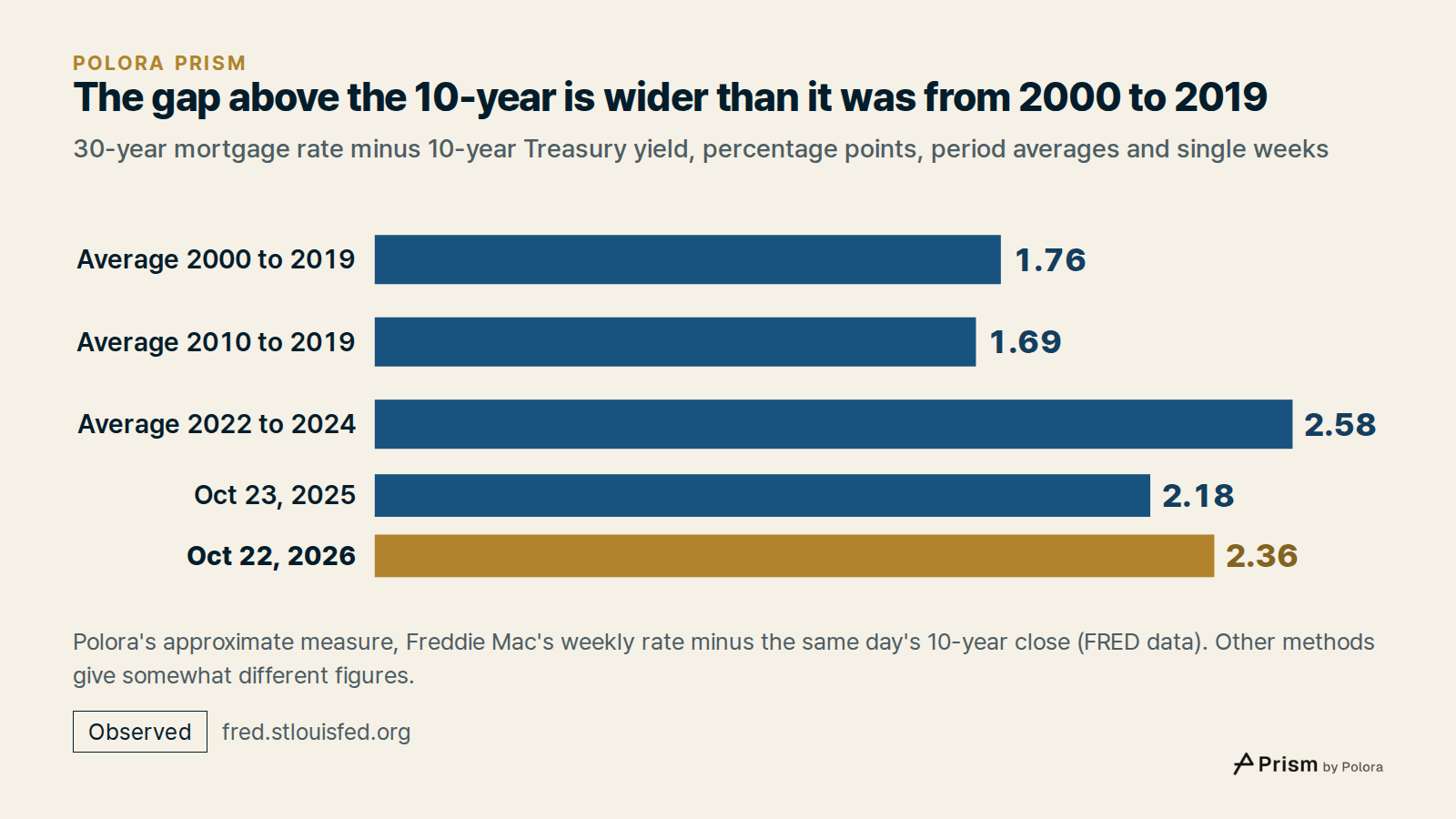
The gap above the 10-year is wider than it was from 2000 to 2019 · 30-year mortgage rate minus 10-year Treasury yield, percentage points, period averages and single weeks · Average 2000 to 2019 · Average 2010 to 2019 · Average 2022 to 2024 · Oct 23, 2025 · Oct 22, 2026 · 1.76 · 1.69 · 2.58 · 2.18 ·
30-year mortgage rate minus 10-year Treasury yield, percentage points, period averages and single weeks

What these numbers do not tell you

Freddie Mac's figure is a national average for one kind of borrower : conventional loans to buy a single-family home the borrower will live in, with good or excellent credit and a 20% down payment. It is not the rate any one person will be offered. Credit, down payment, loan size and the lender all change it.

Nothing here says where mortgage rates go next. The 10-year yield and the spread can each rise or fall, and they need not move together. The historical averages describe the past over the years and method stated, and they promise nothing about the future. New figures will keep arriving. The Fed's next decision is due on October 28, 2026, and when this piece was checked it had not yet been announced, so the target range given here is the one set on September 16. Freddie Mac's next survey is due on October 29, so every rate in this piece is given with its date.

What the president's new housing executive order deals with

Executive Order 14438, "Decreasing Housing Costs for the American People", is dated October 22, 2026, and its Federal Register publication date is October 28. It calls for agency actions and pilot programs on the costs around a mortgage : how title risk (the risk of a flaw in the legal record of who owns the home) is assessed and charged on some refinances, cancelling mortgage insurance on time once a loan falls to 78% of the home's value, rates on certain direct home loans from the Department of Veterans Affairs and the Department of Agriculture, and factory-built housing.

Many of these steps are pilots or come with conditions, and they depend on agencies and the industry acting on them. They deal with the fees and costs layered on a mortgage, not with Treasury yields or the spread investors demand, the two forces this piece describes.

The sentence to take away

A 30-year mortgage rate is set in the market for mortgage bonds, where it is measured against the 10-year Treasury yield, not the Fed's overnight rate. Above that yield sits a spread that pays for running the loan and, by the Boston Fed's account, mostly for the borrower's right to refinance whenever rates fall. In October 2026 both parts were high at once, and that is why the average mortgage cost more than 7% while the Fed's target range was 3.75 to 4.00%. To understand a mortgage rate, look at the 10-year yield and the spread, not the Fed's headline number.
Why are mortgage rates above 7% when the Fed's rate is under 4%?Why are mortgage rates above 7% when the Fed's rate is under 4%?Mortgages follow the 10-year Treasury plus a spread, not the Fed. · On October 22, 2026 : 10-year yield 4.96%, spread 2.36 points by one approximate measure, average 30-year mortgage 7.32% (Freddie Mac). The Fed's target range was 3.75 to 4.00%. · ※ Spread : the extra margin a mortgage rate carriesOct 2025 · Oct 2026 · 30-year mortgage rate · 10-year Treasury yield · Fed target, top of range · 6.19 · 4.01 · 4.25 · 7.32 · 4.96 · 4.0 · The Fed's rate edged down while mortgage rates rose more than a point · Rates in percent, October 2025 and October 2026 · Mortgage rate is Freddie Mac's nationalInvestors usually measure a 30-year mortgage against the 10-year Treasury. · Most US mortgages are bundled into bonds and sold to investors, and few loans run their full term. The Fed's overnight rate reaches the 10-year yield only indirectly.After costs, the spread mostly pays for the right to refinance, a Boston Fed paper argues. · That is a research finding, not a fixed rule. The option is worth more when rates swing hard. · ※ Spread : the extra margin a mortgage rate carries above the 10-year Treasury yieldAverage 2000 to 2019 · Average 2010 to 2019 · Average 2022 to 2024 · Oct 23, 2025 · Oct 22, 2026 · 1.76 · 1.69 · 2.58 · 2.18 · 2.36 · The gap above the 10-year is wider than it was from 2000 to 2019 · 30-year mortgage rate minus 10-year Treasury yield, percentage points, period averages and single wLook at the 10-year yield and the spread, not the Fed's headline number. · Of the 1.13-point rise in the 30-year rate over the year, 0.95 point came from the 10-year yield and 0.18 from a wider spread, by Polora's approximate measure. Nothing here says where rates go next.Sources 13 : freddiemac.com · Freddie Mac Primary Mortgage Market Survey, freddiemac.com · Freddie Mac Primary Mortgage Market Survey archive, federalreserve.gov · Federal Reserve press release, September 17, 2025 + 10Read the full story at · polora.ai
Why are mortgage rates above 7% when the Fed's rate is under 4%?

Alpha · deepseek-v4-pro

The short answer: the Fed's rate and a mortgage rate are prices for two very different loans. The Federal Reserve's target range — 3.75% to 4.00% since September 16, 2026 — is for overnight borrowing between banks. A 30-year mortgage is a decades-long loan, and it is not priced off that overnight rate. Most U.S. mortgages are packaged into mortgage-backed securities and sold to investors, and those investors compare a mortgage bond with the safest long-term bond of similar length: the 10-year Treasury. Why the 10-year instead of 30 years? Because a 30-year mortgage rarely lasts 30 years. Borrowers sell the house, refinance, or pay down principal early, so investors treat a mortgage bond as more like a loan of about ten years. On October 22, 2026, the 10-year Treasury yield was 4.96%. Freddie Mac's weekly survey put the average 30-year fixed mortgage rate at 7.32%. The difference — 2.36 points — is the mortgage spread. So the 7%-plus number is: 4.96% (10-year Treasury) + 2.36 points (mortgage spread) = 7.32% The Fed's rate is only one input into that 10-year yield. The 10-year yield reflects what investors expect short-term rates to average over the next decade, plus what t…

Beta · gpt-6-sol

Alpha has the central explanation right, but I would tighten two points before publishing it. The arithmetic is sound; the comparison is approximate. Freddie Mac reported a 7.32% weekly average for 30-year mortgages on October 22, 2026, while the 10-year Treasury yield was 4.96% on that date. Subtracting gives a 2.36-percentage-point spread. But Freddie Mac’s figure averages applications from the preceding Thursday through Wednesday; it is not a mortgage quote observed at the October 22 Treasury close. The spread is a useful benchmark, not a precise same-moment market price. (freddiemac.com) The 10-year Treasury is a benchmark, not the mortgage’s literal maturity. Mortgage payments return principal gradually, and sales and refinancing can return it sooner. That makes a 30-year mortgage-backed security unlike a 30-year Treasury bond—but also unlike a single, guaranteed ten-year loan. The Boston Fed explicitly calls the 10-year Treasury an *imperfect* comparison and adjusts for those different cash flows, credit protection, and origination costs before analyzing the remaining spread. Its author argues that the…

Gamma · gemini-3.1-pro

Alpha and Beta have laid out the core mechanics clearly. I will add the remaining verifications requested in the research brief, drawing on live searches to complete the picture for the manuscript. The Dallas Fed on Volatility (2022): The manuscript accurately reflects the Dallas Fed’s findings. An April 4, 2023 article titled "Interest rate volatility contributed to higher mortgage rates in 2022" confirms that while the rise in risk-free Treasury rates drove the primary increase, it was "amplified by increases in the cost of the mortgage prepayment option, which reflected broader uncertainty about the future path of interest rates." (dallasfed.org) The Guarantee Fee (G-Fee) Definition: The manuscript cites a Boston Fed paper for a guarantee fee of "about 0.42 point" (42 basis points). However, this figure is highly dependent on what is included and the timeframe measured. The Federal Housing Finance Agency’s (FHFA) annual report on single-family guarantee fees, published in late 2025, states that the average guarantee fee across Fannie Mae and Freddie Mac’s single-family loan acquisitions was 65.2 basis points i…

Researcher · gpt-6-luna

The core rate comparison checks out, with one important timing caveat: at 16:00 UTC on October 28, the Fed’s scheduled October 27–28 meeting had not yet reached its 2 p.m. Eastern announcement. The latest confirmed target I found was therefore the September 16 range of 3.75%–4.00%—not a verified post-meeting rate for “today.” The Fed’s calendar lists the October 28 announcement. Sources: https://www.federalreserve.gov/newsevents/2026-october.htm ; https://www.federalreserve.gov/newsevents/pressreleases/monetary20260916a.htm Freddie Mac’s archive confirms its 30-year survey averages: 7.40% on October 8 and 15, 2026, and 7.32% on October 22. Freddie Mac says its weekly figure averages rates offered from Thursday through Wednesday, so subtracting it from the October 22 Treasury yield is a useful comparison, but not a same-moment market quote. FRED reports the 10-year Treasury yield at 4.96% on October 22; the arithmetic difference is 2.36 percentage points. Sources: https://www.freddiemac.com/pmms/archive ; https://fred.stlouisfed.org/series/DGS10 The Boston Fed paper supports the main explanation, but calls the 10-year Treasury an imperfect benchmark: mortga…

The Arbiter · gpt-6-sol

The voices agree on the central distinction: the Fed’s target is for overnight lending, while the mortgage rate reflects longer-term bond-market pricing plus mortgage-specific costs and risks. Freddie Mac reports a 7.32% weekly mortgage average for October 22, 2026; the last Fed target confirmed in this round is 3.75%–4.00%, set September 16. (freddiemac.com) The qualification worth carrying into the verdict is Beta’s: subtracting one day’s 10-year Treasury yield from a *weekly* mortgage survey gives a useful spread, not a same-instant quote or a literal pricing formula. Freddie Mac says its survey averages offers from the preceding Thursday through Wednesday. (freddiemac.com) The remaining time-sensitive point is the October 28 Fed announcement. At the 16:00 UTC point checked by the Researcher, it was still pending; no one should present an anticipated decision as an announced one. (federalreserve.gov)

The Arbiter's Final Verdict · gpt-6-sol

The Fed’s rate and a mortgage rate price different things. The Fed’s target is for overnight borrowing. A 30-year mortgage is priced in a market for longer-term loans, where investors weigh Treasury yields alongside mortgage-specific costs and risks. The 10-year Treasury is a useful benchmark, though mortgages do not mechanically equal that yield plus a fixed markup. For a dated comparison, Freddie Mac’s October 22, 2026 survey put the average 30-year fixed mortgage at 7.32%; the 10-year Treasury yield that day was 4.96%. The difference was 2.36 percentage points. That gap reflects factors including lending and servicing costs, guarantee fees, investor demand, and the risk that borrowers refinance when rates fall. It is an *approximate comparison*, not a same-instant quote: Freddie Mac’s number is a weekly survey average. (Freddie Mac; FRED; Boston Fed) So the answer is a nearly 5% longer-term benchmark plus a substantial mortgage-specific gap, rather…