Membership fees set against operating income
Costco charges shoppers a yearly fee to shop in its warehouses. In its income statement the fees are a revenue line of their own, next to net sales of merchandise. Operating income is what is left of all revenue, fees included, after merchandise costs and the costs of running the business, before interest and tax.
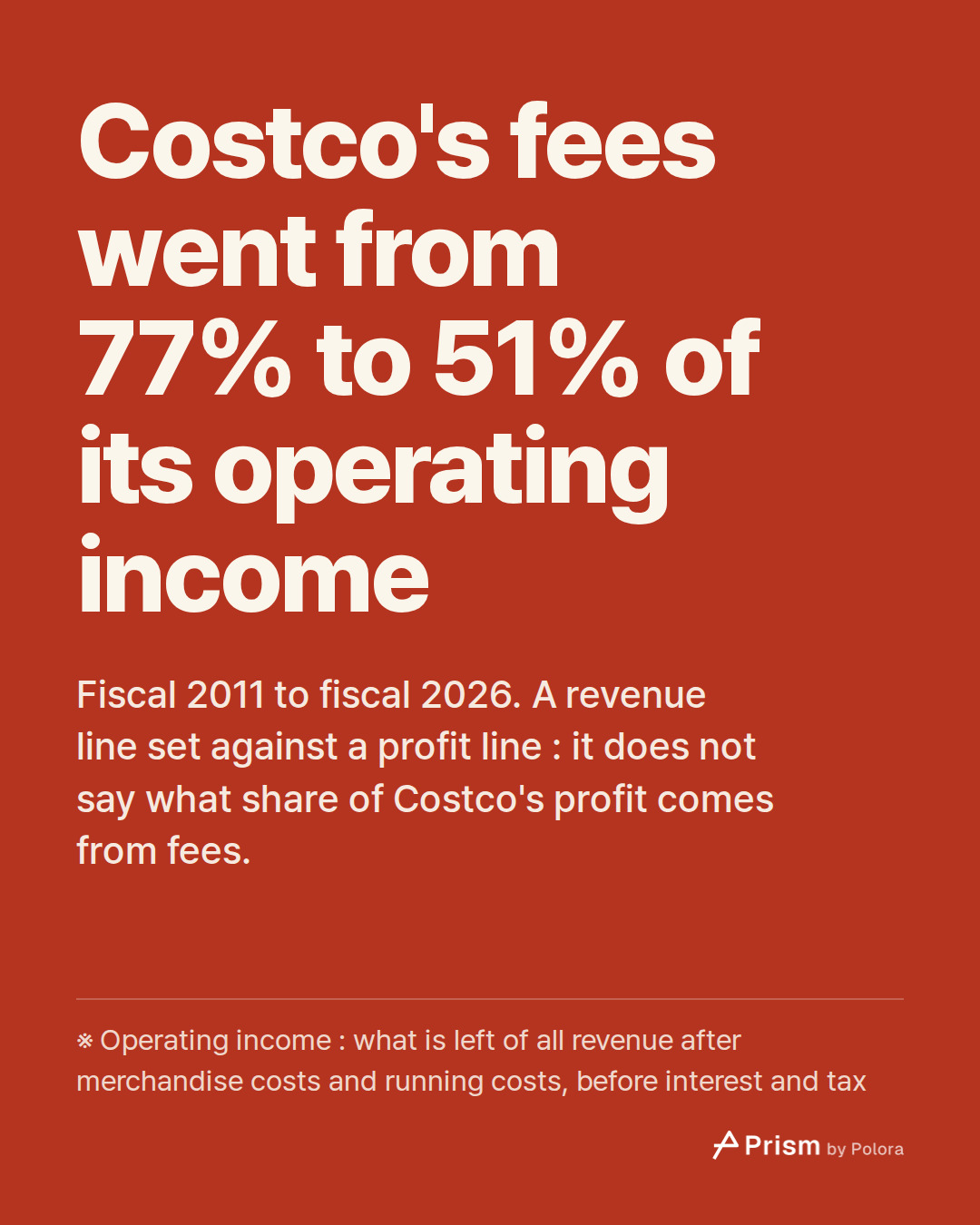
The comparison sets a revenue line against a profit line. It does not say what share of Costco's profit comes from fees. Costco does not report what it costs to earn its fees; it reports its operating costs for the business as a whole. The ratio says how large the fee total is against operating income, nothing more.
All financial figures are for Costco worldwide, in dollars of the day, from its annual reports filed with the US Securities and Exchange Commission. Costco's fiscal year ends on the Sunday nearest the end of August. Fiscal 2012, 2017 and 2023 were a week longer than the others, so both lines cover an extra week in those years.
The comparison starts in fiscal 2011 for a reason. At the start of that year Costco began fully consolidating its half-owned joint venture in Mexico. Before then only Costco's half of the venture's results appeared, below operating income, so earlier years cover a smaller business and are not measured the same way.
From three-quarters to half
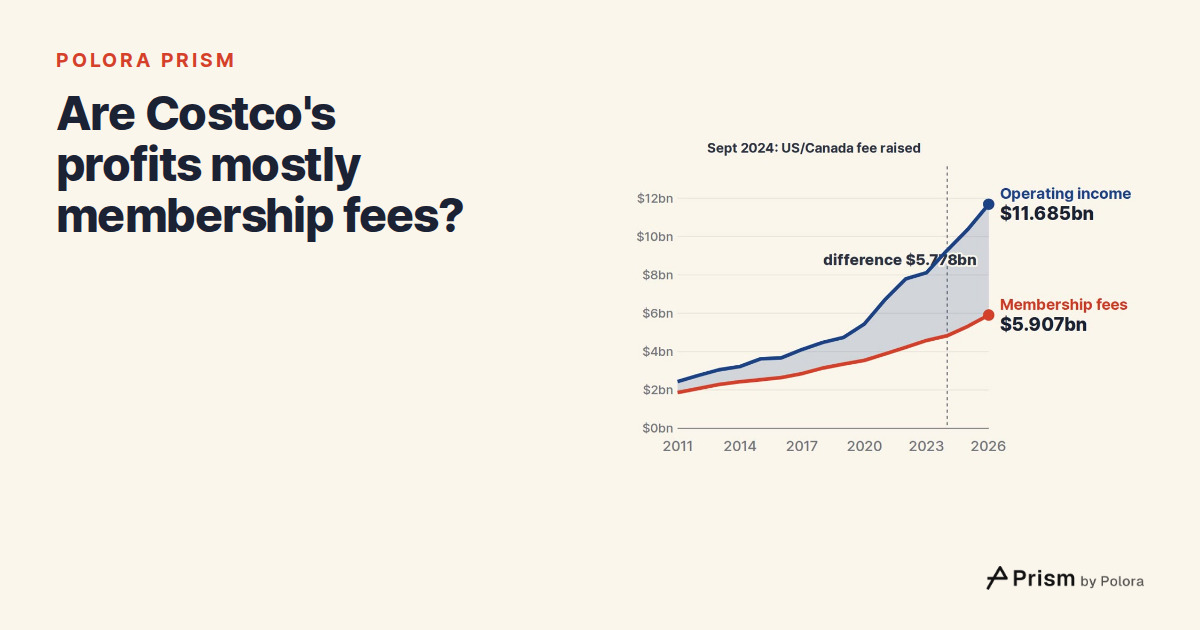
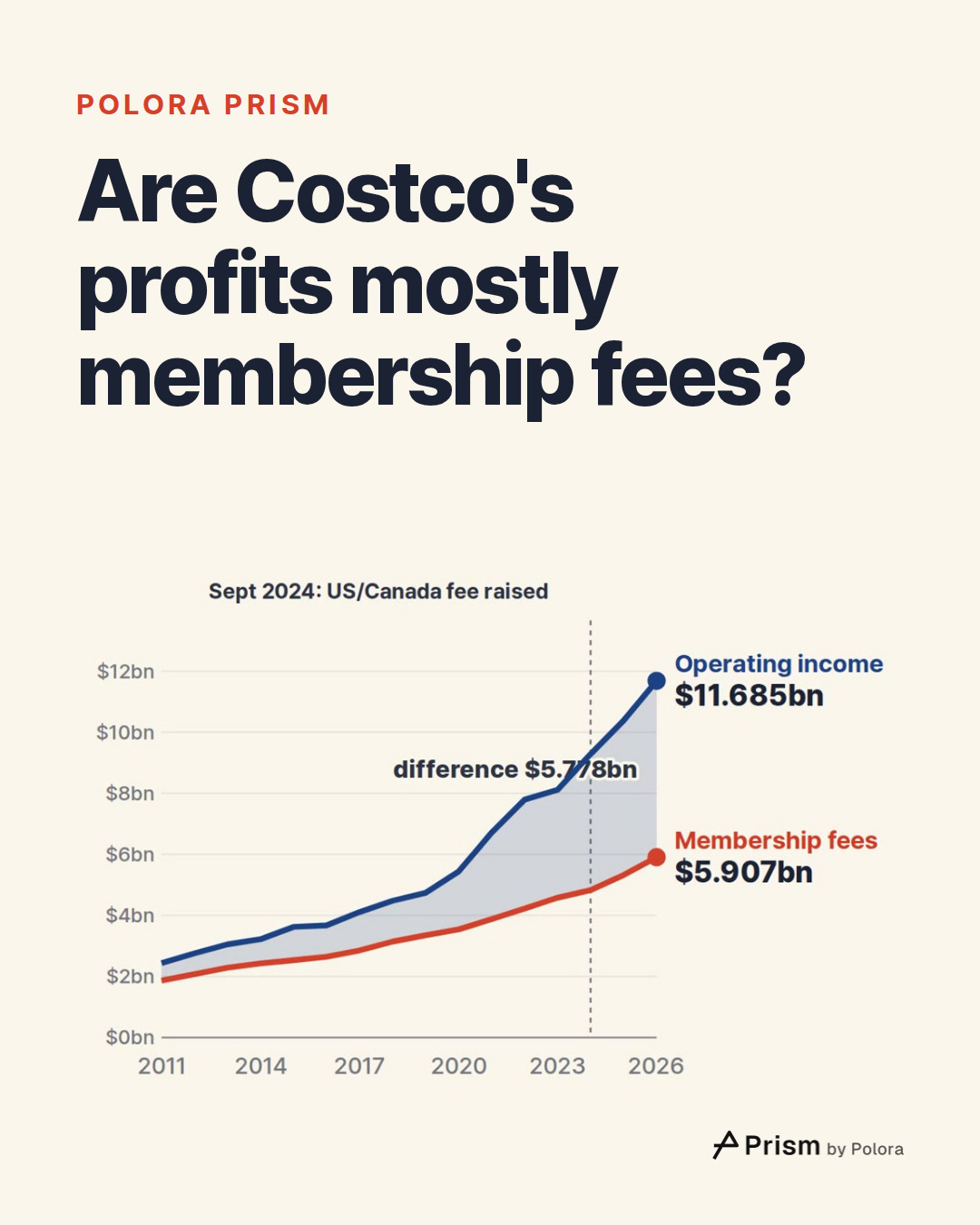
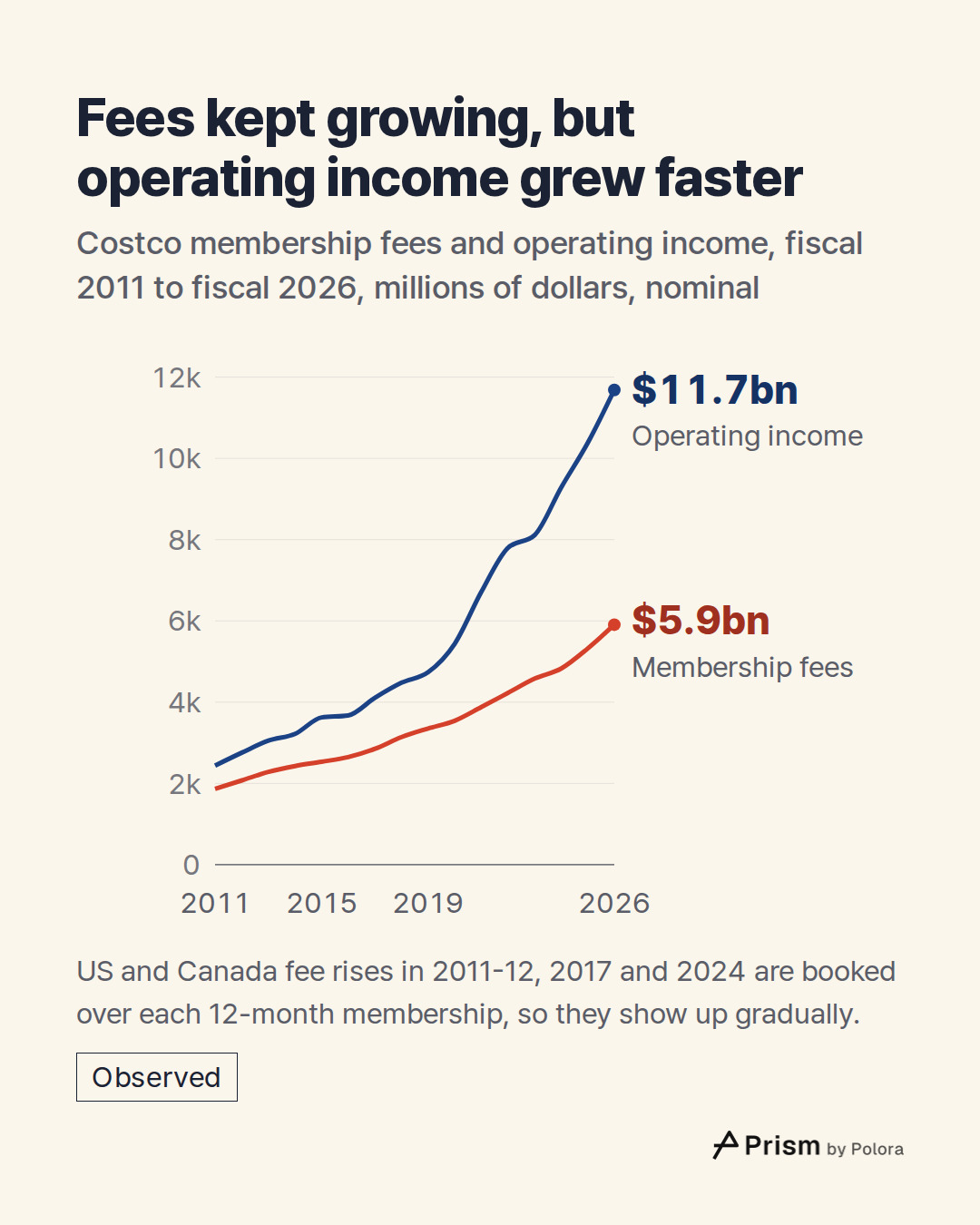
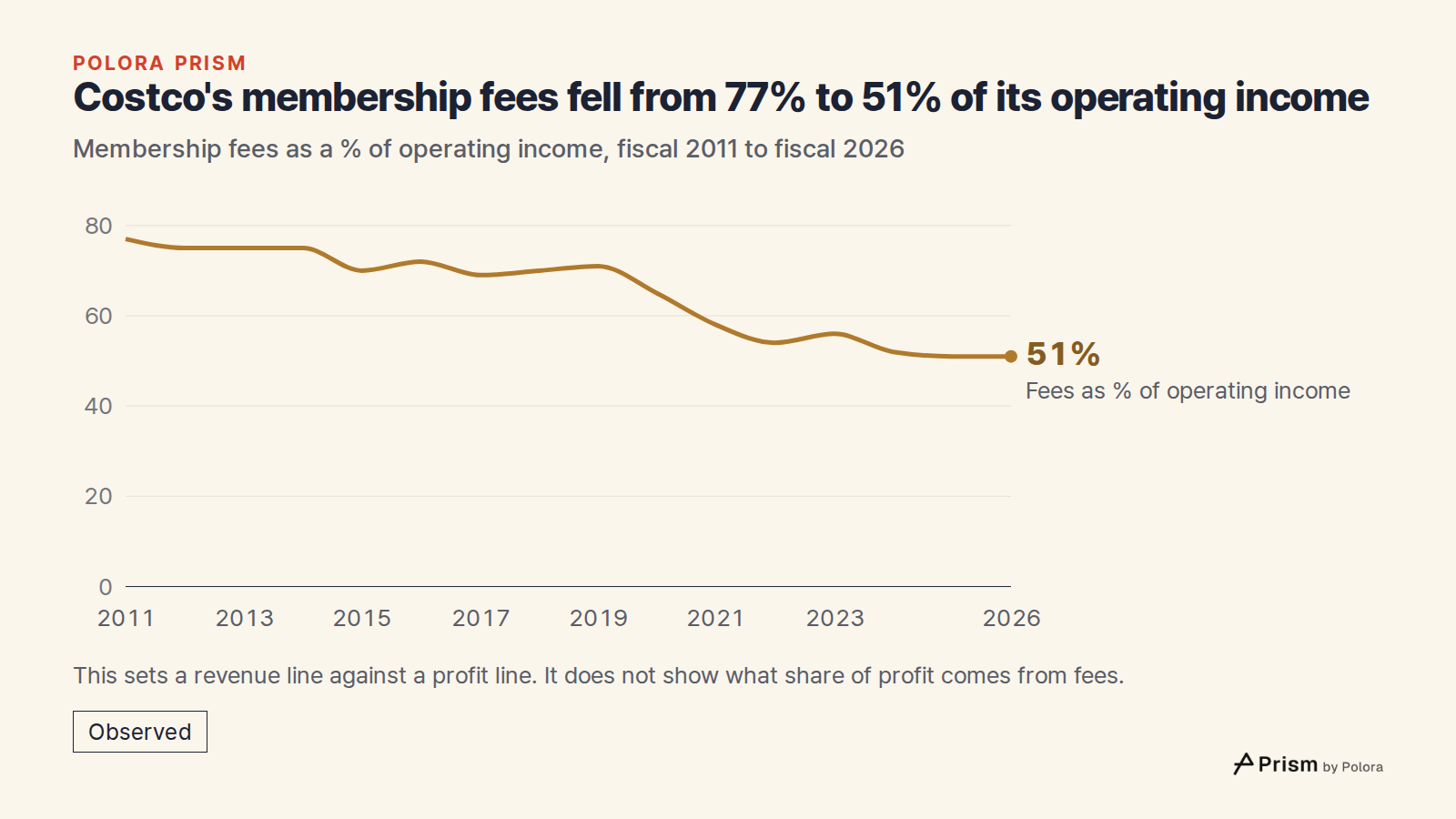
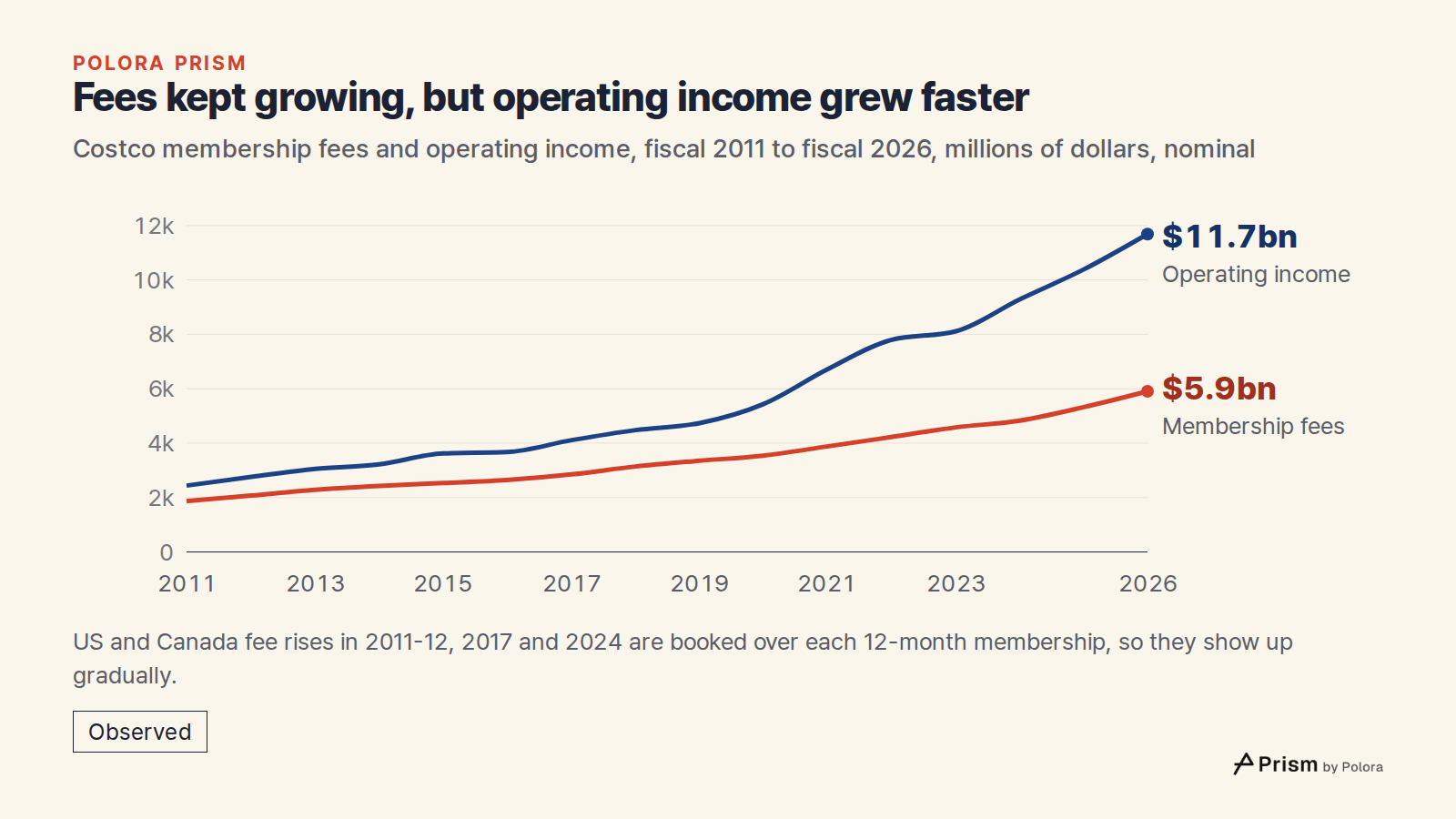
In fiscal 2011, Costco took in $1.9bn in membership fees and reported $2.4bn of operating income : fees equalled 77% of it. In fiscal 2026, fees were $5.9bn and operating income $11.7bn, which puts the ratio at 51%.
The fall was not steady. The ratio was 69% in fiscal 2017 and edged back up to 71% by fiscal 2019. Then operating income pulled away, from $5.4bn in fiscal 2020 to $7.8bn in fiscal 2022, and the ratio dropped to 54%. It rose a little in fiscal 2023 and was back down to 52% by fiscal 2024.
Over the fifteen years, membership fees grew 3.2 times, Costco's total revenue 3.4 times and its operating income 4.8 times.
Three fee rises
Costco raised its basic yearly membership fee in the United States three times in this period, each time with rises in Canada too : to $55 from November 2011 for new members and January 2012 for renewals, to $60 in June 2017, and to $65 in September 2024. The higher-priced Executive membership went up each time as well. Fees in Canada and elsewhere are set in local currencies.
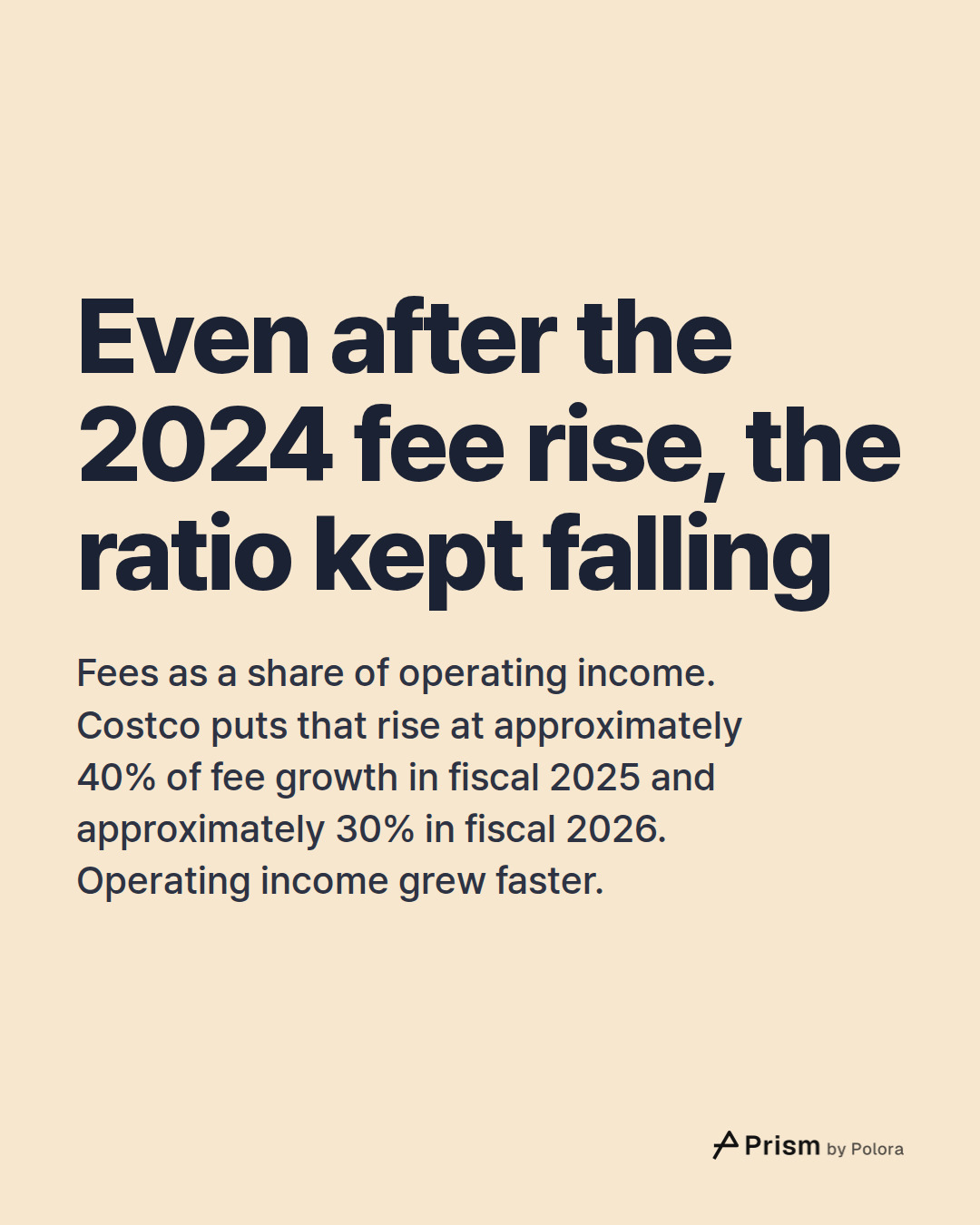
A rise does not show up in fees at once. Costco books each fee evenly over the twelve months of the membership it pays for, so a rise comes in gradually as members renew. Costco's annual reports put the 2024 rise at approximately 40% of the growth in membership fee income in fiscal 2025 and approximately 30% in fiscal 2026. The fiscal 2026 report names new members signing up and upgrades to Executive membership as the other drivers.
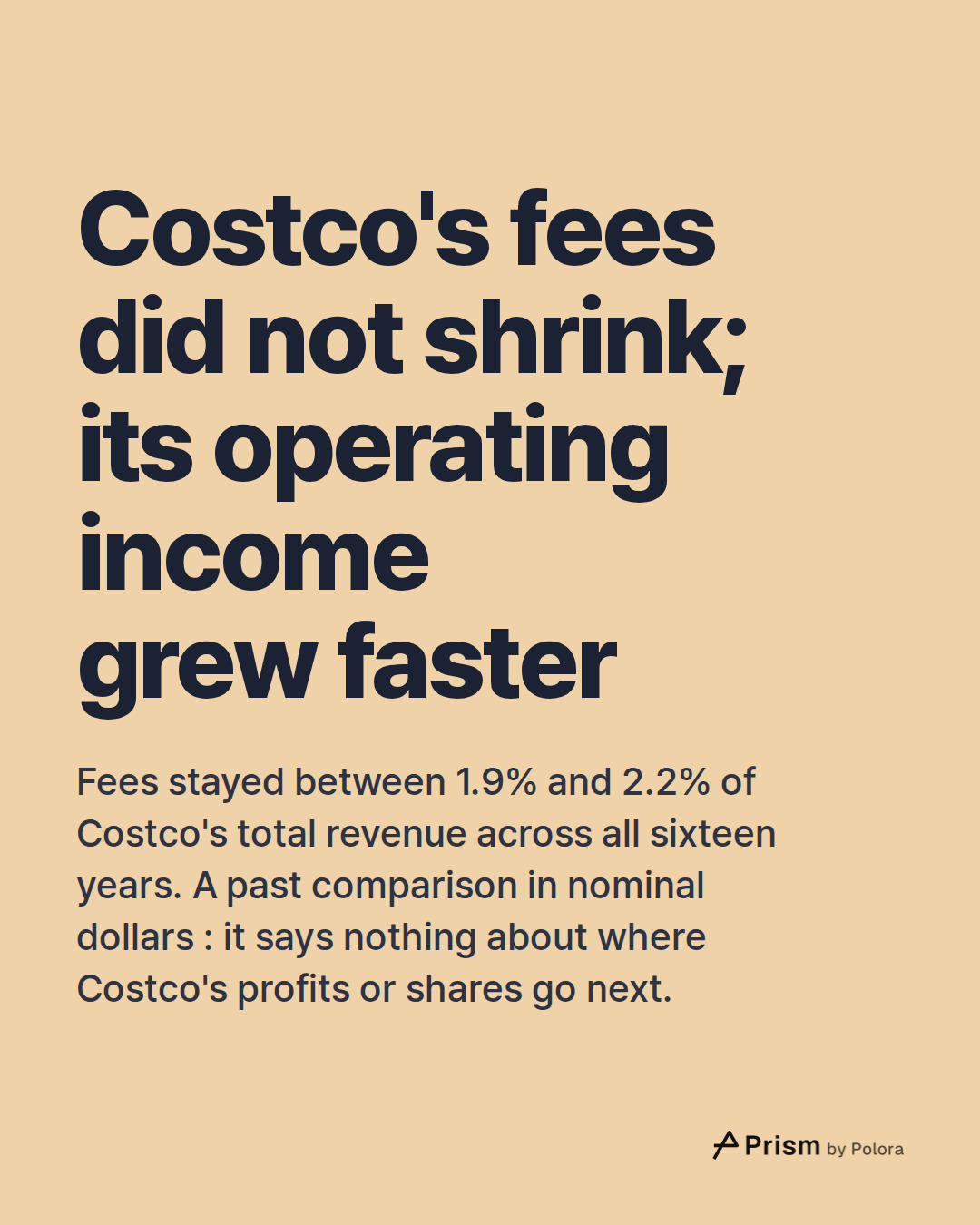
Even so, the ratio kept falling after 2024 : operating income grew faster than fees did. Across all sixteen years, fees stayed between 1.9% and 2.2% of Costco's total revenue, rounded to one decimal.
Where the faster growth shows up
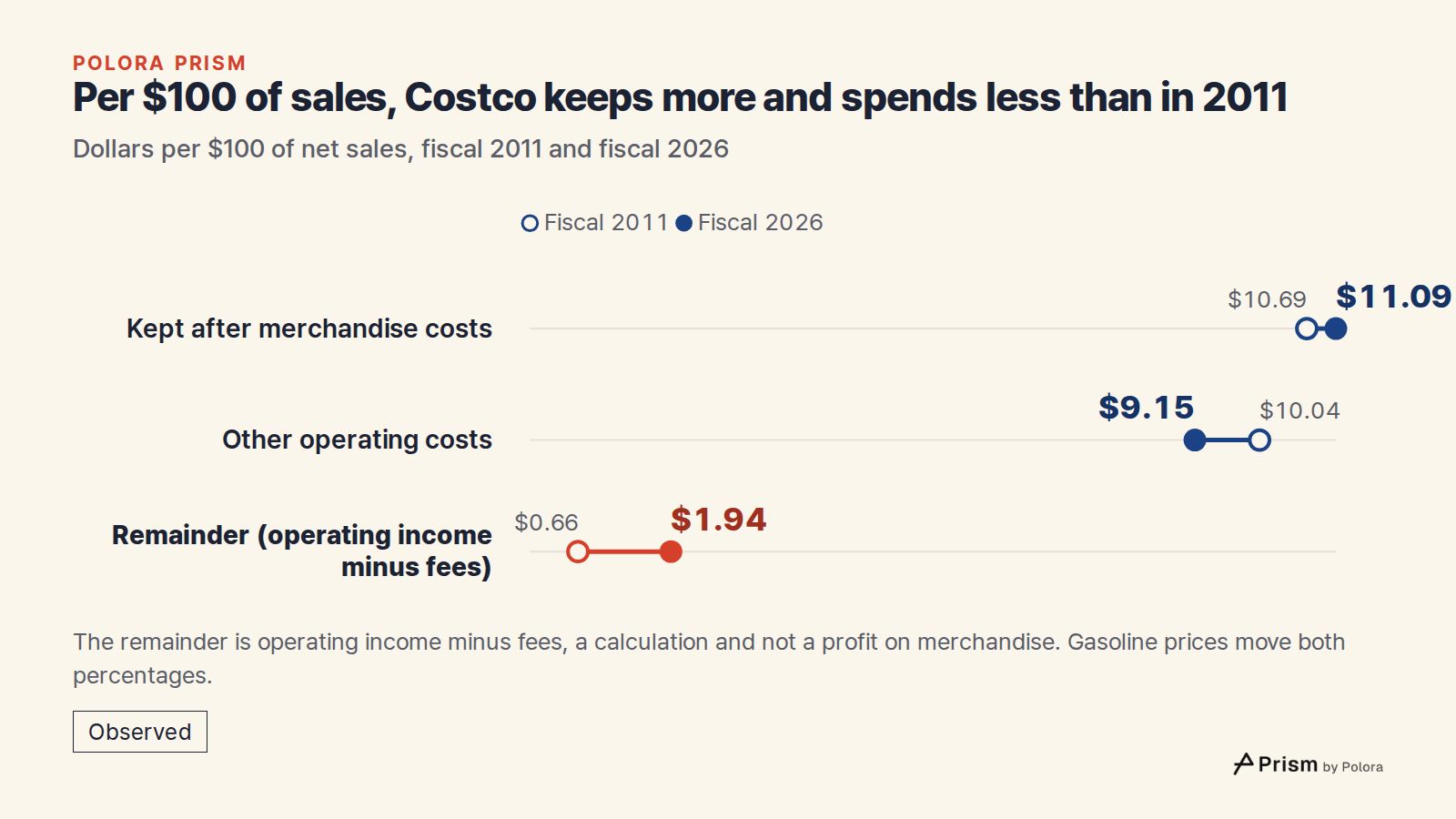
If fees stayed near 2% of revenue while operating income went from 2.7% of revenue in fiscal 2011 to 3.9% in fiscal 2026, the change sits in the rest of the income statement : what Costco keeps on the goods it sells, and what it spends on running warehouses.
For every hundred dollars of net sales in fiscal 2011, Costco kept $10.69 after paying for the merchandise and spent $10.04 on its other operating costs, leaving $0.66. In fiscal 2026 it kept $11.09 and spent $9.15, leaving $1.94. Those other operating costs are mainly selling, general and administrative expenses, and in fiscal 2011 also preopening and closing costs, which Costco then reported on separate lines and now includes in the same line.
That remainder is simply operating income minus membership fees. It is arithmetic, not a profit on merchandise. Since Costco does not split its costs between members and merchandise, all of its operating costs fall on sales in this calculation.
These percentages move for reasons Costco itself names. Its fiscal 2026 annual report says gasoline sales carry a lower gross margin and lower operating costs, both as a share of sales, than the rest of the business, so changes in gasoline prices move both percentages. Fiscal 2011's gross margin also included an inventory accounting charge that the year before did not have. The figures show that the margin on sales widened; they do not say why, and this piece does not put the change down to any one cause.
What the ratio does and does not say
Fees remain a large and steady part of Costco's business. The falling ratio does not mean fees became less important in dollars. It means operating income grew faster than the fees did.
This is a past comparison over fiscal 2011 to 2026, in nominal dollars, using the company's own reported figures. It says nothing about where the ratio, Costco's profits or its shares go next.
How the figures were made
Each year's membership fees, total revenue and operating income come from the data the SEC publishes from Costco's filings, taking the latest filing for each year. Each was checked against that year's own annual report as first filed, and fiscal 2026 against Costco's earnings release for the year, filed in September 2026; they agreed to the million every year. The figures per hundred dollars of net sales are worked out from the same statements : net sales, merchandise costs, operating costs and operating income for fiscal 2011 and fiscal 2026, read from the SEC data and from the statements as filed, with the same result.
- Costco, annual report (Form 10-K) for fiscal 2026, ended August 30, 2026
- Costco, fourth-quarter and fiscal 2026 earnings release (Form 8-K, exhibit 99.1), September 24, 2026
- Costco, annual report (Form 10-K) for fiscal 2025
- Costco, annual report (Form 10-K) for fiscal 2024
- Costco, annual report (Form 10-K) for fiscal 2017
- Costco, annual report (Form 10-K) for fiscal 2016
- Costco, annual report (Form 10-K) for fiscal 2012
- Costco, annual report (Form 10-K) for fiscal 2011