Where does SpaceX's AI revenue come from, now that it tops Starlink?

From a mix of AI services, including newly launched cloud computing, with one unnamed customer paying about two-thirds of it. Yet Starlink's segment still made about 85% of SpaceX's operating profit (Q3 2026 filings).

2026-10-29

AI is SpaceX's biggest business by sales, not by profit

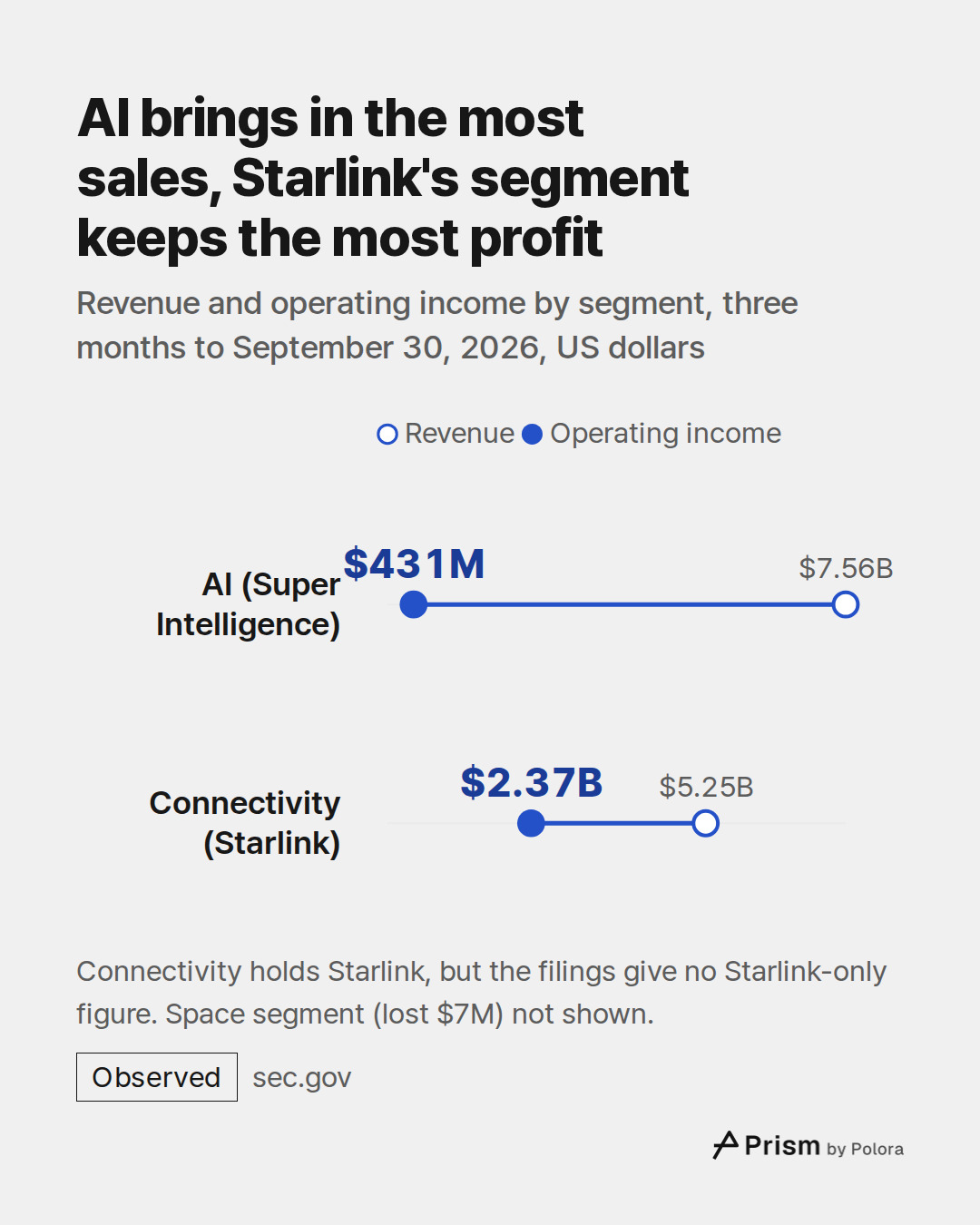
In the three months to September 30, 2026, SpaceX brought in $14.58 billion of revenue. Its AI segment, which the company now calls Super Intelligence, accounted for $7.56 billion of it. Connectivity, the segment that holds Starlink, the satellite internet service, brought in $5.25 billion. The filings do not give a figure for Starlink on its own, so the comparison is between the two segments. On sales, in this quarter, AI is the larger business.

Profit tells the story the other way round. Operating income is what a business keeps from its sales after paying the costs of running it, before interest and taxes. SpaceX made $2.79 billion of it in the quarter. Connectivity made $2.37 billion of that, about 85%. The AI segment made $431 million, and the rockets and launch business, the Space segment, lost $7 million.

So the idea that AI now tops Starlink is half right. In the quarter, AI brought in the most money and Starlink's segment kept most of the profit. The rest of this piece explains where the AI money comes from, what the filings leave unsaid about it, and why those two facts sit side by side.
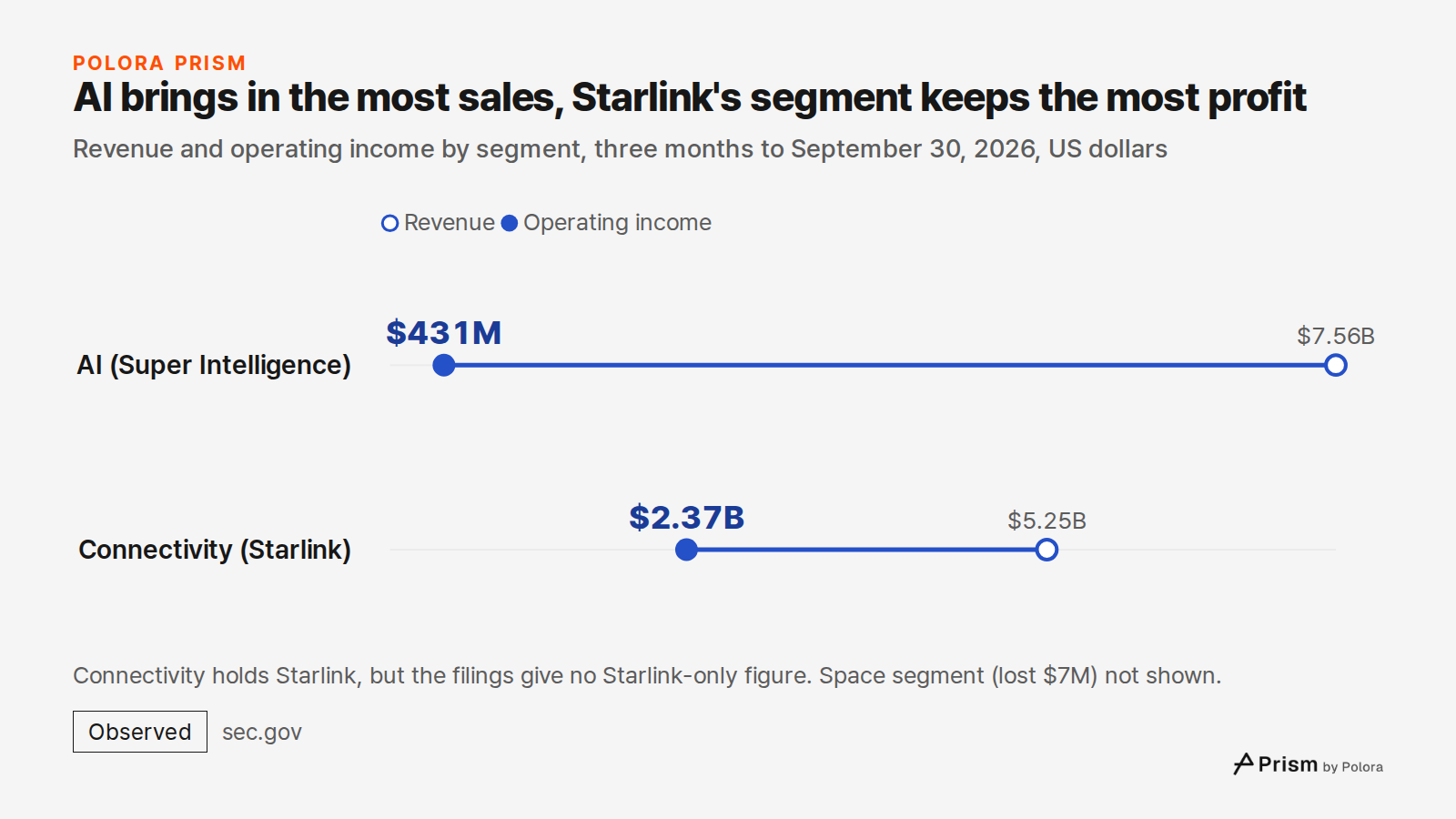
AI brings in the most sales, Starlink's segment keeps the most profit · Revenue and operating income by segment, three months to September 30, 2026, US dollars · Revenue · Operating income · AI (Super Intelligence) · Connectivity (Starlink) · $7.56B · $5.25B · $431M · $2.37B · Connectivity holds Sta
Revenue and operating income by segment, three months to September 30, 2026, US dollars

The AI money comes from a mix of services, and mostly from one customer

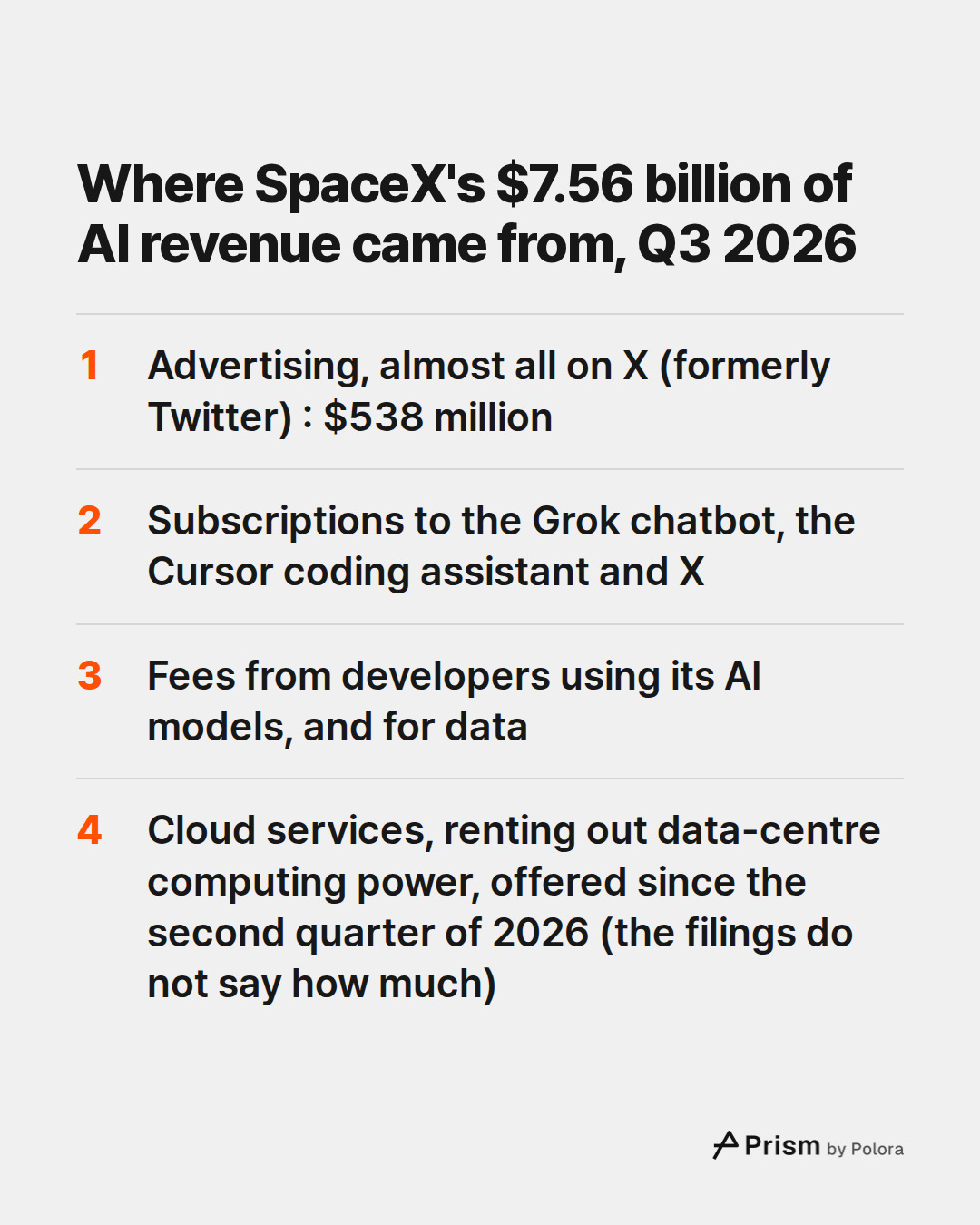
The company splits the $7.56 billion in two. $538 million is advertising, almost all of it on X, the social network formerly called Twitter. The other $7.02 billion is what it calls solutions and infrastructure. That covers subscriptions to its Grok chatbot, to Cursor (a coding assistant it bought in August) and to X, plus fees from other developers who connect to its AI models and fees for data. It also covers cloud services, which means renting out the computing power in its data centres to other companies that build AI.

The cloud services are new. SpaceX says it began offering them in the second quarter of 2026, and it names new cloud agreements as a primary driver of the segment's growth, alongside the Cursor purchase and growth in its AI models and software. It does not report how much of the $7.02 billion came from cloud services, so the filings do not show whether rented computing power is most of the AI money.

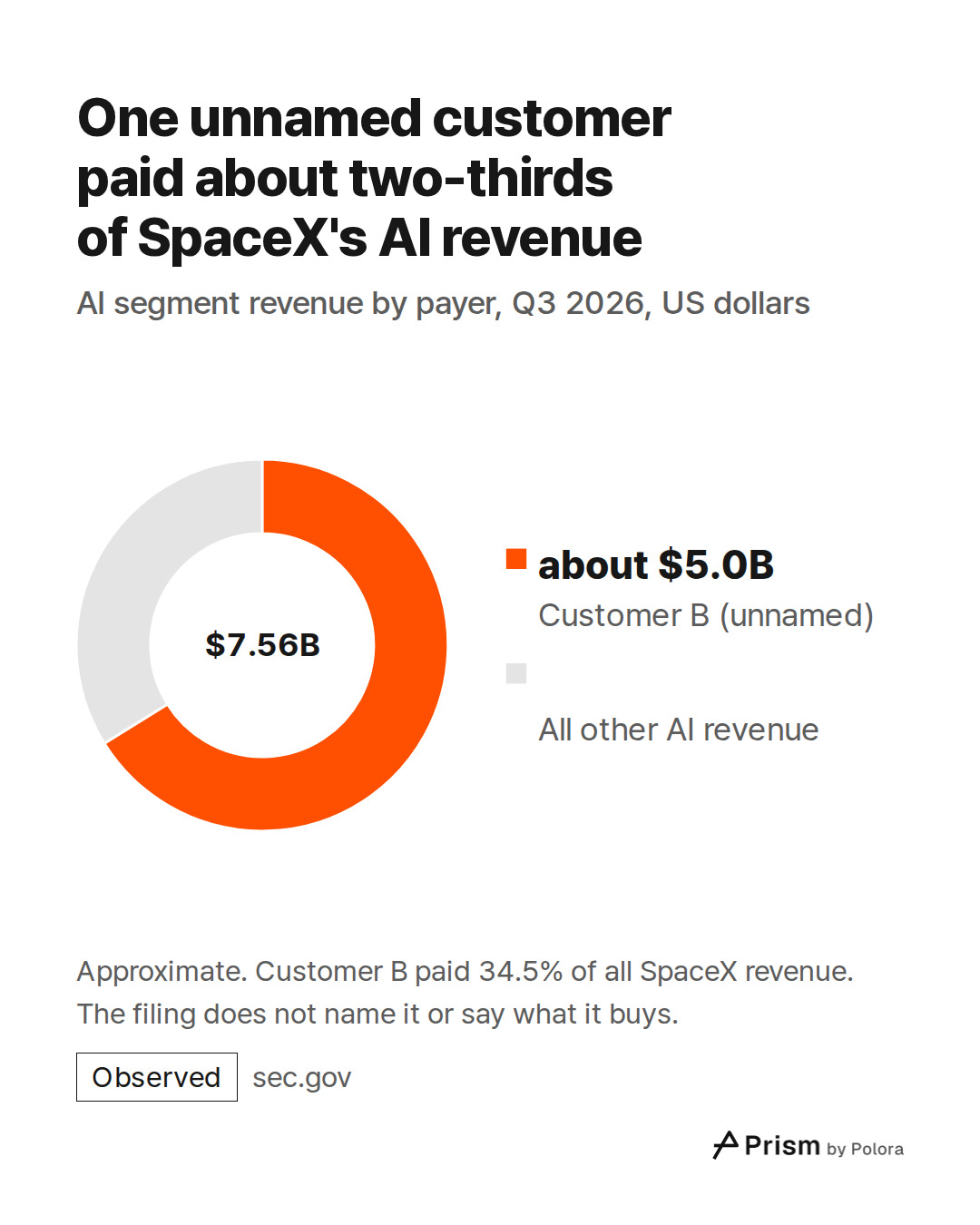
One number shows how concentrated this money is. The quarterly report says a single customer, named only as Customer B, paid 34.5% of all SpaceX revenue in the quarter, and that all of it falls in the AI segment. That works out to about $5.0 billion, or roughly two-thirds of the AI segment's revenue. A year earlier the same customer paid less than 10% of the total. The filing does not name the customer, and it does not say what the customer buys : computing power, access to the models, or something else.

The filing does describe how cloud services are sold. They are billed as a fixed monthly fee, over contracts that typically run three years and that either side can end with 90 days' notice. That describes cloud contracts in general. The filing does not say whether Customer B's contract is one of them, so it does not show how easily this customer could leave. What it does show is that about two-thirds of the AI segment's revenue rests on a single customer whose purchases are not disclosed.
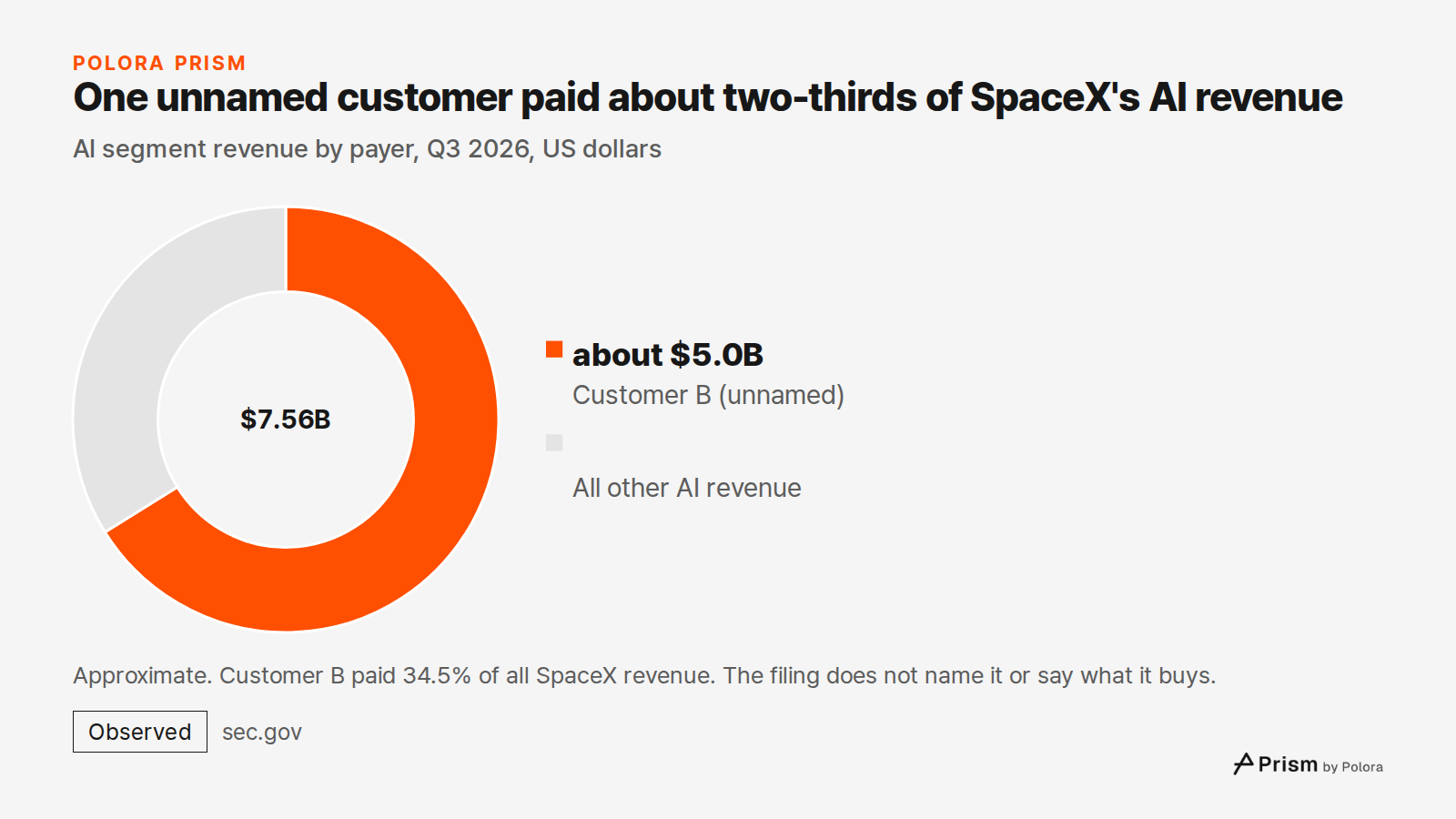
One unnamed customer paid about two-thirds of SpaceX's AI revenue · AI segment revenue by payer, Q3 2026, US dollars · Customer B (unnamed) · about $5.0B · All other AI revenue · $7.56B · Approximate. Customer B paid 34.5% of all SpaceX revenue. The filing does not name it or say what it buys.
AI segment revenue by payer, Q3 2026, US dollars

What SpaceX's ninefold jump in AI revenue does and does not include

A year earlier, in the third quarter of 2025, the same segment brought in $813 million, so revenue grew more than ninefold. Part of that was bought, not grown, and it helps to know which part.

SpaceX merged with xAI, the AI company behind Grok, in February 2026, and xAI already owned X. The filing describes these deals as common-control mergers, meaning the same person controlled the companies on both sides. The segment's year-ago figures include $454 million of advertising, which suggests X was already counted in the $813 million. The filings checked for this piece do not spell out how the 2025 figures were restated, so this reading rests on those figures rather than on an explicit statement. On that reading, the merger is not what drives the year-on-year jump.

Cursor is part of it. SpaceX completed the purchase on August 14, 2026, at an implied value of $60 billion, and Cursor added $608 million of revenue in the six weeks it was owned. That money came with the purchase. Taking it out leaves about $6.95 billion of AI segment revenue, still more than eight times the year before. That is simple subtraction, not a growth figure the company reports. The company names new cloud agreements as a primary driver of the rise, without saying how much of it they account for. Even without Cursor, solutions and infrastructure revenue nearly tripled from the previous quarter, from $2.19 billion to about $6.41 billion.
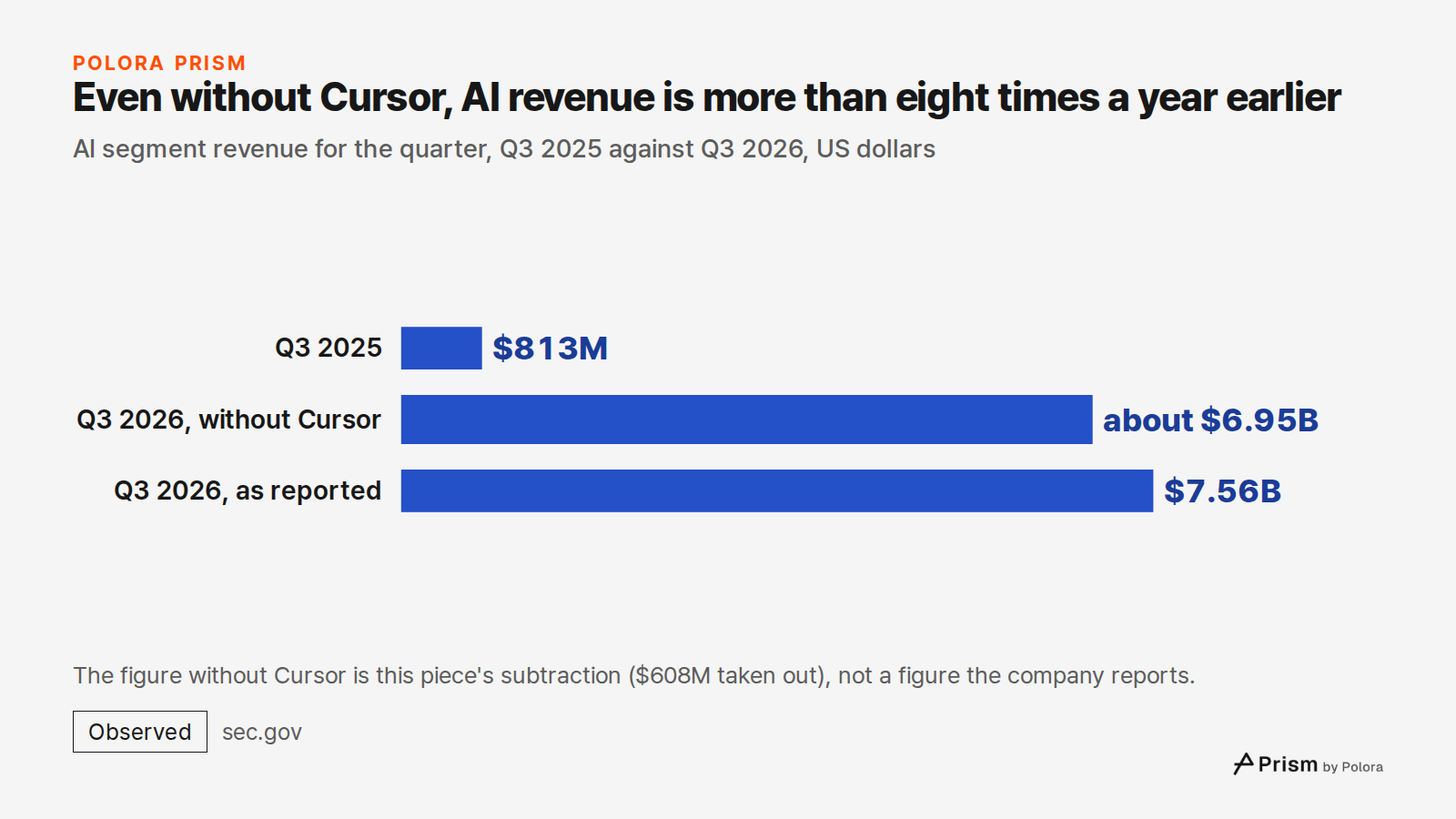
Even without Cursor, AI revenue is more than eight times a year earlier · AI segment revenue for the quarter, Q3 2025 against Q3 2026, US dollars · Q3 2025 · Q3 2026, without Cursor · Q3 2026, as reported · $813M · about $6.95B · $7.56B · The figure without Cursor is this piece's subtraction ($608M
AI segment revenue for the quarter, Q3 2025 against Q3 2026, US dollars

Why SpaceX's AI profit looks small next to its sales

The AI segment's $431 million of operating income comes after $1.2 billion of share-based compensation tied to the Cursor deal. The company attributes these share awards to service after the purchase, so they are in effect the cost of SpaceX shares given to keep Cursor's staff on board. No cash leaves the company, but the cost is real, because it spreads ownership across more shares.

The segment's costs are also heavy because the hardware wears out. In the quarter the AI segment booked $2.47 billion of depreciation and amortization, the accounting cost of computers and data centres losing value as they are used.

SpaceX also reports a measure it calls Segment Adjusted EBITDA, which leaves out depreciation, share-based compensation and some other costs. On that measure the AI segment made $4.95 billion. The company's filing calls this a non-GAAP measure, meaning it is not defined by the standard accounting rules, and says it should not be read in isolation. The gap between $431 million and $4.95 billion is mostly the costs that measure leaves out.

Starlink's segment has no such gap to close. Connectivity revenue grew 69% from a year earlier, and its operating income nearly doubled, to $2.37 billion. In this quarter, that is what carried SpaceX's profit.
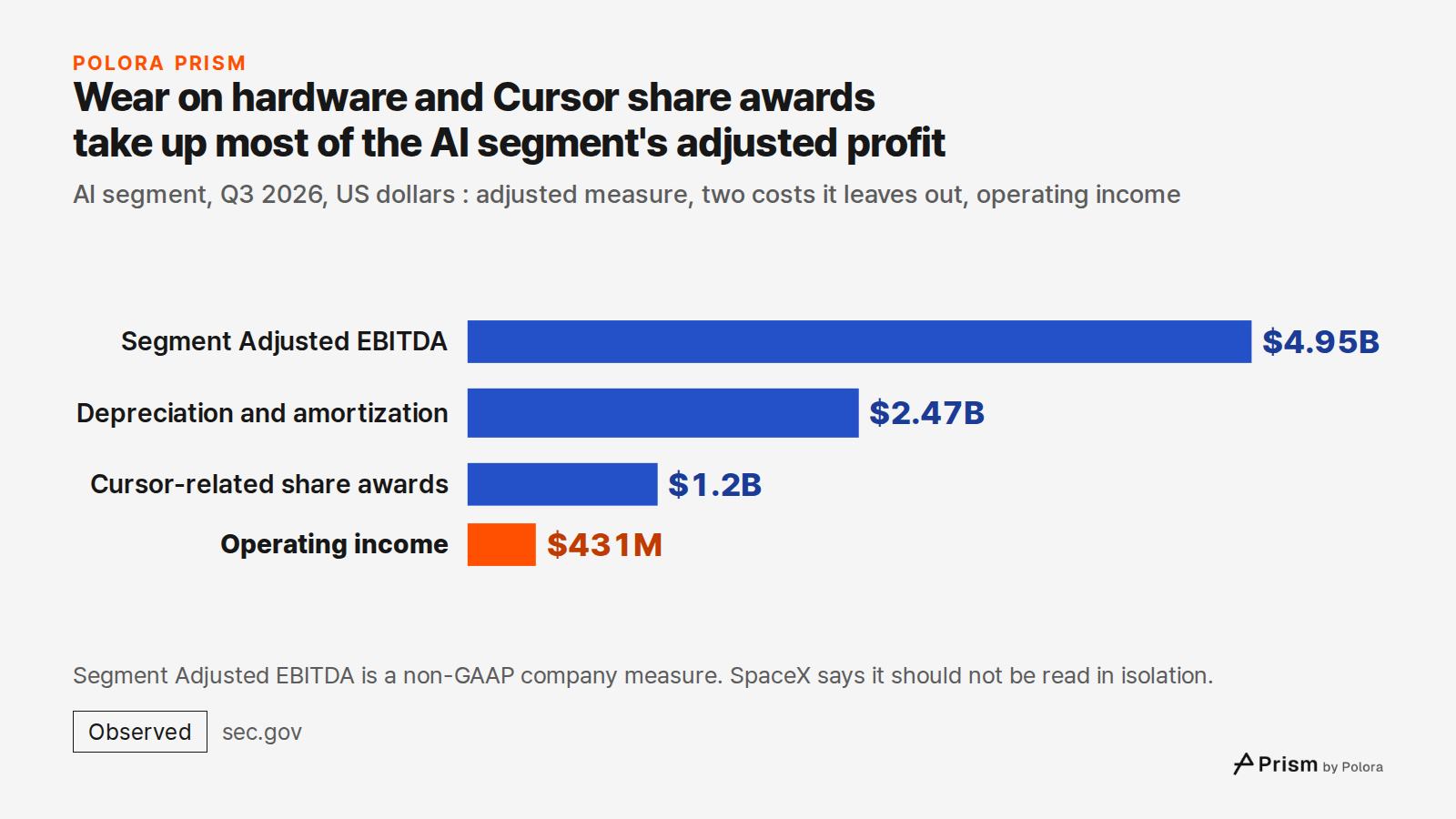
Wear on hardware and Cursor share awards take up most of the AI segment's adjusted profit · AI segment, Q3 2026, US dollars : adjusted measure, two costs it leaves out, operating income · Segment Adjusted EBITDA · Depreciation and amortization · Cursor-related share awards · Operating income · $4.95
AI segment, Q3 2026, US dollars : adjusted measure, two costs it leaves out, operating income

SpaceX's AI spending runs far ahead of its AI revenue

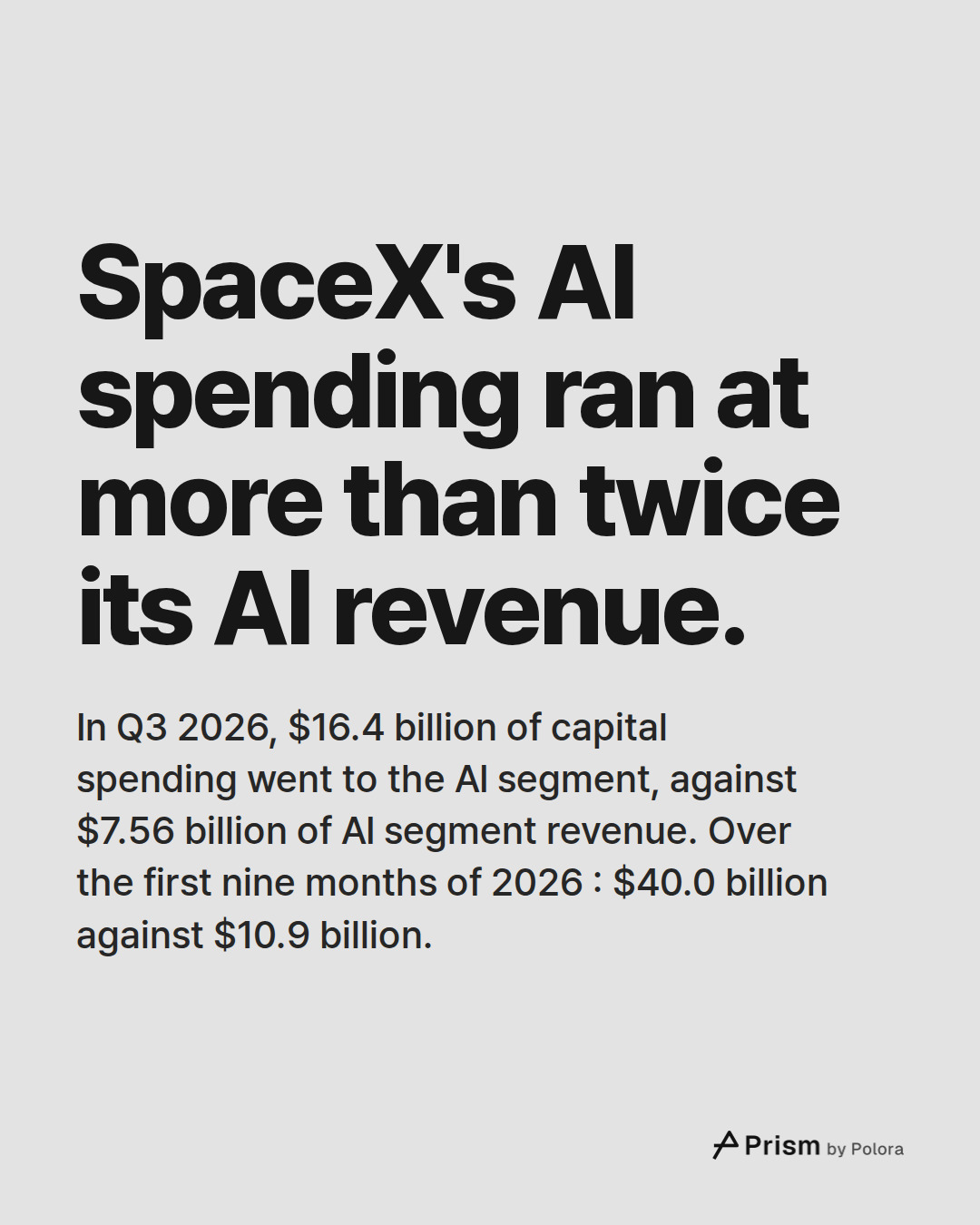
Capital expenditure is money spent on long-lived things such as buildings, chips and machines, and it does not show up in operating costs all at once. SpaceX spent $19.6 billion of it in the quarter, and $16.4 billion went to the AI segment. That is more than twice the $7.56 billion the segment brought in over the same three months. Connectivity, by comparison, spent $1.5 billion.

Over the first nine months of 2026, AI capital spending was $40.0 billion, against $10.9 billion of AI segment revenue.

Each of the three numbers answers a different question. Revenue shows who is paying now, and about two-thirds of the AI share comes from one customer whose purchases the filing does not describe. Operating income shows what is left after running costs, mostly from Starlink's segment. Capital spending shows where the money is going, mostly into data centres, before the revenue that is meant to pay for them has arrived.
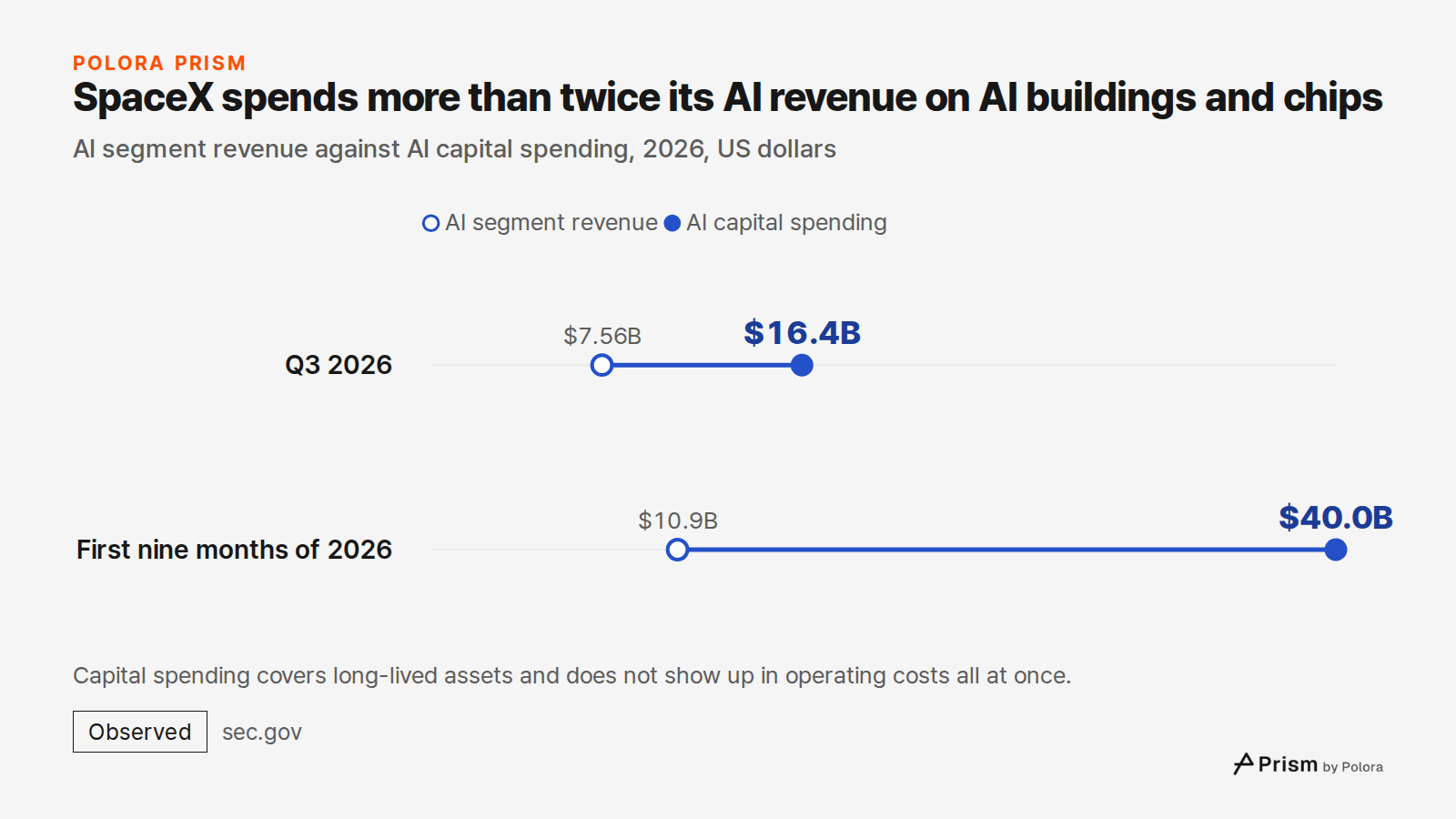
SpaceX spends more than twice its AI revenue on AI buildings and chips · AI segment revenue against AI capital spending, 2026, US dollars · AI segment revenue · AI capital spending · Q3 2026 · First nine months of 2026 · $7.56B · $10.9B · $16.4B · $40.0B · Capital spending covers long-lived assets a
AI segment revenue against AI capital spending, 2026, US dollars

What one quarter of SpaceX's figures cannot tell you

These figures describe three months, and the cloud business behind much of the growth is about six months old. They cannot show whether the large customer keeps buying at this scale, what it is buying, whether new contracts replace or add to it, or whether the computing power now being built will find buyers.

One more number needs care. SpaceX reported net income of $4.4 billion, more than its $2.79 billion of operating income. The difference comes from items outside its day-to-day business, including a $390 million tax benefit. That is why this piece uses operating income to compare the segments.

This piece describes what SpaceX's filings for one quarter show. It is not a view on SpaceX shares or their price, and the figures say nothing on their own about what comes next.
Where does SpaceX's AI revenue come from, now that it tops Starlink?Where does SpaceX's AI revenue come from, now that it tops Starlink?Where SpaceX's $7.56 billion of AI revenue came from, Q3 2026 · Advertising, almost all on X (formerly Twitter) : $538 million · Subscriptions to the Grok chatbot, the Cursor coding assistant and X · Fees from developers using its AI models, and for data · Cloud services, renting out data-centre comCustomer B (unnamed) · about $5.0B · All other AI revenue · $7.56B · One unnamed customer paid about two-thirds of SpaceX's AI revenue · AI segment revenue by payer, Q3 2026, US dollars · Approximate. Customer B paid 34.5% of all SpaceX revenue. The filing does not name it or say what it buys.Revenue · Operating income · AI (Super Intelligence) · Connectivity (Starlink) · $7.56B · $5.25B · $431M · $2.37B · AI brings in the most sales, Starlink's segment keeps the most profit · Revenue and operating income by segment, three months to September 30, 2026, US dollars · Connectivity holds StaSpaceX's AI spending ran at more than twice its AI revenue. · In Q3 2026, $16.4 billion of capital spending went to the AI segment, against $7.56 billion of AI segment revenue. Over the first nine months of 2026 : $40.0 billion against $10.9 billion.One quarter cannot show whether SpaceX's big AI customer keeps buying. · That one customer paid about two-thirds of SpaceX's AI revenue in Q3 2026. The cloud business behind much of the growth is about six months old. This is not a view on SpaceX shares.Sources 2 : sec.gov · SpaceX third quarter 2026 earnings release, sec.gov · SpaceX Form 10-Q for the quarter ended September 30, 2026Read the full story at · polora.ai

SpaceX now earns more from AI than from Starlink, so where does that money actually come from?

Alpha · deepseek-v4-pro

Short answer: the AI revenue is mostly rented computing power, and in Q3 2026 it was dangerously concentrated in one unnamed customer. If the Q3 2026 figures in the filing excerpts are right, SpaceX’s AI segment — now called Super Intelligence — did $7.56 billion of revenue. That breaks into two pieces: - $538 million of advertising, nearly all on X. - $7.02 billion of “solutions and infrastructure.” That covers Grok, Cursor and X subscriptions, API/data fees, and — the big new piece — cloud services: renting out data-centre compute to other AI developers. The cloud part is new. It only began in Q2 2026, and the filing claims it is responsible for most of this year’s growth. So the headline is not really “AI passed Starlink because of chatbots”; it is “SpaceX became a compute landlord.” The concentration is the most important line. One customer — only ever identified as Customer B — paid 34.5% of all SpaceX revenue for the quarter, and all of that sat inside the AI segment. That works out to about $5.0 billion, or roughly two-thirds of the whole AI segment. A year earlier the same customer was below 10% of total revenue. So where does the money…

Beta · gpt-6-sol

I checked the Q3 earnings release and 10-Q. The headline holds for revenue in this quarter, but Alpha’s answer goes further than the disclosures allow. SpaceX reported $7.56 billion in Super Intelligence (SI) revenue, versus $5.25 billion for *Connectivity*, the segment containing Starlink. Of SI revenue, $538 million was advertising and $7.02 billion was “solutions and infrastructure”: a combined category for subscriptions, data licensing, model access and cloud services. SpaceX says its new cloud services were a *primary driver of the increase*, but it does not report a separate cloud-revenue figure. (sec.gov) The striking disclosure is Customer B: it accounted for 34.5% of SpaceX’s $14.575 billion total revenue, entirely within SI. That calculates to about $5.03 billion—66.5% of SI revenue. But the filing does not say what Customer B bought. We cannot t…

Gamma · gemini-3.1-pro

Beta has correctly identified the most significant leap of logic in the manuscript, and I strongly agree with their assessment: the manuscript conflates general segment disclosures with the specific terms of Customer B. Here is my review of the claims and what needs to change before publication: 1. The Customer B Assumption (Needs Revision) The manuscript states: *"Mostly from renting computing power to other AI companies, and one unnamed customer paid about two-thirds of it... Much of the AI segment's revenue therefore depends on one customer that can leave with about three months' notice."* As Beta noted, the 10-Q states that Customer B makes up 34.5% of total consolidated revenue and sits entirely within the Super Intelligence (SI) segment. However, the filing *does not* state that Customer B is purchasing cloud services, nor does it state that Customer B is on the standard 90-day termination contract. The manuscript is combining three separate disclosures (Customer B's concentration, the launch of cloud services, and general cloud contract terms) into one definitive claim. The editor must revise this to state simply that a single SI customer accounts for two-thirds o…

Researcher · gpt-6-luna

Verification against the SEC filings and release: Beta is right to flag the key overreach in Alpha’s answer. The filings support saying that one unnamed customer accounted for a very large share of the SI segment’s revenue; they do not identify what that customer bought. So the customer cannot be described as the buyer of two-thirds of the rented compute—or as being on a 90-day cancellation term. - Customer concentration: SpaceX’s 10-Q says Customer B supplied 34.5% of consolidated Q3 revenue and that its revenue was in the SI segment. At $14.575 billion in total revenue, that is about $5.03 billion, or 66.5% of SI’s $7.56 billion. The filing says Customer B was below 10% in Q3 2025. These dollar and percentage conversions are calculations from the filing, not figures it states directly. SEC 10-Q, concentration disclosure (sec.gov) - What the customer bought and its contract: The 10-Q describes cloud-service fees and typical contract terms, including three-year terms terminable by…

The Arbiter · gpt-6-sol

Round mediation — what has been established, and what remains open The voices agree on the central comparison: in Q3 2026, SpaceX reported $7.56 billion of Super Intelligence (SI) revenue, more than the $5.25 billion of Connectivity revenue from the segment containing Starlink. Connectivity, however, supplied about 85% of company operating income. This is a comparison of reported *segments* in one quarter, not a separately disclosed Starlink-only revenue figure. (sec.gov) The consequential disagreement is about who paid for what. Alpha describes the money as mostly rented compute from one buyer. Beta and the Researcher draw a narrower line: the filings say cloud services helped drive growth, and they say Customer B supplied 34.5% of company revenue, entirely within SI—about $5.03 billion, or 66.5% of SI revenue. They do not say what Customer B bought or disclose a separate cloud-revenue total. The filing’s typical 90-day termination provision applies to cloud-service contracts generally; it does not establish Customer B’s terms. Those distinctions matter for the man…

The Arbiter's Final Verdict · gpt-6-sol

Verdict The premise holds for reported revenue in Q3 2026, with one qualification: SpaceX reported $7.56 billion from its Super Intelligence (SI) segment, versus $5.25 billion from *Connectivity*, the segment that contains Starlink. The filings do not give a Starlink-only figure for this comparison. This is one quarter, not an established trend. Earnings release Where did the AI money come from? SpaceX reported $538 million in advertising and $7.02 billion in “solutions and infrastructure”—a broad category covering cloud computing alongside subscriptions, model access, data and other services. The company identifies new cloud agreements as an important driver of growth, but does not disclose how much of the $7.02 billion was rented compute. Earnings release · 10-Q The clearest answer about *who* paid is also the biggest limit on what we know. An unnamed Customer…