Two molecules, five names
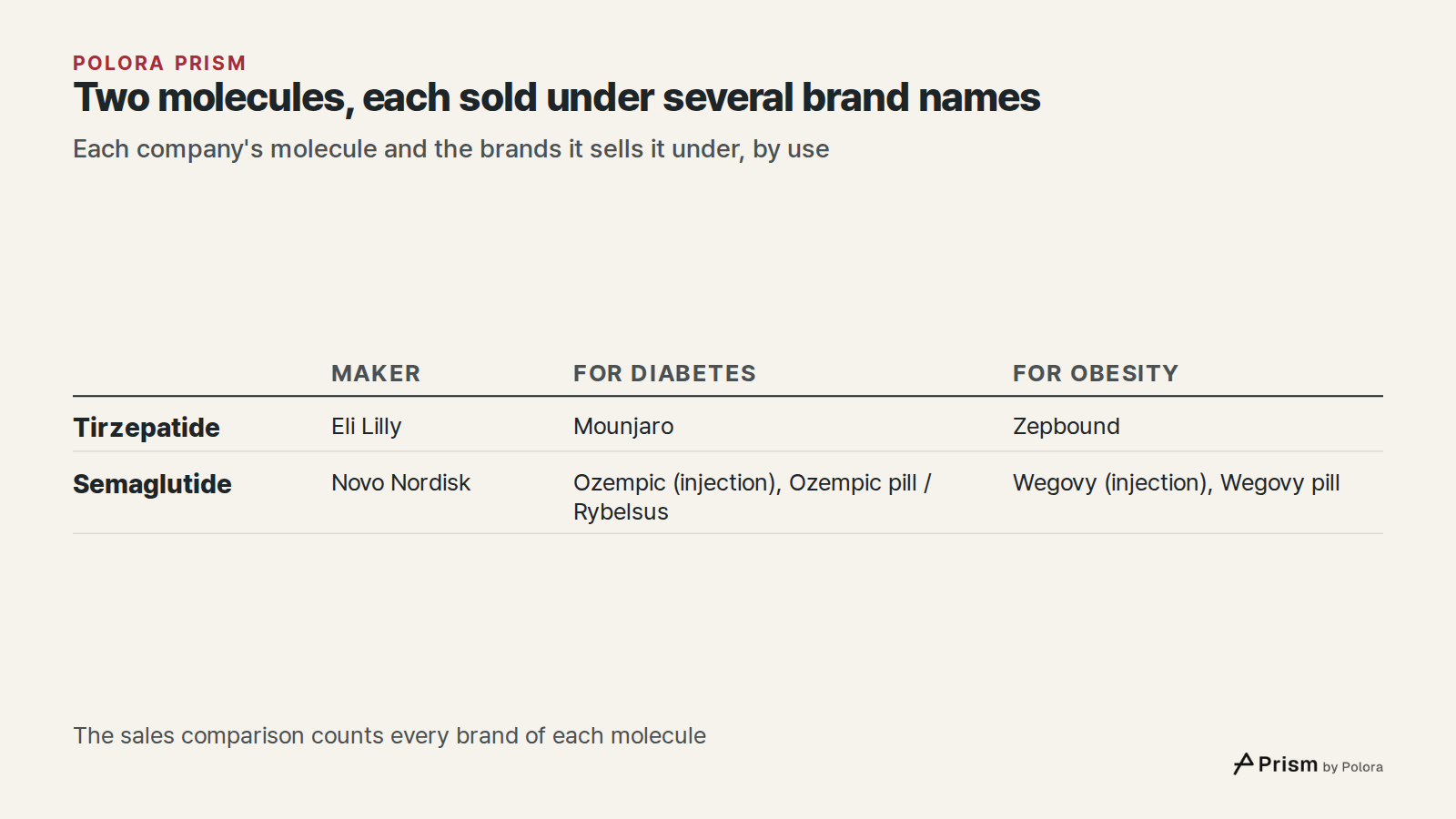
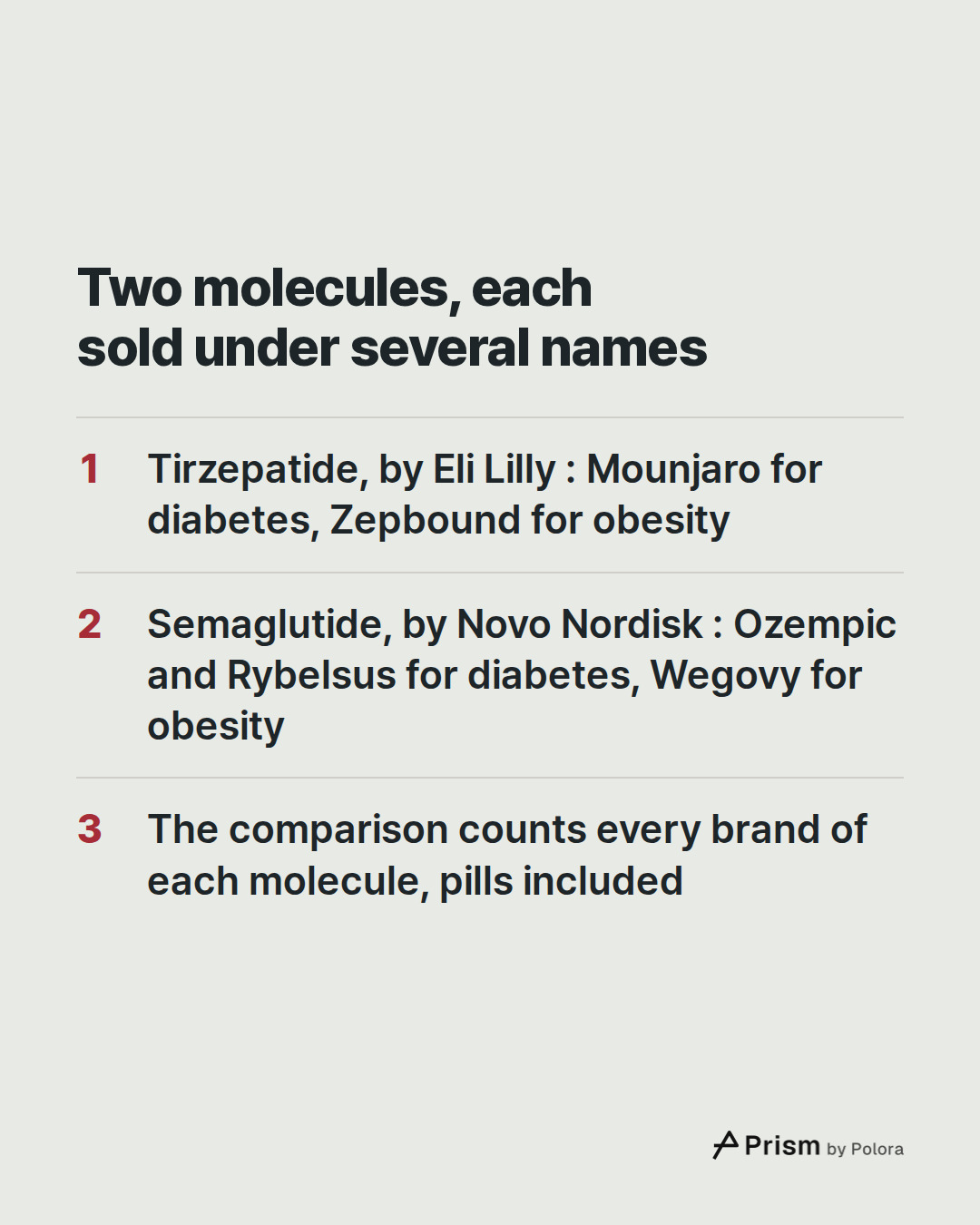
The race is between two medicines, each sold under several brand names. Tirzepatide is Eli Lilly's. The US Food and Drug Administration approved it as Mounjaro in May 2022, to improve blood sugar control in type 2 diabetes. In November 2023 it approved the same molecule as Zepbound, for chronic weight management in adults with obesity, or with overweight and a weight-related condition. The FDA describes it as acting on the receptors of two gut hormones, GLP-1 and GIP, to reduce appetite and food intake. Lilly says it markets tirzepatide for obesity as Zepbound in the United States, Canada and Japan.
Semaglutide is Novo Nordisk's. Novo sells it as Ozempic, an injection it lists among its diabetes medicines ; as Wegovy, listed among its obesity medicines ; and as Rybelsus, a diabetes pill. In January 2026 it launched a Wegovy pill in the US, which it reports as a separate line, and it now reports Rybelsus as "Ozempic pill / Rybelsus". The comparison here counts all of them, because all of them are semaglutide.
From far behind to far ahead
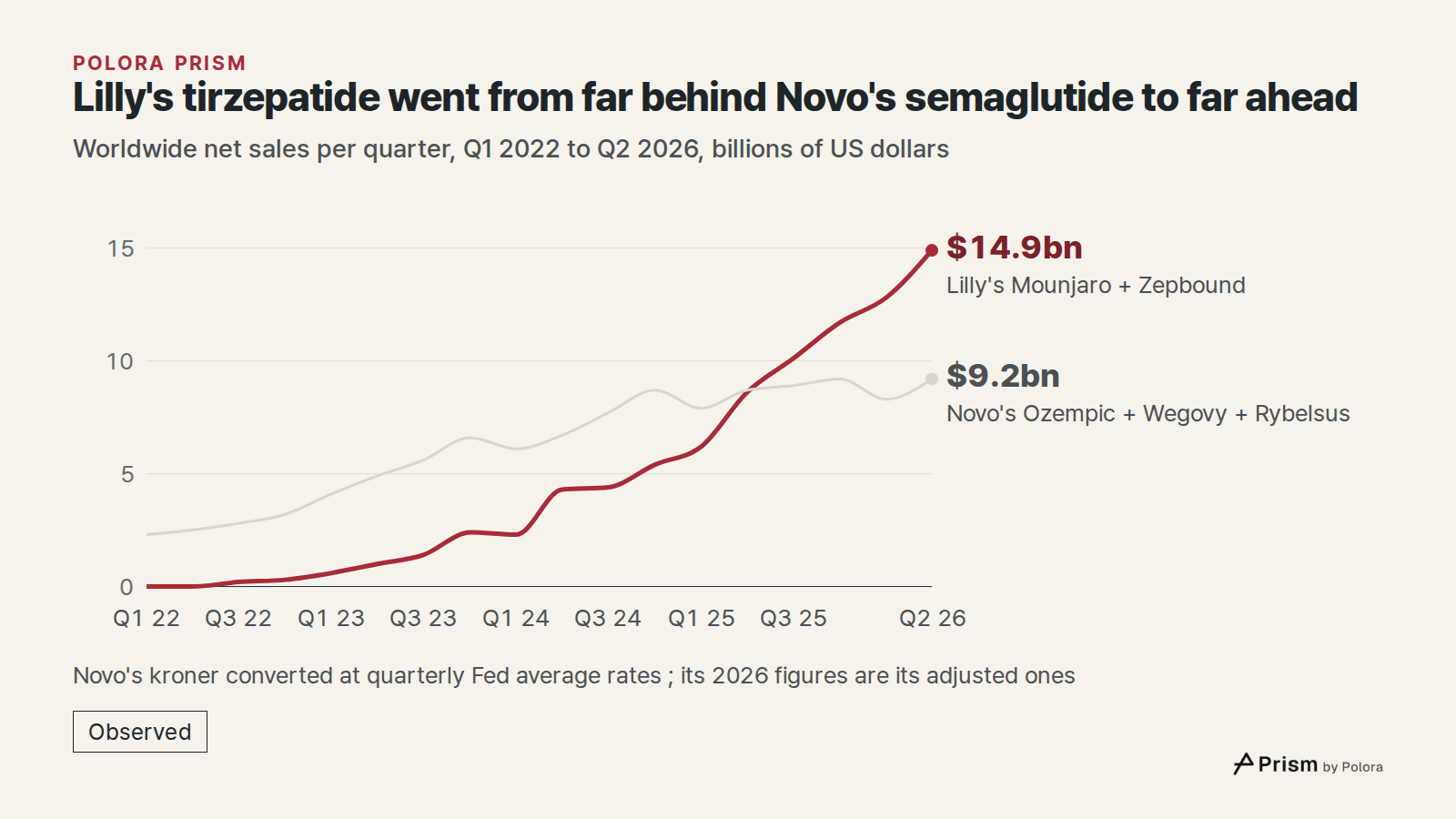
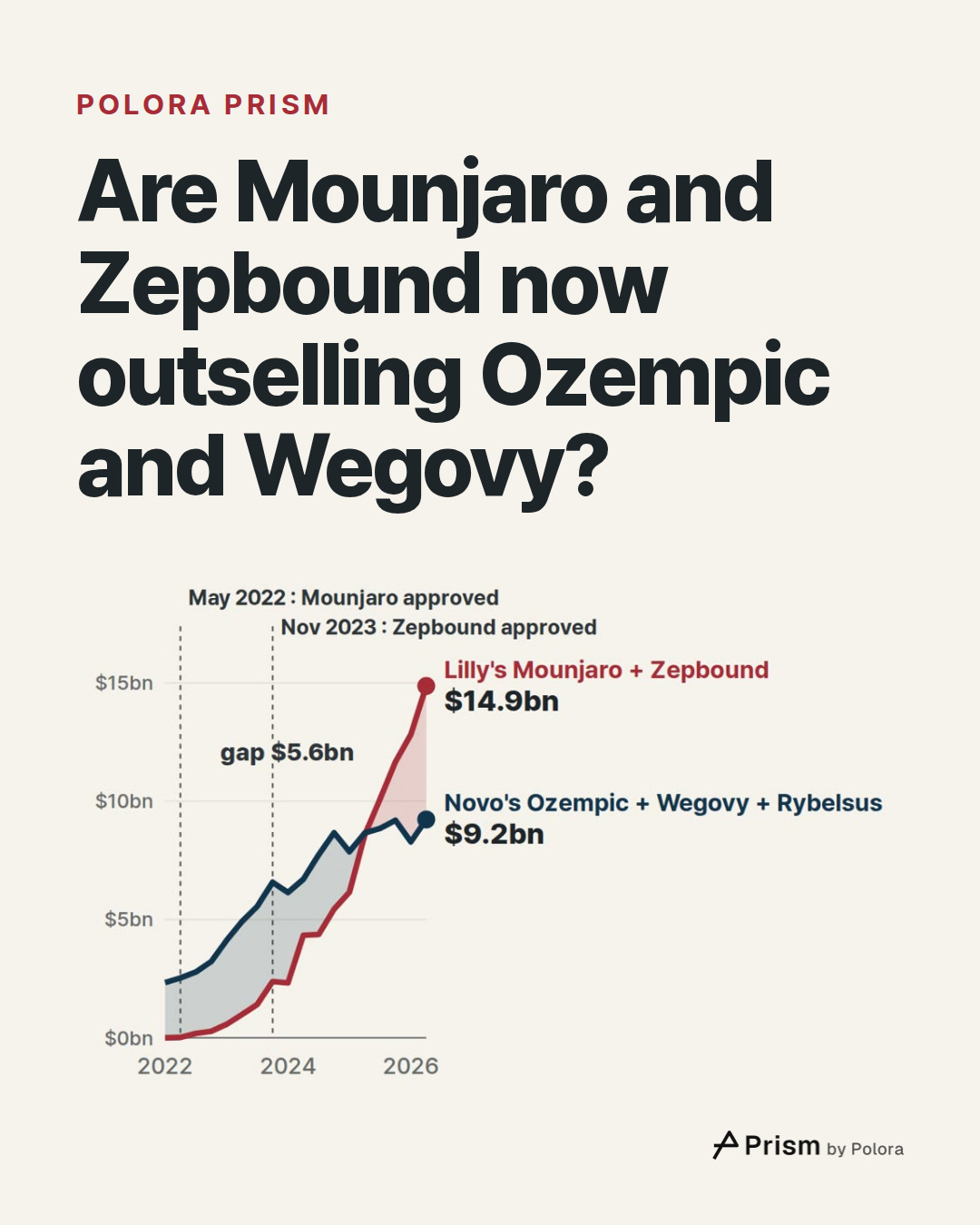
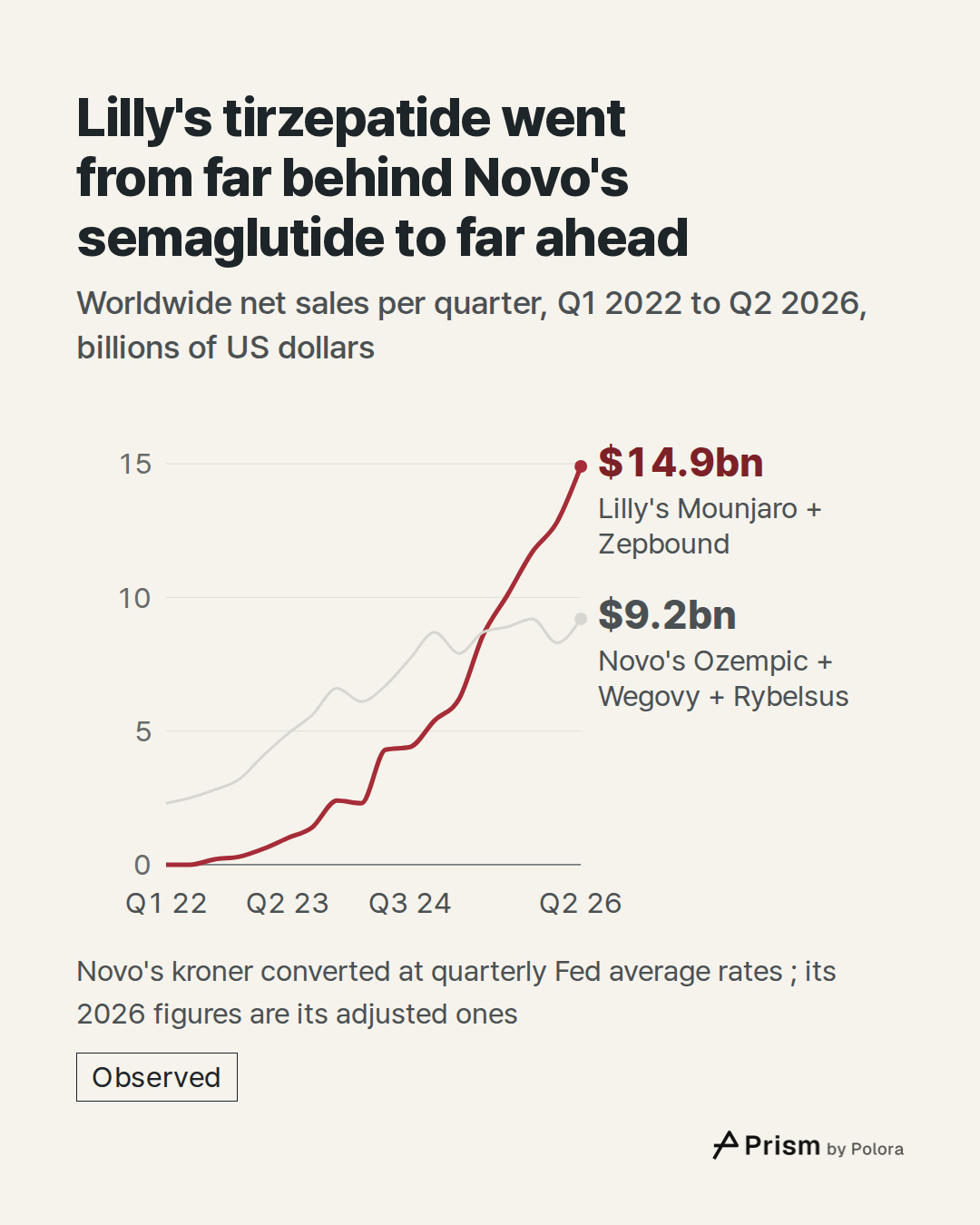
In the first quarter of 2022, before Mounjaro was approved, Novo's semaglutide drugs sold $2.3 billion. Lilly's tirzepatide sold nothing yet. By the end of 2023, Mounjaro and Zepbound together were selling $2.4 billion a quarter, a fourth of Lilly's revenue, and Novo still sold 2.8 times as much.
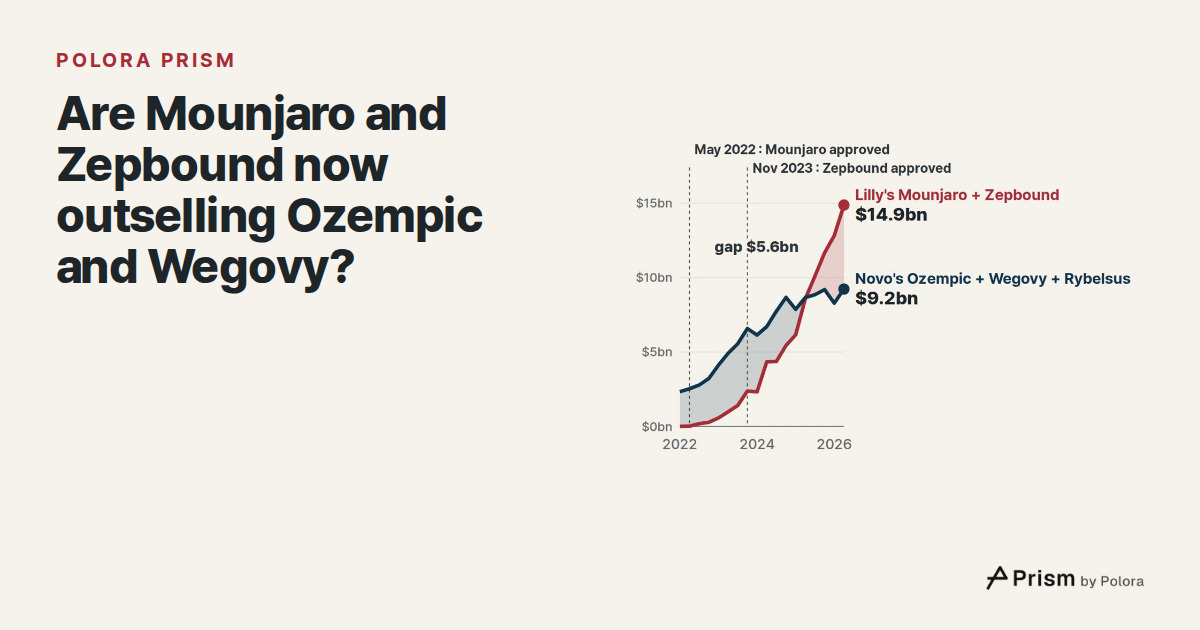
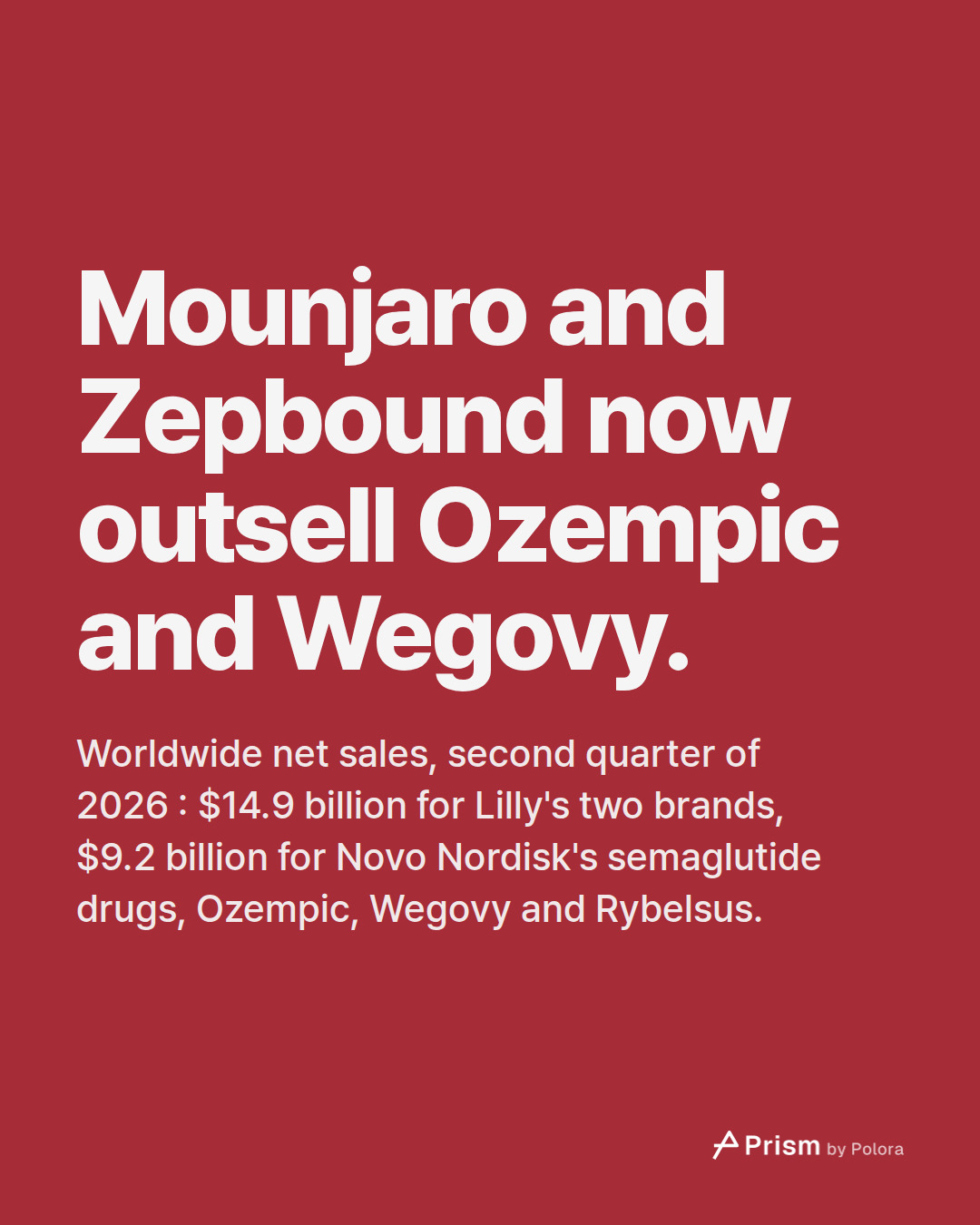
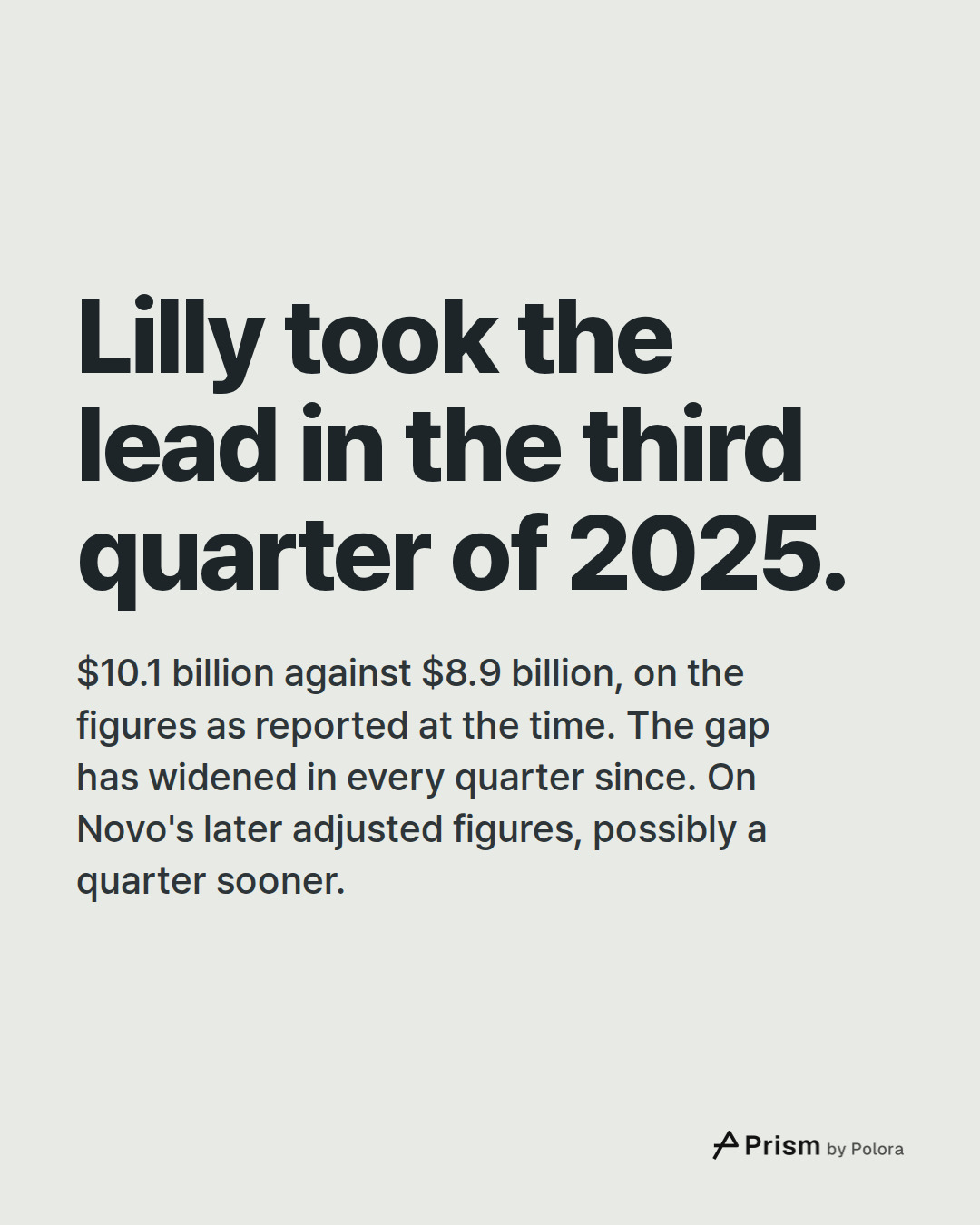
Then Lilly's line grew much faster. Over the next five quarters it went from $2.4 billion to $6.2 billion. Novo's grew too, more slowly, and dipped in the first quarters of 2024 and 2025. In the second quarter of 2025 the two were almost level, at $8.6 billion for Lilly and $8.7 billion for Novo. In the third quarter Lilly pulled ahead, with $10.1 billion against $8.9 billion. The gap has widened in every quarter since. By the second quarter of 2026 it was $14.9 billion against $9.2 billion.
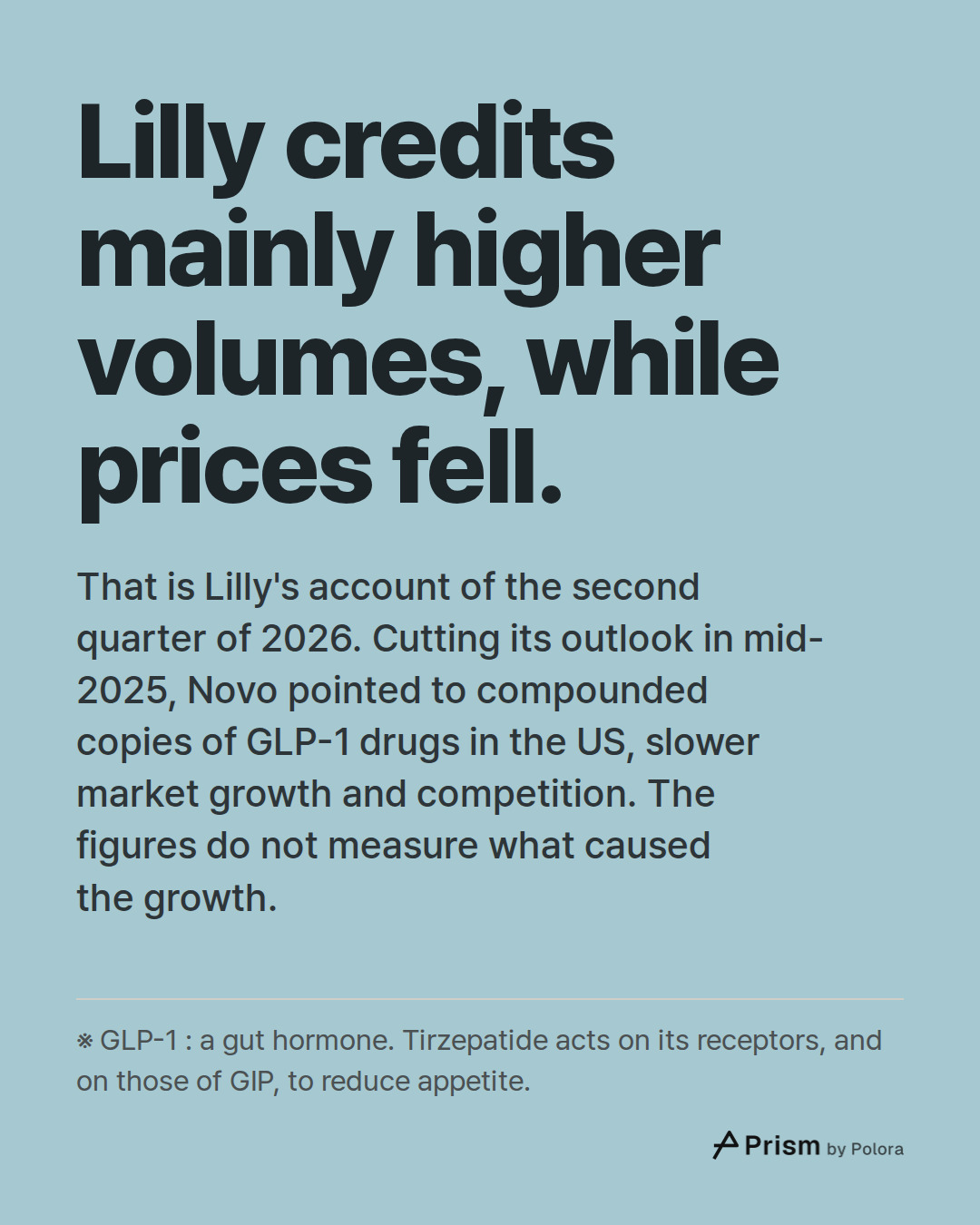
The companies give their own reasons. Lilly says its revenue growth in the second quarter of 2026 was driven mainly by higher volumes of Mounjaro and Zepbound, while realised prices fell. In mid-2025, when Novo cut its sales outlook for the year, it pointed to the continued use of compounded copies of GLP-1 drugs in the US, a slower-than-expected expansion of the market, and competition. In its 2026 reports Novo points to lower realised prices, partly offset by growing volumes. The figures show growth following approvals ; they do not measure what caused it.
Over the whole of 2025 the lead was narrower : $36.5 billion for Mounjaro and Zepbound against $34.6 billion for Novo's semaglutide, counting Novo's year as the sum of its four quarters in dollars. The quarters show what the yearly total hides. Lilly started the year behind and ended it well ahead.
How the comparison is measured
Both figures are worldwide net sales, after rebates and discounts. Lilly reports under US accounting rules (GAAP) and Novo under international rules (IFRS). For 2026, Novo's figures here are its adjusted ones, explained below, rather than the sales it booked under IFRS. Each quarter is a calendar quarter, which is also each company's fiscal quarter. Lilly files no quarterly report for its fourth quarter, so each fourth quarter here is its yearly report less the first nine months. Lilly's earnings releases give the same rounded figures. All amounts are in dollars of the day, not adjusted for inflation. They measure money, not the number of patients or prescriptions.
Novo reports in Danish kroner. Its figures here are converted at each quarter's average of the Federal Reserve's daily krone-dollar rate. That makes Novo's dollar line move partly with the currency. Each krone bought more dollars in late 2025 and 2026 than at the start of 2025, so part of the rise in Novo's dollar line over that time is the currency. Measured in kroner, and on the adjusted basis used here for 2026, its semaglutide sales have stayed below their level of the last quarter of 2024. A different published rate, the European Central Bank's, gives the same rounded figures in every quarter but one. In the third quarter of 2025 it gives $8.8 billion instead of $8.9 billion. Either way, Lilly is ahead.
One-off releases that move Novo's numbers
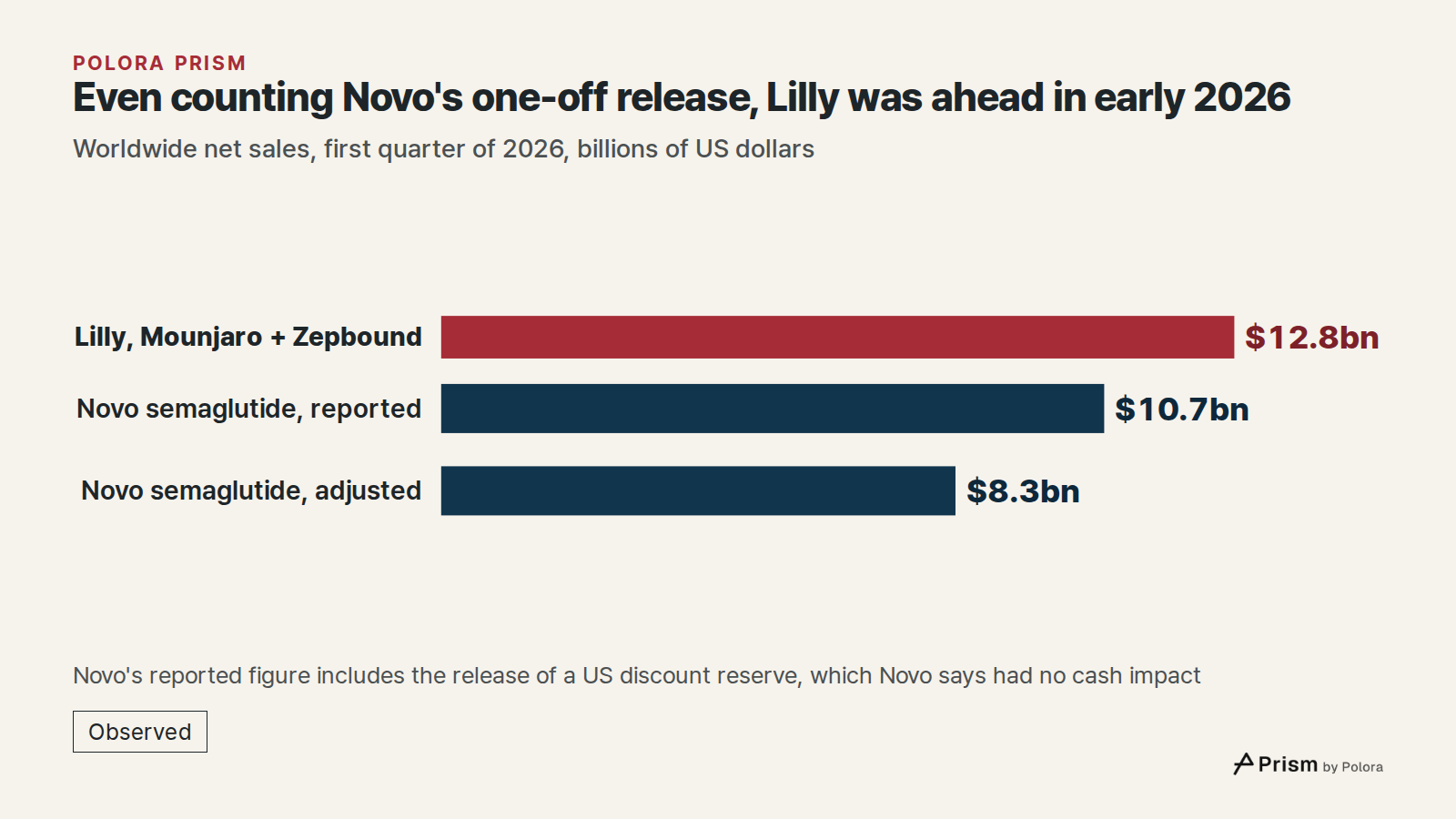
Novo's figures need one more caution. Under a US drug-pricing programme, certain healthcare providers get medicines at a discount. In 2021 Novo changed how it delivers those discounted medicines to the pharmacies the providers work with. The change was challenged in court, so Novo set aside a reserve against its sales for discounts it might yet owe. In the first quarter of 2026 it released that whole reserve, a one-off that raised reported sales and, in Novo's words, had no cash impact. Novo's own adjusted figures leave it out, and so do the figures for 2026 used here. On Novo's reported basis, its semaglutide sales in that quarter would be $10.7 billion instead of $8.3 billion. That is still below Lilly's $12.8 billion. In the second quarter of 2026 there was no such item.
Novo had made a smaller release of the same kind in the second quarter of 2025, worth 2.6 billion Danish kroner across all its products. Novo now leaves that out of its adjusted figures as well. The 2025 figures here are as Novo reported them at the time, so they include it. That matters for when Lilly took the lead. Novo has not said how much of the 2025 release was booked on its semaglutide brands. If more than 19.5 percent of it was, then without it Lilly's two brands were already ahead in the second quarter of 2025, not only from the third. Novo's figures do not settle it. In the larger 2026 release, where Novo does give the split by product, 58 percent fell on semaglutide brands, but that was a different release and says nothing certain about the earlier one. So Lilly took the lead in the third quarter of 2025 on the figures as reported at the time, and possibly a quarter sooner on Novo's later adjusted basis. On either basis, Lilly has been ahead since.
What the numbers do not say
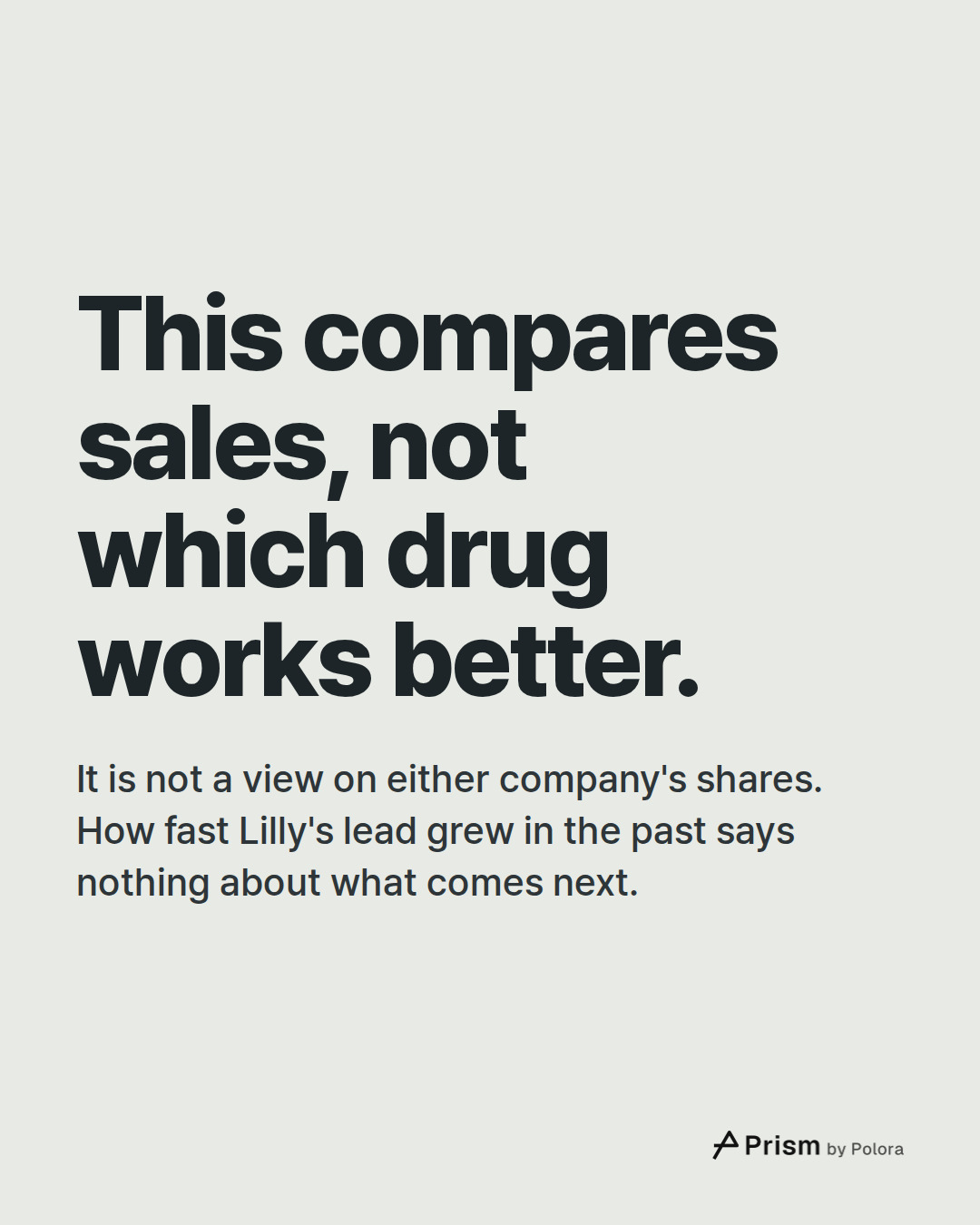
The figures run to the second quarter of 2026, the latest quarter both companies had reported when the data was gathered in late October 2026. Newer results will extend the picture. The comparison covers sales of two molecules. It says nothing about which drug works better for whom, and it is not a view on either company's shares. How fast Lilly's lead grew in the past says nothing about what comes next.
- US FDA, Novel Drug Approvals for 2022 (Mounjaro, 13 May 2022)]
- US FDA (8 November 2023), FDA Approves New Medication for Chronic Weight Management]
- Eli Lilly, quarterly reports (10-Q) and annual reports (10-K), 2022 to 2026, via SEC EDGAR]
- Eli Lilly, Q2 2026 earnings release, via SEC EDGAR]
- Eli Lilly, Q4 2025 earnings release, via SEC EDGAR]
- Novo Nordisk, quarterly company announcements (6-K), 2022 to 2026, via SEC EDGAR]
- Novo Nordisk, financial report for the first six months of 2025, via SEC EDGAR]
- Novo Nordisk, financial report for the first three months of 2026, via SEC EDGAR]
![Sources 8 : fda.gov · US FDA, Novel Drug Approvals for 2022 (Mounjaro, 13 May 2022)], fda.gov · US FDA (8 November 2023), FDA Approves New Medication for Chronic Weight Management], sec.gov · Eli Lilly, quarterly reports (10-Q) and annual reports (10-K), 2022 to 2026, via SEC EDGAR] + 5](https://media.cdn.polora.ai/picks/2026/11/pickrun_a1d67fd2ec8e46fe/MyOFXoZhImJqKv5Q-slide-08--are-mounjaro-and-zepbound.jpg)