Does your streaming subscription pay the artists you listen to?

Not directly. Your fee joins one pot for your country, divided by share of all plays there. Your plays count, but so do everyone else's, and the heaviest listeners steer the most.

Business & Economy · 2026-10-02

Your fee goes into one pot for your country

Say you pay for a music subscription every month and listen mostly to three artists. It feels natural to assume your fee is shared among those three. It is not. On Spotify, the money from every subscriber and every ad in a country goes into one pot each month. The pot is then divided by share of plays : if an artist's songs make up 1% of all streams in that country that month, the owners of those recordings receive 1% of the recording royalties paid there. The UK competition authority describes this kind of split, by share of plays, as the model most streaming services use.

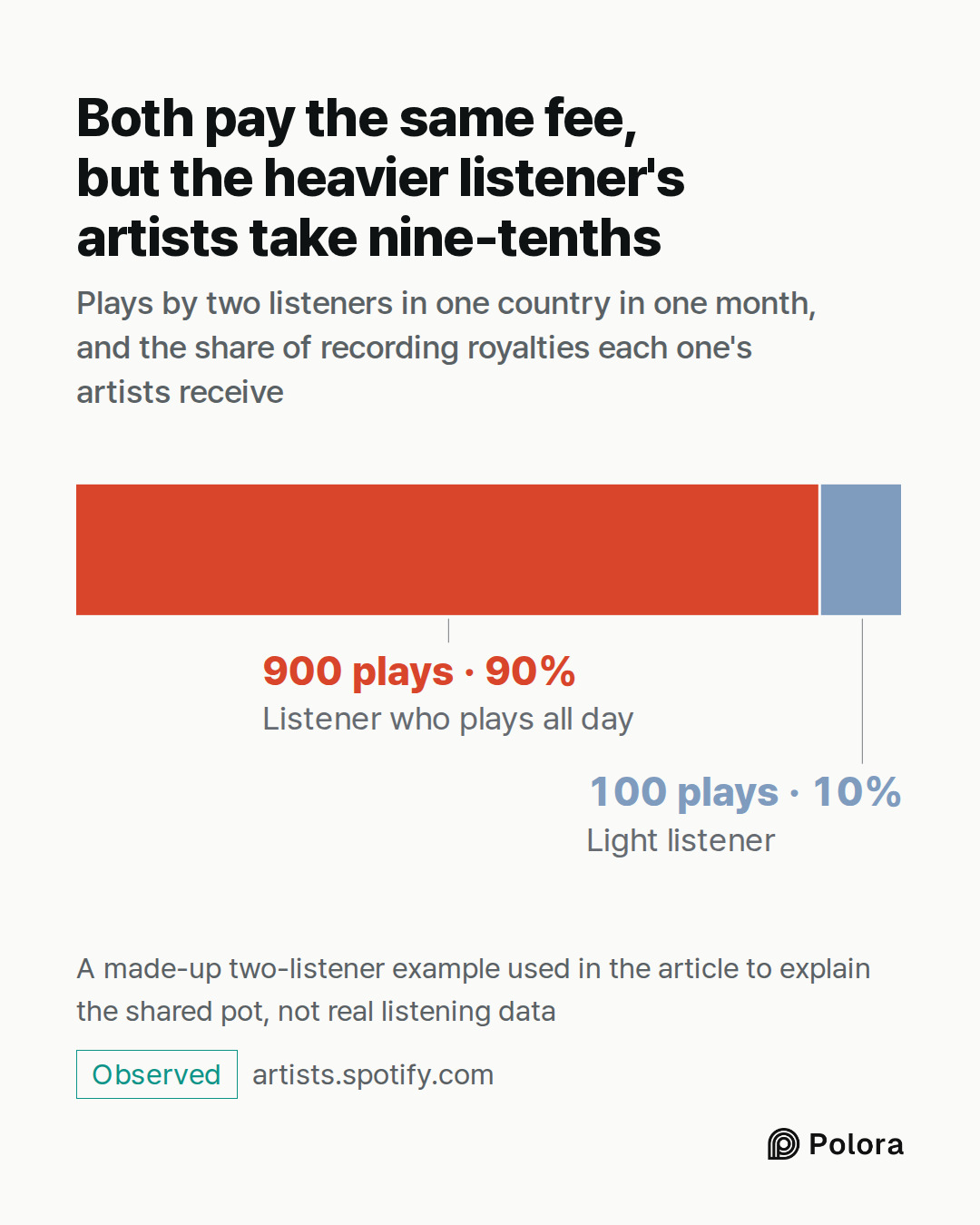
A country with two listeners shows what that means. Both pay the same fee. One leaves music on all day and plays 900 songs in a month, and the other plays 100. Together they made 1,000 plays, so the first listener's favourite artists take nine-tenths of the recording royalties the two fees fund, including most of what the second listener's fee put in. Your plays still count : each one adds to the share of the artists you play. But your money follows what everyone around you plays, weighted by how much they play.

Spotify puts the calculation in its own words. Every month, in every country, a rights holder's streams in that market divided by all streams in that market gives its share of that market's royalty pool. Each pool is built from that country's subscription and advertising money, so the same play can be worth different amounts in different places.
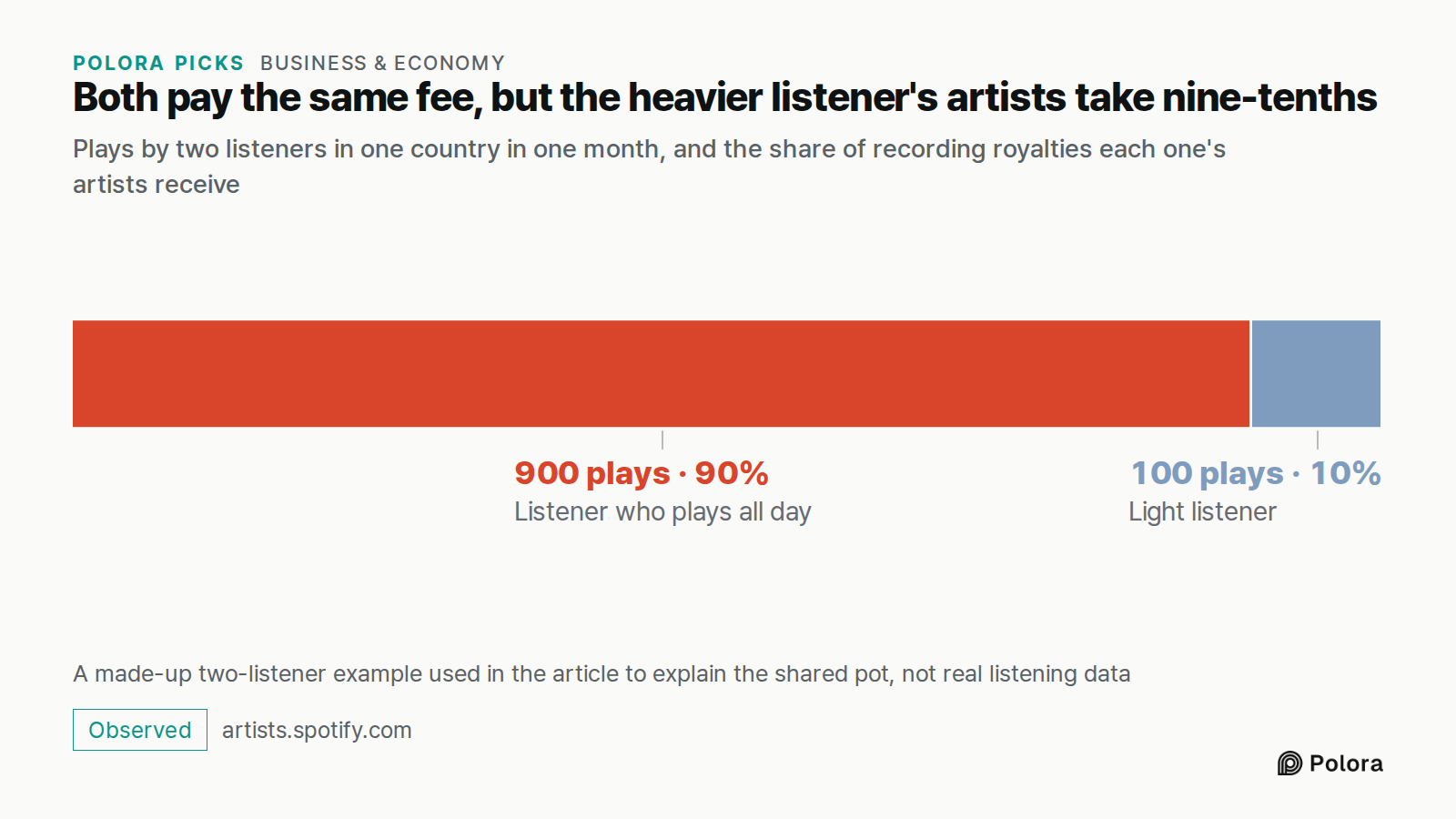
Both pay the same fee, but the heavier listener's artists take nine-tenths · Plays by two listeners in one country in one month, and the share of recording royalties each one's artists receive · Listener who plays all day · Light listener · 900 plays · 100 plays · A made-up two-listener example used
Plays by two listeners in one country in one month, and the share of recording royalties each one's artists receive

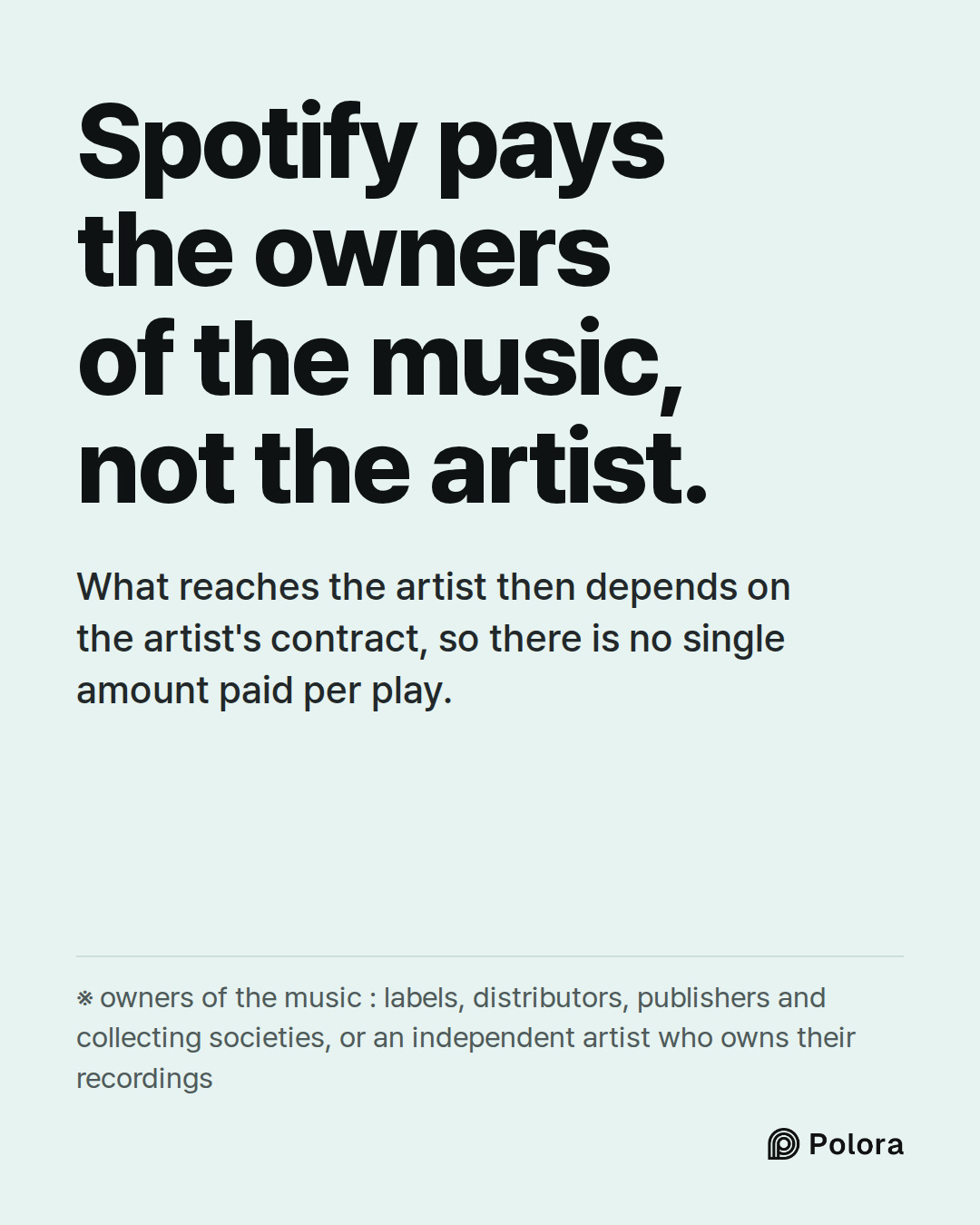
Spotify pays the owners of the music, not the artist

The money does not go straight to the musician. Spotify says roughly two-thirds of its music revenue, from subscriptions and ads, is set aside for royalties. About four-fifths of that is for recordings and about one-fifth is for the songs themselves, which means songwriters and their publishers. Spotify pays whoever holds the rights : record labels, distributors that place independent artists' music on the services, publishers and collecting societies. It says it does not pay artists or songwriters directly. An artist can still be the rights holder, as an independent artist who owns their own recordings is.

What reaches the artist then depends on the artist's contract with those companies, and contracts differ from one artist to the next. That is why there is no single amount paid per play. The per-stream figures that circulate online, usually a fraction of a cent, are averages worked out afterwards, and they change with the country, the type of plan and the month. Spotify says no major service pays per stream, because listeners do not pay per song.
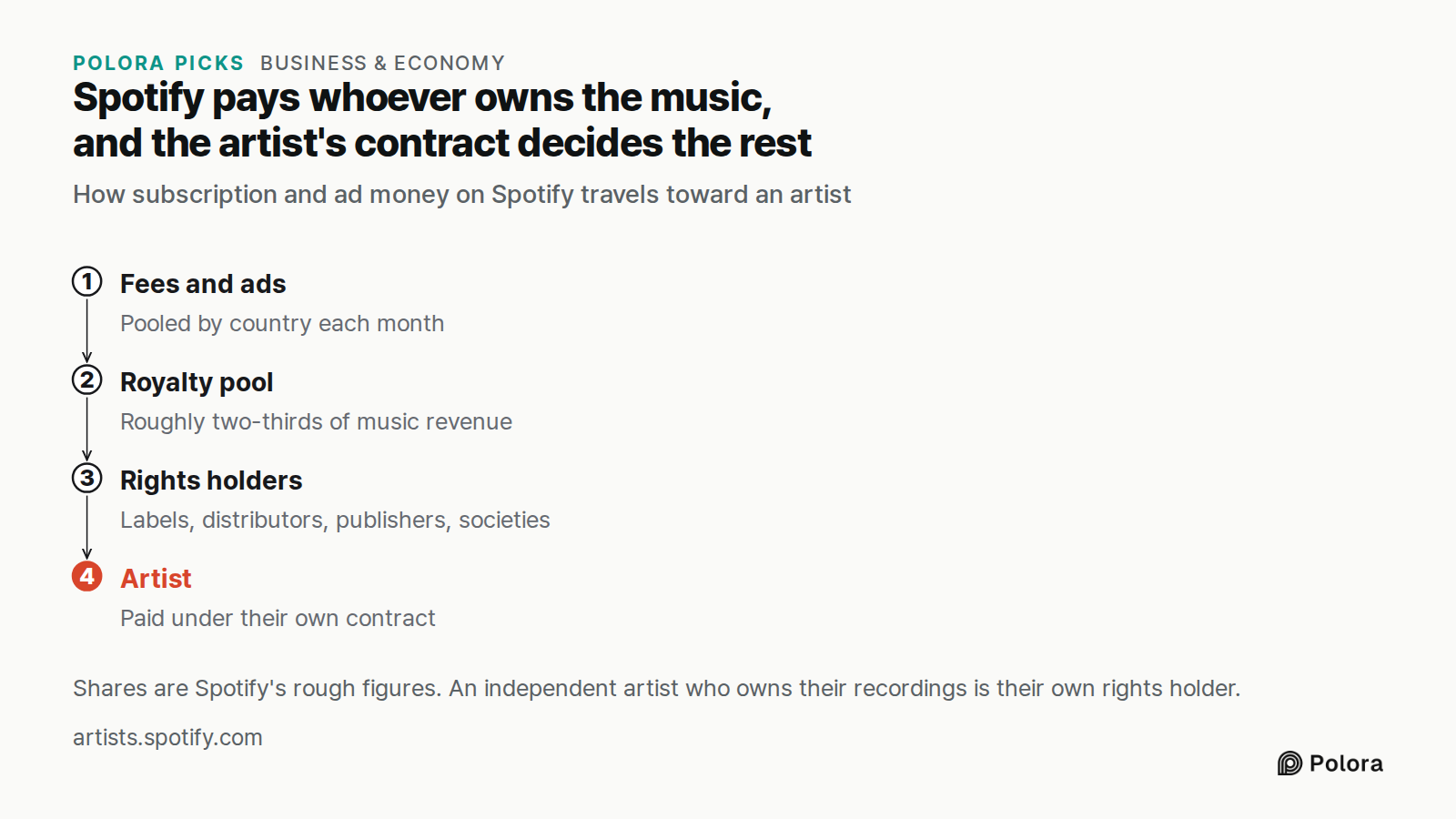
Spotify pays whoever owns the music, and the artist's contract decides the rest · How subscription and ad money on Spotify travels toward an artist · Fees and ads · Royalty pool · Rights holders · Artist · Pooled by country each month · Roughly two-thirds of music revenue · Labels, distributors, pub
How subscription and ad money on Spotify travels toward an artist

Since April 2024, a song needs 1,000 plays a year to earn on Spotify

Spotify changed one rule in April 2024. A track now earns recording royalties only if it reached at least 1,000 streams in the previous 12 months, counted across all countries. Royalties are still worked out month by month, and reaching the line does not pay for earlier months. Spotify's support page for artists says a track also needs a minimum number of different listeners, so that no one can reach the line by playing a track hundreds of times. Spotify does not publish that number. The threshold applies only to the recording side. Spotify says nothing changed in how songwriting and publishing royalties are calculated.

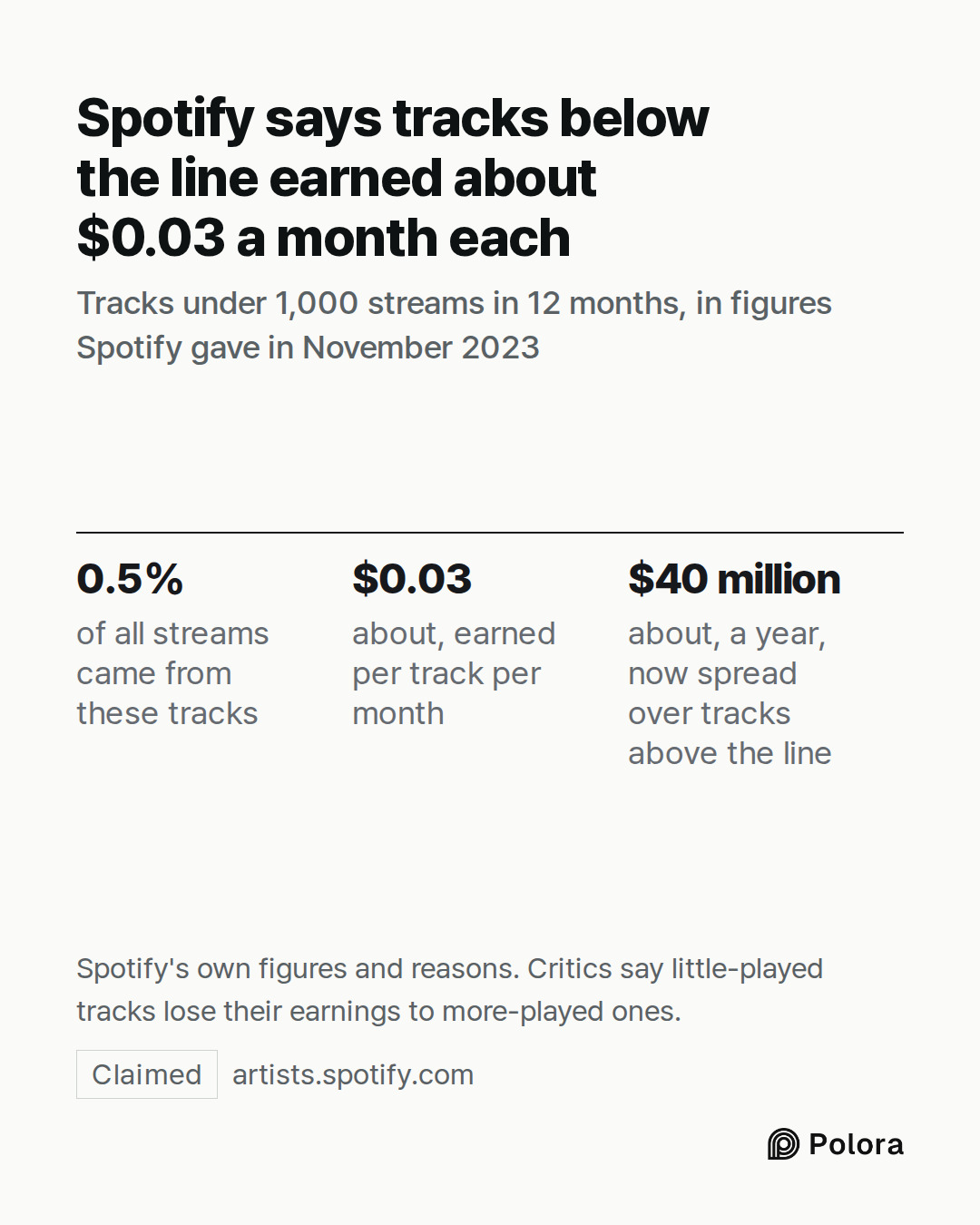
Spotify explained its reasons when it announced the change in November 2023. It said tracks below the line made up 0.5% of all streams and earned about $0.03 a month on average, money that often never reached its owners once withdrawal minimums and bank fees were applied. Spotify put the total for all those tracks at about $40 million a year. Spotify says the total paid to rights holders stays the same and that it keeps none of the difference. That money is spread over the tracks above the line instead. These are Spotify's figures and Spotify's reasons. Critics describe the same mechanism from the other side : little-played tracks below the line stop earning, and their share moves to tracks that are played more.
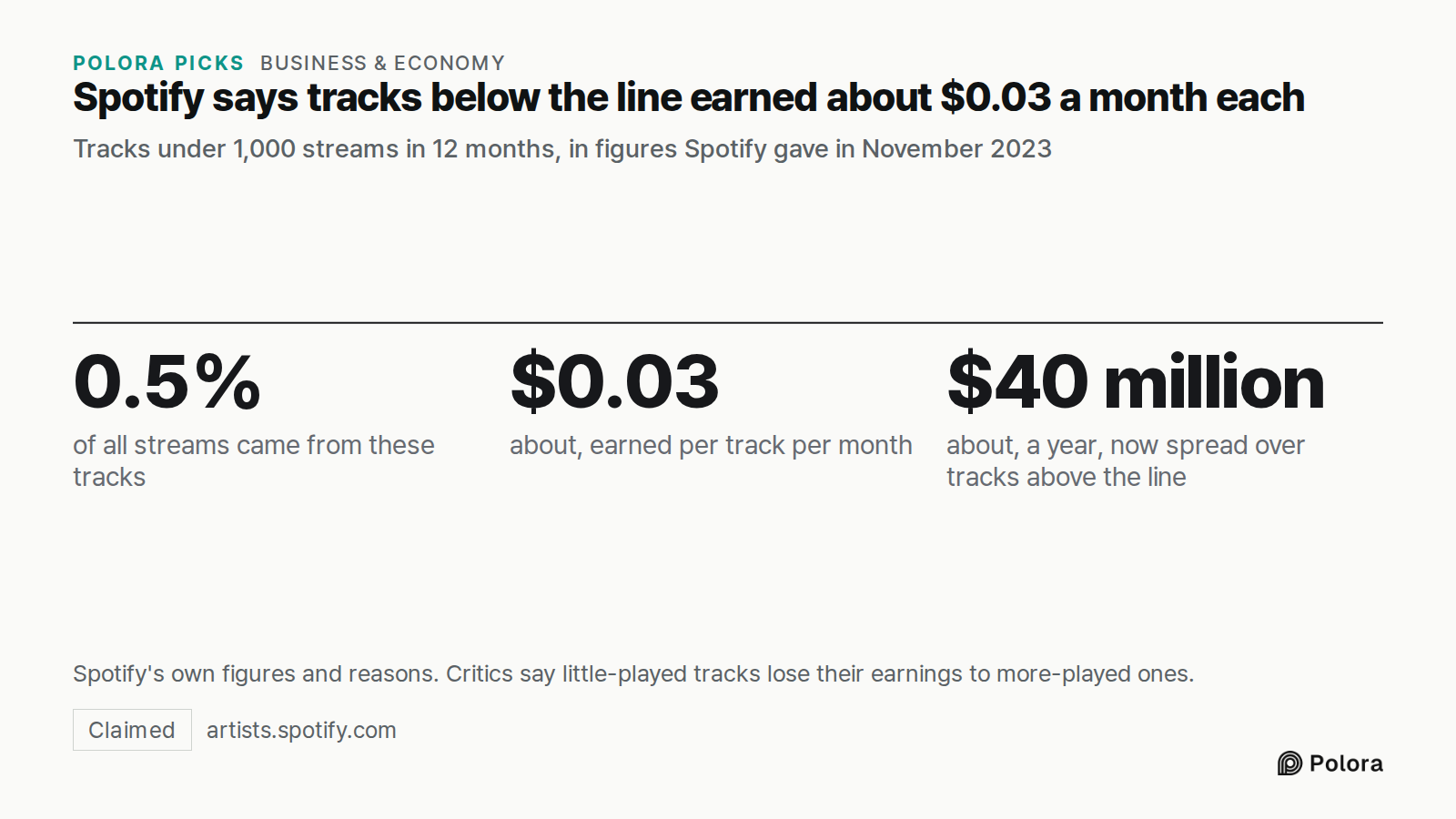
Spotify says tracks below the line earned about $0.03 a month each · Tracks under 1,000 streams in 12 months, in figures Spotify gave in November 2023 · 0.5% · $0.03 · $40 million · of all streams came from these tracks · about, earned per track per month · about, a year, now spread over tracks abov
Tracks under 1,000 streams in 12 months, in figures Spotify gave in November 2023

The fix people keep proposing, and who actually uses it

The obvious alternative is to split each subscriber's fee only among what that subscriber played. It is usually called user-centric payment. SoundCloud has used a version of it, which it calls fan-powered royalties, since April 2021, first for independent artists paid directly through the platform. Under it, an eligible listener's subscription money, or the ads they heard, goes to the artists that listener played. Warner Music Group joined in 2022. In 2023 Merlin, which licenses music for independent labels, joined as well.

Deezer, a French streaming service, is often named alongside it, but the model Deezer launched with Universal Music Group in France in October 2023 is a different one, which the two companies call artist-centric. It keeps the single shared pot and changes how plays are weighted. Plays of artists with at least 1,000 streams and 500 different listeners a month count double, and plays of tracks a listener actively searched for count double again. It also limits how much one listener can weigh : a listener's plays count toward payment up to 1,000 a month, and plays beyond that are scaled down, so the heaviest listeners cannot pull the pot without limit. In January 2025 Deezer and Sacem, the French society that collects for songwriters and composers, announced that the model would cover French publishing rights too. SoundCloud's model ties each fee to its own listener. Deezer's keeps the shared pot but limits how much any one listener, and any one play, can count.
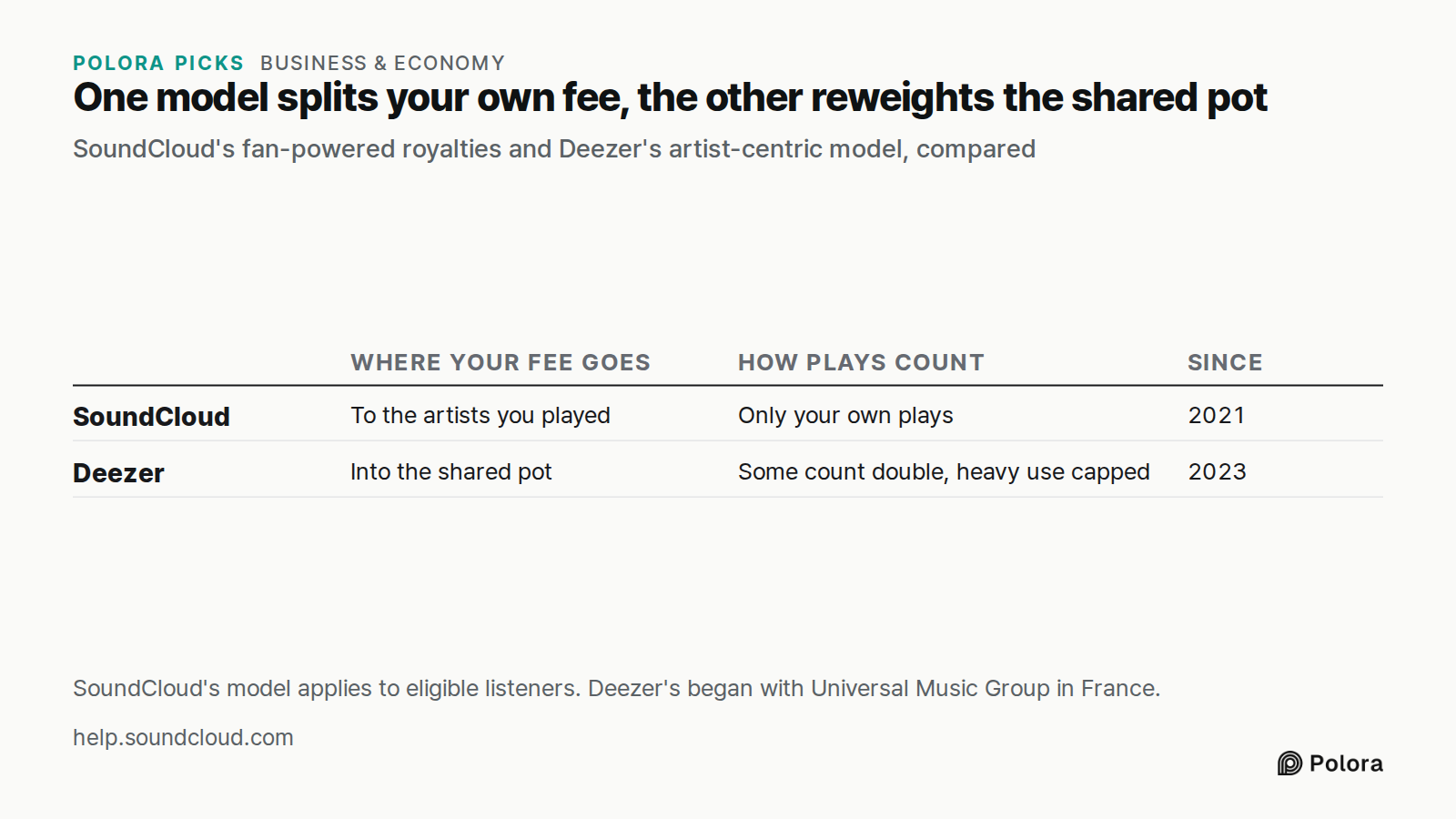
One model splits your own fee, the other reweights the shared pot · SoundCloud's fan-powered royalties and Deezer's artist-centric model, compared · Where your fee goes · How plays count · Since · SoundCloud · Deezer · To the artists you played · Only your own plays · 2021 · Into the shared pot · So
SoundCloud's fan-powered royalties and Deezer's artist-centric model, compared

When France ran the numbers, listeners moved more than artists

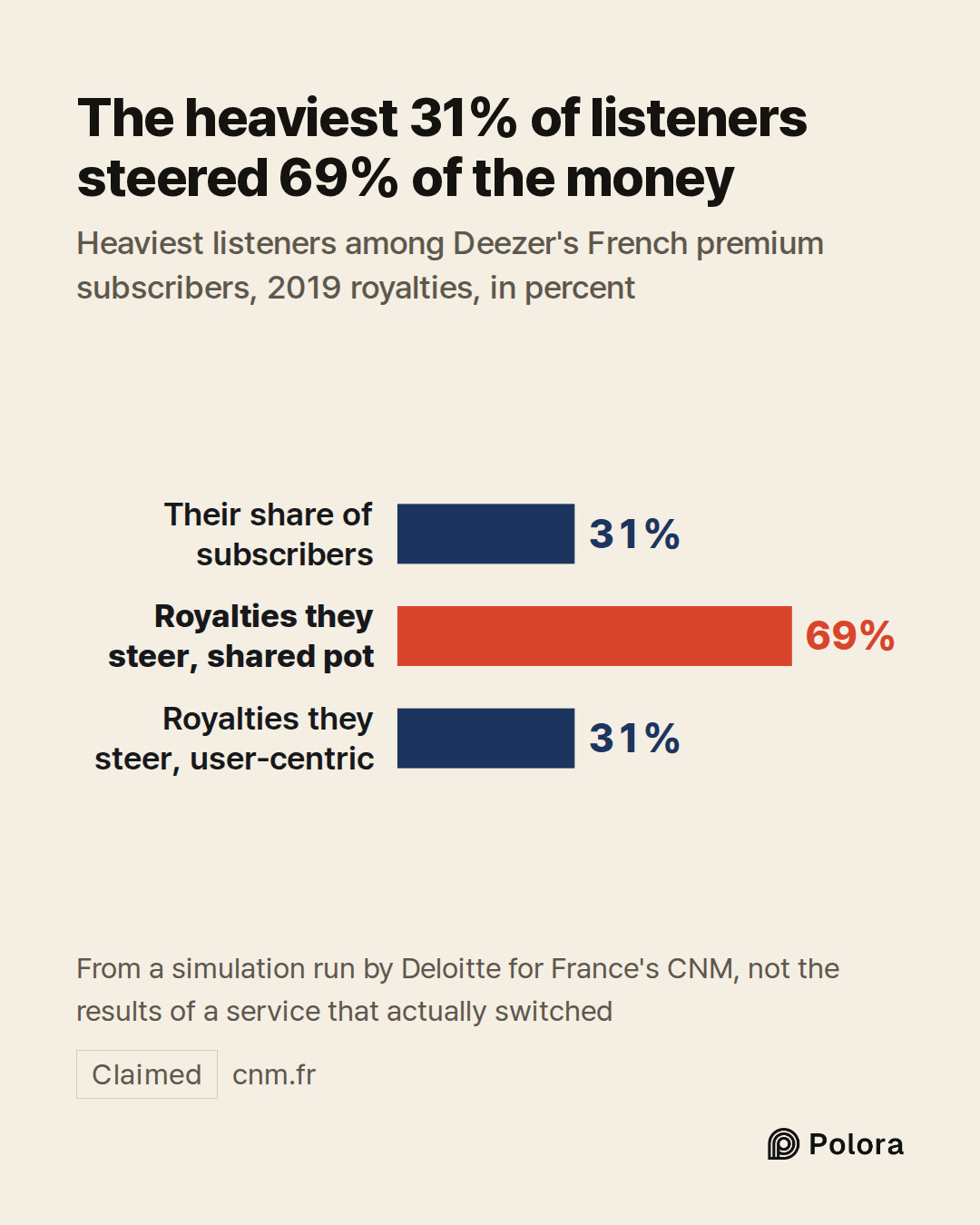
In January 2021 France's national music centre, the CNM, published a study run by Deloitte. It recalculated 2019 royalties for French premium subscribers of Deezer and Spotify as if each fee had gone only to what that subscriber played. These are simulations, not the results of a service that actually switched. The clearest shift was between listeners. In Deezer's data, the heaviest listeners, about 31% of subscribers, steered 69% of royalties under the shared pot. Under the user-centric model they would steer 31%, the same as their share of the fees.

Between artists the change was smaller than the debate suggests. In Deezer's data the 10 most-streamed artists would lose 17.2% of their royalties, several hundred thousand euros a year on average, and Spotify's smaller sample showed a 12.5% drop. Artists below the top 10,000 would gain 5.2% on average, which the study puts at under €10 a year per artist, and that sum is shared by everyone holding rights in the music, not what the artist takes home. Rap would lose about 21% and hip-hop about 19%, while pop would gain about 12% and rock about 13%. The CNM's president, Jean-Philippe Thiellay, concluded that this was not where the fight of authors, composers and performers for better pay would take place.

A peer-reviewed study published in 2024 by François Moreau and colleagues, using the 2020 listening of 154,505 Deezer premium subscribers, points the same way. In its simulations, user-centric payment would move money mainly away from superstars, rap and hip-hop, and new releases. The authors also found that the artist-centric model, as they modelled it, does not significantly raise what professional artists earn.
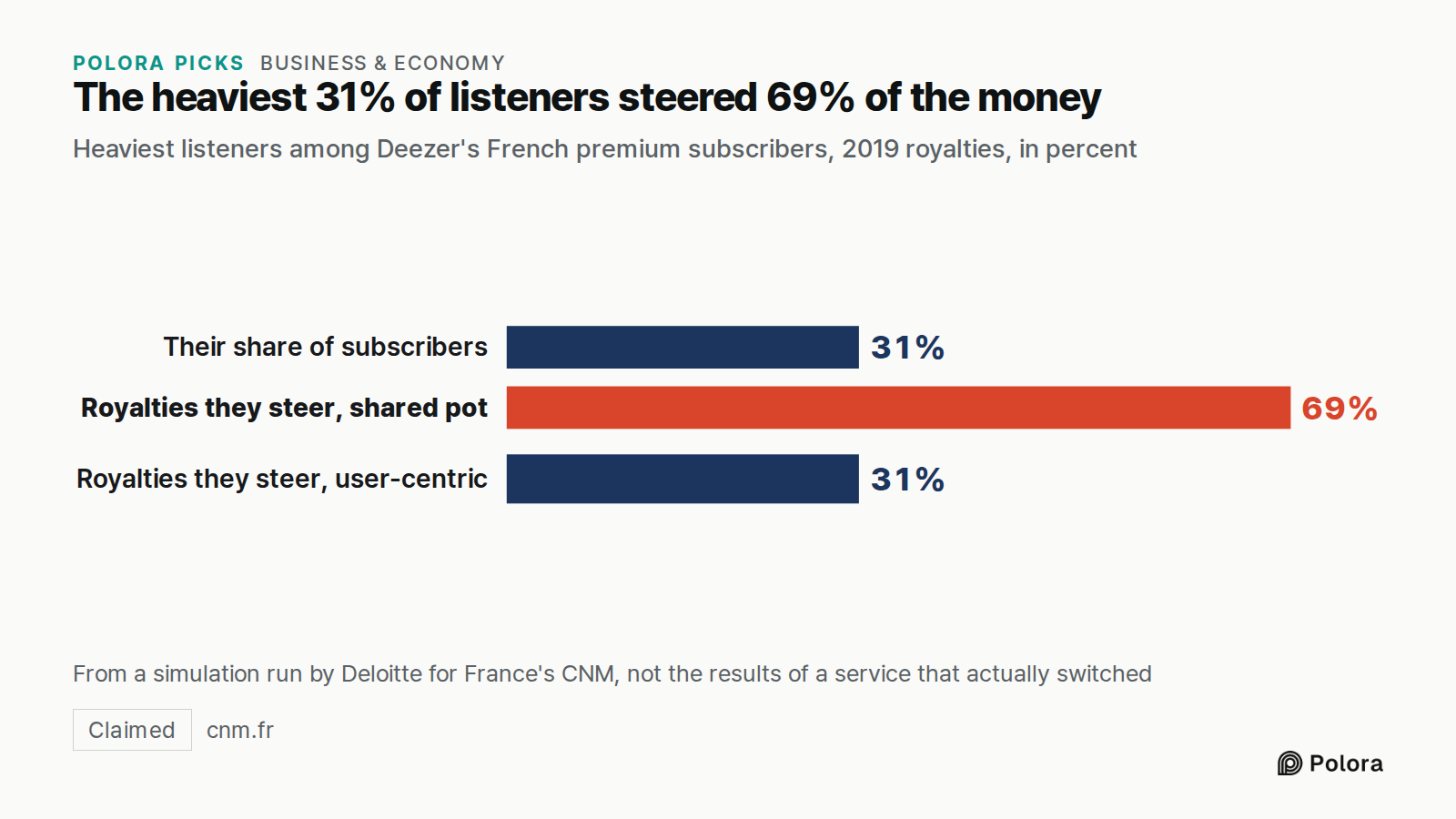
The heaviest 31% of listeners steered 69% of the money · Heaviest listeners among Deezer's French premium subscribers, 2019 royalties, in percent · Their share of subscribers · Royalties they steer, shared pot · Royalties they steer, user-centric · 31% · 69% · From a simulation run by Deloitte for F
Heaviest listeners among Deezer's French premium subscribers, 2019 royalties, in percent

The real question is who counts in the pot

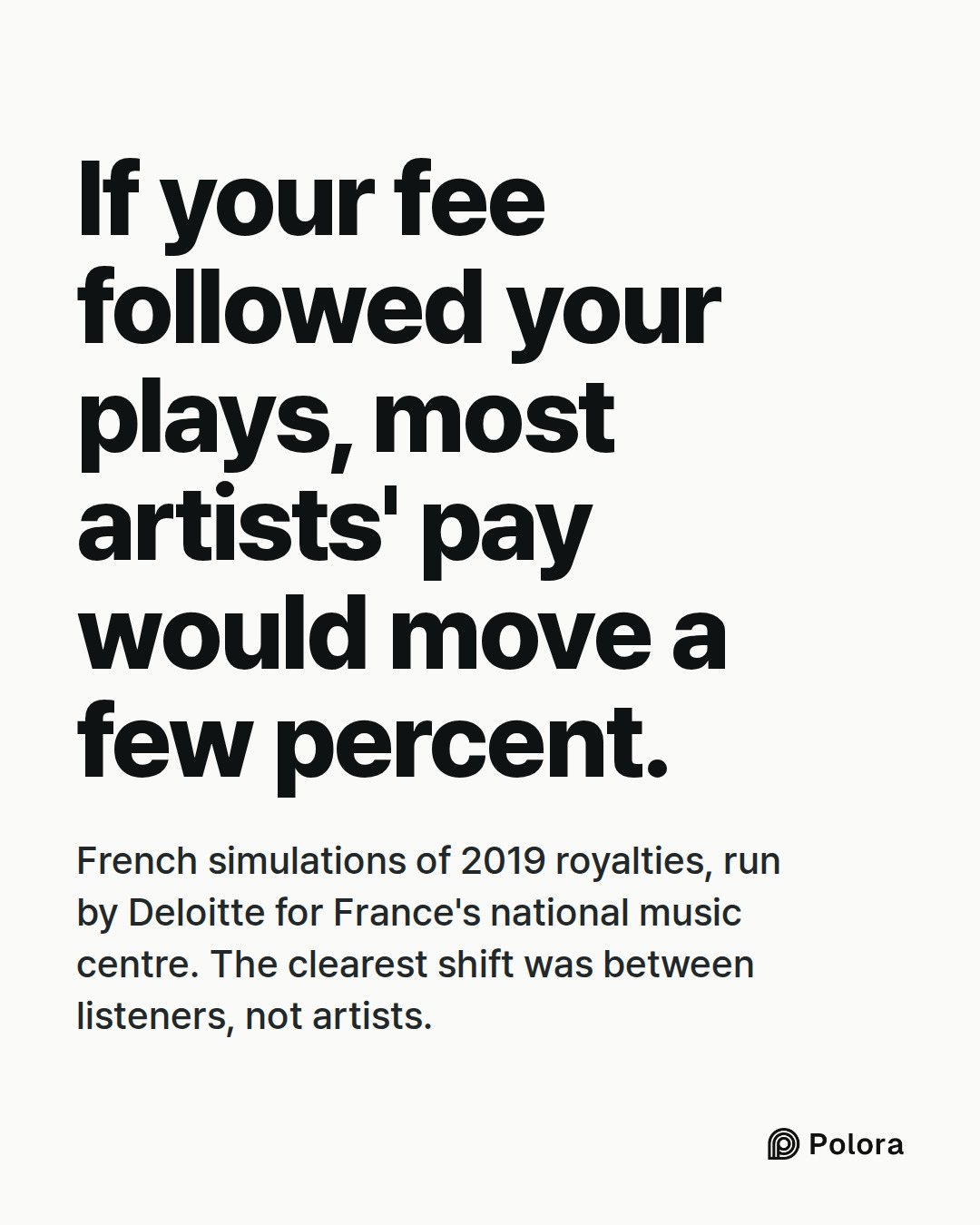
So here is the sentence to keep. Your subscription is not set aside for the artists you play. It buys a share of everything played in your country. Your plays add to your artists' share, but the people who play the most decide most of where the money goes. Making your fee follow your own listening would mostly move weight from heavy listeners to light ones. For most artists, the French simulations put the change at a few percent.

That is why the argument has moved on. Spotify's 1,000-stream line, like Deezer's double weighting and its per-listener cap, keeps the shared pot and changes which plays count inside it, and by how much. Deezer's cap even borrows part of the user-centric idea, by limiting how far one heavy listener can steer the pot. The next time streaming pay is in the news, the useful question is not only how the pot is split but whose plays are allowed to count.

Does your streaming subscription pay the artists you listen to?Does your streaming subscription pay the artists you listen to?Your fee goes into one pot for your country, not to the artists you play. · On Spotify, the pot is split each month by each artist's share of all plays in that country. Your plays count, but so do everyone else's.Listener who plays all day · Light listener · 900 plays · 100 plays · Both pay the same fee, but the heavier listener's artists take nine-tenths · Plays by two listeners in one country in one month, and the share of recording royalties each one's artists receive · A made-up two-listener example usedSpotify pays the owners of the music, not the artist. · What reaches the artist then depends on the artist's contract, so there is no single amount paid per play. · ※ owners of the music : labels, distributors, publishers and collecting societies, or an independent artist who owns their recordings0.5% · $0.03 · $40 million · of all streams came from these tracks · about, earned per track per month · about, a year, now spread over tracks above the line · Spotify says tracks below the line earned about $0.03 a month each · Tracks under 1,000 streams in 12 months, in figures Spotify gave in NovTheir share of subscribers · Royalties they steer, shared pot · Royalties they steer, user-centric · 31% · 69% · 31% · The heaviest 31% of listeners steered 69% of the money · Heaviest listeners among Deezer's French premium subscribers, 2019 royalties, in percent · From a simulation run by DeloitteIf your fee followed your plays, most artists' pay would move a few percent. · French simulations of 2019 royalties, run by Deloitte for France's national music centre. The clearest shift was between listeners, not artists.Sources 15 : artists.spotify.com · Spotify for Artists, Royalties Guide, loudandclear.byspotify.com · Spotify Loud & Clear, FAQ, assets.publishing.service.gov.uk · UK Competition and Markets Authority, Music and streaming final report + 12Read the full story at · polora.ai

When you stream a song, does your subscription money go to the artists you listen to?

Alpha · claude-sonnet-5

Verification findings — Alpha The manuscript's core premise holds up well under checking. Here's where I can confirm, correct, or flag gaps. The pro-rata pool itself: confirmed, and the "unverified" flag in the manuscript's own checklist can be resolved. The editor's team couldn't find Spotify's own wording on the unique-listener requirement and asked for it to be checked against a primary Spotify page. I found it: Spotify's own support article states plainly that "Starting in April 2024, tracks must have reached a threshold of at least 1,000 streams in the previous 12 months to be included in the recorded music royalty pool calculation. There's also a minimum number of unique listeners required for a..." track to qualify. That same Spotify page explains the reasoning: the unique-listener floor exists "to ensure users can't game the system by streaming the track hundreds of times in order to qualify." So this is not just secondary-source chatter — Spotify's own support.spotify.com page says it. The manuscript's claim stands, and the "did not find it on a Spotify page" caveat can be dropped; Spotify for Artists support counts as Spotify's own statement, distinct from (but…

Beta · gpt-6-sol

The answer is generally no—but “your listening doesn’t matter” would be wrong. On Spotify, your subscription helps fund royalties, and your plays help determine the shares paid to rights holders. The fee is not earmarked for the artists you personally played: Spotify calculates shares from streams in a market each month. A UK competition authority describes pro-rata distribution as the model adopted by *most*, not necessarily all, streaming services. (artists.spotify.com) Addresses: https://artists.spotify.com/en/royalties-guide ; https://assets.publishing.service.gov.uk/media/6384f43ee90e077898ccb48e/Music_and_streaming_final_report.pdf Here is what I would tell the editor to keep or change: - Pool and two-listener example — keep, with limits. Spotify’s example says that 1% of streams in a country earns the relevant rights holders 1% of its *recording royalties* there. Thus, if two equal-paying listeners generate 900 and 100 qualifying plays in the same pool, the first listener’s plays exert nine times the influence. This is an illustration, not a claim that their entire subscription fees are paid…

Gamma · gemini-3.1-pro

Verification findings — Gamma Alpha and Beta have laid the groundwork well. I have reviewed the remaining unchecked items from the editor’s brief, run the necessary searches, and can provide the final missing pieces for the manuscript. The manuscript’s core premise—that your subscription fee is pooled and distributed pro-rata rather than acting as a direct micro-payment to the artists you stream—is entirely correct for the dominant streaming model. However, the manuscript’s explanation of the *alternatives* contains a critical omission that undermines its own argument. Here is what you need to adjust or keep: 1. The Deezer cap completely changes the manuscript’s contrast (Critical Correction) The manuscript claims that Deezer’s "artist-centric" model *only* changes how plays are weighted, implying that a heavy listener still exerts unlimited pull on the royalty pool. This is factually incomplete. Deezer’s official documentation and press releases from late 2023 confirm a User-Centric Cap: Deezer caps the monetization impact of any single user at 1,000 streams per month. If a user streams 2,000 tracks, each track counts for half a stream in the pool. *Why it matt…

Researcher · gemini-3-7-flash

Core Premise Assessment The manuscript’s central premise stands: In the dominant music streaming model, an individual user's subscription fee is not earmarked or distributed directly to the specific artists that user streams. Instead, revenues are pooled (typically by country/market and tier) and distributed to rights holders based on their overall share of qualifying plays (*pro-rata* or *streamshare*). However, several specific claims require correction, clarification, or vital context. --- Claim-by-Claim Verification 1. Pro-Rata Pooling and Market Differences * Manuscript Claim: Subscription money goes into market-wide pools and is divided by stream share; Spotify and other major platforms work this way; payouts per stream vary because pools depend on local revenue. * Finding: Confirmed. * Spotify’s documentation states that all subscription and ad money in a market is pooled and split according to each rights holder's monthly share of total qualifying streams []. Spotify also confirms that per-stream rates vary across markets because subscription pricing and ad revenues differ by territory. * For other major DSPs (Apple Music, Amazon Musi…

The Arbiter · gpt-6-sol

Round record for the editor: Alpha, Beta, Gamma and the Researcher agree on the central distinction: on Spotify, a subscriber’s fee is not reserved for the artists that subscriber plays. Subscription and advertising revenue fund royalty pools distributed by streamshare to rights holders. Listening still matters: each eligible play can affect a rights holder’s share. Spotify documents its country-level recording-royalty example; Beta and Gamma caution that the UK CMA supports describing pro-rata as used by *most* services, not asserting that every large service has precisely the same country-pot arrangement. (artists.spotify.com) - Payment path and rates: Beta and the Researcher confirm Spotify’s roughly two-thirds royalty allocation and approximate four-fifths recording/one-fifth publishing split. Labels, distributors, publishers and collecting bodies may stand between Spotify and creators; an independent artist can also own their rights. There is no fixed payment per stream. The two-listener example works as an illustration of recording-royalty streamshare, not as a literal division of both subscr…

The Arbiter's Final Verdict · gpt-6-sol

Usually, not directly. On Spotify and most major music services, your subscription payment is pooled with other subscription and advertising revenue. Royalties are then allocated to music rights holders according to their share of eligible streams—not by dividing *your* fee only among the artists *you* played. That does not mean your listening makes no difference. An eligible stream can increase a rights holder’s share of the pool. But the service generally pays rights holders, such as labels, distributors and publishers; what an artist or songwriter receives depends on their rights and contracts. There is no fixed amount paid for every play. Spotify’s royalties guide Some services offer alternatives: SoundCloud’s fan-powered royalties tie eligible listener revenue more closely to that listener’s plays. So the accurate answer is “not necessarily the artists you listen to, and not in proportion to your personal fee”—rather than “your plays don’t count.”