Do airports make more money from parking and shops than from airlines?
Not overall. Airlines still pay the larger share worldwide and across US airports, though not at every airport. Of the 44% that US airports earn from other sources, parking and ground transport come first, far ahead of the shops.
Business & Economy · 2026-10-17
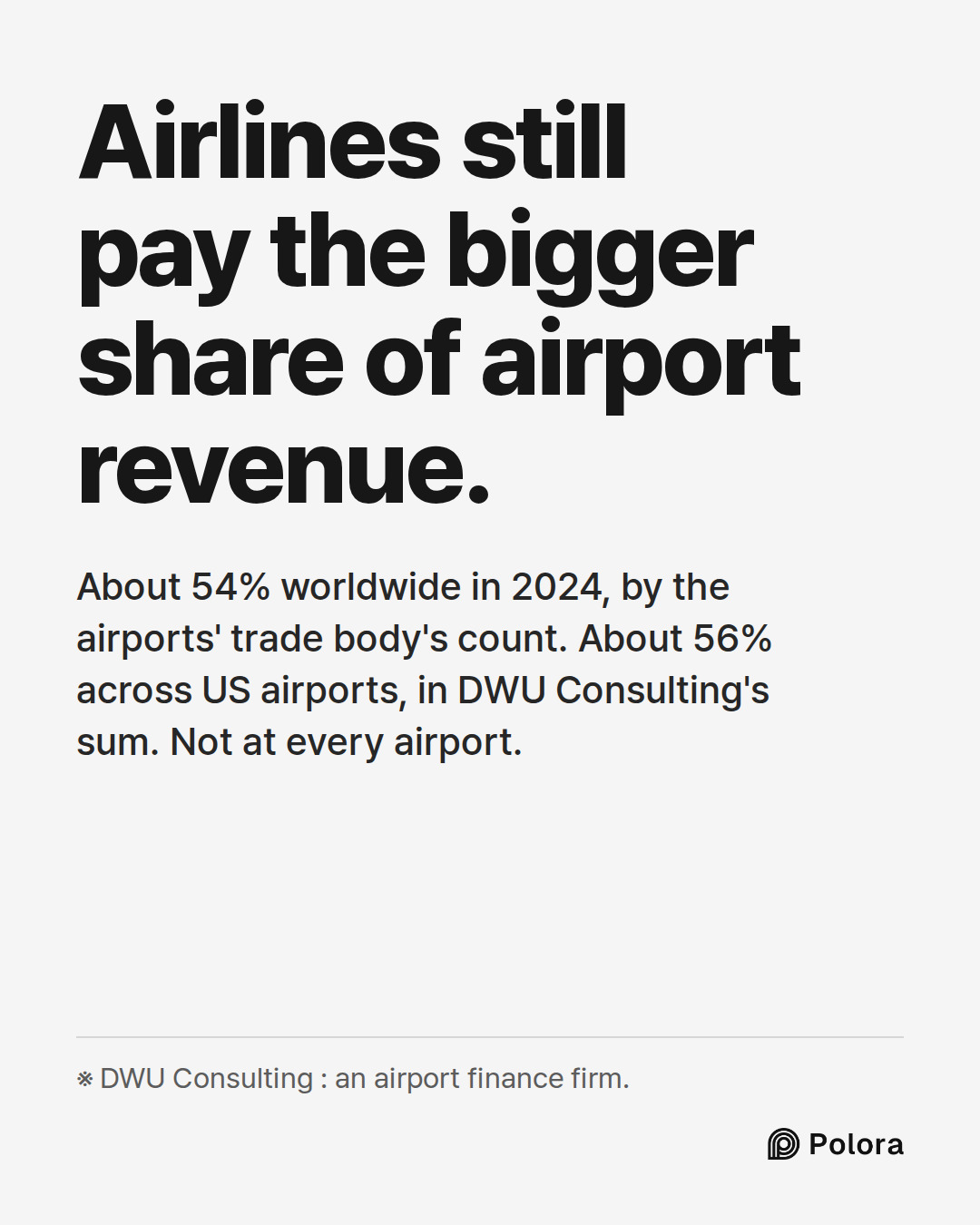
Airlines still pay the bigger share, but in the US it is close
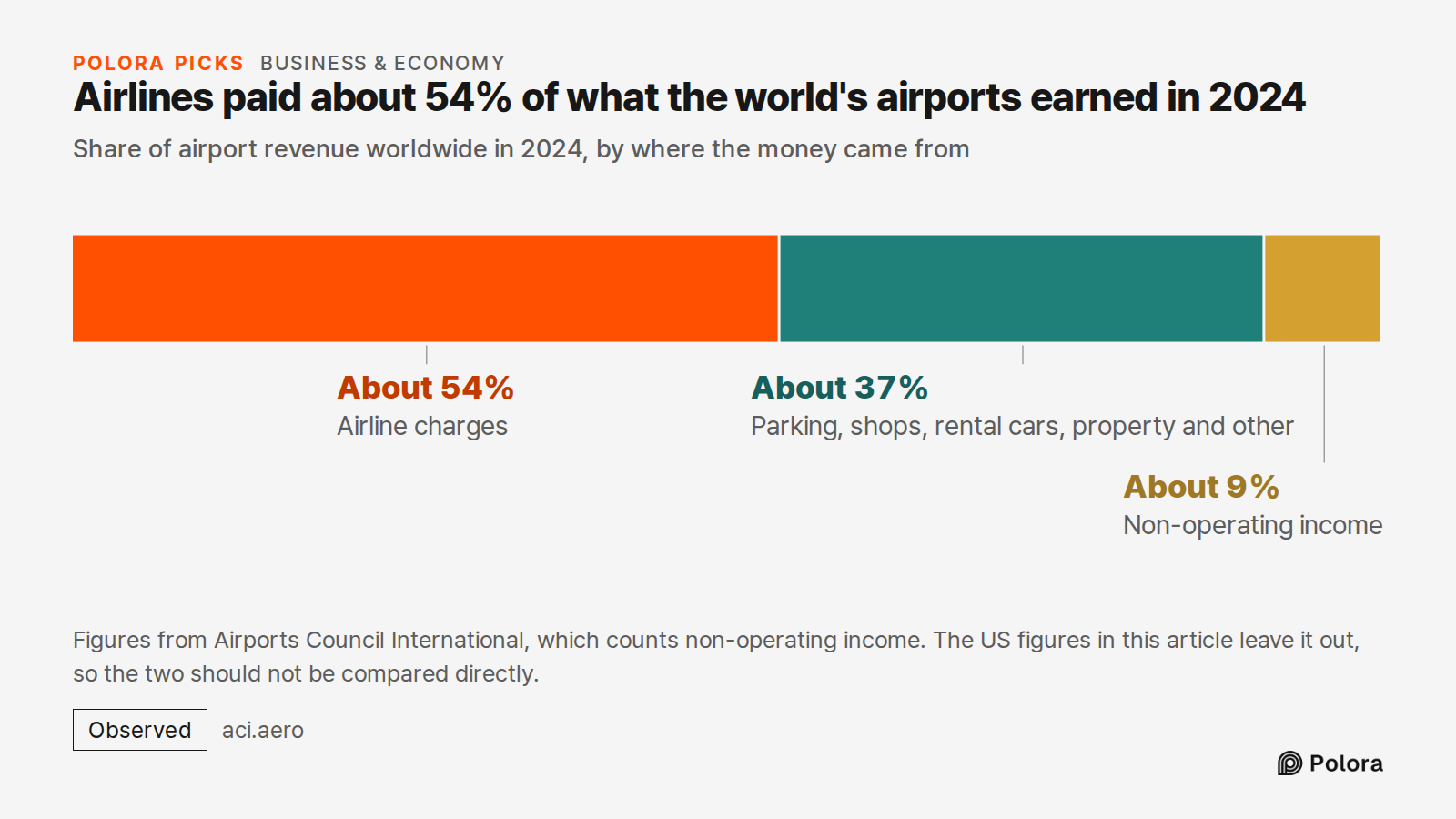
The short answer is no, at least in the totals. Airports around the world earned about 54% of their 2024 revenue from aeronautical charges. These are the fees airlines pay to land, to park their planes and to move passengers through the terminals. About 37% came from everything else that travellers and businesses pay for at an airport. That includes parking and shops, and also rental cars and property. The last 9% was non-operating income, money that does not come from running the airport itself. The figures come from the Airports Council International (ACI), the airports' global trade body.
In the United States the gap is smaller. Every year, US airports send their accounts to the Federal Aviation Administration (FAA). DWU Consulting, an airport finance firm, added up the 417 reports for fiscal year 2025 that had been filed by July 21, 2026. It counts $34.5 billion in operating revenue : $19.3 billion from airlines and $15.2 billion from other sources. That is about 56 to 44. This is DWU's sum, not a final national figure. Airports can amend their reports and more keep arriving, and DWU's dashboard now counts 424 airports.
The two sets of figures are measured differently. ACI includes non-operating income in its total and the US figures leave it out. So the percentages should not be laid side by side as if they measured the same thing. Both are also totals across many airports. They show which side is larger overall, not how many airports fall on each side.
Share of airport revenue worldwide in 2024, by where the money came from
In the US the biggest non-airline earner is the car park
The question puts parking and shops together, but at US airports they are far apart. Even together, they are only part of the money that does not come from airlines. In a webinar deck from June 2026, ACI put car parking in North America at 43.2% of non-aeronautical revenue in 2024. Shops were 6.9% and food and drink 7.6%. ACI noted that no other region has a parking share anywhere near this.
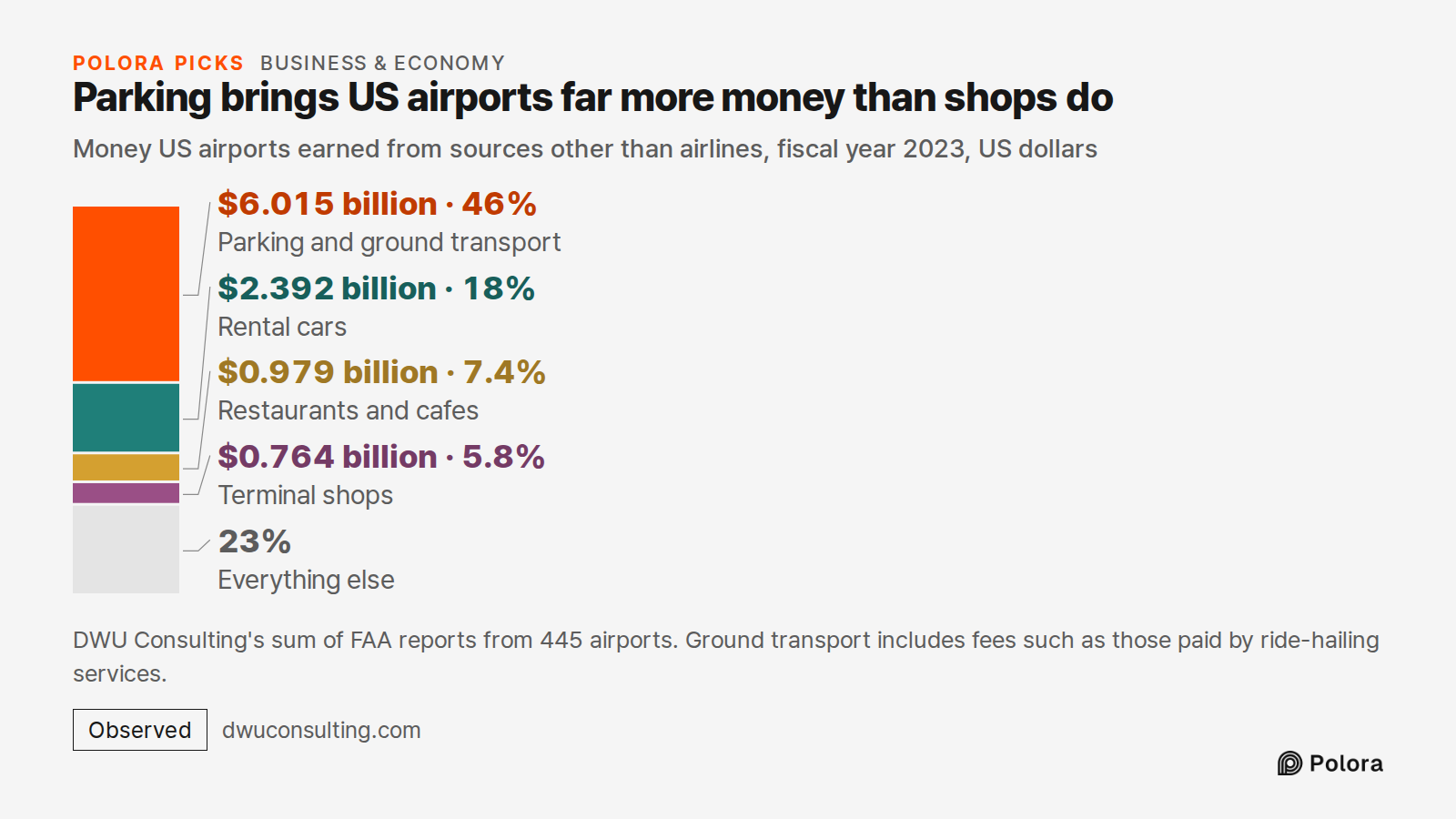
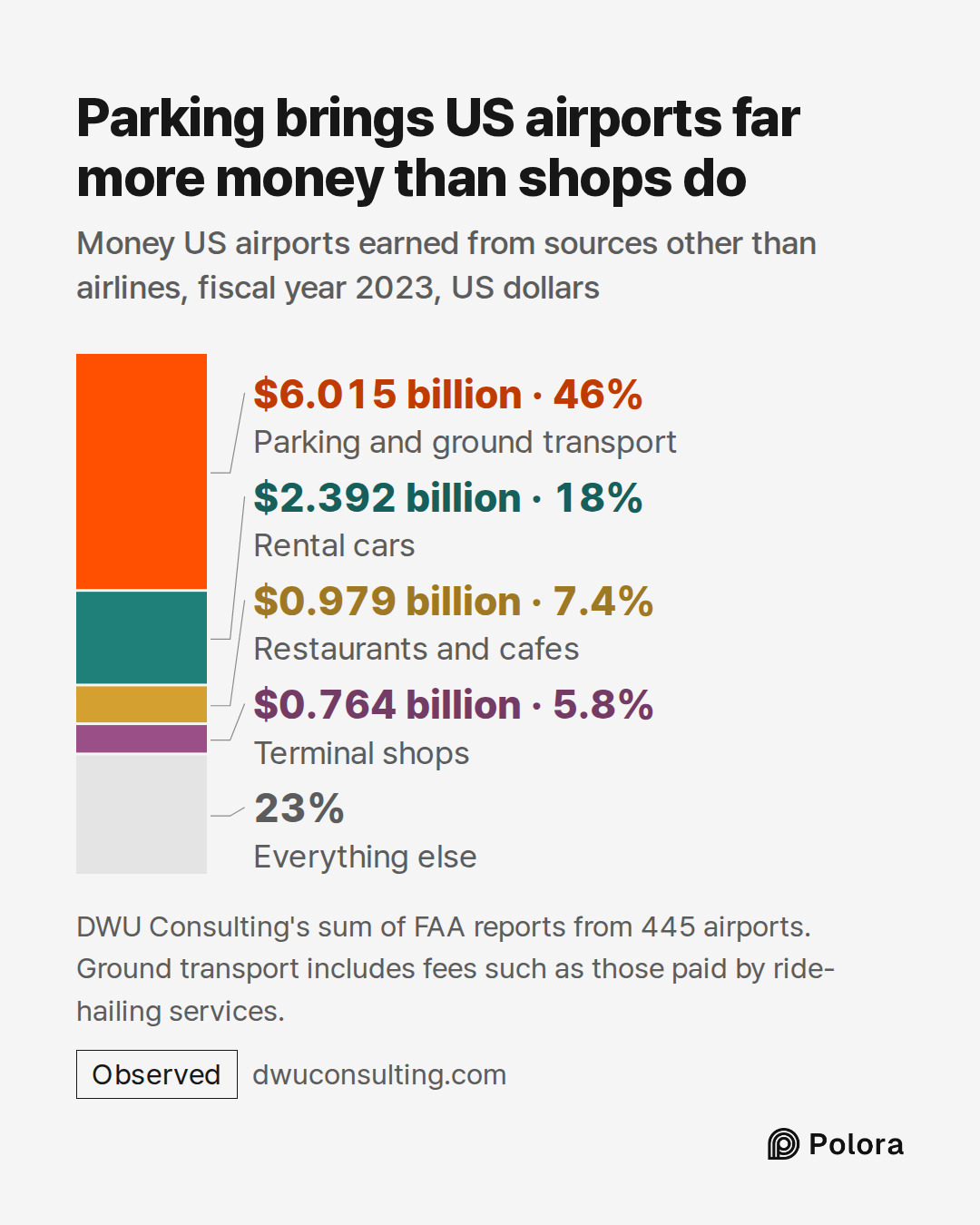
The FAA reports show the same thing in dollars. DWU added up the reports of 445 airports for fiscal year 2023. Of the $13.216 billion that did not come from airlines, $6.015 billion came from parking and ground transportation, about 45.5%. Ground transportation covers fees such as those paid by ride-hailing services. Rental car companies pay airports for their counters and lots, and they added $2.392 billion, or 18.1%. Terminal shops brought in $0.764 billion and restaurants and cafes $0.979 billion, together about 13%. DWU's newer figures for fiscal year 2025 put parking and ground transportation at $6.9 billion and rental cars at $2.5 billion, so the order has not changed.
So the coffee and the duty-free bag are a small slice. The money is in how you get to the airport and where you leave your car, and in the companies that rent you one.
Money US airports earned from sources other than airlines, fiscal year 2023, US dollars
Averages hide a wide range. DWU also split the fiscal year 2025 figures by airport size. At large airports about 59% of operating money came from airlines, and at medium-sized airports 50%. Small airports were the other way round, earning 58% of their operating money from sources other than airlines. So the national figure says little about any one airport.
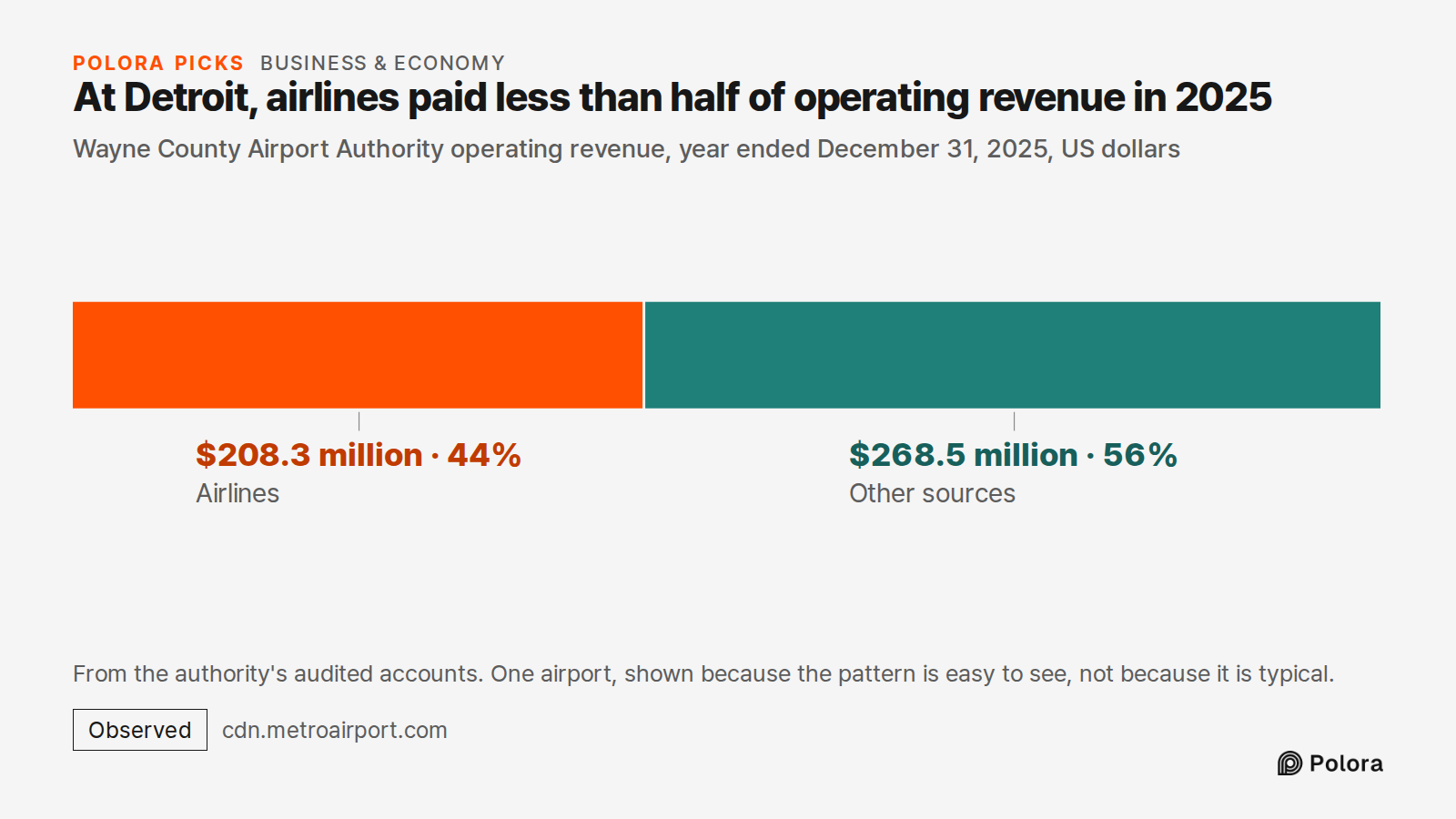
Detroit Metropolitan Wayne County Airport is one named case. In its audited accounts for the year ended December 31, 2025, the Wayne County Airport Authority, which runs the airport, reported $476.8 million in operating revenue. Airlines paid $208.3 million of that, about 44%, and $268.5 million came from other sources. Parking fees brought in $108.0 million, against $14.1 million from retail at Detroit Metro. The parking figure covers the whole authority, which also runs Willow Run airport, so it is not a figure for Detroit Metro alone.
One airport's mix is not every airport's. Detroit is shown here because it makes the pattern easy to see, not because it is typical.
Wayne County Airport Authority operating revenue, year ended December 31, 2025, US dollars
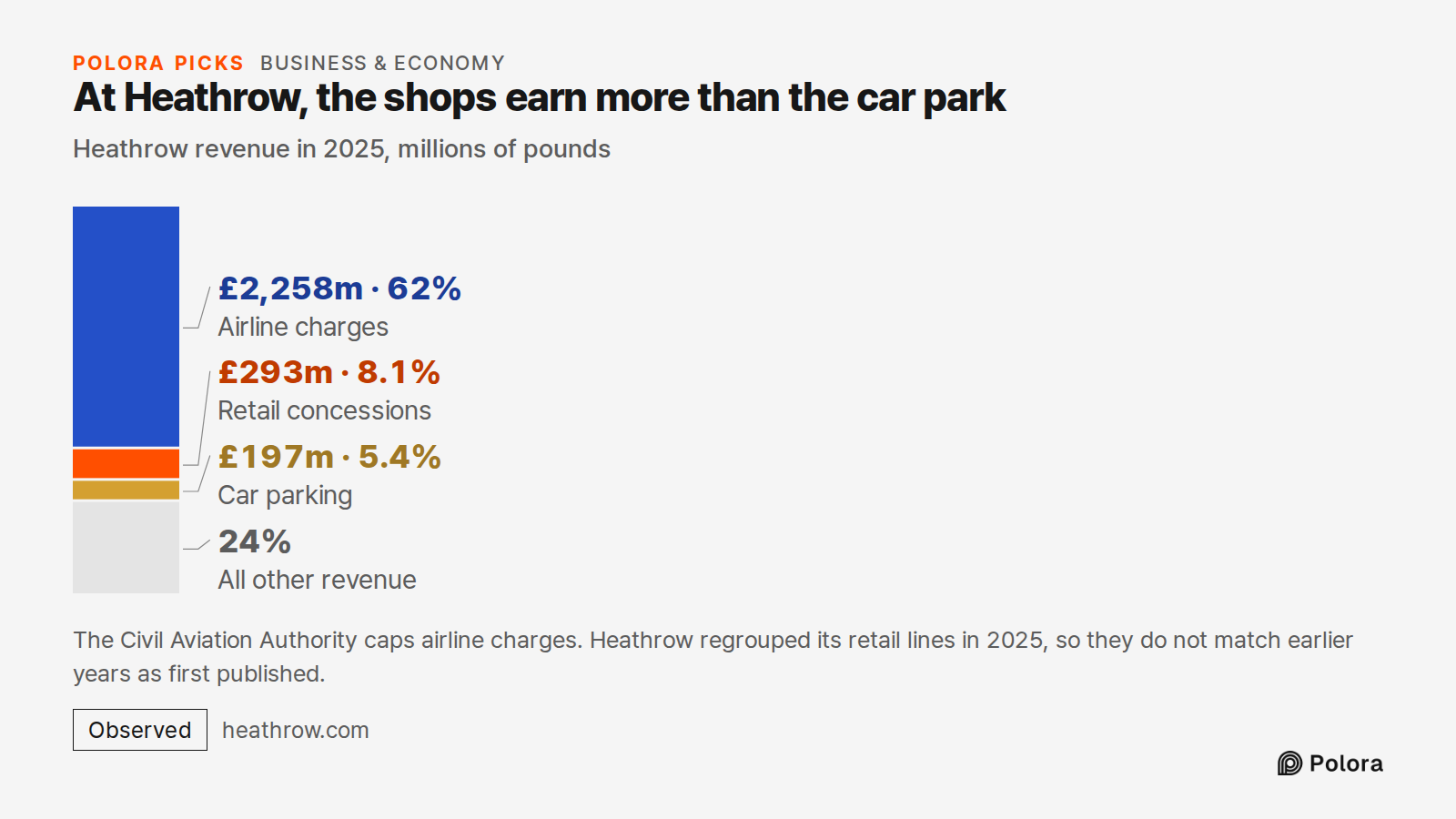
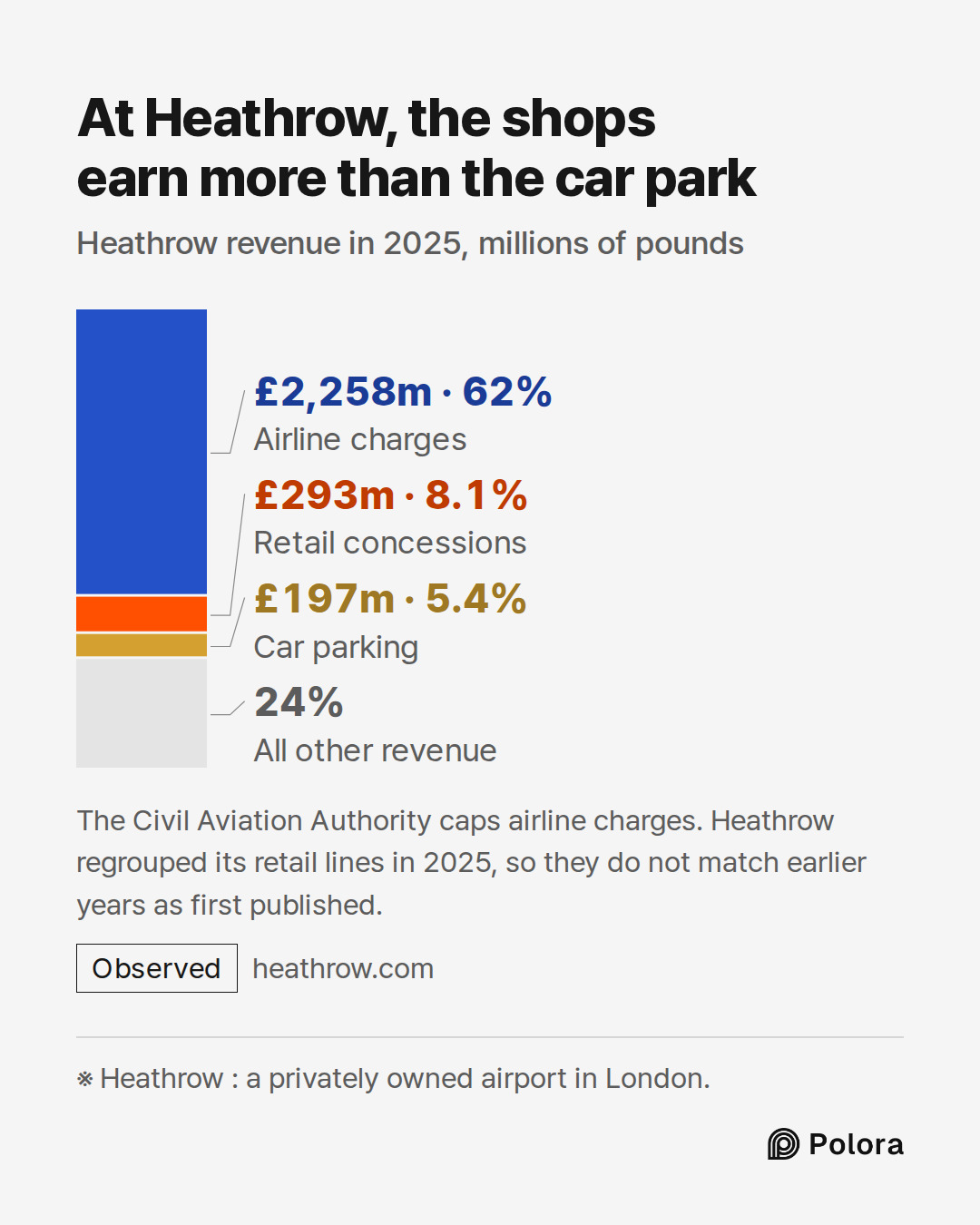
Heathrow in London is privately owned. A regulator, the Civil Aviation Authority, sets the most it may charge airlines. In 2025 Heathrow reported £3,623 million in revenue, and £2,258 million of it, about 62%, came from airline charges.
Heathrow reports a line called 'retail' worth £791 million, but that line includes the car park. Inside it, car parking brought in £197 million, about 5% of all revenue, and retail concessions £293 million. At this airport the shops earn more than parking. Heathrow regrouped these retail lines in its 2025 report, so they do not match figures for earlier years as first published.
Who owns an airport and who caps its prices changes what its accounts look like. That is one more reason no single answer fits every airport.
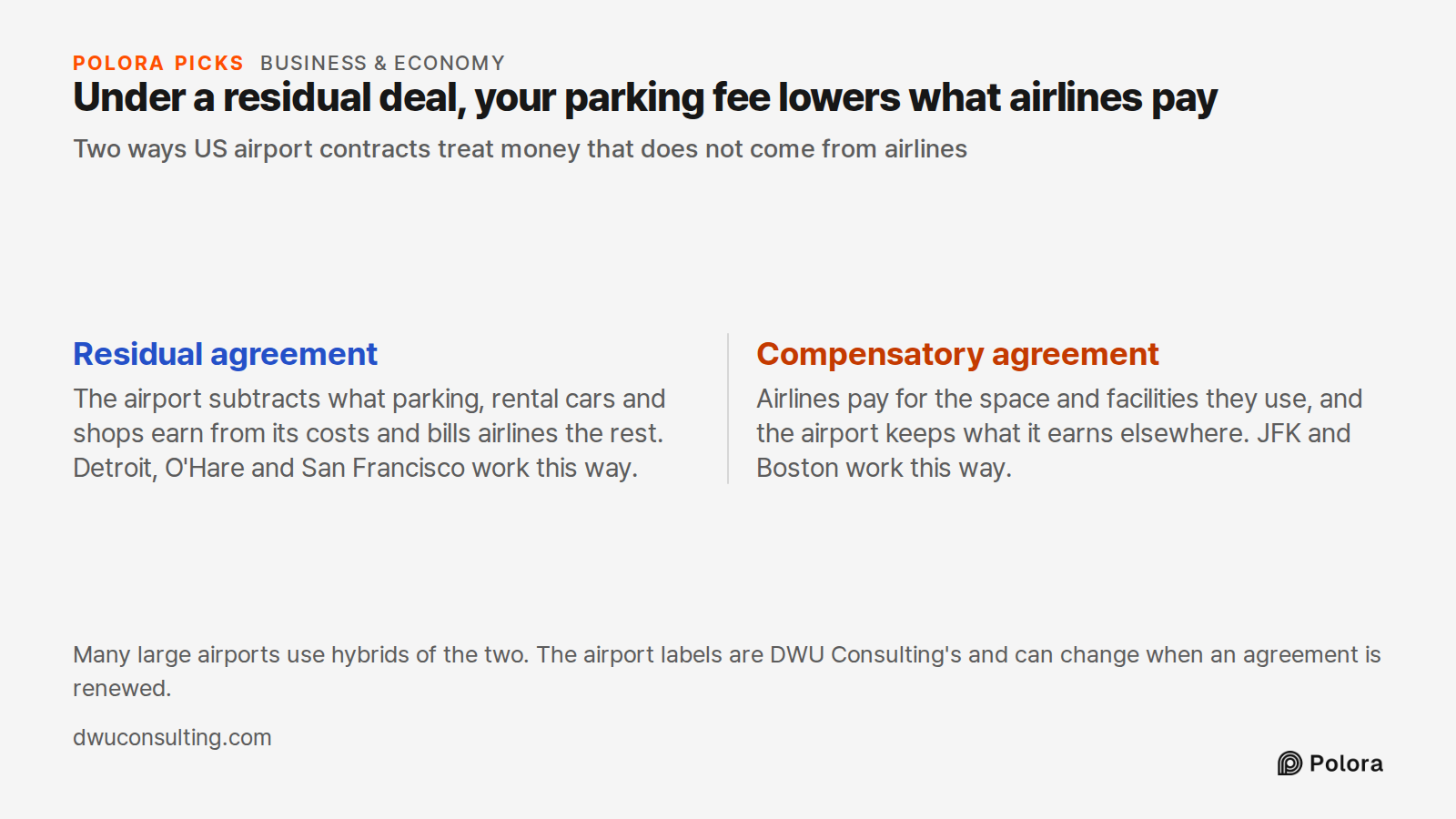
Many large US airports are owned by cities, counties or public authorities, such as the Wayne County Airport Authority at Detroit. They set what airlines pay through long contracts called airline use agreements. How a contract counts the money that does not come from airlines matters.
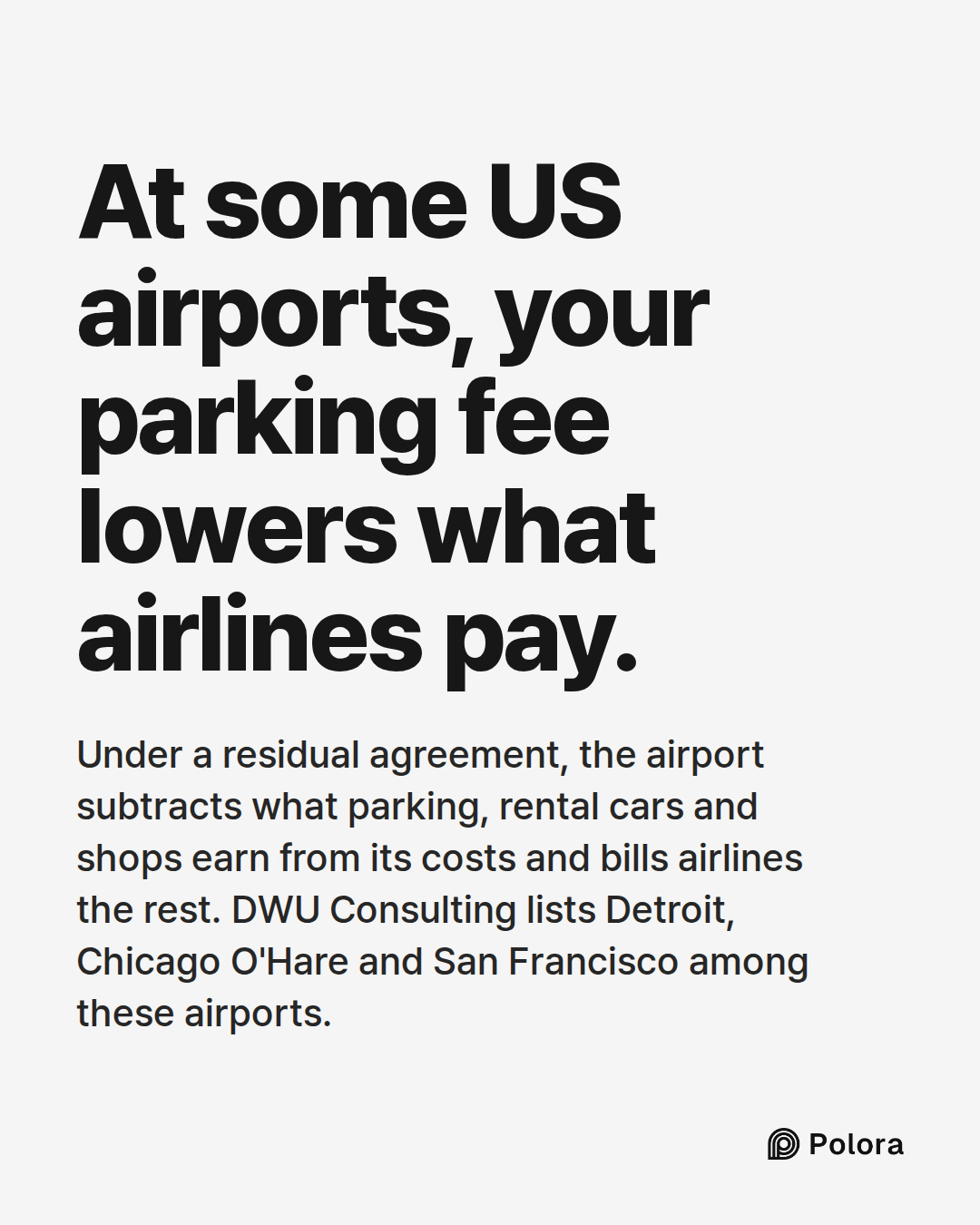
Under a residual agreement, the airport adds up its costs. It then subtracts what it earned from parking, rental cars, shops and everything else, and charges the airlines the rest. Every extra dollar from the car park lowers the airlines' bill. In return, the airlines guarantee that the airport's costs are covered. Detroit's own audited report describes this calculation, and DWU lists Detroit, Chicago O'Hare and San Francisco among the airports that work this way.
Under a compensatory agreement, airlines pay for the space and facilities they use, and the airport keeps what it earns elsewhere. DWU lists New York JFK and Boston among these. Many large airports, such as Los Angeles, Denver and Atlanta, use hybrids that mix the two, often sharing part of the non-airline money with the airlines. These are DWU's current labels, and they can change when an agreement is renewed.
At an airport with a residual agreement, then, money from parking and shops lowers what airlines are billed. As a result, the airlines' share in that airport's accounts is smaller than it would otherwise be. How much this shapes the national totals has not been measured.
Two ways US airport contracts treat money that does not come from airlines
What to remember next time you pay for airport parking
Across the world's airports, and across US airports added together, airlines still pay the larger share, though not at every airport. US airports get close to half their operating money from other sources. The biggest single piece is parking and ground transportation, not the shops. At airports with residual agreements, that money is written into how much the airlines are charged.
Airports watch the parking line closely because travel habits change it. That is why fees on pick-ups and drop-offs are now discussed alongside parking. At Dallas Fort Worth in fiscal year 2024, DWU's figures put ride-hailing fees at $39.0 million, against $209.4 million from parking. These figures come from DWU's analysis, not from the airport's own report.
Do airports make more money from parking and shops than from airlines?
Alpha · deepseek-v4-pro
No, not for most airports — but the question mixes two very different money streams.
Airlines still pay the larger share.
The broad global picture has aeronautical charges at roughly 54% of 2024 airport revenue, with about 37% coming from all non-aeronautical sources and 9% from non-operating income. So even if you lump parking, shops, food, car rental and everything else together, airlines still bring in more.
In the United States the gap is narrower. Adding up FAA filings for fiscal 2025 gives about $19.3 billion from airlines against $15.2 billion from all other operating sources — around 56/44. That is close, but airlines are still the larger of the two.
But parking and shops are not equal partners.
This is where the question goes wrong. In North America, car parking is about 43% of non-aeronautical revenue. Shops are only around 7%, and food and drink about 7.6%. In dollar terms from US figures, parking and ground transportation were roughly $6.0 billion, rental car concessions about $2.4 billion, while terminal shops brought in under $0.8 billion and restaurants under $1.0 billion.
So the real non-airline engine is the car park, not the duty-free bag. If the q…
Beta · gpt-6-sol
Usually no—but “parking and shops” is much narrower than “everything airlines don’t pay.” ACI World reports that aeronautical revenue made up 54% of airports’ total revenue worldwide in 2024, versus 37% from non-aeronautical businesses such as parking, shops, restaurants and car rental. Those figures support the manuscript’s overall answer, not a claim that airlines out-earn *parking and shops at every airport*. (aci.aero)
For the US, DWU Consulting’s aggregation of 417 FAA fiscal-2025 filings puts operating revenue at $19.3 billion aeronautical and $15.2 billion non-aeronautical—roughly 56/44. Its newer breakdown puts parking *and ground transportation* at $6.9 billion and rental cars at $2.5 billion. Neither category is parking alone; nor is all non-aeronautical revenue money paid directly by travellers. The 417 filings were a snapshot extracted on July 21, 2026, not a fixed final national total. The FAA confirms that airports can amend their filings. ([dwuconsulting.com](https://dwuconsulting.com/dwu-ai/us-airport-industry-…
Gamma · gemini-3.1-pro
I agree with the overall premise that airlines pay the larger share at most major airports, though the exact mix depends heavily on the airport's size and agreement structure.
To clear up a few remaining verification points from the research brief:
1. Heathrow 2025 Figures:
I checked Heathrow's 2025 Annual Report. I can confirm the top-line numbers stated in the manuscript: Heathrow reported £3,623 million in total revenue, with £2,258 million coming from aeronautical charges (roughly 62%) and £791 million from retail. The manuscript's claim that retail out-earns parking at Heathrow holds up at the macro level, as retail forms the largest non-aeronautical block there. (heathrow.com)
2. Residual vs. Compensatory Agreements:
The manuscript correctly describes how residual agreements work. I verified this against the Transportation Research Board's (TRB) ACRP Report 36, *Airport/Airline Agreements—Practices and Characteristics*. The report confirms that under a residual structure, airlines guarantee that the airport's costs are covered, and non-aeronautical revenues (like parking and concessions)…
Researcher · gpt-6-luna
Verification update: several claims are supported, but the turns above overstate what the data establish and contain an important Detroit correction.
- Global figures: ACI World’s March 17, 2026 release says that in 2024 aeronautical revenue was 54% of total airport revenue and non-aeronautical revenue 37%. It does not establish that airlines bring in more than parking and shops at most individual airports. Nor does that release confirm the manuscript’s finer breakdown of parking, retail and food-and-beverage shares.
Source: https://aci.aero/2026/03/17/policymakers-must-support-airport-investment-as-global-air-travel-demand-rises/ (aci.aero)
- US FY2025 figures: DWU’s overview supports its July 21, 2026 snapshot of 417 airports: $34.5 billion in operating revenue, including $19.3 billion aeronautical and $15.2 billion non-aeronautical. It also reports that large hubs were 59% aeronautical, medium hubs 50/50, and small hubs 58% non-aeronautical. These are a dated DWU aggregation of FAA filings, not a final, fixed FAA national total. DWU’s c…
The Arbiter · gpt-6-sol
The voices agree on the key distinction: parking and shops are only part of non-aeronautical revenue. The global and US figures discussed compare *all* non-aeronautical revenue with aeronautical revenue, so they cannot be presented as a direct parking-and-shops total. DWU’s US figures also combine parking with ground transportation in one reporting line; they do not isolate parking receipts. (dwuconsulting.com)
The strongest challenge to the manuscript’s wording is “at most airports.” The cited global and US totals add up dollars across airports. They show an aggregate split, not how many individual airports have airline revenue above parking and shops. DWU’s hub-size breakdown makes that distinction consequential: large hubs lean toward aeronautical revenue, medium hubs are near even, and small hubs lean toward non-aeronautical revenue. (dwuconsulting.com)
For the manuscript’s fact-check, the Researcher found that Detroit’s audited 2025 report conflicts with its date and figures. Beta and the Researc…
The Arbiter's Final Verdict · gpt-6-sol
Generally, no in the aggregate figures checked—but it depends on the airport. ACI World reports that aeronautical revenue made up 54% of global airport revenue in 2024, while *all* non-aeronautical revenue—not just parking and shops—made up about 37%. A dated aggregation of US airport filings likewise puts aeronautical operating revenue ahead, $19.3 billion to $15.2 billion for all other operating revenue. (ACI World; DWU Consulting)
That does not prove airlines bring in more at *most individual airports*: totals across airports cannot tell us how many airports fall on either side. Detroit’s airport authority, for example, reported more non-airline than airline operating revenue in 2025. Nor should “parking and shops” be treated as the whole non-airline side—it also includes such sources as rental cars and property. ([Wayne County Airport Authority audited report](https://cdn.metroairport.com/uploads/business_documents/PDFs/Finance/CAFR/55154%20-%20Wayne%20County%20Airport%20Authority%20A…