Who really makes money from the Olympics, the host city or the IOC?

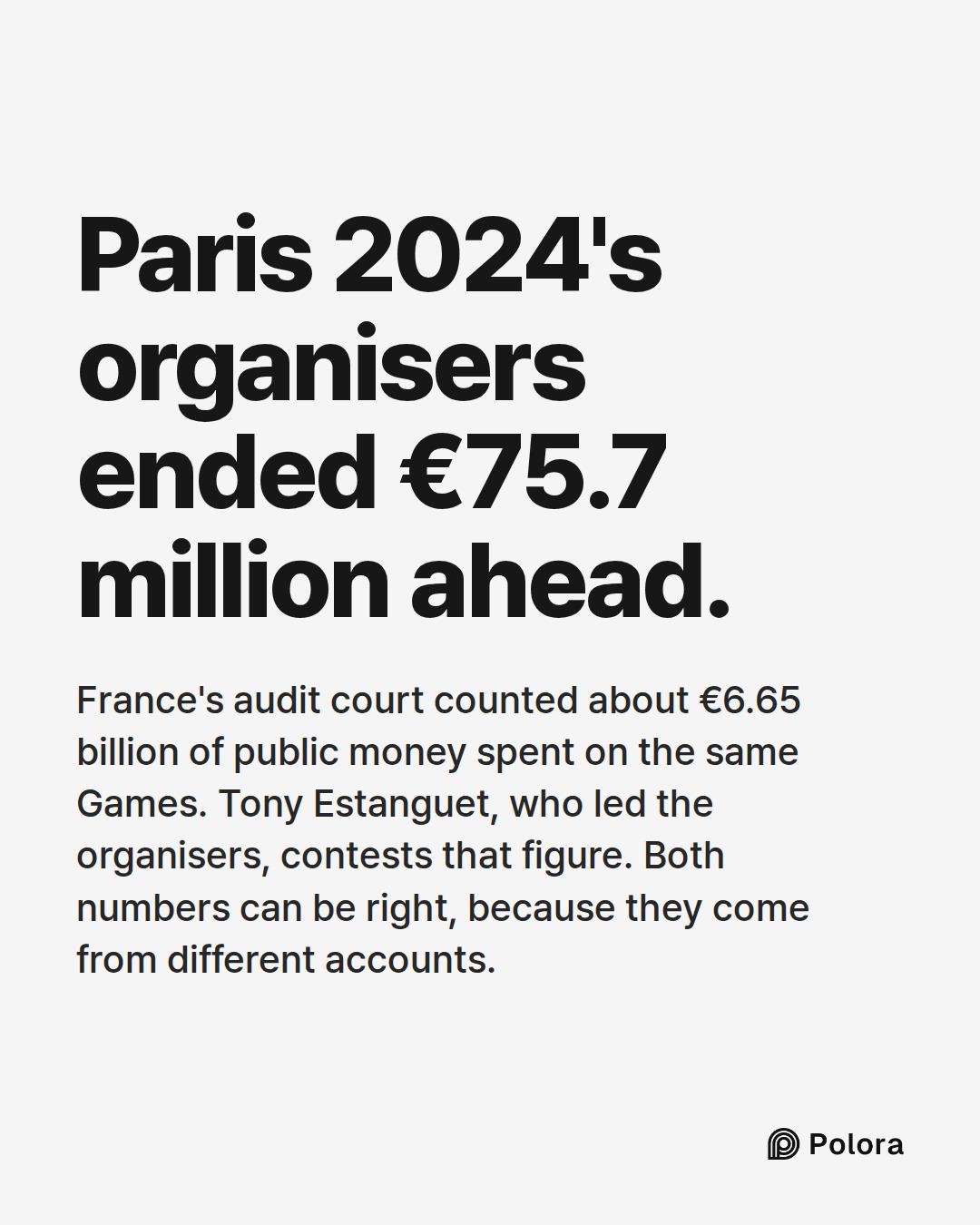
The IOC has the safer income. It sells TV rights and global sponsorships years ahead, while public bodies in the host country pay for venues, transport and security. Paris 2024's organisers ended €75.7 million ahead, and France's auditors counted about €6.65 billion in public spending, most of it by the national government.

Business & Economy · 2026-10-17

Paris made a profit, and France paid billions

In June 2025 the committee that organised the Paris 2024 Olympics and Paralympics closed its books with a surplus of €75.7 million. Six months earlier it had announced €26.8 million. The figure rose as the last contracts with suppliers were settled. By the standards of the Games, that is a good result.

Three months later France's national audit court, the Cour des comptes, published a very different figure. It found that about €6.65 billion of public money had been spent on the same Games. Against it, the court could identify only about €293.6 million coming back to the public sector in tax and commercial receipts. Tony Estanguet, who led the organising committee, said he strongly contested the figure.

Both numbers can be right, because they come from two different sets of accounts. The gap between them is the answer to the question.
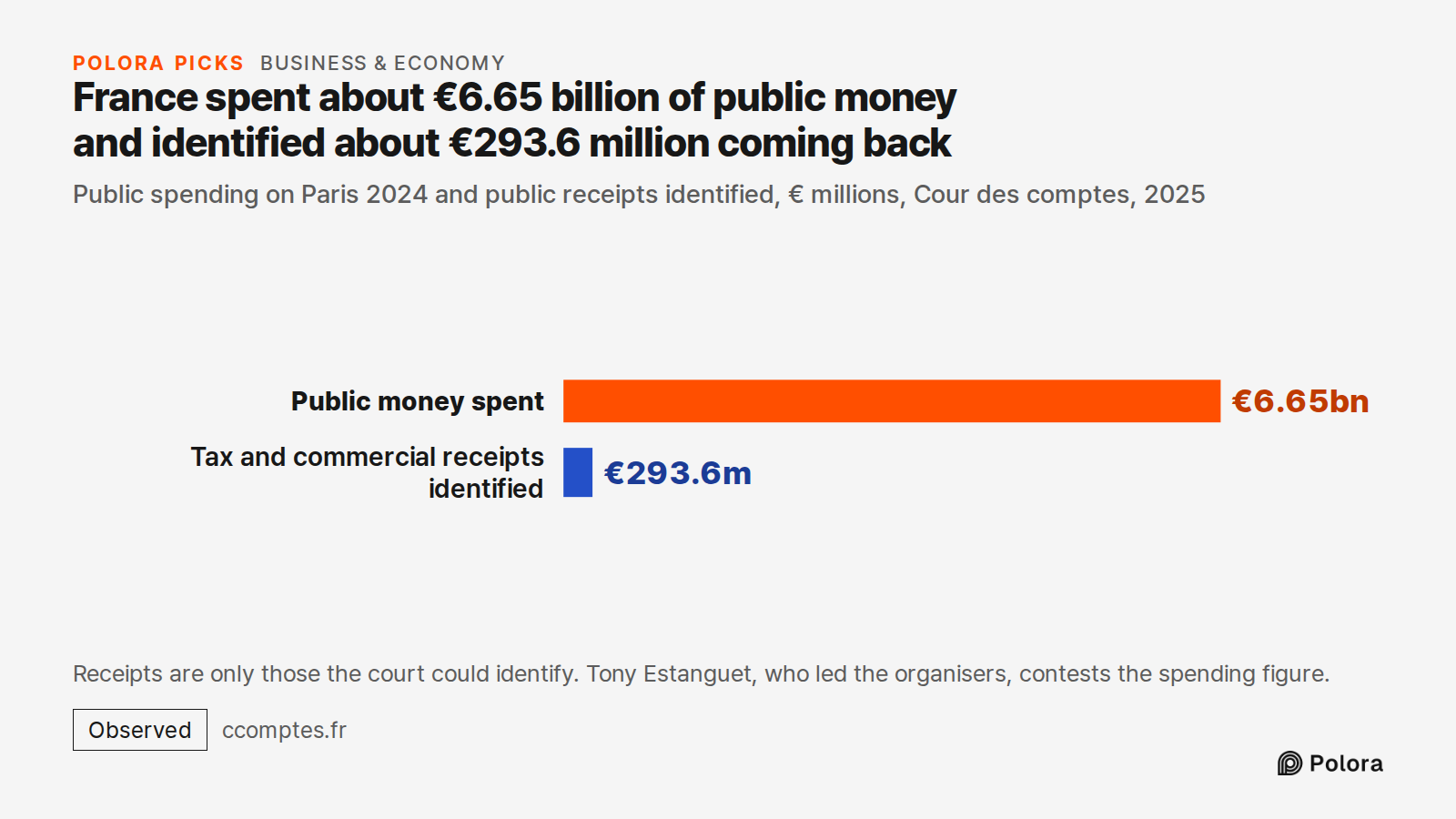
France spent about €6.65 billion of public money and identified about €293.6 million coming back · Public spending on Paris 2024 and public receipts identified, € millions, Cour des comptes, 2025 · Public money spent · Tax and commercial receipts identified · €6.65bn · €293.6m · Receipts are only th
Public spending on Paris 2024 and public receipts identified, € millions, Cour des comptes, 2025

What the organisers' budget covers, and what it leaves out

An organising committee pays to run the event itself : staff, operations, ceremonies, temporary installations. In Paris it took in €4,494.2 million and spent €4,418.5 million. Most of that revenue was private. By December 2024 the committee counted about €1.333 billion from tickets, €1.238 billion from sponsors it signed in France, and €1.228 billion passed on by the IOC from its own TV and sponsorship deals. Public subsidies to the committee came to €224.1 million, and the surplus was reached with that money included.

The second ledger belongs to the public sector. The Cour des comptes counted €3.02 billion of public spending on running the Games, €1.44 billion of it for security, plus €3.63 billion for infrastructure such as venues, the athletes' village and transport. When it reported, it had identified no budgetary revenue on the infrastructure side.

The auditors attribute about €3.88 billion of that spending to the French state and its agencies, and about €2.36 billion to local authorities and their agencies taken together, with public enterprises also involved. Local authorities here means several bodies, not the City of Paris alone, and the report does not show how much the city's own government paid.

Not all of this is money gone. The auditors separate the cost of the event from infrastructure that adds to the country's assets, while saying its longer-term economic returns remain uncertain.

So when people say the Games paid for themselves, that is true of the committee's books, which include public subsidies, and not of the public accounts as a whole.
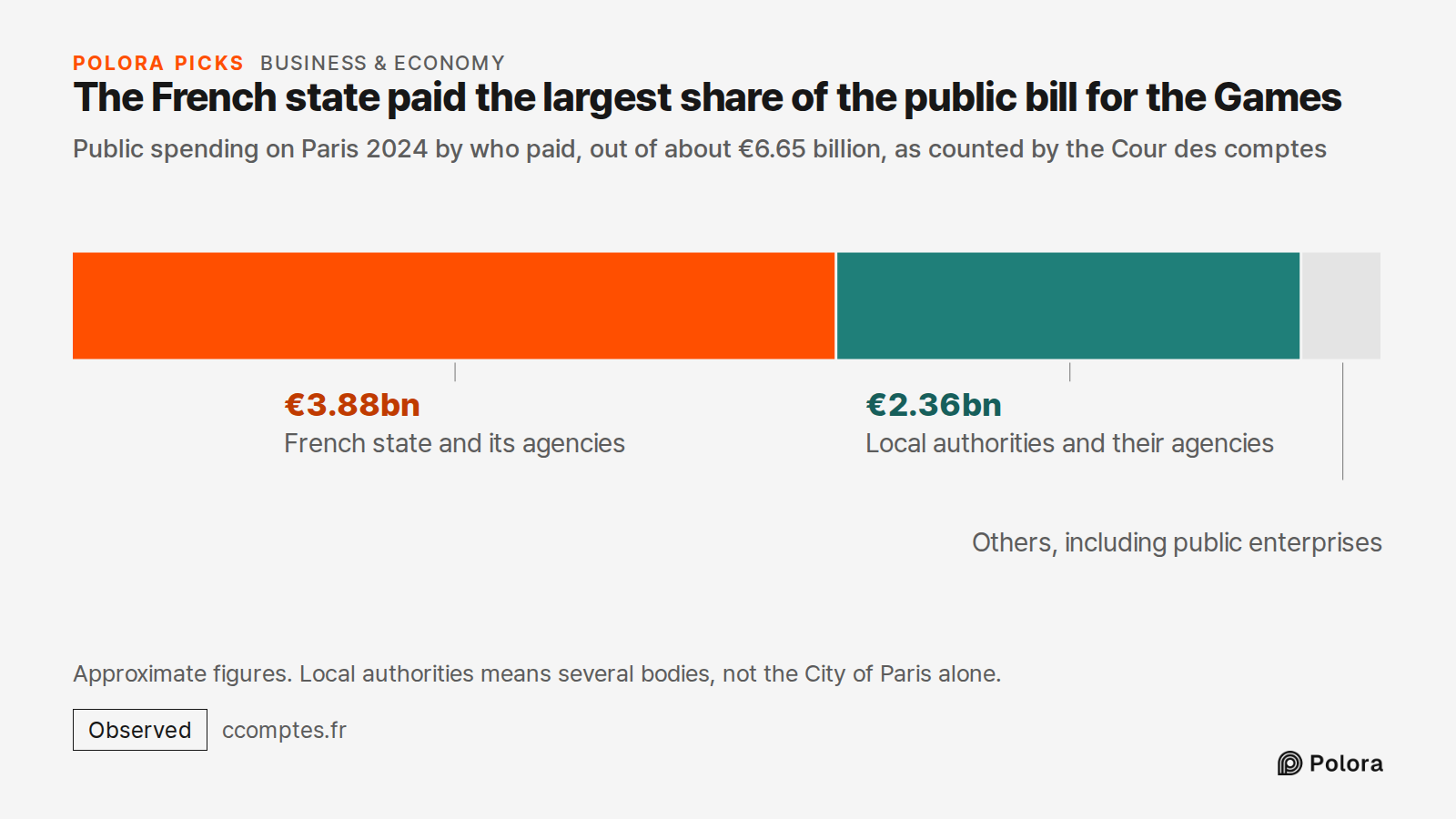
The French state paid the largest share of the public bill for the Games · Public spending on Paris 2024 by who paid, out of about €6.65 billion, as counted by the Cour des comptes · French state and its agencies · Local authorities and their agencies · €3.88bn · €2.36bn · Others, including public e
Public spending on Paris 2024 by who paid, out of about €6.65 billion, as counted by the Cour des comptes

The IOC sells the Games before anyone hosts them

The International Olympic Committee, the private body based in Switzerland that owns the Games, earns most of its money in two ways. It sells TV rights to broadcasters around the world, and it sells global sponsorship to a small group of companies through what it calls the TOP Programme. From 2021 to 2024 these commercial deals brought in $7.7 billion, which the IOC calls a record.

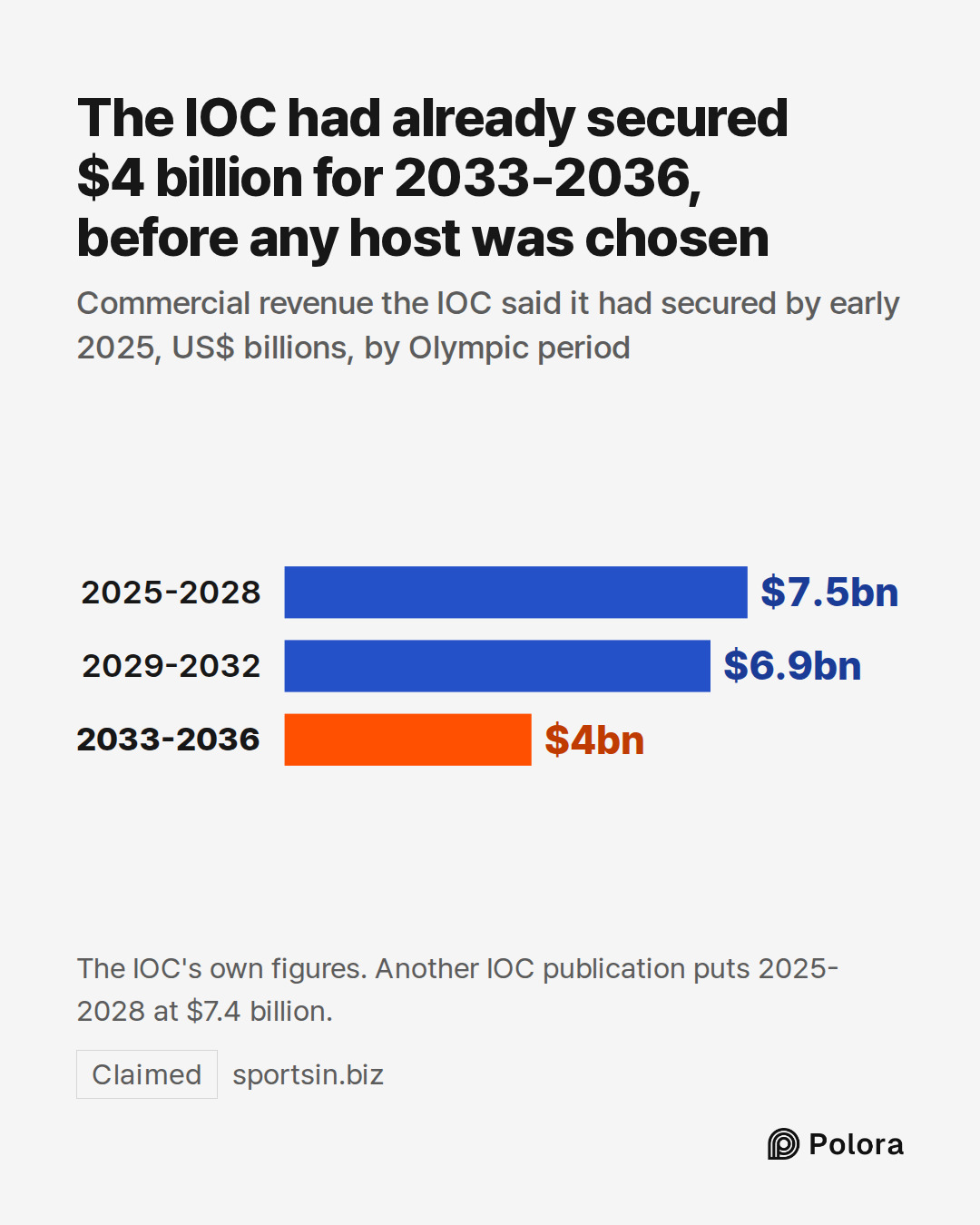
The deals are signed years, sometimes more than a decade, ahead. By early 2025 the IOC said it had already secured $7.5 billion for 2025-2028, $6.9 billion for 2029-2032 and $4 billion for 2033-2036, a period that includes Games with no host yet. Another IOC publication puts the 2025-2028 figure at $7.4 billion. Either way, the money is agreed long before any host's stadium goes up or its budget is tested.

A badly run Games would still hurt the IOC eventually, because the next deals would be harder to sell. But most of the income tied to any one Games is agreed before the host spends its first euro.
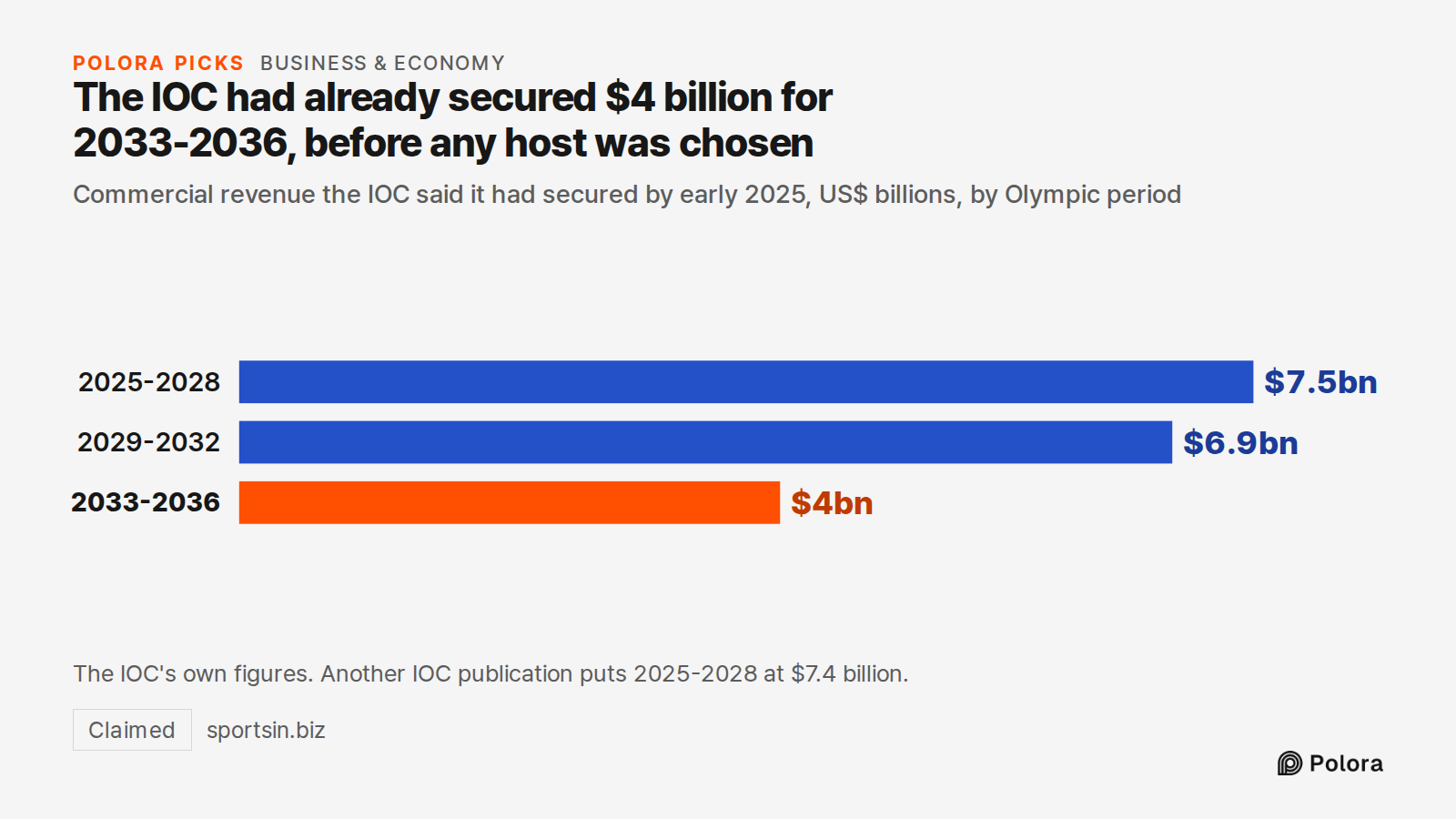
The IOC had already secured $4 billion for 2033-2036, before any host was chosen · Commercial revenue the IOC said it had secured by early 2025, US$ billions, by Olympic period · 2025-2028 · 2029-2032 · 2033-2036 · $7.5bn · $6.9bn · $4bn · The IOC's own figures. Another IOC publication puts 2025-202
Commercial revenue the IOC said it had secured by early 2025, US$ billions, by Olympic period

How much the IOC passes on depends on who is counting

The IOC says it distributes more than 90 percent of its revenue across the Olympic Movement, the equivalent, in its words, of $4.7 million a day, and uses the rest to run itself. Part of that goes to each Games' organising committee. Paris received about €1.228 billion, roughly a quarter of its budget. The rest goes to international sports federations, national Olympic committees and programmes for athletes.

Outside counts come out lower. The Sports Examiner, a US newsletter that covers Olympic business, went through the IOC's 2024 annual report and calculated that 73.9 percent of revenue was paid out in 2021-2024, or 64.9 percent if media rights from the Tokyo 2020 Games are left out. By its count, much of the remainder went to running costs and to reserves of about $4.9 billion. The result depends on which years and which revenue are counted, so the 90 percent is the IOC's own formulation rather than a settled figure.

Money also flows back the other way. Under the arrangements reported for Paris, 20 percent of the organisers' surplus goes to the IOC and 20 percent to France's national Olympic committee, with the rest meant for sport in France.
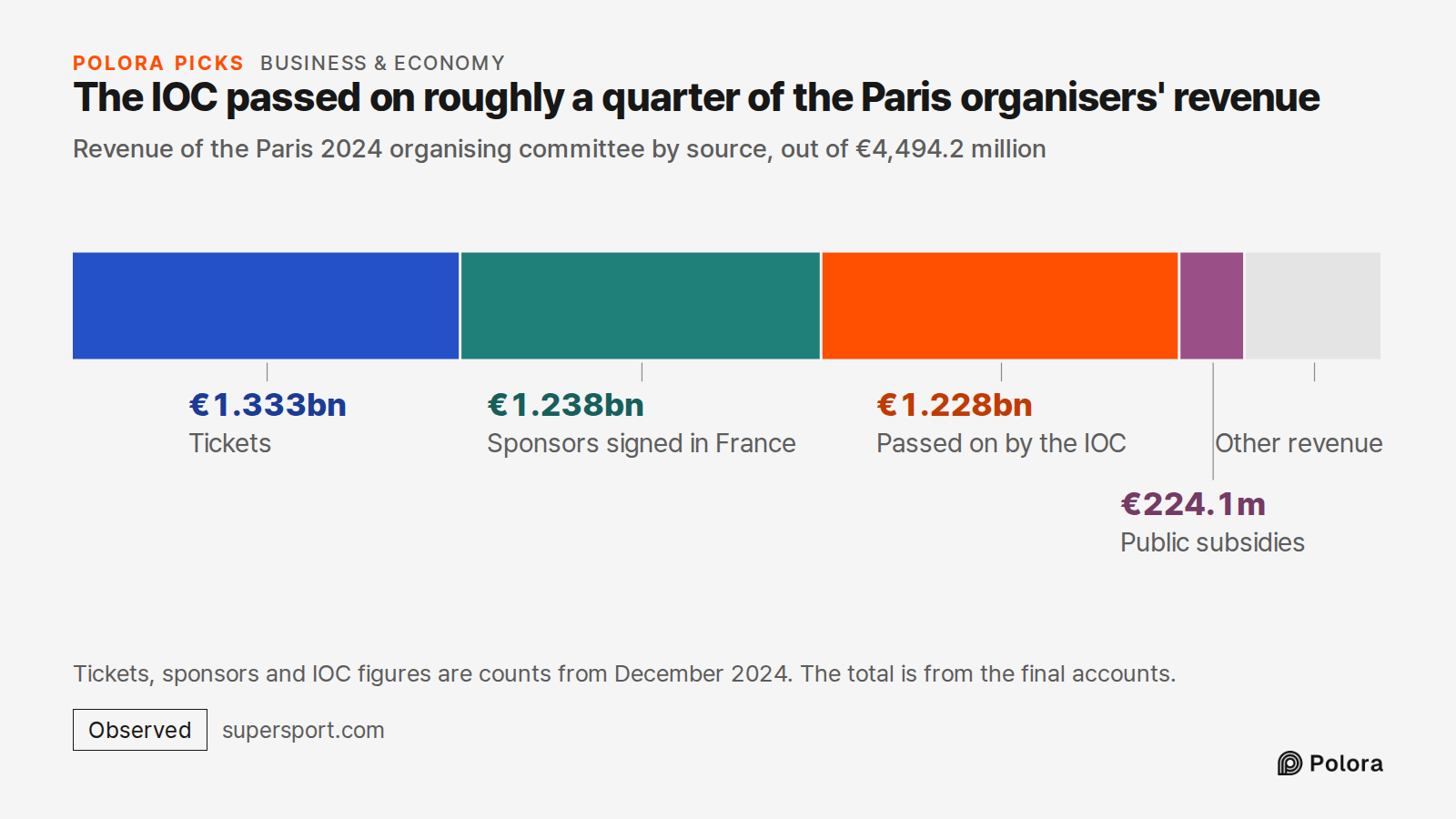
The IOC passed on roughly a quarter of the Paris organisers' revenue · Revenue of the Paris 2024 organising committee by source, out of €4,494.2 million · Tickets · Sponsors signed in France · Passed on by the IOC · Public subsidies · €1.333bn · €1.238bn · €1.228bn · €224.1m · Other revenue · Ticket
Revenue of the Paris 2024 organising committee by source, out of €4,494.2 million

Who signs for the shortfall

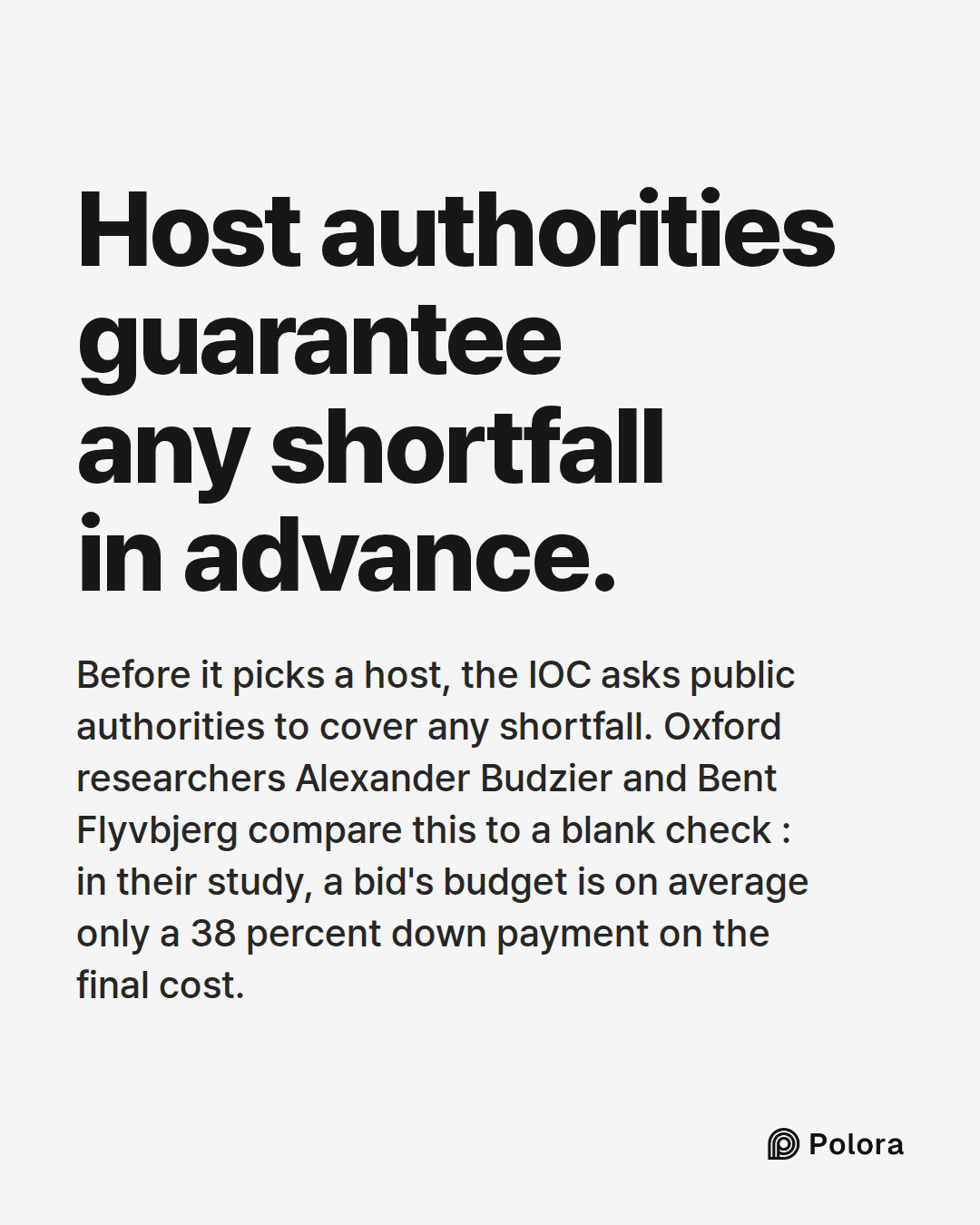
Before it picks a host, the IOC asks for guarantees that public authorities will cover any shortfall in the organising committee's budget. When Los Angeles was bidding for the 2024 Games, the city committed to covering any shortfall. California added its own guarantee, capped at $250 million, which would apply only after the city's. Los Angeles ended up with the 2028 Games, and the terms in force for them may differ.

The Oxford researchers Alexander Budzier and Bent Flyvbjerg compare this to writing a blank check : the host agrees in advance to pay whatever the Games end up costing. In their study, the budget in a bid is on average only a 38 percent down payment on the final cost.
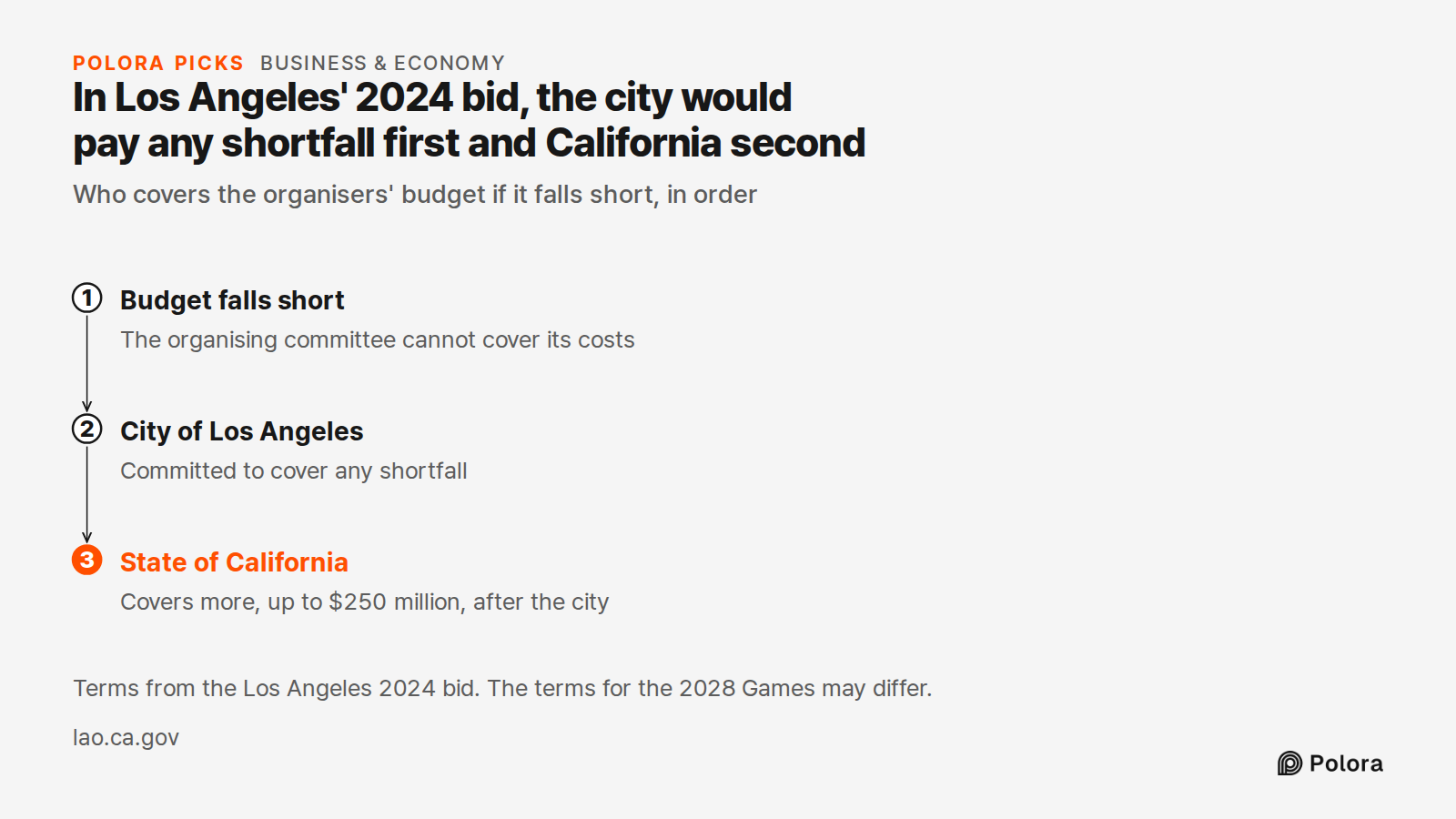
In Los Angeles' 2024 bid, the city would pay any shortfall first and California second · Who covers the organisers' budget if it falls short, in order · Budget falls short · City of Los Angeles · State of California · The organising committee cannot cover its costs · Committed to cover any shortfall
Who covers the organisers' budget if it falls short, in order

Every Olympics with cost data has gone over budget

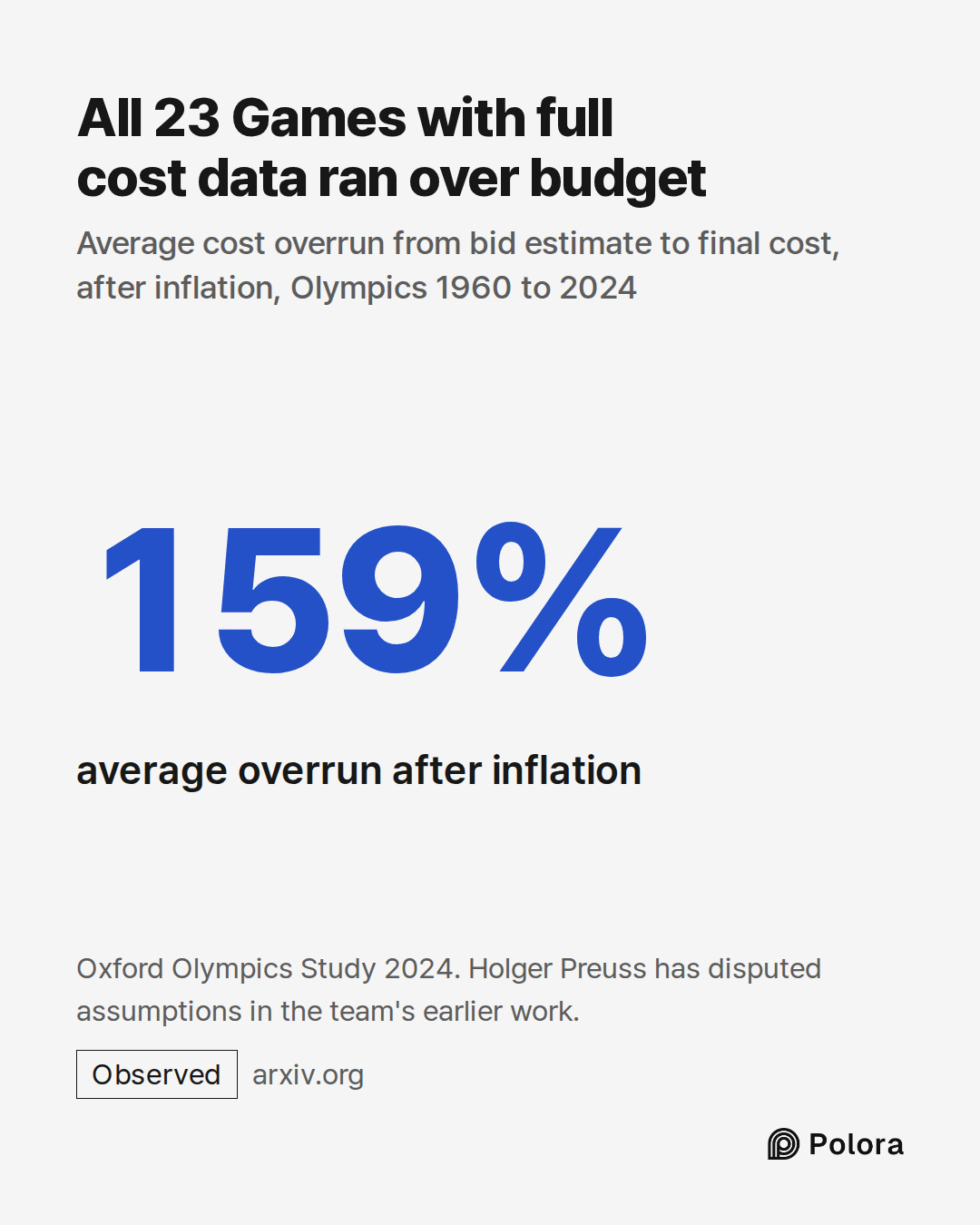
The Oxford Olympics Study 2024 gathered cost data for every Games from 1960 to 2024. For the 23 Games where both the bid estimate and the final cost were known, every one ran over budget. After inflation the average overrun was 159 percent, the second highest of any type of large project the authors track. Only nuclear waste storage was worse. They also found that the cost of the Games is rising, not falling.

The Cour des comptes found no overall budget slippage in Paris. The Oxford authors, counting only sports-related costs and leaving out wider infrastructure, still put the cost of Paris at $8.7 billion in 2022 dollars, 115 percent above the original estimate. The two studies measure different things, so their totals should not be set side by side.

The Oxford method has critics. In 2022 Holger Preuss published a peer-reviewed paper disputing assumptions and comparisons in the team's earlier work. It did not show that hosting pays for itself.
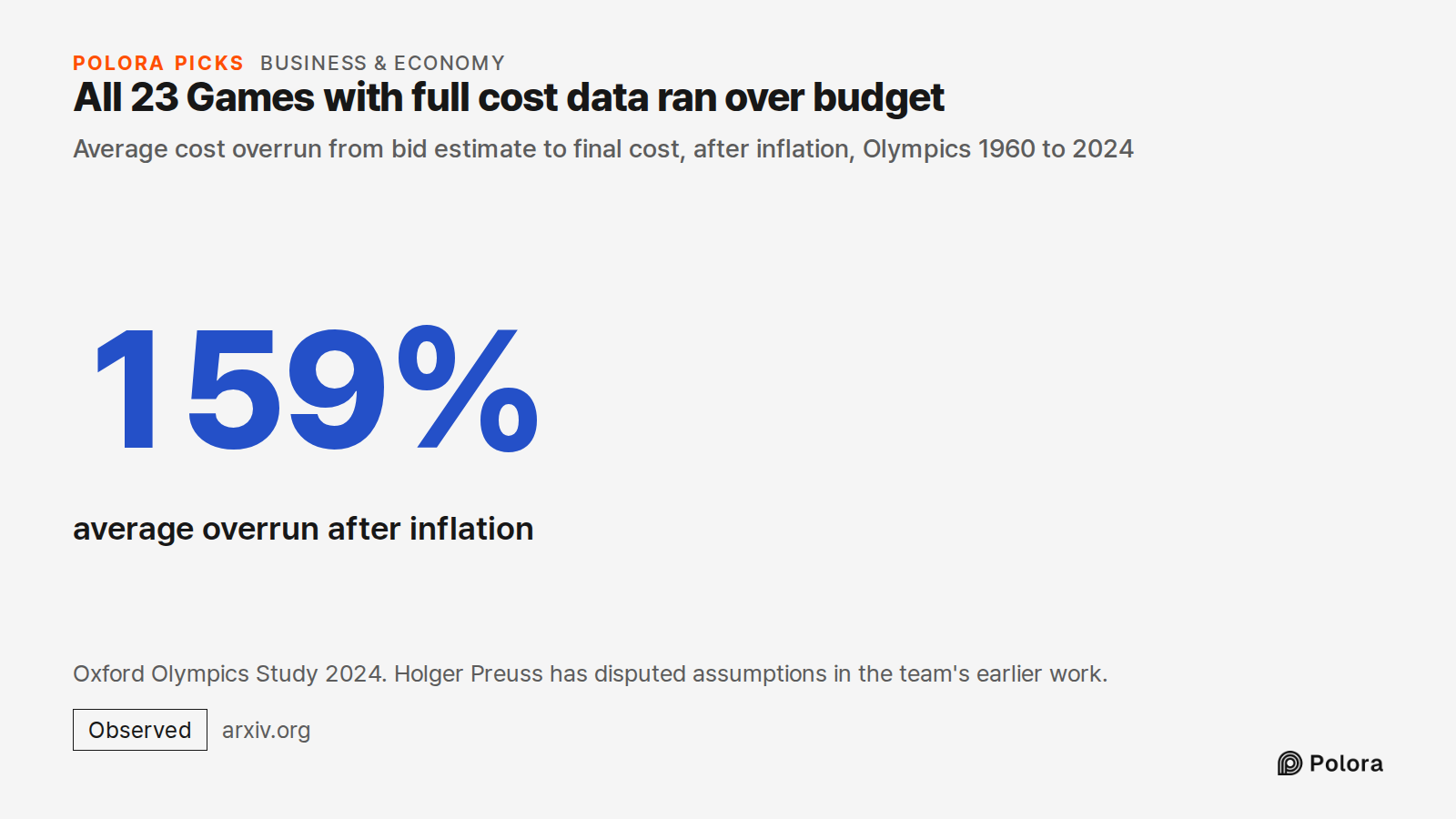
All 23 Games with full cost data ran over budget · Average cost overrun from bid estimate to final cost, after inflation, Olympics 1960 to 2024 · 159% · average overrun after inflation · Oxford Olympics Study 2024. Holger Preuss has disputed assumptions in the team's earlier work.
Average cost overrun from bid estimate to final cost, after inflation, Olympics 1960 to 2024

The promised payoff rarely arrives

Hosts justify the bill with what comes afterwards : tourists, investment, a better-known city. In 2016 the economists Robert Baade and Victor Matheson reviewed the research and concluded that in most cases the Olympics lose money for host cities. They found the Games pay off only in very specific and unusual circumstances, and that the case is weaker still in developing countries.

Paris is consistent with that so far. The Cour des comptes estimated that the Games added about 0.07 percentage points to France's growth in 2024. Hotel stays in the Paris region fell significantly that summer, among both residents and foreign visitors. On the new infrastructure, the auditors wrote that its operation seems unlikely to produce positive economic returns, though they also said its longer-term value was not yet established.

Baade and Matheson also count civic pride and the feel-good effect as real benefits. Those benefits are just hard to weigh against a bill in billions.

Fewer cities want the deal

Voters have noticed. In the race for 2024, Boston, Hamburg, Rome and Budapest all dropped out, largely because residents were worried about cost. That left Paris and Los Angeles, and the IOC gave one the 2024 Games and the other 2028. The 2022 Winter Games had come down to just China and Kazakhstan.

The IOC has changed how it chooses. Instead of an open race, it now picks a preferred host and negotiates with that city alone. Brisbane was the first host chosen this way, confirmed for 2032 by 72 votes to 5 with no rival city on the ballot. The Los Angeles organisers say they plan to build no new permanent venues. The Oxford authors doubt that reusing venues is enough : they found it did not have the desired effect in Tokyo and looked ineffective in Paris.

So who comes out ahead?

The IOC's income is largely sold before a host is chosen, and it passes a large share of it on to organisers and the wider Olympic Movement. Public authorities in the host country guarantee any shortfall and pay for the stadiums, trains and police, and whether that spending earns anything back over the long run is not yet known in Paris. An organising committee can end in profit, as Paris did, while the public bill runs to billions. So when someone says an Olympics made money, the question to ask is : whose accounts?
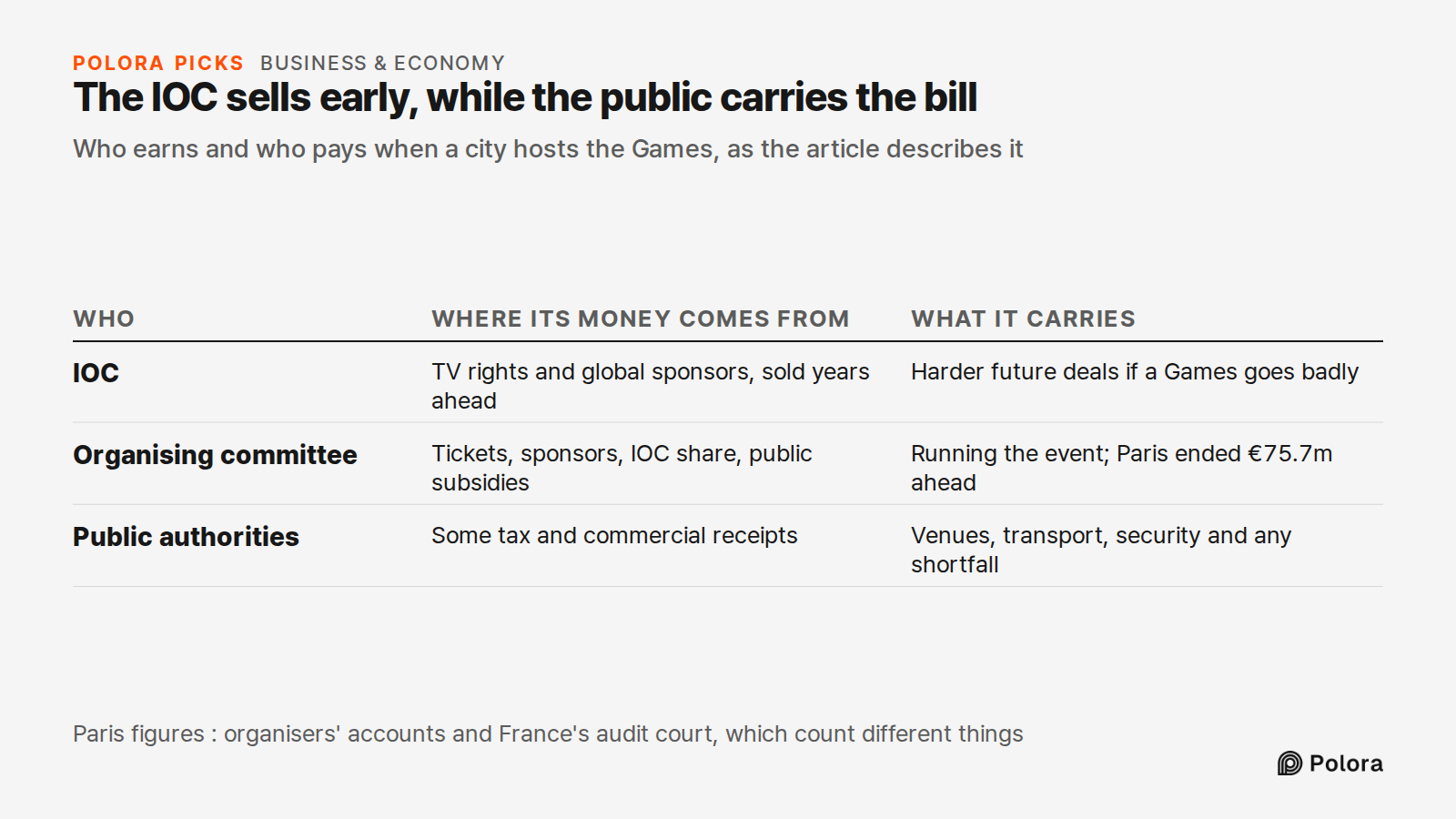
The IOC sells early, while the public carries the bill · Who earns and who pays when a city hosts the Games, as the article describes it · Who · Where its money comes from · What it carries · IOC · Organising committee · Public authorities · TV rights and global sponsors, sold years ahead · Harder f
Who earns and who pays when a city hosts the Games, as the article describes it
Who really makes money from the Olympics, the host city or the IOC?Who really makes money from the Olympics, the host city or the IOC?The IOC sells early. The host's public bodies pay. · The IOC's income is largely sold before a host is chosen, and it passes a large share on. Public authorities in the host country pay for stadiums, trains and police, and guarantee any shortfall. · ※ IOC : International Olympic Committee, the privaParis 2024's organisers ended €75.7 million ahead. · France's audit court counted about €6.65 billion of public money spent on the same Games. Tony Estanguet, who led the organisers, contests that figure. Both numbers can be right, because they come from different accounts.2025-2028 · 2029-2032 · 2033-2036 · $7.5bn · $6.9bn · $4bn · The IOC had already secured $4 billion for 2033-2036, before any host was chosen · Commercial revenue the IOC said it had secured by early 2025, US$ billions, by Olympic period · The IOC's own figures. Another IOC publication puts 2025-202Host authorities guarantee any shortfall in advance. · Before it picks a host, the IOC asks public authorities to cover any shortfall. Oxford researchers Alexander Budzier and Bent Flyvbjerg compare this to a blank check : in their study, a bid's budget is on average only a 38 percent down payment o159% · average overrun after inflation · All 23 Games with full cost data ran over budget · Average cost overrun from bid estimate to final cost, after inflation, Olympics 1960 to 2024 · Oxford Olympics Study 2024. Holger Preuss has disputed assumptions in the team's earlier work.When someone says an Olympics made money, ask : whose accounts? · An organising committee can end in profit, as Paris did, while the public bill runs to billions.Sources 19 : ccomptes.fr · Cour des comptes, Les Jeux olympiques et paralympiques de Paris 2024 (rapport, septembre 2025), patrickbayeux.com · COJOP Paris 2024 : la Cour des comptes salue une organisation globalement maîtrisée, franceinfo.fr · franceinfo : Jeux de Paris 2024, 6,6 milliards de dépensRead the full story at · polora.ai

Who really makes money from the Olympics, the host city or the IOC?

Alpha · deepseek-v4-pro

Straight answer: the IOC, far more reliably than the host city. The host city can produce a profitable organising committee — Paris did — but that is not the same as the city making money. The IOC’s position is structurally safer. It sells broadcast rights and global sponsorships years in advance, under contracts that do not shrink if a venue runs late or a host’s budget blows out. The figures in the record put that in concrete terms: about $7.7 billion in commercial revenue for 2021–2024, with $7.5 billion already secured for 2025–2028, $6.9 billion for 2029–2032, and $4 billion for 2033–2036. That means the IOC has locked in income for Games whose hosts do not even exist yet. The host, by contrast, signs guarantees that the public will cover any shortfall. Los Angeles did exactly that, with California’s backup capped at $250 million. The Oxford Olympics Study is blunt about what this amounts to: the bid budget is on average only a 38 percent down payment on the final cost, and every Games with full data has run over budget, by an average of 159 percent in real terms. Paris 2024 is the clearest illustration of the real answer. The organising committee closed its books with a €75…

Beta · gpt-6-sol

The IOC earns money more reliably; a profitable organising committee does not mean the host city made a profit. I agree with Alpha on that distinction, but the manuscript should not turn it into a claim that the IOC simply keeps the Games’ proceeds while “the host city” pays the whole bill. The primary Paris audit is now accessible. It confirms that the Paris 2024 organising committee recorded €4,494.2 million in revenue, €4,418.5 million in expenses and a €75.7 million surplus in June 2025, up from the €26.8 million forecast in December 2024. That surplus *includes* €224.1 million in public subsidies; it is not a return to French taxpayers. The audit separately estimates €3.02 billion in public organisation spending and €3.63 billion in public infrastructure spending, and identifies €293.6 million in public tax and commercial receipts. These are different accounting boundaries—not a calculation showing that the City of Paris itself lost €6.36 billion. (ccomptes.fr) Audit: https://www.ccomptes.fr/sites/default/files/2025-09/20240929-rapport-JOP-2024_0.pdf “Host city” needs p…

Gamma · gemini-3.1-pro

The premise holds, but the legal and accounting specifics in the manuscript need tightening. I used Live Search to verify the claims Beta left open. Here is what the sources show: 1. Tony Estanguet’s reaction: The manuscript is correct that he strongly contested the Cour des comptes’ €6.6 billion figure. In responses reported by *Sud Ouest* and *Orange* in late 2025, Estanguet contested the auditors' methodology, arguing that one cannot impute the full cost of long-term infrastructure (such as transport and housing built to last decades) solely to the Olympic event. He maintained that the true cost of organizing the Games was under €4.5 billion. *(Source: https://www.orange.fr / https://www.sudouest.fr)* 2. The Sports Examiner’s 74% claim: I confirmed this publication and its calculation. In a June 2025 review of the IOC’s 2021–2024 financial statements, *The Sports Examiner* challenged the IOC’s headline claim of distributing 90% of revenue. By their accounting, roughly 74% was actually distributed to the Olympic Movement, with the remaining 26% going toward administrative costs and building the IOC's reserves (which they noted reached nearly $4.9 billion). The manu…

Researcher · gpt-6-luna

The Paris figures in the debate are verified, with important limits on what they mean. The Cour des comptes’ September 2025 report gives the organising committee a €75.7 million surplus on €4,494.2 million in revenue and €4,418.5 million in spending. The surplus includes €224.1 million in public subsidies. Separately, the auditors estimate €3.02 billion in public spending on organising the Games, €3.63 billion on infrastructure, and €293.6 million in public tax and commercial receipts. They say no budgetary revenue had been identified for infrastructure at that point. These are distinct accounts—not a calculation of the City of Paris’s net loss. The auditors also distinguish event costs from infrastructure that adds to the country’s assets, while saying longer-term economic returns remain uncertain. (ccomptes.fr) The claim that the public bill fell mainly on the national government needs a breakdown, not an assumption. The report says the spending involved the state, local authorities and public enterprises; the figures above do not by themselves show how much Paris’s municipal governmen…

The Arbiter · gpt-6-sol

The round has narrowed the central question to whose accounts are being compared. The debaters agree that Paris 2024’s organising-committee surplus is not a profit for the City of Paris. The French auditors report a €75.7 million committee surplus alongside €3.02 billion in public organisation spending and €3.63 billion in public infrastructure spending. Their report does not turn those nationwide figures into a municipal loss, and it leaves the longer-term value of infrastructure to be assessed. (ccomptes.fr) The main qualification to the manuscript’s angle is that public spending is not automatically a net loss, and IOC revenue is not all retained by the IOC. There is also an unresolved measurement dispute: the IOC’s stated distribution share and *The Sports Examiner*’s roughly 74% calculation use different accounting definitions. The latter is an outside calculation, not a second figure published by the IOC. ([thesportsexaminer.com](https://www.thesportsexaminer.com/intl-olympic-committee-annual-report-shows-ioc-distributed-almost-74-of-its-revenues-from-2021-24-and-…

The Arbiter's Final Verdict · gpt-6-sol

The IOC earns Olympic revenue more reliably than a host city makes a financial return. It sells broadcast rights and global sponsorships, while host governments and other public bodies pay substantial costs to stage the Games. But the IOC does not simply pocket all that revenue: it distributes a substantial share to organisers and the wider Olympic movement. Paris shows why *whose accounts?* is the crucial question. Its organising committee reported a €75.7 million surplus. Separately, France’s auditors counted about €6.65 billion in public spending on organisation and infrastructure, against €293.6 million in identified public receipts. A surplus for the committee therefore does not mean that Paris—or French taxpayers—made money. Equally, the public-spending total is not a net-loss figure for the City of Paris: much of the spending was national, and some infrastructure may have lasting value that the audit could not yet establish. Cour des comptes audit So the manuscript’s central premise stands as a comparison of financial risk, not as a claim that every host loses or…