Does IKEA make its money selling furniture, or selling the IKEA name?
Both. The company that owns the IKEA name rarely runs the stores. It charges them 3% of their sales, but takes in far more by selling them the goods, and does not say which of the two earns it more profit.
Business & Economy · 2026-10-18
The IKEA you shop at probably does not own the name IKEA
Ask most people who IKEA is and they will point at the store : the blue box, the meatballs, the flat-pack bookcase you carried out to the car. It is a fair answer. For almost every store in the world, it is also not quite right.
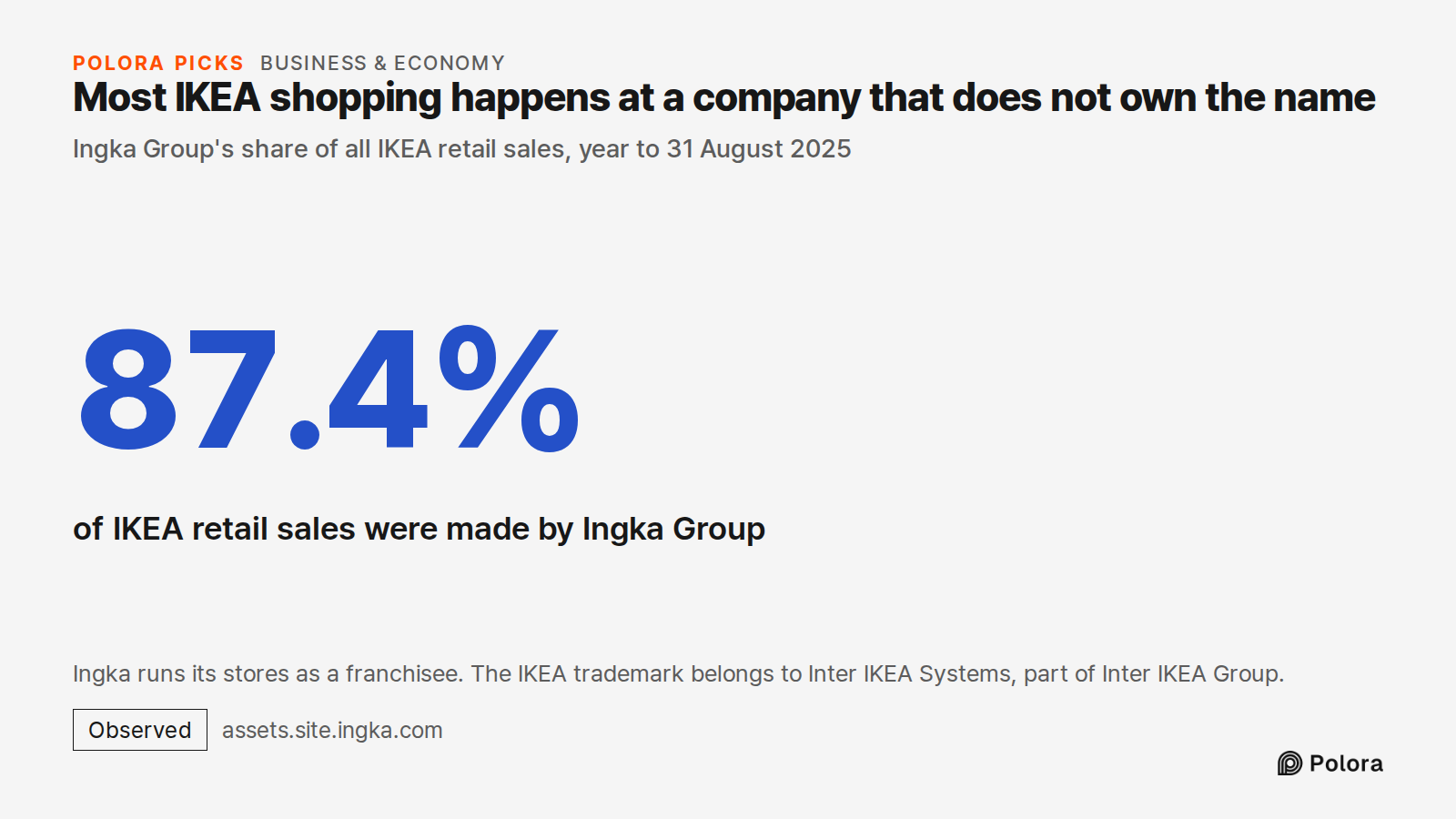
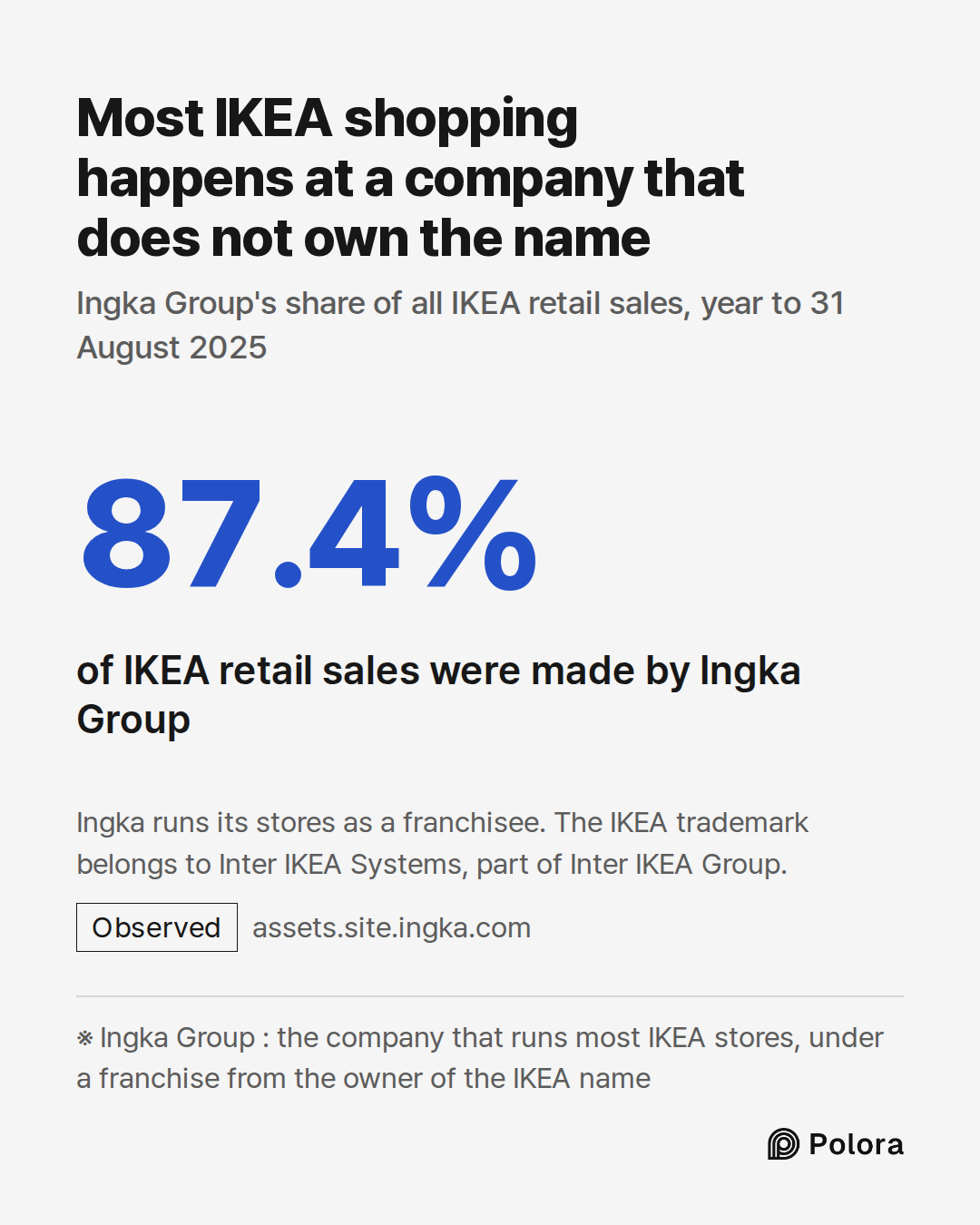
The company running the store you walked into is very likely Ingka Group, which made 87.4% of all IKEA retail sales in the year to 31 August 2025. Ingka does not own the name on its sign. The IKEA trademark belongs to another company, Inter IKEA Systems, part of Inter IKEA Group. So does the rulebook for how an IKEA store works, which IKEA calls the IKEA Concept. Ingka is the largest of the franchisees that run IKEA stores under agreements with it. Inter IKEA's annual report for that year counts 13 franchisee groups, a count that includes operations Inter IKEA owns itself. Ingka's own FAQ gives 12.
The owner of the name runs very few stores itself. IKEA says every IKEA store operates under a franchise agreement except one, in Delft in the Netherlands. Inter IKEA Group also owns the IKEA stores in the Baltic states, but its annual report says they continue to operate under the franchise system. Owning a store and franchising it are, here, two separate things.
Ingka Group's share of all IKEA retail sales, year to 31 August 2025
Every store pays 3% of its sales for the right to be IKEA
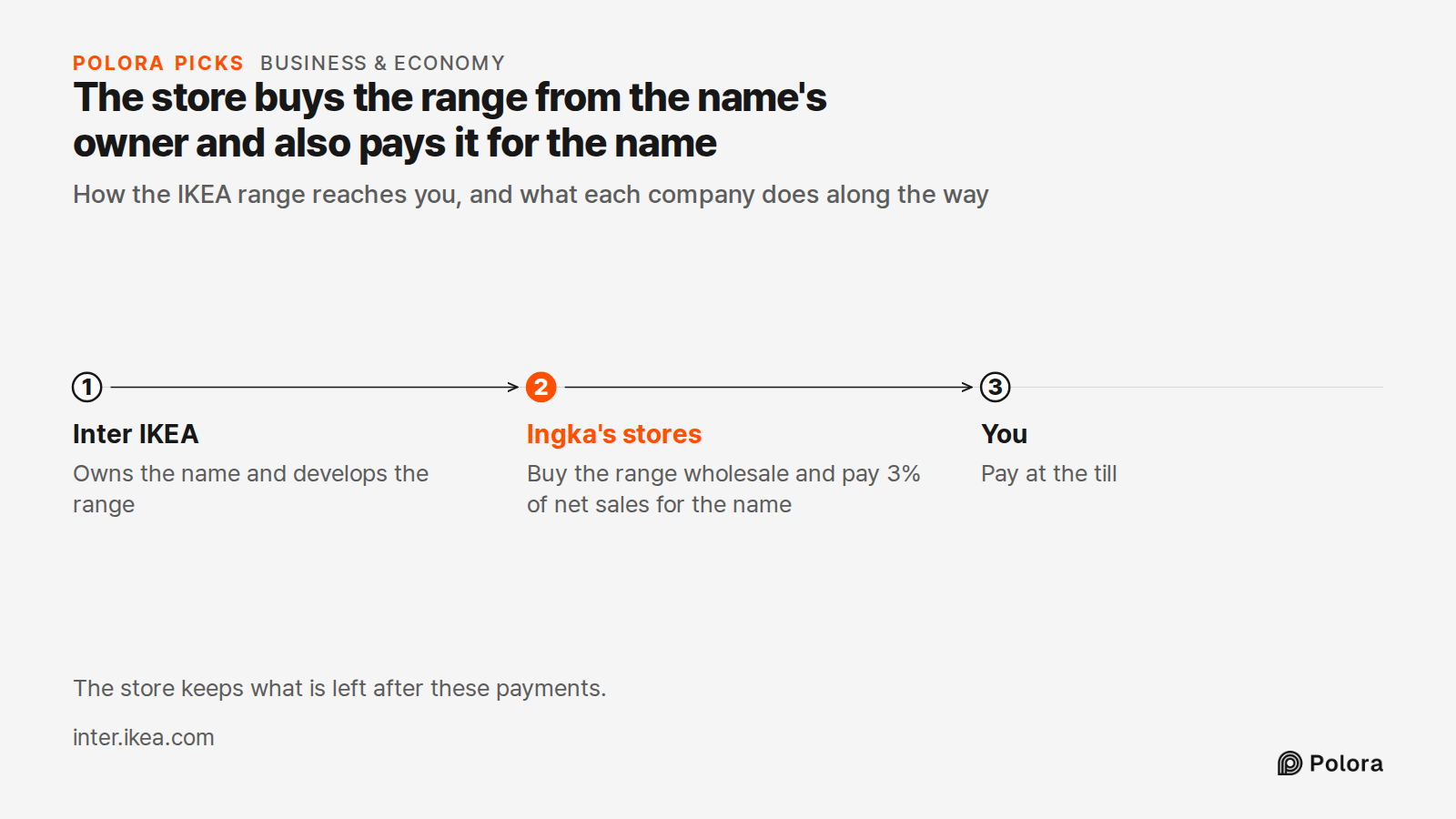
What a franchisee pays for is the name and the permission that comes with it. In Inter IKEA's words, franchisees pay it an annual fee of 3% of their net sales, and in return they may use the IKEA trademarks, sell the IKEA range and run IKEA stores. In the financial year to August 2025 those fees came to 1,320 million euros, down from 1,348 million the year before because retail sales fell.
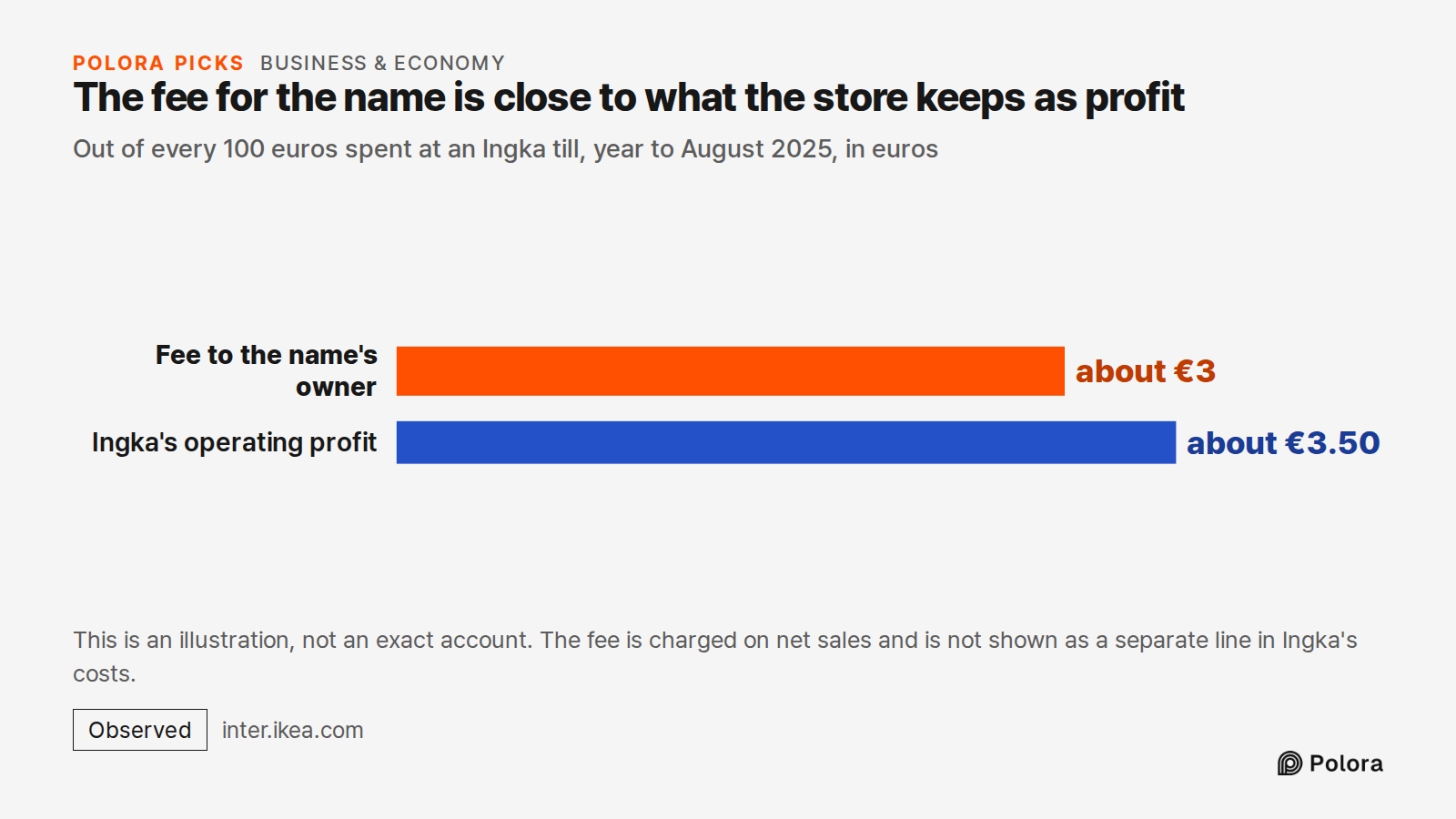
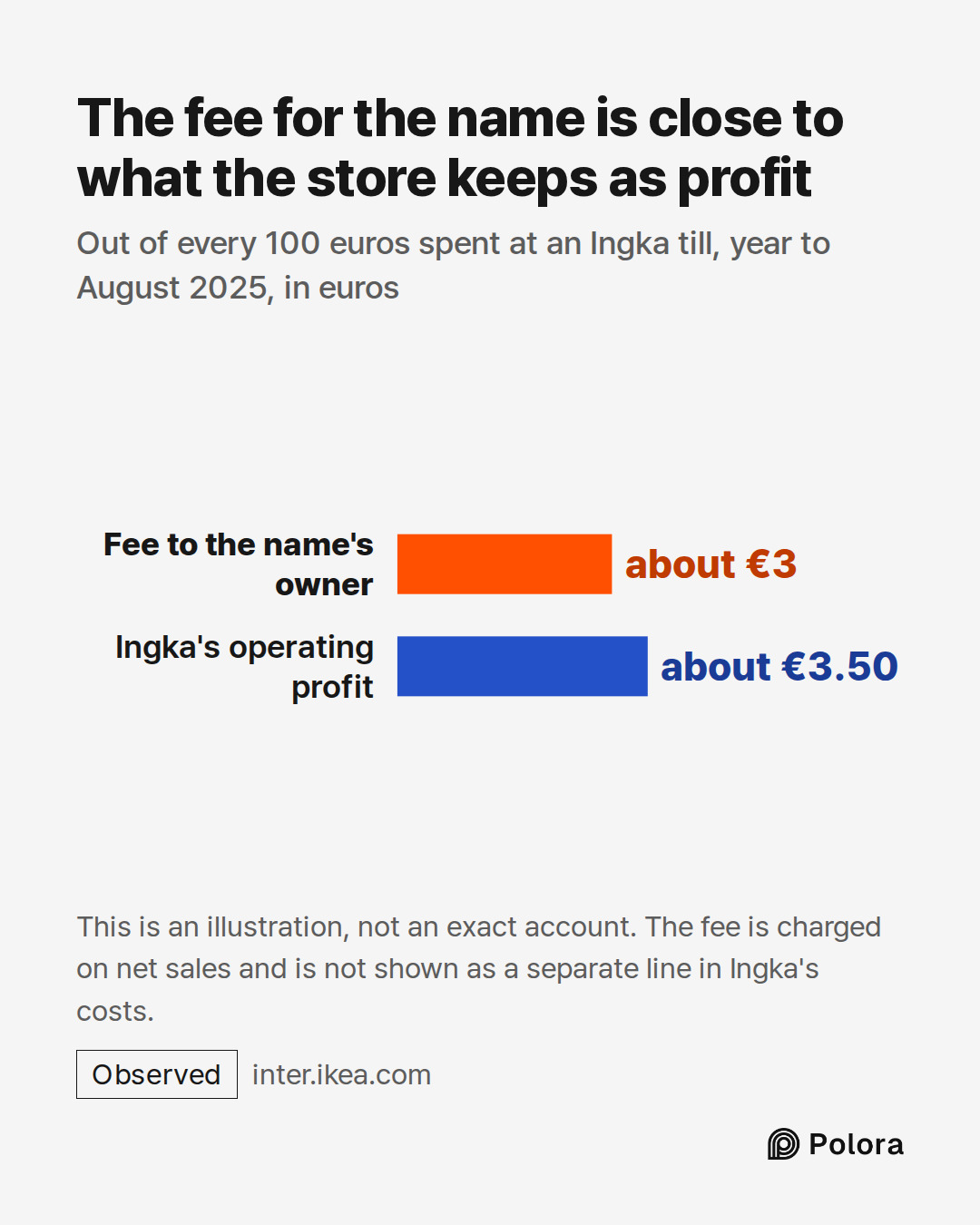
Three percent sounds small until you set it next to what the store keeps. Ingka reported an operating profit of 1,464 million euros, which it describes as 3.5% of sales. So, roughly, out of every 100 euros spent at an Ingka till, about 3 go to the company that owns the name, and Ingka's own operating profit comes to about 3.50 euros. The comparison is an illustration rather than an exact account, since the fee is charged on net sales and the figures cited here do not show it as a separate line in Ingka's costs.
Ingka does not publish the fees it paid as a figure of their own. Applying 3% to its roughly 39 billion euros of IKEA retail sales gives about 1.2 billion euros, and taking Ingka's 87.4% share of the 1,320 million euros all franchisees paid gives a similar figure. Both are estimates rather than a reported figure, because the fee is charged on net sales, which need not equal the retail sales Ingka reports.
Out of every 100 euros spent at an Ingka till, year to August 2025, in euros
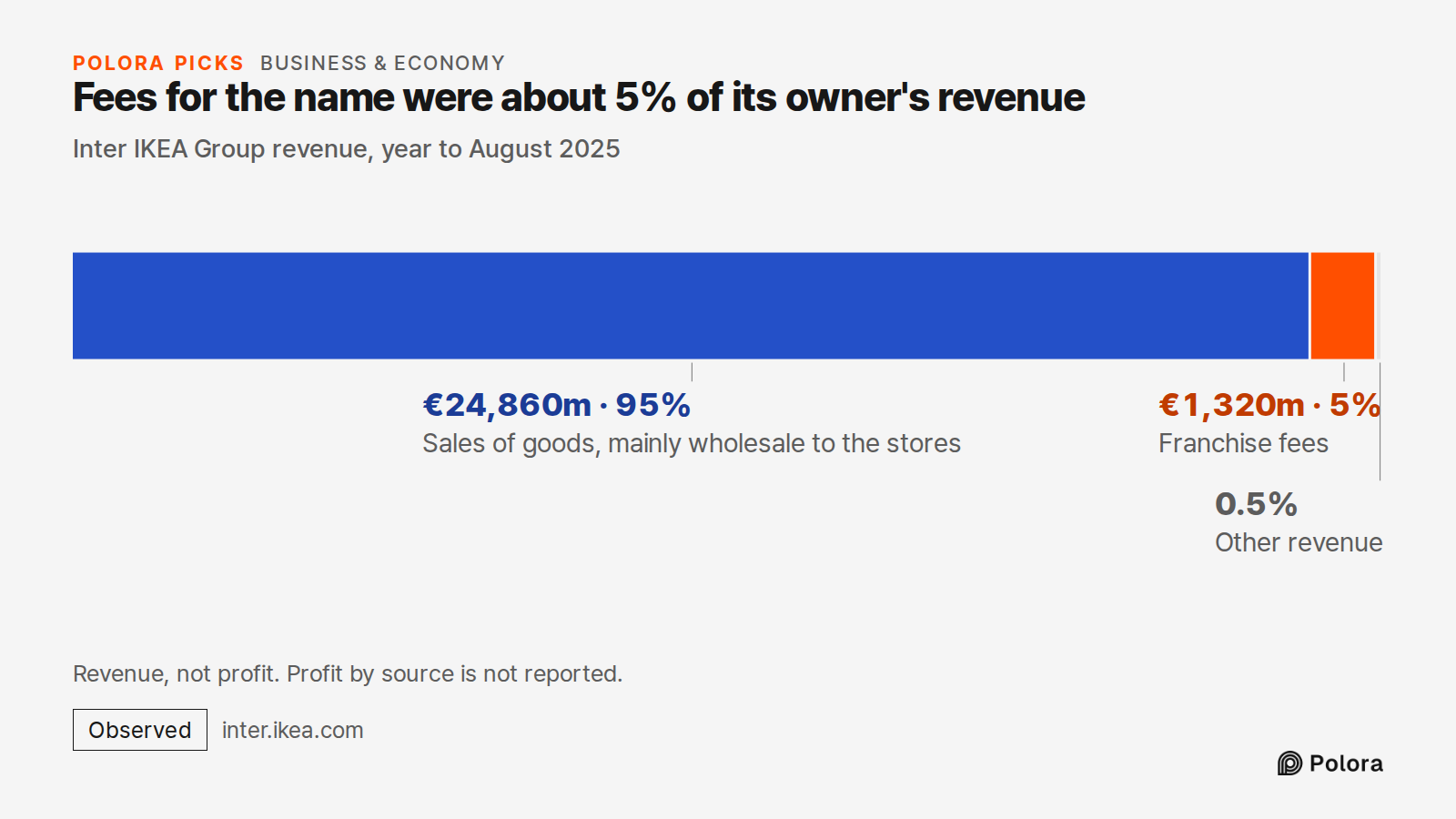
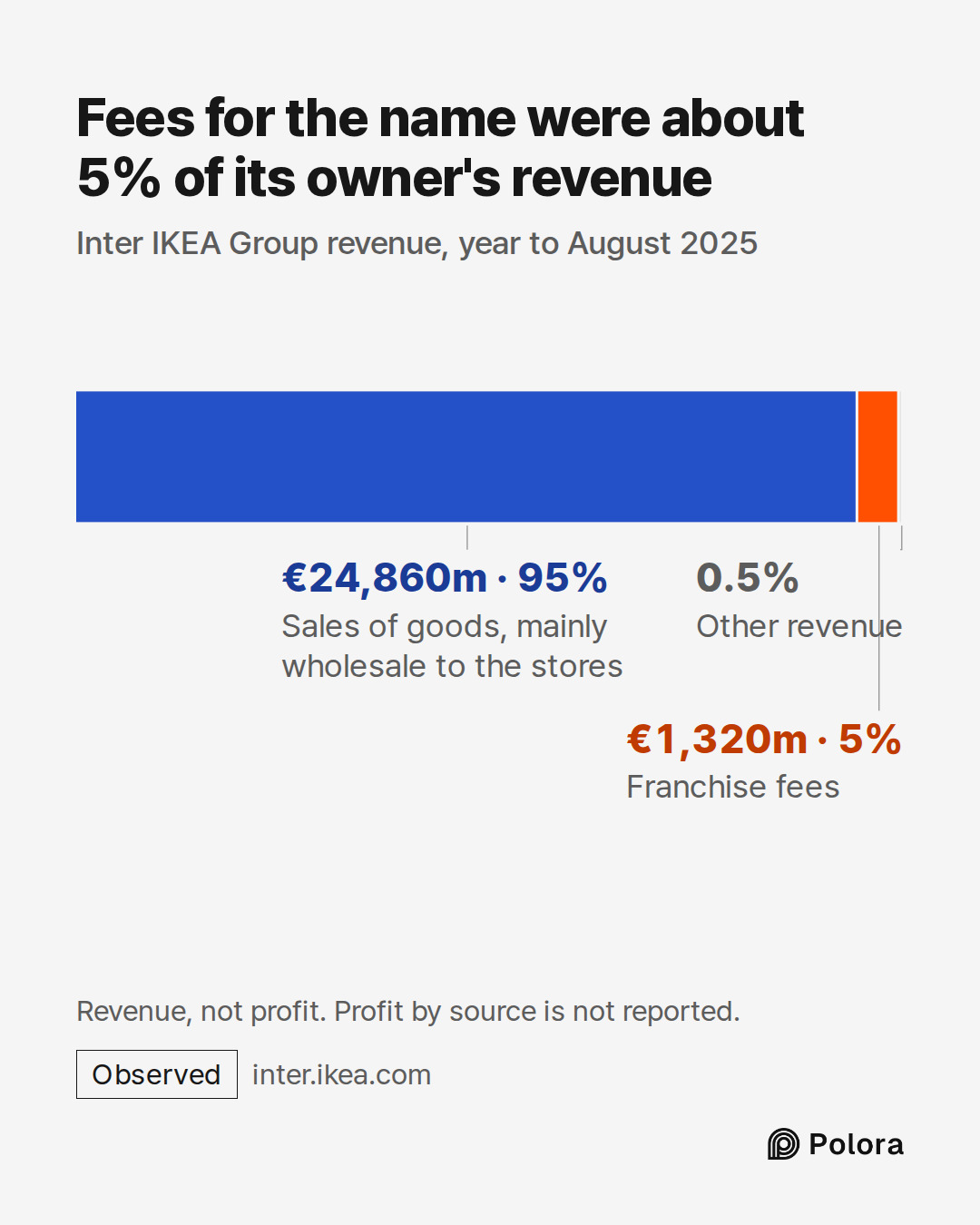
The name's owner takes in far more selling the furniture to the stores
If the fee were the whole story, the answer would be that IKEA sells its name. It is not the whole story. Inter IKEA Group's revenue in the year to August 2025 was 26,306 million euros, and the franchise fees were only about 5% of it. Most of the rest, 24,860 million euros, is what the group calls sales of goods : mainly wholesale sales of IKEA products to the franchisees, plus retail sales from the stores it owns in Delft and the Baltic states. The goods are the whole IKEA range, not furniture alone.
The same company decides what there is to sell. It develops the IKEA range, makes about 10% of it in its own factories and buys the rest from more than 800 outside suppliers. Ingka, in its own report, calls Inter IKEA "our franchisor and wholesale supplier".
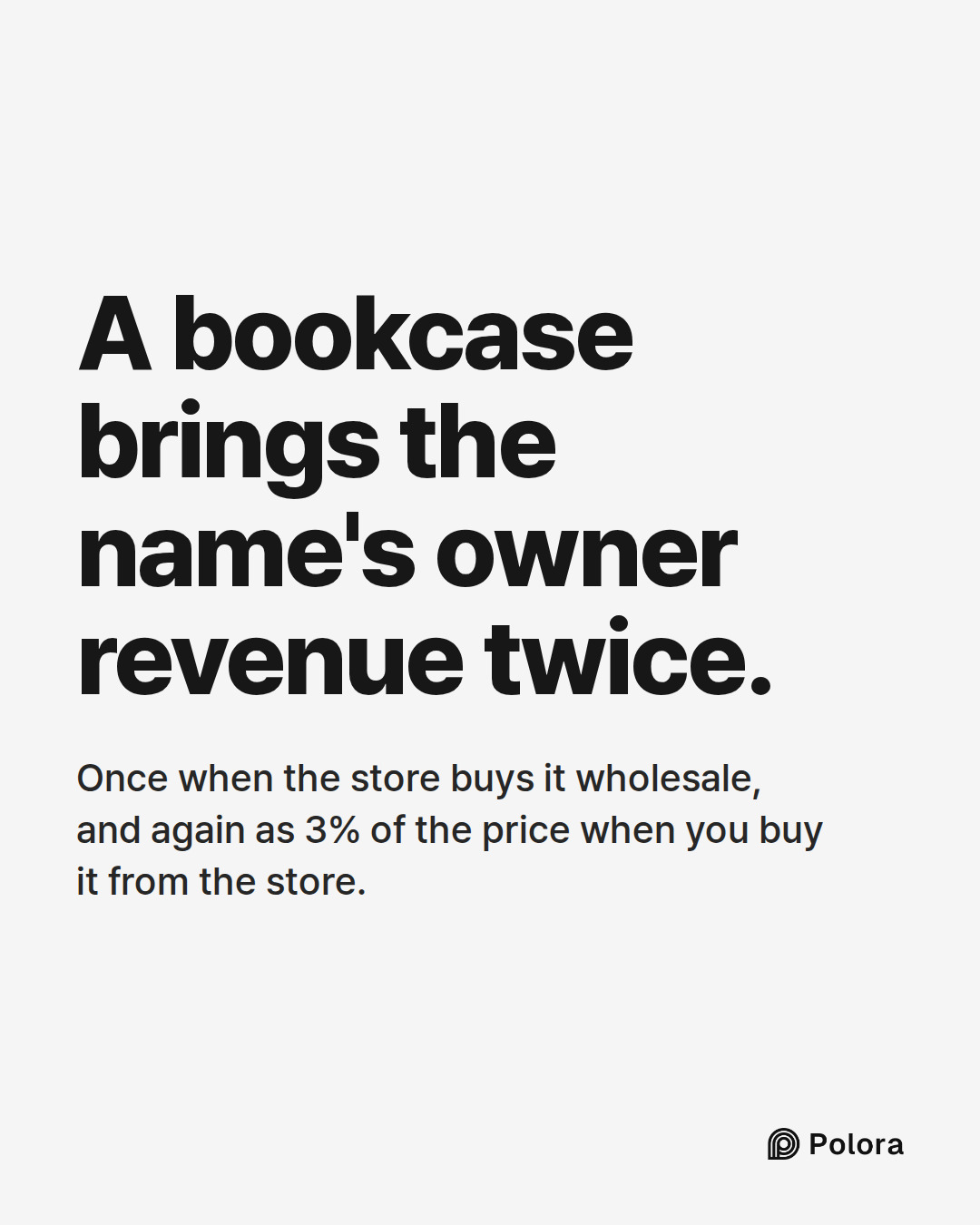
So a bookcase brings the name's owner revenue twice. Once when the store buys it wholesale, and again as 3% of the price when you buy it from the store. In that year Inter IKEA Group made an operating profit of 1,725 million euros and a net profit of 1,496 million. Net profit was down from 2,199 million the year before. The group put the fall down to higher sourcing costs, including US tariffs, at a time when it held its wholesale prices to the stores at the previous year's level.
Revenue is not profit, though. Those profits are totals for the whole group, and Inter IKEA does not report how much of them comes from selling goods and how much from the fees. Wholesaling can bring in large sales on a thin margin, while a fee charged on someone else's sales carries few costs of its own, so the name may earn a larger share of the profit than its 5% of revenue suggests. The published accounts do not settle which of the two earns more.
Both halves were set up this way on purpose. IKEA says that as the business expanded in the early 1980s, its founder Ingvar Kamprad chose a franchise system as the way to grow internationally while protecting the IKEA Concept.
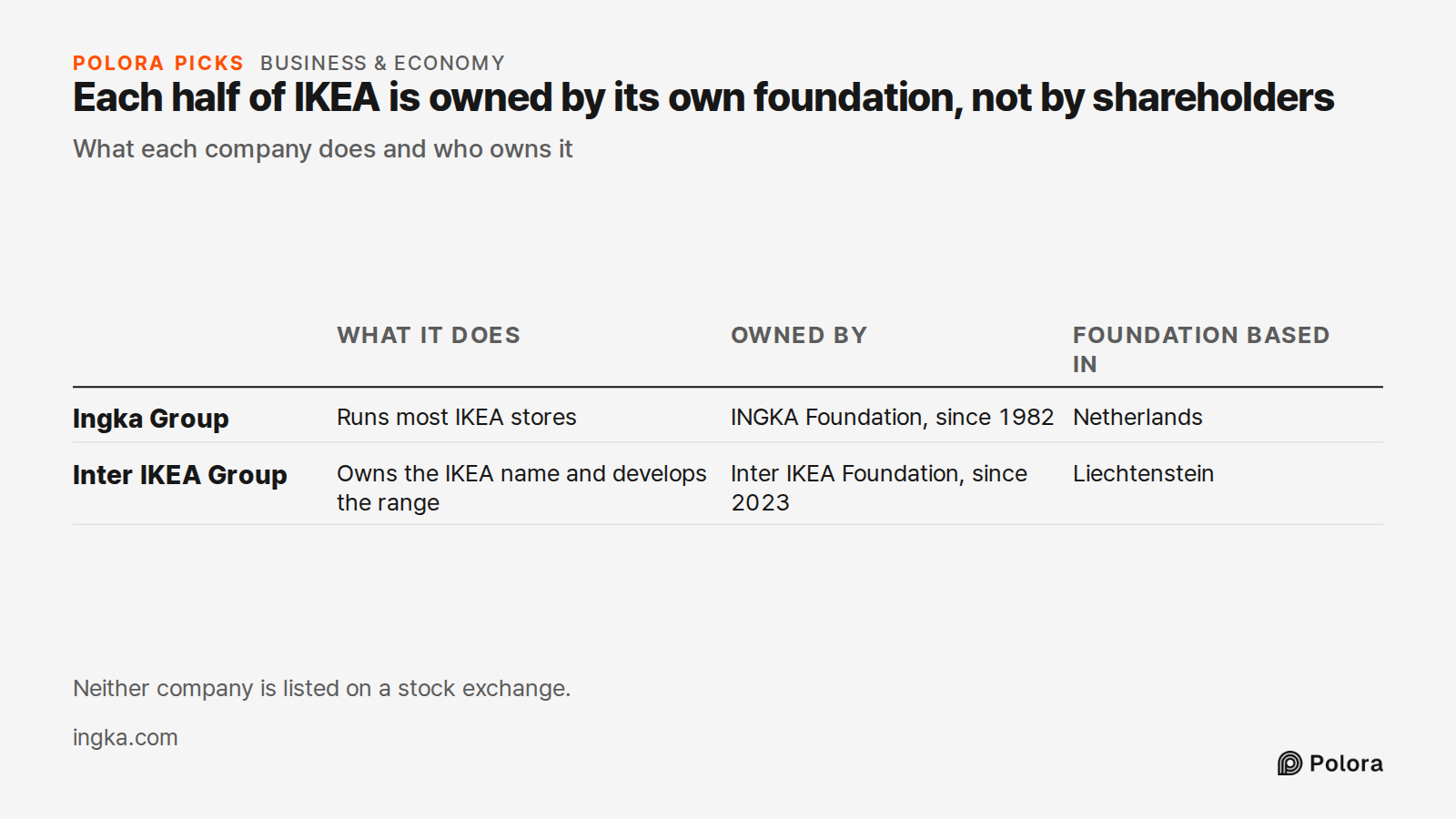
In 1982 Kamprad transferred the ownership of Ingka to the INGKA Foundation, a Dutch foundation. Ingka is not listed on any stock exchange. Of its 1,411 million euros of net profit in the year to August 2025, 85% was put back into the company and 15% paid as a dividend to the foundation, which has a charitable purpose of funding the IKEA Foundation.
The name's side sits under a separate foundation in Liechtenstein. Inter IKEA Group's ultimate owner is the Inter IKEA Foundation, which says it has no individual beneficiary and cannot have one. It was created in 2023, when the Interogo Foundation, set up in 1989 and until then the owner of Inter IKEA, split in two. Interogo kept an investment business, and the new foundation took the IKEA business. Neither half of IKEA has shares anyone can buy.
IKEA is one company that owns the name and another that runs the shop
So, furniture or the name? Both, but not in the place most people would look. The company that owns the IKEA name earns a fee on sales in nearly every store, and takes in far more revenue by selling those stores what they sell in the first place. Which of the two earns it more profit, its accounts do not say.
The company you actually pay at the till is its biggest customer. It buys the range from the owner of the name, pays that owner 3% of its net sales for the right to call itself IKEA, and keeps what is left.
How the IKEA range reaches you, and what each company does along the way
Does IKEA make its money selling furniture, or selling the IKEA name?
Alpha · deepseek-v4-pro
The short answer: furniture — but by a more interesting route than most people assume.
IKEA is not one company, so the question has to be answered at two levels.
Take the company that actually owns the name and the IKEA Concept: Inter IKEA Group. In the financial year to 31 August 2025 it reported revenue of €26,306 million. Its franchise fees were €1,320 million — only about 5% of revenue. The rest, €24,860 million, was what it calls sales of goods: wholesale sales of IKEA products to franchisees, plus a little company-owned retail. So the owner of the trademark does not mainly rent out its name. It is mostly a wholesale supplier. It earns on the bookcase when it sells the bookcase to the store, and only secondarily when the store pays 3% of the till price for the right to call itself IKEA.
For the retailer you actually visit — almost always Ingka Group — the answer is even more plainly furniture. Ingka made about 87.4% of all IKEA retail sales and reported operating profit of €1,464 million, roughly 3.5% of sales. It makes that by selling goods to customers. The 3% franchise fee is a big cost against that thin margin, but it is not Ingka's income.…
Beta · gpt-6-sol
Both—but “selling furniture” is the better answer if we mean revenue, not necessarily profit. In FY25, Inter IKEA Group, which owns the IKEA Concept and brand, reported €24.86 billion in sales of goods and €1.32 billion in franchise fees. Franchisees pay 3% of net sales for the right to use the trademarks and operate under the concept. The goods figure is chiefly wholesale sales to those franchisees, though it also includes sales at Inter IKEA-owned retail operations. (inter.ikea.com)
That distinction matters because the retailer and the brand owner are not generally the same company. Ingka Group runs the largest retail operation, while Inter IKEA supplies the range and grants the franchise rights. The brand is therefore both a source of fee income *and* the framework through which Inter IKEA sells products to retailers. (ingka.com)
I would qualify Alpha’s last step: a 5% share of revenue does not establish a 5% share of profit. The published group income statement gives total costs and profit, not a clean comparison of profit earned from licensing ve…
Gamma · gemini-3.1-pro
The manuscript’s premise stands regarding corporate structure and revenue, but I agree with Beta that equating revenue size with profit generation requires more caution.
Based on the manuscript’s claims and my live search, here is the verification of the remaining unchecked points:
1. The 1989 founding of the Interogo Foundation
The manuscript's date is correct. While the manuscript editor only found this on Wikipedia and noted the foundation's site just said "the 1980s," a live search confirms that Interogo Foundation's own corporate site explicitly states it was "established in 1989" (Source: https://www.interogofoundation.com/about-us/in-brief).
2. Ingka's 87.4% retail sales share vs. 88%
The manuscript correctly uses 87.4%. The 88% figure found in some press releases is simply rounded up from the exact figure published in the Ingka Group Annual Summary and Sustainability Report FY25. The manuscript is safe to use 87.4%.
3. The €1.2 billion fee estimate and operating income
Applying Ingka's 87.4% share of retail sales to the €1,320 million total franchise fees collected by Inter IKEA yields roughly €1,153 million, making "about 1.2 billion euros" a mathemati…
Researcher · gpt-6-luna
The live sources broadly support the FY25 figures, but they also expose a few places where the manuscript—or the debate—needs more careful wording.
- Inter IKEA’s revenue mix: Its FY25 summary reports €26,306 million in total revenue, including €24,860 million in sales of goods and €1,320 million in franchise fees. Inter IKEA says sales of goods are mainly wholesale sales to IKEA franchisees, but also include retail sales from Delft and IKEA Retail Baltics. Thus, the revenue figures support “mostly selling goods,” but they do not show which activity produces more profit. Inter IKEA FY25 results · FY25 financial summary
- 13 franchisee groups, with an important distinction: Inter IKEA’s FY25 annual report says 13 groups operate IKEA customer meeting points, but identifies IKEA Baltics and Delft as Inter IKEA-owned. It also says Baltics continues to operate under the franchise system. So “13 franchisee groups” is the cu…
The Arbiter · gpt-6-sol
The voices agree on the corporate distinction: Inter IKEA owns the name and supplies products; Ingka runs most of the shops. Inter IKEA’s FY25 accounts record €24,860 million in sales of goods and €1,320 million in franchise fees. Those figures establish the *revenue mix*, not which activity contributed more profit. That is the consequential disagreement: Alpha’s profit conclusion goes beyond what the cited accounts establish, as Beta, Gamma and the Researcher point out. (inter.ikea.com)
For the manuscript, the Researcher’s checks leave three qualifications: use Inter IKEA’s FY25 count of 13 franchisee groups rather than the unqualified “12”; label Ingka’s roughly €1.2 billion fee as an estimate, since the fee is based on net sales; and do not treat the Baltic stores’ ownership as proof that they operate outside the franchise system. (inter.ikea.com)
One source disagreement can be closed: Gamma found, and I checked, Interogo Foundation’s own statement that it was established in 1989. The Res…
The Arbiter's Final Verdict · gpt-6-sol
Verdict
By revenue, IKEA makes far more from selling goods than from licensing its name. By profit, the public figures discussed here do not settle which earns more. That distinction is the manuscript’s essential correction, not a reason to abandon its premise.
IKEA is not a single retailer. Inter IKEA Group owns the brand and concept, supplies the range, and collects franchise fees; Ingka Group runs most IKEA retail sales. In FY25, Inter IKEA reported €24.86 billion in sales of goods—mainly wholesale sales to franchisees, but including some retail sales—against €1.32 billion in franchise fees. The fee is 3% of franchisees’ net sales. Thus the name is a consequential source of income and control, but the evidence for “mostly furniture” is a revenue comparison, not a profit breakdown. Inter IKEA FY25 results · FY25 financial summary
What the manuscript can keep—and what it must qualify
- Structur…