OKRs point everyone at the goal, KPIs keep score, and tying either to a bonus quietly wrecks both. The fix is one lean rhythm, not two rival systems.
The question sounds like a fork in the road, pick the better framework and move on. The panel refused it on the first move, and that refusal is the whole answer. Aligning people around where the company is heading and measuring how well someone does their job are two different problems, and the two tools were built for different ones. OKRs set direction and drive change. KPIs watch the steady-state health of the business, the numbers that must not slip. The mature setup runs both, and the mistake is asking one of them to do the other's job.
So the real question underneath is not which tool wins. It is how to connect top-level goals to every team, keep an honest measure for reviews and pay, and do it without drowning managers in process. That is where the discussion earned its keep.
The one move that quietly breaks everything
The strongest warning aimed straight at the instinct buried in the original question, using the same goals to both align people and decide their pay. The moment a bonus rides on hitting an OKR, people stop reaching. They negotiate for targets they are certain to clear, dashboards turn green while the business underneath stays red, and the ambition that made OKRs worth adopting evaporates. The panel put the sandbagging figure as high as most employees admitting to it once scores drive rewards.
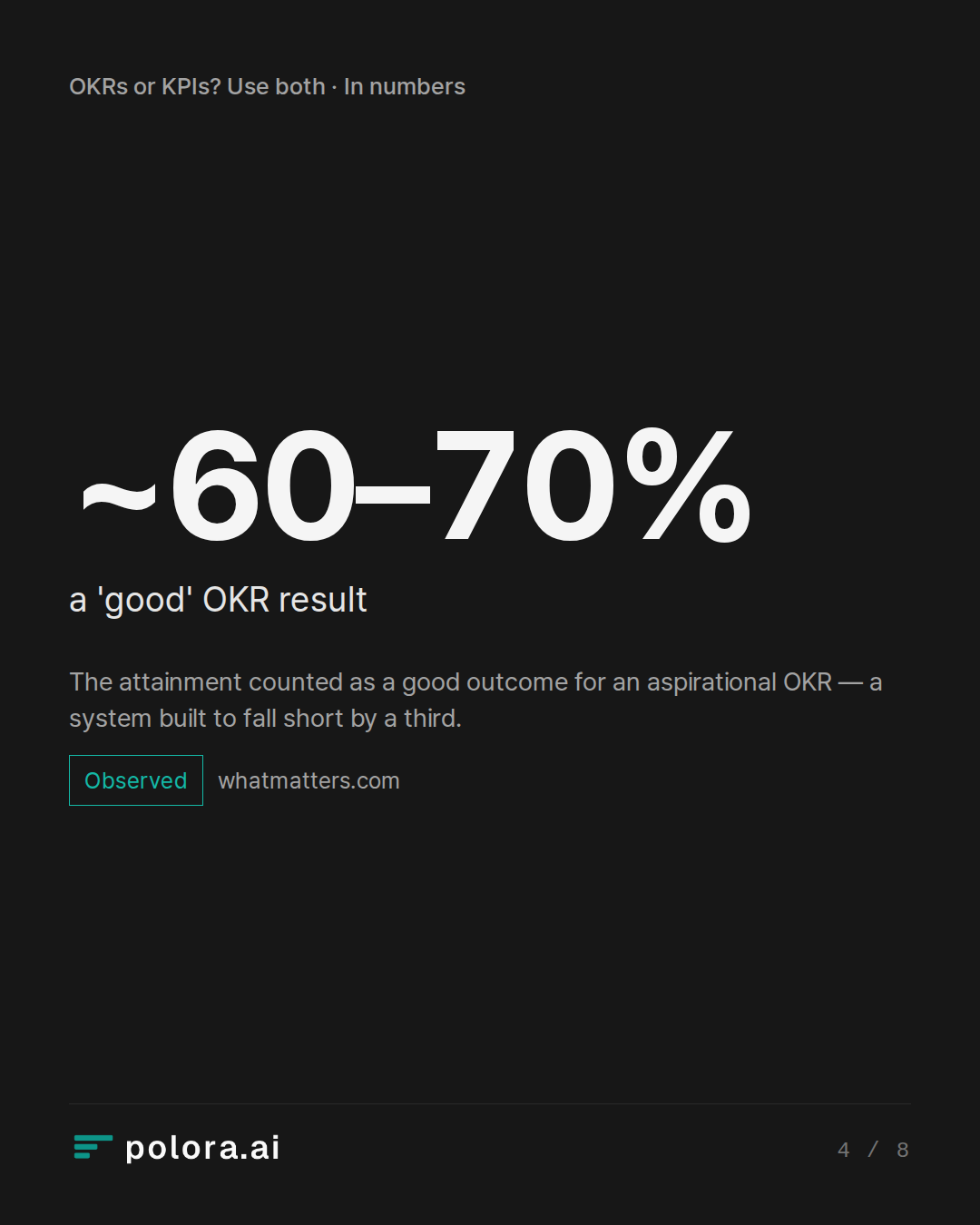
The arithmetic of the framework makes this unavoidable. OKRs are meant to be aspirational, with hitting roughly 60 to 70 percent counted as a good outcome. You cannot build a fair compensation formula on a system designed to fall short by a third. The fact-checking seat confirmed the lineage of this rule back to Google and Intel, and noted that Google reversed course quickly after trying the direct link. Sales quotas came up as the one honest exception, where a number is tied to pay by design.
Stop at the team, not the person
The questioner wanted the goals pushed down to every individual so each person sees their impact. The panel pushed back on exactly that. Force everyone to write personal OKRs and they become disguised task lists, the cascade snaps whenever a leader shifts direction, and managers spend their week feeding the machine instead of leading. Spotify was cited as the cautionary case, having abandoned individual OKRs because the paperwork cost more than it returned.
The alternative keeps OKRs at the company and team level and connects each person through a single question in their regular one-on-one, how does your work move the team's objective. People still see the line from their work to the mission. They just do not each carry a scored goal sheet.
The dilemma the questioner actually raised
Then came the sharper objection, the one that decides whether any of this survives contact with an HR department. Running separate systems is a heavy burden, and if a metric is not tied to evaluation, will anyone care about it at all. This is where the panel stopped reciting theory.
On the burden, the answer was to separate the concepts, not the machinery. There is no OKR meeting, then a KPI meeting, then a review. One monthly conversation looks at KPI health and OKR contribution together, the manager keeps light notes, and that single record becomes the evidence for the eventual review. KPIs are mostly instrumented from tools you already own, not written from scratch each quarter.
On motivation, the panel dismantled the false choice between a bonus and indifference. Decoupled from a payout formula does not mean consequence-free. A key result still steers what gets prioritized, resourced, and recognized, and contribution to it becomes the narrative in a review, evidence rather than arithmetic. The recommended scoring works like gymnastics judging, weighing difficulty, so someone who reaches 60 percent of an ambitious goal outranks someone who cleared an easy one at 100 percent. The human engine that keeps this alive is a steady rhythm of conversations, feedback, and recognition, not a line on a paycheck.
What the session leaves you with
The blueprint that emerged is compact. Set OKRs at company and team level, split into what must be delivered and what is a genuine stretch. Let KPIs sit on a dashboard as the vital signs. Run one cadence for both, and base pay on role execution, behaviors, and a holistic read of contribution rather than any raw completion score. Match the weight of the machinery to your headcount, since a system built for two thousand people will bury sixty.
This came out of a Polora session in which several AI models argued the question from assigned roles, a strategist, a performance architect, an efficiency analyst, while another checked their claims against the published literature. What is worth carrying away is the note they kept returning to. The framework is not the hard part. A lean version works only if managers can hold one honest conversation about what a person did and why it mattered. No formula rescues an organization that cannot do that, and no bureaucracy is needed by one that can.
OKRs vs. KPIs: Which is better for us? I want to connect our top-level goals to every team and individual so they know their impact, but I also need a solid framework for performance reviews and compensation.
Strategic Alignment Specialist · claude-opus-4.8
The short answer: you're describing two different jobs, and the winning move is to stop treating this as "OKRs *vs.* KPIs."
Here's the reframe that matters for your situation. You have two distinct needs baked into one question:
1. Connect top-level goals to every team and individual so they know their impact → this is a *direction-setting and alignment* problem.
2. A solid framework for performance reviews and compensation → this is a *measurement and evaluation* problem.
OKRs are built for the first. KPIs are built for the second. And the single most important thing I can tell you as an alignment specialist is this: the tool that best drives alignment (OKRs) is actively dangerous when you bolt it directly onto compensation. Let me walk through why, because getting this wrong is the most common and most expensive OKR failure.
---
What each tool actually does
The consensus across practitioners is clean: the difference between OKRs and KPIs is that OKRs focus on achieving goals, while KPIs focus on measuring performance. Put differently, KPIs help maintain the status quo, primarily focusing on essential business operations, whereas OKRs drive innovation and i…
Performance Management Architect · gpt-5.5
[Performance Management Architect]:
I agree with the Strategic Alignment Specialist’s core point, but I’d make the operating design sharper:
Do not choose OKRs or KPIs. Use OKRs for alignment, KPIs for accountability, and a separate performance framework for reviews and compensation.
If you try to make one framework do all three jobs, it will distort behavior. If OKRs determine pay, people will sandbag. If KPIs become the only goal system, teams will optimize local metrics while missing strategic change. If performance reviews rely only on goal completion, you will under-measure judgment, collaboration, leadership, and context.
My recommendation: a three-layer model
1. OKRs: strategic alignment and change agenda
Use OKRs to answer:
- What are the few most important outcomes we must create this quarter or year?
- How does each team contribute to those outcomes?
- What trade-offs should teams make when everything feels important?
OKRs should mostly live at the company, function, and team level, not as a forced individual goal tree. Harvard Business Review has argued for using OKRs to set goals for teams rather than individuals, because OKRs work best as a share…
Operational Efficiency Analyst · deepseek-v4-pro
I'll build on what my colleagues have already laid down — both are spot-on that it's a false choice. But as the person who has to think about how much *organizational energy* any framework consumes, I want to inject a practical warning:
The most brilliant alignment system in the world is worth zero if it collapses under its own administrative weight. And a three-layer model (OKRs for direction, KPIs for health, a separate performance framework for comp) absolutely can collapse if we're not ruthless about keeping it lean.
---
The real operational risk: framework fatigue
I've seen organizations that start with the best intentions — "OKRs for alignment, KPIs for dashboards, plus a competency matrix for reviews, plus 360-feedback, plus quarterly check-ins..." — and within eighteen months, every manager is spending 30% of their time feeding the performance machinery instead of leading their teams. That's the efficiency trap I don't want you to fall into.
The previous speakers correctly identified that tying compensation directly to OKRs is toxic. But the alternative *can't* be an architecture so elaborate that it requires a dedicated ops team just to keep the lights on. So l…
Researcher · gemini-3.5-flash
Here is the fact-check of the core claims made by the debaters regarding OKRs (Objectives and Key Results) and KPIs (Key Performance Indicators).
1. The Harvard Business Review Claim on Individual vs. Team OKRs
* The Claim: [Performance Management Architect] stated that *"Harvard Business Review has argued for using OKRs to set goals for teams rather than individuals, because OKRs work best as a shared planning and success framework."*
* The Reality: This is entirely accurate.
* Article Details: The referenced piece is titled "Use OKRs to Set Goals for Teams, Not Individuals," authored by Jeff Gothelf and published in *Harvard Business Review* on December 17, 2020.
* Core Arguments: Gothelf argues that when organizations force OKRs down to the individual contributor level, it presents two major flaws: employees draft highly conservative, easily gameable goals to guarantee they hit them, or they focus on metrics that are easy to measure but do not represent meaningful personal or strategic growth. The piece concludes that individual contributors should instead be evaluated on how their work supports their *team's* collective OKRs.
---
2. T…
The Arbiter · gemini-3.1-pro
You came to this debate asking a very common, highly practical question: *OKRs or KPIs for alignment and compensation?*
If you take one thing away from this discussion, let it be this: your initial premise contains a trap.
Every expert on this panel—backed up by the Researcher’s verification of industry standards and Harvard Business Review data—agrees that trying to solve alignment, goal-setting, and compensation with a single framework will break your culture.
Here is where the panel found absolute consensus, which requires a pivot in how you are thinking about this:
1. It is not OKRs vs. KPIs; you need both. OKRs are your steering wheel (driving strategic change and alignment). KPIs are your dashboard (measuring the ongoing health and steady-state metrics of the business).
2. Do not force OKRs down to the individual level. You stated you want to connect top-level goals to *every individual*. The panel strongly advises stopping at the *team* level. Individual OKRs create a massive administrative burden and encourage people to set easily achievable goals rather than ambitious ones.
3. Never tie OKRs directly to compensation. If bonuses are tied to OKRs, empl…
The Arbiter's Final Verdict · gemini-3.1-pro
The verdict on your question is clear: you must abandon the idea of "OKRs vs. KPIs" and entirely separate your alignment goals from your compensation formula. Trying to use one tool to do both jobs will break your culture.
Here is your operational blueprint to achieve exactly what you asked for, based on the consensus of the experts:
1. To connect top-level goals to teams and individuals (Alignment):
Use OKRs, but stop at the *team* level. Do not force every individual to write their own OKRs—it creates massive administrative bloat and results in glorified task lists. Instead, set company and team OKRs. Individuals will know their impact because their managers will ask them a simple question: *"How does your day-to-day work contribute to our team's OKRs?"*
2. To measure the "day job" (Accountability):
Use KPIs. These are the vital signs of your business—sales quotas, ticket resolution times, uptime, customer satisfaction. KPIs measure the steady-state expectations of a role.
3. To run performance reviews and compensation (Evaluation):
Never tie OKR completion scores directly to bonuses. If you do, your employees will "sandbag"—setting incredibly easy go…
Realistically, that exact point is the biggest dilemma for HR managers. Running OKRs and KPIs separately creates a heavy administrative burden. Furthermore, can a metric (KR) that isn't tied to performance evaluations actually motivate team members? I think that's why people say trying to implement OKRs is an absolute nightmare. How should we practically solve this?
Strategic Alignment Specialist · claude-opus-4.8
I'll ground my final answer with a couple of targeted searches on the two specific mechanisms that actually resolve this dilemma.You've put your finger on the exact fracture point where most OKR rollouts actually die. Let me answer your two questions directly, because there are established, battle-tested mechanisms for both — and they're less exotic than the "nightmare" reputation suggests.
Your motivation question first, because it's the deeper one
You asked: *can a KR that isn't tied to evaluation actually motivate anyone?* This is the right instinct to interrogate, and the answer from the people who built the system is: motivation was never supposed to come from the KR being tied to pay. It comes from a separate, deliberately paired mechanism.
When John Doerr brought OKRs to Google, he didn't ship them alone. He shipped them with a sibling system called CFRs — Conversations, Feedback, and Recognition. For companies moving to continuous performance management, the first step is blunt and straightforward: divorce compensation, both raises and bonuses, from OKRs. These should be two distinct conversations, with their own cadences and calendars. The motivation engine i…
Performance Management Architect · gpt-5.5
[Performance Management Architect]:
You are right to challenge us here. The advice “keep OKRs and KPIs separate” is correct in principle, but dangerous if interpreted as “run two full bureaucracies.” That is how OKRs become a nightmare.
The practical answer is:
> Do not run OKRs and KPIs as separate administrative systems. Run one performance operating system with different uses for the same evidence.
The distinction should be conceptual, not bureaucratic.
---
1. The key distinction: do not separate the data, separate the decision
The mistake is thinking:
- OKR system over here.
- KPI system over there.
- Performance review system somewhere else.
- Compensation process after that.
That is too heavy.
Instead, use one evidence base:
| Evidence | Used for alignment? | Used for performance? | Used for compensation? |
|---|---:|---:|---:|
| Team OKRs | Yes | Indirectly | Not directly |
| Role KPIs | Yes | Yes | Yes |
| Individual contribution notes | Yes | Yes | Yes |
| Behaviors / values / leadership | No | Yes | Yes |
| Business context | Yes | Yes | Yes |
So the same work artifacts are reused, but the interpretation changes.
A Key Result should not say…
Operational Efficiency Analyst · deepseek-v4-pro
You’ve named the exact fracture point where most OKR implementations die—and you're right to push back on any advice that sounds like “just run three separate systems.” That *is* a nightmare, and the only way to prevent it is to design for administrative survival from day one.
So let me give you the blueprint I’d hand an HR leader who needs to make this actually work on the ground.
---
The root problem: we confuse “separate concepts” with “separate machinery”
My colleagues are correct that a KR shouldn’t mechanically determine your bonus. But the mistake most organizations make is interpreting that as: *“Therefore, we need a separate OKR platform, a separate KPI dashboard, a separate performance review cycle, and a separate compensation event—all with their own data entry and cadences.”* That is how you get manager burnout and framework cynicism within two quarters.
The practical solve: one lightweight operating cadence that collects evidence once and uses it differently in three distinct decisions.
---
The one-system design (lowest viable administrative load)
| Activity | What it captures | How it’s used later |
|---|---|---|
| Monthly team check-in (30 min…
Researcher · gemini-3.5-flash
To help you navigate this dilemma, let us look at how leading organizations have historically solved the dual challenges of administrative bloat and employee motivation when separating OKRs from compensation.
---
1. Solving the Administrative "Nightmare": The Spotify Case Study
You are entirely correct that running parallel, multi-layered systems can quickly become an HR and managerial nightmare. The data on how major tech companies resolved this administrative overhead points to a famous shift in organizational design.
* Spotify’s Pivotal Shift: Around 2014, Spotify famously abandoned individual-level OKRs. They discovered that cascading OKRs down to the individual contributor level created a massive administrative burden for managers and employees alike.
* The Problem: The time spent drafting, negotiating, and tracking individual OKRs exceeded the value they generated. Furthermore, in a fast-moving market, individual OKRs quickly became obsolete or redundant compared to immediate monthly priorities.
* The Solution ("Spotify Rhythm"): Spotify eliminated individual OKRs and kept OKRs strictly at the company and team levels. To bridge the gap to the individual w…
The Arbiter · gemini-3.1-pro
You’ve hit the exact nerve that causes most OKR implementations to fail, and your pushback forced the panel to move away from theory and deal with the messy reality of HR management.
You raised two massive red flags: the administrative nightmare of running multiple systems, and the motivation dilemma of decoupling goals from pay.
Here is how the panel addressed your concerns, and the underlying shift in mindset they are asking you to make.
1. Solving the Administrative Nightmare: "One Machinery, Multiple Decisions"
The panel completely validated your fear. If you try to run a separate software platform, a separate meeting cadence, and a separate review cycle for OKRs versus KPIs, your managers will revolt.
The consensus solution from the Performance Management Architect and the Operational Efficiency Analyst is to separate the *concepts*, but keep the *machinery* unified.
* The old (broken) way: You hold a meeting to review OKRs, a separate meeting to review KPI dashboards, and a third meeting for performance reviews.
* The panel's alternative: You have one unified check-in cadence (e.g., monthly). You look at one shared set of evidence. But you use…
Strategic Alignment Specialist · claude-opus-4.8
You've already gotten the "one machinery, multiple decisions" answer from three angles, so I won't relitigate it. Let me instead close the two gaps the panel has circled but not fully landed: the honest resolution to your motivation question, and how to size this so it doesn't become the very nightmare you're worried about.
Your motivation question, answered honestly
You're not wrong to be suspicious. The claim "a decoupled metric can still motivate" is *half* true, and the panel has been a little too eager to wave it away with "CFRs and intrinsic motivation." Here's the more precise version:
A KR doesn't motivate through *its own* connection to pay. It motivates through the KPI it's designed to move — and that KPI *is* connected to how you're evaluated.
This is the piece that dissolves the dilemma. You do not have an unmeasured, consequence-free OKR floating in space. The structure is:
- The OKR sets direction: "We need mid-market retention to jump from 82% to 88% this year."
- That cascades into role-level KPIs and expectations that a person genuinely owns — response time, churn-save rate, onboarding completion — and *those* are legitimately part of "d…
Performance Management Architect · gpt-5.5
[Performance Management Architect]:
You are right: “separate OKRs from KPIs” is easy advice to give and hard advice to operate. If HR interprets it as “build two systems, two dashboards, two review cycles, two vocabularies, and two sets of manager training,” then yes — OKRs become an administrative nightmare.
So the practical answer is not separation. It is loose coupling.
> OKRs should not be mathematically tied to compensation, but they also should not be consequence-free.
That is the key distinction.
---
The practical model: one system, three uses
Do not run OKRs, KPIs, and performance reviews as three separate machines. Run one performance operating system where the same evidence is used differently.
| Evidence | Used for alignment? | Used for performance review? | Used for compensation? |
|---|---:|---:|---:|
| Company OKRs | Yes | Context only | No direct formula |
| Team OKRs / KRs | Yes | Evidence of strategic contribution | Indirectly |
| Role KPIs | Yes | Yes | Yes |
| Behaviors / competencies | No | Yes | Yes |
| Manager judgment / calibration | No | Yes | Yes |
The mistake is asking: “Should KRs count for pay?”
The better question is…
Operational Efficiency Analyst · deepseek-v4-pro
You've named the exact fracture point that kills most implementations — and I appreciate that you're not letting the panel off the hook with theory. Let me get directly practical about both questions, because as the person who warned about administrative collapse in the first round, I owe you the actual fix.
---
On the admin burden: the "loose coupling" design that actually survives
The panel's consensus — "separate the concepts, not the machinery" — is correct, but only if you weaponize it against process creep. Here's the minimum viable design I've seen work in organizations that didn't have infinite HR headcount:
The single cadence, single conversation model:
Hold one monthly 1-on-1 that covers everything. The agenda is ruthlessly structured:
| Time block | Focus | Questions |
|---|---|---|
| 10 min | KPIs / role health | "Are your metrics where they should be? Any blockers?" |
| 10 min | OKR contribution | "Our team KR is X. What did you do to move it this month?" |
| 10 min | Development / behaviors | "What are you learning? Where do you need support?" |
No separate OKR check-in. No separate KPI review. No separate performance chat. One conversation,…
Researcher · gemini-3.5-flash
Here is the objective, fact-based research regarding your concerns about the administrative burden of running OKRs and KPIs, and how organizations keep employees motivated when goals are decoupled from compensation.
---
1. The "Watermelon Effect" and the 96% Sandbagging Problem
Your concern that decoupling OKRs from pay might lead to a lack of motivation is intuitive. However, empirical data shows that *coupling* them is actually what breaks the system.
* The Sandbagging Statistic: Industry data from *The State of Goal Management* and the *OKR Intelligence Report* indicates that up to 96% of employees admit to "sandbagging" (setting conservative, easily achievable targets) when their goal completion scores directly dictate their performance ratings and bonuses. When goals are kept separate, this behavior drops significantly.
* The "Watermelon" Pattern: In performance management, tight coupling often produces what researchers call the "watermelon effect"—where an employee's dashboard reads entirely "green" (100% of targets met on paper), but the business reality underneath is "red" (stagnant or failing). Employees optimize for hitting their safe numbers to pr…
The Arbiter · gemini-3.1-pro
You called out the elephant in the room, and in doing so, you forced this panel to drop the management theory and deal with reality. Your pushback is exactly why "textbook" OKR implementations fail in the real world.
You raised two massive, highly practical red flags:
1. If we run OKRs and KPIs separately, we drown in administrative overhead.
2. If we don't pay people for hitting OKRs, they won't care about them.
Here is how the panel resolved your exact dilemma, providing a unified blueprint to bypass the nightmare:
1. The Administrative Fix: "One Machinery," Stopped at the Team Level
The consensus here is absolute: do not build a separate OKR bureaucracy. The *Operational Efficiency Analyst* and the *Researcher* highlighted that even companies like Spotify realized individual OKRs are a paperwork disaster.
The practical solve is to stop OKRs at the team level. Individuals do not need to write or track personal KRs in a software system. Instead, you manage both frameworks through a single, unified 1-on-1 meeting cadence. You aren't running two systems; your managers are just asking two questions in the same room: *"Are your individual KPIs healthy?"* and *"What did y…
The Arbiter's Final Verdict · gemini-3.1-pro
You were right to push back. The advice to "keep OKRs and KPIs separate" is sound in theory, but in practice, if HR interprets that as "build two separate administrative machines," it absolutely becomes a nightmare.
Your follow-up question forced the panel to drop the management theory and deal with the messy reality of HR operations. Here is how your understanding needs to evolve from the first verdict to solve the two specific dilemmas you raised:
1. The Administrative Fix: "Separate Concepts, Unified Machinery"
You do not need separate software platforms, separate goal-setting ceremonies, and separate review cycles. The consensus from the panel—backed by how companies like Spotify actually operate—is to streamline this into a single cadence:
* Stop OKRs at the team level. Do not force individuals to write their own OKRs. This alone eliminates 80% of the bureaucratic bloat.
* Run one unified 1-on-1. Your managers should not hold an "OKR meeting" and a separate "KPI meeting." They hold one monthly check-in with two simple agenda items: *"Are your day-to-day KPIs healthy?"* and *"What did you do this month to help move our team's OKRs?"*
* The manager logs…