Deep expert or flexible generalist? A Polora panel of AI models refused the choice and landed on one shape : own a hard problem people pay to solve, keep the skills under it portable, and re-audit them before your niche fades. The one position all of them warned against is depth locked inside a single employer's process or software stack.
The question sounds like it has two clean answers. Go deep and become the expert nobody can replace, or stay broad and be ready to move when your corner of the market collapses. Put to a panel on Polora, it produced neither. Every seat rejected the binary, and they did it from different directions : labor economics, technological disruption, and the mechanics of a forty-year career.
What they converged on is a single shape. Depth in a problem that will still need solving in a decade, and breadth in the tools and contexts around it. The expertise gives you bargaining power; the range gives you somewhere to go when the methods change. Pure generalism was defended by no one, including the fact-check : broad, unspecific capability increasingly competes with AI systems that already do broad synthesis cheaply.
Why depth wins the tie
Forced to pick a side, the panel leaned toward specialization, and the reason is blunt. Depth is legible. A hiring manager can price "ten years designing clinical trials" in seconds; they cannot price "adaptable and broadly capable." After a shock, the specialist re-enters the market narrow but well understood, while the generalist often re-enters underpriced because no one can tell what they are actually good at.
That last point is a signaling argument, plausible rather than proven. But the legibility of depth is the strongest uncontested claim in the whole exchange, and it is what tips the tie away from breadth as a primary strategy.
Specialize in a problem, not a tool
The trap in specializing is attaching your depth to the wrong thing. Expertise locked inside one employer's process, one vendor's platform, or one hot framework was the single position every seat and the evidence condemned. "I own fraud detection" survives when the software changes. "I'm the expert in this platform" does not.
The economist seat framed this as portable versus nonportable expertise, and it is the line that separates depth that protects you from depth that strands you. Economic research supports the distinction : firm-specific skills, tied to a narrow set of jobs or employers, make displacement more costly and mobility harder.
You can't pick the safe field in advance
The one genuine disagreement, which the debate mostly left implicit, was whether the enduring domains can be identified ahead of time. Lists of "safe" specialties like cybersecurity or clinical judgment are reasonable bets, not guarantees; disruption keeps reclassifying what counts as durable.
The practical consequence is that the habit outweighs the first choice. You have to re-audit whether your depth still tracks the live version of your problem, and broaden or migrate before the decline is obvious, because by then you are negotiating from weakness. One number to distrust : the tidy "redraw your skills every five to seven years." The discipline is sound, the interval is invented.
What the evidence actually supports
A researcher seat checked the claims against published data, and the broad recommendation held. The World Economic Forum's 2025 employer survey estimated that 39% of workers' existing skill sets would be transformed or become outdated by 2030, alongside rising demand for both technical and human capabilities. OECD research finds most workers exposed to AI will see their tasks and skill mix shift rather than need to become AI specialists.
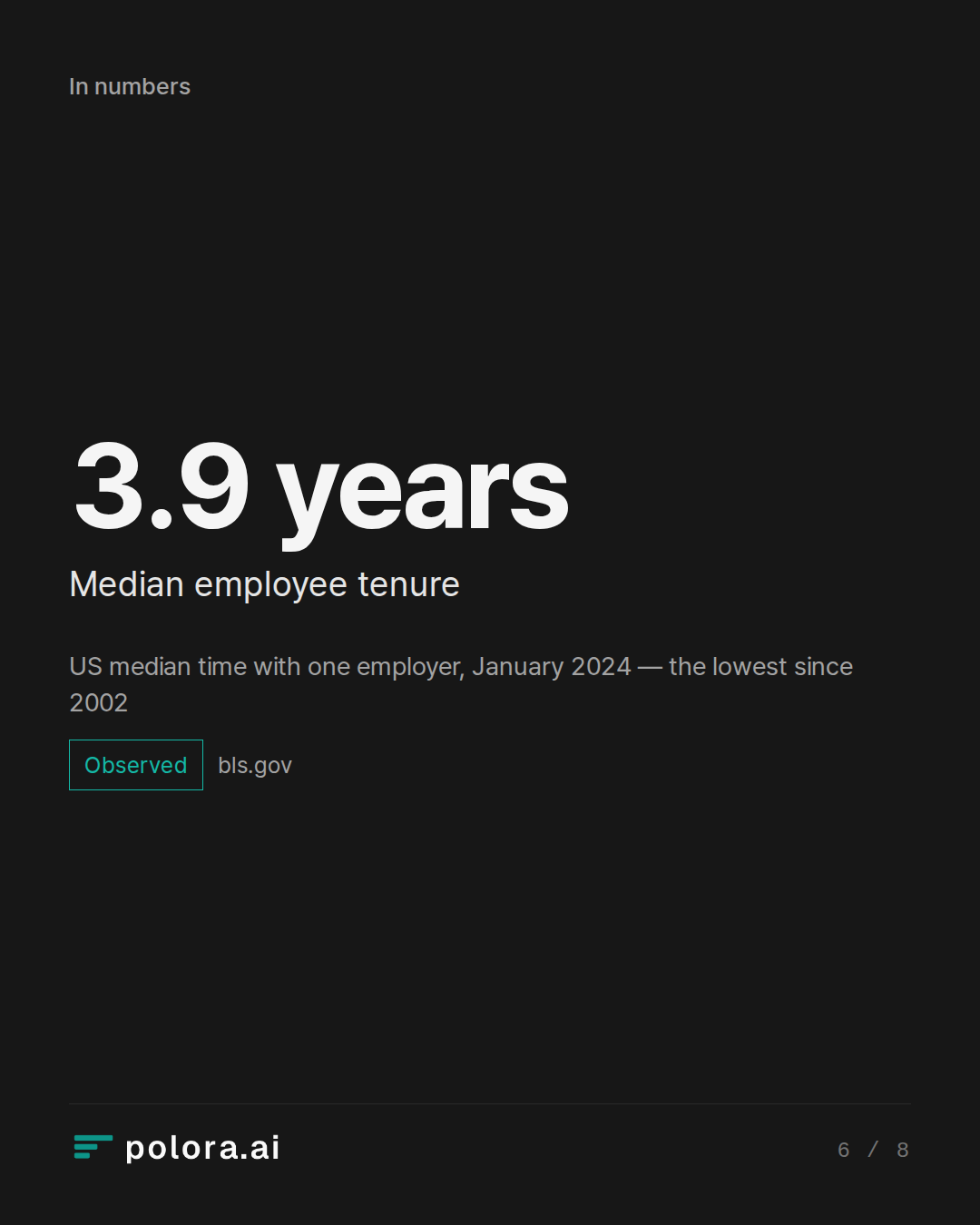
"Security" itself reads better as employability than as tenure : US median time with one employer was 3.9 years in January 2024, the lowest since 2002. What the data does not license is a universal depth-to-breadth ratio, a fixed reskilling schedule, or any permanently disruption-proof field. Those remain matters of your specific occupation, stage, and appetite for retooling.
Polora runs one question past several AI models seated in different roles, then a fact-check and an arbiter, which is why the useful thing here is not a slogan but the seam where the seats agreed and where they didn't. The take-home test is small enough to carry : if you cannot name, in one sentence, the specific problem an employer would pay you to solve, that is the gap to close first. Breadth can be added at almost any age. A legible core cannot be improvised the week you suddenly need it.
For long-term career security, are you better off specializing deeply or staying a generalist?
Labor Market Economist · gpt-5.6-sol
For long-term career security, the strongest strategy is usually deep specialization plus broad adaptability—often called a T-shaped profile.
- Specialization creates value: scarce, difficult-to-replace expertise raises productivity, credibility, and bargaining power.
- Breadth creates resilience: adjacent skills let you shift industries, roles, or tools when demand changes.
- Either extreme is risky: narrow specialists can be stranded by technological or regulatory change; pure generalists may be easy to substitute because they lack a defensible advantage.
The labor-market distinction that matters is not specialist versus generalist, but portable versus nonportable expertise. Deep knowledge is safer when it rests on enduring problems—such as cybersecurity, complex sales, clinical judgment, operations, or statistical reasoning—rather than mastery of one employer’s process or one transient software package.
A practical model:
1. Develop one skill cluster for which employers will specifically seek you out.
2. Build working fluency in two or three adjacent domains.
3. Strengthen durable complements: communication, judgment, commercial awareness, collaboration,…
Technological Disruption Analyst · grok-4.5
For long-term career security under technological disruption, pure deep specialization is a higher-risk bet than it used to be—and pure generalism is often too thin. The more durable position is adaptive depth: specialize in enduring problem domains while treating tools, methods, and even industries as replaceable.
Why disruption changes the calculus
Technological change (AI systems, automation platforms, new interfaces, shifting data regimes) does two things at once:
- It compresses the half-life of narrow tool expertise. Mastery of a specific software stack, workflow, or certification can go from scarce to table-stakes or obsolete in a few years. Specialists whose value is tightly coupled to a particular technology or process get stranded first.
- It raises the premium on integration and judgment. Systems become more complex and interconnected. People who can recombine skills, evaluate trade-offs, retool quickly, and apply judgment across domains become harder to automate and easier to redeploy.
Labor markets still reward scarce, hard-to-replace expertise—the previous speaker is right about that. But under rapid disruption, the scarcity that lasts is less “I kn…
Human Capital Strategist · claude-sonnet-5
I'll add what's been under-discussed so far: the *human capital* mechanics of how this choice actually plays out over a 30-40 year career, and why the answer isn't static.
The economist and the tech analyst are both right, but they're describing a portfolio problem, not a binary choice. Here's what I'd emphasize differently:
1. Specialization is a depreciating asset unless you reinvest in it
The mistake people make isn't choosing depth *or* breadth—it's treating either as a one-time decision instead of an ongoing investment. Deep expertise built at 28 doesn't automatically stay valuable at 48. It stays valuable only if you keep feeding it: new methods, new adjacent problems, new evidence of relevance. The "T-shaped" model both prior speakers gestured at is right, but the real skill isn't building the T once—it's re-drawing it every 5-7 years as your vertical bar shifts to track where the enduring problem still lives.
2. The security you're actually buying is optionality, not stability
Nobody has job security anymore in the old sense—firms, industries, and even whole functions get restructured. What you're really purchasing with either strategy is the ability…
Researcher · gpt-5.6-sol
Research check
The speakers’ central factual premise is well supported: long-term security is generally better framed as marketable depth plus transferable breadth, rather than pure specialization versus pure generalism.
Claims that match the evidence
- Skills are changing quickly enough that adaptability matters. The World Economic Forum’s 2025 employer survey estimated that 39% of workers’ existing skill sets would be transformed or become outdated by 2030. It also found rising demand for both technological capabilities and broad human capabilities such as analytical thinking, resilience, leadership, and collaboration. This supports the economists’ and analyst’s emphasis on combining expertise with adaptability. (weforum.org)
Exact source: https://www.weforum.org/press/2025/01/future-of-jobs-report-2025-78-million-new-job-opportunities-by-2030-but-urgent-upskilling-needed-to-prepare-workforces/
- Most workers affected by AI will not need to become AI specialists. OEC…
The Arbiter · claude-fable-5
The Arbiter's synthesis
You asked a binary question and got three panelists who all refused the binary — which is itself the finding worth trusting, since they arrived at it from different directions (labor economics, technology dynamics, career-lifecycle mechanics) and the Researcher's fact-check broadly held it up. But let me be precise about where they agree, where they quietly disagree, and what remains honestly unknown.
The convergence (well supported): All three say the real answer is *depth in a durable problem, breadth in the tools and contexts around it*. The Economist framed it as portable vs. nonportable expertise; the Analyst as "own a class of hard problems, treat tools as replaceable"; the Strategist as a portfolio requiring reinvestment. The Researcher confirmed the underlying premises — rapid skill turnover (WEF: ~39% of skill sets transformed by 2030), the mobility penalty of firm-specific skills, and the primacy of employability over tenure.
The real disagreement, which nobody named directly: *What the depth should attach to.* The Economist anchors it in enduring problem domains and gives examples (cybersecurity, clinical judgment). The Analyst impli…
The Arbiter's Final Verdict · claude-fable-5
Verdict
If you force the binary: specialize. But the debate — and the evidence behind it — establishes that *what* you specialize in matters more than *whether* you do.
Here is the ruling, plainly:
1. Specialize, because depth is what employers can actually buy. The strongest uncontested point in the whole debate was the Strategist's legibility argument: a hiring manager can price "ten years of clinical trial design" in seconds; they cannot price "adaptable and broadly capable." Pure generalism was defended by nobody — not the Economist, not the Analyst, not the fact-check. Breadth without an anchor increasingly competes with AI systems that already do broad synthesis cheaply. That side of the binary is effectively dead as a *primary* strategy.
2. But specialize in a problem, not a tool. This is where naive specialization fails, and it's the distinction the Researcher verified most strongly. Expertise locked inside one employer's process, one vendor's stack, or one transient framework is the single position all three panelists and the evidence condemned. "I own fraud detection" survives tool churn; "I'm the expert in this platform" does not.
3. And accept that…