What happens to the clothes you drop in a donation bin?

Only part is resold nearby. The rest is sorted, sold by the kilo and often shipped abroad in bales, where many clothes are worn again. What those kilos fetch has long helped pay for the bin on your street.

Business & Economy · 2026-10-26

Much of the bag never reaches a local charity-shop rail

You fill a bag, drop it in the bin on the corner, and picture it on a charity-shop rail or on the back of someone who needs a coat. Some of it ends up there. Much of it does not.

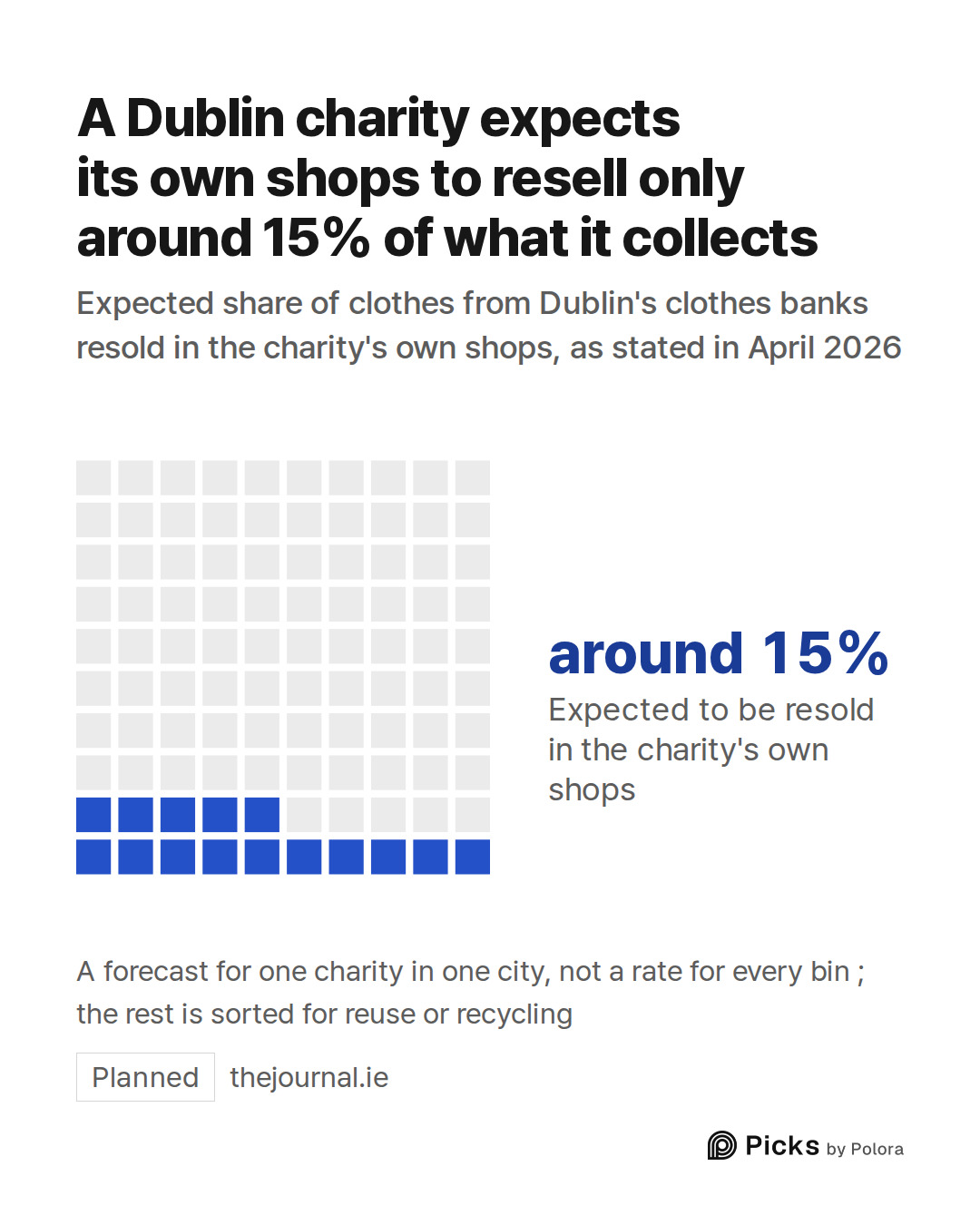
Nobody counts the local share the same way, but where it has been counted it is smaller than people expect. In 2024 the head of WRAP, a UK charity that works on waste, wrote in a blog post that about half of what people give to charity shops sells there, and that 60% of the clothes the UK collects for second-hand use are exported. The post does not make clear exactly what that 60% is a share of. In Dublin, a charity took over the city's clothes banks, as the street bins are called there, and in April 2026 said it expected to resell around 15% of what it collects in its own shops. The rest is sorted for reuse or recycling, and the part its shops cannot use goes to a recycler that supplies markets in Asia, Africa and Eastern Europe.

None of these figures is a rate for every bin, and a coat that is not sold nearby has not necessarily gone to waste. Many exported clothes are bought and worn by someone else. Others become rags or filling, and some are thrown away. The bin itself cannot tell you which of these will happen to yours.

Not every bin belongs to a charity either. For years most of Dublin's clothes banks were run by a private company, Textile Recycling Limited, under the name Clothes Pod.
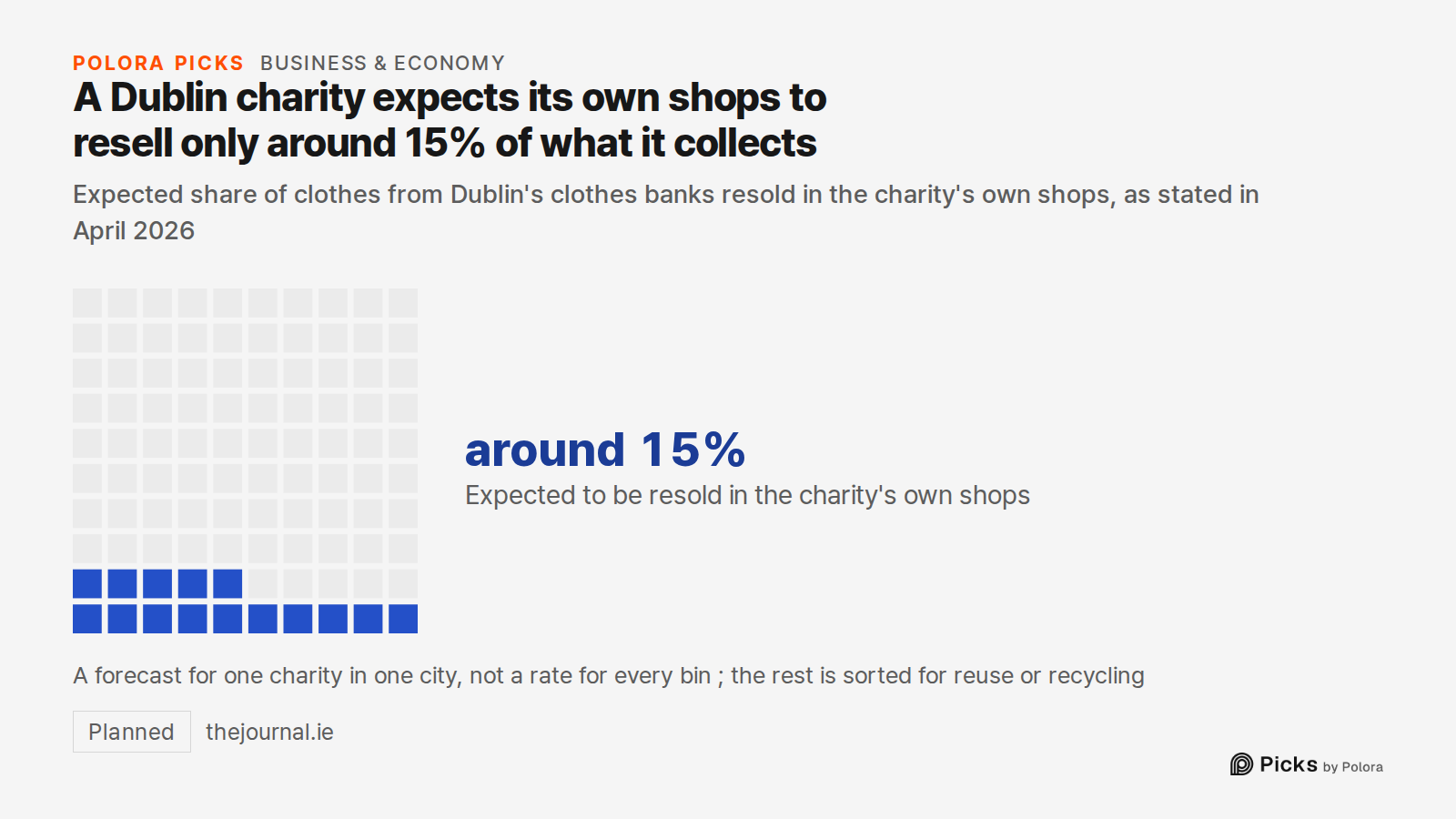
A Dublin charity expects its own shops to resell only around 15% of what it collects · Expected share of clothes from Dublin's clothes banks resold in the charity's own shops, as stated in April 2026 · Expected to be resold in the charity's own shops · around 15% · A forecast for one charity in one
Expected share of clothes from Dublin's clothes banks resold in the charity's own shops, as stated in April 2026

Your old coat is sold by weight, not by the piece

Once clothes leave the bin, they are counted by weight. According to the European Environment Agency (EEA), collectors, whether charities or companies, usually go through the bags first and take out the best pieces, which the trade calls "cream", to sell in their own shops. The rest is sold on by the tonne. Some is sorted by hand into grades and pressed into bales. A large amount leaves Europe unsorted, as so-called "originals" in which wearable and unwearable clothes are still mixed together.

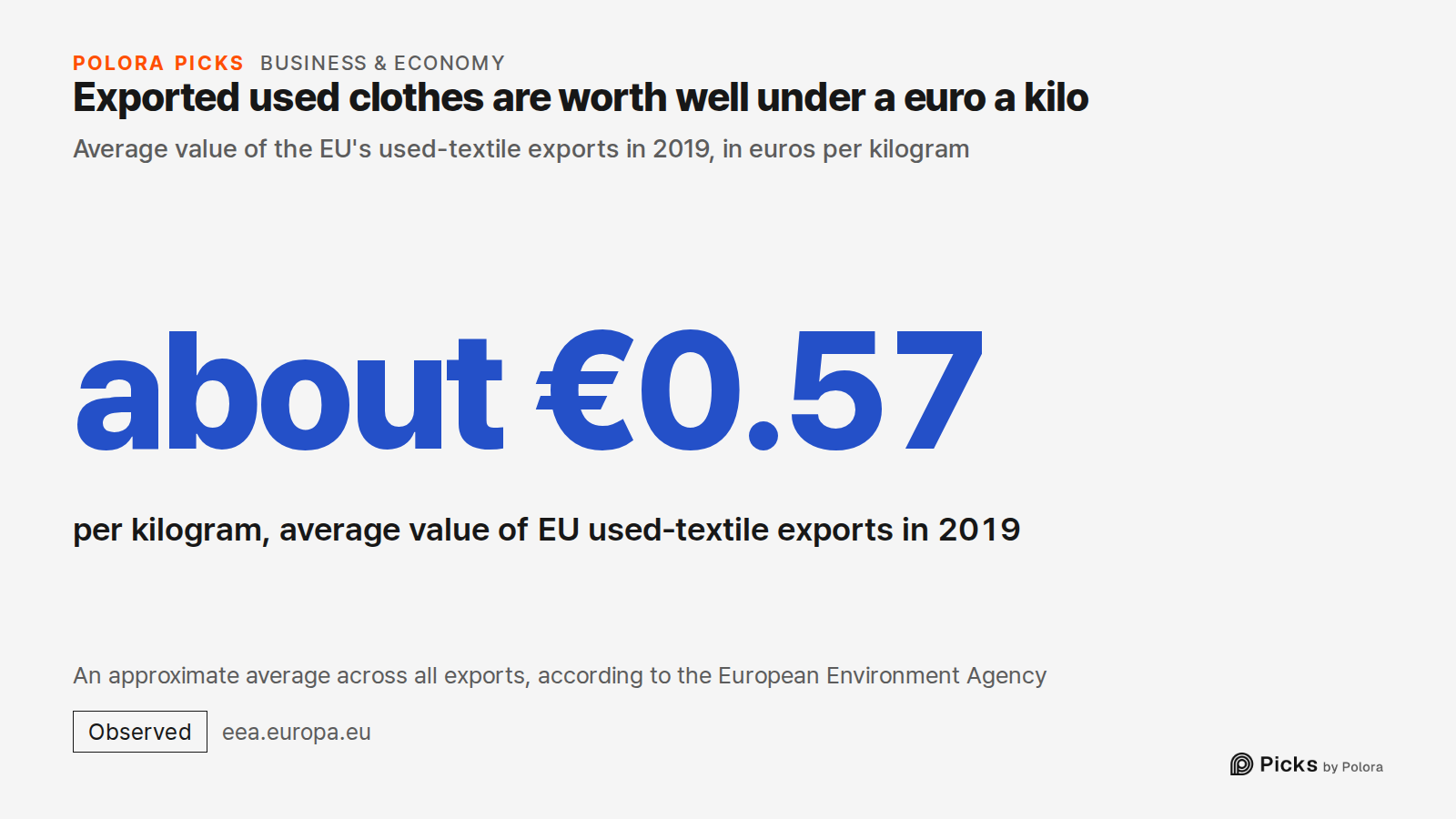
At the bottom of the scale, what nobody will wear is cut into industrial rags or shredded into filling. Across the trade the price is low. The EEA puts the average value of the EU's used-textile exports in 2019 at about €0.57 per kilogram.
Exported used clothes are worth well under a euro a kilo · Average value of the EU's used-textile exports in 2019, in euros per kilogram · about €0.57 · per kilogram, average value of EU used-textile exports in 2019 · An approximate average across all exports, according to the European Environment A
Average value of the EU's used-textile exports in 2019, in euros per kilogram

The price abroad has long helped pay for the bin on your street

Collecting clothes costs money. Someone has to drive the van, rent the warehouse and pay the sorters, and the EEA notes that sorting is mostly done by hand, which is why it moves to countries where labour is cheaper. For a long time selling the bales covered much of this, and in many places the bin stood on the street because what came out of it could be sold. Sales were not the only source of income everywhere, though. In France, Refashion, the body that hands out money for textile collection, pays collectors by the tonne.

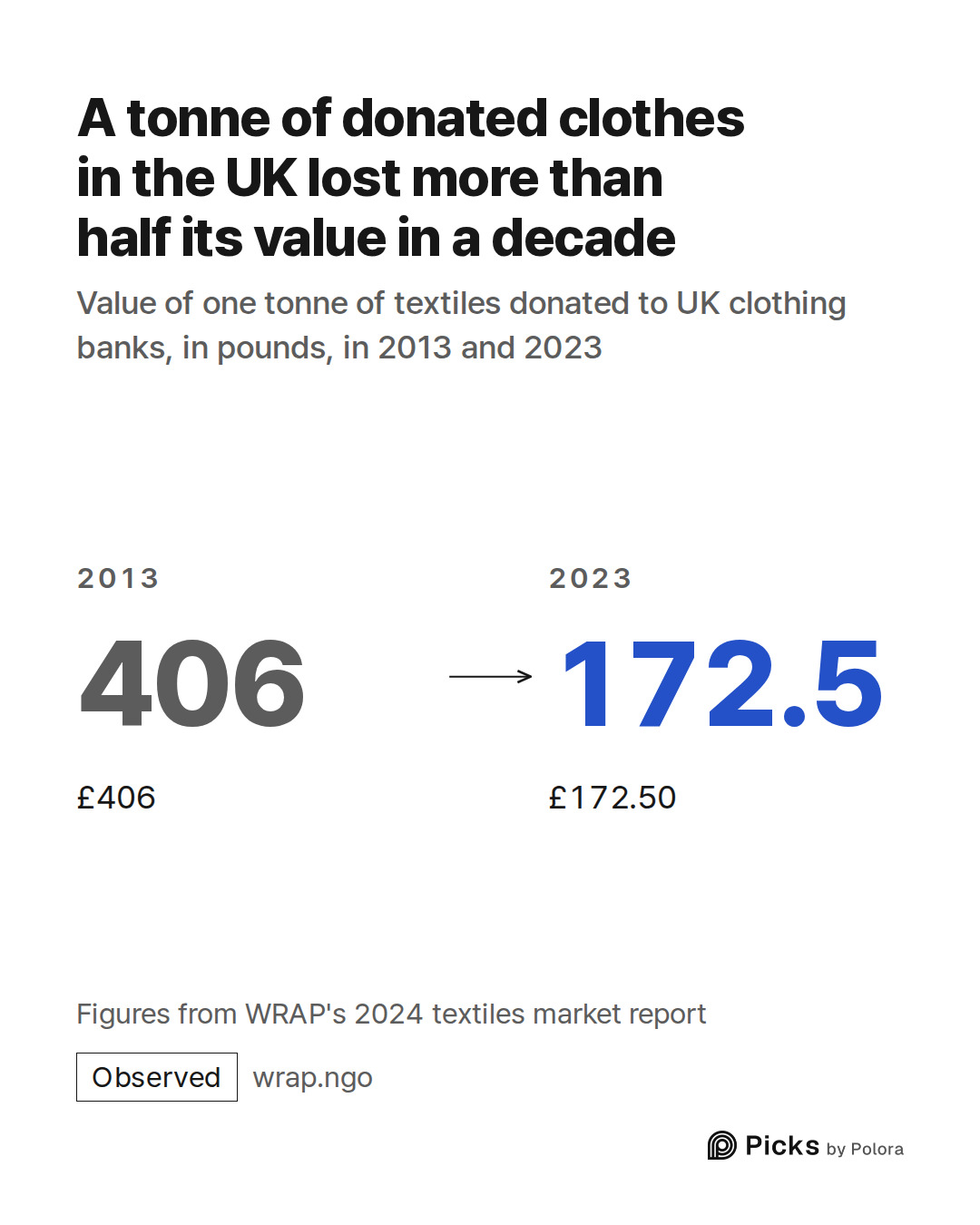
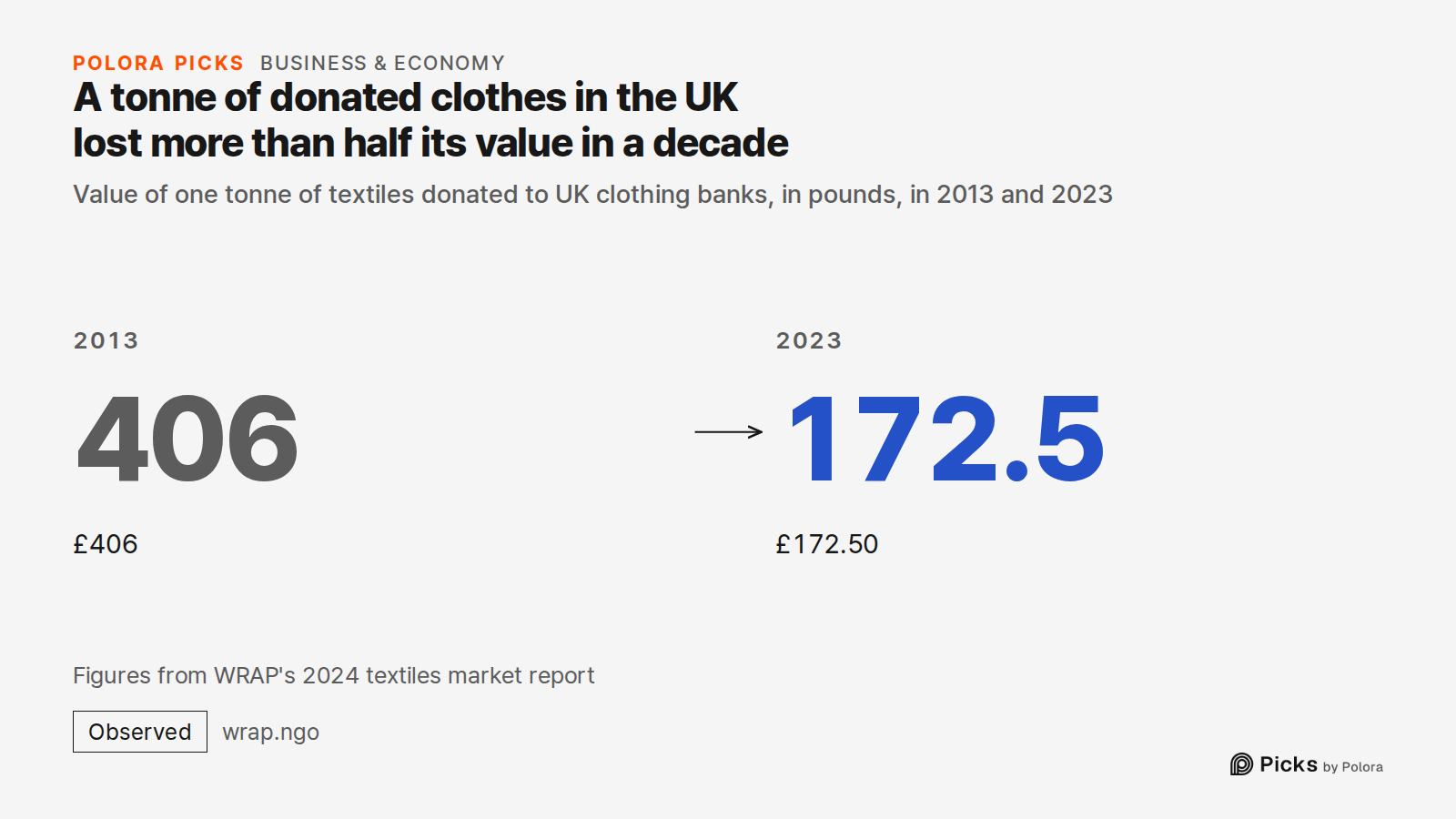
That price has been falling for years. WRAP's 2024 market report found that a tonne of textiles donated to UK clothing banks was worth £406 in 2013 and £172.50 in 2023. In Dublin the old operator ran the banks under a deal in which it paid the council per tonne. In 2025, TheJournal reported, a report to the city's councillors called that arrangement "increasingly unsustainable" and said future contracts would require councils to pay the operator instead.
A tonne of donated clothes in the UK lost more than half its value in a decade · Value of one tonne of textiles donated to UK clothing banks, in pounds, in 2013 and 2023 · 2013 · 406 · £406 · 2023 · 172.5 · £172.50 · Figures from WRAP's 2024 textiles market report
Value of one tonne of textiles donated to UK clothing banks, in pounds, in 2013 and 2023

What happened when used clothes sold for less than it cost to sort them

In October 2024 two European associations, EuRIC for the recycling industry and Municipal Waste Europe for local authorities, warned that "since spring 2024, the prices for sorted second-hand garments no longer cover processing costs". They said warehouses were filling up and that more clothes risked being burned. That same month Soex, a Berlin-based collector and recycler, filed for insolvency. In July 2025 two German subsidiaries of the Swiss group Texaid followed. One of them runs collection containers across Germany and 50 second-hand shops.

In Dublin, the operator of most of the city's clothing banks suspended collections on 27 January 2025. Its warehouses were full because, as a later report put it, "many international textile markets are currently inaccessible".

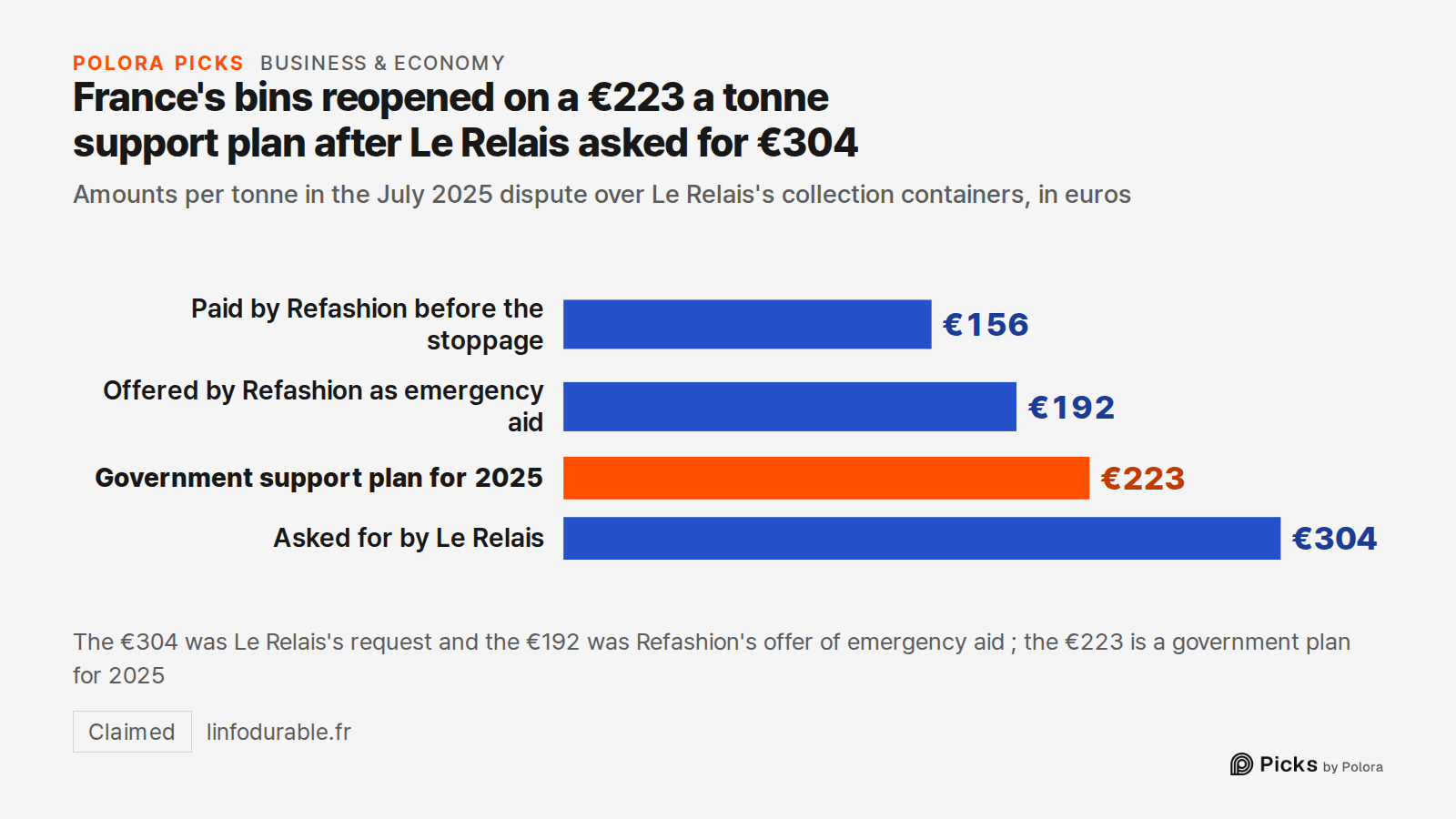
In France, Le Relais, a social enterprise that runs collection containers across the country, stopped collecting from them on 15 July 2025. Refashion had been paying it €156 per tonne. Le Relais asked for €304, and Refashion offered €192 as emergency aid. Refashion put the crisis down to a sharp drop in export prices for sorted used textiles, mainly in Africa. After the government announced a support plan worth €223 per tonne for 2025, collection resumed on 24 July, nine days after it stopped.
France's bins reopened on a €223 a tonne support plan after Le Relais asked for €304 · Amounts per tonne in the July 2025 dispute over Le Relais's collection containers, in euros · Paid by Refashion before the stoppage · Offered by Refashion as emergency aid · Government support plan for 2025 · Aske
Amounts per tonne in the July 2025 dispute over Le Relais's collection containers, in euros

Where the bales go

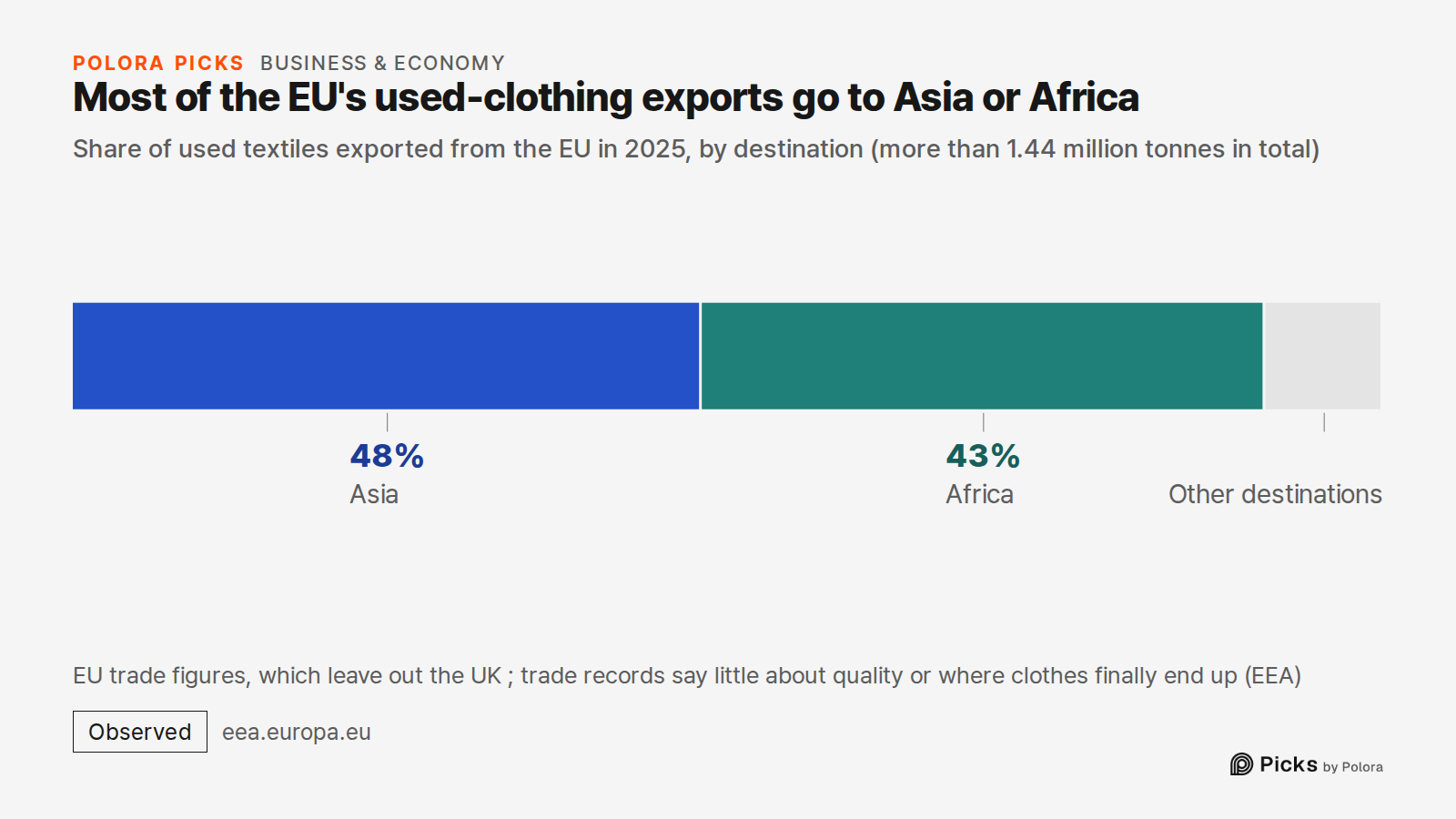
Most of what Europe exports goes to two continents. The EEA counts more than 1.44 million tonnes of used textiles exported from the EU in 2025, or 3.2 kg per person. The volume has stayed around 1.4 million tonnes a year since 2015, nearly double the 2005 level. In 2025, 48% went to Asia and 43% to Africa. These are EU trade figures, which leave out the UK from 2020, and the EEA cautions that trade records say little about the quality of what is shipped or where it finally ends up.

The two routes do different jobs. In Africa the clothes are mostly sold to be worn again. In Asia they mostly go to sorting hubs, where they are recycled or shipped on to other countries, including back to Africa. On both routes, the EEA notes, some end up in dumps or are burned in the open. Le Relais says that 25 to 30% of what it recovers goes to countries such as Senegal, Madagascar and Burkina Faso.
Most of the EU's used-clothing exports go to Asia or Africa · Share of used textiles exported from the EU in 2025, by destination (more than 1.44 million tonnes in total) · Asia · Africa · 48% · 43% · Other destinations · EU trade figures, which leave out the UK ; trade records say little about qual
Share of used textiles exported from the EU in 2025, by destination (more than 1.44 million tonnes in total)

How much of an exported bale becomes waste depends on which market you count

Kantamanto in Accra, Ghana, is one of the largest second-hand clothing markets in West Africa. TIME reported in 2025 that it receives 15 million garments a week. Traders buy the bales without seeing what is inside. One told TIME that sometimes 90% of a bale sells and sometimes only 30%, and that a bale cannot be returned once bought. Traders estimate that 30 to 40% of bales cannot be sold, and the Or Foundation, a charity working in the market, puts the share that leaves as waste at 40%. That figure is disputed. The Ghana Used Clothing Dealers Association has called it exaggerated and unrepresentative, while the market's leadership has defended it.

In Kenya, WRAP's chief executive wrote after a 2024 visit that an estimated 2% of imported clothing is waste, without saying who made the estimate. These two figures come from different markets and are measured in different ways. Neither one describes all the clothing that is exported.

Importing countries weigh the trade differently. In April 2026 Ugandan media reported that parliament had approved a 30% environmental levy on imported second-hand clothes, on top of a 35% import duty. The levy was proposed in the External Trade (Amendment) Bill, 2026, and when it takes effect is not settled in the reports cited here. In Kenya, a tax on second-hand clothes was proposed in the 2026 Finance Bill and removed by the National Assembly. The finance minister said he would try to bring it back through amendments, but no report cited here shows that he has.

Europe is moving part of the bill from the bales to the brands

Since 2025, EU countries have had to collect textiles separately from other rubbish. The EEA warns that collecting more will also bring in clothes of lower quality, and that unless sorting and recycling capacity grows, more of it could be burned, buried or exported.

The next change is about who pays. Under a revised EU law that took effect on 16 October 2025, every member state has 30 months, until about April 2028, to set up a scheme in which clothing and footwear brands pay a fee on each product they sell. That fee will fund collection and what happens to the clothes afterwards. Clothes collected separately must be sorted before they are shipped anywhere, so that waste cannot leave labelled as reusable. The law also treats such clothes as waste until they are sorted and leaves room for social enterprises that collect second-hand clothes to keep their own collection, though how these rules apply in practice will depend on how each country writes them into its own law.

So the bin on the corner is the front door of a worldwide trade, and for years the bales have helped pay for it. When the price of a kilo of used clothes fell below the cost of sorting, collections stopped in several places. What leaves in the bales is often worn again by someone far away, and some of it becomes waste. Europe's new rules move part of the cost of collecting it onto the companies that sell the clothes new.
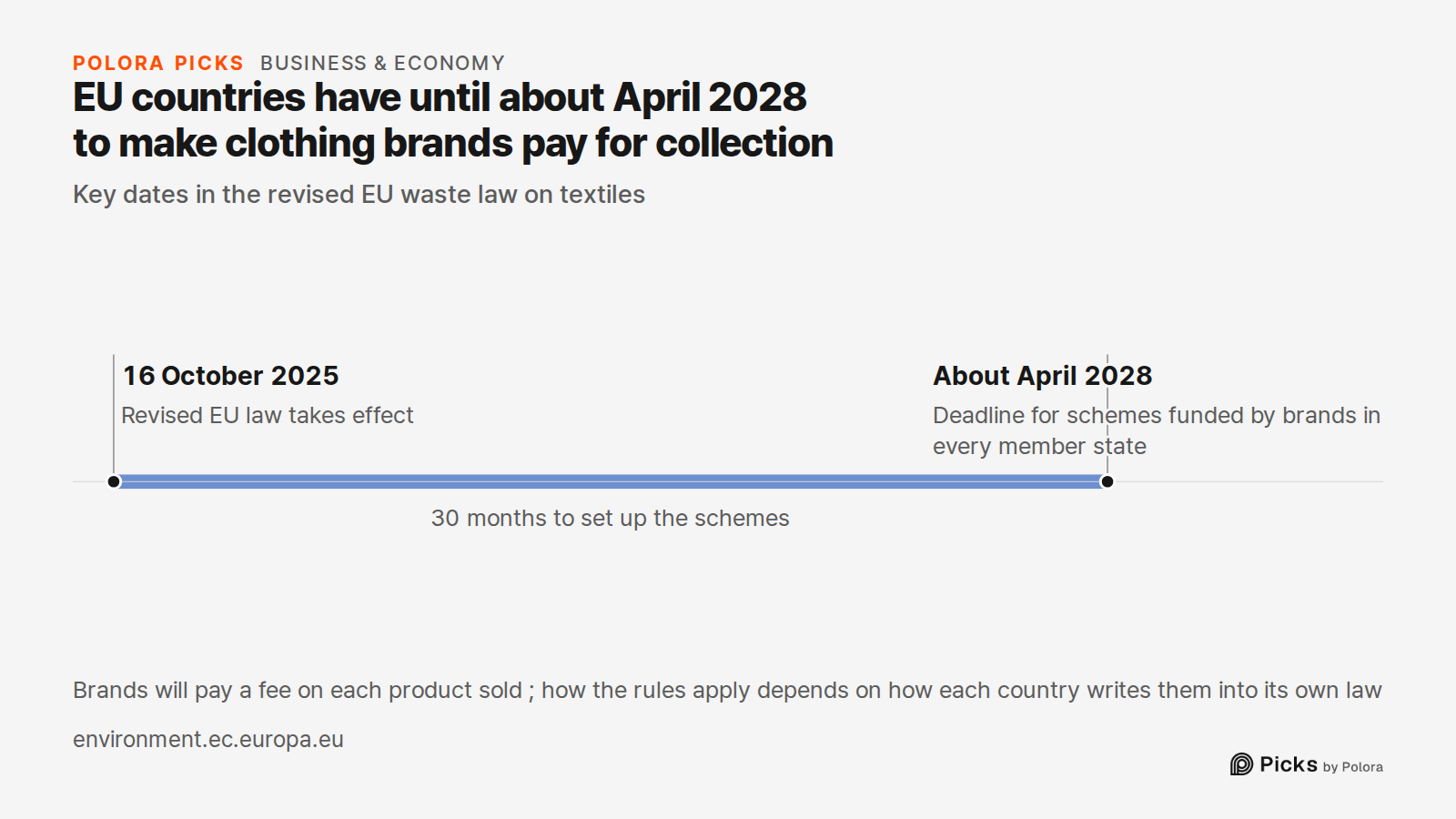
EU countries have until about April 2028 to make clothing brands pay for collection · Key dates in the revised EU waste law on textiles · 16 October 2025 · About April 2028 · Revised EU law takes effect · Deadline for schemes funded by brands in every member state · 30 months to set up the schemes ·
Key dates in the revised EU waste law on textiles
What happens to the clothes you drop in a donation bin?What happens to the clothes you drop in a donation bin?Only part of the bag is resold nearby. · The rest is sorted, sold by the kilo and often shipped abroad. Many clothes are worn again, and some are thrown away.Expected to be resold in the charity's own shops · around 15% · A Dublin charity expects its own shops to resell only around 15% of what it collects · Expected share of clothes from Dublin's clothes banks resold in the charity's own shops, as stated in April 2026 · A forecast for one charity in oneIn many places, the bin stood on your street because what came out of it could be sold. · Not everywhere : in France, a body called Refashion pays collectors by the tonne.2013 · 406 · £406 · 2023 · 172.5 · £172.50 · A tonne of donated clothes in the UK lost more than half its value in a decade · Value of one tonne of textiles donated to UK clothing banks, in pounds, in 2013 and 2023 · Figures from WRAP's 2024 textiles market reportWhen used clothes sold for less than it cost to sort them, collections stopped in places. · Dublin's main operator suspended collections in January 2025. In France, the collector Le Relais stopped for nine days in July 2025.Europe is moving part of the bill from the bales to the brands. · EU countries have until about April 2028 to set up schemes in which clothing and footwear brands pay a fee on each product they sell.Sources 21 : wrap.ngo · WRAP : The end of the clothing line, thejournal.ie · TheJournal : Dublin City Council clothes banks taken over by charity, irishtimes.com · The Irish Times : Clothes banks are overflowing as market for castoffs collapses + 18Read the full story at · polora.ai

What happens to the clothes you drop in a donation bin?

Alpha · deepseek-v4-pro

Most people picture the donation bin as a direct hand-off: your coat goes to a charity-shop rail, or onto the back of someone who needs it. The more accurate picture is that your coat enters a global commodity chain, and only a minority of what goes in is ever sold locally as a piece of clothing. Here is the chain as I see it. 1. The bin is a collection point, not a promise. Some bins are run by charities, but many are run by for-profit textile collectors. What matters is whether the contents can be sold by weight. So the bin is not really a moral transaction — it is the front door of a used-textile business. 2. First comes a rough sort. Collectors open the bags and pull out the best pieces — sometimes called the “cream” — because those can be sold at the most profitable point in the chain, often a local second-hand shop. The share sold this way is smaller than people expect. Figures in the record range from about 15% in Dublin’s clothes banks to around half in some UK charity-shop systems. The rest moves on as bulk material. 3. Then the clothes become a commodity priced by the kilo. What does not sell locally is baled and sold by weight to textile merchan…

Beta · gpt-6-sol

Beta: The broad route Alpha describes is right, but two parts of the manuscript overreach: a donation bin does not tell you who runs it or where its contents will go, and the export price is not necessarily the sole thing keeping it in place. Clothes may be selected for local resale, sold in bulk to sorters, exported for resale or further sorting, or turned into rags and other materials. Some ultimately become waste. The proportions depend on the collector and market; they cannot be read off from a single bin. WRAP’s chief executive says roughly half of items *given to UK charity shops* sell there, but that is not a measured percentage for all donation bins. The same post says 60% are exported without clearly defining that figure’s denominator, and it confusingly refers to a “remaining 70%” after saying half sell. Those figures need checking against WRAP’s underlying report before publication as a precise split. (wrap.ngo) The export route is substantial, not hypothetical: the EEA reports over 1.44 million tonnes of used textiles exported from the EU in 2025, with 48% going to Asia and 43% to…

Gamma · gemini-3.1-pro

Here is what I found by checking the manuscript’s claims against the live web, following the research brief: 1. WRAP 2024/2019 Figures (UK) The manuscript states that WRAP’s chief executive wrote in 2024 that "about half of what people give to charity shops sells there, and that 60% of the clothes the UK collects for second-hand use are exported." I was unable to extract the exact page numbers from the full WRAP Textiles Market Situation Report PDFs to verify the strict denominator of these splits. However, recent academic and industry citations of WRAP's data confirm that UK clothing consumption generates more waste beyond UK borders than within them, and that roughly 45–60% of collected used clothing is exported for reuse abroad. 2. Dublin City Council Clothes Bank Tender The manuscript claims that in May 2025, a report said future contracts would require councils to pay the operator. I found news reports from *TheJournal.ie* (May 28, 2025) and the *Dublin Inquirer* (May 2, 2025) confirming that the previous operator (Textile Recycling Limited) suspended collections in January 2025 due to warehouse capacity, and that a new tender process was underway. A later source (*…

Researcher · gpt-6-luna

Research check: Several claims are supported by sources retrieved this turn, but some details in the debaters’ accounts remain unverified. I found no retrieved source that establishes a general percentage of all donation-bin clothes that are resold locally—or that most donated clothes are never worn. - WRAP’s UK price figures are confirmed. Its 2024 report says the price per tonne for textile-bank donations fell 57.5% from 2013 to 2023, to £172.50 per tonne. WRAP’s release gives the earlier figure as £406 per tonne. These are prices for textile-bank donations, not proof that export prices alone fund every bin. WRAP’s report page and release: (wrap.ngo) - EU export figures are confirmed, with an important limit. The EEA’s current indicator reports more than 1.44 million tonnes of used textiles exported in 2025, or 3.2 kg per person. It says the main destinations are Africa and Asia, but also notes that trade data provide very limited information about the textiles’ quality. The indicator’s page is the source for the headline volume; the percentage split c…

The Arbiter · gpt-6-sol

The voices largely agree on the route a donated garment *can* take: a collector selects some for local resale, while other textiles move through bulk sorting, resale abroad, recycling or disposal. The disagreement is about how far the manuscript can generalize from that route. No source checked in this round establishes the fate of most items in all donation bins. In particular, “not sold locally” cannot be treated as “never handed to anyone”: clothes sold in an importing market may be worn there. Two points are now firmer. The EEA’s current series reports more than 1.44 million tonnes of EU used-textile exports in 2025, with 48% going to Asia and 43% to Africa. That measures EU exports, not the contents of a particular bin or their ultimate fate. (eea.europa.eu) The European Commission confirms that the revised directive entered into force on October 16, 2025, gives member states 30 months to establish textile and footwear producer-responsibility schemes, and requires sorting separately collected textiles before possible shipment. ([environment.ec…

The Arbiter's Final Verdict · gpt-6-sol

Verdict: the manuscript’s central picture holds, but its opening claim does not. A donation bin is usually the start of a sorting and resale chain, not a promise that your garment will appear in a nearby charity shop. But “most of them are never handed to anyone” wrongly equates *not sold locally* with *not worn*. Exported clothes can be bought and worn elsewhere, and the checked sources do not establish the fate of most garments put in bins. What happens depends on the bin’s operator and the condition of its contents. A collector may select good pieces for local sale, sell other textiles in bulk to merchants, or send them for further sorting. From there, wearable clothes may be resold abroad; other material may become rags or filling, and some becomes waste. A bin may be run by a charity or a commercial collector. The EEA describes sorting and export routes, but warns that trade records reveal little about garments’ eventual fate: EEA, *EU exports of used textiles*. Here is where the manuscript’s more specific claims land: - Local resale and UK shares: WRAP’s chief executive gives the…