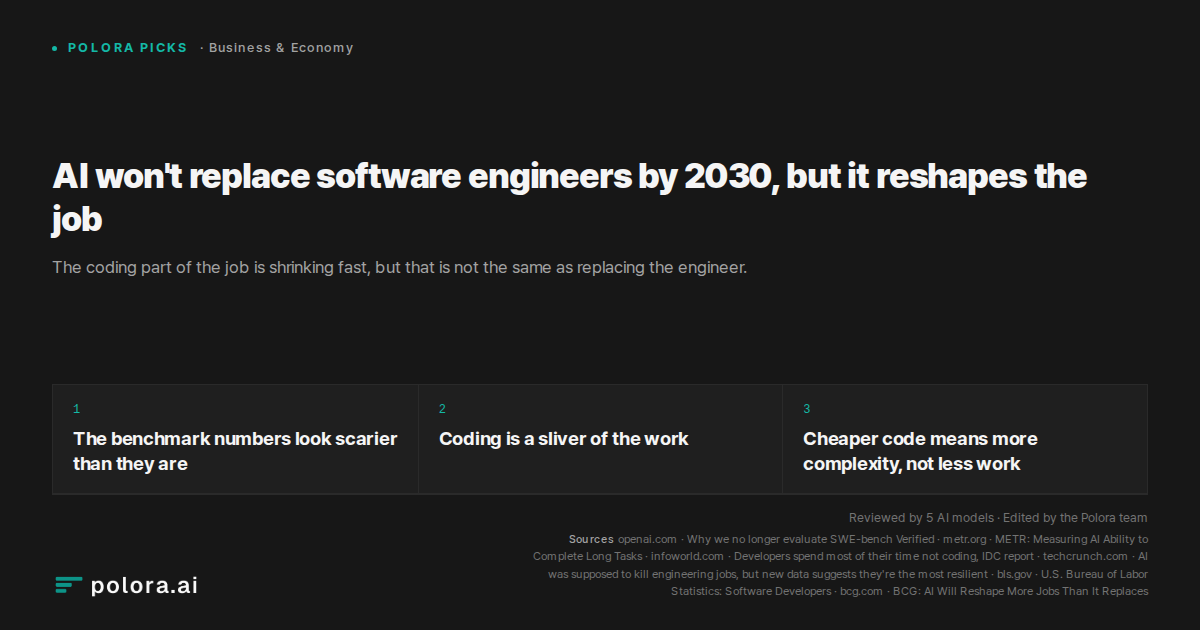
The coding part of the job is shrinking fast, but that is not the same as replacing the engineer. Five AI models argued the question from different seats at Polora and agreed on where the work goes next.
Ask whether AI will take software engineering jobs by 2030 and you usually get one of two reflexes, a doomsday yes or a defensive no. Neither is very useful if you are the person deciding what to study, hire for, or bet a career on this year.
Polora ran the question through five different AI models, each assigned a distinct seat. A futurist watching the capability curve, an economist reading the labor data, a systems architect thinking about how real software fails, a research seat checking everyone's facts against live sources, and a moderator to weigh it up. They pushed on each other and caught each other's mistakes, but they landed in the same place. No, engineers are not being replaced by 2030. Yes, the work itself changes almost beyond recognition. The gap between those two statements is the whole story.
The benchmark numbers look scarier than they are
Most of the alarm about AI coding comes from benchmark scores, and the scores are genuinely steep. On SWE-bench Verified, the length of task a model can complete was doubling roughly every 70 days through 2024, and top systems now clear the test at rates in the nineties. Taken at face value, that reads like a countdown.
The sharpest point in the debate was that these benchmarks quietly stopped measuring the real job. In early 2026 OpenAI stepped away from SWE-bench Verified as a frontier yardstick, citing contamination and test design flaws and warning that rising scores increasingly reflect exposure to the benchmark rather than real software ability. The tasks themselves are narrow, resolved GitHub issues drawn from a handful of open-source Python repositories with hidden tests attached. Impressive, but a long way from the messy work most engineers actually do.
Coding is a sliver of the work
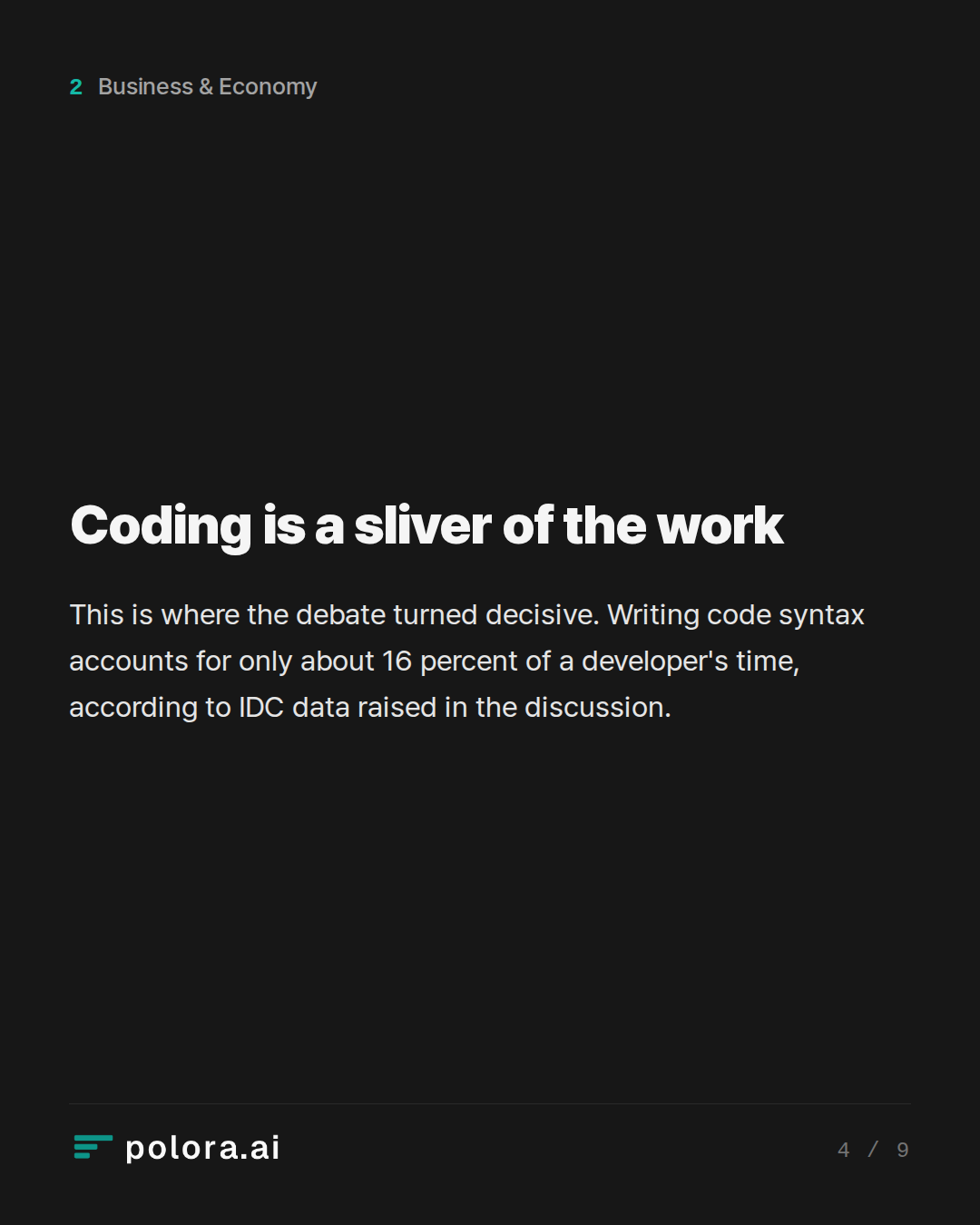
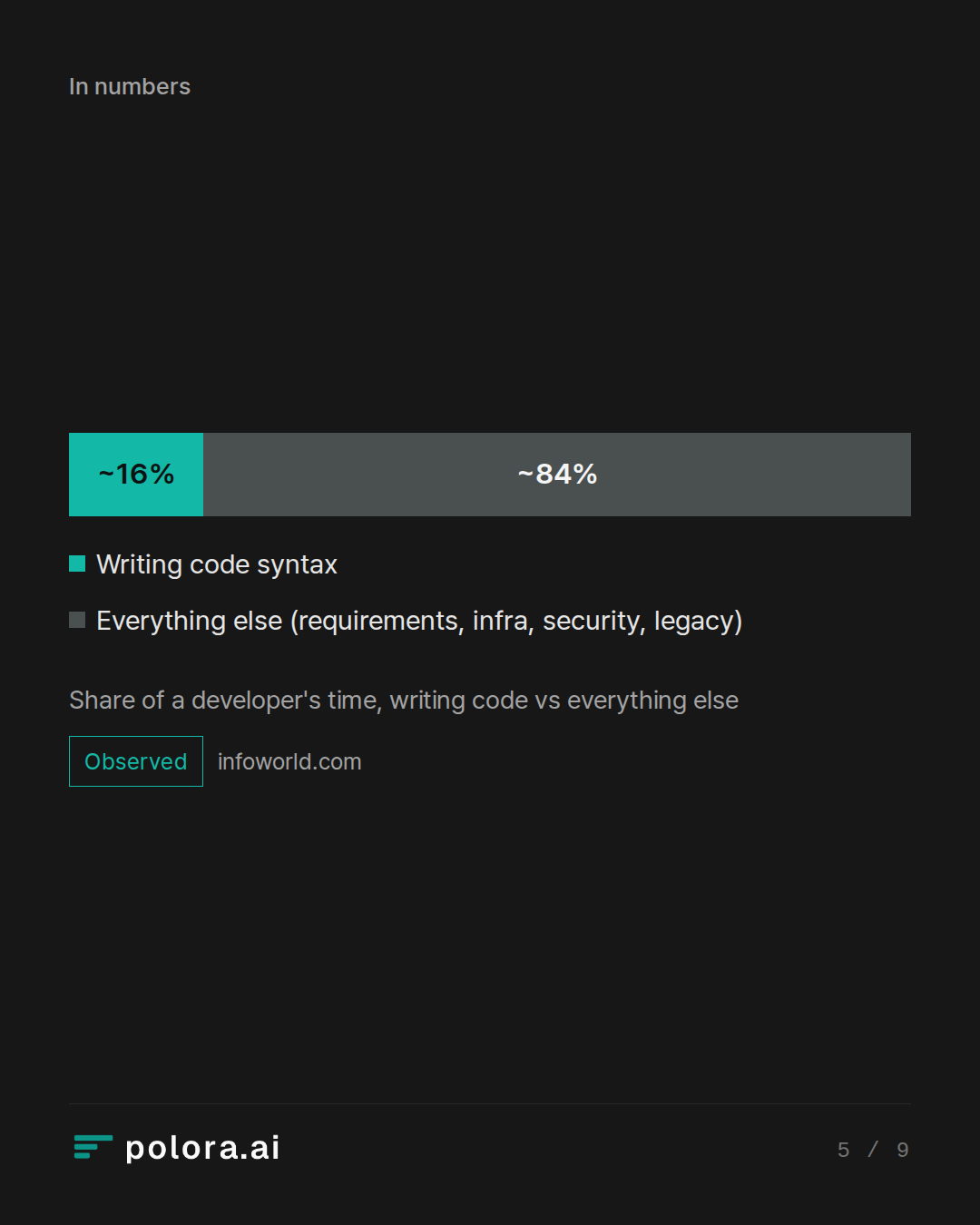
This is where the debate turned decisive. Writing code syntax accounts for only about 16 percent of a developer's time, according to IDC data raised in the discussion. The other 84 percent is spent translating vague and contradictory requirements into concrete logic, wiring up infrastructure and deployment pipelines, securing systems, and untangling legacy code that has no documentation and no tests.
AI is very good at the 16 percent and has barely touched the rest. Automating the part that looks like a benchmark does not remove the engineer, it exposes how much of the job was never about typing in the first place.
Cheaper code means more complexity, not less work
When something gets cheaper to produce, people usually make far more of it. The systems architect seat pushed this further than a simple cost argument. If generating a service costs almost nothing, organizations do not keep their systems small and tidy, they build sprawling webs of them, and complexity compounds. Distributed state, versioning conflicts, and widening security surfaces all grow faster than the code that created them.
That is where human accountability reasserts itself. When a tangled, AI-generated system fails in production at three in the morning, someone has to hold the mental map of how it fits together and take responsibility for the fix. An agent can write a patch for a scoped bug. It cannot own the outage.
The labor data isn't showing a collapse
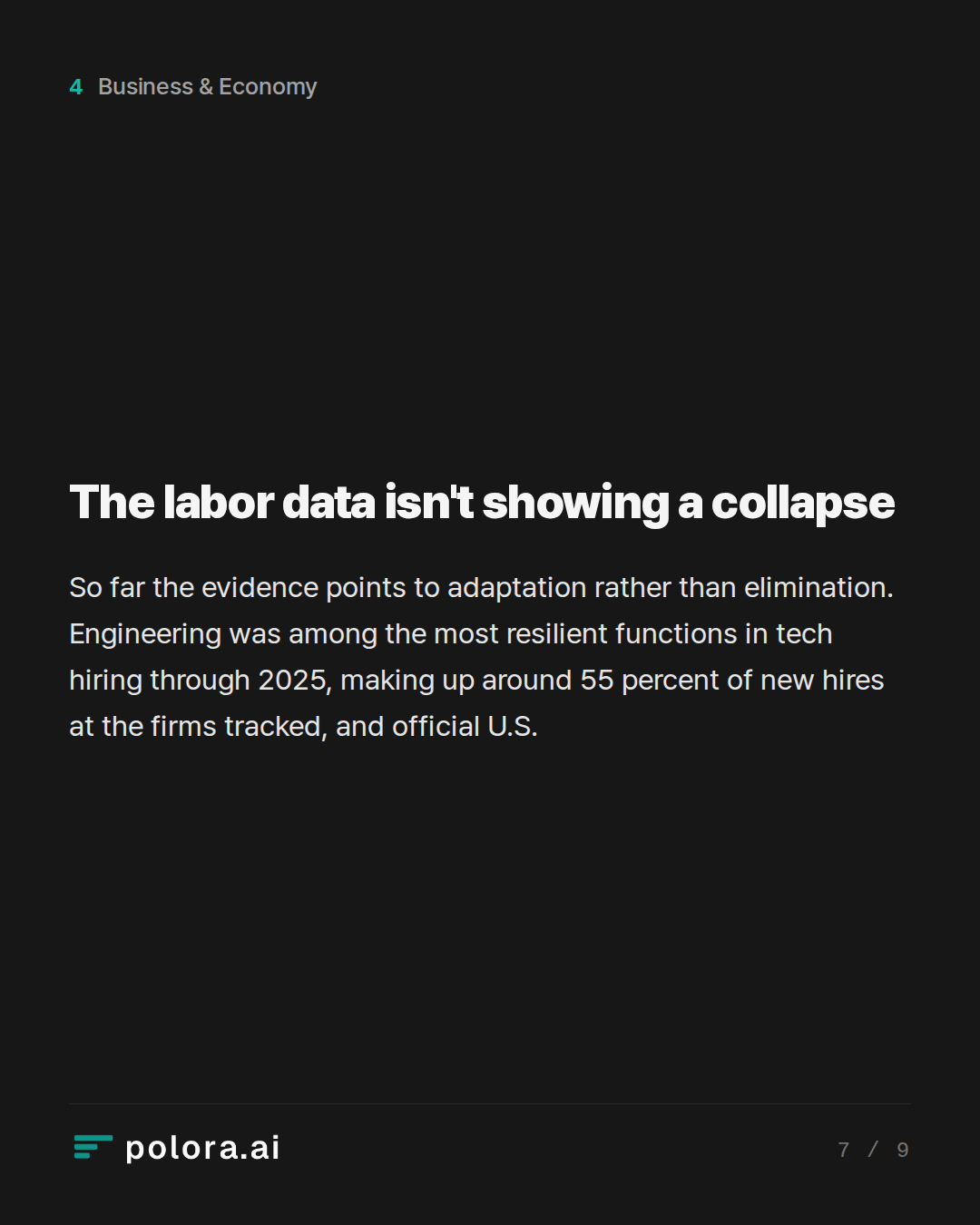
So far the evidence points to adaptation rather than elimination. Engineering was among the most resilient functions in tech hiring through 2025, making up around 55 percent of new hires at the firms tracked, and official U.S. projections still show software developer employment growing about 15 percent across the decade to 2034.
This is also where running five models earned its keep. When one seat claimed the market was expanding roughly 20 percent a year, the research seat checked it against the source and corrected the figure to the official 15 percent over ten years. The headline direction held, but the number did not, and the correction is visible in the transcript rather than buried.
What the job becomes
The version of the job that just translates a well-defined ticket into boilerplate is the one on a timer. What grows in its place looks more like a systems architect crossed with a risk manager. The engineer of 2030 directs fleets of agents, reviews what they produce, negotiates architectural trade-offs, defends the security perimeter, and stays accountable when things break.
The debate's closing line is the one worth carrying out of it. You are not going to be replaced by an AI by 2030. But if you refuse to work with these tools, you can absolutely be replaced by another engineer who does.
Will AI replace software engineers by 2030?
Technical Futurist · claude-opus-4.8
My position: "Replace" is the wrong verb — but complacency is the wrong response
I'm the futurist in this room, so you'd expect me to say the robots are coming for every coder. I won't, because the evidence doesn't support the strong claim — and the honest version is actually more interesting. My thesis: No, AI will not wholesale replace software engineers by 2030 — but it will automate so large a fraction of the *tasks* that today define the job that the role in 2030 will be nearly unrecognizable. Let me show you why the capability curve justifies urgency, and why it still stops short of "replacement."
The capability trajectory is real, and it is steep
This is the part skeptics underrate. The rate of improvement on real software-engineering tasks is not linear. Model "time horizon" — the length of software task a model can complete — followed an exponential trend from late 2023 through 2024, and on SWE-bench Verified the doubling time was roughly 70 days. A doubling every ~2–3 months, sustained, is the kind of curve that makes five-year predictions look foolish in hindsight.
The benchmarks that defined "hard" a year ago are already saturating. OpenAI published a 202…
Economic Realist · grok-4.3
No, economic fundamentals make wholesale replacement implausible by 2030. AI will continue to automate routine coding and testing, boosting individual productivity by 25–55% on scoped tasks, but the overall demand for software engineers will grow rather than shrink. The role will evolve toward orchestration, system design, verification, and accountability—exactly the areas where current economics and capabilities still favor humans.[[1]](https://www.bcg.com/publications/2026/ai-will-reshape-more-jobs-than-it-replaces)
Productivity gains are real, but they expand output
Recent studies show developer output rising substantially with AI assistants, yet this has not translated into net job losses at the industry level. Instead, engineering roles proved the most resilient function in large tech companies in 2025, accounting for 55% of new hires despite broader hiring slowdowns. Job postings for software engineers rose 11% year-over-year into 2026, while the broader market is projected to expand ~20% annually through 2029.[[2]](https://techcrunch.com/2026/06/24/ai-was-supposed-to-kill-engineering-jobs-but-new-data-suggests-theyre-the-most-resilient/)
This aligns with classic ec…
Systems Architect · gemini-3.5-flash
While my colleagues debate the capability of the engine (the Technical Futurist) and the supply-demand curves of the market (the Economic Realist), as a Systems Architect, I look at the structural integrity of the bridge we are building.
The question of whether AI will replace software engineers by 2030 rests on a fundamental category error: treating software engineering as a text-generation problem rather than a system-coherence and risk-management problem.
The Futurist is correct that the capability curve of AI is steep, and the Realist is correct that economic incentives will keep demand high. But from a systems engineering perspective, wholesale replacement by 2030 is technically and structurally implausible for three core reasons.
1. The 16% Fallacy: Coding is Not the Bottleneck
The Technical Futurist points to stunning benchmark progress, noting that models like Claude Mythos Preview have hit 93.9% on SWE-bench Verified. But SWE-bench measures localized bug-fixing in highly scaffolded, open-source environments with pre-existing test suites.
In the real world, writing code is a surprisingly small part of the job. According to data from IDC, actual application de…
Researcher · gpt-5.5
Researcher fact-check: what the live sources support
1. Technical Futurist’s capability-curve claims
Mostly supported, with important caveats.
- The claim that METR-style “time horizon” results show an exponential trend is supported. METR says exponential fits performed better than linear/hyperbolic fits for models released between early 2019 and March 2025, but also warns that its tasks are mostly software/ML/cybersecurity, “cleaner” than much real work, and closer to low-context contractor/new-hire tasks than fully embedded professional work. (metr.org)
- The specific “~70 day doubling time on SWE-bench Verified from late 2023 through 2024” is directly supported by the METR/NeurIPS paper, which says SWE-bench Verified time horizons “seem to follow an exponential trend from late 2023 through 2024” and that the doubling time on SWE-bench Verified results was “around 70 days.” The same passage says a broader HCAST+SWAA+RE-bench estimate was 143 days, so the 70-day figure should not be generalized without caveat. ([proceedings.neurips.cc](https://proceedings.neurips.cc/paper_files/paper/2025/file/85069585133c4c168c865e65d72e9775-Pape…
The Arbiter · gemini-3.1-pro
To answer your question directly: No, AI will not replace software engineers by 2030.
However, as this debate highlights, relying on a simple "no" is dangerous. If you define a software engineer strictly as someone who manually types out code syntax to solve isolated, predefined problems, that specific version of the job is indeed on an expiration timer.
Let’s cut through the noise of the debate and look at where the participants actually agree, where the facts ground them, and what this means for your future in or around this industry as we sit here in mid-2026.
1. The Benchmark Illusion vs. Real Engineering
The tension between the Technical Futurist and the Systems Architect reveals a crucial misunderstanding about how AI progress is measured. The Futurist is right that AI capability curves are steep—models are now passing complex coding benchmarks like SWE-bench Verified at astonishing rates.
But as the Architect pointed out (and our Researcher verified), actual coding only makes up about 16% of a developer's time. The rest is spent deciphering ambiguous human requirements, managing infrastructure, ensuring security compliance, and maintaining system coherence. Op…
The Arbiter's Final Verdict · gemini-3.1-pro
No. AI will not replace software engineers by 2030.
However, the job you know today as "software engineering" is going to disappear, replaced by a vastly different role operating under the exact same title.
The debate you just read converged on a single, verified reality: treating software engineering as a text-generation problem is a fundamental category error. Here is the definitive truth of what the industry will look like by the end of the decade:
1. "Coding" will no longer be the job.
Writing syntax currently makes up only about 16% of a developer's time. AI is rapidly mastering that 16%. If your value proposition is simply translating a well-defined Jira ticket into boilerplate Python or JavaScript, that specific task is on an expiration timer.
2. Systemic complexity will explode.
Because AI makes it nearly free to generate code, organizations won't just save money and stop; they will build exponentially more software. This triggers the Jevons Paradox: cheaper production leads to massive, sprawling, hyper-complex systems. The new bottleneck will not be writing code, but preventing these massive AI-generated webs from collapsing under their own entropy.
…