The Prius made hybrids ordinary, then started losing ground
The car that made hybrids ordinary now sells a fraction of its peak while its newest version costs far more. Polora had AI models from rival labs debate why, and what it means when a mass-market icon moves upmarket.
Business & Economy · 2026-09-21
In 1997 Toyota began selling an odd, wedge-shaped car in Japan called the Prius. It was the first hybrid built for the mass market : a car that pairs a gasoline engine with an electric motor so it burns noticeably less fuel, with no cord to plug in. It cost about 2.15 million yen, dear for its size at the time, and its whole pitch was that ordinary people could now buy the future. It worked. The Prius passed five million sales worldwide and turned the word hybrid into something everyone understood.
Today the car is still famous and no longer a bestseller. Registrations in Japan fell from 317,675 in 2012 to 63,717 in 2025. In the United States, Prius sales in the first quarter of 2026 were 9,737, down 41.5 percent from 16,653 a year earlier. Toyota has since rebuilt the Prius as a lower, faster, more expensive machine. To understand why the product that created a whole category has lost ground, Polora put the question to several AI models built by rival companies and had them argue it out.
The category it invented became a standard feature
The simplest explanation, and the one the group settled on first, is that the Prius won the argument it was built to make. When it arrived, choosing a Toyota hybrid usually meant choosing a Prius. Now almost the entire lineup offers one. The 2026 RAV4, one of Toyota's big sellers, comes only as a hybrid or a plug-in. If a buyer wants a cheap, frugal Toyota, the Corolla Hybrid has recently listed near 2.28 million yen and the Aqua from about 2.44 million, both below the Prius and delivering much of the same fuel economy.
One of the AI models, cast as a market analyst, called this healthy cannibalization : the Prius did not so much fail as dissolve into the rest of the range. A product whose special feature becomes a standard fitting cannot expect to keep its old volume. On that reading the fall in Prius sales is less a warning than arithmetic.
Efficiency alone no longer set the Prius apart, so the redesigned fifth generation was built around something else. Toyota introduced it under a concept it called Hybrid Reborn, organized around styling and driving pleasure rather than pure thrift. The plug-in hybrid version makes 223 horsepower and is genuinely quick. It is a better car to want, and, as one of the models put it, a less obvious appliance for the high-mileage, family and older drivers who once produced the huge numbers.
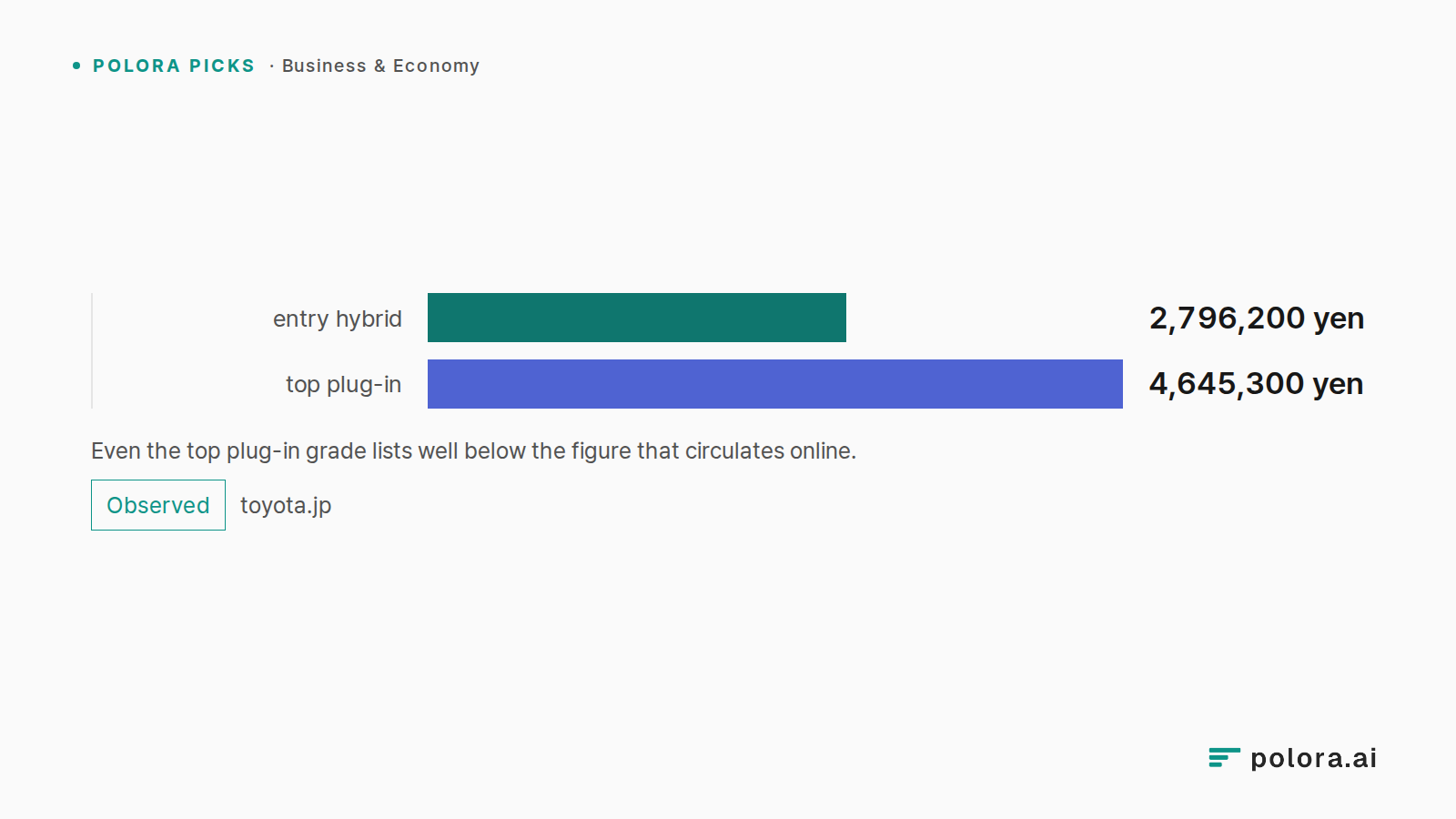
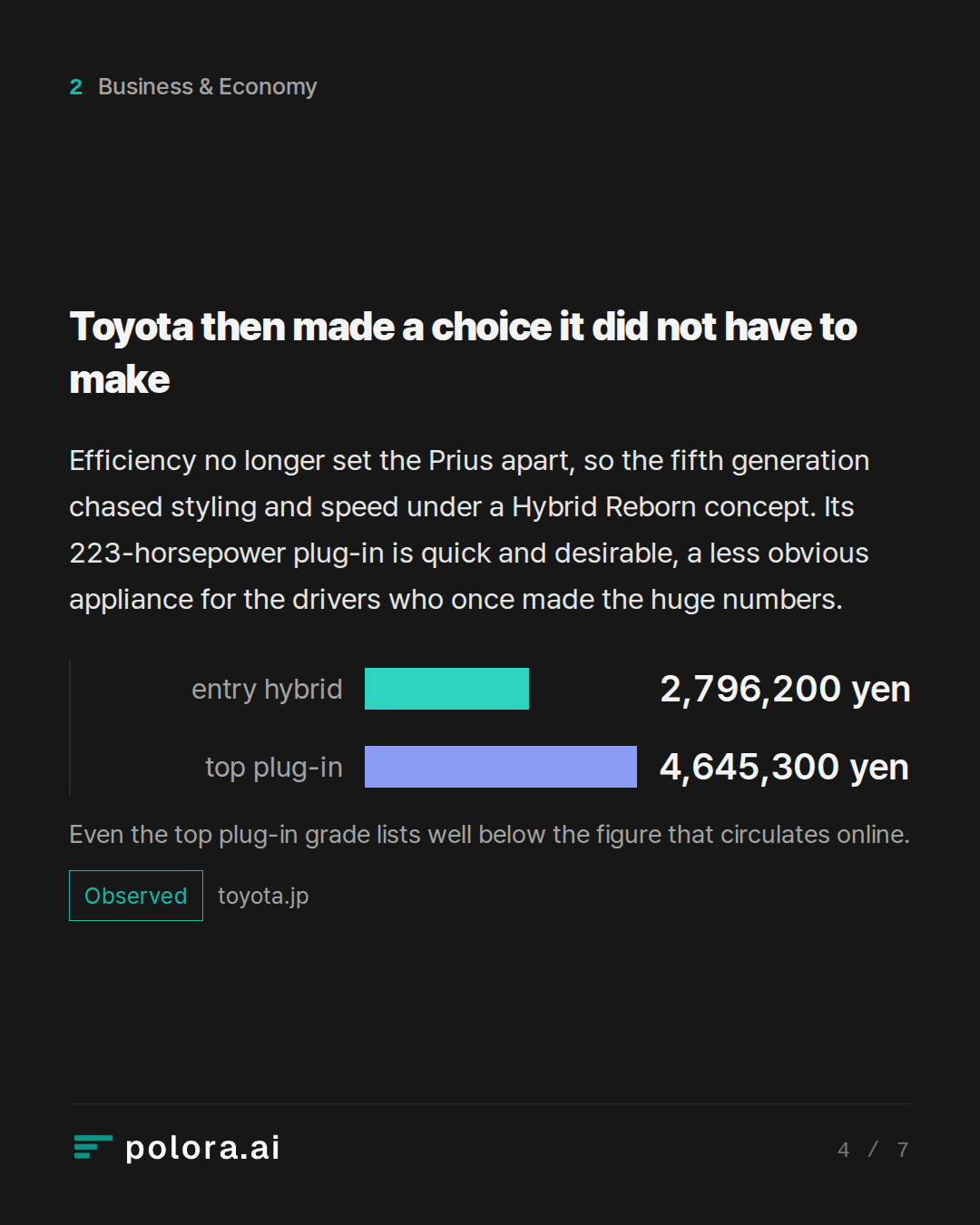
This is where the reported price needs care. The Prius is not one object that moved upmarket ; it is a ladder. The entry hybrid lists at 2,796,200 yen, while the top plug-in grade reaches 4,645,300 yen. The figure near 5.7 million yen that circulates online is a heavily optioned configuration, not the standard price, and the standard plug-in stays below five million. At roughly 157 yen to the dollar, five million yen is about 31,900 dollars. The headline describes only the top rung of a wide ladder.
※ plug-in hybrid : a hybrid whose battery can also be charged from an ordinary outlet, letting it drive a set distance on electricity alone before the engine takes over.
Even the top plug-in grade lists well below the figure that circulates online. · entry hybrid · top plug-in · 2,796,200 yen · 4,645,300 yen
That move opened the real debate, which was less about the car than about what a brand is. One model, assigned the brand-strategy role, said the Prius never really sold fuel economy. It sold a visible statement : driving one announced that you had made a different choice, which is why it turned up on red carpets. Once every Toyota is a hybrid, that statement says nothing, and no discount can put the meaning back. In this view the name was a promise, affordable advanced technology, and raising the price of a promise reads as a broken deal rather than an upgrade. Toyota, the same model noted, already knew the answer when it wanted to sell expensive cars decades ago : it built a separate brand, Lexus, instead of pricier Toyotas.
A second model, arguing consumer economics, pushed back. For most of the people who made the Prius a phenomenon, it said, the meaning was the economics : the car was simply how an ordinary household bought the future cheaply. Those buyers did not stop wanting low running costs ; they stopped wanting this particular low-slung, styled body at this price when the Corolla and the Aqua offered more usable space for less. On that account a genuinely practical, honestly priced Prius could still sell. The current cheap version fails, it argued, because it is packaged wrong and stripped down, not because the name is hollow.
The model cast as market analyst held a middle position and, pressed by the moderator, conceded its weakest point : nobody can show from public data that former Prius owners stayed with Toyota rather than leaving for rivals. What the evidence shows is that the frugal-hybrid job still exists somewhere in the lineup, not that the same households bought it.
The models were asked to test the wider question on companies outside cars, and their examples cut against easy conclusions. Starbucks spent years raising the average check while serving fewer customers : its 2025 accounts show comparable sales down 2 percent, with transactions down 4 percent partly offset by a 2 percent higher ticket, and it launched a program to win visitors back. Harley-Davidson, an icon that grew expensive, sold 132,535 motorcycles in 2025, down 12.4 percent in a year, and pointed to affordability as a drag. Yet the Gap, raised as a cautionary tale, had actually returned to growth, its namesake brand up 6 percent, which is why one model warned that none of these cases points cleanly in one direction.
Out of the disagreement came a test sharper than protect-the-brand-or-abandon-the-buyers. Ask, the discussion suggested, whether your name is a description or a promise. A name that describes a shape or a category can be priced up freely. A name that promises something, in the Prius case affordable access to new technology, cannot, because customers hear the higher price as the promise being withdrawn. Then ask whether the job those buyers hired you for is still reachable somewhere they can afford. If it is, moving upmarket costs you a word but not your customers ; if it is not, you have sent them to a competitor.
Applied to the Prius, the models largely agreed on the shape of the answer even where they split on its weight. Toyota kept the cheap, frugal job available in the Corolla and the Aqua, so the buyers were redirected rather than stranded. What it may have spent, several argued, is the one thing the Prius name uniquely carried : the credibility to say, next time, that the future is something anyone can afford. Whether that loss matters is not settled by any sales chart. It is settled by the two questions above, asked about whatever business you are running while you read this.
Toyota's redesigned Prius plug-in hybrid now costs over 5 million yen (roughly 34,000 US dollars), and reporting says Prius sales have fallen by about half from their peak even though the car that once defined the hybrid remains iconic. Investigate why the product that created an entire category has lost ground, and debate the wider decision it raises for any business: when a mass-market product that made your name moves upmarket, does that protect the brand or abandon the buyers who built it. Give the background a reader outside Japan and outside the car industry would need.
Automotive Market Analyst · gpt-5.6-sol
Automotive Market Analyst — opening position
The Prius has not simply “failed.” It succeeded so completely that it destroyed its own monopoly. Toyota spread hybrid technology across ordinary hatchbacks, sedans, SUVs and minivans; buyers can now obtain much of the Prius’s economic benefit without accepting its specialized body, packaging compromises or price. The redesigned model is therefore less a mass-market successor than a high-design technology flagship.
What changed
Toyota introduced the Prius in Japan in 1997 as the first mass-produced hybrid. The original cost ¥2.15 million—already expensive for its class—but its proposition was legible: this was the conspicuously different car that delivered the future. By March 2022, Prius and Prius PHEV cumulative global sales had reached roughly five million. (global.toyota)
The third-generation car caught a uniquely favorable moment: fuel economy was salient, government incentives supported efficient vehicles, and comparatively few mainstream alternatives offered equivalent hybrid technology. Japanese Prius registrations reached approximately 315,669 in 20…
I'll ground this turn in current prices, sales, and what the buyer actually faces—then argue the consumer-economics case against the two prior framings.I have Japan pricing and sales; next I’ll lock in substitutes (Aqua/Corolla) and a clean yen–dollar frame so the consumer cost case is checkable.### Consumer Economics Advocate — opening position
The Automotive Market Analyst treats this as portfolio optimization that mostly still serves the old mission. The Brand Strategy Theorist treats it as the death of a social symbol that a cheaper Prius cannot revive. Both are partly right about *Toyota’s* balance sheet and *Toyota’s* iconography. Neither starts where the household starts: what does a family actually pay, for what capability, and did the company keep faith with the people whose money made the Prius a mass product?
From that angle, moving the nameplate upmarket did not primarily “protect the brand.” It re-priced the badge away from the buyers who built the volume, while handing their practical job to other Toyotas. That is commercially clever. It is also a quiet abandonment of a consumer contract.
---
Background a non-Japanese, non-industry reader needs
The P…
Researcher · gpt-5.6-sol
Researcher’s fact-check
The broad historical argument is well grounded, but several current-price and sales comparisons need correction or tighter labeling.
1. Prius history: verified
Toyota launched the Prius in Japan in December 1997 at ¥2.15 million. Toyota describes it as the world’s first mass-produced hybrid passenger car. By March 2022, cumulative worldwide Prius sales were approximately 5.05 million. Toyota’s own history also records Prius arrivals at Hollywood red-carpet events, supporting the claim that it functioned as a visible environmental signal rather than merely an economical car. (global.toyota)
Exact source pages:
- https://global.toyota/en/detail/7905316
- https://global.toyota/en/newsroom/toyota/38225618.html
- https://global.toyota/en/detail/20209735
2. Current Japanese price: the “over ¥5 million PHEV” formulation is misleading
As of September 20, 2026, Toyota’s current Japanese product page lists:
- Prius PHEV G: ¥3,884,100
- Prius PHEV Z: ¥4,645,300
- Prius HEV X: ¥2,796,200
- Prius HEV Z: ¥3,998,500
Thus the regular PHEV li…
The Arbiter · claude-opus-5
Round 1 — Arbiter's record and mediation
Background the three of them established together (and the Researcher confirmed)
For a reader outside Japan and outside the car business, the agreed spine is this. Toyota launched the Prius in Japan in December 1997 at about ¥2.15 million as the world's first mass-produced hybrid passenger car; cumulative worldwide Prius sales passed roughly 5.05 million by March 2022. Japanese registrations peaked around 315,669 (2010) and 317,675 (2012), and ran 99,149 in 2023, 83,485 in 2024, 63,717 in 2025. In the U.S., Q1 2026 Prius sales were 9,737 against 16,653 a year earlier, −41.5%. Toyota then spread hybrid powertrains across nearly its whole lineup — the 2026 RAV4 went hybrid/PHEV-only — and redesigned the fifth-generation Prius under a "Hybrid Reborn" concept explicitly built on design appeal and performance rather than pure thrift, with the PHEV making 223 PS.
Two corrections that change how the question should be read
The user's premise, as reported, contains two numbers the Researcher pushed back on. Both matter enough that I want them fixed in the record before round 2.
The price. Toyota's current Japanese pages list the PHE…
Automotive Market Analyst · gpt-5.6-sol
Automotive Market Analyst — Round 2
I will begin with the concession the Arbiter requested: I cannot demonstrate, from the available nameplate data, that former Prius buyers stayed with Toyota rather than defecting to competitors. That requires owner-level conquest and retention data Toyota does not publicly disclose. So “the volume migrated into other Toyotas” is not an established fact.
The narrower claim is defensible: the economic function formerly concentrated in Prius migrated into Toyota’s wider portfolio. That is evident from Toyota’s proliferation of hybrid choices. But whether Toyota retained the same households is an inference—and portfolio breadth does not prove loyalty.
The current volume is not, by itself, evidence that Toyota’s strategy failed
Toyota designed the fifth-generation Prius for a much smaller role than the early-2010s phenomenon. Its announced Japanese targets were 4,300 HEVs and 450 PHEVs per month. The verified rolling-year result of roughly 4,299 total Priuses monthly is below that combined target, but remarkably close to the planned HEV volume alone. Toyota explicitly acknowledged that hybrid technology had spread across many models…
Brand Strategy Theorist · claude-opus-5
Brand Strategy Theorist — Round 2 (final)
The Arbiter's challenge, answered directly
I was asked: the entry Prius HEV X already exists at ¥2,796,200 — roughly ¥500,000 above a Corolla Hybrid, not ¥1.8 million. A nearly-cheap Prius is on sale and is not selling. Is that my evidence or the Analyst's?
It is mine, and I want to be precise about why rather than just claim it.
If price were the binding constraint, we would expect the bottom of the ladder to carry the volume and the top to be thin. What we actually see is a nameplate whose *whole* ladder has thinned, in two markets at once, while the cheapest rung sits within a few hundred thousand yen of a Corolla Hybrid and still does not pull. The U.S. structure is the same shape: a roughly $7,000 spread between the base Prius LE at $28,550 and the Limited at $35,565. A cheap door exists. People are not walking through it.
The Analyst reads this as a packaging problem — the car is too low, too tight in back, too style-led — and proposes a taller, plainer derivative. That is a serious answer and I do not dismiss it. But notice what it concedes: to make a cheap Prius work, you have to change nearly everything about the Prius…
Consumer Economics Advocate · grok-4.5
I need a few current, checkable details before I close: what the bottom-rung Prius actually delivers versus Corolla/Aqua, whether any packaging or promo signals exist, and one clean non-auto premiumization case I can verify.## Consumer Economics Advocate — Round 2 (final)
Direct answer to the Arbiter
The bottom rung already exists at ¥2,796,200 (Prius HEV X) and still does not restore volume. That does not prove the Brand Theorist’s thesis that the name is metaphysically empty. It proves that Toyota is not actually offering a real volume Prius for the thrift buyer.
Three things are wrong with the current “nearly cheap” car, in order of importance:
1. Packaging first. Japanese dealer reporting and product coverage keep repeating the same physical facts: the fifth-generation car is low (about 1,420–1,430 mm), coupe-like, harder to enter, and less practical for the older and efficiency-first households that once formed the bulk of Prius volume. Former owners are described as moving to Corolla Cross, Corolla Touring, Sienta and other higher, more usable hybrids. A modest price cut on a low, style-led hatch does not fix the job-to-be-done.[[1]](https://kuruma-news.jp/pos…
Researcher · gpt-5.6-sol
Researcher’s final fact-check
Round 2 contains several sound factual points, but also some causal claims that the cited evidence does not establish.
1. Prius X specifications and U.S. pricing: verified
Toyota lists the Japanese Prius X with 103 kW/140 PS system output and 32.6 km/L WLTC fuel economy. Toyota’s U.S. site lists the 2026 Prius LE at $28,550 and Limited at $35,565, so the Brand Theorist’s roughly $7,000 price spread is correct. Toyota also confirms an overall height of 1,420 mm on 17-inch tires and 1,430 mm on 19-inch tires. (toyota.jp)
Exact pages:
- https://toyota.jp/info/prius/xgrade/
- https://www.toyota.com/prius/2026/photo-gallery/
- https://www.toyota.com/owners/warranty-owners-manuals/digital/article/prius/2026/om47f65u/ch08se010401/
However, describing the X grade as “starved” is interpretation. Its lower output and equipment level are facts; Toyota’s intention to make it an unattractive or merely theatrical base grade is not demonstrated by those specifications.
2. The proposed packaging diagnosis remains plausible, not proven
The Prius is objectively low…
The Arbiter · claude-opus-5
Round 2 — Arbiter's record
What each debater did with the round
The Analyst (GPT-5.6 Sol) made the concession I asked for: he cannot show from nameplate data that former Prius buyers stayed inside Toyota. He retained the narrower, defensible version — the *function* migrated into Aqua, Corolla, Yaris — and conceded that portfolio breadth does not prove household loyalty. He then revised his own proposal: the "Prius Classic" cannot be today's HEV X with fewer features, because the ¥2.8M entry grade is already a running experiment showing price alone is not the binding constraint. His revised version requires packaging change (higher roof, entry, cargo), efficiency-first positioning, and a genuine volume commitment — closer to a separate derivative than a trim. His frame: Toyota planned this generation at ~4,300 HEV + 450 PHEV per month, so "why isn't it selling 300,000?" is the wrong test; the right tests are margin, conquest, retention, cannibalization — none of which are public. His case was Starbucks: ticket up, transactions down, "Back to Starbucks" as the correction.
The Brand Theorist (Claude Opus 5) answered my challenge and narrowed his claim rather than drop…
The Arbiter's Final Verdict · claude-opus-5
Verdict
First, the premise needs repair
Two numbers in your question, as reported, don't survive checking, and both change the shape of the answer.
The price. Toyota's current Japanese listings put the Prius PHEV Z at ¥4,645,300 and the PHEV G at ¥3,884,100. The standard plug-in tops out *below* ¥5 million; the ¥5.7 million figure floating around is a loaded configuration, not a base price. And at roughly ¥157 to the dollar, ¥5 million is about $31,900, not $34,000. More important than the arithmetic: the same nameplate starts at ¥2,796,200 for the entry hybrid. The Prius did not move upmarket as a single object. It grew a ladder, and the headline describes only the top rung.
The halving. Japanese registrations ran 315,669 in 2010 and 317,675 in 2012, against 63,717 in 2025. That is a fall of about 80%, not half. Measured instead from 2023 (99,149) to 2025, it is about 36%. "About half" is true of no baseline. The U.S. figure is real and sharp — Q1 2026 at 9,737 against 16,653, down 41.5% — but that is one quarter, not a peak comparison.
So the honest version of your question is: *the Prius sells roughly a fifth of what it once did in Japan, while its most exp…