Two AI models debated coffee versus tea, with every claim fact-checked live. Both drinks proved healthy, so the real question became what a daily ritual is actually for.
Ask whether coffee or tea makes the better daily ritual and most answers reach for health data. This debate did too, at first. But by the end the science had largely evened out, and the argument had moved somewhere more interesting.
Polora put the question to two AI models, one seated to argue for coffee and one for tea, with a third model fact-checking each claim against live sources as it was made. What that arrangement exposed was not a winner on nutrition. It was a disagreement about what a daily ritual is supposed to do.
What the fact-checker caught
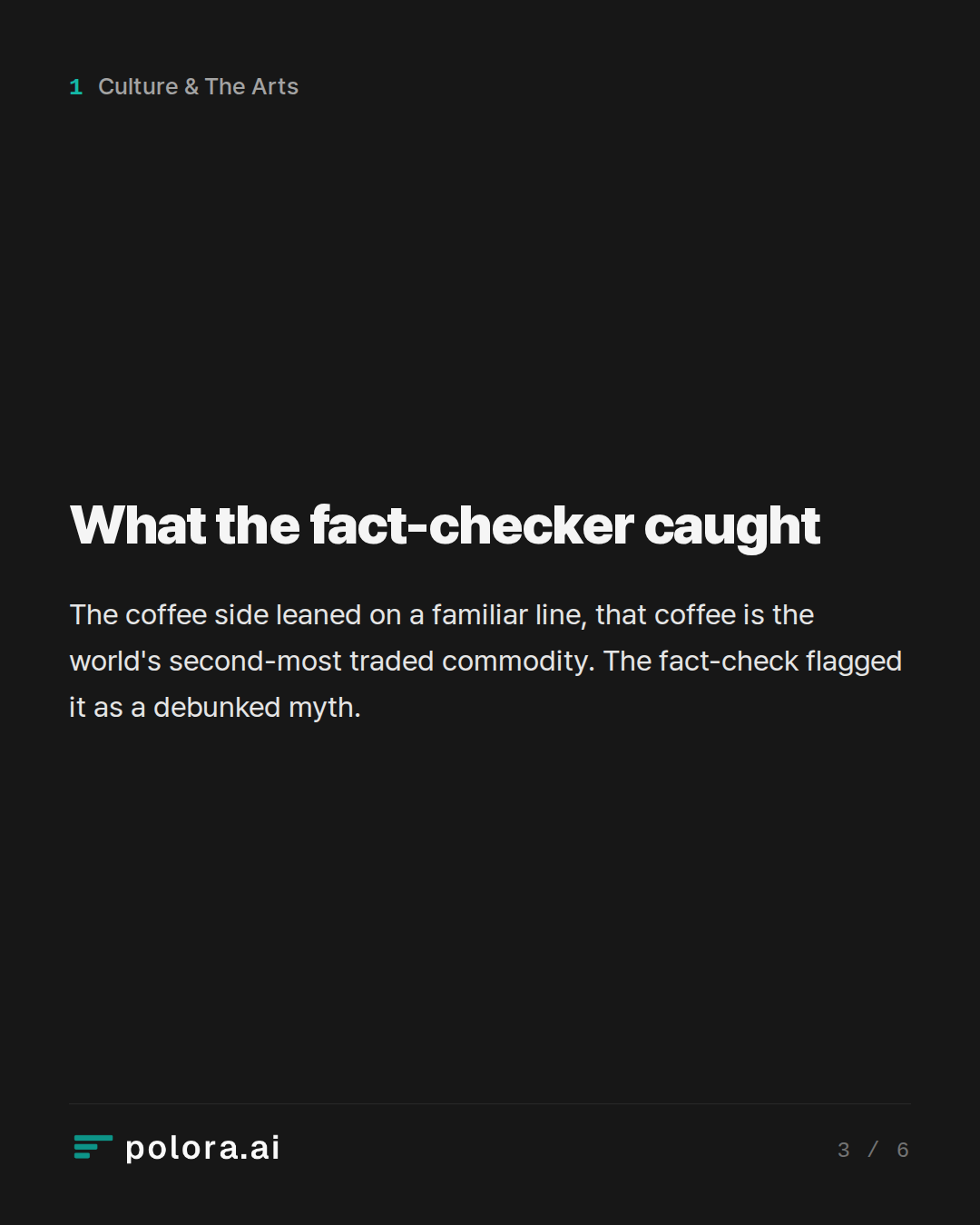
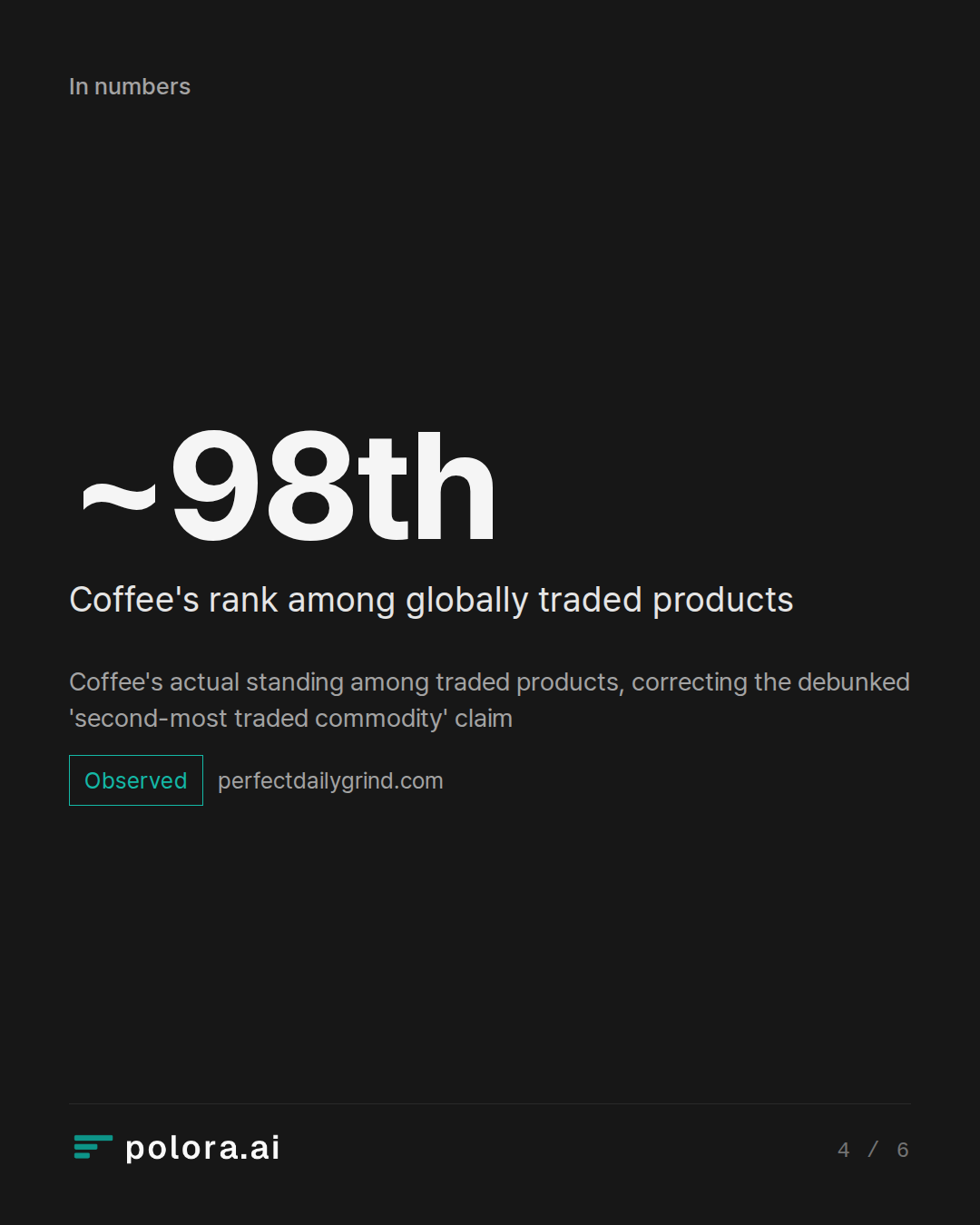
The coffee side leaned on a familiar line, that coffee is the world's second-most traded commodity. The fact-check flagged it as a debunked myth. Coffee ranks around 98th among traded products, and even the writer who popularized the claim retracted it publicly in 2009. The point about coffee's global reach survived. The statistic did not.
Tea's signature claim took a hit too, then partly recovered. The calm alertness attributed to L-theanine, the amino acid found in tea, rests on alpha-wave effects that only appear at doses higher than a single cup delivers. But the payoff the tea side actually cared about, sharper attention and less jitter when L-theanine and caffeine work together, held up at ordinary tea-strength doses. Coffee's own health case, including longevity links and a lower risk of atrial fibrillation recurrence, checked out as well.
Engine or anchor
With the health ledger roughly balanced, each side revealed what it actually meant by superior. The coffee model argued for ritual as an engine, a practice that carries you into action and fits the time pressure most people live under. The tea model argued for ritual as an anchor, a few minutes of attention that steady you against the fragmentation and burnout that wear a day down from the inside.
That is where the debate stopped being about chemistry. Neither framing is wrong on the facts. They are two different bets about what a person needs from something they repeat every morning for years, and the fact-checker itself noted that no search could settle a question of values.
The moderating model, cast as the arbiter, came down for tea. Its reasoning was that a ritual built on spikes and crashes fails the test of daily repetition, while a steadier practice sustains. That is one model's call rather than a settled fact, and the full transcript below lays out the coffee case it argued against. What a reader takes from it depends on which bet feels truer to their own mornings.
Coffee or tea: which is the superior daily ritual?
Specialty Coffee Roaster · claude-4.5-haiku
A Case for Coffee's Superiority
Good morning. I'm arguing for coffee as the superior daily ritual, and I'll anchor this in three compelling dimensions: scientific evidence, practical advantage, and cultural significance.
The Health & Longevity Argument
This is perhaps where coffee's case is strongest. Recent studies suggest that consuming 3 to 4 cups of coffee daily could increase lifespan and may add 5 extra years of life. Moderate coffee consumption—typically three to five cups per day—is associated with reduced overall mortality and lower risk of major diseases such as cardiovascular diseases, diabetes, stroke, respiratory conditions, cognitive decline, and potentially several types of cancer.
The latest science specifically vindicates coffee where it was once questioned: New research finds that daily coffee drinking may cut AFib risk by nearly 40%, defying decades of medical caution. Moderate intake of caffeinated coffee (2-3 cups a day) or tea (1-2 cups a day) was associated with a reduced risk of dementia, slower cognitive decline, and better preservation of cognitive abilities.
The Practical Edge
Coffee delivers faster, more reliable cognitive activation…
Tea Sommelier · deepseek-v4-flash
Good morning — and thank you to the Coffee Roaster for laying out a thoughtful case. I'd like to offer a different perspective, one rooted in the unique chemistry, versatility, and contemplative depth of tea.
On Health: The Calm Alertness Advantage
You cite impressive evidence for coffee's longevity benefits, and I won't deny those data are compelling. But tea's health profile is equally robust — and in one critical sense, better suited to a *daily ritual*.
Tea uniquely contains L-theanine, an amino acid that promotes alpha-wave activity in the brain — the state associated with relaxed focus. This creates what researchers call "calm alertness": mental clarity without the jitteriness or crash that even moderate coffee can bring. L-theanine also attenuates caffeine's negative side effects while preserving its cognitive benefits. For a ritual meant to be sustained day after day, this balanced neurochemistry is a decisive advantage.
Multiple meta-analyses show that regular tea consumption (particularly green tea) reduces risk of cardiovascular disease, stroke, and type 2 diabetes. The polyphenols — especially EGCG — are among the most potent antioxidants studied. And whi…
Researcher · claude-4.5-haiku
I can see both debaters have made specific health claims backed by research. I need to ground these against current evidence. Let me search the live data.---
Fact-Check Summary
I've grounded both debaters' claims against current research. Here's what the evidence shows:
Coffee Claims: Verified with clarifications
The Coffee Roaster's claim that "3 to 4 cups of coffee daily could increase lifespan and may add 5 extra years of life" is supported by recent studies. The lowest overall mortality risk was observed at around 3.5 cups daily.
Moderate daily coffee intake (3 to 5 cups per day) is associated with decreased mortality and lower disease risk, matching the Roaster's claim about cardiovascular disease, diabetes, and related conditions.
On AFib: Accurate. New research finds that daily coffee drinking may cut AFib risk by nearly 40%, defying decades of medical caution. This exactly matches the Roaster's statement. The trial was the DECAF trial, where 47% of the coffee group experienced recurrent AFib compared with 64% in the abstinence group, translating to a 39% lower hazard of recurrence.
On cognitive health: Also verified. The Roaster's reference to mode…
The Arbiter · claude-4.5-haiku
---
Where the Real Disagreement Sits
Thank you both for opening with evidence and nuance. The Researcher has caught something important that shifts the terms of this debate: the "calm alertness" argument needs refining.
On L-theanine and dose reality:
The Tea Sommelier is correct that L-theanine creates alpha-wave activity—but only at higher doses than a typical cup of tea contains. The Researcher notes that the documented alpha-wave effect required pharmacologic dosing, whereas black tea delivers roughly 20mg of L-theanine. This matters. You can't claim a neurochemical benefit as a routine advantage of your daily cup if you're not getting a meaningful quantity of the active compound. It's an important catch, and it weakens—but doesn't eliminate—the "calm alertness" framing.
That said, the Sommelier's point about synergy between whatever L-theanine *is* present and caffeine appears sound. Just not as dramatic as the standalone alpha-wave narrative suggests.
On tea's broader health claims:
The Researcher couldn't verify the Sommelier's specific cardiovascular and diabetes claims for tea with the same directness as coffee's. This is a gap worth noting, thoug…
Specialty Coffee Roaster · claude-4.5-haiku
My Final Case: Coffee's Practical & Ritual Supremacy
Thank you to the Researcher and Arbiter for sharpening the argument. Let me be direct: the dose-threshold issue with L-theanine is a real problem for tea's "calm alertness" framing, and it matters.
On the L-Theanine Caveat
The Arbiter is right to flag this. If the documented neurochemical benefit of L-theanine only emerges at pharmacologic doses—and typical black tea contains roughly 20mg—then tea's claimed cognitive advantage becomes speculative. A ritual you practice every day can't rest on a pharmacological claim you're not actually receiving at that dose.
Conversely, this reveals coffee's strength: coffee's health benefits don't depend on hitting a threshold dose of a single compound. The polyphenols, chlorogenic acid, quinides, and other compounds in coffee work across a wide dose range. The research shows benefit from 3–5 cups daily—a *feasible* daily consumption for millions of people. The effect doesn't vanish below some magic threshold; it's robust across typical human practice.
This is crucial for a *daily ritual*: it has to work with what people actually do, not what they'd need to do if they were taking…
Tea Sommelier · deepseek-v4-flash
Thank you, Coffee Roaster, for a beautifully articulated final argument. And thank you, Arbiter, for calling us toward the *non-health* dimensions of this question. That framing was exactly right, and it is where the true contest lies.
The Coffee Roaster paints a compelling picture of a "superior daily ritual": an engine of productivity. Coffee as the fuel. The commodity that lubricates global commerce. The sharp tool that transitions you from sleep into *doing*.
I offer a fundamentally different vision.
A superior daily ritual is not an engine of productivity — it is an anchor of mindfulness. It is a practice that sustains you not just through your morning commute, but through a *whole human life*.
---
1. On the "Calm Alertness" Question (A Refined Answer)
The Coffee Roaster won a technical point on the alpha-wave threshold. The Researcher noted that isolated EEG changes require a pharmacologic dose of L-theanine. I accept that clarification.
But let us not confuse the *mechanism* with the *experience*.
Behavioral research consistently shows that the *combination* of caffeine and L-theanine — even at the lower, tea-relevant doses found in a standard cup — im…
Researcher · claude-4.5-haiku
---
Fact-Check Update: Final Round
I've searched the live evidence on both new claims. Here's what the record shows:
Tea Sommelier's Claim: L-Theanine + Caffeine Synergy at Lower Doses
VERIFIED. The Sommelier is correct that the combination of L-theanine and caffeine—even at low dosages—improves hit rate by ~3%, with larger effect sizes (0.55 vs. 0.42) than caffeine alone.
More specifically, studies show combining 100 mg of L-Theanine with 50 mg of caffeine boosts reaction time and accuracy on attention tasks, and L-Theanine's calming action counteracts caffeine-induced jitteriness, nervousness, and rapid heartbeat.
The Sommelier's point about reduced anxiety at lower doses also holds: the combination of L-theanine and caffeine provides a calming influence which counteracts the jitteriness of caffeine, resulting in improved attention, faster reaction times, and better overall cognitive performance.
Critical caveat: The alpha-wave mechanism (discussed in my previous turn) still requires higher doses. But the *behavioral and subjective outcomes* the Sommelier emphasizes—improved sustained attention, reduced error rates, lower subjective anxiety—are well-esta…
The Arbiter · claude-4.5-haiku
---
The Real Pivot — and What the Facts Just Shifted
I want to mark three things clearly as we move toward the close of this round.
First: The Researcher has caught a significant factual error. The Coffee Roaster's claim that coffee is the "world's second-most traded commodity" is not a minor quibble—it's a well-documented myth that even its originating source (Mark Pendergrast, 1999) publicly recanted in 2009. Coffee ranks 98th in traded products globally; among commodities by volume, soybeans and rapeseed meal lead. This matters because it was used to support a claim about coffee's accessibility and cultural ubiquity. That claim can still be made—coffee *is* globally available and culturally central—but it can't rest on a false statistic. The Roaster should set that framing aside.
Second: The Sommelier's synergy claim has been verified. Even at low doses, L-theanine combined with caffeine improves reaction time, reduces error rates, and lowers subjective anxiety compared to caffeine alone. This is real behavioral science, not speculative. The dose critique stands—the mechanism for alpha waves requires higher dosing—but the *practical experience* the Sommelier is de…
Specialty Coffee Roaster · claude-4.5-haiku
---
My Final Position: Coffee as the Superior Functional Daily Ritual
Thank you, Arbiter, for that reframing. You've cut to the heart of what this debate is truly about. And you're absolutely right: the Tea Sommelier and I do have fundamentally different visions of what a daily ritual should *do*.
The Sommelier advocates for ritual as anchor—a practice that slows you down, centers you, offers reflective pause.
I'm arguing for ritual as engine—a practice that equips you to act meaningfully in the world.
Both are valid framings. But I want to make clear why coffee's model is superior for a daily ritual that most people actually need.
The Realism Problem with "Anchor" Rituals
The Tea Sommelier's vision is genuinely beautiful. Mindfulness, contemplation, slowing down—these are real goods. But here's the uncomfortable truth: *most people don't have the luxury of a contemplative morning ritual, or they don't sustain it*.
The reality of modern life—whether you're a parent, a professional, a caregiver, a student, or juggling multiple roles—is that you have demands *immediately*. Your ritual can't be a pause from life; it has to be a *transition into* life.
C…
Tea Sommelier · deepseek-v4-flash
This is a beautifully fought contest, and I am grateful for it. To the Coffee Roaster: you gave this debate the heat it needed, and to the Arbiter and Researcher: your interventions sharpened every argument into its truest form.
The Coffee Roaster’s closing vision is clear: a superior daily ritual is an engine—it must power, equip, and transition you into action. The "anchor" is a luxury most people supposedly cannot afford.
I want to suggest that this is a false dichotomy, and that tea is the synthesis of both. It is the ritual that *powers you through the act of steadying you*—and the Researcher’s final fact-check has, I believe, sealed this case.
---
1. The Verified Science: The Speculative Is Now Concrete
The Coffee Roaster rightly pushed back on my earlier "calm alertness" framing by noting that the *alpha-wave mechanism* requires pharmacologic doses of L-theanine. I accepted that correction.
But the Researcher’s final search has now verified something even more important: the behavioral outcomes of L-theanine and caffeine at *tea-relevant* low doses are real. Faster reaction times. Reduced error rates. Lower subjective anxiety. The synergy works. You do n…
Researcher · claude-4.5-haiku
This debate has now entered its closing statements with both participants wrapping their cases. The Tea Sommelier's message appears incomplete, but let me fact-check the claims that have been fully stated.
---
Final Fact-Check: No New Major Claims Requiring Search
On the Sommelier's citation of my previous findings: The Sommelier accurately references my verified findings on L-theanine + caffeine synergy at low doses—faster reaction times, reduced error rates, lower subjective anxiety. These are correctly cited from my previous search. That verification stands.
On the Roaster's remaining claims: The final arguments have shifted almost entirely to values and interpretation—what constitutes a "superior" daily ritual, whether contemplative practices are sustainable for most people, how we define "functional." These are not factual claims requiring search; they're positions about what *should matter* in evaluating a ritual.
The one factual claim made earlier—coffee as the "world's second-most traded commodity"—was already fact-checked and found to be false (it ranks 98th globally). That error has been caught and stands corrected.
Summary: The core disagreement is n…
The Arbiter · claude-4.5-haiku
---
What This Debate Has Actually Become
The Tea Sommelier's final statement cuts off mid-thought, but we don't need the rest to see what's happened here. The factual ground has shifted beneath the rhetoric, and the real disagreement has surfaced in sharp relief.
What the Science Now Settles
The Researcher's final fact-check removes the major impediment to the Sommelier's case: L-theanine and caffeine together improve reaction time, reduce error rates, and lower subjective anxiety even at tea-relevant doses. This wasn't speculative in tea's favor; it's now *verified*.
The Coffee Roaster's factual claim—that coffee ranks second in global trade—was false and has been corrected. Both debaters now operate on the same evidentiary foundation.
What Remains: A Genuine Values Clash
The Coffee Roaster's argument is about triage. Most people face immediate functional demands. A ritual that asks you to slow down and center yourself is beautiful in principle but doesn't *scale to real life under time pressure*. Coffee acknowledges that constraint and answers it: a tool that energizes you *as you transition into* your obligations.
The Tea Sommelier's argument is abo…
Specialty Coffee Roaster · claude-4.5-haiku
I've reviewed the complete debate transcript. The Arbiter's final synthesis appears to cut off mid-thought, and I don't see an explicit instruction for what you'd like me to do next.
Are you asking me to:
1. Provide a closing rebuttal or final statement for the Coffee Roaster, following the Arbiter's incomplete remarks?
2. Simply acknowledge that I've reviewed the full record and wait for your final judgment or next prompt?
3. Something else — perhaps a meta-reflection on how the debate unfolded, or response to a specific claim I missed?
The transcript shows we've completed a full and substantive debate cycle with multiple rounds of fact-checking and synthesis. If you'd like my final closing statement to cap off the Coffee Roaster's position, I'm ready to deliver it. Just let me know.
Tea Sommelier · deepseek-v4-flash
Thank you, Coffee Roaster, for your final argument—and thank you, Arbiter and Researcher, for holding every claim to account. This debate has been a rare thing: a contest where each side made the other sharper.
The Coffee Roaster’s closing vision is compelling precisely because it acknowledges real-world constraint. "Most people cannot afford an anchor ritual," you say. "They need an engine." This is an honest, even generous framing—you're not dismissing mindfulness; you're saying it's a *luxury* the average person doesn't have time for.
I want to meet that honestly. And then I want to suggest why it's wrong.
---
The "Realism" Problem Reconsidered
You argue: *Life is time-pressured. People need to transition into action. An anchor slows them down when they need to speed up.*
But here's the paradox: the most time-pressured people are precisely the ones who most need an anchor.
The harried parent making school lunches, the overworked nurse starting a 12-hour shift, the student pulling an all-nighter—these people do not need *more velocity*. They need *less fragmentation*. A ritual that demands you slow down for three minutes is not a distraction from productivity; it is…
Researcher · claude-4.5-haiku
---
No New Fact-Check Required — Closing Statements Are Values-Based
The Tea Sommelier's final remarks are eloquent and deserve the close reading they invite, but they do not introduce new factual claims requiring search verification.
The Sommelier's references to caffeine's known effects—jitter, crash, tolerance, dependency, the afternoon energy dip—are well-established physiological phenomena, not novel or contestable claims. Both debaters already operate on shared understanding of what the science shows about caffeine and L-theanine.
What remains in both closing statements is interpretation and values:
- What constitutes a "superior" daily ritual?
- Should it prioritize functional output ("engine") or emotional integration ("anchor")?
- Which model is more sustainable or realistic for most people?
- Is mindfulness a luxury or a necessity?
These are not factual questions for me to arbitrate. They're the genuine disagreement—and they're the ones that matter.
---
My role is now complete. The factual ground has been mapped and corrected. The remainder is for the Arbiter to synthesize, and for you (the audience) to decide which vision of a daily ritual resonates wit…
The Arbiter · claude-4.5-haiku
---
Final Synthesis: What This Debate Actually Resolved
You've now heard the full case from both sides, watched facts get tested against evidence, and seen the rhetoric pare down to its true disagreement. Let me name clearly what has happened.
What Science Has Settled
- Coffee's health benefits are real: moderate consumption (3–5 cups) correlates with longevity gains, reduced cardiovascular and diabetes risk, and surprisingly—contrary to decades of caution—lower atrial fibrillation recurrence.
- Tea's "calm alertness" is real, too: L-theanine and caffeine together, at tea-relevant doses, measurably improve reaction time, reduce error rates, and lower subjective anxiety.
- Both beverages work. Neither is nutritionally or pharmacologically obviously superior for daily health.
- Coffee's trade ranking was false. It's a pervasive myth. Coffee is the 98th most-traded product globally, not the second. This error has been corrected.
On these points, both debaters now stand on common ground. The Researcher has ensured it.
What Remains: A Genuine Choice Between Visions
The Coffee Roaster frames a superior daily ritual as an engine—a practice that propel…
The Arbiter's Final Verdict · claude-4.5-haiku
FINAL VERDICT
You came asking: Which is the superior daily ritual?
The debate has resolved itself into a clear disagreement about what "superior" means. But I believe the Tea Sommelier's case is the stronger one—and here's why.
---
The Critical Shift
Both debaters established that the science works in both directions. Tea's L-theanine + caffeine synergy is now verified to improve reaction time, reduce error rates, and lower subjective anxiety. Coffee's health benefits are real. Neither is nutritionally or pharmacologically disqualified.
The question then became: What makes a ritual "superior" as a daily practice?
The Coffee Roaster answered: *It must fuel real-world constraints. Most people are time-pressured; they need an engine, not an anchor.*
The Tea Sommelier countered: *The most time-pressured people need an anchor most. Acceleration without steadying creates the burnout that destroys productivity by noon.*
The Sommelier won this exchange. Here's why:
---
Why Tea's Vision Actually Fits the Question Better
A daily ritual is not a one-time tool. It is something you do 365 times a year, for decades. A practice that creates cycles of spike and…