From six in ten days to one in four
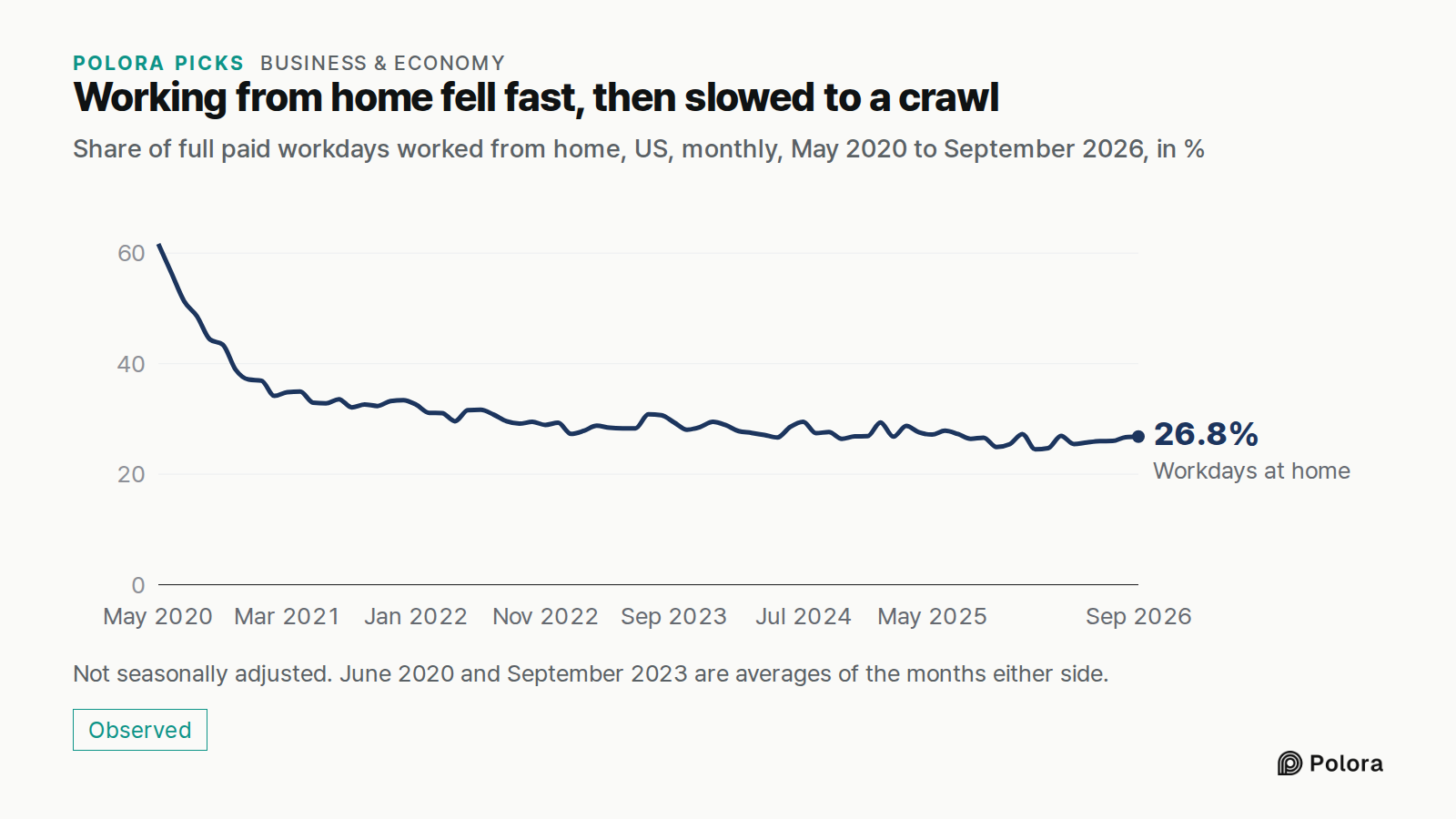
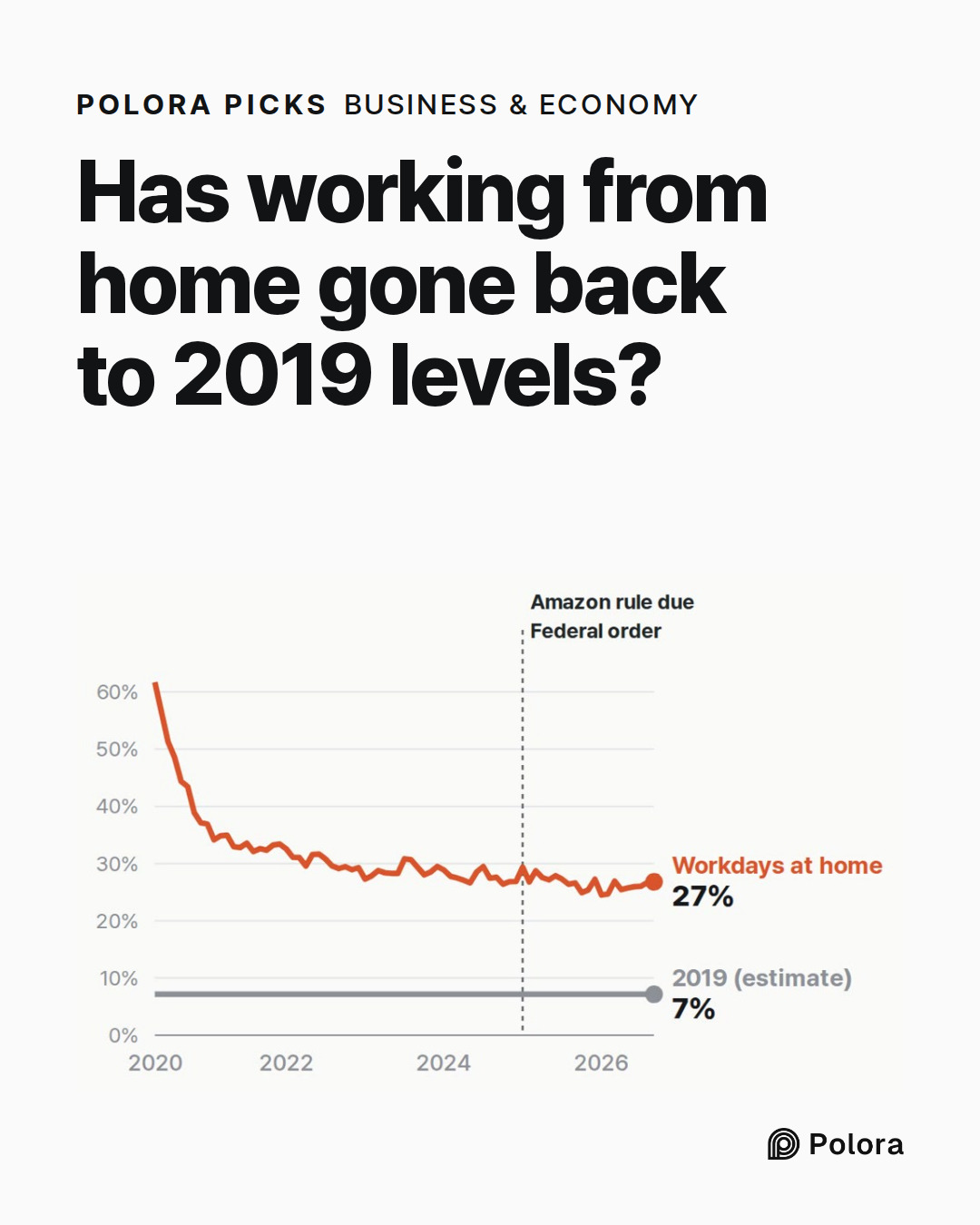
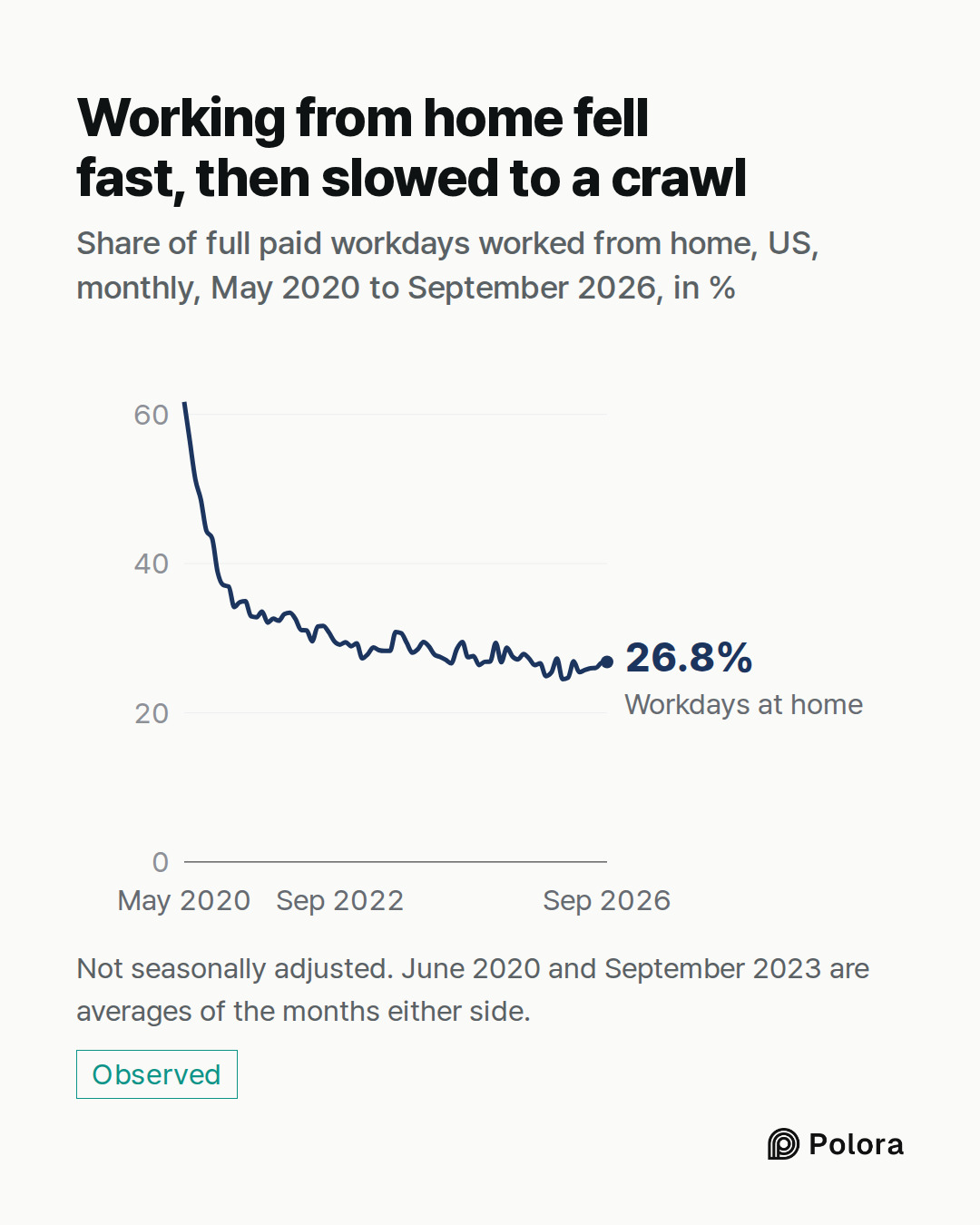
In May 2020, the first month of the Survey of Working Arrangements and Attitudes, 62% of full paid workdays in the US were worked from home. The economists who run the survey, Jose Maria Barrero, Nicholas Bloom and Steven J. Davis, put 2019 at about 7%.
Most of the fall happened fast. By December 2021 the share was 33%, a third of workdays. In 19 months it had covered a little more than half the distance back to the 2019 level.
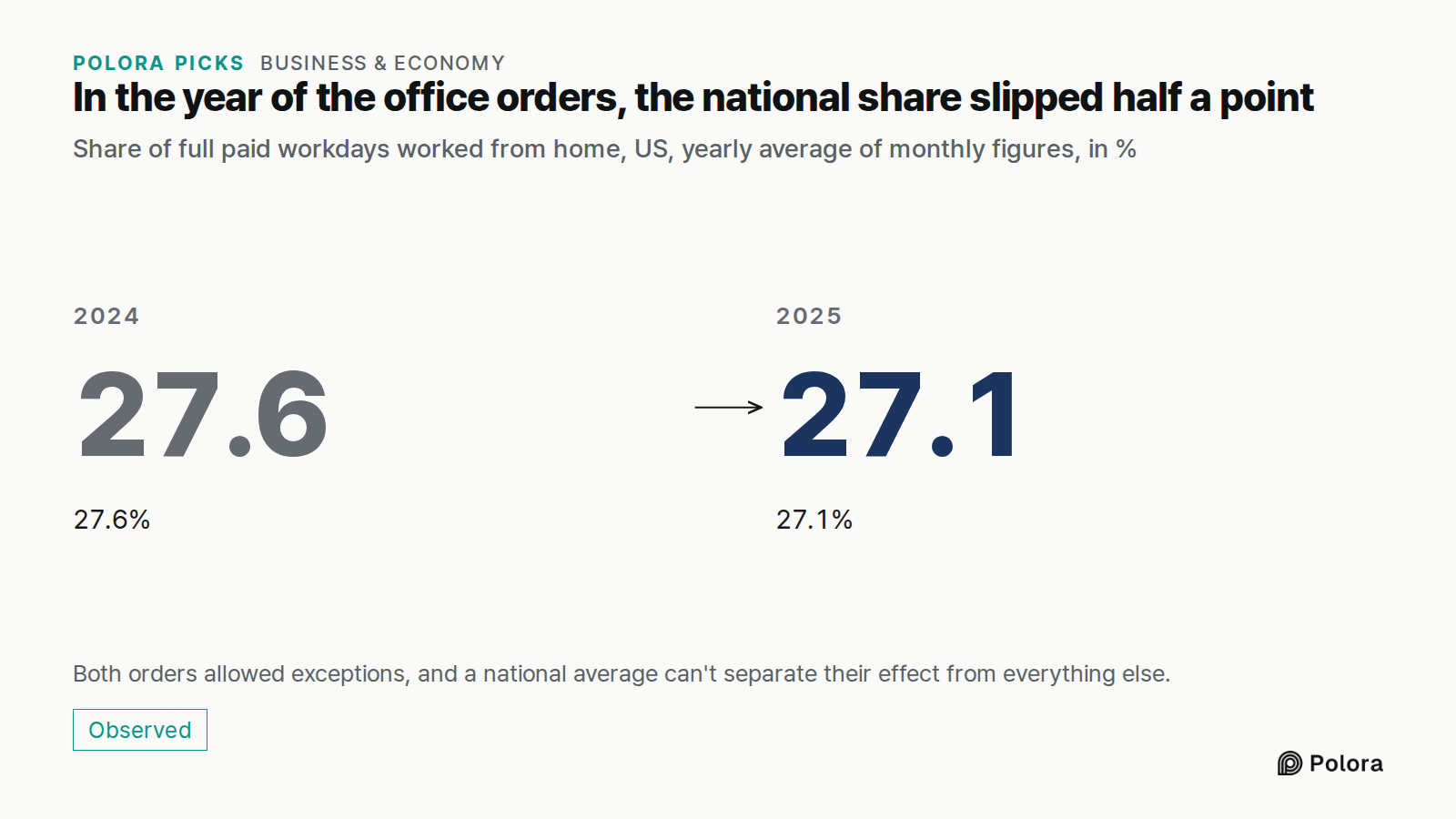
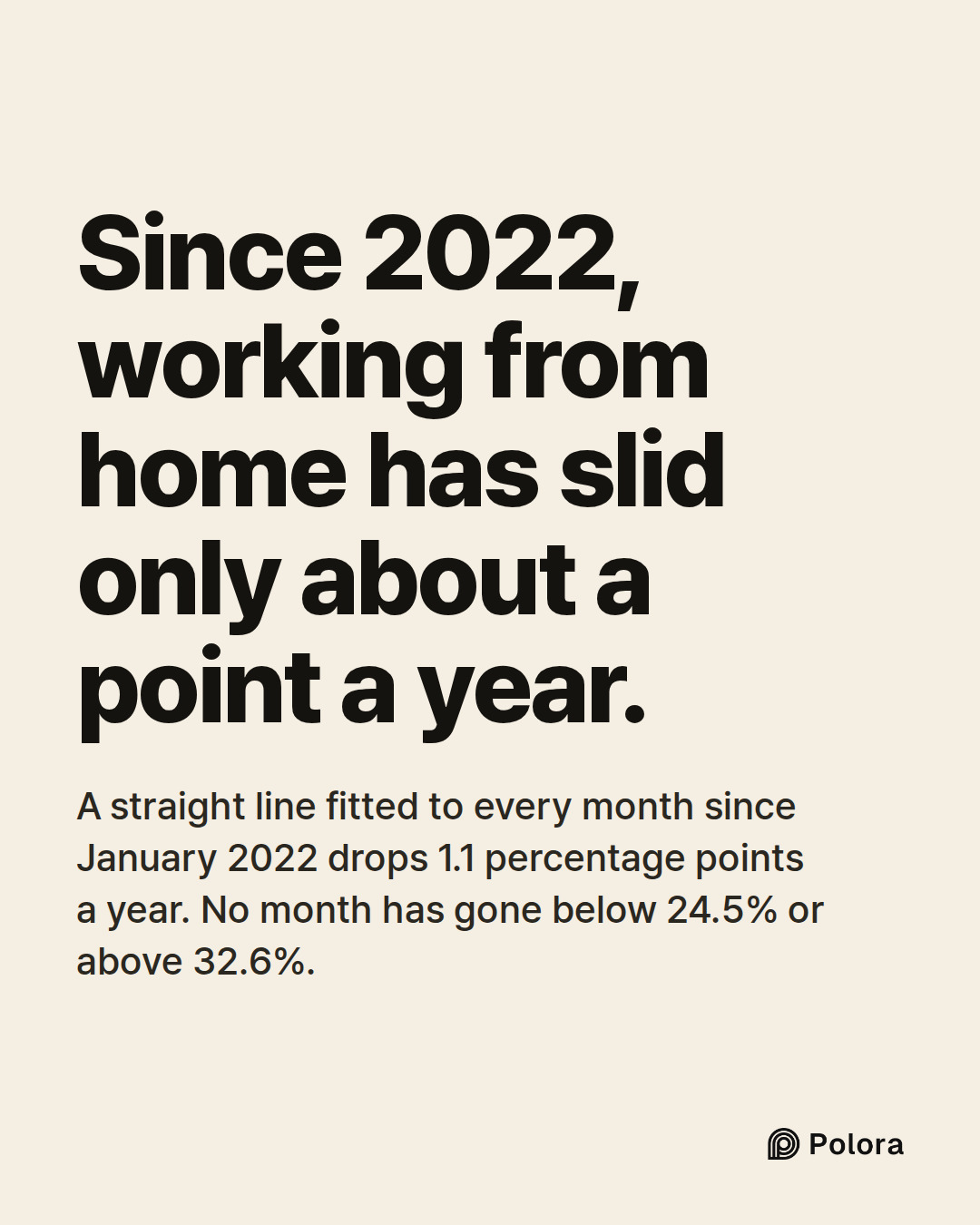
Then the fall slowed. Averaging the monthly figures for each year gives 30.4% for 2022, 28.8% for 2023, 27.6% for 2024 and 27.1% for 2025. In the first nine months of 2026 the average was 25.9%. A straight line fitted to every month since January 2022 drops by 1.1 percentage points a year. Over that whole stretch, no month has gone below 24.5% or above 32.6%.
Not every month falls. The lowest point since 2022 came in January 2026, at 24.5%, and the share then rose to 26.8% by September. The slow slide describes the trend across almost five years, not each month.
What the number counts
The survey measures days, not people. It asks US workers aged 20 to 64 who earned at least $10,000 in the prior year how they worked, and it reweights the answers by age, sex, education and earnings to match the government's Current Population Survey. The figure is the share of all their full paid workdays that were worked from home. A hybrid worker who spends two days a week at home counts as two days at home and three on site.
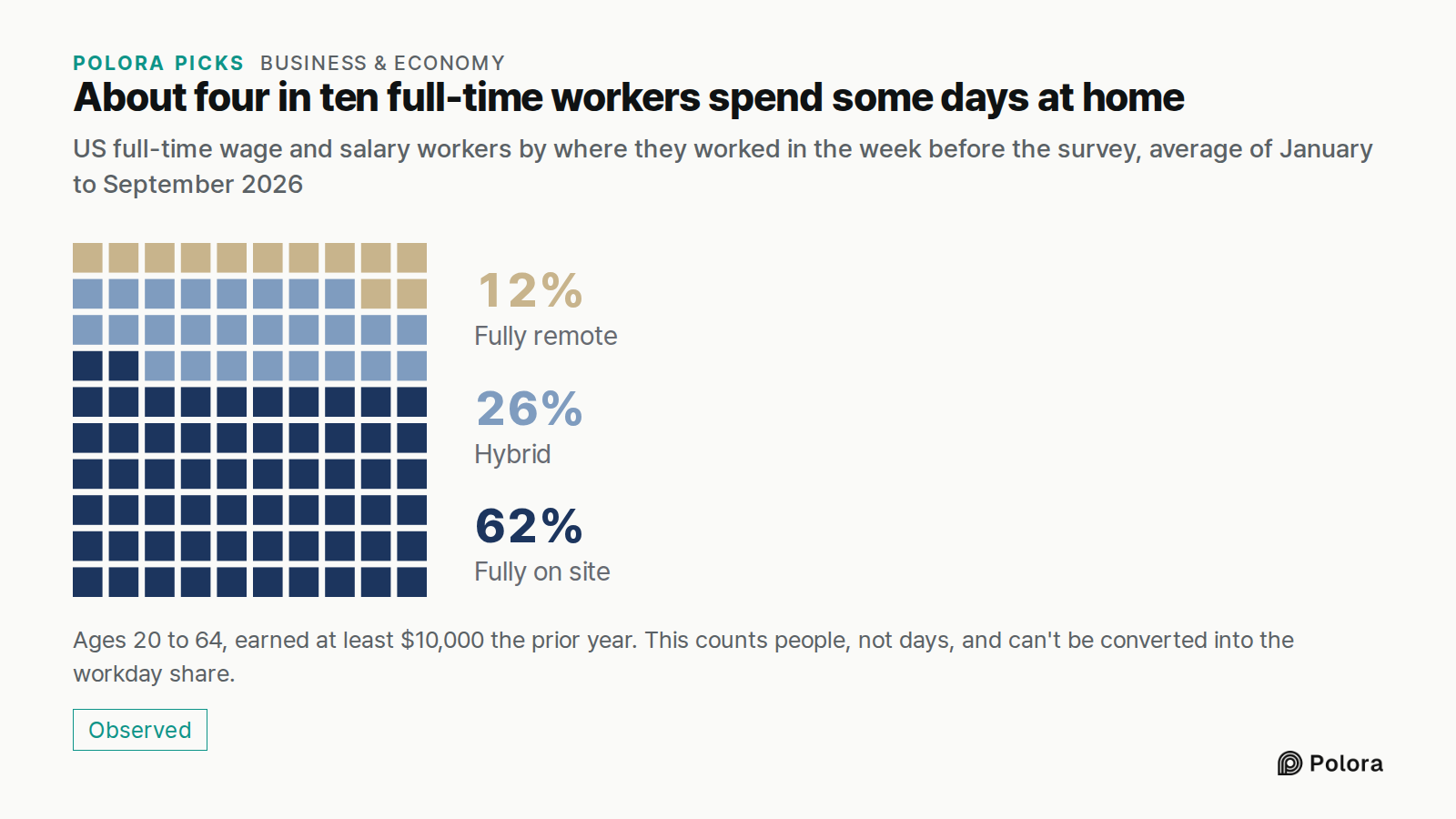
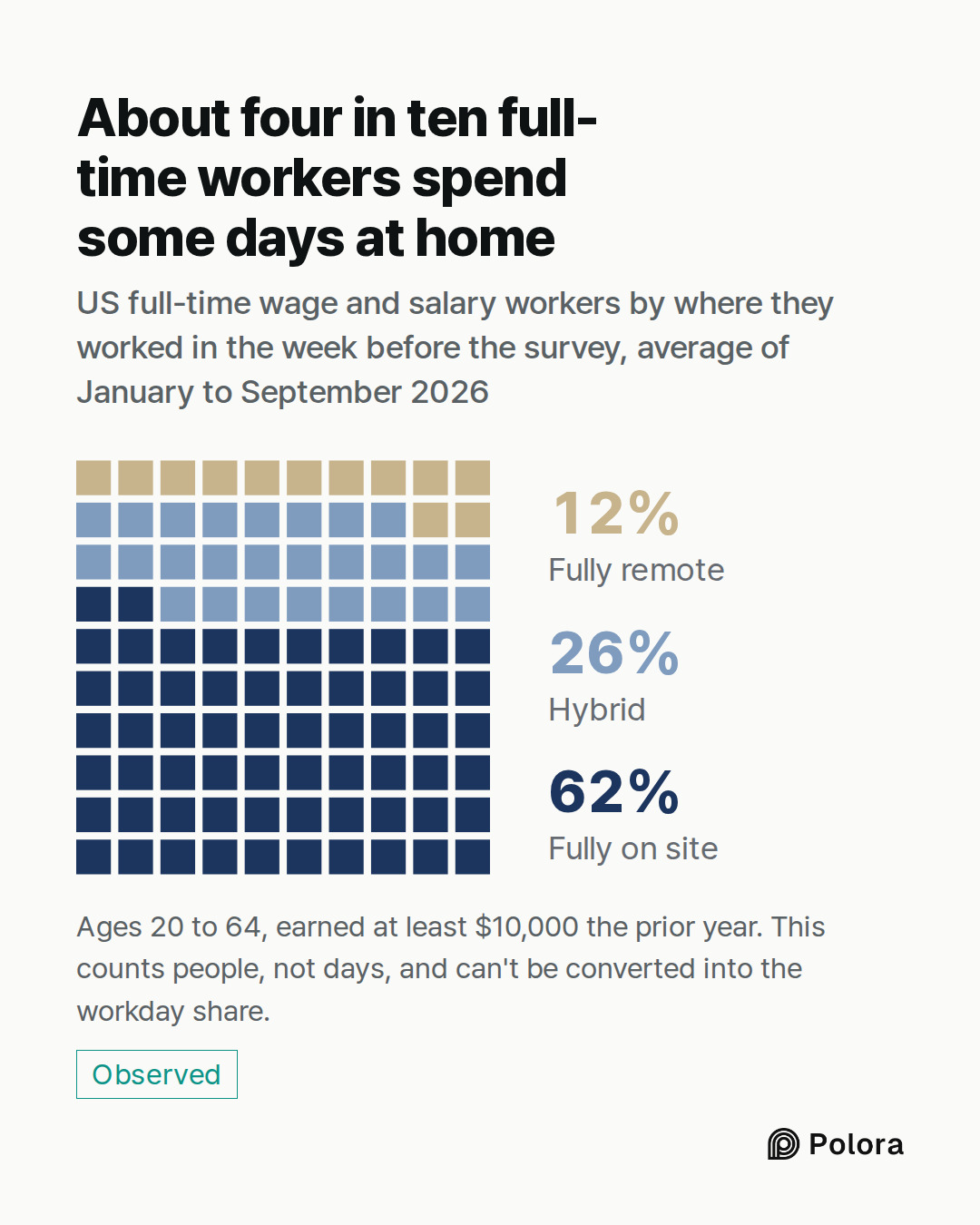
The same survey also counts people, though only full-time wage and salary workers, with the same age and earnings limits. Averaged over January to September 2026, about 62% of them had worked fully on site in the week before the survey, 26% were hybrid and 12% had worked only from home. Among these full-time workers, then, every day at home comes from the roughly four in ten who are hybrid or fully remote. Single months of these shares jump around, so the figures here are the 2026 average. Because these counts cover a narrower group than the day share above, the two can't be converted into each other.
After the return-to-office orders, the national share barely moved
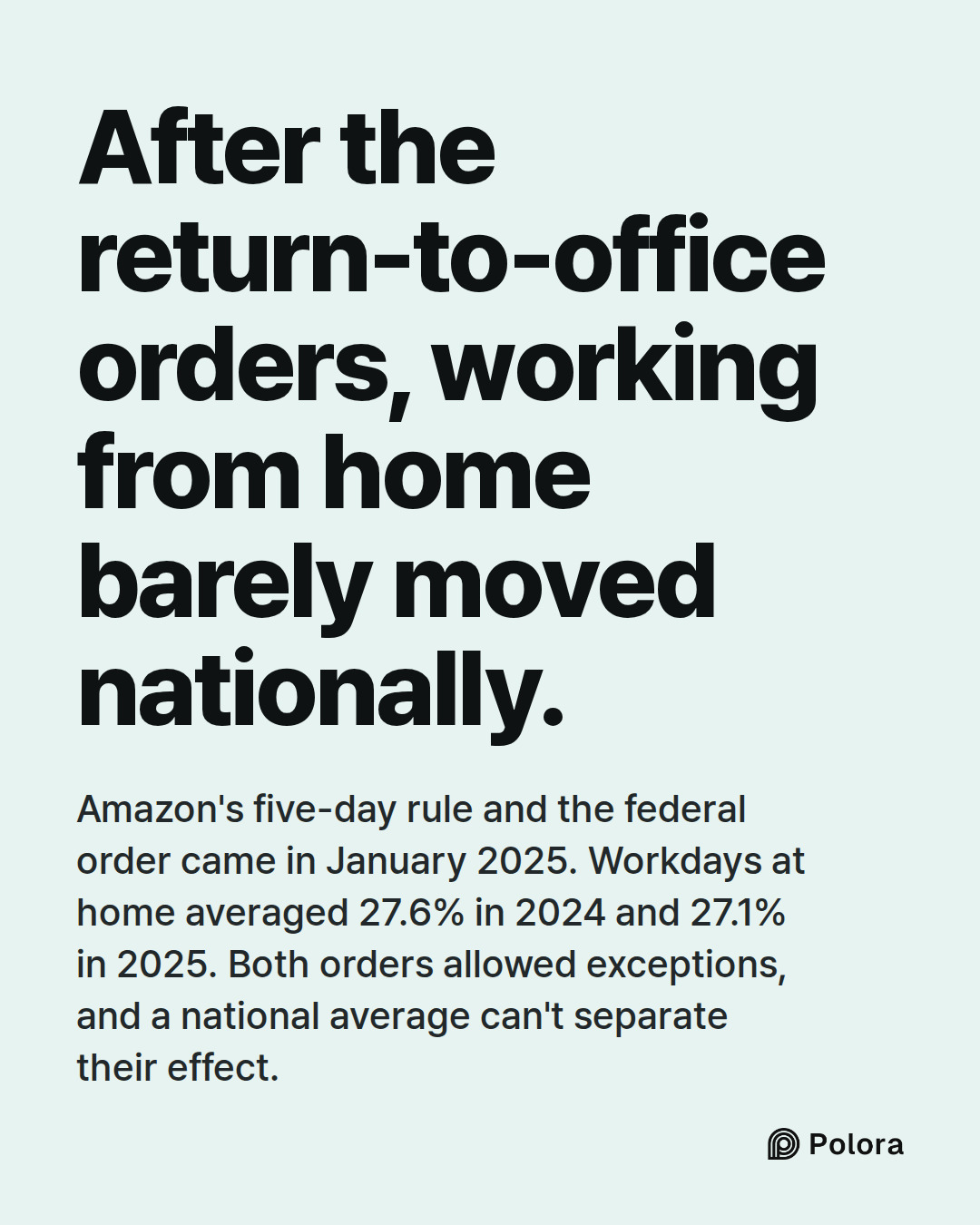
January 2025 brought two big pushes back to the office : Amazon's five-day rule was due to start, and the White House ordered federal agencies back. In a message to staff months before, Amazon's chief executive, Andy Jassy, said the company would return "to being in the office the way we were before the onset of COVID", five days a week, starting January 2, 2025. His message noted that Amazon had already been in the office at least three days a week for the previous 15 months, and it kept exceptions for emergencies and approved remote-work arrangements. On January 20, 2025, a presidential memorandum told federal agencies to end remote work and bring employees back full time "as soon as practicable", with exemptions their heads deem necessary.
The national share barely changed : the 2025 average, 27.1%, was half a point below 2024's. That does not show the orders failed. Both allowed exceptions, the survey can't show how fully they were carried out, and a national average can't separate their effect from everything else going on. It only shows that, nationally, the slow slide carried on.
How far to trust it
The monthly line comes from a single survey, run by the same team each month, and it is not seasonally adjusted. Two months are filled in by the authors : June 2020, when they ran no survey, and September 2023, which had data quality problems. Each is the average of the months either side.
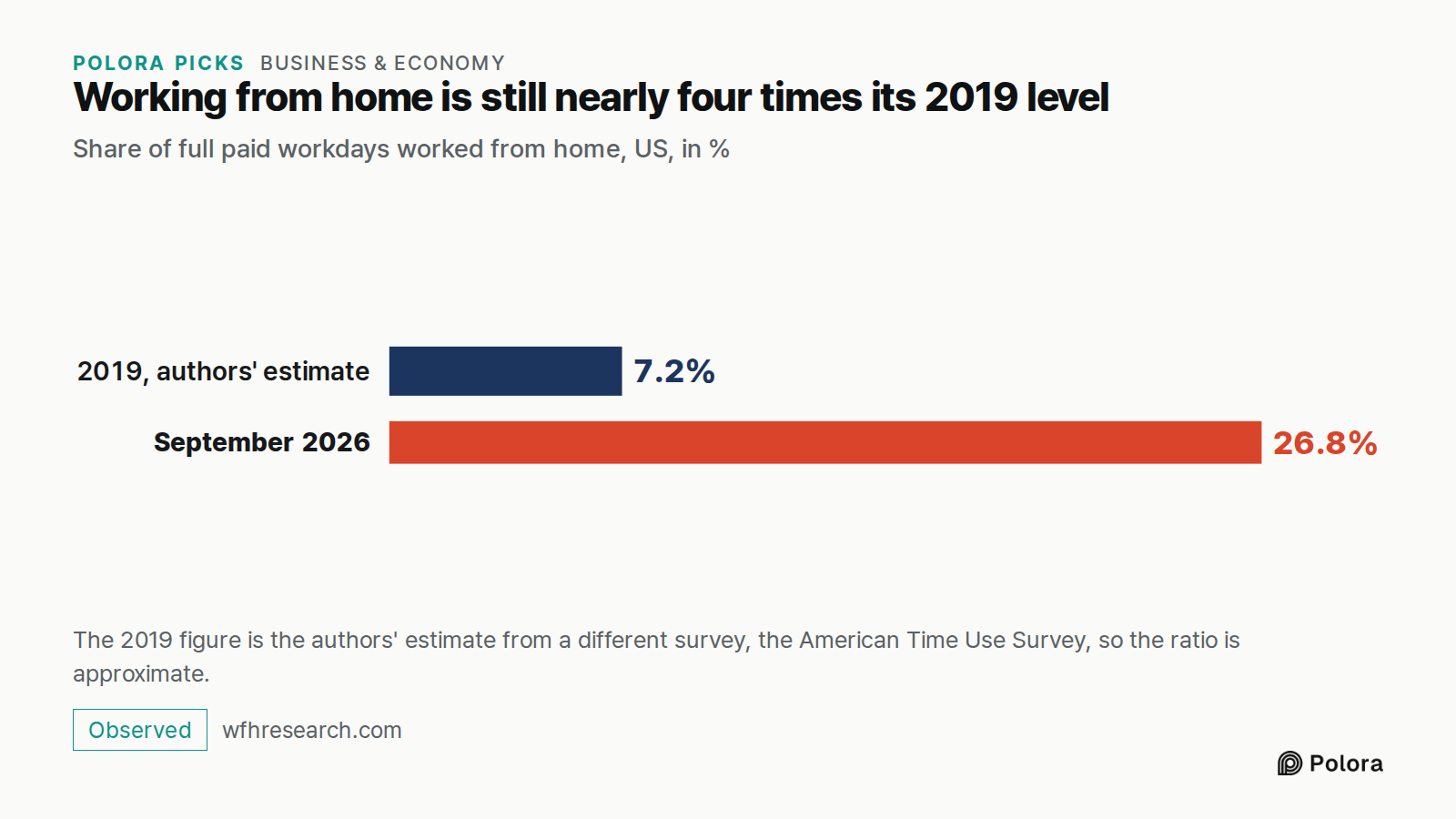
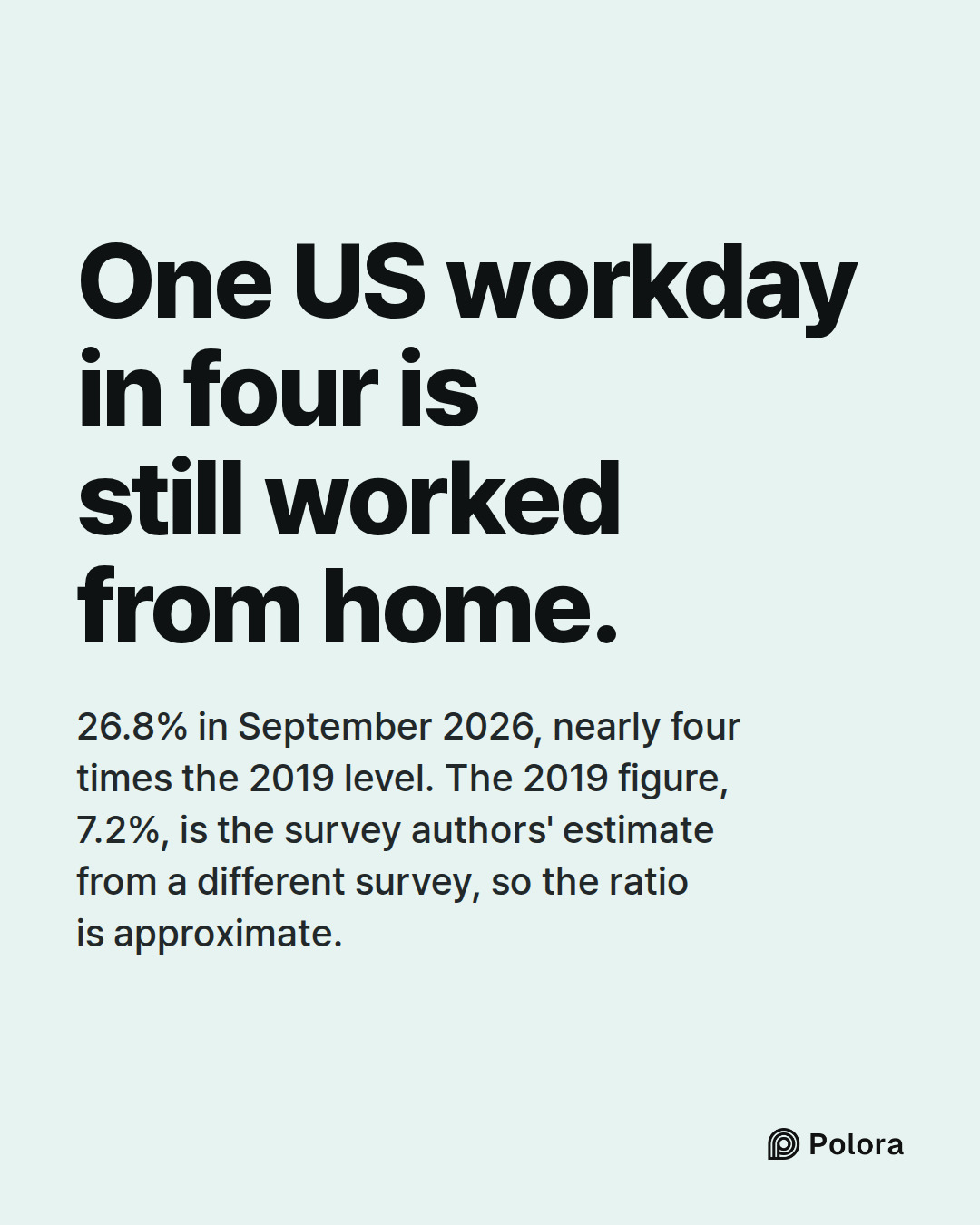
The comparison with 2019 is the weakest link. The survey started in 2020, so its 2019 figure of 7.2% is the authors' own estimate from a different survey, the American Time Use Survey. That makes "nearly four times" (26.8% against the estimate's 7.15%, a ratio of 3.75) an approximate comparison, not an exact one. Still, the gap is large enough that the conclusion doesn't depend on the decimals : on this measure, working from home is still well above where it was before the pandemic.
The survey's authors titled their 2021 paper "Why working from home will stick". Five years later, their own numbers show a smaller share than in 2021, but one that has stopped falling fast.
- [Work from Home Rate (WFHCOVIDMATQUESTION), FRED, Federal Reserve Bank of St. Louis]
- [All Full-Time Wage and Salary Workers: Working Fully Remote (FULLREMOTECURR), FRED]
- [Survey of Working Arrangements and Attitudes, WFH Research]
- [Message from CEO Andy Jassy: Strengthening our culture and teams, Amazon]
- [Return to In-Person Work, The White House]
![Sources 5 : fred.stlouisfed.org · [Work from Home Rate (WFHCOVIDMATQUESTION), FRED, Federal Reserve Bank of St. Louis], fred.stlouisfed.org · [All Full-Time Wage and Salary Workers: Working Fully Remote (FULLREMOTECURR), FRED], wfhresearch.com · [Survey of Working Arrangements and Attitudes, WFH Res](https://media.cdn.polora.ai/picks/2026/10/pickrun_99fa5d5ebf7d47ad/9TUEeX4UuhgQY-lJ-slide-07--has-working-from-home.jpg)