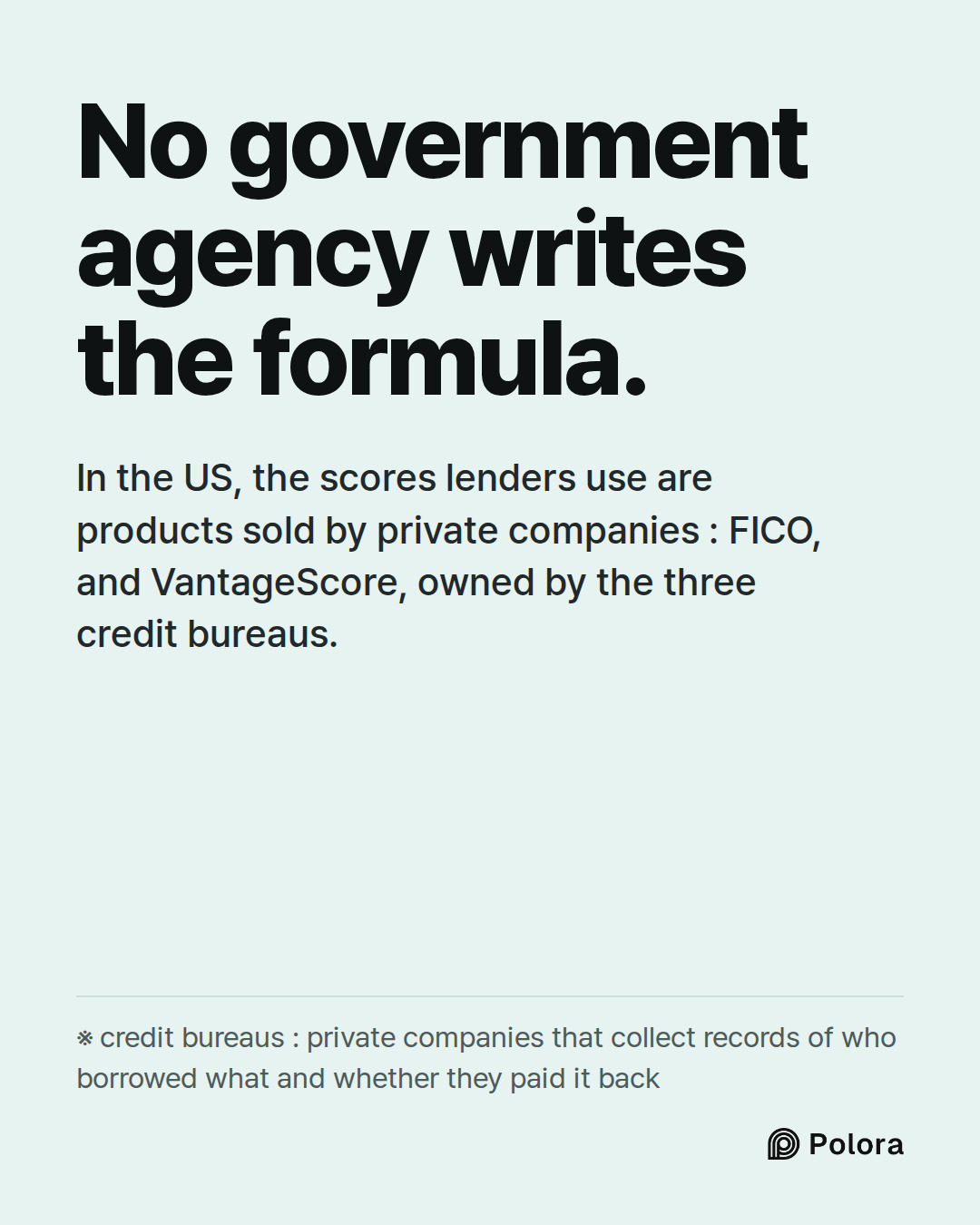
No government agency writes the formula. In the US, the scores lenders use are products sold by private companies. One is FICO, a company listed on the stock exchange. The other is VantageScore, owned by the three credit bureaus that hold the data both scores are built from. The lender chooses which score to buy, so the number in your app is often not the one the lender sees. Government comes in at one point. For home loans sold to Fannie Mae and Freddie Mac, the two big mortgage buyers, a federal agency decides which scores lenders may use.
You have more than one credit score
Ask most people who sets their credit score and they will picture a single official number, kept somewhere by some public body. There is no such number. The US consumer finance regulator says it plainly : "You have more than one credit score." Scores can be calculated from different data held by different credit reporting companies, or at different times. Lenders also use different scores for different kinds of loans.
The free score in a phone app is often a different product from the one a lender buys. Credit Karma, one of the best known free apps, says its scores come from a model called VantageScore 3.0, using data from two of the three big credit bureaus, Equifax and TransUnion. A card issuer or a mortgage lender may be looking at a FICO score built on another formula, from a different mix of files. The regulator also warns that some sources give out an "educational" score instead of one a lender would actually use.
So the real question is not what your score is. It is who builds these numbers, who buys them, and who decides which one counts.
Two private companies make the scores
The best known score comes from Fair Isaac Corporation, the company behind the name FICO. It was founded in 1956, has traded on the New York Stock Exchange since 1987 under the ticker FICO, and is based in Bozeman, Montana. Its credit score is a product it licenses for money, and it sells other software as well.
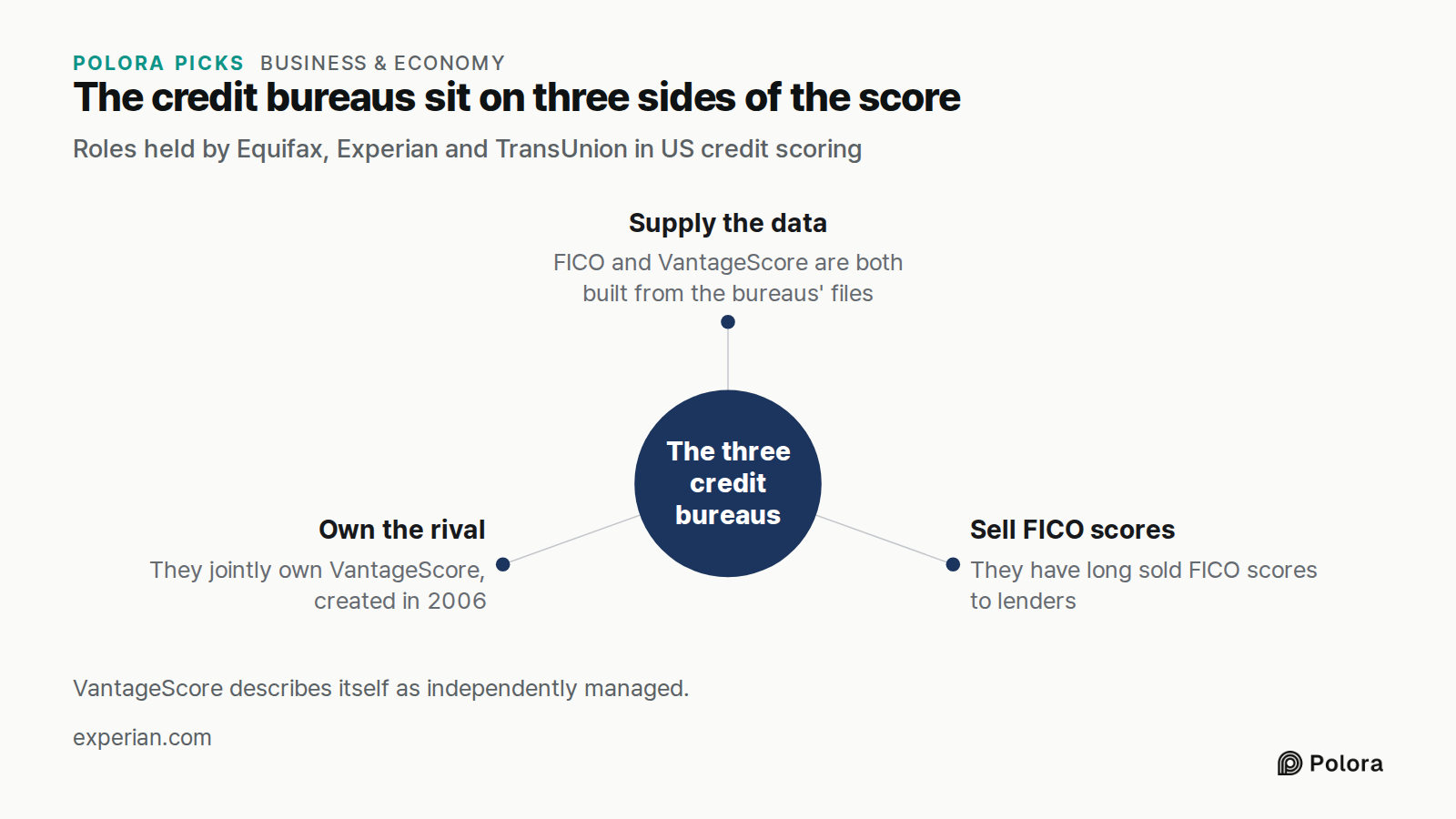
The main rival, VantageScore, was created in 2006 by Equifax, Experian and TransUnion, the three nationwide credit bureaus, as a joint venture. The three still own it together, though VantageScore describes the company as independently managed. The bureaus are private companies too. They collect the records of who borrowed what and whether they paid it back, and that file is the raw material for both FICO and VantageScore.
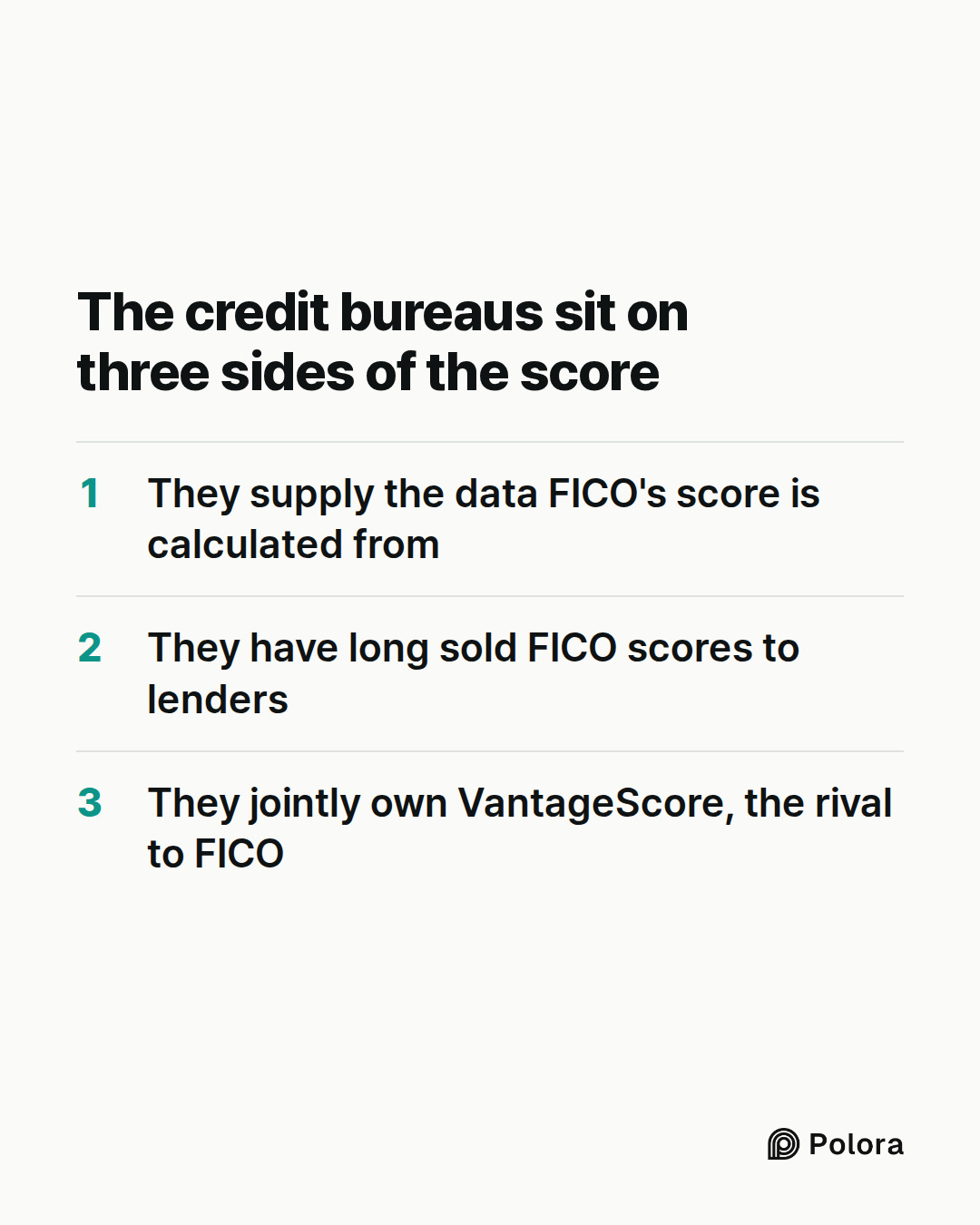
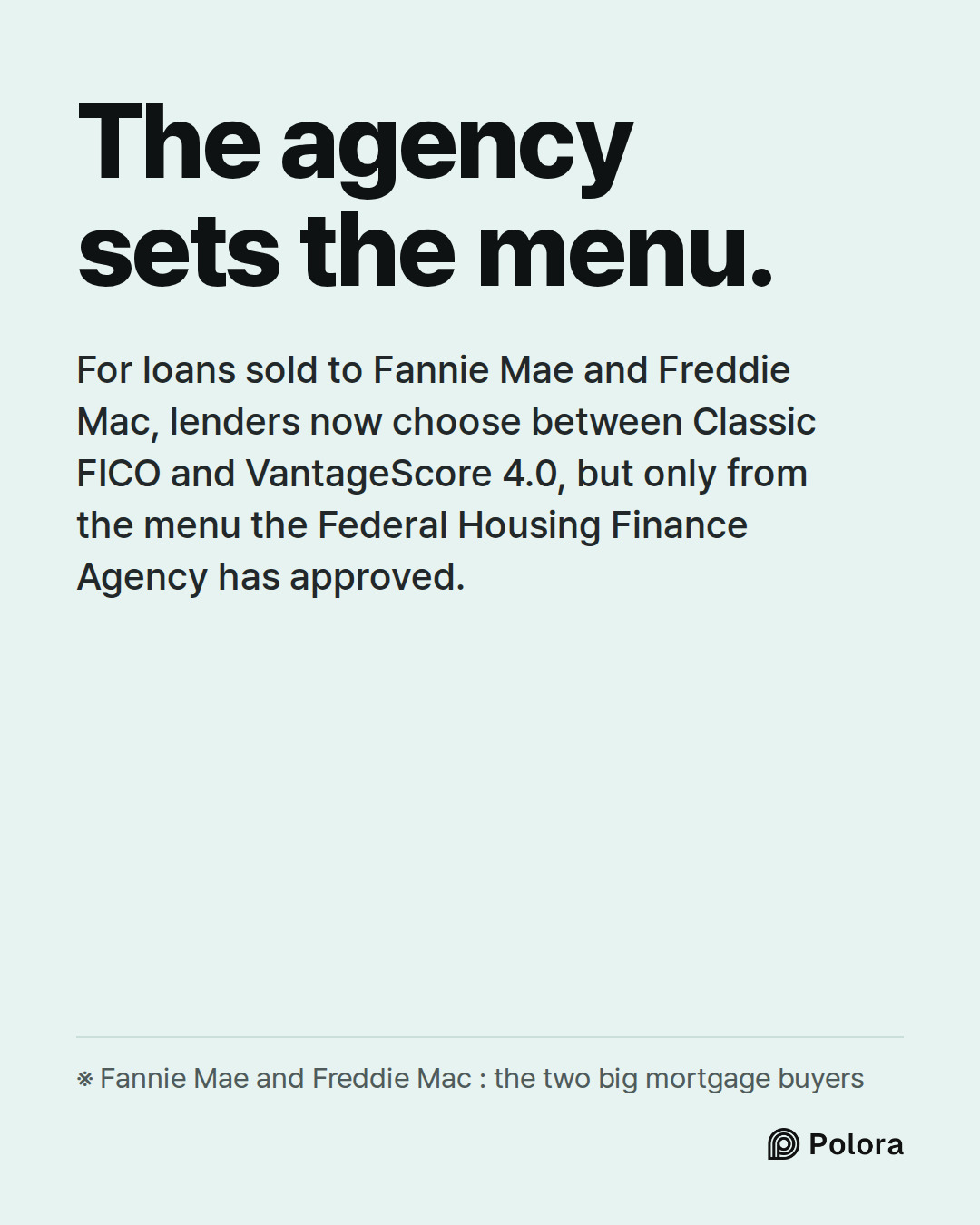
That makes the arrangement unusual. The bureaus supply the data FICO's score is calculated from, they have long sold FICO scores to lenders, and they jointly own the company that competes with FICO. No government agency writes either formula. Government comes in at a different point. It sets rules on credit reports, and for loans sold to the two big mortgage buyers, Fannie Mae and Freddie Mac, a federal agency decides which scores are accepted. That covers a major part of the US mortgage market, so the agency sets the menu even though it does not write the recipe.
The lender is the customer, not you
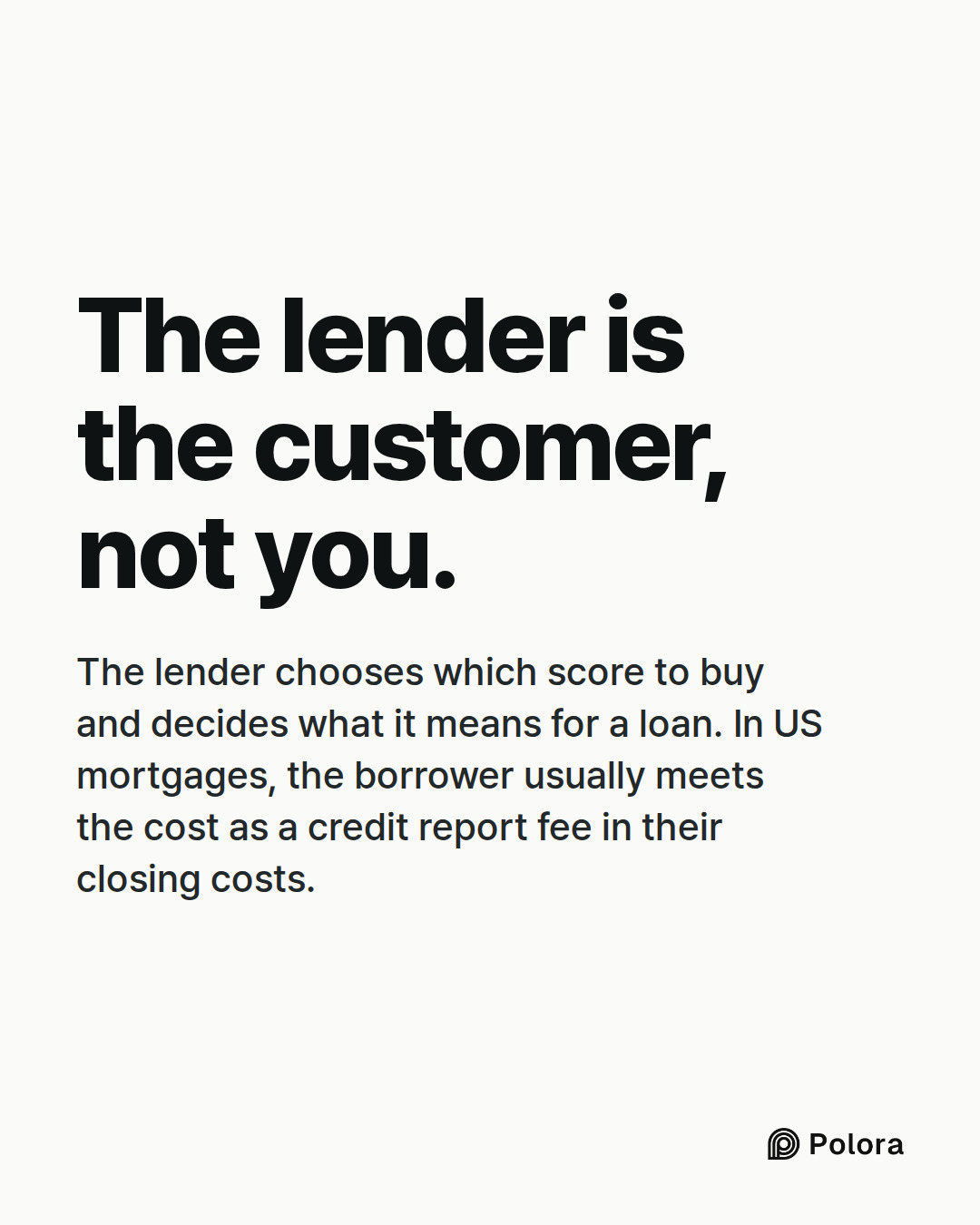
The main buyers of credit scores are lenders. A bank deciding whether to approve a card, a car loan or a mortgage pays for the score it wants, from the model and version it has chosen. People can also buy their own scores directly, and some apps hand them out free, but that is a side market.
The lender also decides what the score means for the application. It sets the cutoffs and weighs the score alongside anything else it looks at. The score feeds the decision. It does not make it.
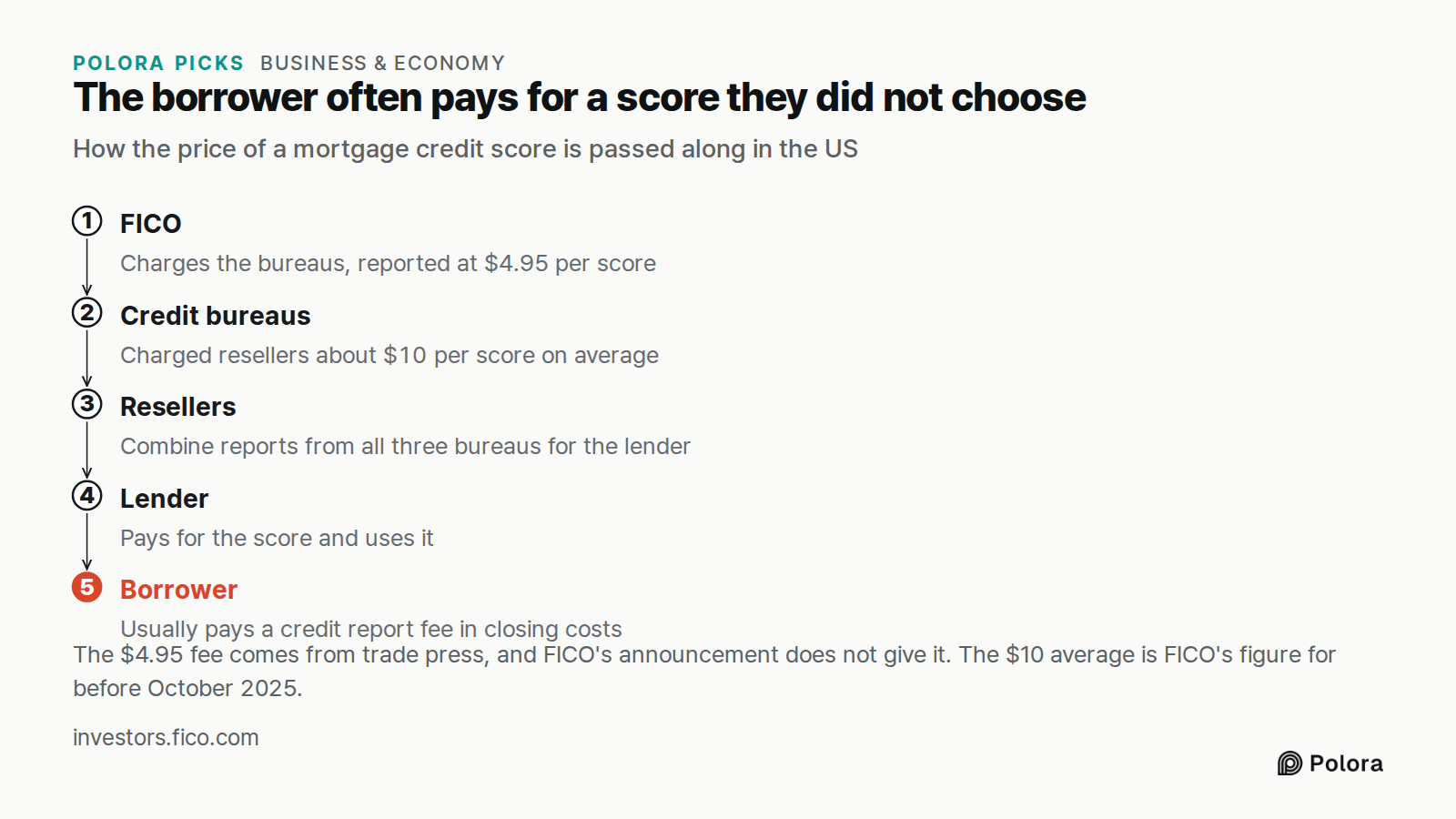
In mortgages the money passes through several hands. FICO charges the bureaus, and trade press reports put that wholesale fee at $4.95 per score, a figure FICO's own announcement does not give. The bureaus then charge the specialist resellers that combine reports from all three bureaus for the lender. FICO itself says that before October 2025 the bureaus charged those resellers about $10 per score on average. The borrower usually meets the cost at the end, as a credit report fee in their closing costs.
So the person being scored is neither the one who designs the score nor the one who picks it. Lenders pay for the score, they use it, and the cost often comes back to the borrower.
What goes into a FICO score, by FICO's own account
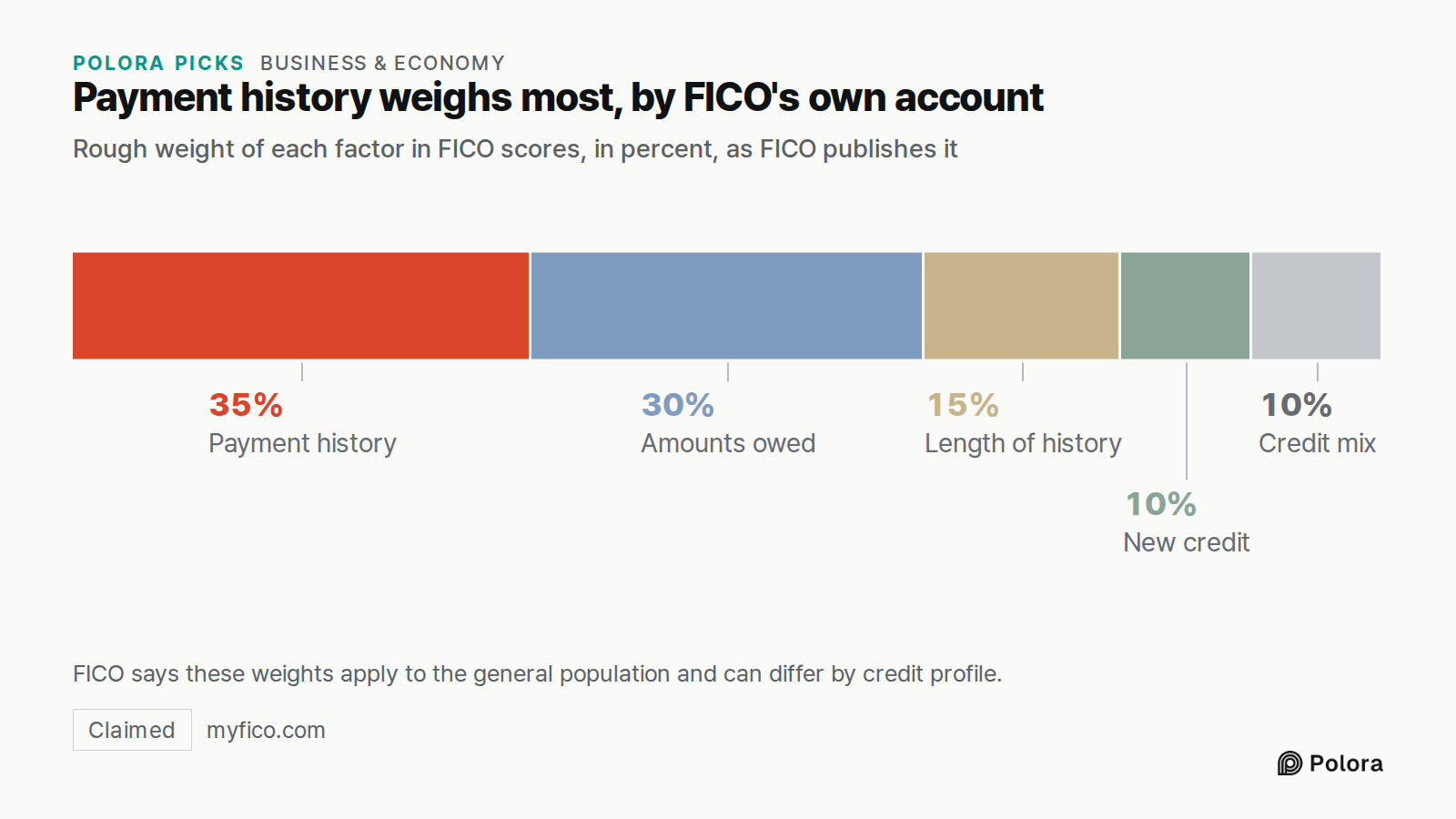
FICO publishes a rough breakdown of what its scores weigh. Payment history counts for 35 percent, amounts owed for 30, length of credit history for 15, new credit for 10 and the mix of credit types for 10. All of it comes from the credit report. Income, savings and job title are not part of the score, though a lender may look at them separately when it decides.
FICO attaches a caveat to these numbers. It says the percentages are for the general population and may be different for different credit profiles, and that the effect of any single factor cannot be measured without looking at the whole report. They describe how the formula leans on average. They do not show how any one person's number will move. Other models, VantageScore among them, publish different weightings, so no single breakdown applies to every score.
The mortgage fight that shows who decides
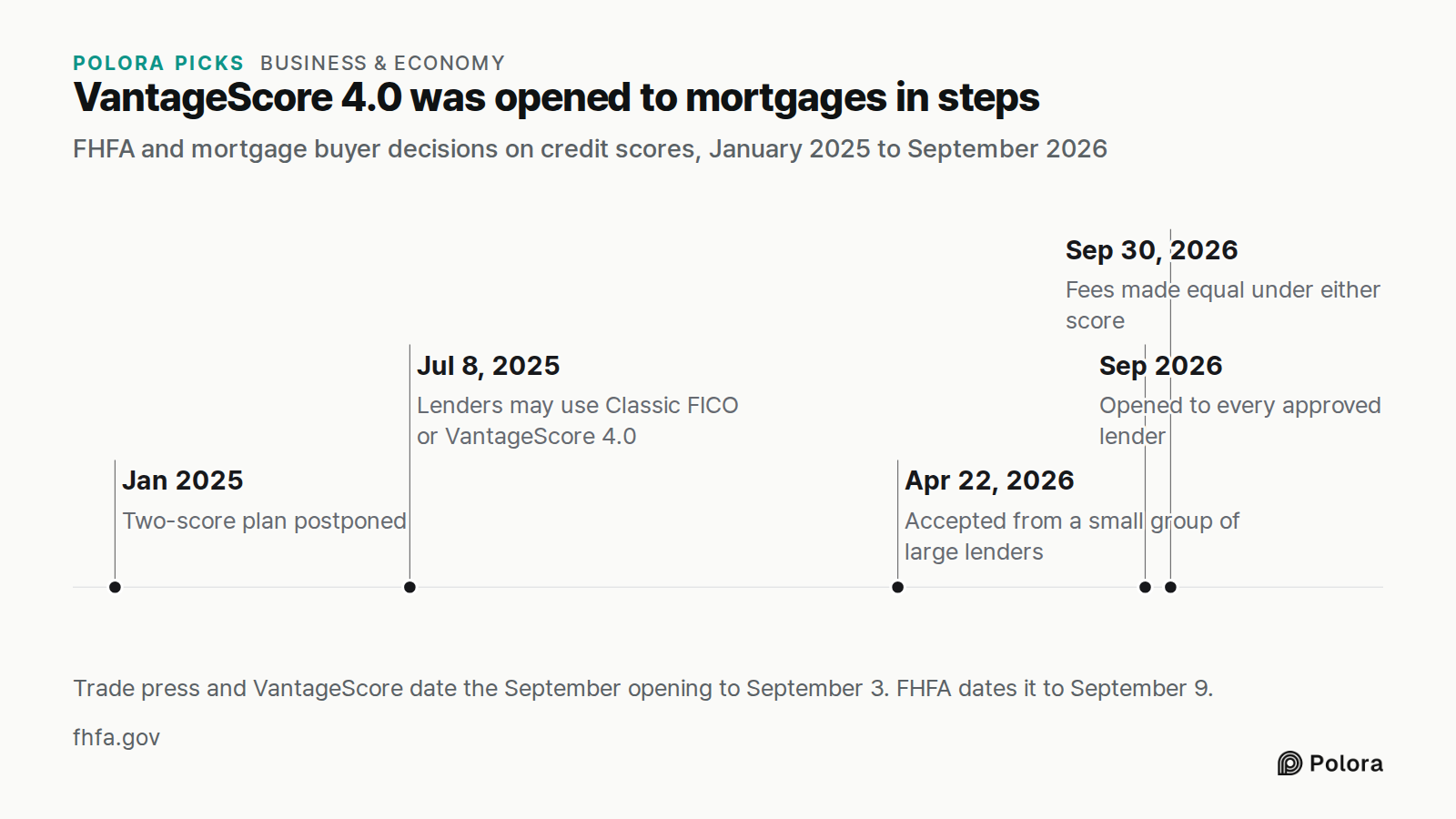
For decades, a loan sold to Fannie Mae or Freddie Mac needed a FICO score, specifically the older versions known as Classic FICO. Their regulator, the Federal Housing Finance Agency (FHFA), had a plan to change that. Lenders would have had to deliver two newer scores, FICO 10T and VantageScore 4.0, and pull reports from two bureaus instead of three. In January 2025 that plan was postponed to a date to be determined.
On July 8, 2025, FHFA Director Bill Pulte announced a different route. Lenders could use either Classic FICO or VantageScore 4.0. Reports from all three bureaus would still be required, and the two-bureau plan was dropped for the time being. On April 22, 2026, Fannie Mae and Freddie Mac began accepting VantageScore 4.0, at first only from a small group of large lenders. Press reports put the group at about 21, a figure Pulte gave at a press conference. In early September 2026, Pulte directed that VantageScore 4.0 be opened to every approved lender. Trade press and VantageScore date that directive to September 3, while FHFA's own record dates the change itself to September 9, when the requirement for prior written approval was removed. On September 30, the two mortgage buyers adjusted their upfront fees so that a loan costs the same under either score.
Two things have not changed yet. FICO 10T is approved but, according to FHFA, not currently eligible for delivery. A credit report from all three bureaus is still required. Industry reports say Pulte wrote on social media in early September that the agency was seriously considering allowing a report from two bureaus, but FHFA has issued no rule on it so far. In practice, each lender now chooses which score its mortgage applicants are judged on, but only from the menu FHFA has approved.
- FHFA : Credit scores
- Fannie Mae : Credit score models
- NAR : FHFA approves VantageScore 4.0 for mortgage underwriting
- Brownstein : FHFA reverses course on bi-merge, opens door to VantageScore 4.0
- Scotsman Guide : Lenders begin rolling out VantageScore for Fannie Mae and Freddie Mac loans
- Inman : NAR, FHFA and VantageScore 4.0
- VantageScore : VantageScore 4.0 now FHFA approved for all lenders
- HousingWire : GSEs broaden VantageScore 4.0 access
FICO goes around the bureaus
Regulators are not the only ones changing the rules. On October 1, 2025, FICO announced a Mortgage Direct License Program. It lets the resellers that assemble mortgage credit reports calculate FICO scores themselves, without buying them through the three bureaus. FICO offered two prices. One is $4.95 per score plus $33 per borrower per score when the loan is funded. The other is a flat $10 per score. Lenders that prefer to keep buying through the bureaus can still do so.
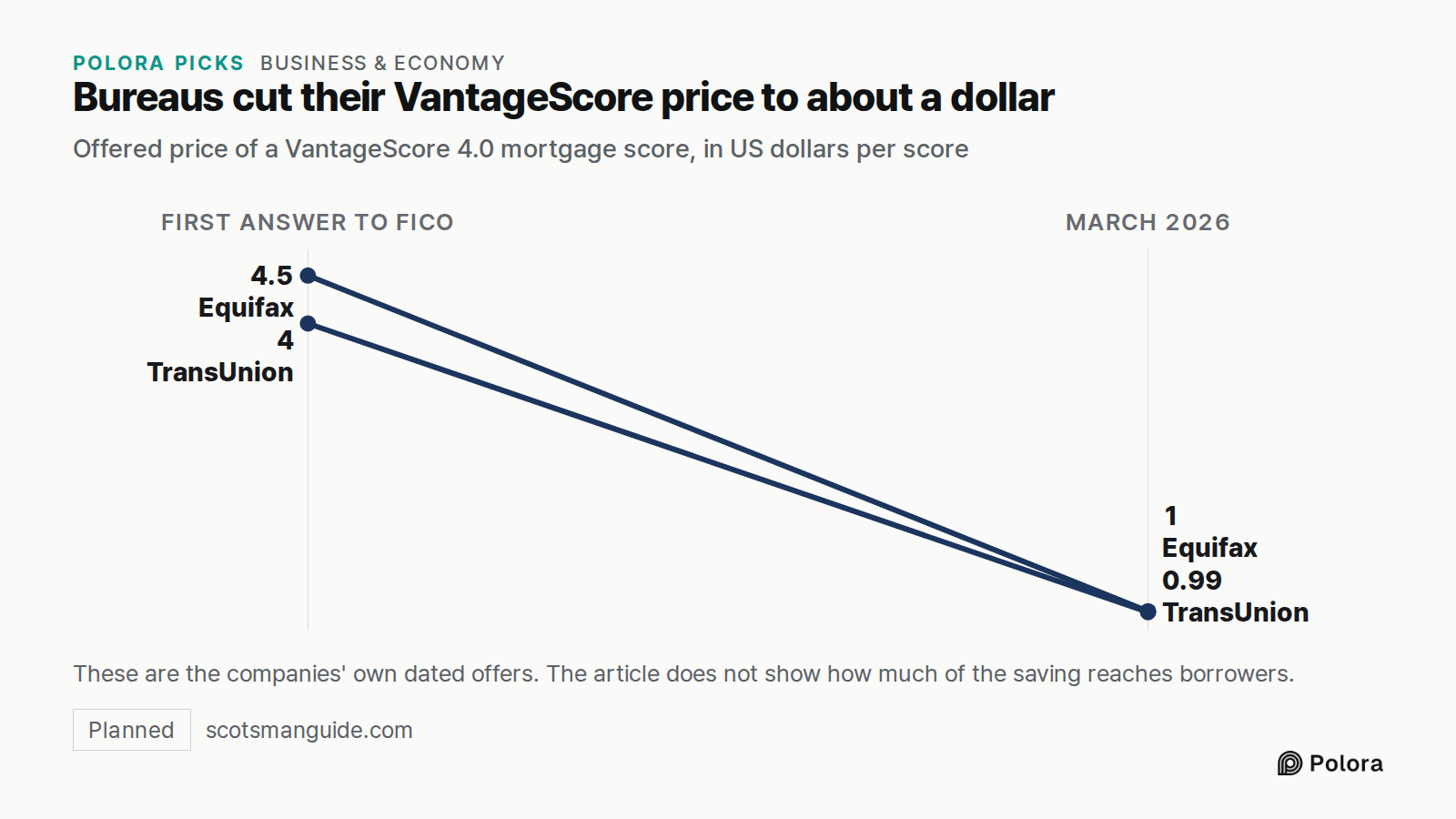
The bureaus answered quickly, and not all in the same way. On October 7, 2025, Equifax called FICO's $10 option a "monopoly-like doubling" and offered VantageScore 4.0 mortgage scores at $4.50 through the end of 2027. TransUnion offered VantageScore 4.0 at $4 per score in 2026, and free to lenders that also bought a FICO score. In March 2026, after Pulte had publicly criticized their pricing, the bureaus went further. TransUnion and Experian set the price at $0.99 per score. Equifax's own filing from that month gives its price as $1, which Equifax says it will hold through the end of 2027. On September 29, 2026, TransUnion said it would keep its $0.99 price through December 2028, and keep the score free with a FICO purchase.
Underneath the numbers is an argument over who stands between the formula and the lender. FICO wants to sell its score without passing through the bureaus. The bureaus want lenders to switch to the score they own. Each side describes its own move as a saving for borrowers. These are dated offers from the companies themselves, and none of them shows how much, if any, of the saving reaches the person taking out the loan.
- FICO : FICO launches cost-cutting Direct License Program for mortgage
- MortgagePoint : FICO launches direct license program for mortgage lenders
- Equifax : Equifax expands mortgage credit offerings
- HousingWire : TransUnion VantageScore price cut
- Experian : Experian announces $0.99 pricing for VantageScore 4.0
- Scotsman Guide : Credit bureaus slash VantageScore pricing following FHFA scrutiny
- Equifax SEC filing, March 2026
- Equifax : VantageScore for mortgage
Other countries split the job differently
In Germany the best known credit bureau, SCHUFA, is also a private company. Germany's competition authority describes it as a credit bureau that rates the creditworthiness of individuals and businesses, with shares held by banks, savings banks and other businesses, especially retailers. So some of the lenders who use its ratings are also among its owners.
In the UK there is no single official credit score either. The country's data protection regulator names three main private agencies that hold the files, Equifax, Experian and TransUnion, and says those agencies do not tell lenders whether to offer credit. The lender decides. The number in a UK app is the agency's own guide, not a verdict the lender is bound by.
A product, a customer, and the person being scored
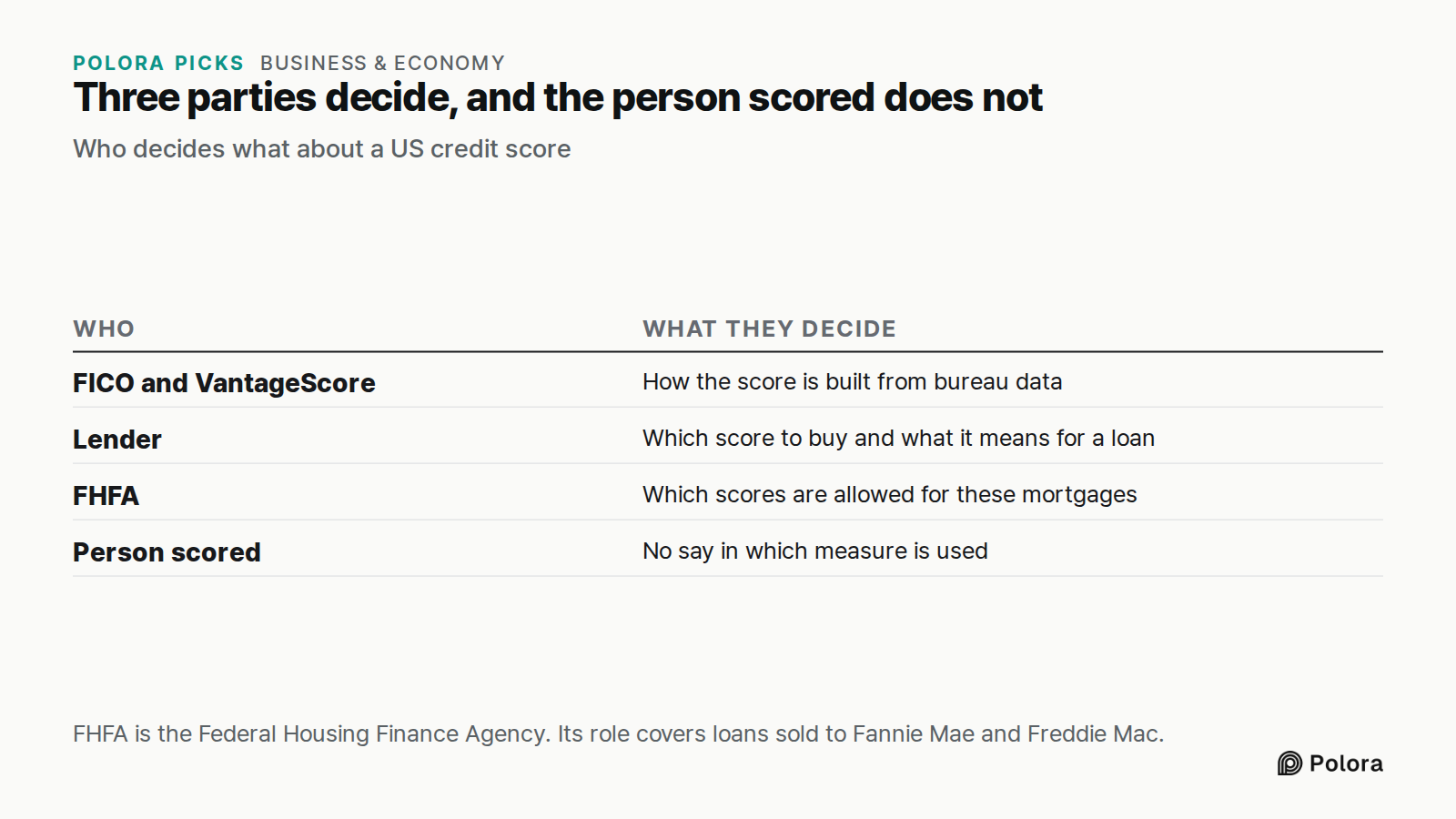
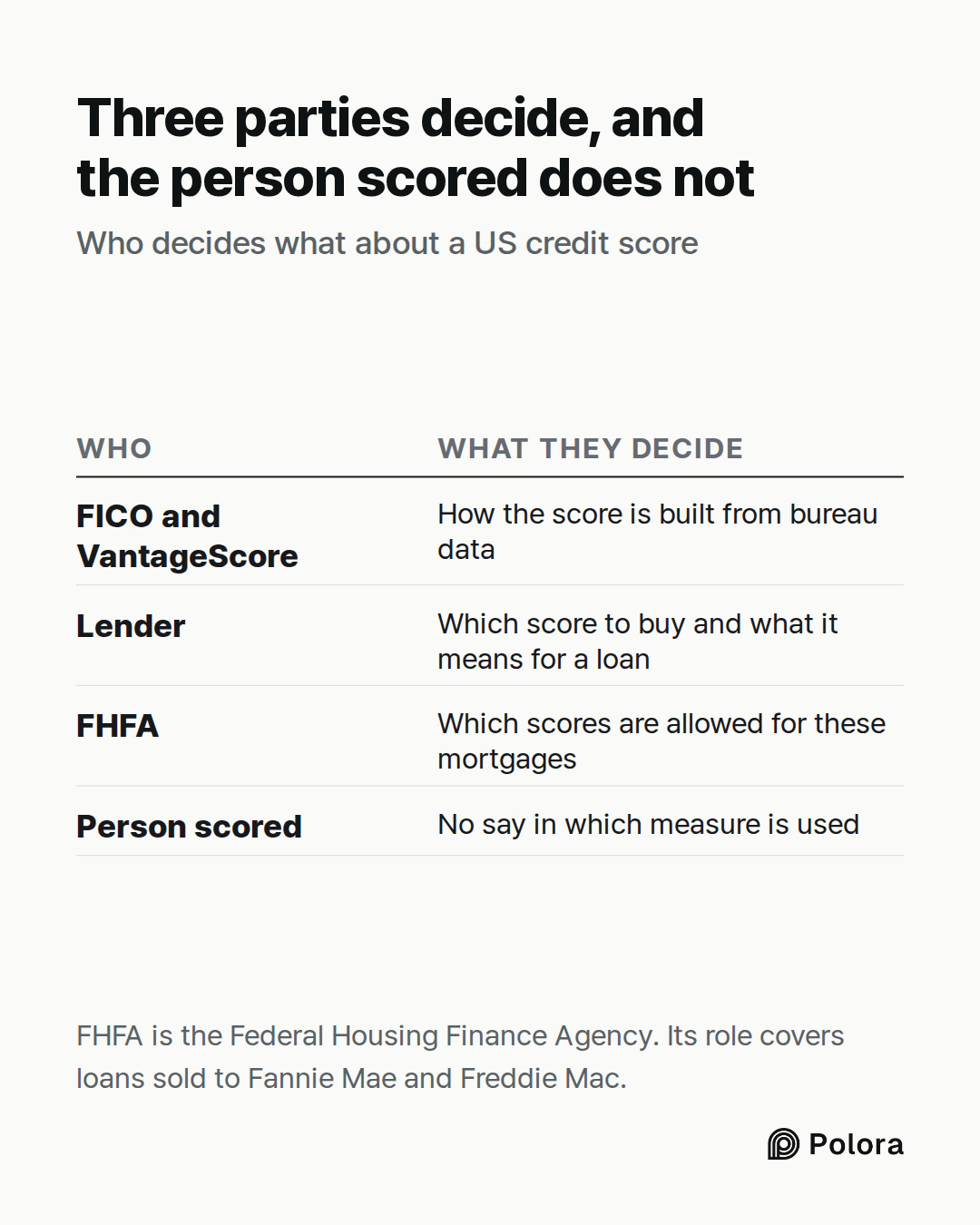
In the US, a credit score is not a public verdict. It is a product with a maker, a price and a customer. FICO and VantageScore make it from data the bureaus hold. The lender chooses which version to buy and decides what the number means for a loan. For mortgages sold to Fannie Mae and Freddie Mac, a federal agency decides which versions are allowed at all. Three different parties make three different decisions. The person whose name is on the report is the one being measured, and has no say in which measure is used.