Why does Starbucks hold over a billion dollars of customers' money?
Because money loaded onto a Starbucks card or the app is paid before any coffee is made, and Starbucks books it as a debt it repays in drinks. In June 2026 that debt, counted together with unspent rewards points called Stars, stood at about $1.7 billion. Card balances earn customers no interest and carry no deposit insurance.
Business & Economy · 2026-10-16
The balance in your Starbucks app is a promise of coffee
You top up the Starbucks app so the morning order goes through with one tap. The money leaves your bank account at that moment. The coffee comes later, sometimes weeks later. In between, the money already belongs to Starbucks, and what you hold is a promise.
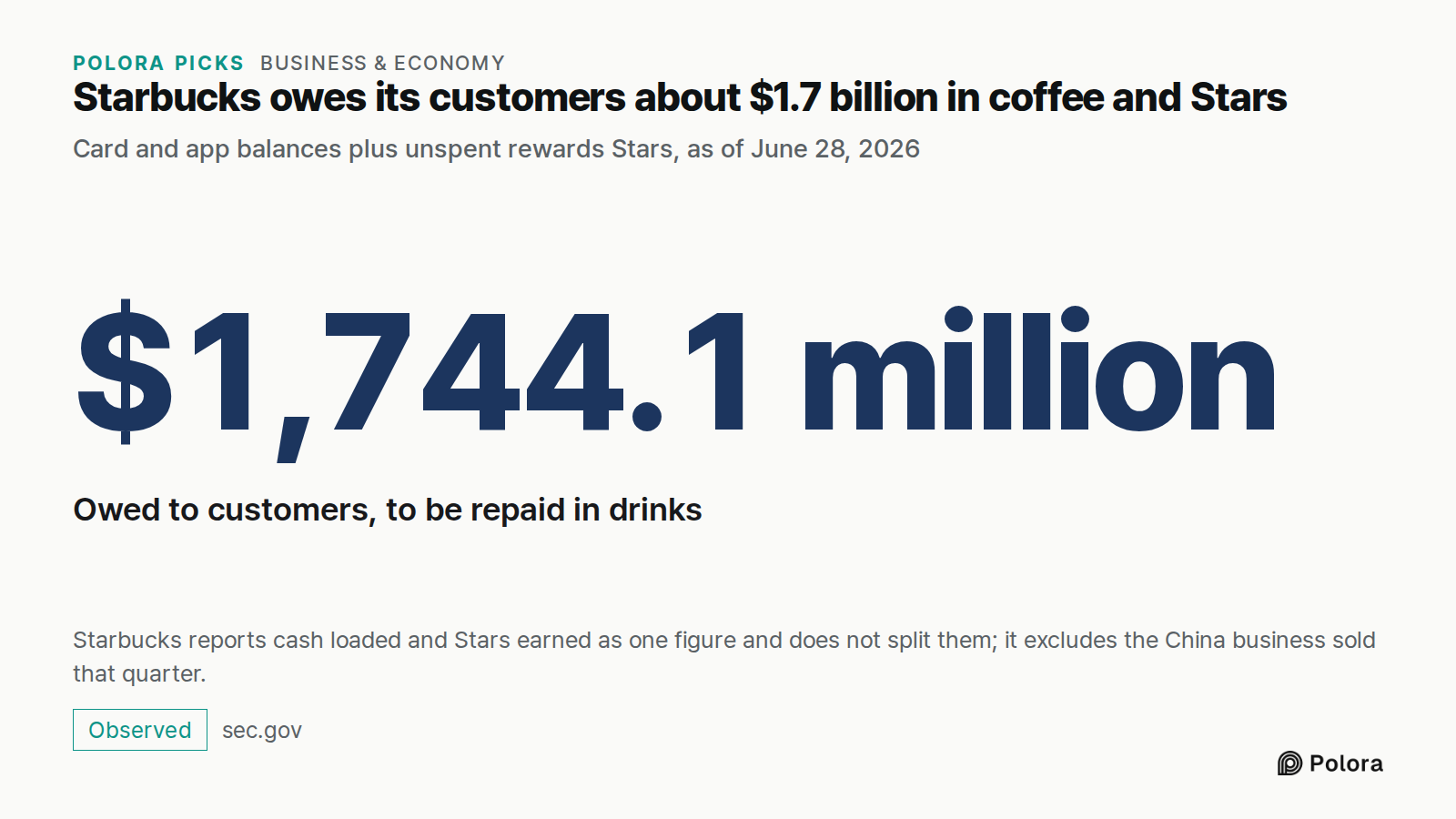
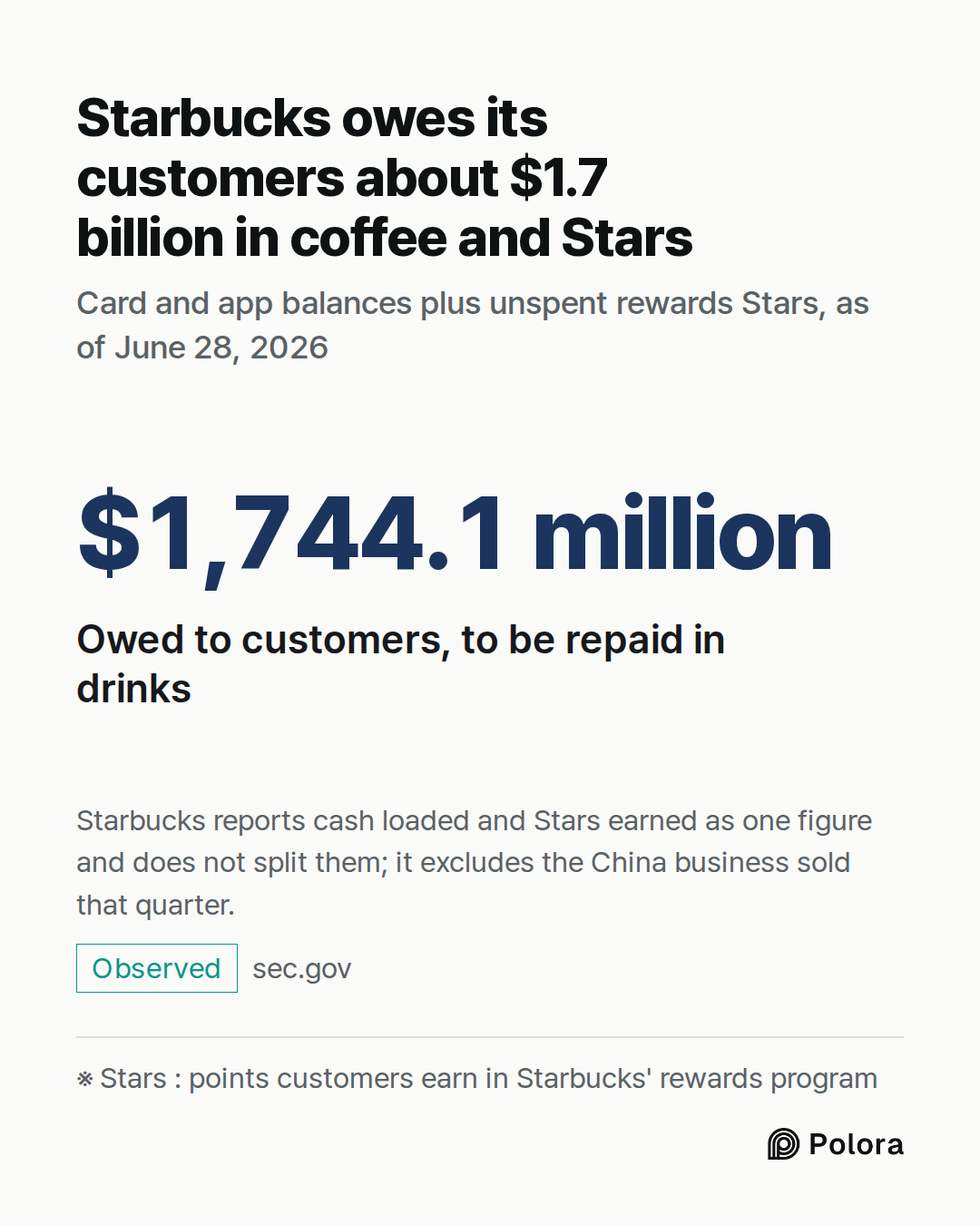
Add up those promises across every card and app account, together with the Stars customers have earned in its rewards program, and you get $1,744.1 million on June 28, 2026, according to Starbucks' latest quarterly report to the US Securities and Exchange Commission. Starbucks reports the two as one figure. It does not say how much is cash customers loaded and how much is Stars, which members can also earn by paying with cash or a bank card without loading anything. The figure already leaves out the company's coffee shops in China, which Starbucks sold off during that quarter.
Card and app balances plus unspent rewards Stars, as of June 28, 2026
Starbucks books your top-up as a debt it owes in coffee
Starbucks' own card terms describe the money you load as "a prepayment for the goods and services of participating stores." Unless a law says otherwise, it cannot be refunded or taken back out as cash.
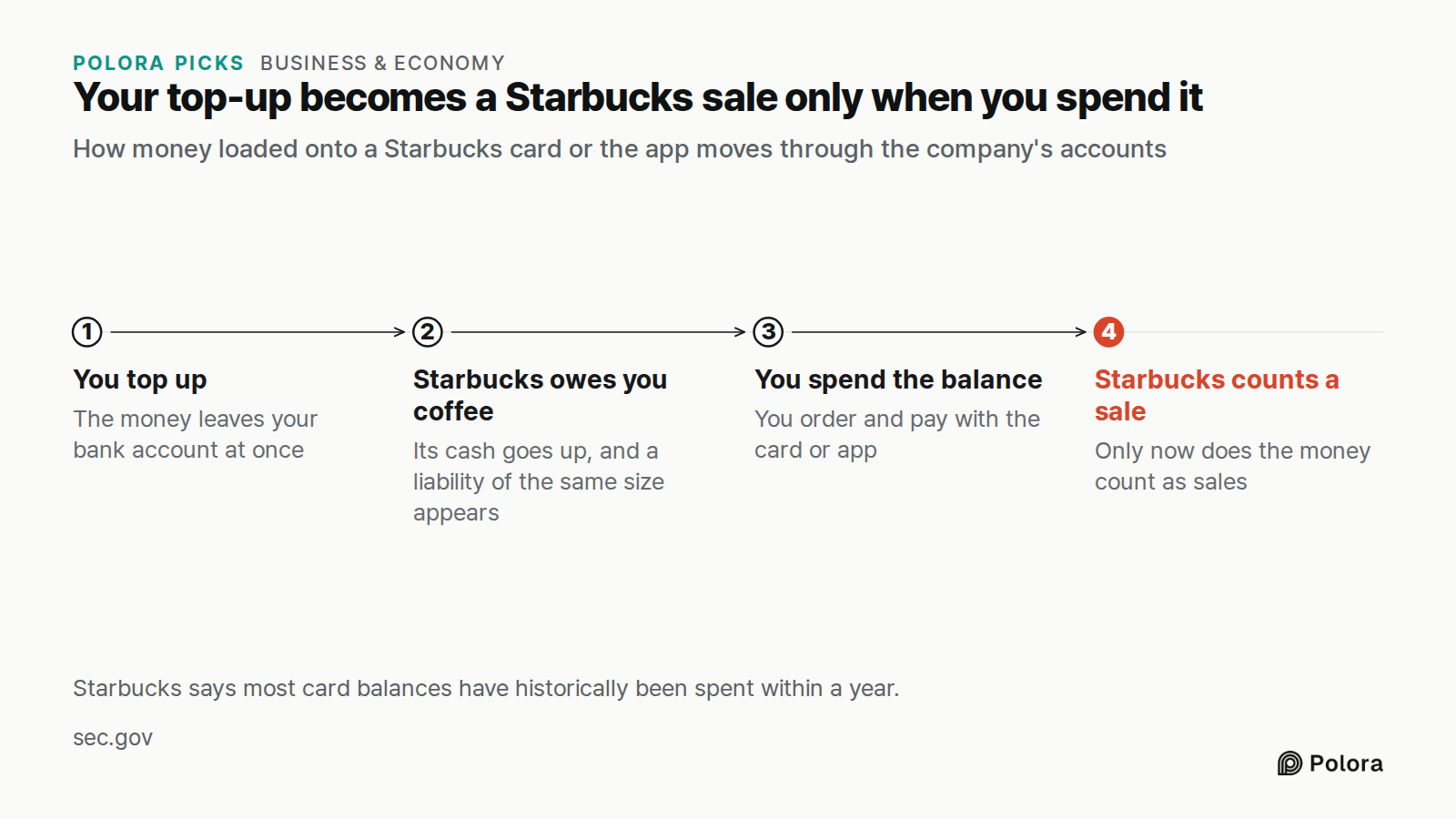
In Starbucks' accounts the same top-up appears twice. Cash goes up by the amount you load, and a liability of the same size appears next to it, standing for coffee the company still owes you. Only when you spend the balance does Starbucks count the money as sales. The company says most card balances have historically been spent within a year.
How money loaded onto a Starbucks card or the app moves through the company's accounts
Billions flow through every year, yet the pool barely moves
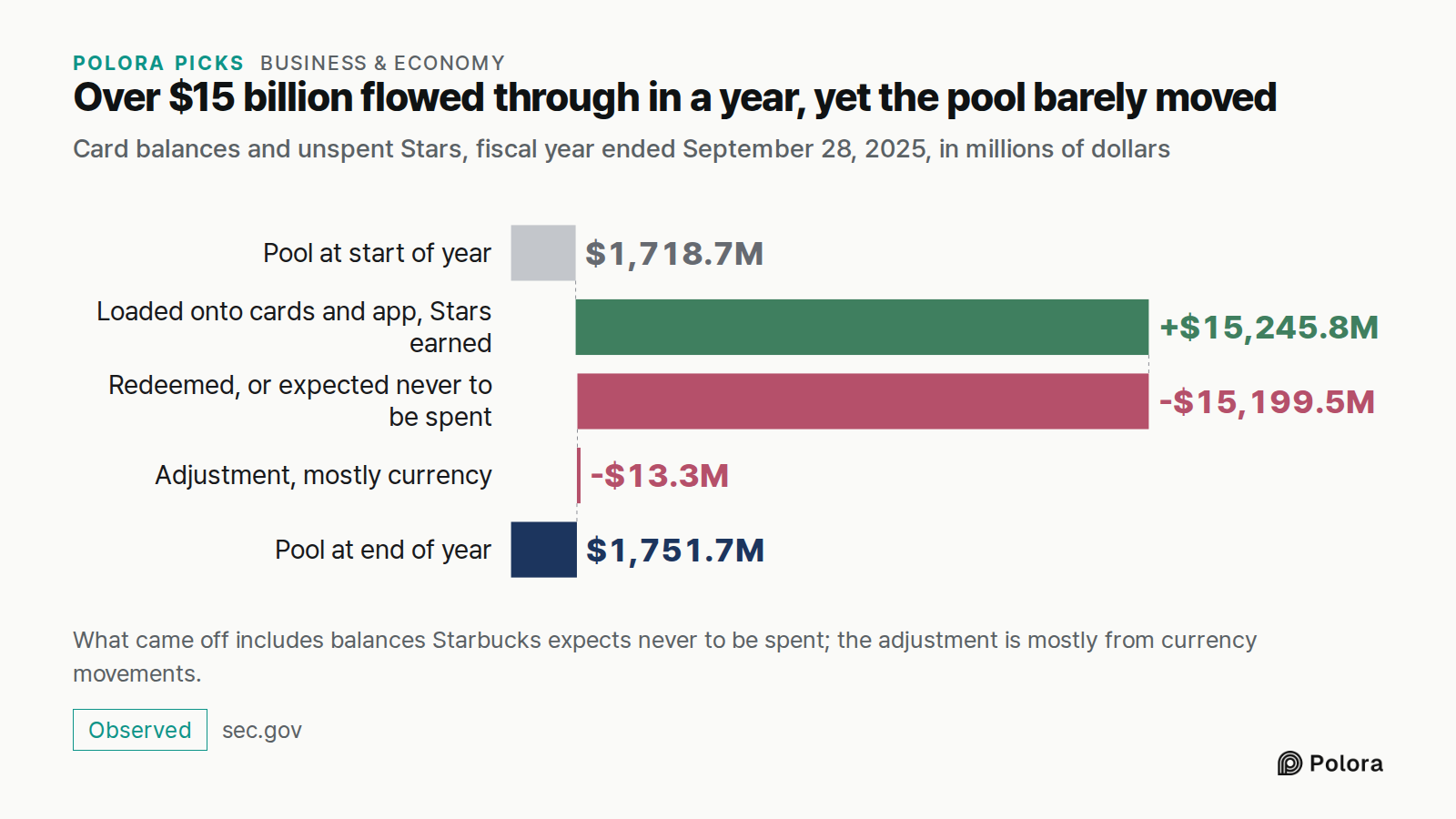
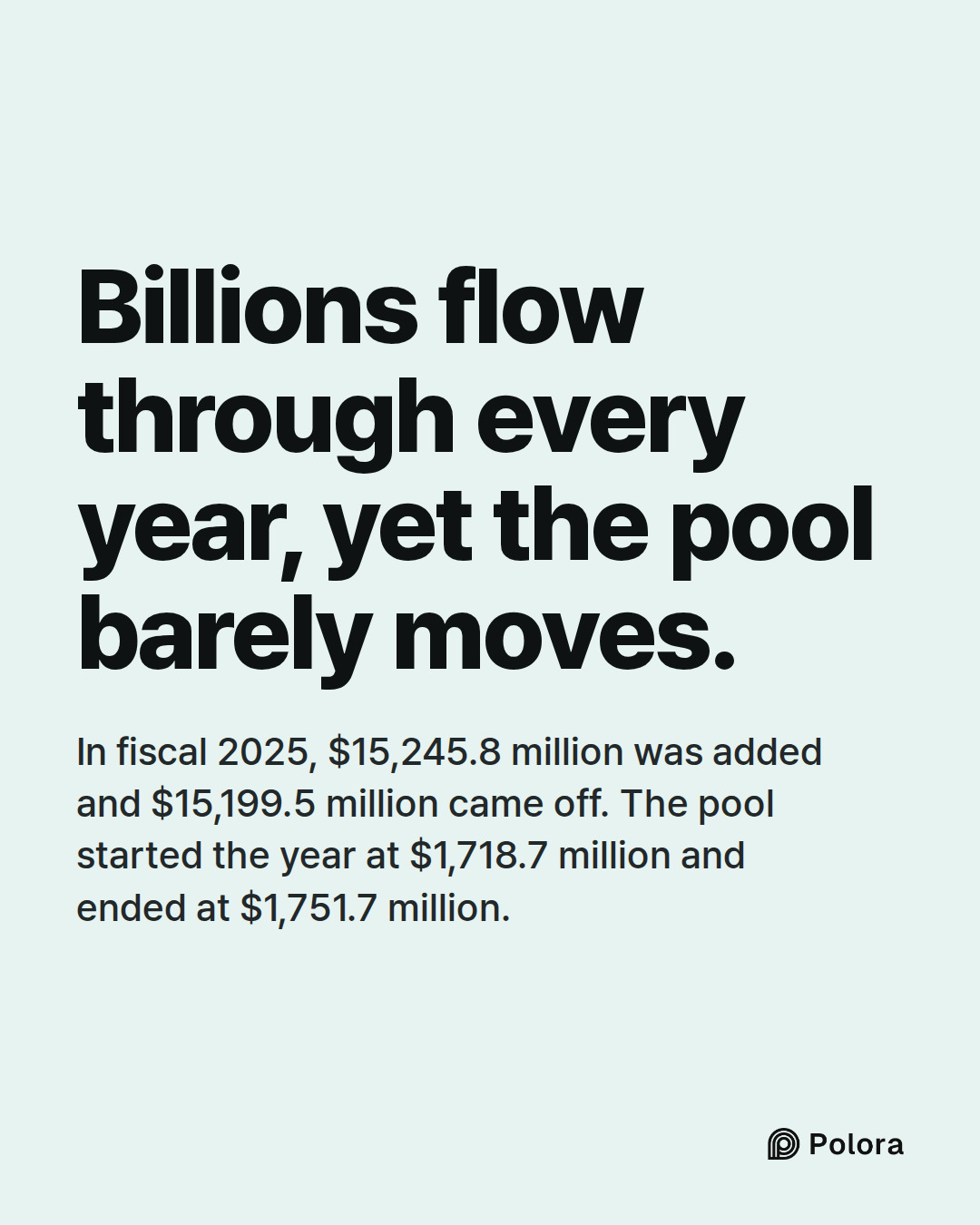
In the fiscal year that ended September 28, 2025, $15,245.8 million was added to the pool of card balances and unspent Stars, from money loaded onto cards and the app and from Stars earned. Over the same year, $15,199.5 million came off, through redemptions of card balances and Stars and through balances Starbucks expects never to be spent. Another $13.3 million came off in an adjustment, mostly from currency movements. The pool started that year at $1,718.7 million and ended at $1,751.7 million.
It works like a bathtub with the tap and the drain both open. Most of what goes in is spent sooner or later, but new value keeps arriving, so the level stays roughly the same. Starbucks always carries an obligation of well over a billion dollars, made up of cash customers have already paid and Stars they have earned.
The level rises after the holidays, when gift cards are bought and loaded. On December 29, 2024 the pool reached $2,213.1 million. A year later, on December 28, 2025, it stood at $2,073.3 million, but that figure already excludes the China business, so the two Decembers are not a like-for-like comparison.
Card balances and unspent Stars, fiscal year ended September 28, 2025, in millions of dollars
In the US, a Starbucks card never expires and carries no activation, inactivity or service fees, according to the company's terms. Federal rules generally require store gift cards to keep their money for at least five years, so Starbucks goes further than federal law requires. Some states set stricter rules of their own.
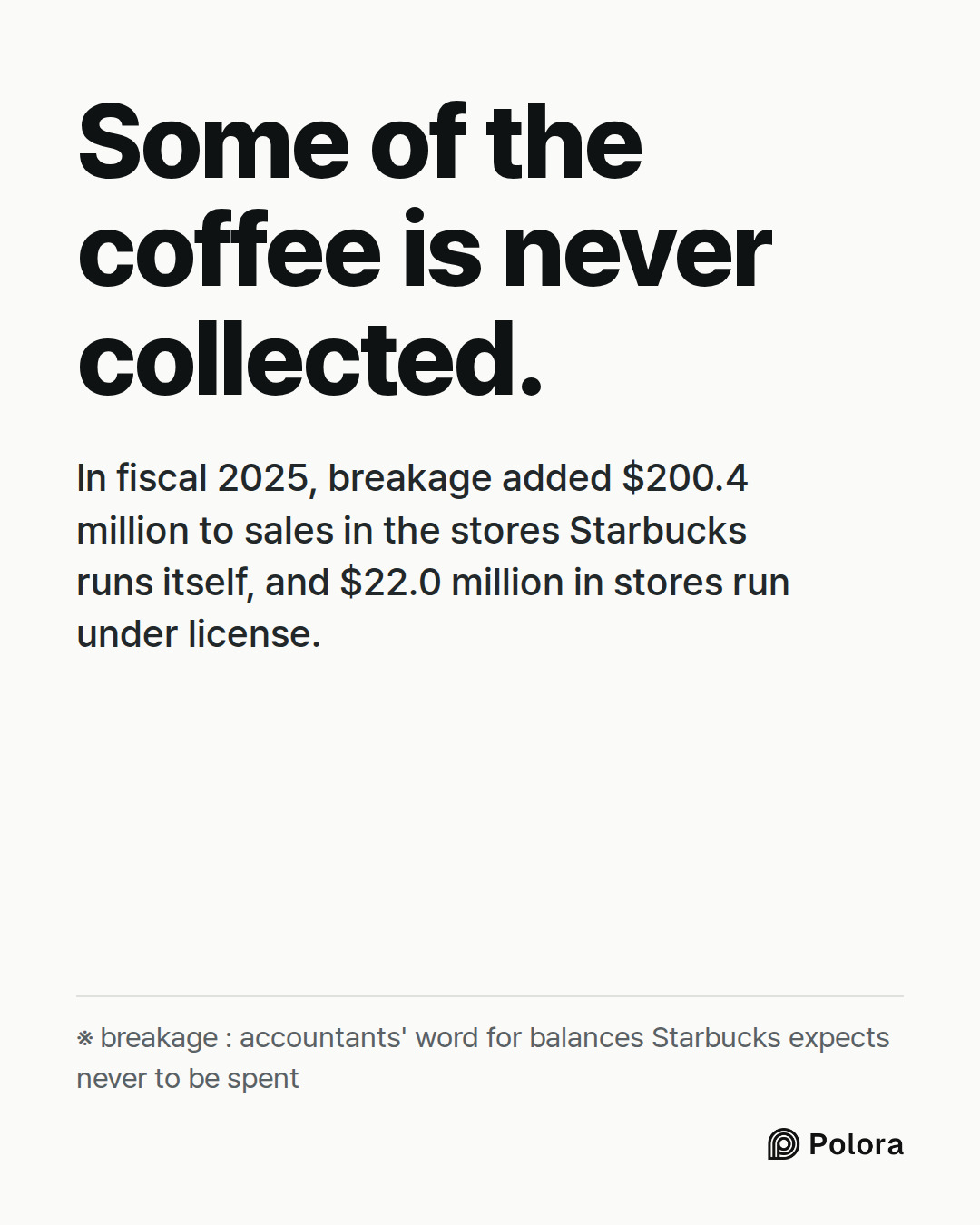
Even so, some balances are never spent, like a forgotten card in a drawer or a few dollars left in an old account. Accountants call this breakage. Starbucks estimates how much will go unspent from each market's history, including how cards were bought and what it has to hand over to governments under unclaimed property laws. It does not book that amount all at once. It counts it as revenue a little at a time, in step with the balances customers do spend.
In fiscal 2025 breakage added $200.4 million to sales in the stores Starbucks runs itself and $22.0 million in stores run under license. That is small next to the more than $15 billion that passed through, but it is revenue for which no coffee was ever made.
The biggest prepayment on Starbucks' books is not from customers
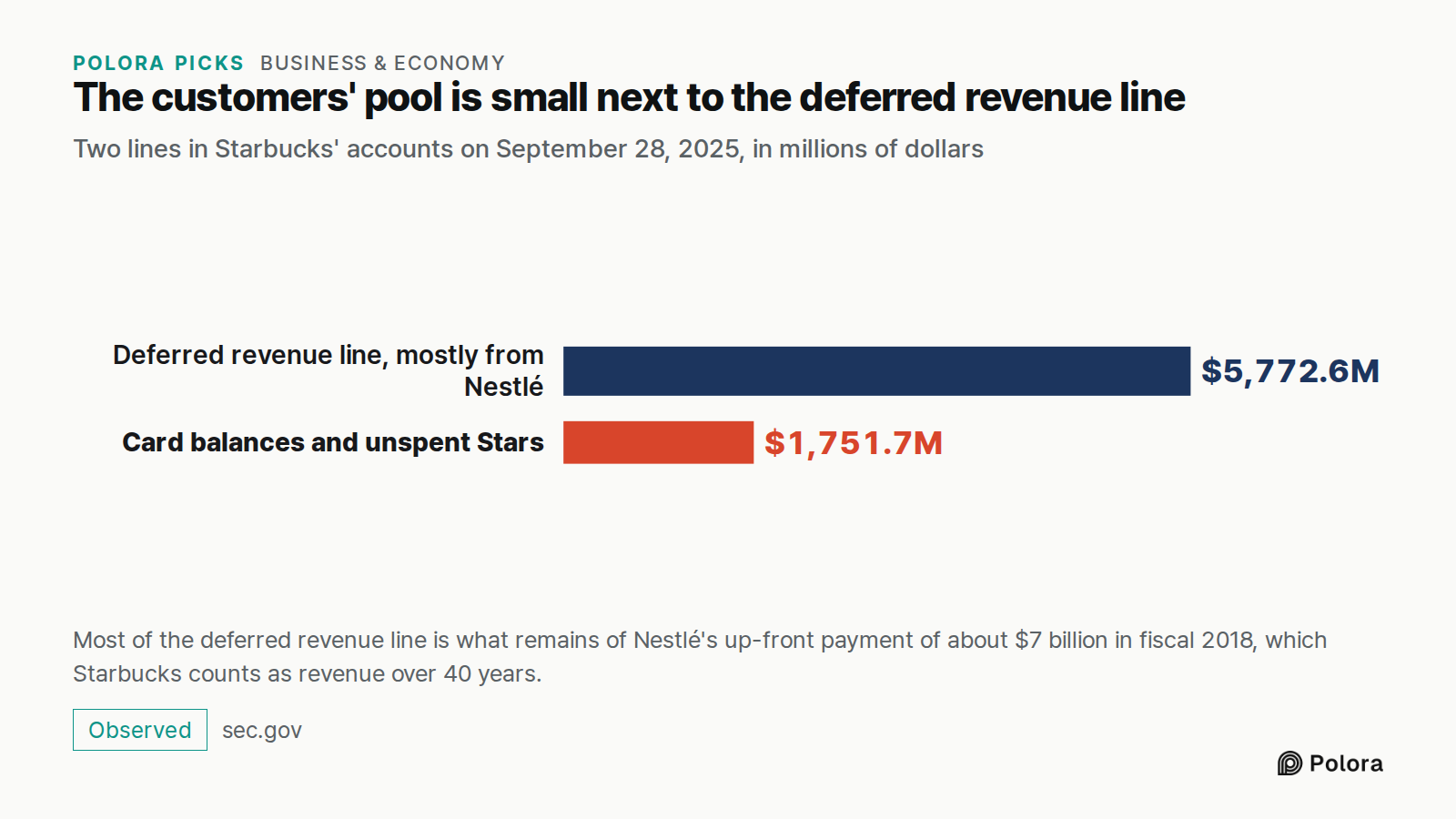
Anyone who opens Starbucks' balance sheet will find a much larger line called deferred revenue, $5,772.6 million at September 28, 2025. That is not coffee owed to customers. Most of it is what remains of an up-front payment of about $7 billion that Nestlé made in fiscal 2018 for the right to sell Starbucks coffee in supermarkets and other channels.
Starbucks counts that payment as revenue in equal slices over 40 years. At September 28, 2025, about $5.6 billion of it was still to come in later years. Confusing it with card balances makes the customers' pool look three times bigger than it is.
Two lines in Starbucks' accounts on September 28, 2025, in millions of dollars
Is Starbucks a bank? Where the comparison holds, and where it breaks
Starbucks is often compared to a bank, and part of the comparison holds. It holds money customers paid in advance, the pool stays steady because new money keeps replacing what is spent, and the company has the use of that cash in the meantime.
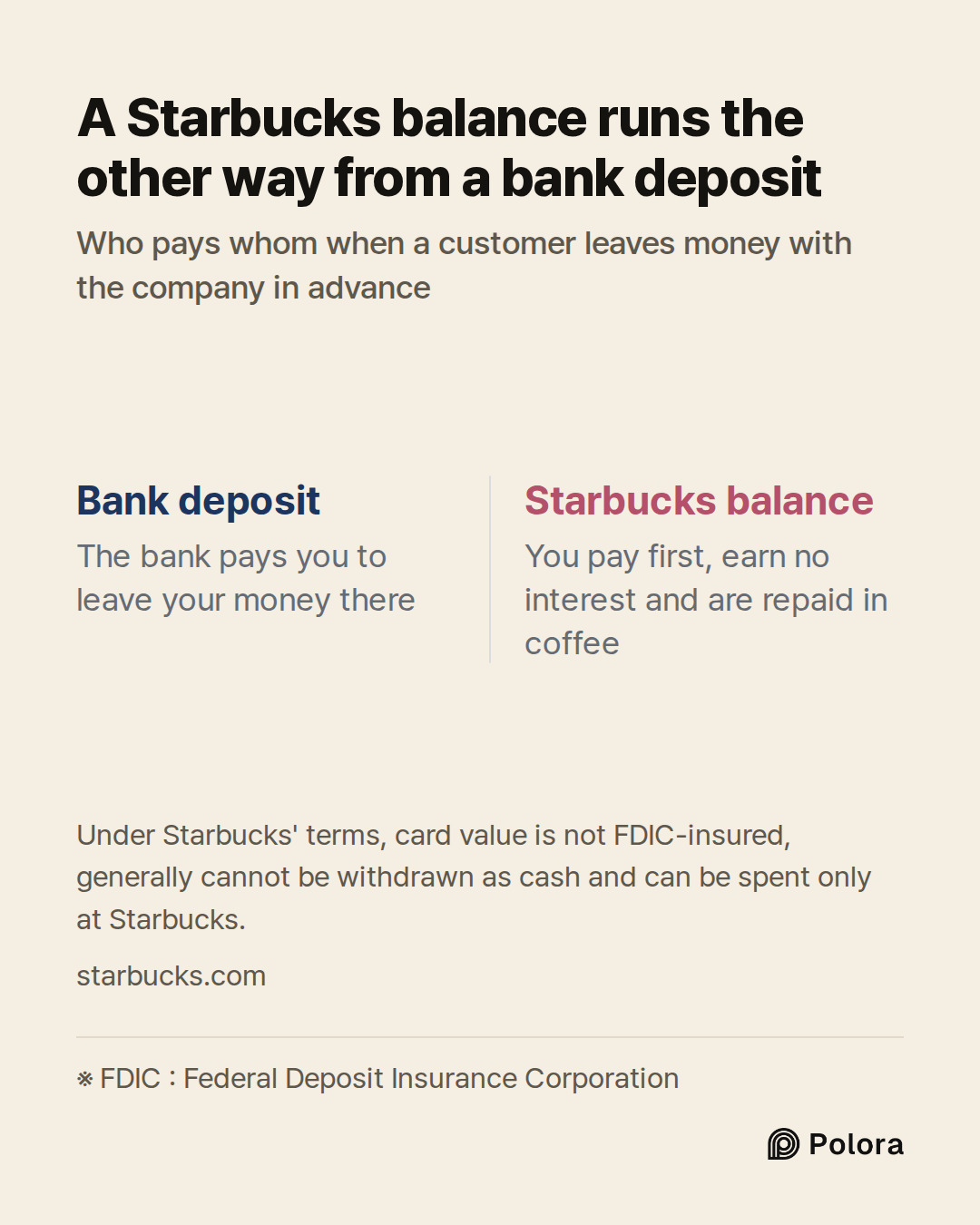
The rest does not hold. Starbucks' terms say the value on a card is not insured by the Federal Deposit Insurance Corporation and does not earn interest. It generally cannot be withdrawn as cash, and it can be spent only at Starbucks. The FDIC, in a 2004 rule proposal, described a retailer's gift cards as a closed system in which the merchant takes the prepayment directly rather than through a bank. In 2008 it set out its later position in General Counsel's Opinion No. 8, which addresses when the money behind stored-value cards counts as a deposit. And the filings checked for this piece do not show Starbucks lending these balances out the way a bank lends deposits.
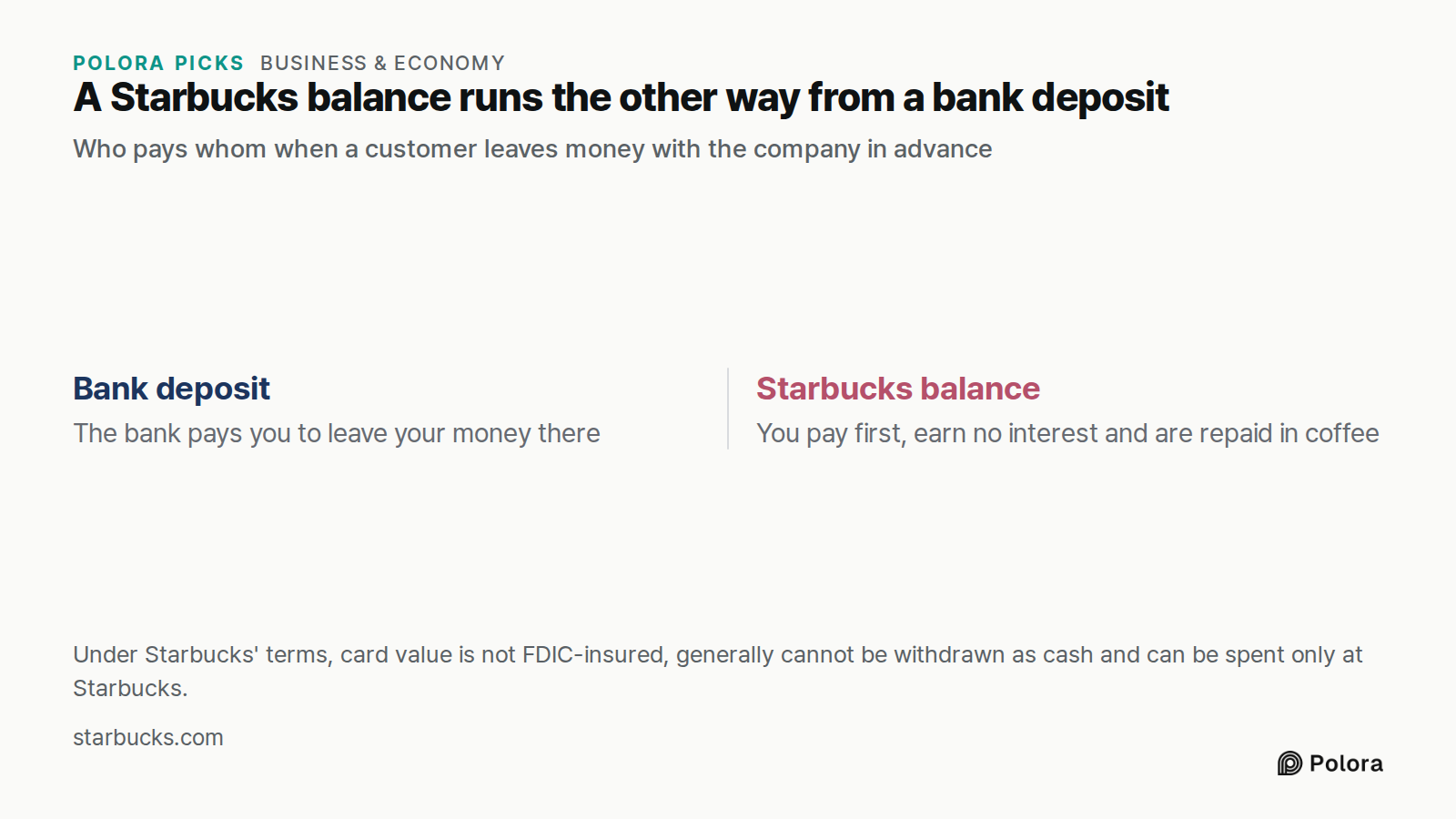
So the direction runs the other way from a bank. With a bank, the customer is paid to leave money there. With a Starbucks balance, the customer hands over the money first, receives no interest, and is repaid in coffee. In that sense the customers who load cards are making an interest-free loan to a coffee company. The filings do not say exactly how large that loan is. The $1.7 billion figure also counts Stars, which customers earn rather than load, so the cash part is some amount below it.
Who pays whom when a customer leaves money with the company in advance
Why does Starbucks hold billions of dollars of its customers' money?
Alpha · deepseek-v4-pro
Alex — the short answer is that Starbucks holds billions of its customers’ money because a Starbucks Card or app balance is a prepayment for future coffee, not a bank deposit.
When you load the app, Starbucks receives your cash immediately. In return, it owes you goods later. In its accounts, that obligation is a liability. Across every card and app account, the unspent portion of those prepayments was $1,744.1 million on June 28, 2026, according to the latest quarterly SEC filing. That figure excludes the China retail business Starbucks divested during that quarter.
So the “billions” are not one hoard Starbucks set out to collect. They are the steady-state pool of money loaded now but not yet redeemed.
Why the pool stays so large:
- Loads run ahead of redemptions. In fiscal 2025, customers loaded $15,245.8 million and spent $15,199.5 million. The balance barely moved: from $1,718.7 million to $1,751.7 million, with a small currency adjustment. It is a bathtub with the tap and the drain both open.
- Holiday spikes. The balance peaked at $2,213.1 million on December 29, 2024. A year later it was $2,073.3 million, but that comparison is distorted becau…
Beta · gpt-6-sol
Alex, Starbucks holds these balances because customers pay before they buy. Loading a card or app gives Starbucks cash now and gives the customer a claim to future purchases at participating stores. Starbucks records the unredeemed value as a liability, then generally recognizes sales when customers redeem it. Its card terms call a load a prepayment, not a deposit. (starbucks.com)
The editor’s central figure checks out: Starbucks reported $1.7441 billion in its *stored-value cards and loyalty program* balance on June 28, 2026. That pool persists even as people make purchases because others keep loading cards. In fiscal 2025, the balance moved from $1.7187 billion to $1.7517 billion; the filing records $15.2458 billion of new deferred value, $15.1995 billion of redemptions and breakage, and a $13.3 million reduction chiefly associated with currency translation. The June 2026 figure excludes China retail operations classified as held for sale earlier in fiscal 2026 and subsequently divested. (sec.gov)
The strongest correction…
Gamma · gemini-3.1-pro
Alex, my analysis confirms the broad mechanics of the editor’s manuscript, but I agree with Beta that the central accounting premise contains a critical flaw. Here is what the record shows, where the manuscript needs correction, and the strongest counter-argument to the editor's angle.
1. The $1.7 Billion Conflates Cash with Loyalty Points
Beta is absolutely correct. SEC filings confirm that the $1.744 billion figure on Starbucks' balance sheet is a combined line item: *stored value card liability* and *unredeemed loyalty points (“Stars”)*.
The manuscript repeatedly claims this entire pool is money customers handed over ("money loaded," "customers put $15,245.8 million onto cards," "interest-free loan"). This is factually incorrect. Customers do not deposit cash to get Stars; Starbucks grants them as deferred discounts. Lumping them together means the manuscript overstates how much actual cash customers have "loaned" the company. The SEC filings do not publicly break out the exact split between cash-loaded cards and unredeemed Stars.
2. The FDIC Rule: Update to the 2008 Final Opinion
The editor relies on a 2004 FDIC *proposed* rule to argue these are not bank deposi…
Researcher · gpt-6-luna
Research check: The key figures and accounting treatment are supported by Starbucks’ SEC filings, with one important limitation: the reported balance combines card value with unredeemed Rewards Stars, so it is not a measure of cash customers loaded.
- Latest balance: Starbucks’ June 28, 2026 Form 10-Q reports $1,744.1 million for “stored value cards and loyalty program.” The filing says that balance excludes China retail operations divested in the third quarter of fiscal 2026. It also shows $3,672.2 million deferred and $3,678.9 million recognized during that quarter; the latter includes card and Stars redemptions and breakage.
Address: https://www.sec.gov/Archives/edgar/data/829224/000082922426000130/sbux-20260628.htm (sec.gov)
- What is in the pool: The filing explicitly says its deferred revenue includes the unredeemed stored-value-card liability and unredeemed Stars. Starbucks’ 2025 Form 10-K says members can earn Stars by paying with cash, credit or debit cards, or selected mobile wallets. So Beta and Gamma are right that the total is not all c…
The Arbiter · gpt-6-sol
The voices agree on the basic mechanism: customers load cards before buying anything, and Starbucks records the unredeemed obligation as a liability. The important dispute is what the headline number measures. Beta and Gamma point out—and the Researcher confirms from the filings—that the reported $1.7441 billion at June 28, 2026 combines prepaid card value and unredeemed Rewards Stars. It cannot, on this evidence, be called $1.7441 billion of cash customers loaded. The same distinction affects the manuscript’s descriptions of its annual inflows and outflows. (sec.gov)
A second correction is narrower but definite: “every dollar is spent eventually” conflicts with the reported *breakage*—value Starbucks expects will not be redeemed. The Researcher confirmed the manuscript’s fiscal 2025 breakage figures, while noting that recognized value includes more than customer purchases. (sec.gov)
The bank analogy remains a question of precision, not a disagreement about the card terms. The Researcher found support…
The Arbiter's Final Verdict · gpt-6-sol
Verdict: Starbucks receives money when customers load its cards or app, before they buy anything. It can use that cash in the meantime, while recording an obligation to provide future purchases. Because new value is added as existing value is redeemed, a large outstanding balance persists. That explains the headline—but the reported $1.7441 billion at June 28, 2026 is not a verified total of customers’ unspent cash. It combines stored-value-card obligations with unredeemed Starbucks Rewards Stars, which customers can earn without loading a card. The filing does not separate the two. June 2026 Form 10-Q; 2025 Form 10-K.
For the manuscript, the principal findings are:
- Prepayment and accounting: Starbucks’ card terms support calling a load a prepayment, generally not refundable in cash except where law requires. The 10-K supports recording an obligation and re…