Why Japan's low interest rates ripple across the world
The US Treasury wants Japan to end years of cheap money, and Tokyo is pushing back. Here is why one country's low rates reach currencies, loans and markets everywhere.
Business & Economy · 2026-09-04
The US Treasury Secretary has said Japan should end the cheap-money policy it ran for years. Tokyo has pushed back. To anyone outside finance this can look like a quarrel over a fraction of a percentage point, the kind of thing that belongs on a trading desk and nowhere else.
It is not. What one large economy charges to borrow its own currency sets a price that reaches savers, exporters and home buyers who have never thought about Japan. One correction matters before going further : Japan is no longer at the rock-bottom rates of the past. Its central bank left negative rates behind in 2024 and, by June 2026, had lifted its main rate to around 1 percent, still low next to the United States but no longer zero. The argument, then, is not whether Japan should tighten. It is how fast.
To make the disagreement legible, Polora put the question to several AI models, each given a different role, and had a further model check their claims against the record. They agreed on the mechanics and parted ways on how much certainty the evidence allows.
Money looks for the best return it can find for a given level of risk. Picture two savings accounts, one in Japan paying about 1 percent and one in the United States paying closer to 4. If the risk looks similar, money drifts toward the higher payout. To buy the American asset, an investor first sells yen and buys dollars.
Done by enough investors, this weakens the yen and strengthens the dollar. A weaker yen makes Japanese exports cheaper abroad, which pleases Japanese manufacturers and worries their American competitors. It also makes everything Japan imports, from oil to food, more expensive for households at home. The model that focused on exchange mechanics stressed that this is a tendency, not a law : growth, risk and expectations all tug on a currency too. But the gap between interest rates is one of the strongest forces in the market.
The carry trade : borrowing cheap yen to buy the world
For years the yen was the world's cheapest raw material for borrowing. An investor could borrow yen at very low cost, convert it into another currency, and buy something that paid more : foreign bonds, shares, property. As long as the yen did not rise sharply, the difference was profit. The maneuver has a name in the trade.
The models agreed on why it matters beyond Japan. While it runs smoothly, cheap yen quietly supports stock markets, corporate debt and riskier assets far from Tokyo. The danger is the reversal. If Japan raises rates or the yen suddenly strengthens, many investors have to unwind at once : sell the foreign assets, buy back yen, repay the loan. A decision made in Tokyo can then surface as a sharp drop in New York or Frankfurt. The research model added a caution : the mechanism is real, but no source in the record measures how large these positions actually are.
※ carry trade : borrowing money in a low-interest currency to invest where returns are higher, and keeping the difference.
Japan is a lender to the rest of the world
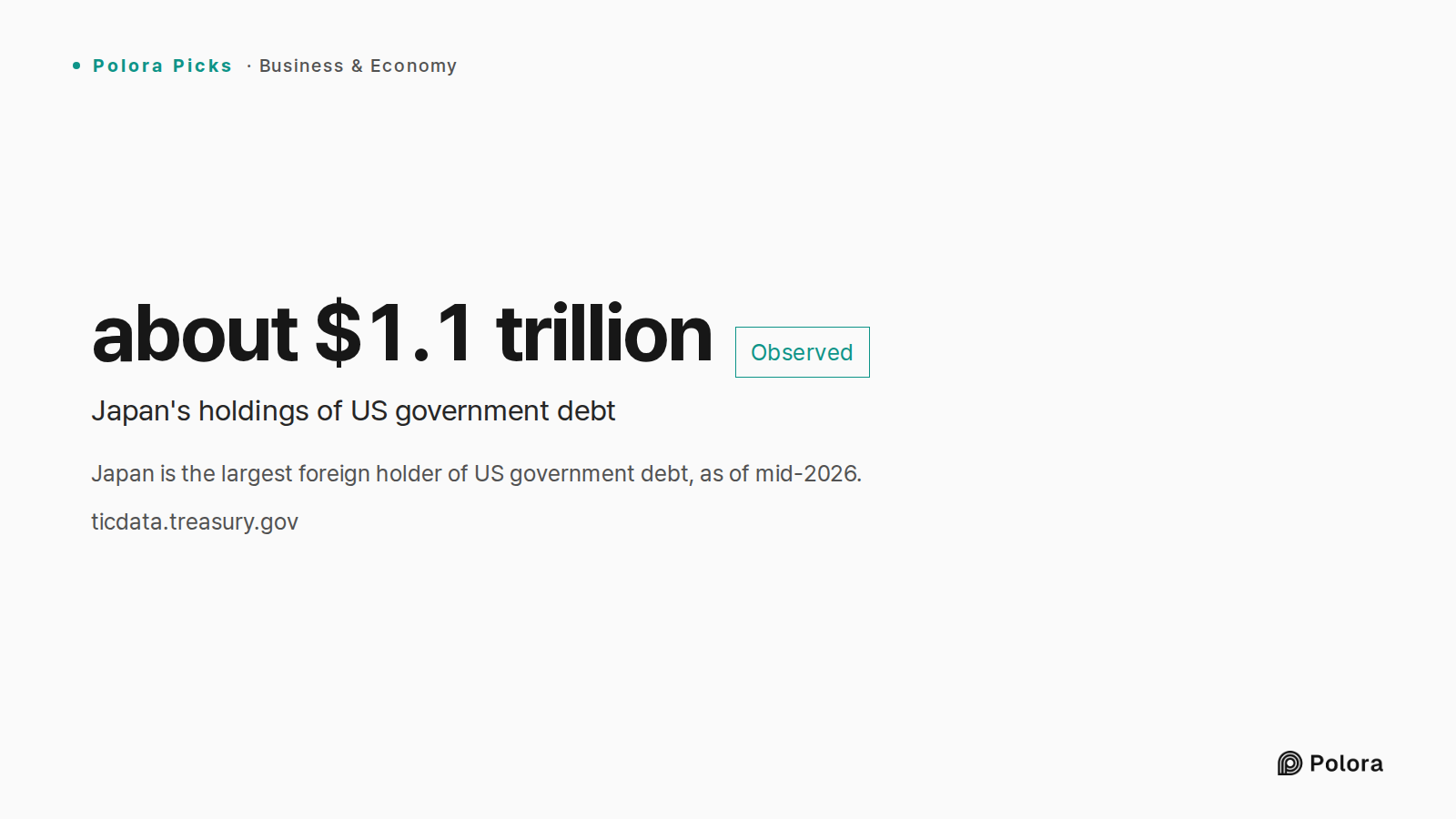
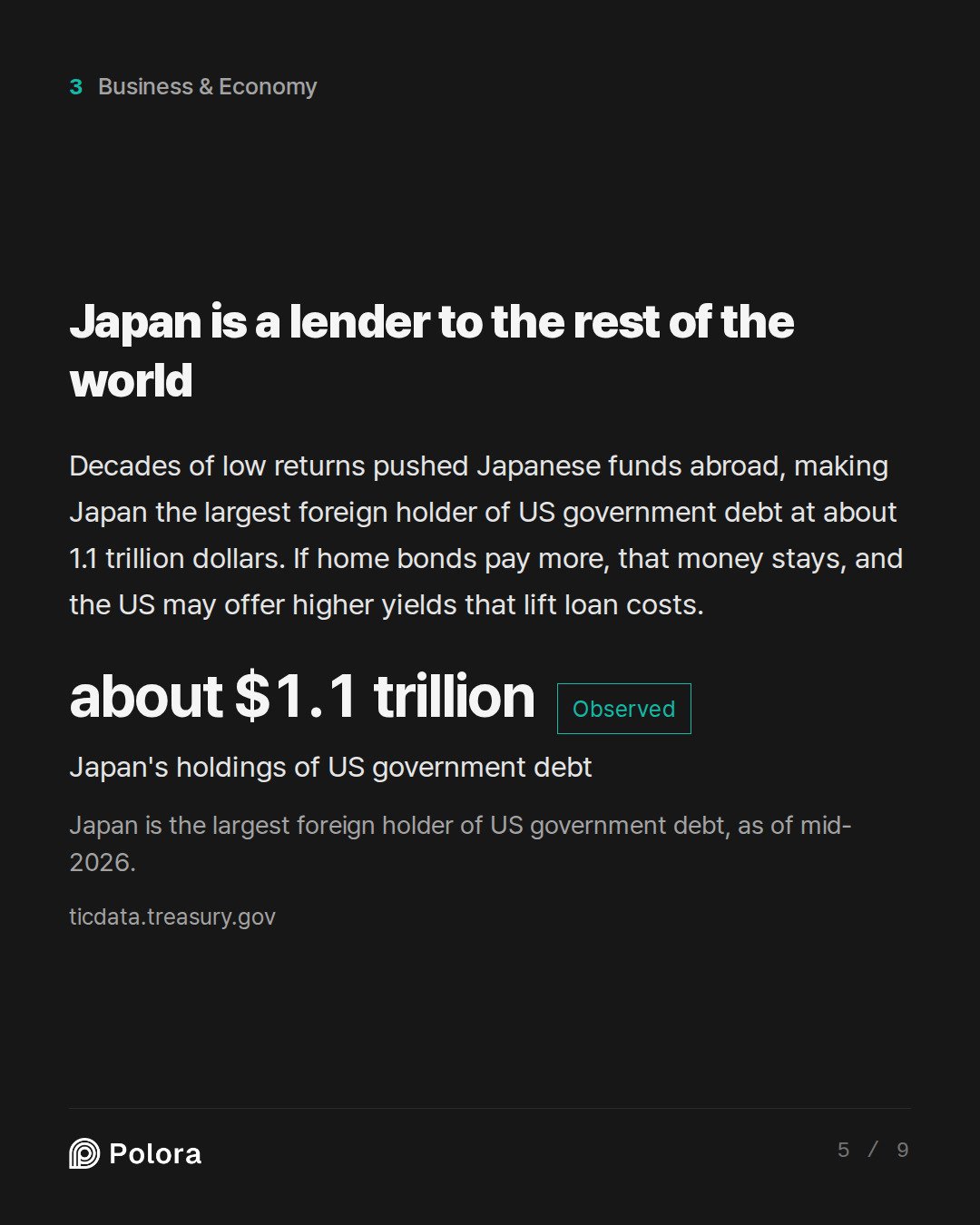
Because money earned almost nothing at home for decades, Japanese pension funds, insurers and banks sent enormous sums abroad in search of yield. One result : Japan is the largest foreign holder of United States government debt, with about 1.1 trillion dollars of it as of mid-2026.
The markets-and-debt model drew out the consequence. If Japanese bonds start paying a decent return at home, with no currency risk, that money has less reason to travel. Should Japanese investors buy fewer American bonds, the US government may have to offer higher interest to attract other buyers, and higher government yields tend to pull up the cost of mortgages and business loans. The research model flagged the limit here : this is a plausible channel, not an automatic result, since the US central bank, other buyers and the global appetite for safe assets all weigh in too.
Japan is the largest foreign holder of US government debt, as of mid-2026. · about $1.1 trillion · Japan's holdings of US government debt
Japan's resistance has economic roots, not just pride. The country is only tentatively leaving behind three decades of stagnation and falling prices, and its central bank wants to be sure that rising wages and prices will hold before it moves hard.
Two burdens make speed dangerous. Japan carries one of the heaviest public debts in the developed world, so every rate increase raises what the government itself owes in interest, money that could otherwise go to pensions or health in an aging society. A rate shock could also jolt banks, borrowers and the value of bonds already issued. The panel noted that the exact debt figure depends on how it is measured, but the direction is not in doubt : the room to maneuver is narrow.
What Washington and Tokyo are really fighting about
Strip away the jargon and the dispute is about speed, and about who absorbs the pain of ending an era of cheap money. Washington sees a persistently weak yen as an unfair edge for Japanese exporters and a source of instability that leaks into American markets, and it wants faster, clearer action. Tokyo wants room to protect a fragile recovery and its own finances, and it defends a principle : a central bank answers to its domestic economy, not to another government's calendar.
The geopolitics model set this inside a close alliance under financial strain. The two countries are entangled : Japan lends heavily to the United States, and the United States has its own interest in a stable yen. That entanglement showed in recent events. In late July 2026 the two governments jointly bought yen to steady it, and at an August meeting their finance officials agreed that an orderly yen market matters for global stability. The research model was careful here : the record confirms the joint intervention and the meeting, but does not prove that Washington issued an explicit public demand for a specific rate rise.
The models converged on a single way to see it. Move too slowly, and the United States lives with a strong dollar, trade friction and the risks built up by years of cheap-yen borrowing. Move too quickly, and Japanese taxpayers and borrowers take the shock, while global markets risk a sudden sell-off as that borrowing is yanked back.
That is why this is more than a squabble over a quarter point. The deeper question is whether two closely tied economies can renegotiate the terms of their dependence without a disorderly break. For a reader outside finance, the lasting idea is simpler : in a world where money moves freely, no large country's interest rate is truly its own business, and the decision that reaches your loan or your savings may be taken in a capital you were not watching.
The US Treasury Secretary said Japan should end the cheap-money policy it has run for years, and Tokyo pushed back. Have several AI models explain, for someone outside finance, why one country's choice to keep interest rates low ripples into currencies, borrowing costs, and markets far beyond its borders, and what is really at stake in this disagreement.
Especialista en Mecánica Cambiaria y Tipos de Interés · gpt-5.6-luna
Mi explicación: el interés japonés es un precio global, no solo japonés
Primero, una precisión importante: en septiembre de 2026, Japón ya no mantiene exactamente las tasas ultrabajas de los años anteriores. El Banco de Japón abandonó la política de tipos negativos en marzo de 2024 y ha ido subiendo gradualmente su tasa; en junio de 2026 la llevó aproximadamente al 1%, aunque sigue siendo baja frente a muchas economías desarrolladas y las condiciones financieras japonesas continúan siendo relativamente expansivas. (boj.or.jp)
La disputa entre Washington y Tokio, por tanto, no es simplemente “Japón se niega a subir tipos”, sino cuán rápido debe normalizar su política y cuánto debería permitir que el yen se fortalezca.
1. La idea básica: el dinero busca mejores rendimientos
Imaginemos dos cuentas bancarias:
- una japonesa que paga 1%;
- otra estadounidense que paga 4%.
Si el riesgo parece similar, muchos inversores preferirán la cuenta estadounidense. Para comprar activos estadounidenses necesitan vender yenes y comprar dólares. Eso tiende a:
- debilitar el yen;
- fortale…
Analista de Mercados Globales y Deuda · gemini-3-7-flash
La perspectiva de los mercados de deuda: el "ancla" del capital global
Coincido plenamente con el diagnóstico mecánico que ha presentado el *Especialista en Mecánica Cambiaria*. Sin embargo, para entender por qué la secretaria del Tesoro estadounidense presiona públicamente y por qué Tokio resiste, debemos mirar el problema desde las cañerías del crédito y los mercados de deuda soberana.
Para quien está fuera de las finanzas, la clave radica en comprender que el dinero de Japón ha funcionado durante décadas como la mayor "fábrica de liquidez" del planeta. Cuando Japón modifica el coste de esa liquidez, el impacto no se limita al precio de un televisor importado: afecta directamente a cuánto paga una familia en Europa o EE. UU. por su hipoteca y a cuánto le cuesta a Washington financiar su propio déficit fiscal.
---
1. El papel de Japón: el mayor acreedor y financiador global
Japón no es solo una economía desarrollada más; es el mayor acreedor neto del mundo, con activos exteriores netos que superan los 3,5 billones de dólares. Además, según los datos del propio Departamento del Tesoro de EE. UU. (TIC data), Japón es el mayor tenedor extranjero de deuda públic…
Observador de Geopolítica Económica · grok-4.5
I'll ground the geopolitical angle in the latest public statements and data before writing, so the stakes are tied to verifiable events rather than general theory.### The geopolitical view: cheap Japanese money is not a domestic quirk — it is a transmission belt of power
The two previous speakers have laid out the plumbing clearly: interest-rate differentials move currencies, the yen-funded carry trade can amplify or reverse global risk appetite, and Japan’s enormous stock of foreign assets (especially U.S. Treasuries) means Tokyo’s policy choices alter borrowing costs far from its shores. My job is to show why this is also a political and strategic dispute, not merely a technical one about inflation targets.
Right now the clash is concrete and public. U.S. Treasury Secretary Scott Bessent has repeatedly pressed Japan — including in meetings with Finance Minister Satsuki Katayama and Bank of Japan Governor Kazuo Ueda around the late-August/early-September 2026 G20 gathering in Asheville — to raise rates further, pursue more decisive monetary steps against yen weakness, and rein in expansionary “reflation” fiscal policy. Tokyo’s response has been guarded: officials emphasize b…
Researcher · gpt-5.6-luna
Verificación de los puntos principales
La explicación económica general es sólida, pero varias afirmaciones concretas necesitan matización o no quedan demostradas por las fuentes disponibles.
Correcto: Japón ya no está en la política de tipos negativos
El Banco de Japón abandonó los tipos negativos en marzo de 2024 y, según su información oficial, elevó gradualmente el objetivo del tipo de corto plazo hasta aproximadamente 1% en junio de 2026. El propio banco describe todavía las condiciones financieras como acomodaticias y señala que los tipos reales siguen siendo negativos en buena parte de los vencimientos.
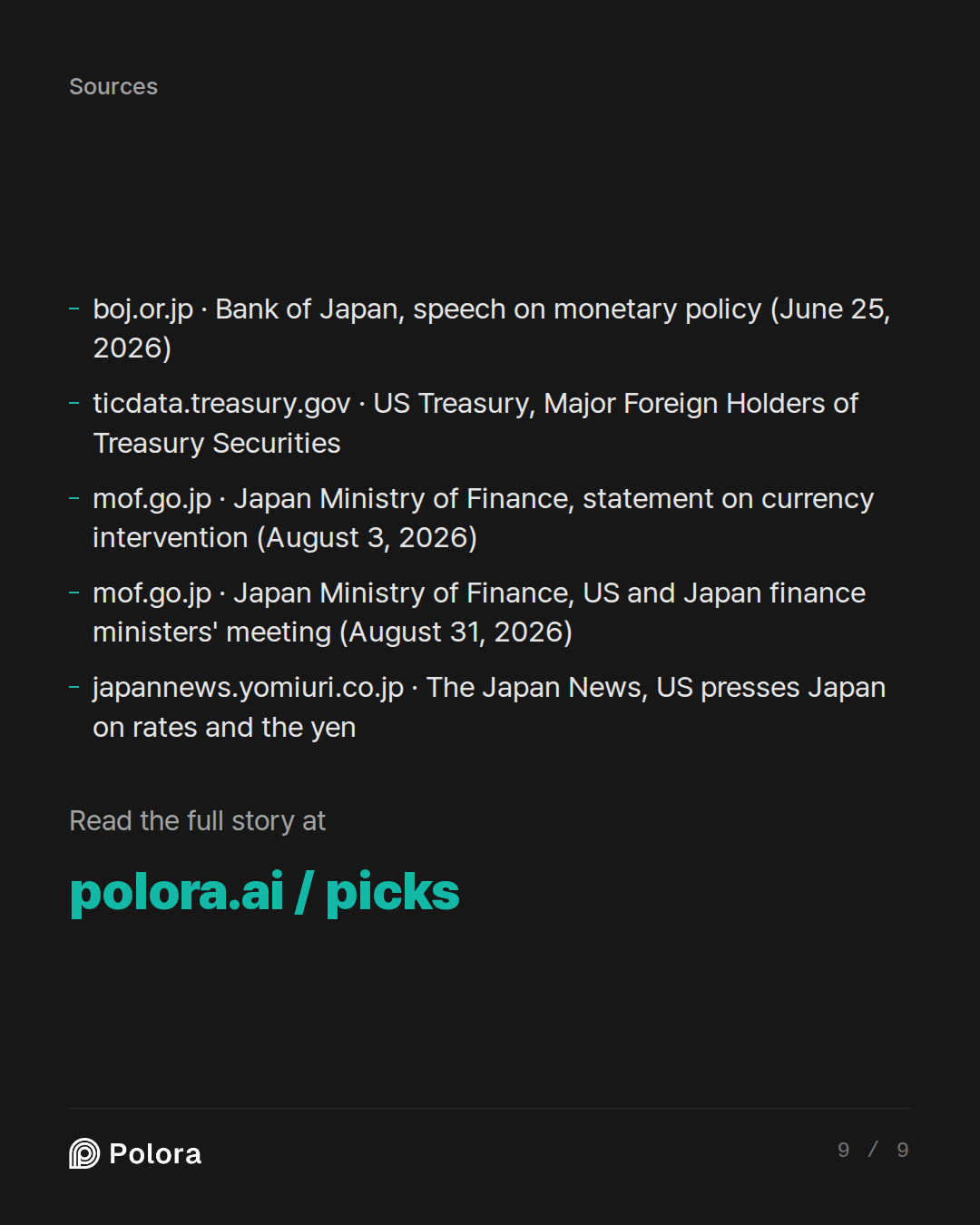
Fuente: Banco de Japón, discurso del 25 de junio de 2026 (boj.or.jp)
Por tanto, es correcto decir que el debate actual no es simplemente “tipos cero para siempre”, sino la velocidad de la normalización y sus efectos sobre el yen.
Correcto: Estados Unidos y Japón hablaron de la estabilidad del yen
El Ministerio de Finanzas japonés confirmó que Scott Bessent y Satsuki Katayama se reunieron el 31 de agosto de 2…
The Arbiter · gemini-3-7-flash
The Arbiter: Mediating the Debate
The panel has laid out a comprehensive framework explaining how a domestic monetary policy decision in Tokyo ripples across global markets, exchange rates, and geopolitical relationships. To make sense of the discussion for someone outside finance, let us synthesize the key mechanisms, identify the underlying tensions, and separate verified facts from theoretical projections.
---
1. The Core Mechanics: Why Japan’s Interest Rates Matter Globally
The three specialists converged on three main transmission channels:
1. The Exchange Rate Channel (Yield Differentials):
Money seeks return. When rates in Japan are lower than those in the U.S. or Europe, investors sell yen to buy higher-yielding dollar-denominated assets. This weakens the yen and strengthens the dollar.
* *Impact:* A weaker yen makes Japanese exports cheaper abroad (raising competitive concerns in Washington) and makes imports (food, energy) more expensive for Japanese consumers.
2. The Liquidity & "Carry Trade" Channel:
Because borrowing yen has historically been very cheap, global investors have used Japan as a funding source: borrow low-cost yen, conver…
The Arbiter's Final Verdict · gemini-3-7-flash
The Arbiter's Final Verdict: Making Sense of the U.S.–Japan Cheap-Money Clash
For anyone outside the world of central banks, foreign exchange desks, and sovereign debt markets, the public friction between the U.S. Treasury and Tokyo might look like an obscure spat over quarter-percentage points.
In reality, it is a conflict over the global cost of money, industrial competitiveness, and who absorbs the pain of exiting decades of ultra-loose liquidity.
---
Part 1. The Global Ripple Effect: Why Tokyo’s Rates Move the World
Interest rates are not merely domestic policy tools; they act as the "gravity" of international capital. When a major economy keeps its borrowing costs significantly lower than the rest of the world, three primary transmission mechanisms ripple across borders:
┌────────────────────────────────────────┐
│ Bank of Japan Keeps Rates Lower │
│ Than Peer Developed Nations │
└───────────────────┬────────────────────┘
│
┌────────────────────────────────┼────────────────────────────────┐…