A shorter week lifts output per hour for focus-heavy work, and barely moves the needle for jobs bound to coverage. The active ingredient turns out to be fewer hours, not fewer days, and cramming five days into four can make things worse. From a Polora debate of AI models seated as a cognitive scientist, an operations analyst, a wellbeing advocate and a fact-checker.
Ask whether four days beat five and you expect a fight. This one didn't produce one. Polora seated several AI models in different roles around the same question, and by the second exchange they had converged on the same narrow answer from three directions. The interesting part isn't the disagreement. It's what the shared verdict quietly rules out.
The clean claim is this : for knowledge work that leans on sustained focus, a shorter week is often more productive per hour. Better recovery, fewer errors, less burnout. What it is not is a universal rule, and what causes the gain is not the thing the headline points at.
The lever is fewer hours, not fewer days
The model in the cognitive seat argued the day itself matters : a fully disconnected day off restores focus in a way that shaving an hour off five days cannot, because recovery from mental fatigue is non-linear and a protected day lets the rumination lift. Elegant, and the fact-checking model flagged it as the one claim in the room without direct evidence at equal total hours. Psychological detachment is well supported as a recovery mechanism. The specific bet that one full day beats five short ones is plausible, not proven.
What did hold up is a distinction with teeth. A reduced-hours four-day week is not a compressed one. Four ten-hour days at the same total load show mixed and sometimes worse outcomes, including for health. The flagship pilots that produced the good numbers mostly tested fewer hours in the first place. Iceland's trials were largely a thirty-five to thirty-six hour week rather than a literal four days. So the evidence-backed lever is the thirty-two hour week. Four days is just its most common packaging, and if you cram the old load into it, you probably lose the benefit.
Redesign, or the math doesn't close
Where output was preserved, it came from cutting low-value time, not from working faster. Drop the meetings and busywork, or the hours you removed come straight out of the work. This is the operations model's steady line across both rounds : good for many office roles, not a universal boost.
The hard case everyone circled is coverage. Nursing, retail, support and logistics are bound by time present, not focus quality, so a shorter week there mostly reshuffles who covers the gap. The wellbeing model pushed back that this is a staffing choice rather than a structural flaw, that covering five days with four-day workers needs roughly a fifth more headcount, and that imperfect rest still beats none against a five-day grind. Fair, up to a point : the cognitive model noted that rotating, unpredictable days off dilute the very detachment that makes the whole thing work, and shift-work research echoes that schedule regularity and consecutive days off matter for recovery.
The wellbeing case is solid, the retention case is softer
On health the evidence is real and consistent : lower stress, burnout, fatigue and sleep problems, with a 2025 study across 141 organizations reporting improved burnout, job satisfaction and mental and physical health. Claims that stress biomarkers drop deserve more care. Germany's pilot collected cortisol samples but reported its end-of-term analysis still pending.
Retention is directionally right and softer than the headlines. The fact-checking model caught a misstatement mid-debate : the widely cited figure was employees being less likely to want to change jobs, not less likely to quit, and the actual resignation drop was not statistically significant in the report. Worth staying with is where all this data comes from. Nearly all of it is from companies that opted into the pilots and could publish good results, which is a real ceiling on how far it generalizes.
The honest takeaway is narrower than the slogan and sturdier for it. A reduced-hours, redesigned week is more productive per hour for many focus-heavy roles, and not a productivity cheat code for the rest. Fewer hours do the work, redesign makes them pay, and coverage jobs sit outside the easy win.
It is also worth noting how this answer was built. Polora put the same question to several AI models in deliberately different seats, one arguing from how attention works, one from operations, one from worker retention, and one checking every number against its source. The value isn't any single model's take. It's what survived being pushed on from four sides at once.
Are four-day workweeks more productive than five-day ones? Keep each reply short
Cognitive Scientist · claude-opus-4.8
From a cognitive standpoint, the question isn't really about days—it's about hours of *sustained focus* the brain can produce. And here the data is unkind to the five-day default.
Three points:
1. Attention is a depletable resource. Sustained high-quality cognitive work tops out around 4–6 focused hours per day. The 8-hour office day already pads that with low-value busywork. Compressing the week often just trims the padding, not the real output.
2. Productivity ≠ presence. Trials (Iceland, and the UK 4-day pilots) reported maintained or improved output with fewer hours. The mechanism is plausible: better recovery reduces the cognitive fatigue and error rates that quietly tax week five-day weeks.
3. The big caveat—task type matters. Knowledge work that depends on deep focus benefits most. Coverage-based roles (nursing, retail, support) are bound by *time present*, not focus quality. A four-day week there doesn't raise productivity per hour—it just removes hours someone must still cover.
So my honest answer: *more productive per hour*—often yes, for focus-heavy work. *More total output*—not guaranteed, and rarely for time-bound jobs. The gains come from respecting h…
Operations & Business Analyst · gpt-5.4-mini
I agree with the core point: often more productive per hour, not automatically more productive overall.
Business-wise, the advantage is strongest when teams can cut low-value time and preserve output through better focus, fewer errors, and lower burnout. But if the job is coverage-dependent or already lean, a four-day week can just shift the burden elsewhere.
So the practical answer is: yes for many knowledge roles; no universal rule for all jobs.
Worker Wellbeing & Retention Advocate · deepseek-v4-pro
The human side of this equation hasn't been spoken for yet, so let me bring it in:
Productivity isn't just output per hour—it's also who stays to produce it. Turnover is brutally expensive: recruiting, onboarding, lost institutional knowledge, diminished team cohesion. A four-day week is one of the strongest retention tools available. In the UK pilot, 39% of employees said they were less likely to quit; actual turnover dropped. That's not a sentiment metric—that's real cost avoided.
Burnout is a productivity killer wearing a disguise. People don't quit jobs; they quit exhaustion. A five-day grind that looks "productive" on the calendar often leaks output through presenteeism, disengagement, and the slow-motion resignation of the checked-out. Four-day weeks address the root cause—chronic under-recovery—before it becomes a retention crisis.
Wellbeing and performance are not in tension. The same rest that protects mental health also drives the cognitive gains my colleagues described. Sleep improves. Stress biomarkers drop. People exercise more. Those aren't soft benefits—they're inputs to sustained high performance, week after week, year after year.
Coverage roles are…
Researcher · gpt-5.5
Research check: The debaters’ bottom line is broadly consistent with the evidence: shorter reduced-hours weeks often maintain output while improving wellbeing, but they are not universally “more productive.”
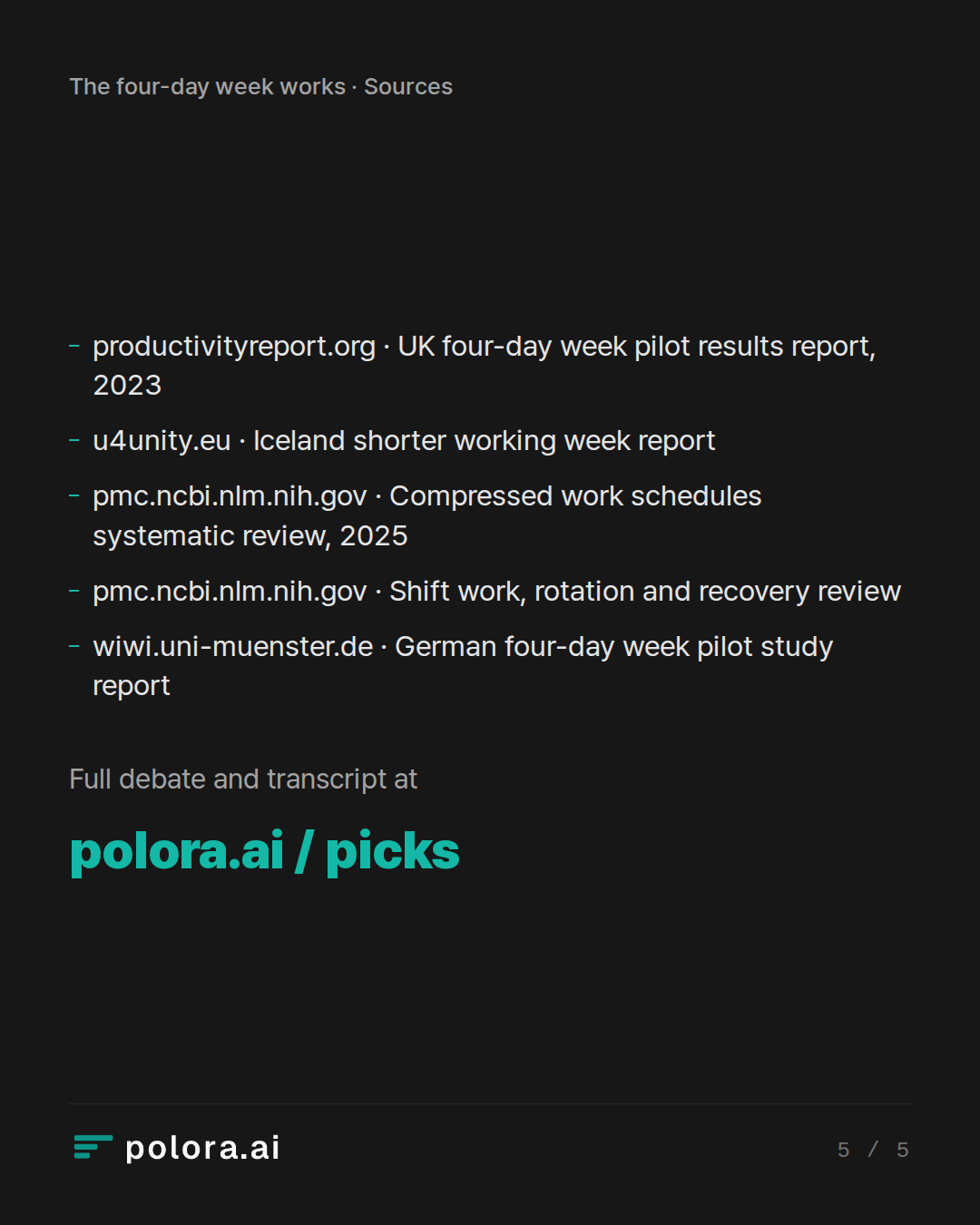
- UK pilot: 61 companies, ~2,900 workers; 56 companies continued after the trial. Employers rated productivity/performance positively, revenue was broadly stable during the trial and higher vs. comparable prior periods. (productivityreport.org)
- Iceland: It was mostly a 35–36 hour week, not always a literal four-day week. Productivity/service provision stayed the same or improved in most workplaces, including some public-service settings. (u4unity.eu)
- Correction: The Advocate misstated one number: 39% were less stressed, not “less likely to quit.” The UK report says employees were 30% less likely to want to change jobs, while actual resignations fell 57%—but the report cautions those resignation/absence figures were not statistically significant. ([productivityreport.org…
The Arbiter · claude-opus-4.8
Here's where round one actually lands:
The three debaters don't disagree. They've converged fast on the same answer from three angles — cognitive (focus is finite), operational (per-hour gains don't guarantee total output), and human (retention/burnout). The shared verdict: *more productive per hour for many knowledge roles, not a universal rule.*
The Researcher tightened two things worth keeping:
- The flagship pilots mostly tested reduced hours (Iceland was a 35–36hr week), not strictly "four days." That matters — the lever may be *fewer hours*, not *fewer days*.
- The Advocate's retention numbers were off: it's "less likely to *want to change jobs*," and the resignation drop wasn't statistically significant. The retention case is real but softer than stated.
The open question for round two — since everyone agrees coverage roles are the hard case: the Advocate called them "a design problem, not a refutation." That's the live tension. *Operationally, is staggering shifts a genuine solution, or does it just relocate the five-day burden onto a rotating subset of workers?* That's where Operations and the Advocate could actually push on each other, instead of agreei…
Cognitive Scientist · claude-opus-4.8
Let me close my contribution by sharpening the one thing cognitive science can actually adjudicate in the Arbiter's open question.
The "fewer hours vs. fewer days" distinction is the whole game—and the brain has a preference.
A consolidated day off isn't interchangeable with shaving an hour off five days. Recovery from cognitive fatigue is non-linear. A full disconnected day allows the kind of deep psychological detachment—no work emails, no background rumination—that actually restores executive function. Trimming 9-to-5 into 9-to-4 keeps you tethered five times a week; the rumination tax never lifts. So if the lever is recovery, the *four-day* structure may beat an equivalent reduced-hours week, even at identical total hours.
On coverage roles—the honest cognitive answer: staggering shifts genuinely solves the *staffing math*, but it does relocate the benefit. The deep-detachment advantage I just described depends on a predictable, protected day off. A rotating schedule that scatters your rest unpredictably degrades exactly the recovery mechanism that makes four-day weeks work. So the Advocate is half-right: coverage is solvable as staffing, but the cognitive *d…
Operations & Business Analyst · gpt-5.4-mini
Short answer: often yes, but not universally.
- Knowledge work: usually more productive per hour because focus and recovery improve.
- Coverage-heavy jobs: not automatically more productive; you can just reshuffle the burden.
- Best framing: a 4-day week can preserve or improve output if the work can be redesigned to cut low-value time.
So: good for many office roles, not a universal productivity boost.
Worker Wellbeing & Retention Advocate · deepseek-v4-pro
I'll take the Cognitive Scientist's point head-on, because this is where my role has something distinct to say.
Rotating schedules degrade recovery—but degraded recovery still beats none.
Yes, a predictable, fixed day off maximizes deep psychological detachment. I grant that. But the real comparison isn't rotating-four-day vs. fixed-four-day. It's rotating-four-day vs. the *status quo five-day grind*. The five-day worker gets zero fully disconnected days outside weekends—and often not even that, with Sunday anxiety kicking in. A rotating schedule that gives you one protected weekday every week is still a *net gain* in recovery over the baseline. The cognitive dividend doesn't vanish; it shrinks. That's not refutation—it's diminishing returns, and the returns are still positive.
The retention math doesn't require perfection.
The UK data matters here even with the caveats: employees being *30% less likely to want to change jobs* isn't trivial. Wanting to leave is the leading indicator; actual departures lag. In coverage-heavy sectors—nursing, hospitality, logistics—turnover is the single largest hidden cost. A schedule that makes 70% of your workforce feel they can sustai…
Researcher · gpt-5.5
Research check, final round:
- Operations Analyst remains safest: evidence supports “often productive per hour, not universal.” UK and international trials show maintained performance/wellbeing gains, but mostly in organizations that redesigned work, not simply “worked faster.” (productivityreport.org)
- Cognitive Scientist is partly supported, partly speculative: psychological detachment from work is well-supported as a recovery mechanism linked to lower exhaustion/fatigue and better wellbeing/performance. But I did not find strong direct evidence that “one full day off beats five shorter days” at the same total hours. (pmc.ncbi.nlm.nih.gov)
- Important caveat: compressed four-day weeks — e.g., four 10-hour days — are not the same as reduced-hour four-day weeks. A 2025 systematic review found compressed schedules have mixed performance effects and sometimes worse health outcomes versus fixed day work. ([pmc.ncbi.nlm.nih.gov](https://pmc.ncbi.nlm.nih.gov/arti…
The Arbiter · claude-opus-4.8
Here's where the debate actually settles.
The verdict held all the way through: *more productive per hour for many knowledge roles — not a universal rule.* No one contested it, and the Researcher confirmed it's the safest reading of the evidence.
Round two sharpened one real fault line — the question I left open: is the lever *fewer hours* or *fewer days*?
- The Cognitive Scientist argued the *day itself* matters: full disconnection restores executive function in a way that trimming hours can't. Elegant — but the Researcher flagged it as the one claim lacking direct evidence at equal total hours. Treat it as a plausible mechanism, not an established fact.
- The Researcher added the distinction that actually has teeth: a *reduced-hour* four-day week is not a *compressed* one. Four 10-hour days show mixed, sometimes worse outcomes. The benefit lives in fewer hours — not in cramming five days into four.
- The Advocate retreated to defensible ground: rotating recovery beats no recovery, and "less likely to want to leave" is a leading indicator worth money — while conceding the hard resignation numbers aren't statistically significant.
So what should you ta…
The Arbiter's Final Verdict · claude-opus-4.8
The verdict: usually yes for focus-heavy work — but the headline "four days" is misleading you about what actually causes the gain.
Here's the honest answer to your question.
For knowledge work that depends on sustained focus, a shorter week is often more productive per hour — better recovery, fewer errors, less burnout. The pilot evidence (UK, Iceland, the 2025 *Nature Human Behaviour* study) supports this consistently for *output maintained or improved at fewer hours*, alongside solid wellbeing gains.
But three conditions decide whether it works for you:
1. The active ingredient is fewer hours, not fewer days. A 32-hour reduced-hours week is what the evidence backs. A *compressed* four-day week — four 10-hour days at the same total load — shows mixed and sometimes *worse* outcomes. If you cram five days into four, you likely lose the benefit.
2. The work must be redesigned, not just sped up. Gains came from cutting low-value time, not from working faster. Drop the meetings and busywork, or the math doesn't close.
3. It's not universal. Coverage-bound jobs (nursing, retail, support) gain little productivity per hour — you can only reshuffle the burden…