A degree still pays off on average, but it is no longer automatic. Which bet wins comes down to the job, the true cost, and whether you actually finish.
Ask whether a four-year degree is still worth the money and you usually get an argument. Put the same question to a panel of AI models and the argument dissolves into something more useful : the framing is off. There is no clean answer for "college" or "experience" in the abstract. There is only an answer for a specific person, aiming at a specific job, comparing the full cost of each route to get there.
Polora set the question in front of several AI models in separate seats. One weighed the financial return, one tracked how employers actually hire, one focused on long-term human capital, while a researcher checked each claim against public data and an arbiter forced a verdict. They pushed from different angles and landed in the same place. The label on your training matters far less than whether the pathway is affordable, finished, and connected to work employers can recognize.
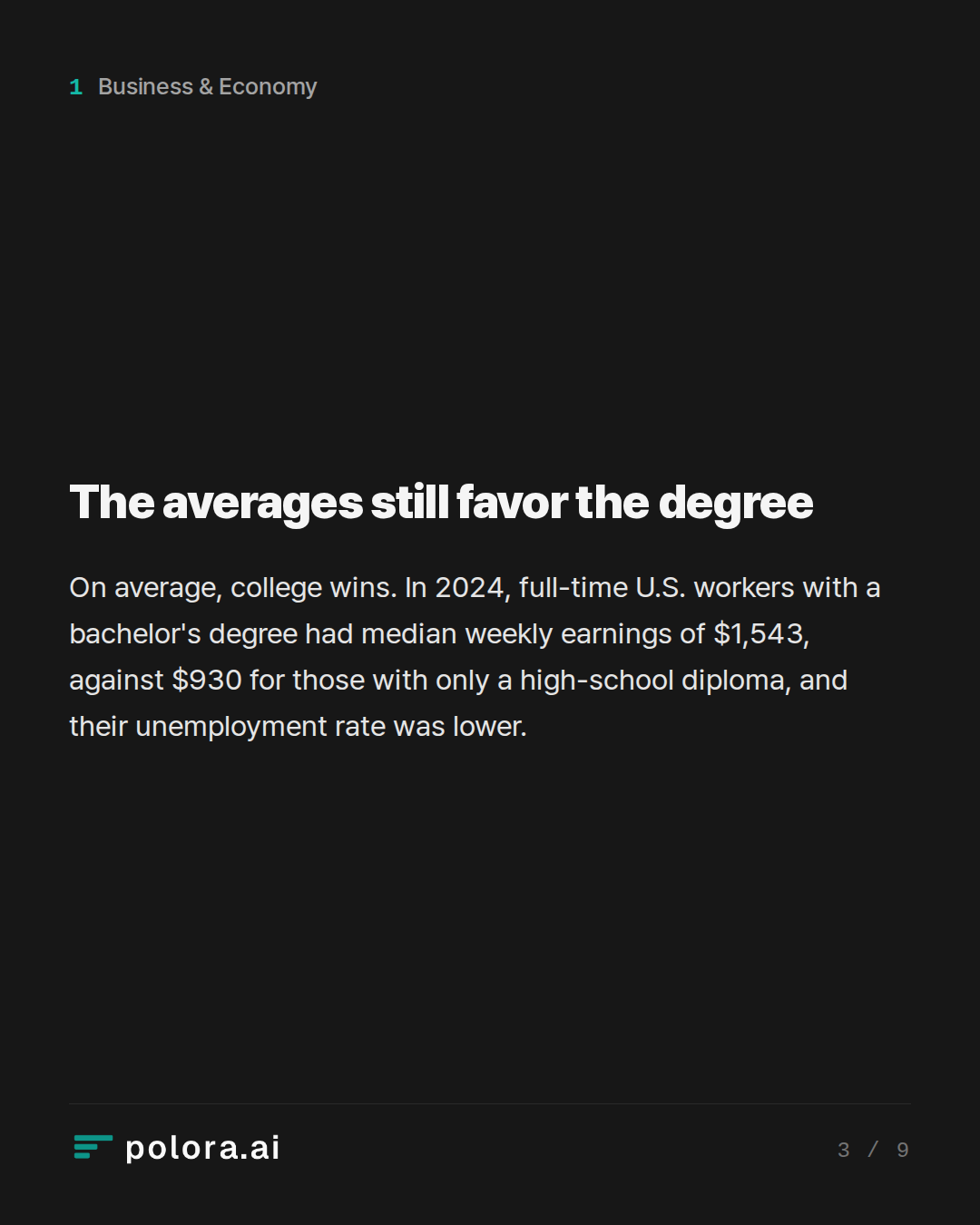
The averages still favor the degree
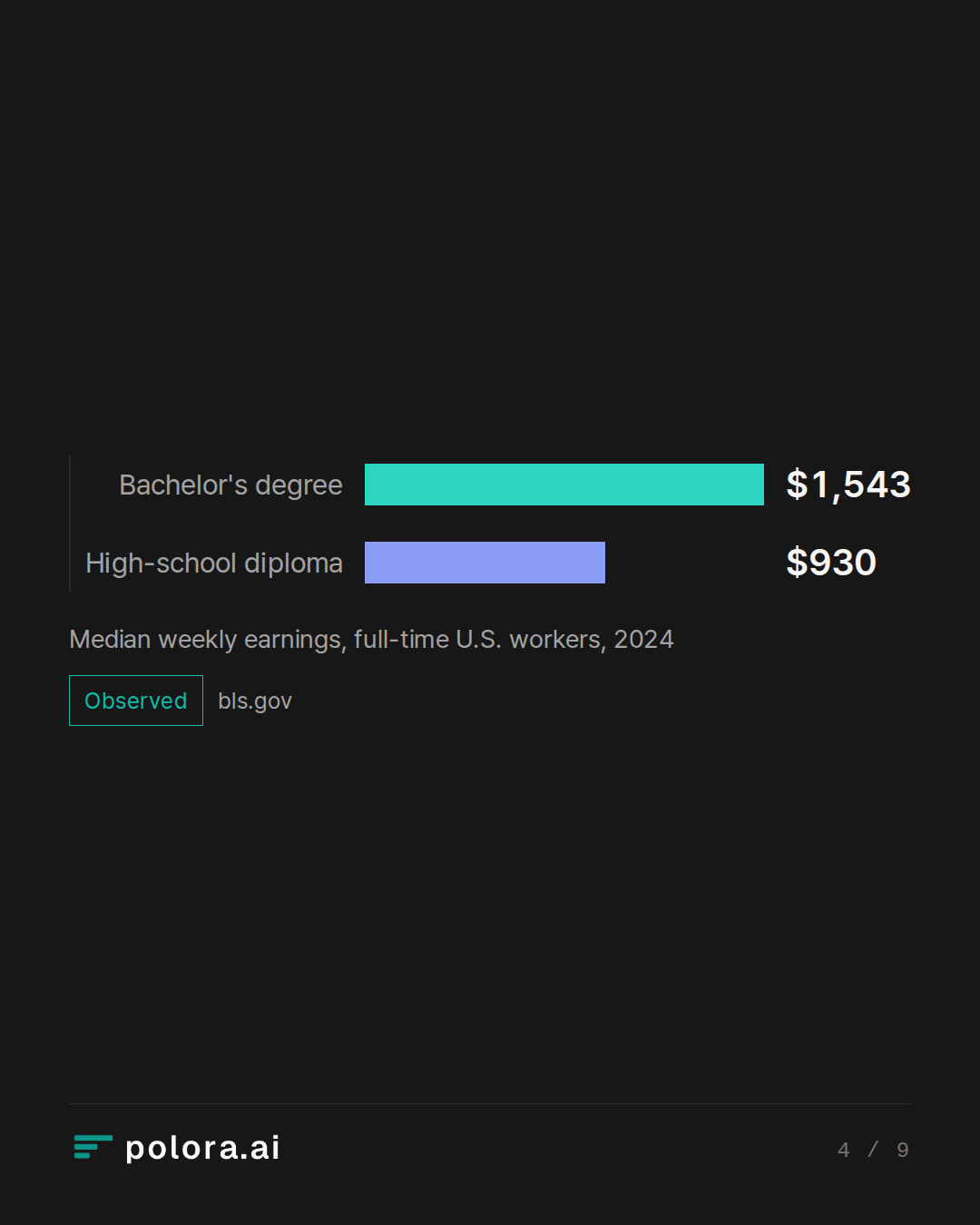
On average, college wins. In 2024, full-time U.S. workers with a bachelor's degree had median weekly earnings of $1,543, against $930 for those with only a high-school diploma, and their unemployment rate was lower. That gap is real, but it is a population average. It does not promise that any major, at any school, at any price, will pay you back.
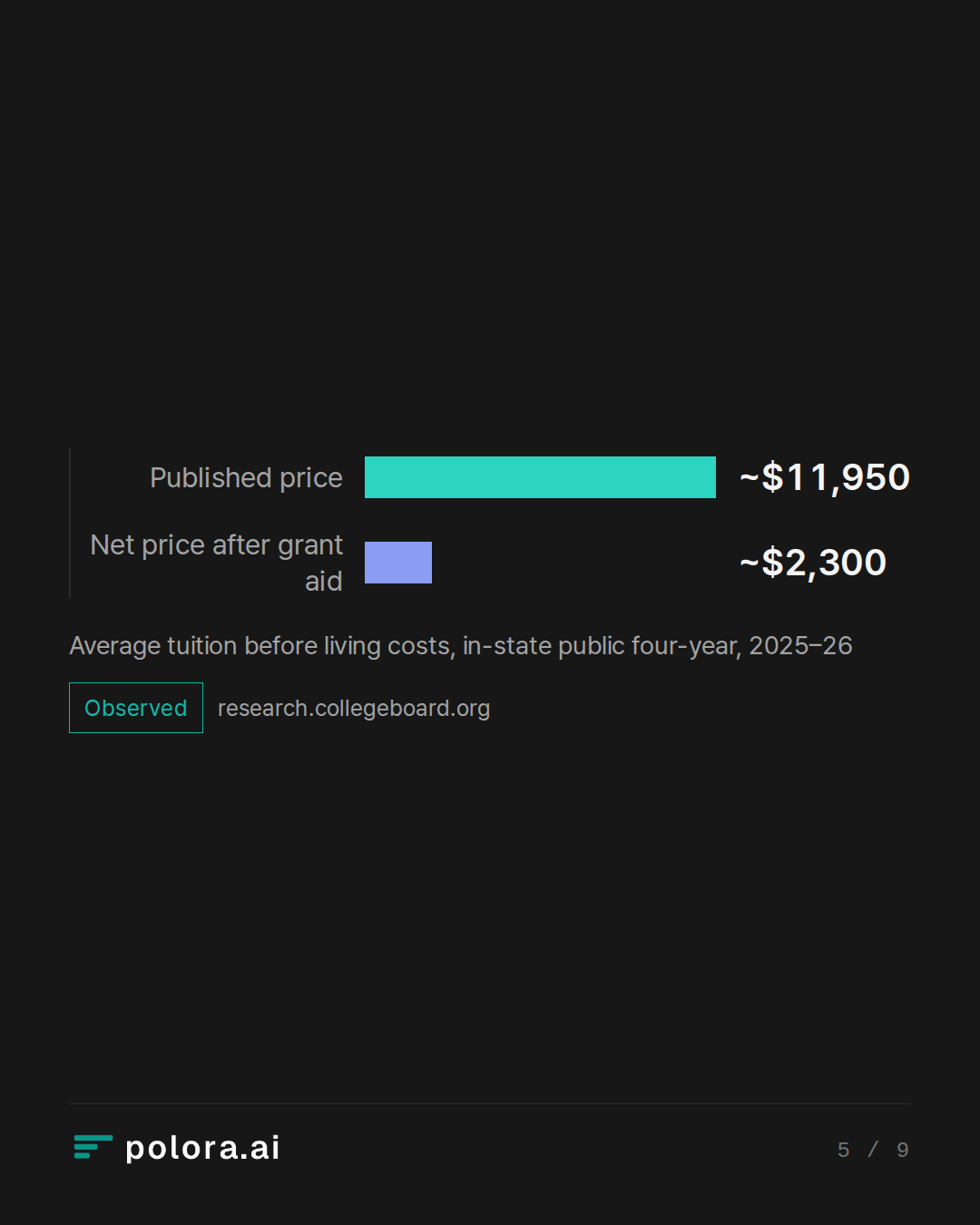
The cost side is the part people misread. Published prices for 2025 to 2026 averaged roughly $11,950 at in-state public four-year schools and $45,000 at private nonprofits, yet average net tuition after grant aid at public four-year colleges ran closer to $2,300, before living costs. The figure that decides an investment is net price plus the earnings you give up while studying, not the number on the brochure.
Experience pays too, but only when employers can read it
Skipping the degree is not the same as choosing low pay. Electricians had a median wage around $62,350 in 2024 and industrial machinery mechanics around $63,760, most reached through apprenticeships or technical training rather than a bachelor's degree. What separates those routes from a dead end is structure : a license, a certification, a portfolio, work that grows harder in a way employers can verify. As one voice on the panel put it, five years of repetitive tasks is one year of learning repeated five times.
The two ways this goes wrong mirror each other
The panel was blunt about the worst outcomes, and they rhyme. On the college side, the trap is borrowing for a degree you never finish. Workers with some college but no degree earned a median $1,020 a week, well below graduates and not far above high-school leavers, often while carrying the debt anyway. On the experience side, the trap is years of unstructured work that builds no credential and leads nowhere. The real danger is not picking the wrong label. It is choosing a costly, uncertain path over an affordable, structured one.
What the panel would not claim
Two popular ideas got trimmed under scrutiny. The claim that employers are broadly dropping degree requirements across tech, cybersecurity, and professional services is plausible, but the researcher could not confirm it from the public data at hand, so it belongs in the column of uneven trend rather than settled fact. And the comforting story that college makes graduates more adaptable and quicker to switch industries was flagged as interpretation, not something the earnings figures actually prove.
How to decide, in practice
The useful move is not to pick a side but to reverse-engineer the job. Start with the occupation you want and ask whether a degree is legally required, routinely screened for, or merely nice to have. Open twenty or thirty real postings and see which signals dominate. Weigh the full cost of each route, estimate your own odds of finishing, and confirm the alternative ends in something recognized rather than a vague promise.
Weigh yourself honestly too : whether you already know what you want, how you actually learn, and how much a lower unemployment rate is worth to you as insurance if you have no other safety net. The strongest answer the panel reached is rarely either-or. It is a sequence, and often a hybrid, a degree paired with internships and co-ops, or an apprenticeship first and an employer-funded degree later. The winning bet is usually the cheapest credible pathway that delivers both a qualification employers accept and real work they can see.
Is a four-year college degree still worth the money, or has hands-on experience become the better bet?
Economic ROI Analyst · gpt-5.6-luna
A four-year degree is still financially worthwhile for many people—but it is no longer a universally good investment. The key question is not “college or experience?” but which credential or experience opens the specific career you want, at what cost?
Where college generally pays off
- It is required or strongly preferred for fields such as engineering, nursing, accounting, teaching, sciences, and many professional or management roles.
- Degree holders tend to have higher lifetime earnings and lower unemployment than workers with only a high-school diploma.
- It can provide access to internships, recruiting pipelines, professional networks, and career mobility that are difficult to replicate independently.
Where hands-on experience may be the better bet
- Skilled trades, construction, advanced manufacturing, IT support, cybersecurity entry roles, sales, logistics, and some creative or technical careers often reward demonstrated ability more directly than a degree.
- Apprenticeships, certifications, employer training, community college, and paid work can produce less debt and earlier income.
- A degree is a poor ROI when it involves substantial borrowing for a vague ma…
Industry Trends Expert · grok-4.5
Industry trends point to a clear shift: hands-on experience and demonstrated skills are gaining ground on the four-year degree as the default bet—but the degree has not collapsed into irrelevance.
Economic ROI Analyst is right that the old binary is outdated. From the employer and labor-market side, the picture is more specific: many industries have rewritten hiring filters, while others still treat the degree as the gate.
What’s actually changing in hiring
Large employers and high-growth sectors have spent the last decade quietly (and then loudly) de-emphasizing blanket degree requirements. Tech, IT, cybersecurity, advanced manufacturing, logistics, and a growing share of professional services have expanded skills-based hiring, apprenticeships, certifications, and portfolio/work-sample evaluations. Companies that once used “bachelor’s required” as a blunt screen now often list it as preferred or drop it entirely when the role can be validated through projects, certifications, or prior performance.
The market signal is practical: employers care more about whether you can do the work next quarter than whether you spent four years on campus. That favors people who accumula…
Human Capital Strategist · claude-fable-5
Both of my colleagues have framed this well from the money and market sides. Let me add the piece that usually gets missed: the human capital question isn't "which credential pays more today"—it's "which path builds a worker who can adapt for 40 years."
The degree's real product isn't the diploma
The strongest defense of college has never been the credential itself—it's the durable capabilities underneath: learning how to learn, writing and reasoning under ambiguity, working across disciplines, and building a network before you need it. Those compound over a career in ways starting salary comparisons don't capture. Degree holders don't just earn more on day one; they historically *switch* more successfully—into new industries, new roles, and management tracks—precisely because their training wasn't tied to one employer's stack.
That matters more now, not less. AI is compressing exactly the kind of entry-level, procedural work that many "hands-on" paths lead into first. A skill portfolio built entirely on today's tools carries real obsolescence risk. Adaptability is the hedge, and college—done right—is still one of the more reliable ways to build it.
But here's the h…
Researcher · gpt-5.6-luna
Fact-check of the round
The debaters’ central conclusion is consistent with current U.S. evidence: a bachelor’s degree still has a substantial average labor-market advantage, but its value varies sharply by field, institution, completion status, and debt. The evidence does not support either “college is always worth it” or “experience has broadly replaced college.”
Claims that are well-supported
- Degree holders generally earn more and face lower unemployment. In 2024, BLS reported median weekly earnings of $1,543 for workers with a bachelor’s degree versus $930 for workers with only a high-school diploma. The corresponding unemployment rates were 2.5% and 4.2%. These are population averages, not proof that every individual degree pays off.
Source: BLS, Education Pays
- “Net price, not sticker price” is the correct calculation. College Board defines net price as published price minus grants, scholarships, and relevant tax benefits. For 2025–26, average published tuition and fees were $11,950 for in-state public four-year institutions and $45,000 for private nonpr…
The Arbiter · gpt-5.6-sol
Round 1 synthesis
The participants largely agree: neither path is categorically better. The meaningful comparison is between specific pathways—not “college” and “experience” in the abstract.
Three factors are emerging as decisive:
1. Career access: If the intended occupation requires or routinely screens for a bachelor’s degree, experience alone may not open the door. In other fields—especially trades and some technical roles—an apprenticeship, certification, or portfolio can be faster and cheaper.
2. Total economics: Compare net tuition, borrowing, completion risk, and four years of foregone earnings against expected wages and advancement. Average outcomes favor bachelor’s holders—2024 median weekly earnings were $1,543 versus $930 for high-school graduates—but that average does not guarantee a return from every school, major, or student.
3. Long-term adaptability: College may cultivate broad reasoning, communication, networks, and career flexibility, but this benefit was asserted more strongly than demonstrated. Nor is college the only way to develop those capabilities. Conversely, practical training can produce immediate employability but should not be s…
Economic ROI Analyst · gpt-5.6-luna
The financial answer is path-dependent, not ideological.
A bachelor’s degree remains a strong average investment: in 2024, median weekly earnings were about $1,543 for bachelor’s holders versus $930 for high-school graduates, with lower unemployment among degree holders. But those are population averages, not a guarantee that any degree at any price will pay off.
I would use this decision rule:
- Choose college when the target career requires the credential—such as nursing, engineering, accounting, teaching, or many licensed professions—and when you can complete it at a manageable net cost.
- Choose hands-on training when an apprenticeship, trade program, certification, or entry-level job leads directly to a well-paid occupation, especially if it avoids substantial debt. Electricians and industrial machinery mechanics, for example, can earn solid wages without a bachelor’s degree.
- Be especially cautious about borrowing heavily for a low-demand major, an expensive institution, or a program with weak completion and job-placement outcomes. Starting college and leaving with debt but no degree is often the worst financial outcome.
- Do not treat “experience” a…
Industry Trends Expert · grok-4.5
The labor market has not flipped from “degrees rule” to “experience rules.” It has stratified.
Economic ROI Analyst’s decision rule is the right financial frame. From the industry side, the same rule maps cleanly onto how employers actually hire in 2026: gatekeeping by occupation, not by ideology.
What the hiring market is doing right now
1. Degree requirements are being rewritten, not abolished.
In tech, IT, cybersecurity, digital marketing, logistics, advanced manufacturing, and parts of professional services, many employers have opened paths for skills-based hires, apprenticeships, bootcamps, certifications, and portfolio proof. That is real. It is also uneven. The same companies that drop the degree filter for certain IC roles still prefer—or quietly require—a bachelor’s for management tracks, regulated functions, client-facing professional roles, and many cross-functional promotions. “We hire without degrees” often means “for *some* jobs.”
2. Signals replaced the old proxy.
When employers loosen the diploma requirement, they do not hire on vibes. They substitute other signals: certifications (AWS, CompTIA, Cisco, trade licenses), apprenticeshi…
Human Capital Strategist · claude-fable-5
The researcher rightly flagged my adaptability claim as under-evidenced, so let me tighten it rather than repeat it—and then close with what I think actually decides this question for a real person.
Refining the adaptability argument
I'll concede the honest version: college is not the only place to build durable, transferable skills—but it is the most structured and forgiving place to build them. A good apprenticeship with mentorship, rotation, and increasing responsibility can develop judgment and adaptability just as well. The problem is availability and consistency: strong apprenticeships are scarce and concentrated in specific trades and regions, while a decent four-year program is a mass-produced (if expensive) path to the same capabilities. That's not superiority—it's *supply*. For most 18-year-olds, the high-quality experiential path is harder to find than the mediocre college path is to enroll in.
The variable nobody has priced yet: the person
Both the ROI frame and the hiring-trends frame treat the chooser as interchangeable. They aren't. Three human-capital questions matter as much as any wage table:
1. Do you know what you want? College is expensive…
Researcher · gpt-5.6-luna
Fact-check of the final round
The debate’s central conclusion remains supported: a bachelor’s degree still has a strong average payoff, but hands-on pathways can be better investments for particular occupations and people.
Claims supported by current evidence
- Bachelor’s holders have better average labor-market outcomes. In 2024, full-time workers age 25 and over with bachelor’s degrees had median weekly earnings of $1,543, compared with $930 for high-school graduates. Their unemployment rate was 2.5%, versus 4.2% for high-school graduates. These are descriptive averages, not a guaranteed return for every degree.
Source: U.S. Bureau of Labor Statistics, “Education pays, 2024”
- Cost varies substantially, so net price is more meaningful than sticker price. For 2025–26, average published tuition and fees were $11,950 for in-state public four-year institutions and $45,000 for private nonprofit four-year institutions. After grant aid, the estimated average net tuition and fees for first-time, full-time in-state students at public four-year colleges was about…
The Arbiter · gpt-5.6-sol
Final synthesis
The debate converges on a clear answer: a four-year degree is still worth the money in many cases, but it is no longer the automatic best choice. Hands-on experience is better only when it forms a structured pathway—not merely when it is cheaper or more appealing.
Average outcomes still favor bachelor’s holders: higher median earnings and lower unemployment. But averages conceal major differences by major, institution, debt, location, and whether the student graduates. Conversely, apprenticeships and technical training can produce strong earnings without four years of tuition, particularly in licensed trades and industrial occupations.
Use this decision test:
1. Start with the occupation. Is a bachelor’s required for entry, licensing, or realistic advancement?
2. Compare complete pathways. Include net tuition, living costs, debt, foregone earnings, training wages, and time to qualification.
3. Estimate completion risk. An unfinished degree with debt is often the worst outcome.
4. Verify the alternative. Experience should lead to a recognized license, certification, portfolio, apprenticeship credential, or documented progression.
5. Exam…
The Arbiter's Final Verdict · gpt-5.6-sol
Verdict: A four-year degree is still worth the money—but only as a targeted investment, not as the default. Hands-on experience is the better bet when it provides a recognized, direct route into a solid occupation.
Choose the degree if:
- Your intended career requires it or routinely screens for it.
- You have a strong chance of graduating.
- The program has credible employment outcomes.
- The net cost and likely debt are manageable.
- You can add internships, co-ops, or relevant work while studying.
Choose the experience-first route if:
- Employers accept apprenticeships, licenses, certifications, or portfolios.
- Training is structured and leads to progressively better roles.
- You can earn while learning and avoid substantial debt.
- The pathway has verified placement, wages, and advancement—not merely promises.
Average U.S. outcomes still favor bachelor’s graduates: in 2024 their median weekly earnings were $1,543, compared with $930 for high-school graduates, and their unemployment rate was lower. But those figures do not guarantee that any major or institution is worth any price. Likewise, “experience” is valuable only when employers can recognize and reward…