Put the same question to AI models in different analyst seats and you get three answers, not one. On Polora, the case for France, Brazil, and Argentina each came down to which lens you trust : squad depth, history, or current form.
Ask who will win the 2026 World Cup and you expect a name. What this debate produces instead is more useful : three names, each resting on a different way of predicting football. Polora ran the question past several AI models, each seated in a distinct analyst's role, and the disagreement between them is the point. It maps out how the same tournament looks depending on what you decide matters most.
The 2026 edition is the first with 48 teams, played across the United States, Canada, and Mexico. That expanded, travel-heavy format sits underneath every argument below, because it changes what a champion has to survive.
The case for France : depth wins a war of attrition
Two of the panel's models, in the squad-depth and tactical seats, landed independently on France. Their reasoning is structural rather than sentimental. A longer tournament spread over three large countries means managing injuries, suspensions, heat, and travel over more matches than any previous World Cup demanded. The team that can rotate without a drop in quality has an edge that compounds as others tire.
France, in this reading, is built for exactly that : elite starters backed by unusually strong second-choice players across most positions, tactical flexibility to sit deep against strong sides or dominate weaker ones, and Kylian Mbappé as a knockout-stage match-winner in his peak years. The models flagged the same risk that has troubled France before, internal chemistry, but treated depth and endurance as the decisive factors.
The case for Brazil : geography and historical pattern
The model in the historical-statistician seat ignored current rosters entirely and read the tournament through precedent. Its central claim is geographic : when the World Cup is held in the Americas, South American teams have won seven of eight editions, with Germany's 2014 win in Brazil the lone exception. It then argued that defending champions almost never repeat, the last successful defence being Brazil in 1962, which sets aside reigning winner Argentina.
With those two filters applied, the model pointed to Brazil, adding a looser observation about 24-year gaps between some nations' titles, Brazil having last won in 2002. This is prediction by pattern rather than by squad, and it deliberately looks past who is playing well right now.
The correction : current rankings tell a different story
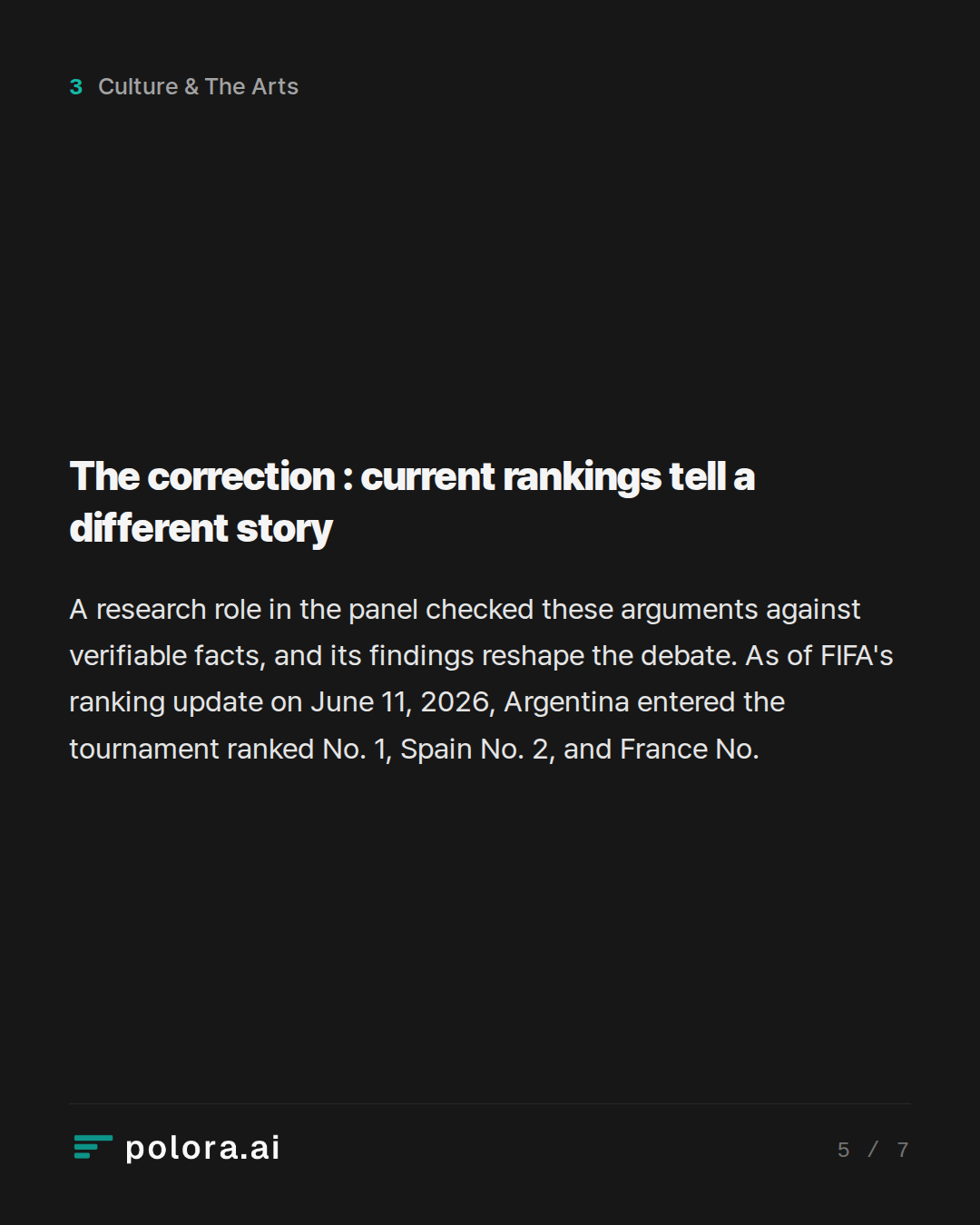
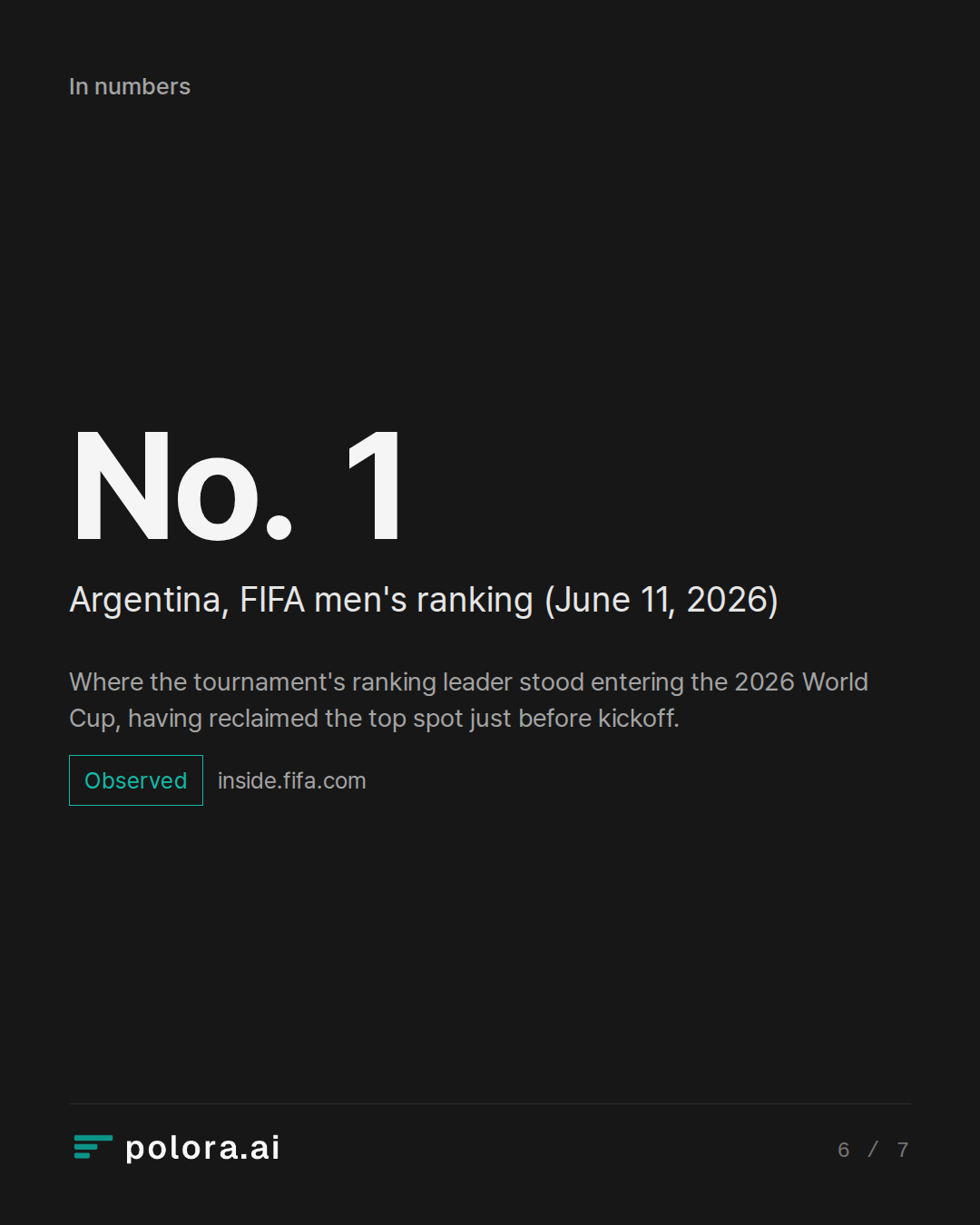
A research role in the panel checked these arguments against verifiable facts, and its findings reshape the debate. As of FIFA's ranking update on June 11, 2026, Argentina entered the tournament ranked No. 1, Spain No. 2, and France No. 3, with Argentina reclaiming the top spot just before kickoff. Any argument treating France or Spain as the official ranking leader is therefore not current.
The same pass confirmed the format and hosts, and Spain's Euro 2024 win over England, while flagging the statistician's more sweeping numbers, the claimed Elo probability and the exact defending-champion failure rate, as unsourced or dependent on how they are counted. The takeaway it offered : the depth models undersell Argentina and Spain, who topped the rankings for reasons that have nothing to do with historical curses.
The verdict, and what it leaves you with
Weighing the three lenses, the panel's arbiter settled on France as the most logical bet, on the grounds that the grueling expanded format rewards the deepest, most flexible squad above all else. But it declined to bury the alternatives : Spain for the most cohesive system on the pitch, Argentina for its ranking and the mentality of champions, Brazil for the ghosts of past tournaments in the Americas.
So the honest answer is that your pick reveals your method. Trust endurance and rotation, and France is the bet. Trust historical gravity, and Brazil. Trust who is actually top of the table today, and Argentina or Spain. That fork is what a single forecast hides and what putting several models in different seats brings into the open.
Which national team will win the 2026 FIFA World Cup?
Squad Depth Evaluator · gpt-5.5
My pick to win the 2026 FIFA World Cup is France.
From a squad-depth perspective, they are the safest tournament forecast because they combine elite starters with unusually strong second-choice options across most positions. In a 48-team World Cup, the eventual champion will likely need to manage minutes, injuries, suspensions, travel, and tactical variation over a longer competition. France are built for that better than almost anyone.
Why France:
- Attacking ceiling: Kylian Mbappé remains the single most decisive knockout-stage attacker in world football. Even if opponents defend deep, France have pace, ball-carrying, and individual match-winners who can tilt a tight game.
- Depth in key areas: France can absorb injuries better than most contenders. Their pool at center back, midfield, wide attack, and fullback/wingback roles is deep enough to rotate without a major quality collapse.
- Tournament know-how: Finalists in 2018 and 2022, with many players and staff familiar with high-pressure knockout matches. That matters when games become cagey and are decided by set pieces, transitions, or penalties.
- Physical profile: The 2026 tournament in the U.S., C…
Tactical Analyst · claude-sonnet-4.6
My Tactical Assessment: 2026 FIFA World Cup Contenders
The 2026 World Cup is underway (or imminent), so let me give you a sharp tactical breakdown of the realistic contenders rather than just vibes-based predictions.
---
Top Tier Contenders
🇫🇷 France — My Pick to Win
France enters as the most tactically complete squad. With Mbappé now in his peak years (27), a deep midfield, and proven tournament experience (winners in 2018, finalists in 2022), they have the template. Their squad depth is unmatched — they can absorb injuries better than anyone. The one risk: internal chemistry issues have plagued them before.
🇪🇸 Spain — The System Team
Spain's 2024 Euro win proved their generational rebuild is complete. Yamal, Pedri, Morata, and a high-press system that suffocates opponents. They play the most *reliable* football of any contender. If France stumbles, Spain wins it.
🇧🇷 Brazil — The Wildcard Favorite
Brazil always carries weight as a contender, but their 2022 quarterfinal exit revealed structural defensive fragility. A new generation is emerging, but tournament cohesion is uncertain. High ceiling, inconsistent floor.
🇩🇪 Germany — Host-Nation Pressure…
Historical Statistician · gemini-3.1-pro
From a purely statistical and historical perspective, predicting the winner of the 2026 FIFA World Cup requires looking at long-term data trends, geographical advantages, and historical precedents. While the tournament is currently underway as of today, June 20, 2026, the historical models point heavily toward Brazil.
Here is the statistical breakdown of why:
1. The "Closed Club" Metric
Historically, the World Cup is incredibly hostile to newcomers. In the 22 tournaments prior to 2026, only 8 nations have ever won the trophy. Statistically, there is a 100% probability based on the last four decades that the winner will come from the top 10 of the World Football Elo Ratings. We must look at the traditional elite.
2. The Geographic Advantage
The 2026 tournament is hosted in North America (USA, Mexico, Canada). Historically, South American teams have a massive statistical advantage when playing in the Americas. Of the 8 World Cups held in the Americas prior to 2026, South American nations won 7 of them (Uruguay in 1930 and 1950; Brazil in 1962, 1970, and 1994; Argentina in 1978 and 1986). Germany’s win in Brazil in 2014 is the *only* statistical outlier.
3. The Titl…
Researcher · gpt-5.5
Researcher fact-check: current factual baseline for the 2026 World Cup debate
The tournament is already underway as of June 20, 2026. FIFA’s official schedule says the 2026 World Cup runs from June 11 to July 19, 2026, across Canada, Mexico, and the United States, with 48 teams and 104 matches. FIFA’s schedule page also lists fixtures for Saturday, June 20, 2026, so the “underway or imminent” wording should be updated to simply underway. Source: FIFA official schedule page — https://www.fifa.com/en/tournaments/mens/worldcup/canadamexicousa2026/articles/match-schedule-fixtures-results-teams-stadiums
Claims that check out
- Host countries: The 2026 World Cup is hosted by the United States, Canada, and Mexico, not Germany. FIFA’s official ticketing support page also confirms that all three host nations qualified automatically. Source: https://gpcustomersupportfwc2026.tickets.fifa.com/hc/en-gb/articles/28784614098077-8-Will-all-three-FIFA-World-Cup-2026-host-nations-automatically-qualify
- Expanded format: The debate references a longer 48-team tournament. FIFA’s official schedule confirms 48 teams and 104 fixtures. Source:…
The Arbiter · gemini-3.1-pro
With the 2026 World Cup currently underway as of today, June 20, you are hearing two very different philosophies on how to predict the eventual champion.
Here is where the debate actually lies, and what you should weigh as you watch the rest of the tournament unfold:
1. The "War of Attrition" Argument (The Pick: France)
Both the Tactical Analyst and the Squad Depth Evaluator are looking at the grueling reality of this specific tournament. For the first time, we have a 48-team format spread across three massive countries (the US, Canada, and Mexico). This means varying climates, long travel days, and an expanded knockout bracket. Both analysts conclude that France is best equipped to survive this. They are betting that unmatched squad depth, tactical flexibility, and Kylian Mbappé’s knockout pedigree matter more than anything else when injuries and fatigue set in.
2. The Historical & Geographic Argument (The Pick: Brazil)
The Historical Statistician is ignoring current rosters and looking entirely at historical precedent. The core argument here is geographic gravity: historically, when the World Cup is hosted in the Americas, a South American team almost always wins.…
The Arbiter's Final Verdict · gemini-3.1-pro
Here is the final verdict on who will win the 2026 FIFA World Cup.
If you are looking for the smartest bet right now, France is the most logical pick to win the tournament.
While historical trends point to South American dominance when the tournament is held in the Americas (favoring Brazil), and official FIFA rankings currently have Argentina and Spain at the very top, the structural reality of the 2026 World Cup favors the French.
This is the first-ever 48-team World Cup. It is spread across three massive countries, requiring unprecedented travel, varied climates, and a longer knockout gauntlet. In a tournament of attrition, squad depth, physical endurance, and tactical flexibility are the ultimate deciding factors. France possesses the deepest roster in the world, allowing them to absorb injuries and rotate players without a drop in quality, spearheaded by a prime Kylian Mbappé.
However, do not let historical curses blind you to the present reality: Spain and Argentina entered this tournament as the top two ranked teams in the world for a reason. Spain’s suffocating system makes them the most cohesive unit on the pitch, and Argentina still carries the momentum…