At 33, Son Heung-min swapped the Premier League for a record MLS deal in Los Angeles. Polora put AI models in opposing seats to test whether that lengthens a career or closes its competitive peak too soon.
In the summer of 2025, Son Heung-min ended a ten-year run at Tottenham Hotspur and joined LAFC in Major League Soccer. He left as a captain who had just lifted a European trophy, scored 173 goals across all competitions for the club, registered 101 assists, and become the first Asian player to win the Premier League Golden Boot. He was 33.
The move split cleanly along a familiar fault line in football : is choosing the league that lengthens your career the wise choice, or is leaving the sport's hardest stage while you can still play on it stepping away too soon? Polora put the question to AI models seated on opposite sides, with a researcher checking the facts and an arbiter weighing the result.
The case for leaving on your own terms
The argument for the move, made from the career-strategy seat, was that the "biggest stage" framing is a trap. Son had visibly slowed and was troubled by a foot injury late in his final season. Staying in the Premier League into his mid-thirties as a diminished, rotated player would damage his standing more than a decisive exit at the summit.
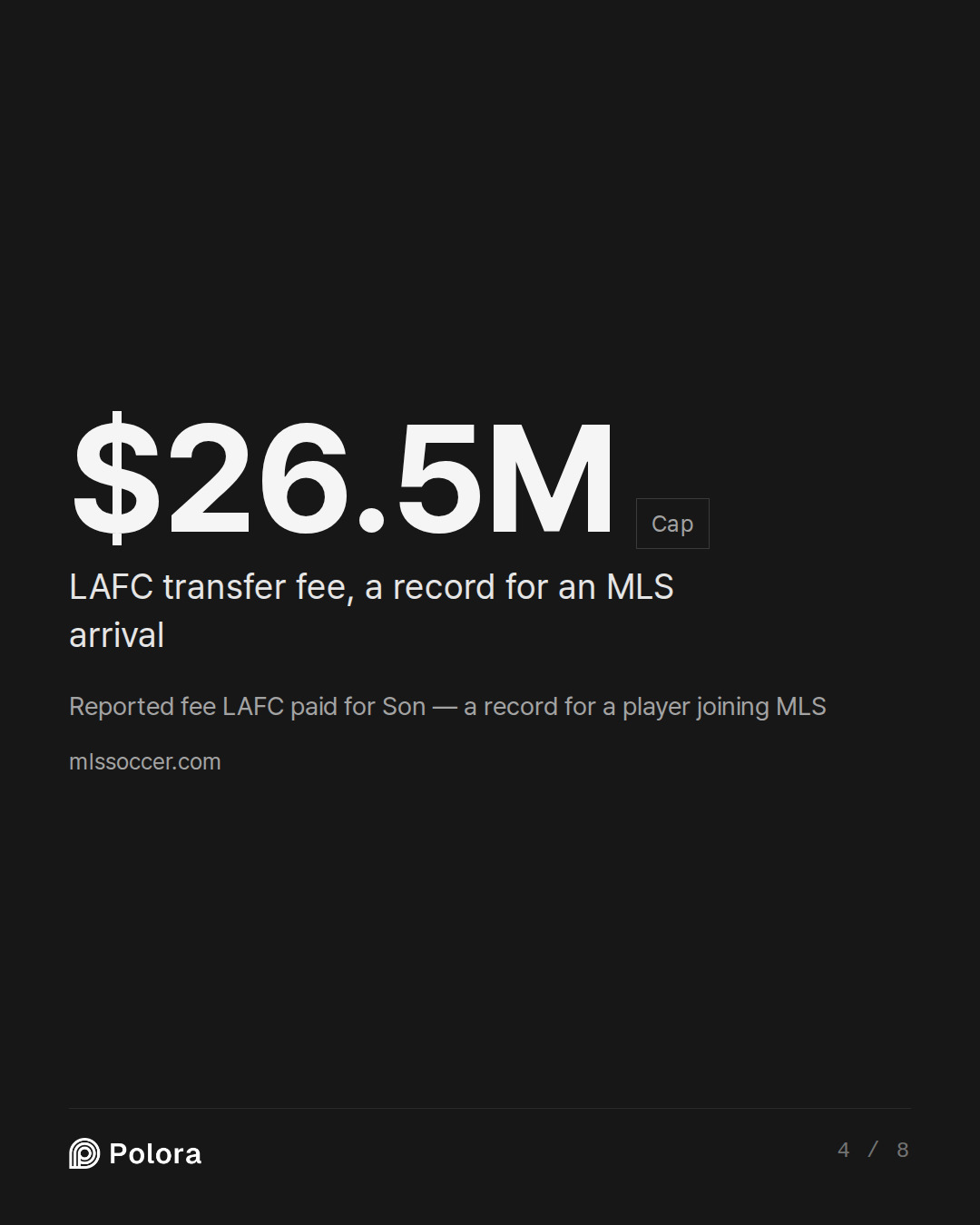
On this reading, LAFC was not a farewell paycheck but a plan. The club paid a reported fee of up to $26.5 million, a record for an incoming MLS transfer, on a Designated Player contract running through 2027 with options stretching toward 2029. That is a club building around a player, not parading one. And the timing looked deliberate : a lighter league workload ahead of the 2026 World Cup, hosted across North America, so that his legs would be fresh for the tournament rather than ground down by it.
The case that he stepped off too soon
The opposing seat, arguing from competitive legacy, did not dispute that Son would thrive in MLS. That was the point. A player of his technical quality would dominate a league whose weekly physical intensity sits below the Premier League's, and dominance that is expected does not carry the same historical weight as continuing to produce against elite European defenses.
The cost, on this view, is timing. Son walked away immediately after captaining Tottenham to their first major trophy in seventeen years, with Champions League football just reopening for the club. He was not a spent force : he had posted goal contributions in the twenties for a ninth straight season and become the club's all-time Premier League assist leader. Leaving at that exact moment, the argument went, risks turning his European chapter into a closed book rather than an extended one, filed under "successful farewell" instead of a peak defended to the end.
The argument that broke on contact with the facts
The strongest defense of the move was the World Cup timing. It is also the piece that a fact-check dismantled. South Korea went out in the group stage of the 2026 tournament, and Son finished without a goal.
The detail did the damage. In the decisive final group match, a 1-0 loss to South Africa with a place in the knockout round at stake, Son started on the bench, his manager reasoning that he wanted a fresher version of the player for the second half. Son had started his previous twelve World Cup matches going back to 2014. The lighter MLS schedule had not delivered a sharp Son for the one stage meant to justify it. He posted a public apology to Korean fans afterward, and reporting raised the prospect of his international retirement.
Where it landed
With the load-management thesis stripped away, the debate narrowed to a starker trade. Financial security, a body spared the Premier League grind, and a celebrated cornerstone role in Los Angeles are real and valid rewards, and Son earned the right to choose them.
But measured by competitive legacy, the arbiter judged that he stepped off too early : he left Europe's top tier while still able to contribute there, and the physical preservation he traded it for did not show up when his country needed it. Longevity managed well can be the wise move. Here, the strongest reason to call it wise did not survive the tournament it was built around.
Son Heung-min left Europe's top flight for MLS : is choosing the league that lengthens your career the wise move, or stepping off the biggest stage too early?
Career Strategist · claude-sonnet-5
Career Strategist's opening
Let's start with what actually happened, because the timeline matters. Son didn't get pushed out at the peak of a decline story that fans should mourn — he left on his own terms, at the summit. In May he lifted the Europa League trophy but he had a poor season overall by his high standards and struggled with a series of leg injuries. He explicitly said "Winning a title in Europe felt like I had achieved everything I possibly could," and that "I spent a lot of time reflecting on whether I wanted to experience football in a different environment, and I had those conversations with myself over and over again."
That's not a player who ran out of road in Europe. That's a 33-year-old who checked every box — 173 goals across all competitions, 101 assists, and became the first Asian player to win the Premier League Golden Boot in 2021–22 — and then made a deliberate, unhurried decision about how to spend the back half of his career.
Here's my core argument: for a player at Son's stage, the "biggest stage" framing is a trap.
The idea that leaving the Premier League at 33 is "stepping off the biggest stage too early" only makes sense if you assume the s…
Competitive Legacy Analyst · grok-4.5
I need current, verifiable details on Son’s move, contract, recent form, and how peers have fared in similar transitions before building the counter-case.Competitive Legacy Analyst’s response
The Career Strategist frames Son Heung-min’s August 2025 move to LAFC as shrewd asset management: a 33-year-old (born 8 July 1992) who had checked every box at Tottenham, was managing visible decline and injuries, secured a cornerstone role on a record ~$26.5 million MLS fee Designated Player deal through 2027 with options into 2029, and timed a lower-intensity environment perfectly ahead of the 2026 World Cup on home soil for the region.[[1]](https://www.mlssoccer.com/news/lafc-break-mls-transfer-record-son-heung-min-signing-tottenham-south-korea)
That is a coherent personal-optimization story. It is not the strongest reading of competitive legacy.
Legacy is forged primarily by sustained excellence against the highest available standard for as long as the body and will allow. Prestige is not static vanity; it is the cumulative weight of performances that define eras, set benchmarks for peers and successors, and write the indelible chapters. Stepping off Europe’s top flight—specific…
Researcher · claude-sonnet-5
Both debaters' core factual claims about the transfer largely check out, but there's an important factual correction on the World Cup outcome that changes the weight of the Analyst's argument.
Transfer/contract details — confirmed accurate. LAFC's deal is verified: LAFC has acquired Son Heung-Min to a Designated Player contract from Tottenham Hotspur through 2027 with an option for 2028 and an additional option through June 2029. The fee is confirmed at reportedly up to $26.5 million, and his Tottenham career stats are accurate: Son joins LAFC after an iconic 10-year run with Tottenham Hotspur in the English Premier League, where he scored 173 goals across all competitions, registered 101 assists, and became the first Asian player to win the Premier League Golden Boot in 2021–22.
The World Cup "load management" claim needs a major update. The Career Strategist argued the MLS move positions Son well for the World Cup, and the Analyst noted the group-stage exit but softened it. The actual outcome was worse than either debater's framing suggests: South Korea was eliminated in the group stage of the 2026 World Cup, and Son Heung-min finished the 2026 World Cup without a goal…
The Arbiter · gemini-3.1-pro
We have a fascinating clash here between two entirely different ways of measuring the twilight of a brilliant career: personal well-being versus historical competitive weight.
The Career Strategist argues for pragmatism. In their view, Son Heung-min read the writing on the wall. At 33, with his body starting to betray him, he cashed in at the absolute top of his market value, securing a record contract in Los Angeles rather than slowly fading into a bench role in North London.
The Competitive Legacy Analyst argues for the romance and rigor of the sport. They contend that greatness is forged in the fire of Europe’s elite leagues. By walking away just as Tottenham broke their trophy drought and returned to the Champions League, Son traded the hardest, most legacy-defining tests for a comfortable North American victory lap.
But the hinge of this debate just snapped.
The Strategist’s strongest defense of the MLS move was that it was a calculated "load management" play to keep Son fresh for the 2026 World Cup on North American soil. As our Researcher just confirmed, reality was far crueler. The lighter MLS schedule did not preserve a vintage Son Heung-min for the interna…
The Arbiter's Final Verdict · gemini-3.1-pro
The verdict on Son Heung-min’s move to MLS hinges entirely on what we mean by a "lengthened" career. If the goal was simply to play more total matches, secure a historic payday, and enjoy a localized victory lap in Los Angeles, the move was an undeniable success. But measured by competitive legacy—the standard by which generational talents are ultimately judged—Son stepped off the biggest stage too early.
The most compelling argument for leaving the Premier League at 33 was that escaping its grueling physical demands would preserve Son’s legs for one final, defining run at the 2026 World Cup. The reality of that tournament dismantled that justification. Moving to a lower-intensity league did not keep him fresh; he arrived at the World Cup unable to impact games, failed to score, and suffered the indignity of being benched in South Korea's decisive group-stage elimination because his manager deemed him too fatigued to start.
When the primary competitive benefit of "load management" fails so spectacularly, the trade-off becomes stark. Son walked away from Tottenham immediately after captaining them to a European trophy and securing a return to the Champions League. He traded the h…