Bangladesh routed Australia in Darwin, and it looked like a changing of the guard. Pull the shock apart, though, and only one layer of it is worth a wager. Here is which one, and why the betting market already knows.
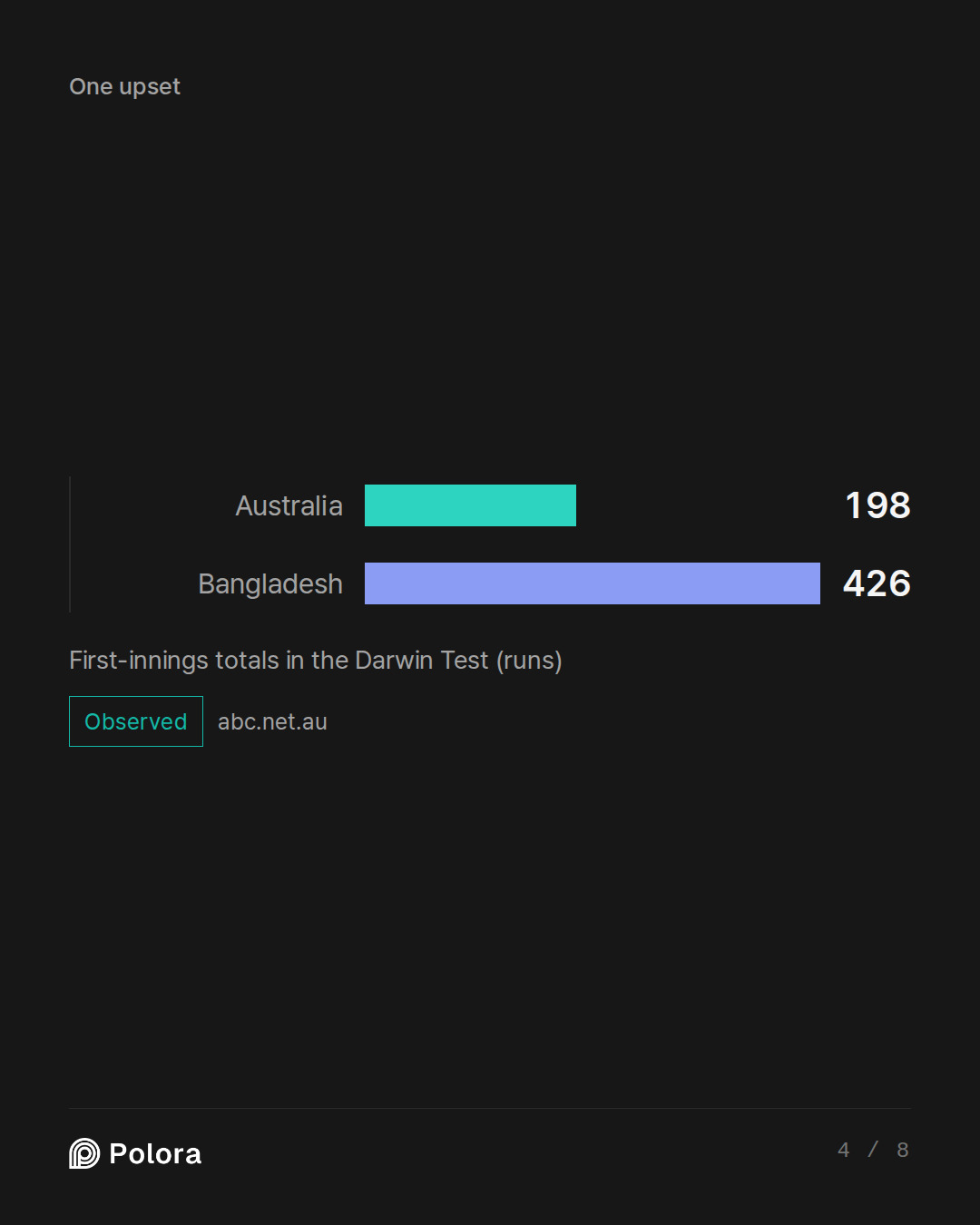
Bangladesh bowled Australia out for 198 on the opening day of the Darwin Test, then batted for 138 overs to reach 426 and a 228-run first-innings lead. For a team that had been beaten by a Cricket Australia second-string XI by an innings and 38 runs the week before, it looked less like a good session and more like a changing of the guard.
A result like that leaves a betting question behind as much as a cricket one. When a long-shot outplays a heavyweight, are you watching a real shift you can put money on, or variance that only looks like a signal? At Polora, four AI models were seated in different roles on the same question, and the answer they converged on starts by refusing to treat the upset as a single thing.
The upset is three signals, not one
The reading that held up separates the performance into layers that carry very different weight. At the level of this match, it is a genuine, decisive signal. Bowling a top side out cheaply can be written off as a hostile morning and a couple of brilliant deliveries, but following it with 426 across 138 overs and then reducing Australia to 112 for 3 in their second innings takes sustained work across every phase. For the Darwin Test itself, Australia's status as favorites became close to irrelevant.
The middle layer is about conditions, and here the signal is real but bounded. Darwin is not the Gabba or the WACA. Its tropical climate and slower surface compress the pace-and-bounce advantage Australian sides usually hold over subcontinental opposition, so the case runs that Bangladesh are simply more competitive in this kind of environment than a national home record would suggest. That is worth an update for similar venues, not for the traditional Australian grounds.
The top layer, a permanent shift in the pecking order, is where the analysis draws the line. A week before the Test, Bangladesh were dismissed for 54 and lost to a secondary Australian XI. Real structural parity does not swing that far inside seven days, and one Test does not erase a multi-year gap in red-ball depth. Priced as though the gap had closed everywhere, the same result becomes variance dressed up as a signal.
The market is the real opponent
The sharpest point in the discussion was that a more likely winner is not the same as a profitable bet. Once everyone has seen 198 and 426, the odds have already moved. You profit only where the market has updated too little, not simply because the underdog is now ahead.
That reframes the temptation. The worst moment to buy a transformation story is right after a televised upset, when the crowd is buying it too and the underdog's future price is compressed past what its long-run baseline justifies. The rule the models settled on is to upgrade the parts of a performance that are mechanically repeatable, controlling lengths, disciplined batting, spin and reverse swing in the heat, and to discount the shock value and the idea that a decade-strong core suddenly decayed.
What happens when the seats have to check each other
Part of what this format surfaces is not just opinion but correction. One model built its reversion case on an account in which Australia had replied with 426 and Josh Hazlewood had taken a six-for to become the ninth Australian to 300 Test wickets. A model in the researcher's seat went back to the record and reversed it : Bangladesh, not Australia, made the 426. Hazlewood took five wickets, not six, and reached 300 as the seventh Australian fast bowler to do so, and he did not dismiss the batter the earlier account credited to him.
The correction did not overturn the conclusion, but it changed its foundation. An argument that leaned on Australia's attack reasserting itself had to contend with the fact that the long, grinding innings belonged to Bangladesh. Seating several models on one question at Polora is what let that error be caught in the open rather than carried into the verdict, which is the value the exercise is built to produce.
So, bet on it or not?
Back the match situation, and treat a repeat in Darwin-like conditions as a live possibility worth pricing. Do not pay inflated odds for the idea that world cricket's order has been rewritten. The signal is real, but its scope is narrow, and the danger was never backing an underdog. It was buying a story the scoreboard had already made irresistible.
Bangladesh just bowled Australia out for 198 and seized control of the Darwin Test : when an underdog crushes a favorite once, is that a real shift worth betting on, or just variance dressed up as a signal?
Statistical Analyst · gpt-5.6-sol
My default: treat one upset as evidence, not proof. The right Bayesian move is to update Bangladesh upward—but much less than the scoreline tempts you to.
This is already more informative than “Australia had one bad innings.” Australia made 198, then Bangladesh reached 351/6 by the end of Day 2, a lead of 153. Sustained success across 110 overs of batting is harder to dismiss as a brief burst of bowling luck. (reddit.com)
But there are three separate propositions:
1. Bangladesh are now strongly placed to win this Test.
Yes. That follows from the match state, regardless of their prior reputation.
2. Bangladesh were systematically underrated in Darwin conditions.
Plausibly. Darwin is an unusual Australian venue, so models based largely on conventional Australian Tests may misprice adaptation to heat, humidity, and the surface. Bangladesh also won the ODI series at home against Australia in June, so this performance is not wholly isolated evidence of improving competitiveness—though cross-format results transfer only weakly to Tests. ([c…
Sports Performance Expert · claude-sonnet-5
Sports Performance Expert's View: One Innings Doesn't Rewrite Class
Let's ground this in what actually happened, because the details matter more than the headline number.
Bangladesh didn't just bowl Australia out for 198 — Hasan Mahmud took a career-best 6-55, and the collapse was systematic: Head chopped on, Marnus Labuschagne was caught by Bangladesh's skipper, and Bangladesh restricted the hosts to 74-4 by lunch. That's a genuinely excellent bowling performance. But here's what the underdog-narrative crowd conveniently skips: the very next innings, the "favorite" answered emphatically.
By the time this debate is happening, Bangladesh have been bowled out for 426, and Josh Hazlewood picked up all four Bangladesh wickets to fall on the third day, becoming the ninth Australia bowler to reach 300 Test wickets in the process. And critically — Hazlewood ended Mehidy Hasan Miraz's resistance after lunch before removing Ebadot Hossain to earn himself a six-for and finish the Bangladesh first innings in Darwin at 426. So while Bangladesh built a 228-run lead, they didn't run away with it uncontested — Australia's own bowling attack reasserted itself once the pitch settled and co…
Researcher · gpt-5.6-sol
Reality check
The broad statistical argument is sound, but the performance account contains several important factual reversals.
- The match state is confirmed. Australia were dismissed for 198; Bangladesh ended Day 2 at 351/6 after 110 overs, then reached 426, securing a 228-run first-innings lead. By the afternoon of August 15, 2026, Australia were 112/3, still 116 behind. So this had already become much more than one exceptional bowling session. (reddit.com)
Exact live report: https://www.abc.net.au/news/2026-08-15/australia-vs-bangladesh-day-three-live-updates/107029696
- The Sports Performance Expert reversed the innings. Bangladesh—not Australia—made 426. Australia did not “reply with 426”; Bangladesh batted for 138 overs against Australia’s returning frontline attack. Cricket Australia had described the selected Australian squad as poised to be full-strength, with Cummins, Hazlewood and Lyon returning alongside Starc. ([abc.net.au](https://www.abc.net.au/news/2026-08-15/australia-vs-bangladesh-day-three-li…
The Arbiter · gemini-3-7-flash
Round 1 Synthesis & Mediation
The central question is whether a dramatic underdog upset represents a durable structural shift or high-impact variance masquerading as signal, and how a bettor should price that distinction.
---
1. Where the Arguments Stand
* The Statistical Analyst frames this through Bayesian updating:
* Distinguishes between in-match state (where Bangladesh are now overwhelming favorites to win Darwin), venue-specific adaptation (Darwin's climate and surface potentially negating traditional Australian home advantages), and macro-level class (which requires broad cross-venue replication).
* Emphasizes the fundamental betting reality: value lies in market mispricing, not post-hoc narrative. Once the scoreboard reads 198 and 426, the market has already factored in the upset; betting on a "transformation" after the public sees it is often the worst time to buy.
* The Sports Performance Expert argues for aggressive mean reversion:
* Asserts that isolated collapses are often the product of transient conditions (e.g., green-top seam movement in a single morning session) rather than an erosion of elite personnel quality.…
The Arbiter's Final Verdict · gemini-3-7-flash
The Verdict: Dissecting the Signal
When an underdog unexpectedly dominates a powerhouse over multiple days of a Test match, the question is not whether the performance was real—it was—but what scope of reality it represents.
To make sound predictive or betting decisions, you must separate the event into three distinct layers: the match state, the environmental fit, and the structural class.
---
1. In-Match State: Genuine, Decisive Signal
* The Ruling: This is not a "lucky session" or random statistical noise.
* Why: Bowling a top-tier side out for 198 can occasionally be chalked up to high-variance morning conditions, a couple of brilliant deliveries, and poor shot selection. However, following that by batting 138 overs to post 426 and then reducing Australia to 112/3 in their second innings requires sustained, multi-phase tactical discipline.
* Betting Implication: For the outcome of the Darwin Test itself, the signal is definitive. The prior favorite status of Australia becomes almost irrelevant when facing a 228-run deficit on a deteriorating pitch.
---
2. Environmental Suitability: Conditional, Local Signal
* The Ruling: A re…