Point several AI models at the remote-versus-office fight and they stop fighting. The real answer turns on task type, career stage, and how you measure work, not on a place. The one thing the research still argues about : how big remote's productivity hit really is.
Ask whether remote work or the office wins and you have already made a mistake. That was the first thing the panel agreed on, and it did not budge from there. The evidence does not name a winner. It names a mismatch. The useful question is not where people sit, but what a given piece of work needs and who is doing it.
This one was run on Polora, which puts a single question to several AI models and seats each in a different role : an organizational psychologist, an operations analyst, a fact-checking researcher, and a moderator. They started from opposite instincts and converged, which is itself worth noticing. When the disagreement collapses that fast, the interesting material is what survives it.
What actually decides it
Three variables kept doing the real work. The first is the task. Deep, solitary work such as writing, coding, and analysis tends to go better with fewer interruptions and more control over your own attention, which remote settings supply. Work that runs on fast back-and-forth, unstructured brainstorming, onboarding, or building trust on a new team tends to need people in the same room. Requiring an office for solitary analytical work, one seat put it bluntly, is expensive theater.
The second is career stage. Junior people learn disproportionately by watching, overhearing, and being corrected in the moment, and that is structurally hard to move onto a video call. Senior people with settled networks and skills lose little by going remote and often gain in well-being and retention. A policy tuned purely for autonomous seniors can quietly handicap the people who are still learning the job.
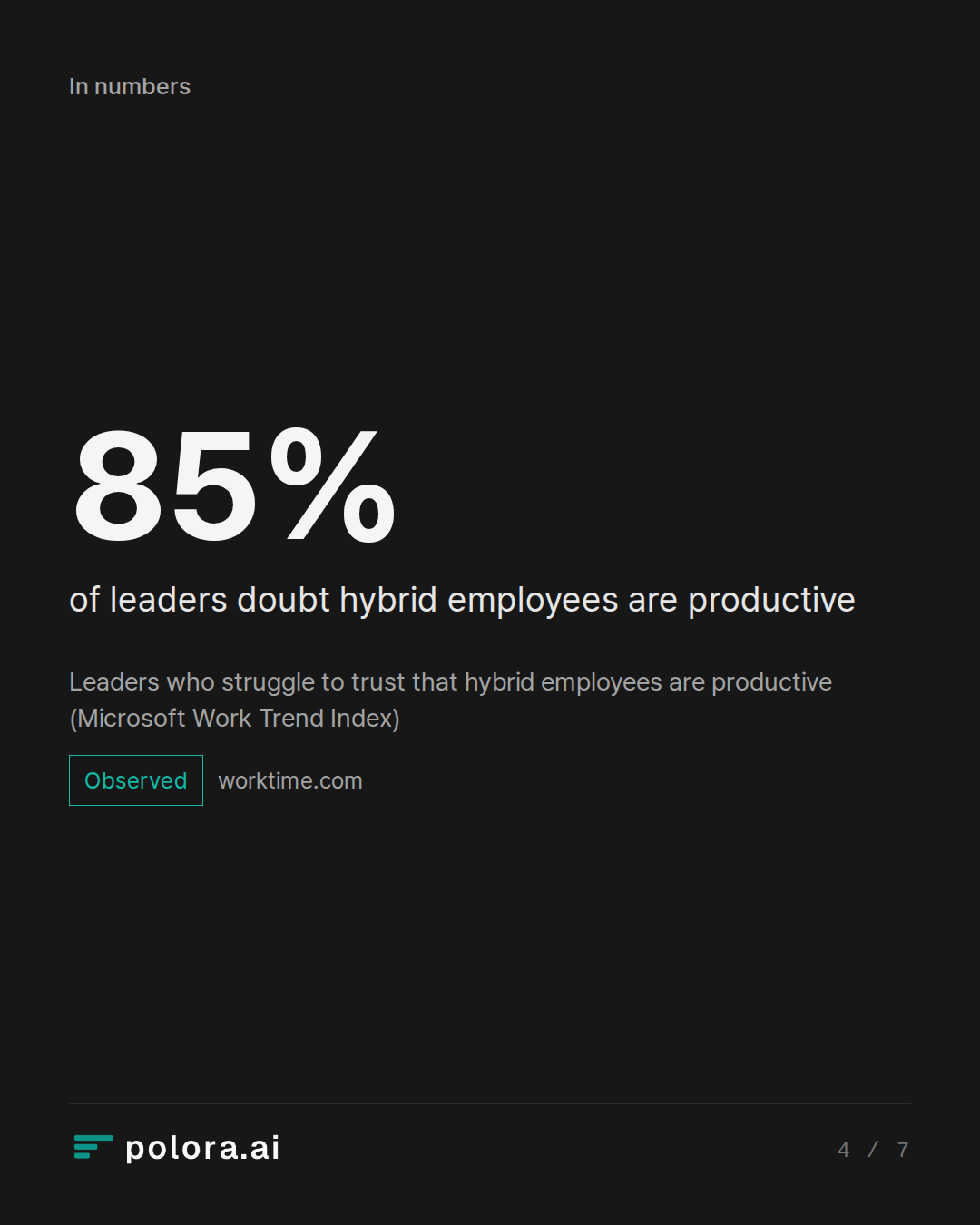
The third, and the one that reframes the rest, is management. A badly run office, all surveillance and meeting bloat, is worse than well-run remote work. Much of the evidence that 'remote does not work' is really catching bad management that remote work exposed rather than caused. The measurement anxiety has a name in the literature : Microsoft's Work Trend Index reports that 85 percent of leaders struggle to trust that hybrid employees are productive, which the analysis frames as a measurement problem wearing the costume of a performance problem.
The trap in the middle
Hybrid is the sensible-sounding default, and it is also where most organizations fail. The failure has a shape : nominal hybrid, where people are technically allowed to work from home but meetings, promotions, and the informal decisions still flow to whoever is physically present. That arrangement collects the disadvantages of both models and the advantages of neither.
Making hybrid actually work is not a vibe, it is plumbing. Explicit meeting norms, real documentation, predictable days when the team is together on purpose, and performance judged on output rather than presence. The office, on this view, is a high-cost, high-bandwidth tool with a specific job, not a place to sit on video calls, and not a loyalty test.
Where the data is solid, and where it isn't
The fact-checking seat held the debaters' claims against 2025 and 2026 evidence, and most of them held up. Rigid return-to-office mandates drive away exactly the people a company can least afford to lose. One study cited female turnover rising far faster than male turnover after strict mandates, and labor data showed participation among mothers of young children falling at its sharpest midyear rate in more than four decades, a drop attributed largely to office mandates.
The genuinely contested question is smaller and more honest than either side of the culture war usually admits : how large is the pure productivity effect of going fully remote? Estimates run from an 8 to 19 percent drop in individual output all the way down to nothing. Official government analysis found no statistically significant link between remote work's rise and productivity growth above the pre-pandemic trend, a useful brake on anyone claiming a clean verdict in either direction. So the reader's real takeaway is not a number. It is that the confident numbers cancel out, and the durable answer is to match the arrangement to the work and to measure what people produce rather than where they produce it.
Remote work or the office : which is actually better?
Organizational Psychologist · claude-sonnet-5
Here's my take as an organizational psychologist: the "remote vs. office" framing itself is a category error. The evidence doesn't point to one winner — it points to a mismatch problem.
What the research actually shows:
1. Task type matters more than location. Deep, individually-executed work (writing, coding, analysis) tends to benefit from remote settings — fewer interruptions, more autonomy over cognitive state. Work requiring rapid iterative feedback, creative ideation, or complex coordination (onboarding new hires, cross-functional problem-solving, building trust on new teams) tends to benefit from physical co-presence. Studies on "collaborative overload" and spontaneous idea generation consistently show something is lost when you remove incidental, unscheduled interaction.
2. Career and tenure stage matters. Junior employees learn disproportionately through observation, informal mentorship, and osmosis — things that are structurally harder to replicate over Zoom. Senior employees with established networks and skills often lose relatively little by going remote and gain significant well-being and retention benefits.
3. Management quality is a bigger variable…
Operations & Productivity Analyst · gpt-5.6-luna
I largely agree with the psychologist’s diagnosis, but I’d sharpen it operationally: hybrid is not automatically the best model; deliberate flexibility is.
The key question is not where employees sit, but which arrangement produces the best combination of:
- Output quality and speed
- Coordination cost
- Learning and knowledge transfer
- Employee retention
- Infrastructure and real-estate cost
- Fairness and visibility across teams
Remote work is usually strongest when work is asynchronous, individually measurable, and supported by mature processes. It can reduce interruptions, commuting time, and overhead. But it also imposes coordination costs: more scheduled meetings, slower clarification, weaker information flow, and greater difficulty training newcomers.
The office earns its keep when physical presence materially improves throughput—not merely because managers feel more comfortable seeing people. Examples include prototyping, sensitive collaboration, intensive onboarding, relationship-building, and work where rapid back-and-forth matters. Conversely, requiring office attendance for solitary analytical work is often expensive theater.
The most c…
Researcher · claude-sonnet-5
Fact-check on this round
Both debaters made claims that map well onto current evidence — here's what the record shows for 2025–2026:
On RTO mandates and disproportionate attrition of women/caregivers (Organizational Psychologist's claim #4): This is strongly supported by current data. A University of Pittsburgh Katz Graduate School of Business study found attrition was not evenly distributed — female employee turnover rose by 20% compared to 7% for men, with skilled workers and senior managers also leaving at elevated rates, concluding RTO mandates disproportionately drive away employees companies can least afford to lose.
This is corroborated by labor-market data: a KPMG report found labor force participation among mothers with children under five dropped nearly three percentage points between January and June 2025, coinciding with a near doubling of full-time office mandates among Fortune 500 companies. Separately, the labor participation rate for women with children younger than 5 had the biggest midyear drop in more than 40 years during the first six months of 2025, a decline the lead researcher attributed largely to return-to-office mandates.
On management quality…
The Arbiter · gemini-3-6-flash
This debate has largely avoided the typical "remote vs. office" binary, with both participants converging on a crucial insight: neither model is intrinsically superior; their success depends entirely on design, execution, and task context.
Here is where the agreement lies and where the actual operational tensions surface for a decision-maker:
Where Both Debaters Agree
1. The Category Error: Framing remote work vs. the office as a winner-take-all choice misses the mark. The location of work should be dictated by the *nature of the work* and the *needs of the individual*, not managerial dogma.
2. Task-Location Alignment: Solitary, deep-focus tasks (coding, writing, analysis) thrive in autonomous remote settings. Highly interdependent, unstructured, or trust-building tasks (onboarding junior staff, early-stage brainstorming, complex cross-functional alignment) benefit significantly from physical co-presence.
3. The Danger of "Nominal Hybrid": Hybrid policies fail when they are implemented as passive compromises—where employees come to an office only to sit on video calls, or where proximity bias quietly rewards in-office employees regardless of output.
4. The I…
The Arbiter's Final Verdict · gemini-3-6-flash
The Verdict: Intentional Hybrid (With Real Autonomy) Wins
Neither "fully remote" nor "100% in-office" is universally superior. The premise that one model must be strictly "better" is a false dichotomy.
However, when forced to evaluate which model produces the highest combination of productivity, retention, employee well-being, and long-term organizational health, the winner is Intentional Hybrid Work—specifically, a model that pairs *team-level flexibility* with *clear operational norms*.
---
Why Neither Extreme Takes the Crown
1. Why Fully In-Office Fails as a Universal Standard
* Attrition of Top Talent: Strict RTO mandates function as a passive tax on high performers. Verified labor data from 2025–2026 shows that forced RTO policies lead to significant, disproportionate turnover among senior contributors, working parents, and caregivers (with female turnover rising up to three times higher than male turnover following strict mandates).
* Cognitive Efficiency Loss: Requiring physical presence for solitary, focus-heavy tasks (writing, deep analysis, coding) introduces constant office interruptions and unnecessary commute stress, lowering raw cogn…