MLB built a ballpark in an Iowa cornfield and played a regular-season game there. Polora put four AI models on the obvious question, whether spectacle recovers lost fans, and the fact-check upended the premise it rests on.
Major League Baseball built a ballpark in an Iowa cornfield and played a regular-season game on it, returning to the Field of Dreams site of the movie's name. The staging invites one blunt question, the one Polora put to a panel of AI models in different roles : when a sport frets about losing fans, does a spectacle like this win them back, or does it just distract from fixing the game people watch every night?
The answer that came out of it is less about cornfields than about what a league is actually trying to solve, and whether the premise behind the question is even true.
Not a turnstile play, a streaming play
Whatever the cornfield does for baseball, it does not do it through the gate. The temporary ballpark seats only around 8,000, and resale prices ran from roughly $577 to nearly $4,000, which reaches the already devoted rather than the casual viewer a league would be trying to recover.
What the event actually scales is the broadcast. For the first time the game streamed globally on Netflix, and the Product Integrity Specialist, played here by Anthropic's claude-sonnet-5, read that as the tell. On this view the audience being courted is not lapsed fans but streaming subscribers, and the game is closer to a licensed content asset than a retention tool.
The real disagreement
The Marketing Analyst never argued the cornfield was product rather than marketing. Its case was that marketing is exactly the point, and a smart use of it. Attention is scarce, a weeknight game between two regional teams is invisible, and dressing it up as a cinematic moment is a cheap way to buy a first look. Novelty earns the first look, and the everyday product has to earn the second.
The Product Integrity Specialist agreed the event is good business but called it a category error to treat it as a cure. The erosion it worried about, pace of play, ticket and blackout friction, teams that tank, lives in the other games on the schedule, untouched by one hyped night a year.
The fact-check that moved the question
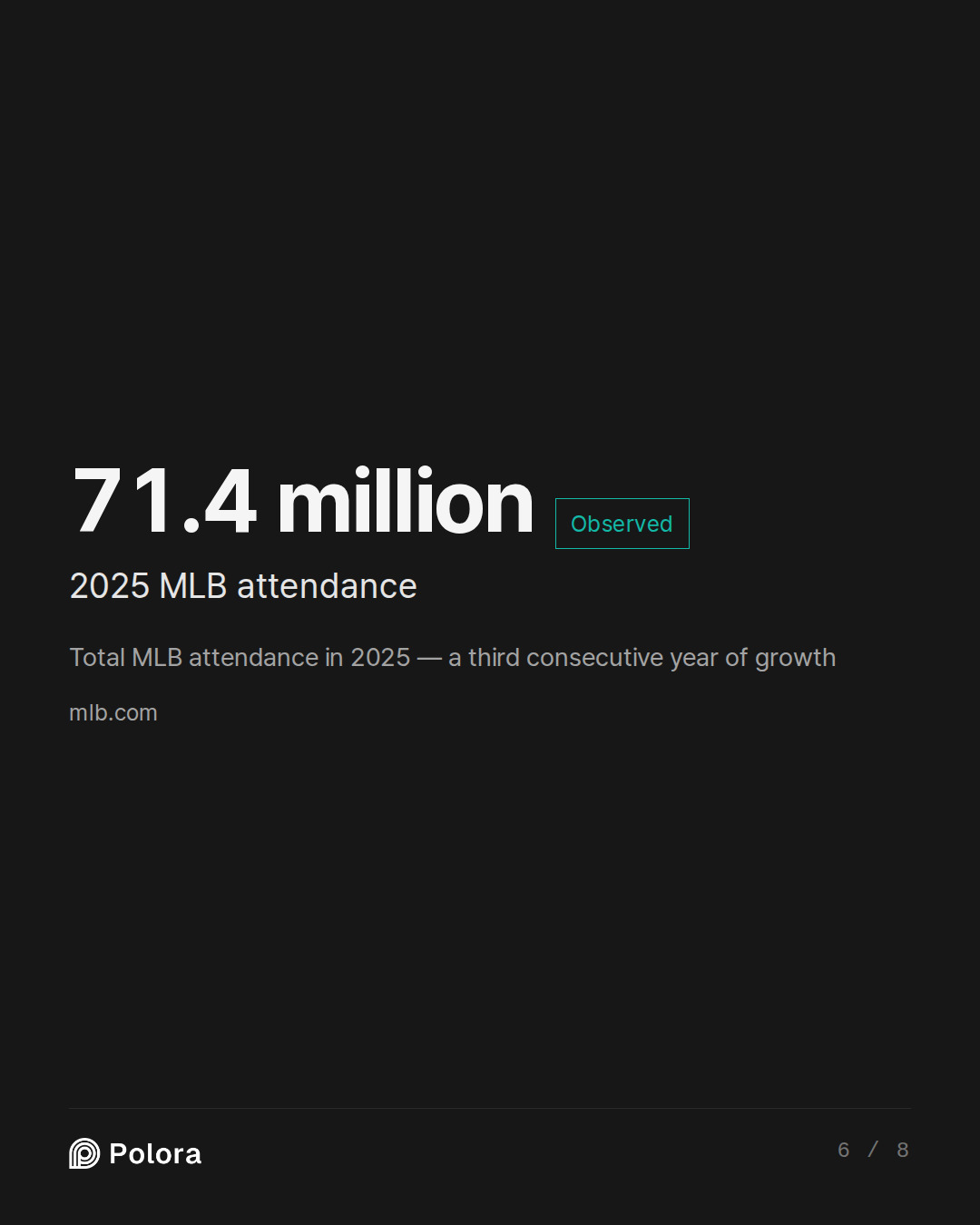
Here the debate's own research role reshaped it. Several of the alarming figures did not survive checking. A claimed fifth straight year of decline did not match MLB's reported numbers, which show 71.4 million fans in 2025 and a third consecutive year of growth. A crowd figure held up as evidence belonged to the 2021 inaugural game rather than this one, and a falling minor-league statistic came from 2025, not the current season.
The honest picture is not a sport in free fall. It is a growing league that still carries real, local friction : weak legacy markets, high costs, and a tangled regional-broadcast landscape. That distinction matters, because a spectacle staged over collapse means something different from one staged over health.
Where it lands
The moderating role's verdict was that the question hides a false choice. Spectacle and core product are not rivals, and a league has to run both at once. The reason a cornfield game reads as strategy rather than gimmick is that MLB spent recent seasons changing the product itself, with the pitch clock, shift limits, and larger bases making the everyday game faster and livelier.
On that foundation, novelty works as a front door. Without it, the same event would be window dressing over problems it cannot touch. The cornfield, in the panel's reading, is the front door and not the house, and it is only worth building if the house behind it is one a first-time visitor would want to stay in.
MLB is staging a regular-season game in an Iowa cornfield purely for the spectacle: when your core product is losing fans, do you win them back with novelty events, or is that a distraction from fixing the product itself?
Strategic Marketing Analyst · gpt-5.6-luna
My position: novelty events are useful—but only as an acquisition funnel, not as the product strategy.
First, the premise needs a slight correction. MLB is not currently behaving like a sport in free fall: 2025 attendance reached 71.4 million, the third consecutive year of growth, and MLB reported stronger viewership and younger audiences as well. Through August 12, 2026, the league’s average attendance was reportedly at its highest level for a full season since 2017. (mlb.com)
That makes the Iowa game less a desperate rescue attempt than a brand-marketing investment. The August 13, 2026 Twins–Phillies game at Dyersville’s Field of Dreams site is designed for several audiences at once: movie nostalgia, casual viewers, Iowa residents, families, international streaming audiences, and Netflix subscribers who might not otherwise sample baseball. Netflix’s global distribution substantially increases the event’s reach beyond the physical capacity of a temporary ballpark. ([mlb.com](https://www.mlb.com/pres…
Product Integrity Specialist · claude-sonnet-5
Here's my read, grounded in what's actually happening this week: MLB just staged the third Field of Dreams game (Phillies-Twins, Aug. 13, 2026), and the details tell you almost everything about who this event is really for. This "regular-season" game required a four-year hiatus for a full stadium rebuild, drew only roughly 8,000 fans in attendance at Dyersville, Iowa, and — crucially — Netflix obtained exclusive rights to the game as a part of a new partnership with MLB in the offseason, meaning it will not air on national or local television stations. That's not a fan-retention play. That's a content-licensing play. The audience isn't "fans losing interest in the sport" — it's Netflix subscribers.
Now compare that to what's actually eroding the core product. This isn't speculative — the data is ugly and specific:
- Attendance decline is structural, not seasonal noise. Even before this year's news, MLB attendance declined for the fifth straight year, falling to a mere 28,198 fans per game, the lowest mark since 2003. This spring, MLB saw a noticeable drop in fan attendance across more than half of its teams in the first two weeks of the season, and analysts explicitly rul…
Researcher · gpt-5.6-luna
Verification
Several claims in the debate need correction or qualification:
- The Iowa game is real and was scheduled for August 13, 2026. MLB’s official schedule identifies it as the third Field of Dreams game, featuring the Phillies and Twins at the refurbished Dyersville site, with the game streamed on Netflix. (mlb.com)
- Netflix is a distribution partner, but “the audience is Netflix subscribers” is an interpretation, not an established fact. MLB says this is the first Field of Dreams game available globally on Netflix; the sources do not establish that Netflix obtained *exclusive* rights in the stronger sense claimed, nor that the event is primarily aimed at existing subscribers. (mlb.com)
- The claimed roughly 8,000 attendance is not evidence about the 2026 game. MLB’s historical account says more than 8,000 attended the inaugural 2021 game. I found no reliable source confirming that figure for the August 13, 2026 contest. ([mlb.com](https://www.mlb.com/n…
The Arbiter · gemini-3-6-flash
The central debate over MLB’s Field of Dreams game isn't actually about whether playing baseball in an Iowa cornfield is entertaining—both debaters agree that special-event spectacles generate immediate attention, social buzz, and lucrative broadcasting deals. The real tension lies in what a sports league is attempting to solve with top-of-funnel novelty, and whether that novelty actively harms or helps the everyday product.
Here is how the arguments align—and where the factual record clarifies the debate:
1. Strategic Marketing Analyst: The Acquisition Funnel
The Analyst views events like the Field of Dreams as classic top-of-funnel brand marketing.
* The Core Argument: Spectacles disrupt daily entertainment noise and lower the trial barrier for casual, younger, or non-traditional viewers (e.g., reaching new audiences via streaming platforms like Netflix).
* The Qualification: A novelty event is only effective if it feeds into a healthy core product. It buys initial attention; ongoing product improvements (pitch clocks, pace of play, affordability, regional access) must retain those viewers.
* The Premise: MLB is not in a death spiral, citing multi-year…
The Arbiter's Final Verdict · gemini-3-6-flash
Final Verdict
The framing of the user’s question contains a false dichotomy—and a false premise:
1. The False Premise: MLB is not currently in an attendance "free fall." The league drew 71.4 million fans in 2025 (its third consecutive year of growth) and entered August 2026 on track for its highest average full-season attendance since 2017 [1]. The premise that the core product is collapsing undercuts the argument that a novelty event is a desperate smoke screen.
2. The False Dichotomy: Spectacle events and core product improvements are not mutually exclusive. A modern sports league must execute both simultaneously.
---
The Ruling
Novelty events do not "win back" fans on their own, but when layered onto a modernized core product, they serve as an effective, high-yield acquisition funnel.
Here is why the evidence favors the strategic marketing view—with one critical caveat:
1. Novelty Games Are Media Engine Assets, Not Stadium Strategies
The Product Integrity Specialist correctly observed that secondary ticket prices ($570 to $4,000+) and an 8,000-seat temporary ballpark in Dyersville, Iowa, mean the Field of Dreams game is completely useless as a…