What is the best first 3D printer for a family with a kid at about $600, as ranked by AI models?
In a debate among AI models, the model acting as moderator ranked the enclosed Elegoo Centauri Carbon 2 Combo first. Seen on sale at $369 with a four-color add-on, it keeps a child's hands away from hot moving parts and leaves money for printing plastic. The Bambu Lab P1S, an enclosed printer at $549, came second. The open Bambu A1 Combo, which the models said beginner lists usually put first, came third. One model still ranked it first for homes where adults can supervise every print.
Business & Economy · 2026-09-27
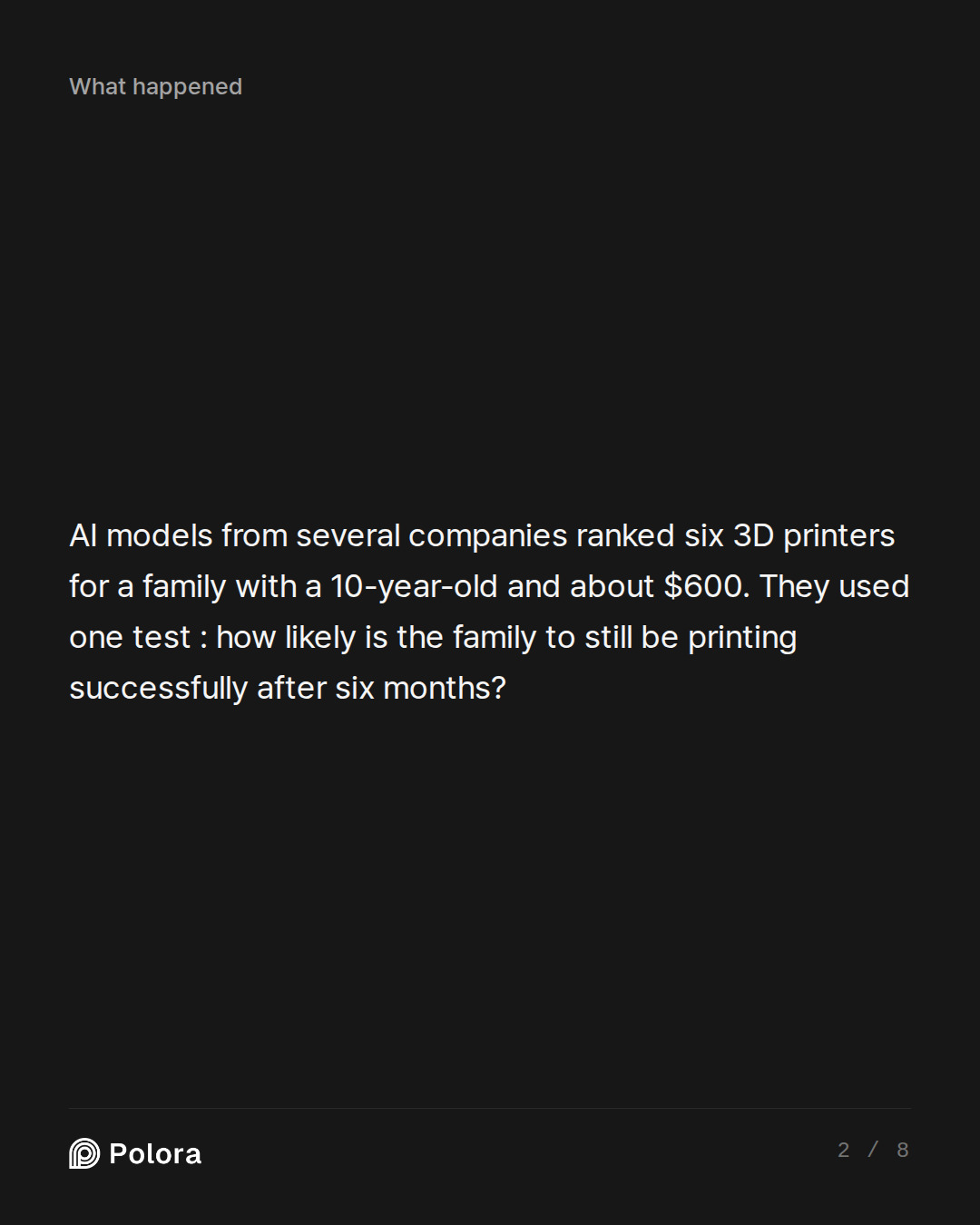
Picture a family buying its first 3D printer for roughly $600. A parent and a 10-year-old want to make household fixes and school projects, and the printer will sit in a room where everyone lives, not in a garage. Polora put that situation to AI models from several companies. It asked them to check current prices and rank six printers by a single test : how likely is this family to still be printing successfully after six months? The six were the Bambu Lab A1 Combo, A1 Mini and P1S, the Elegoo Centauri Carbon, the Prusa Core One and the Creality K2 Pro. Three models each took one angle : safety in the home, reliability and maintenance, and value. A researcher model checked prices, and a model acting as moderator ran the discussion and wrote the final ranking.
Two words come up throughout. Filament is the spool of plastic the printer melts to build each object, and it is the main ongoing cost. A Combo is a printer sold together with an add-on that feeds several colors of filament automatically, so one print can come out in more than one color.
The three debating models never settled on a single winner. What they did agree on is a point buying guides rarely make. The printer that is easiest to start with is not necessarily the one that is best to live with next to a child.
Why the AI moderator ranked the enclosed Elegoo Centauri Carbon 2 first
The original Centauri Carbon now has a successor. According to the researcher model, Elegoo launched the Centauri Carbon 2 Combo on January 26, 2026. It sells the Carbon 2 alone or bundled with a four-color feeding system called CANVAS. The Elegoo US store listing seen in the discussion showed the Combo on sale at $369, down from $449, and the single-spool printer at $319.
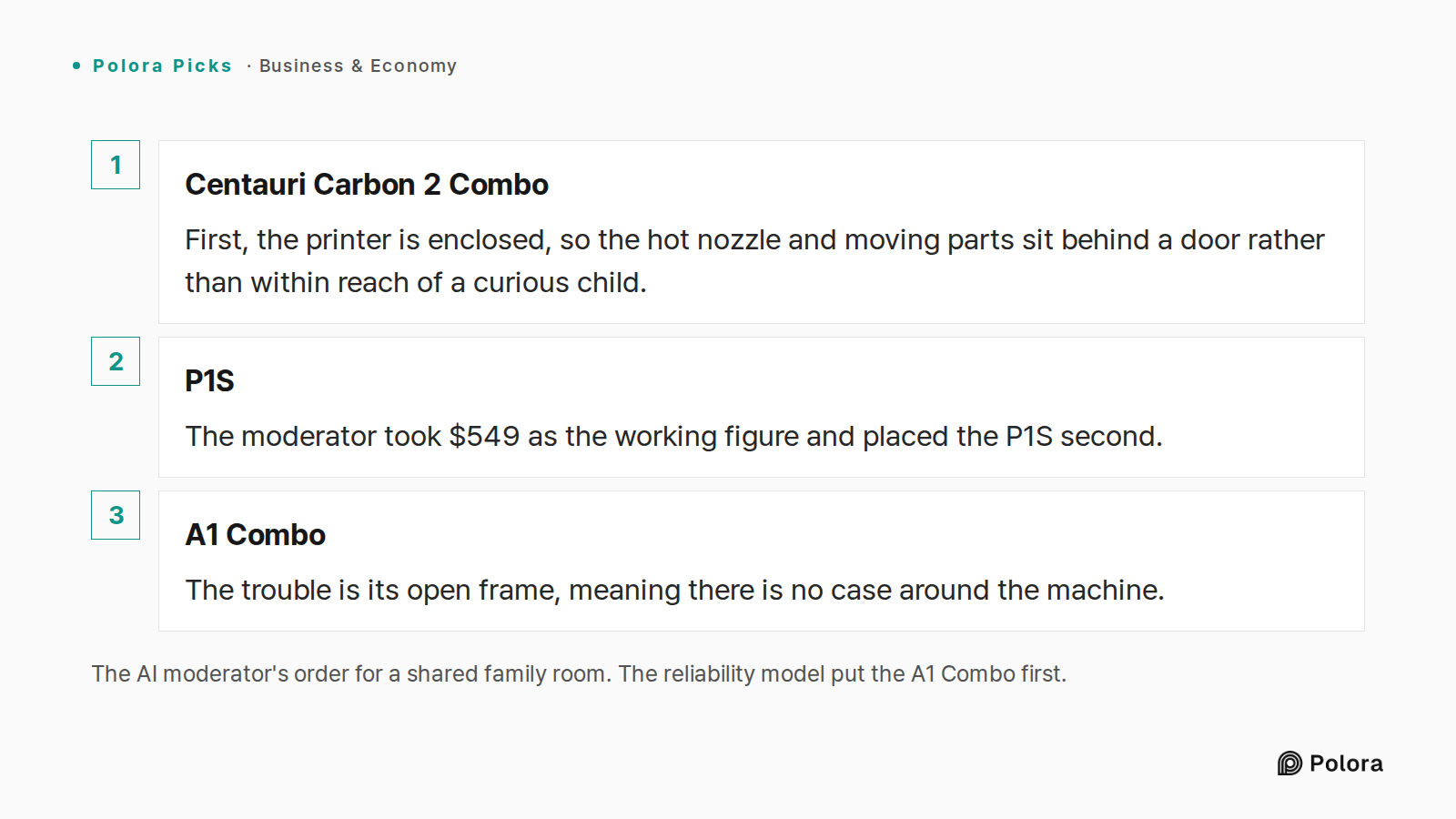
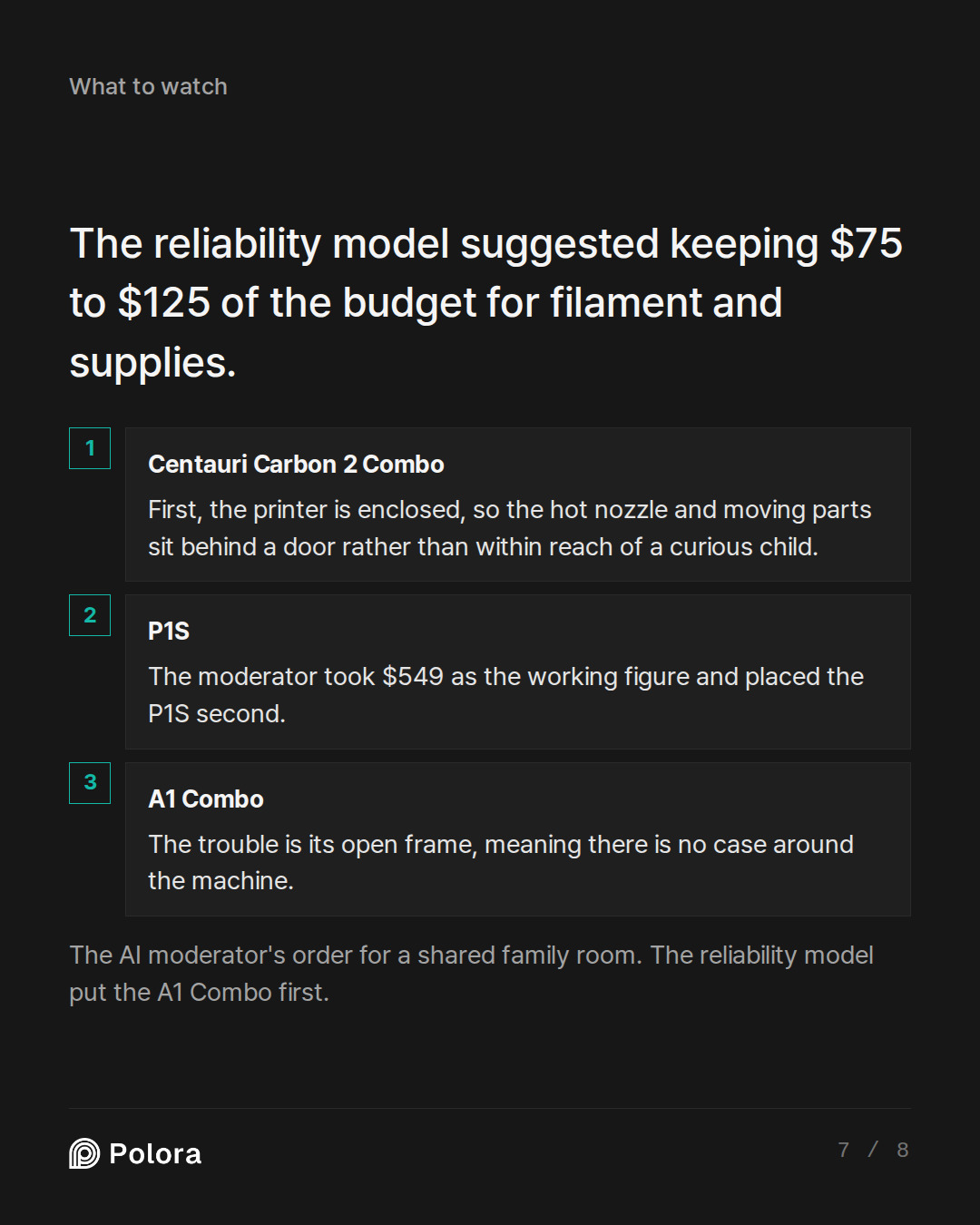
The moderator's case rested on two things. First, the printer is enclosed, so the hot nozzle and moving parts sit behind a door rather than within reach of a curious child. Second, it prints objects up to 256 mm on each side for well under the budget, which leaves money for filament and spare parts. The reliability model also pointed out that the manual documents printing over the local network, and that the printer comes with a USB drive, so everyday printing does not depend on an online account.
The moderator was just as clear about the risk. The Carbon 2 is a newer platform than Bambu's. It lacks the years of owner troubleshooting, tested settings and spare-part history that make a beginner's problems easier to fix. The moderator also said the $369 sale price should not be treated as permanent. The safety model reached the same first place mostly on physical grounds, while the value model put the Elegoo second.
Why the AI moderator put the usual beginner pick, the Bambu A1 Combo, third
The debating models agreed that the A1 Combo earns its place at the top of beginner lists. It calibrates itself, it prints in several colors, and it has a huge base of owners who post fixes online. The reliability model found the plain A1, without the color feeder, at $349 direct from Bambu and called it the benchmark for easy first prints. The moderator could not confirm a current price for the A1 Combo. The value model estimated it at about $489, which would put it above the Elegoo Combo's $369 sale price.
The trouble is its open frame, meaning there is no case around the machine. The bed, the plate the object is built on, slides back and forth, and the heated nozzle is exposed, with nothing between them and a child's hands. The safety model found that makers of add-on enclosures warn that Bambu does not recommend boxing in the A1, because the extra heat may shorten the life of its electronics. So a family that wants a barrier has to work against the manufacturer's own guidance.
The moderator put it this way : the A1 Combo can be the best beginner printing experience and still be a worse purchase for a shared family room. The reliability model disagreed with that ordering and ranked the A1 Combo first, on one condition. Adults must start the prints, and the printer must sit somewhere the child cannot reach. That model's reasoning was that a machine which makes colorful school projects easily keeps a family printing long enough to learn basic maintenance. The moderator accepted part of this and said the A1 Combo would move up to first or second in a home that can meet that condition.
Why the AI moderator placed the Bambu P1S second once its sale price disappeared
No printer's price caused more argument than the P1S's. The reliability model first found it at $869 direct and ruled it out. The value model replied that repeated promotions had brought the standalone P1S down to $399, and ranked it first as the enclosed printer with Bambu's polished, low-failure workflow. The researcher confirmed that the promotions were real. On September 11, 2026, Bambu's US store listed the standalone printer at $399 and the Combo, bundled with Bambu's multicolor feeder, at $499.
The researcher's last check told a different story. The live store page showed the P1S from $549, previously $699, and the moderator read that as the price of the standalone printer. No current price for the Combo was confirmed, and the researcher warned that outside a sale it can run well past $600. The moderator took $549 as the working figure and placed the P1S second. At that price it fits a $600 printer allowance but may go over a $600 total once tax and filament are added. The moderator's view was that a family comfortable with that extra cost, and wanting the more established platform, could reasonably choose it over the Elegoo. This ranking assumes the single-color version, not a multicolor bundle.
Early on, the safety model argued that an enclosure traps fumes and particles and quiets the printer. The moderator challenged the part about air, and the safety model withdrew it. What an enclosure reliably buys a family, it said, is a barrier between a child and the hot, moving parts, plus some containment of noise and drafts, but not cleaner air. It cited one peer-reviewed study in which an enclosure cut the median rate of ultrafine particles, airborne specks far too small to see, by only about 35%. That study tested one printer running ABS, a tough plastic that prints at higher temperatures. The same body of research found that the type of plastic mattered more for emissions than the box around the printer.
That points toward PLA, the most common plastic for home 3D printing, which prints at relatively low temperatures and is usually recommended for beginners. All six printers can use it. The moderator pointed to NIOSH, the US workplace safety agency, which suggests using PLA instead of ABS where possible, along with ventilation.
The safety model kept its point that a closed case helps with noise, but the noise figures got the same scrutiny. Elegoo advertises operation under 45 decibels, roughly the level of a quiet library, but the reliability model noted that the figure comes from Elegoo's own quiet-mode test with PLA and an auxiliary fan turned off. The moderator said noise varies with print speed and placement, and advised against choosing a printer on the strength of that number. The moderator's guidance for any of these printers in a shared room was to start with PLA, keep the machine away from where the child usually plays, ventilate the space, and have an adult handle running and maintaining it.
How much these printers depend on the maker's app and cloud
The value model compared Bambu to Apple : very polished, but closed. It pointed to hotends, the heated part that melts the plastic, built to Bambu's own design, and to a default reliance on Bambu's cloud. The reliability model gave a more balanced picture. Bambu's own security white paper says its printers can run entirely offline in a local-network-only mode, and a memory card offers another way to print without the internet. Setting that up takes more technical effort than simply accepting the app and account. Bambu also sells replacement hotend kits for the A1 directly, so the printer can be repaired in the ordinary consumer sense.
The value model argued that Elegoo's more open approach frees owners from a single supplier when parts break. The moderator noted that this was asserted rather than shown in the discussion. The one point every model agreed on was that Prusa leads here, with the strongest record on repairability, documentation and working without a maker's cloud.
Why the AI moderator ranked the A1 Mini, Prusa Core One and Creality K2 Pro lowest
The A1 Mini costs $249 direct and is just as friendly to use as the A1. But it prints objects only up to 180 mm on each side instead of 256, and it is still open-frame. The value model called its lower price a false economy, arguing that a family would outgrow it before six months as drawer organizers and school models got bigger.
Nobody disputed the Prusa's quality, only its price, and even the price figures conflicted. The reliability model found the current kit at $925 and the assembled printer at $1,202.78. The researcher reported a kit from $1,149 and a new generation assembled at $1,449. The moderator saw Prusa pages listing the kit at $925 or $955.55 and declined to quote a single figure. Whichever number is correct, even the cheapest option is well over $600, and a kit adds hours of assembly for a first-time owner.
The Creality K2 Pro launched as a machine in the $1,200 class, according to the tech news site Tom's Hardware. The sale listings found in the discussion were lower but still above the budget, and at least one showed the US version out of stock. The moderator ranked it last because its size and complexity fit this buyer poorly, and was explicit that no measured failure-rate comparison had shown it to be the least reliable.
What the AI models' printer ranking can and cannot tell a family
The moderator said plainly that this ordering reflects judgments about likely success, not measured failure rates over six months. Bambu's longer track record favors the P1S and A1. The Elegoo came out ahead only narrowly, because in this particular home, keeping a child physically separated from the printer and keeping money for supplies both carried unusual weight.
The budget question mattered almost as much as the printer. The moderator treated $600 as the total starting budget, tax and filament included. The reliability model suggested setting aside $75 to $125 for filament, a spare nozzle, cleaning supplies and a stable surface, and argued that this reserve does more for six-month success than putting every dollar into the machine. Because prices shifted so much during the discussion, the moderator also stressed checking the live checkout total. Choosing between the P1S and the Elegoo is a different decision at $549 than it was at $399.
For a family standing where this one stands, the most useful thing the discussion offers is the order in which to ask the questions. The first is not which printer is easiest. It is whether the adults can truly keep a 10-year-old away from an open, hot, moving machine. If the answer is yes, the models' reasoning makes the well-known beginner favorite a strong choice again. If the answer is no, their arguments point toward an enclosed printer, even though an enclosure does nothing to clean the air.
The AI moderator's order for a shared family room. The reliability model put the A1 Combo first. · Centauri Carbon 2 Combo · P1S · A1 Combo · First, the printer is enclosed, so the hot nozzle and moving parts sit behind a door rather than within reach of a curious child. · The moderator took $549 as
Rank these 3D printers for a first-time buyer in the US with a budget of about $600 who will print household fixes and school projects with a 10-year-old, in a shared living space rather than a garage: Bambu Lab A1 Combo, Bambu Lab A1 Mini, Bambu Lab P1S, Elegoo Centauri Carbon (or its successor if the original is no longer sold), Prusa Core One, and Creality K2 Pro. Check current prices and availability first. Rank them by how likely this household is to still be printing successfully after six months, weighing setup and calibration effort, failure rate, fumes and noise in a shared room, safety around a child, material flexibility, and dependence on the maker's cloud or app versus working offline and being repairable. Say where the printer most reviews call best for beginners is not the best choice for this household.
Safety and Domestic Environment Analyst · claude-sonnet-5
Safety and Domestic Environment Analyst — Opening Position
I'll get straight to the household-safety ranking, because for a family with a 10-year-old printing in a shared living room, the physical environment matters more than raw print quality.
The core safety variable: enclosure
The single biggest safety and livability factor here is whether the printer has a physical enclosure. An open-frame printer in a living room means: exposed heated nozzle (200-300°C) at a child's eye/hand level, exposed moving belts and hotend, and unfiltered fume/particulate release directly into breathable air. An enclosed printer contains all three.
- Bambu Lab A1 Combo and A1 Mini: both open-frame. Bambu Lab A1 and A2L are open-frame machines with no manufacturer enclosure. Worse, aftermarket enclosure kits explicitly warn: Bambu Lab does not recommend enclosing the A1, on the grounds that elevated internal temperature may shorten the life of the printer's electronics. That's a real bind for a shared-room household — you either accept an exposed hot nozzle near a curious 10-year-old, or void the manufacturer's thermal design by boxing it in.
- Bambu Lab P1S: enclosed.
- Elegoo Cent…
Reliability and Maintenance Evaluator · gpt-5.6-terra
Reliability and Maintenance Evaluator — Opening Position
I agree with the safety analyst on the key correction to generic “best beginner printer” advice: the Bambu A1 Combo is probably the easiest machine here for a novice to get good PLA prints from, but it is not automatically the best fit for this particular family. Its open format is a real household compromise, not a minor footnote.
But there is an equally important reliability correction: an enclosure alone does not make a printer the more dependable six-month choice. A beginner succeeds when the printer has mature firmware, predictable profiles, good documentation, readily available parts, and a recovery path when a nozzle clogs or a first layer fails.
First: current budget reality
As of September 27, 2026, the field splits sharply:
- Bambu A1: $349 direct from Bambu; the Combo price is selected separately but is ordinarily within the stated $600 ceiling. It has a 256 mm cube build volume and automatic calibration. (us.store.bambulab.com)
- Bambu A1 mini: $249 direct; 180 mm cube build volume. It is the lowest-cost a…
Ecosystem and Value Strategist · gemini-3.1-pro
Ecosystem and Value Strategist — Opening Position
I need to issue an immediate market correction to the Reliability Evaluator’s financial baseline. When assessing the long-term value and ecosystem of these machines, we have to look at actual street prices in late 2026, not outdated launch MSRPs.
The Reliability Evaluator dismissed the Bambu Lab P1S as an $869 machine. But in reality, aggressive market competition in 2026 has pushed Bambu's pricing down significantly. Verified by major outlets like Tom's Hardware and IGN this summer, the P1S standalone model now frequently drops to $399, and the P1S Combo (with the AMS for multi-color) frequently goes on sale for around $549 (e.g., Best Buy's recent anniversary sales).
This completely changes the math. The P1S is absolutely within this family's $600 budget.
When evaluating whether this household will still be happily printing in six months, we have to balance three things: Total Cost of Ownership (TCO), Ecosystem Lock-in, and the Physical Reality of the Hardware.
The "Best Beginner Printer" Trap
Most reviews enthusiastically name the Bambu Lab A1 Combo the best beginner printer on the mark…
Researcher · claude-sonnet-5
Researcher — Fact-Check on Pricing Claims
I have one search left used already on Prusa/Creality confirmation, so here's what I could verify against the two main pricing disputes in this round.
The P1S price dispute: the Value Strategist is closer to correct, but the Reliability Evaluator wasn't wrong about MSRP
This is a case where two debaters cited genuinely different (but both real) numbers because the P1S has been on deep, repeated promotional pricing all year.
- The Bambu Lab P1S has a US price of $699 (MSRP base unit $699 (frequently discounted to ~$399-499); P1S Combo with AMS ~$899), as of 2026-06-27.
- However, sale pricing has been frequent and substantial: on September 11, 2026, Bambu's official US store marked the standalone P1S, P1S AMS Combo, and P1S AMS 2 Pro Combo in stock at $399, $499, and $579 respectively — those were live promotional prices and can change without notice.
- One review site pegs current typical range as Base P1S: $399-$449 (frequently on sale at the lower end, MSRP was originally $699), P1S + AMS 2 Pro Combo: $650-$750.
- Tom's Hardware itself, in a separate late-2025 review, listed the Bambu Lab P1S Combo... with a price tag of $829 f…
The Arbiter · gpt-6-sol
Round 1 record
The main disagreement is now about the best *six-month household choice*, not the easiest first print. The Safety Analyst, Reliability Evaluator, and Value Strategist all distinguish the beginner-friendly A1 Combo from the needs of a family printing beside its everyday living space. The A1 Combo and A1 Mini have exposed moving and heated parts; the other four candidates are enclosed. The Safety Analyst would give enclosure decisive weight, while the Reliability Evaluator cautions that an enclosure cannot substitute for mature software, dependable profiles, parts, and troubleshooting support. (us.store.bambulab.com)
The P1S price dispute remains consequential. The Reliability Evaluator treated it as an over-budget $869 purchase; the Value Strategist argued that repeated promotions put a standalone P1S near $399 and sometimes bring a Combo under $600. The Researcher found evidence for those promotional prices, including an in-stock September 11, 2026 offer, but also found substantially higher nonsale Combo prices. That establishes a real possible budget option—not that…
Safety and Domestic Environment Analyst · claude-sonnet-5
Safety and Domestic Environment Analyst — Final Ranking
Let me close on the two things the Arbiter flagged as unresolved: an actual checkout price for the Elegoo successor and Centauri Carbon, and a tighter distinction between "enclosed" and "safe to breathe near."This is genuinely useful, and it sharpens rather than weakens my case — including one important correction I need to make honestly.
The correction I owe the table
I need to concede something the Arbiter was right to press on. The peer-reviewed literature does not show that enclosures reliably solve the emissions problem. The key ACS study found that the presence of an enclosure only moderately reduced UFP emission rates from the MakerBot–ABS combination, with a ∼35% reduction in the median emission rate, and the researchers explicitly noted they had no information to date on how the design or shape of printed materials, or printer characteristics such as the presence of enclosures, may influence gas and/or particle emissions at the time. So I'll stop implying "enclosed = clean air." What an enclosure reliably buys this family is child-safety (no small fingers near a 300°C nozzle or moving gantry) and noi…
Reliability and Maintenance Evaluator · gpt-5.6-terra
Reliability and Maintenance Evaluator — Final Position
I agree with the Safety Analyst’s correction: an enclosure is a meaningful physical barrier, not an air-cleaning system. For a shared living space, use PLA, place the printer away from the family’s main seating area if possible, and ventilate the room. Do not treat any desktop FDM printer as something to run unattended around a child.
But I reach a different final ranking because the question is not merely “which machine is safest to stand near?” It is: which household is most likely still to be printing successfully in six months? That puts enormous weight on mature setup workflows, slicer profiles, troubleshooting documentation, replacement parts, and the likelihood that a first-time owner can recover from ordinary clogs, adhesion problems, or filament issues.
My ranking
| Rank | Printer | My verdict |
|---|---|---|
| 1 | Bambu Lab A1 Combo | Best chance of six-month success—*if* the household can put it in a supervised, out-of-reach location and accept open-frame PLA printing. |
| 2 | Bambu Lab P1S, standalone—only if actually available at ≤$450 | Best enclosed alternative, but do not b…
Ecosystem and Value Strategist · gemini-3.1-pro
Ecosystem and Value Strategist — Final Strategy and Ranking
When assessing this as a value strategist, I look at the Total Cost of Ownership (TCO) and the Ecosystem. A printer sitting unused after six months because the family couldn't find good models, couldn't figure out the slicer, or got tired of policing a 10-year-old around a hot nozzle is a $600 paperweight. Value is about maximizing the return on investment—in this case, successful, stress-free household prints and school projects.
Here is my final ranking for this specific $600 budget and household profile.
1. Bambu Lab P1S (Standalone)
Estimated Price: ~$399–$449 (Verified recurring promotional pricing; MSRP higher)
The Verdict: The ultimate ecosystem value for a shared space.
While I originally pushed for the AMS combo, the Researcher and Reliability Evaluator rightly pointed out that catching the Combo under $600 requires timing a specific sale, whereas the standalone P1S frequently hits the ~$399–$449 mark. Buying the standalone P1S leaves $150 in the budget for PLA filament, a textured PEI plate (if not included), and maintenance gear.
Why it wins at 6 months: Bambu's ecosystem (Bambu St…
Researcher · claude-sonnet-5
Researcher — Final Verification (Round 2)
Two pricing claims the debaters leaned on hard both need a real-time correction. I'll keep this tight since I'm down to my last search budget.
1. The P1S: the sub-$450 price the room kept citing is not what the official store shows right now
Nearly every debater built their final ranking on "$399–$449 standalone P1S." That price was real — repeatedly, across January, February, and July 2026 — but it was promotional, and promotions expire. Checking the actual Bambu Lab US store collection page right now:
Bambu Lab P1S 3D Printer From $549.00 USD, was $699.00 USD.
That's the live listing, not a historical snapshot. Separately, multiple Tom's Hardware pieces this year note the P1S's product-lifecycle context: the P1S has been surpassed by the latest P2S 3D printer, but with the P2S still costing around $549, you do have to shell out $200 more for the newer model. Bambu appears to be tapering P1S promotions as it pushes the P2S — the cheaper P1P sibling (uncolored, no AMS-ready enclosure quite the same way) is currently marked $399.00 USD, was $699.00 USD for that model, not the P1S.
Practical takeaway for the household:*…
The Arbiter · gpt-6-sol
Round 2 record
The ranking turns on a real trade-off. The Safety Analyst ranks the Elegoo Centauri Carbon 2 Combo first because its enclosure provides a barrier around hot and moving parts at a price that leaves money for supplies. The Value Strategist ranks the standalone Bambu P1S first for its more established beginner workflow, with Elegoo second. The Reliability Evaluator ranks the A1 Combo first only if adults can maintain a supervised, out-of-reach printing station; otherwise, they favor an enclosed machine. All three agree that the A1 Combo’s reputation as a beginner-friendly printer does not, by itself, make it the best choice for this particular room and family.
The Researcher’s final price check materially changes the P1S argument. They report $549 for the standalone P1S at the US store, rather than the $399–$449 promotions used in the debaters’ rankings. At $549 it may fit a roughly $600 *printer* budget, but leaves little for tax, filament, and maintenance; the Value Strategist’s proposed $150 supply reserve no longer follows. The Elegoo US listing shows the Carbon 2 Combo at $369, reduced from $449, though that sale price should no…
The Arbiter's Final Verdict · gpt-6-sol
My ranking for this household
Buy the Elegoo Centauri Carbon 2 Combo if its US checkout price is still around $369–$449. It is not the safest bet for *proven long-term reliability*—it is too new for that claim—but its enclosed moving parts, usable build size, and room left in a roughly $600 budget for filament make it the best overall bet for this particular family. An enclosure is a touch barrier, not a guarantee of clean air.
I’m treating $600 as the approximate total starting budget, including some filament and tax, rather than permission to spend every dollar on the printer.
| Rank | Printer | Six-month judgment and price/availability check |
|---|---|---|
| 1 | Elegoo Centauri Carbon 2 Combo | The current successor to the original Centauri Carbon. An Elegoo US listing showed $369 on sale, versus $449 regular, with an add-to-cart option; the single-spool version showed $319. The enclosure and supply-budget cushion matter in a shared room. Its principal risk is a shorter repair and reliability track record than Bambu’s. |
| 2 | Bambu Lab P1S, standalone | The more established enclosed…