The big-money years
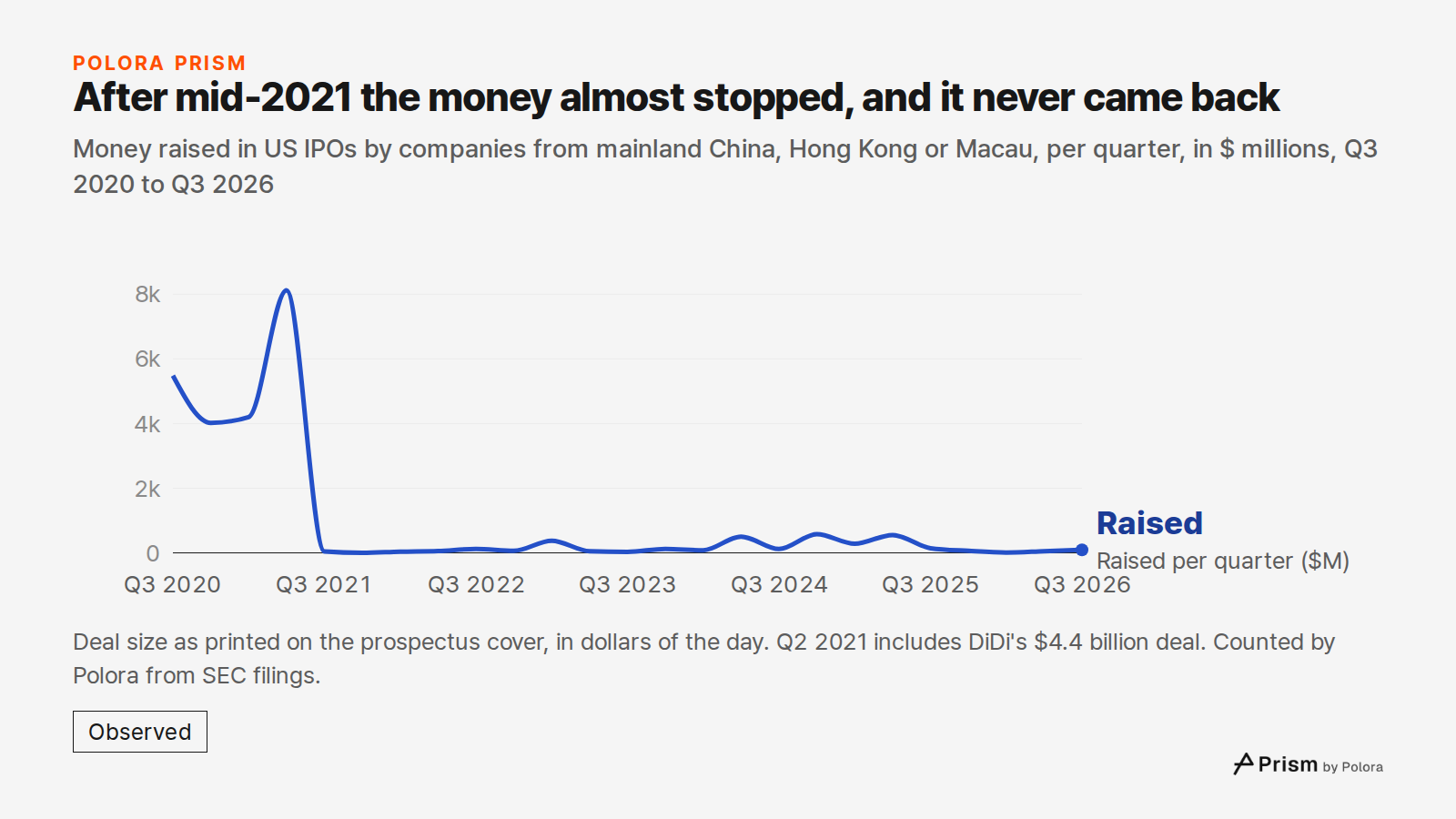
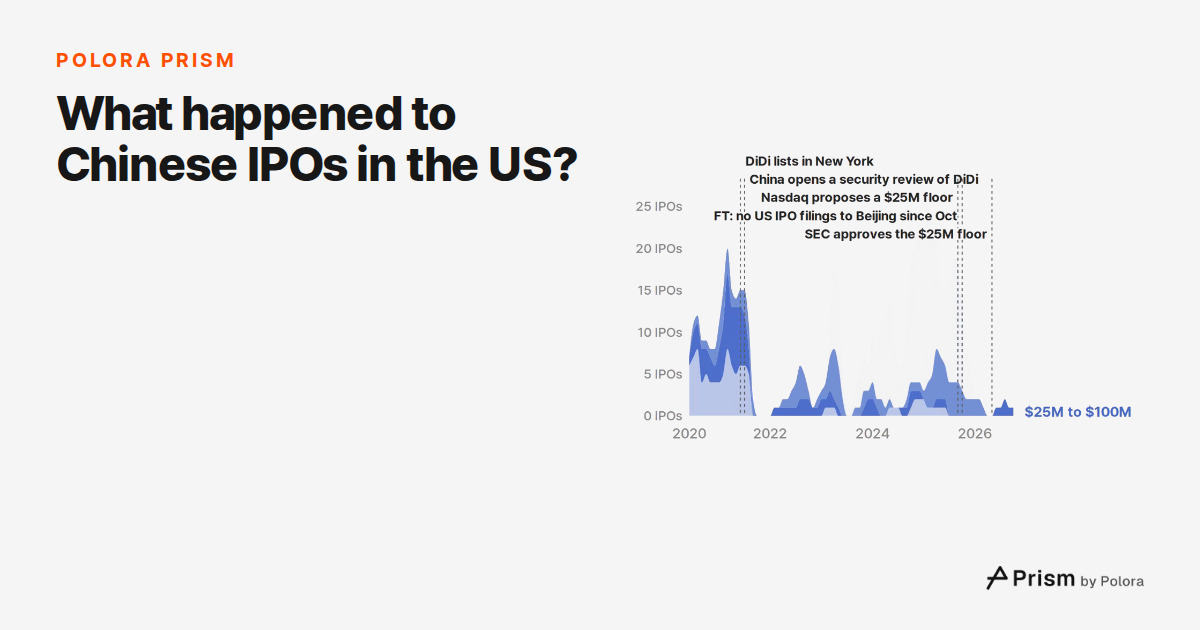
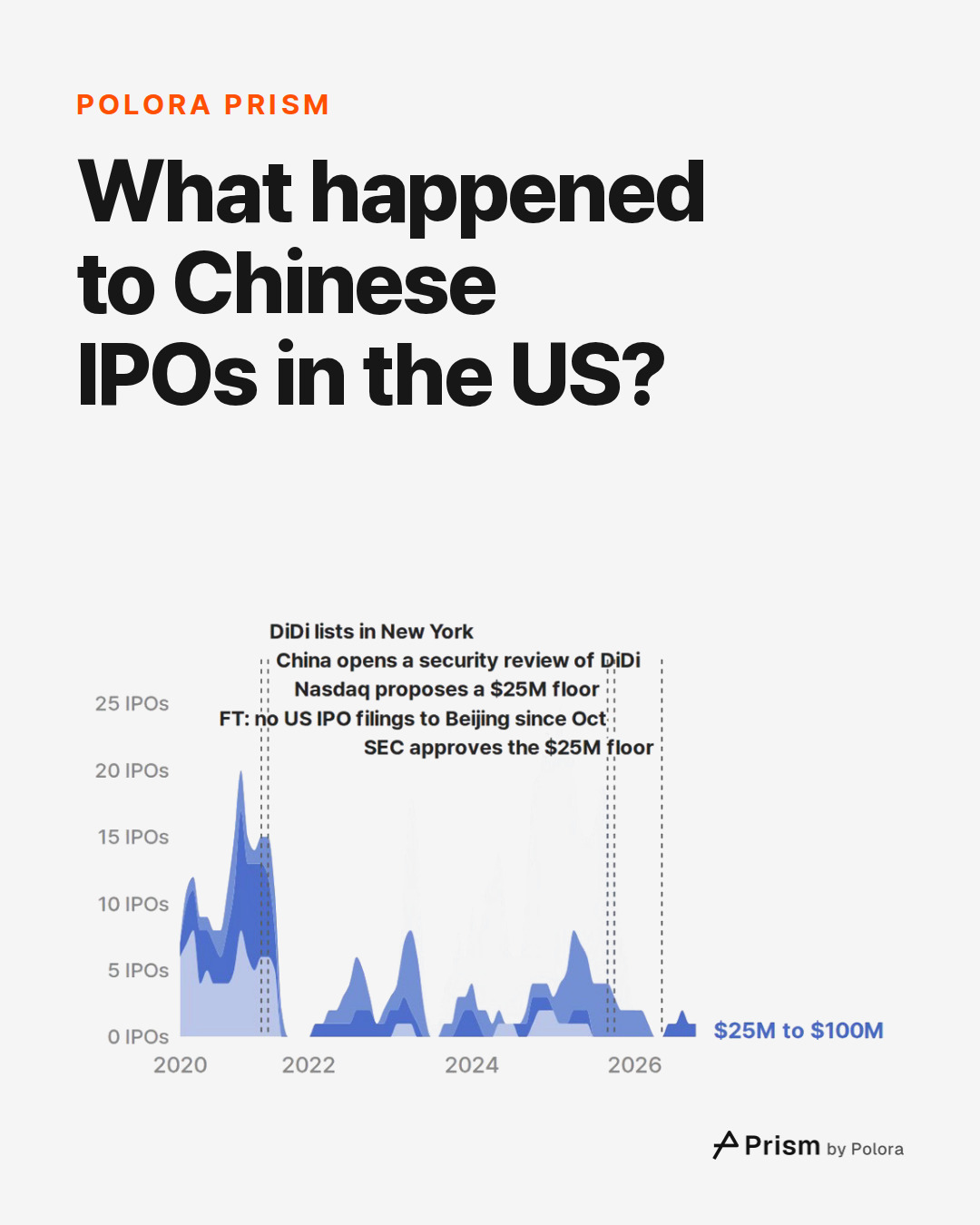
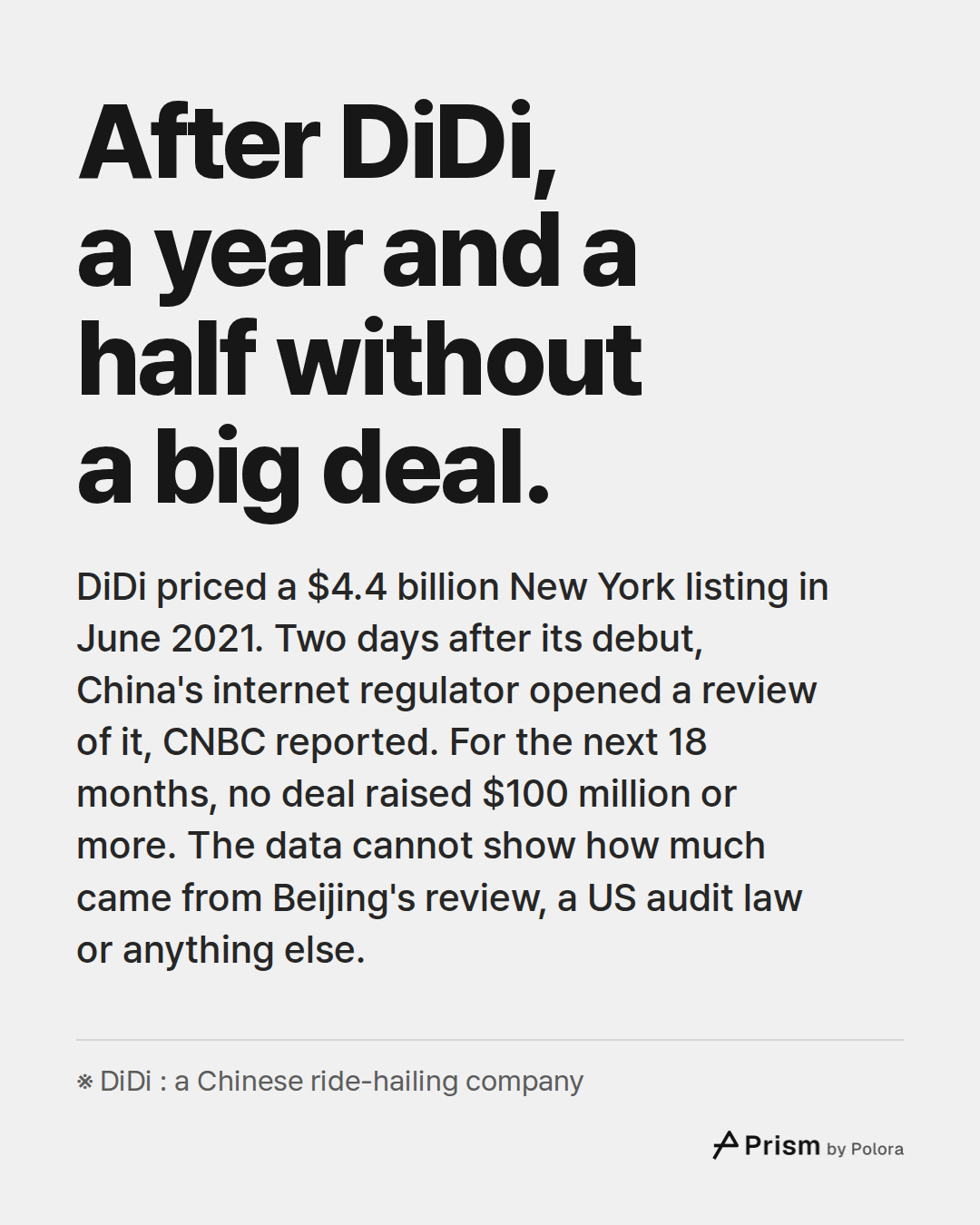
In 2020 and the first half of 2021, large Chinese companies were raising billions in New York. In 2020, 32 companies with a business address in mainland China, Hong Kong or Macau priced US IPOs, raising $11.7 billion. In the first six months of 2021 there were 35, raising $12.3 billion, and 14 of them were deals of $100 million or more. The largest was the ride-hailing company DiDi, which priced its New York listing at the end of June 2021 in a $4.4 billion deal.
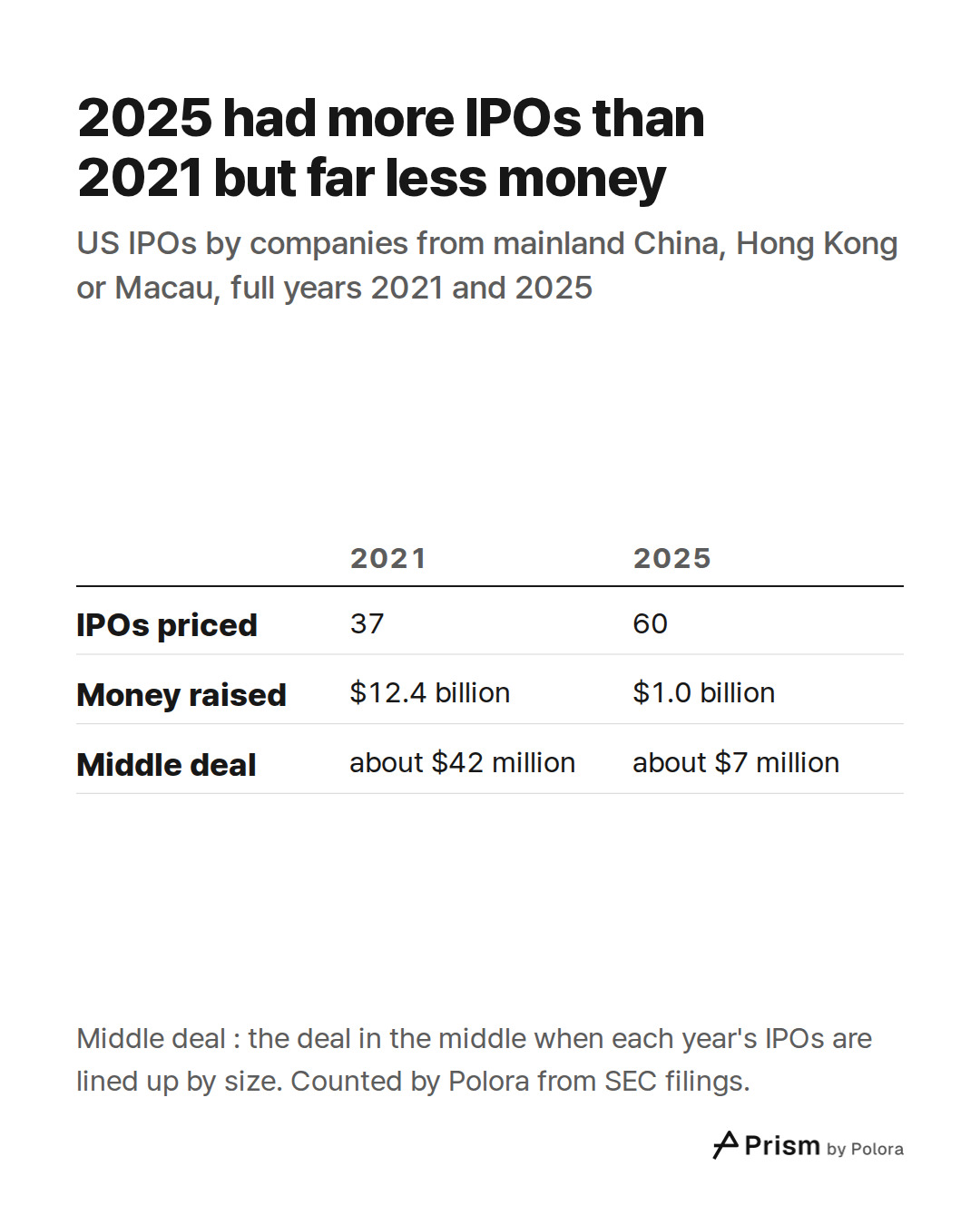
It was not only the top deals that were large. Line up every 2021 IPO in this count by size, and the one in the middle raised about $42 million.
After DiDi, a year and a half without a big deal
Two days after DiDi's debut, China's internet regulator opened a cybersecurity review of the company and barred it from signing up new users while the review ran, CNBC reported. CNBC placed this in a wider crackdown by Beijing on technology companies that had been loosely regulated, months after regulators stepped in and delayed Ant Group's IPO in Shanghai and Hong Kong. On the US side, a law passed in December 2020 told the SEC, the US securities regulator, to ban trading in a company if US inspectors could not fully inspect its auditor for three years in a row. The SEC adopted its first rules under that law in March 2021.
What followed in the data was a drought of large deals. From July 2021 to December 2022, the 18 months after DiDi, 13 companies from mainland China, Hong Kong or Macau priced US IPOs and raised $320 million between them. None raised $100 million or more. All of 2022 brought 11 IPOs and $0.3 billion. The data show the sequence; they cannot show how much of the drought came from Beijing's review, from the US audit law, or from anything else happening in markets at the time.
The number of listings came back, in tiny deals
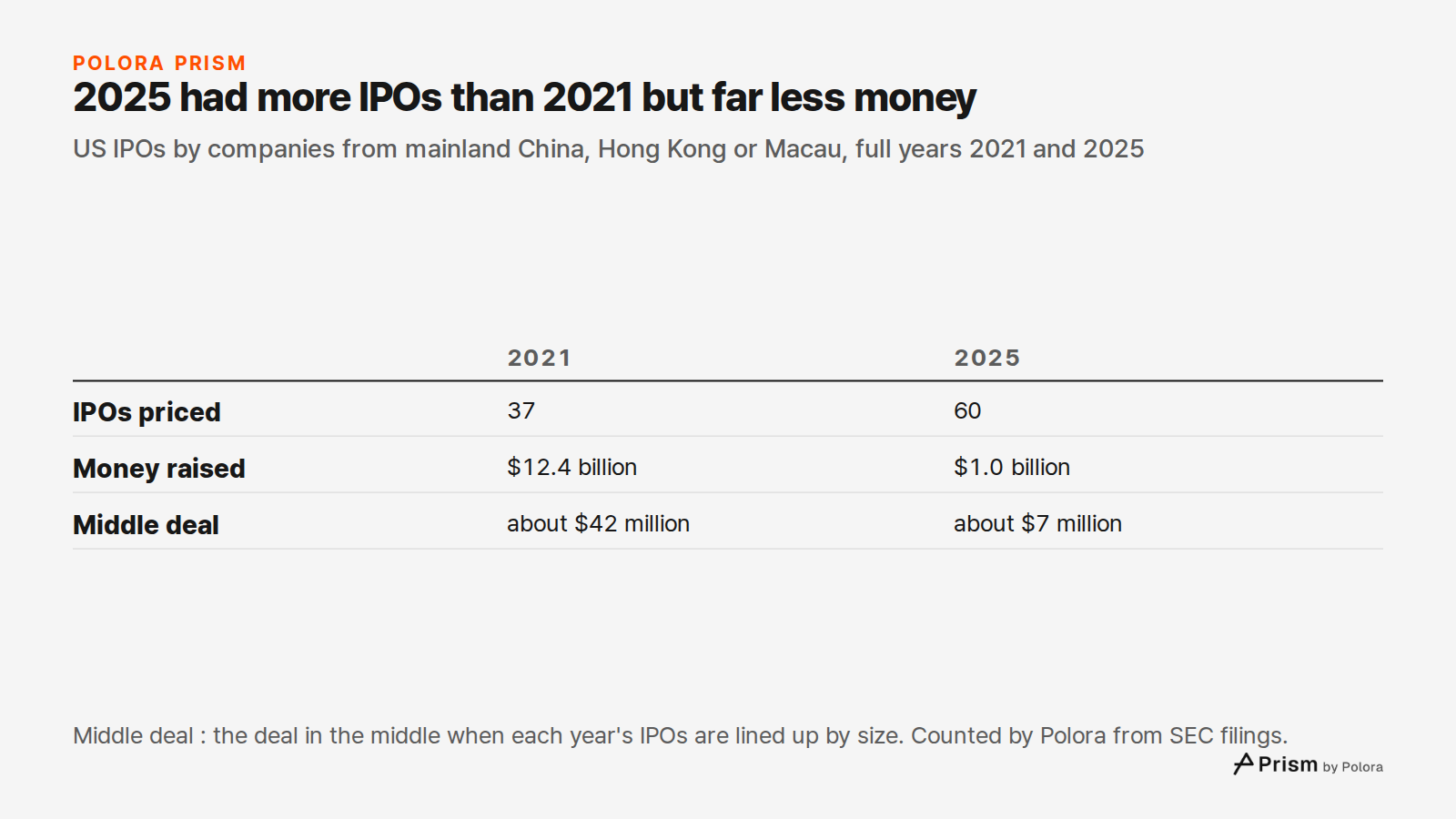
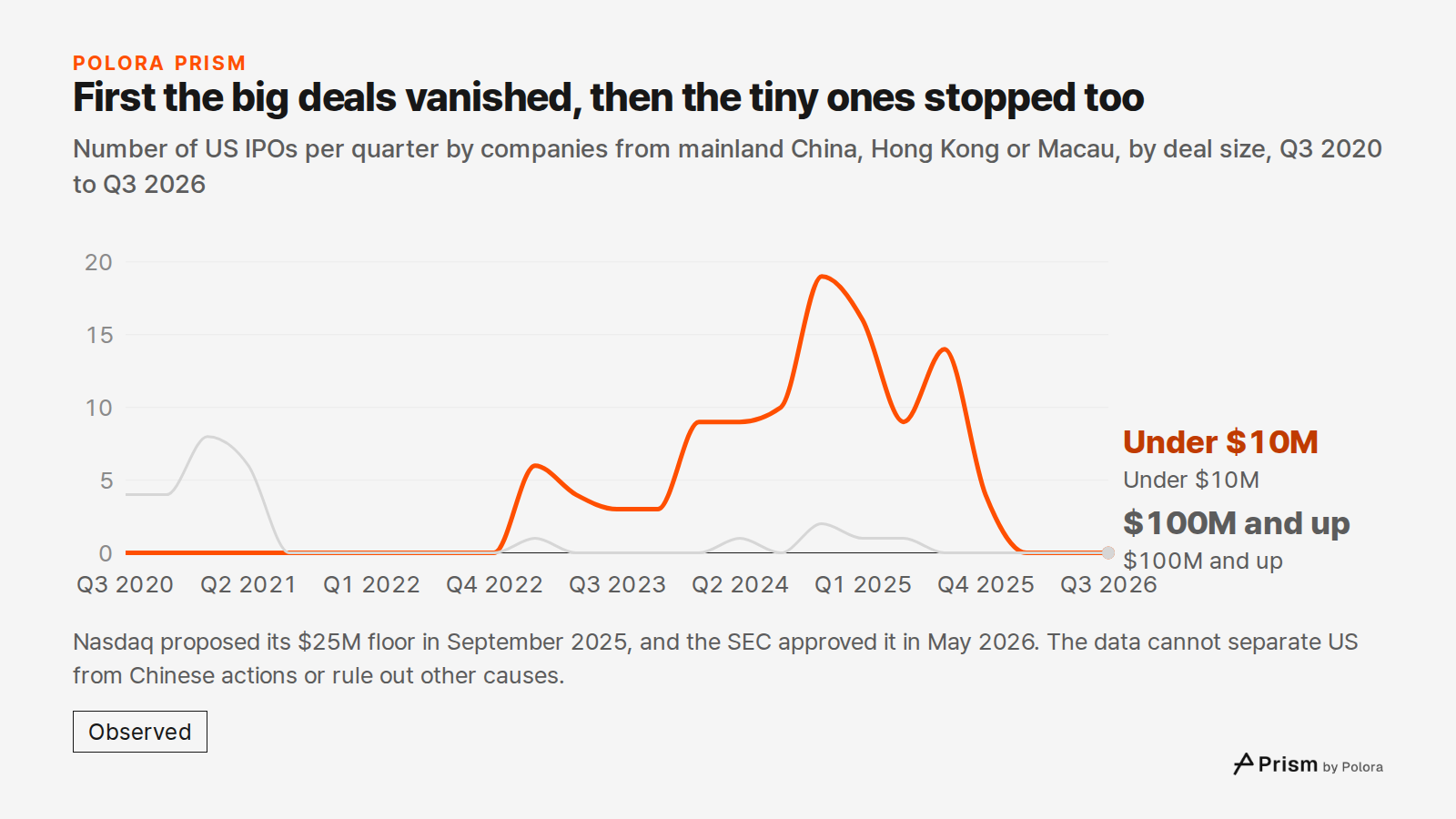
From 2023 the number of IPOs climbed again, but the deals were small. There were 29 in 2023, 16 of them under $10 million. In 2024 there were 56, and 47 of those were under $10 million. In 2025 the count reached 60, more than the 37 of 2021, yet together they raised $1.0 billion, against $12.4 billion in 2021. The middle deal of 2025 raised about $7 million, roughly a sixth of 2021's.
The filings used here do not say why so many small companies came to New York. An executive at a Chinese investment bank that works on US IPOs told the Financial Times that many small Chinese companies could not list at home and turned to lower-threshold venues such as Nasdaq. Meanwhile, as CNBC noted in September 2025, new Chinese policies over the previous three years had required companies to get the securities regulator's approval before listing abroad.
Regulators began to worry about what happened after some of these tiny listings. In November 2022, the US brokerage watchdog FINRA warned of sharp, unusual price jumps on or shortly after the IPOs of some small companies, most of them with operations abroad, and its notice singled out China, according to CNBC. Nasdaq later told the SEC that from August 2022 to April 2025, about 70% of the cases it referred to regulators over possible manipulation involved Chinese companies, which made up less than 10% of its listings.
Then the deals under $10 million stopped
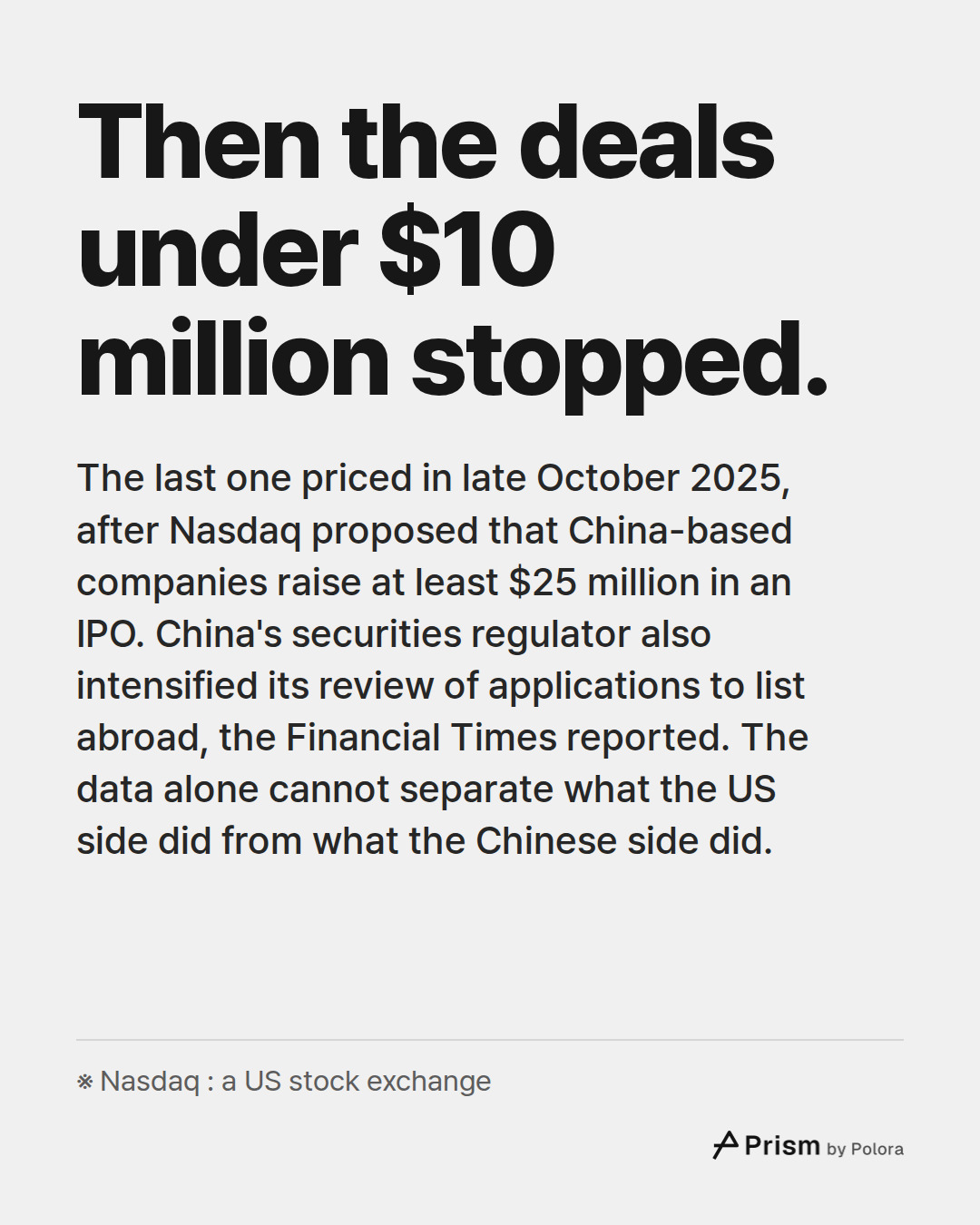
In September 2025 Nasdaq proposed that China-based companies raise at least $25 million in an IPO to list on its market. As approved, the rule covers companies headquartered or incorporated in mainland China, Hong Kong or Macau, or run mainly from there. In the second half of 2025, according to the Financial Times, China's securities regulator also intensified its review of companies' applications to list abroad, and it received no new applications for US IPOs after October.
The last deal under $10 million in this count priced in late October 2025. That was after Nasdaq's proposal and well before the SEC approved Nasdaq's rule in May 2026. The rule was set to take effect about a month after the approval. The FT, reporting in March 2026, put the halt down to regulators in both countries stepping up scrutiny over concerns about stock manipulation. The data alone cannot separate what the US side did from what the Chinese side did, or rule out other causes.
The rule and the size bands here do not measure exactly the same thing. Nasdaq's floor counts what an underwritten offering raises for the company itself, applies only to Nasdaq, and reaches companies run from China wherever they are registered or have their address. The bands here count the full deal on the prospectus cover, including any shares sold by existing holders, on every US exchange, for companies with a business address in mainland China, Hong Kong or Macau.
Chinese IPOs in the US in 2026 so far
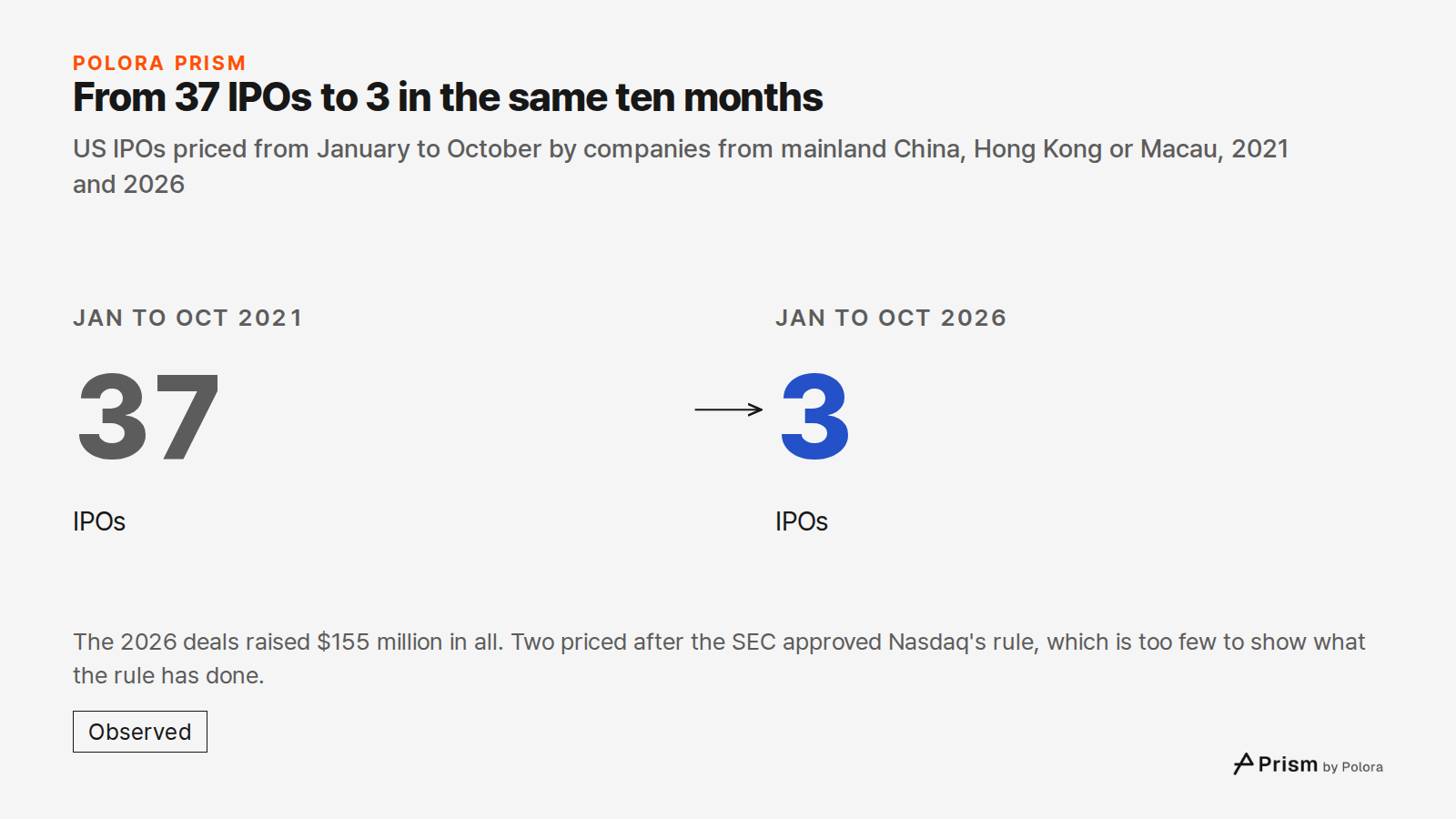
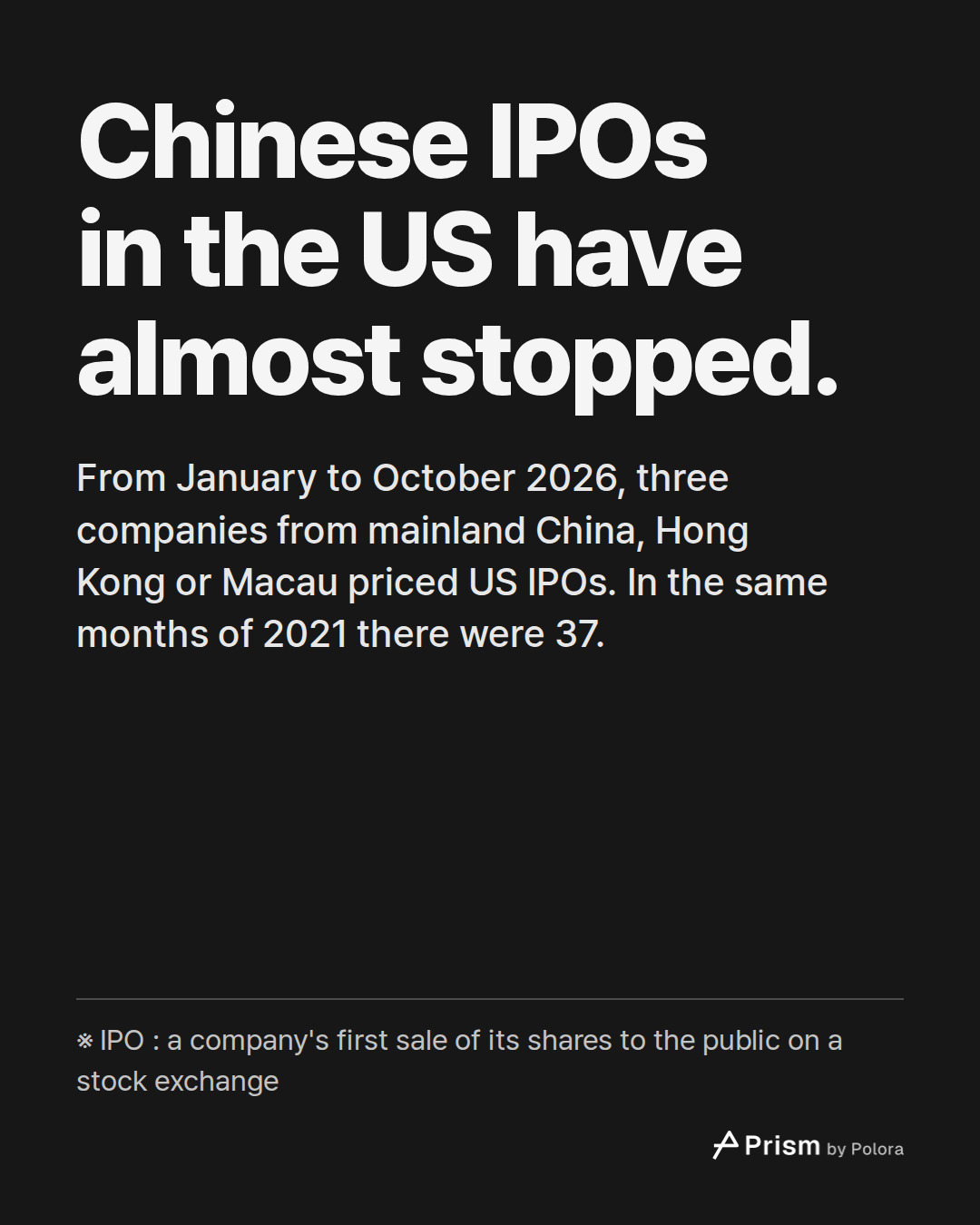
From January to October 2026, three companies from mainland China, Hong Kong or Macau priced US IPOs, raising $155 million in all, against 37 in the same months of 2021. Two priced after the SEC's approval, and both raised more than $25 million, one of them on the New York Stock Exchange, which the Nasdaq rule does not cover. Two deals, with nothing to set them against, cannot show what the rule has done.
How this was counted
Polora built the list from IPO prospectuses filed with the SEC on EDGAR, its public filing database. A company counts if its IPO filing gives a business address in mainland China, Hong Kong or Macau, so a few Chinese-run companies registered with an address elsewhere are left out. Also left out are SPAC mergers, where a company lists by merging with a shell company that is already listed, transfers of shares already trading over the counter, and offerings a company sold without an underwriter. Each deal is dated by its pricing date. For five deals the day the final prospectus was filed stands in for it, which in each case falls within a few days of pricing and in the same month. A deal's size is the total offering price on the prospectus cover, in dollars of the day, before any extra shares the underwriters later bought under their over-allotment option; for some deals, the company's later annual report gives a larger figure that includes those extra shares. The middle-deal figures come from the same list.
Most deals' sizes were read a second time in the company's later filings, usually its first annual report. Five deals were not printed again in any filing saved for this piece, so some yearly totals, and the middle deal of 2025, rest partly on one read.
Other counts differ with the definition. The FT, analysing public records, counted 126 Chinese IPOs in New York across 2024 and 2025; this count finds 116. The FT's list is not published with its article, so the gap cannot be traced here. The count starts in 2020 and does not compare the 2020 to 2021 boom with earlier years.
- SEC EDGAR, company filings (IPO prospectuses, annual reports and closing notices of each company counted)]
- CNBC (2 July 2021), Didi shares fall after China announces cybersecurity review]
- SEC (24 March 2021), SEC Issues Amendments, Seeks Public Comment on Holding Foreign Companies Accountable Act]
- CNBC (4 September 2025), Nasdaq plans will make it harder for small Chinese firms to list]
- K&L Gates (11 September 2025), Nasdaq Proposes to Raise the Bar for New and Existing Listings, Particularly Impacting Small Chinese IPOs]
- Financial Times (March 2026), Chinese IPOs in US falter amid scrutiny of manipulation schemes, as republished by Chin@Strategy]
- Federal Register (19 May 2026), SEC order approving Nasdaq's rule change for China-based companies, release 34-105494]
- Greenberg Traurig in The National Law Review (18 May 2026), SEC Approves Nasdaq's $25 Million IPO Requirement for China-Based Companies]
![Sources 8 : sec.gov · SEC EDGAR, company filings (IPO prospectuses, annual reports and closing notices of each company counted)], cnbc.com · CNBC (2 July 2021), Didi shares fall after China announces cybersecurity review], sec.gov · SEC (24 March 2021), SEC Issues Amendments, Seeks Public Comment on](https://media.cdn.polora.ai/picks/2026/11/pickrun_ce8ec4e2925d4233/0n4xUui01dcnmnbz-slide-06--what-happened-to-chinese.jpg)