What is being measured
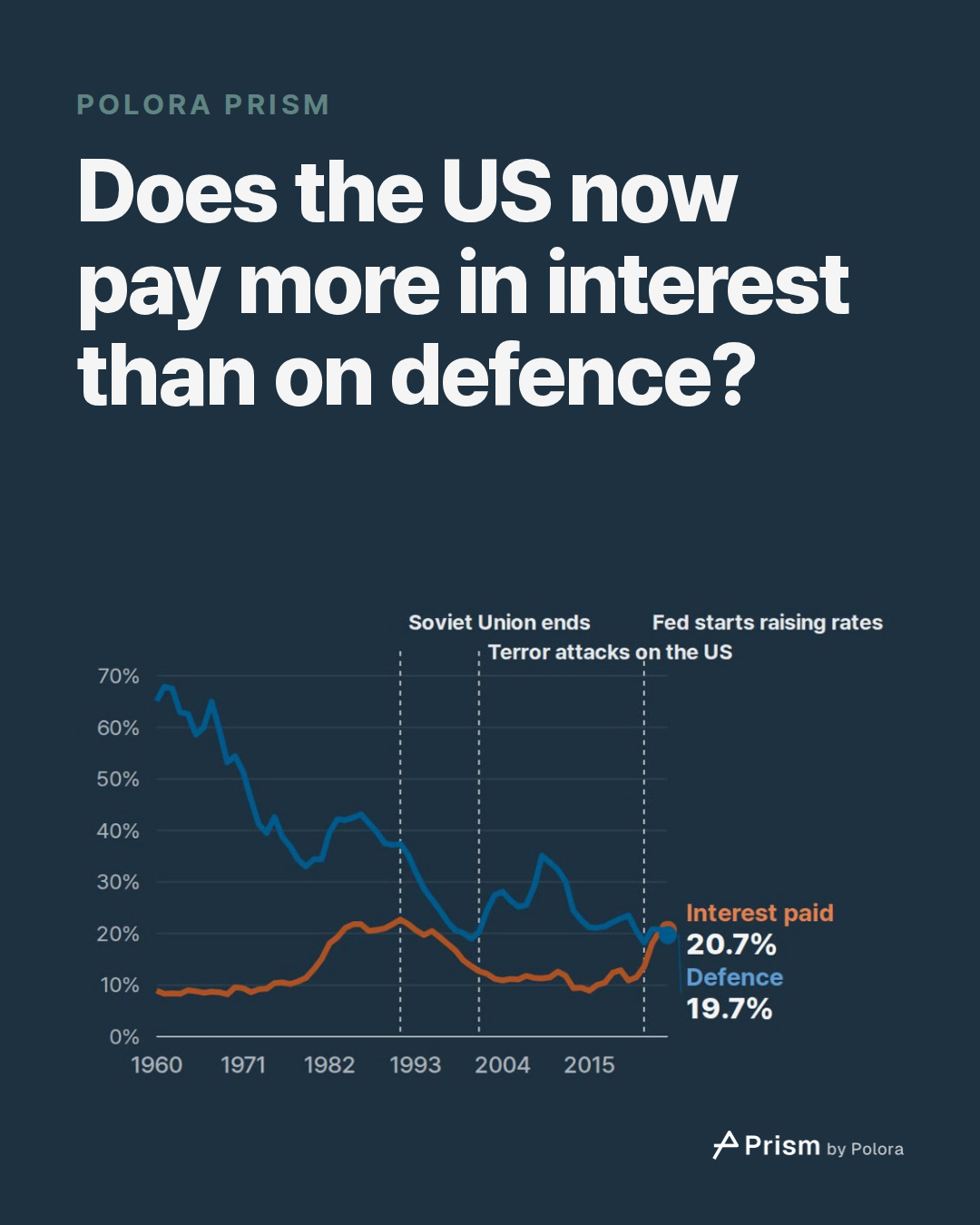
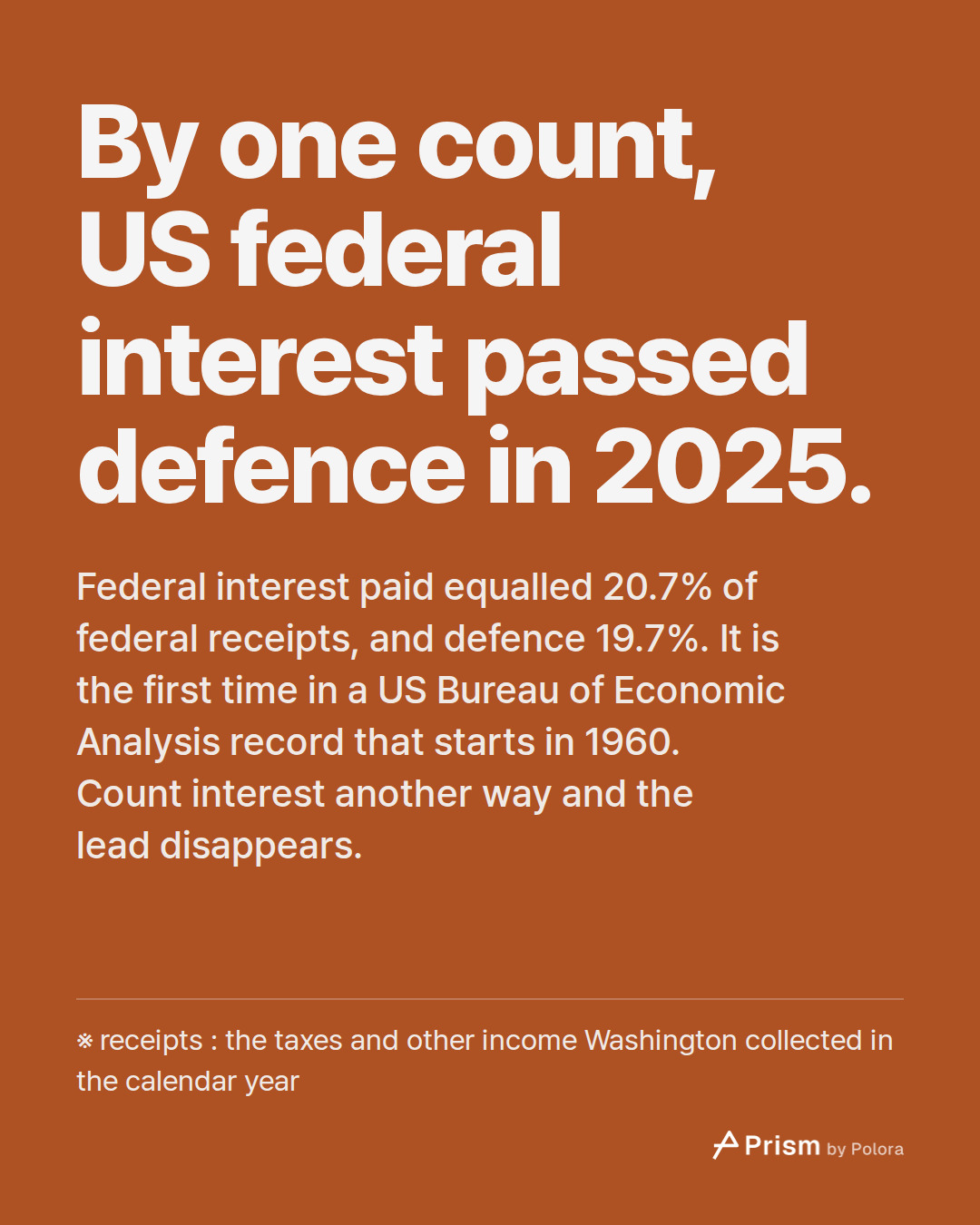
Both lines come from the national accounts of the US Bureau of Economic Analysis (BEA). Each is shown as a share of federal current receipts : the taxes and other income Washington collected in the calendar year.
Interest here is what BEA calls monetary interest paid. It is federal interest without an imputed amount that BEA adds for pensions (more on that below). Defence is national defence consumption and investment, which in these accounts also counts the wear on military equipment and buildings. Because Washington also borrows, the share doesn't say how much of its income went to either one. It is a yardstick : how big each bill is next to what came in.
In 2025, interest paid was $1.18 trillion and defence $1,125 billion, while receipts were $5.70 trillion.
Sixty-five years in four moves
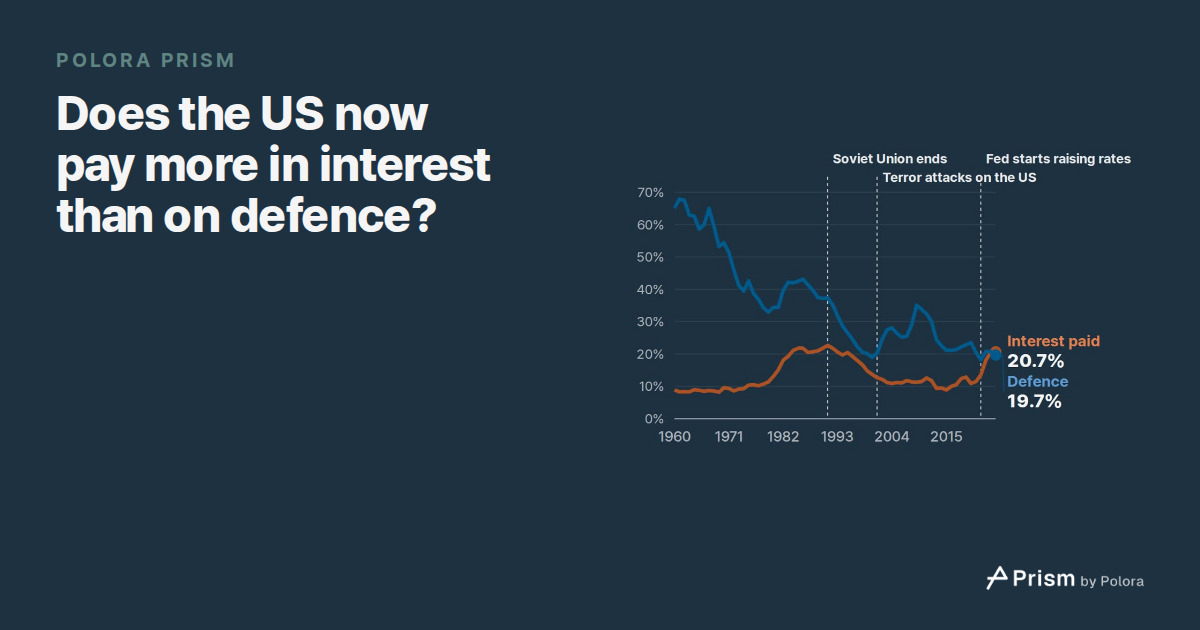
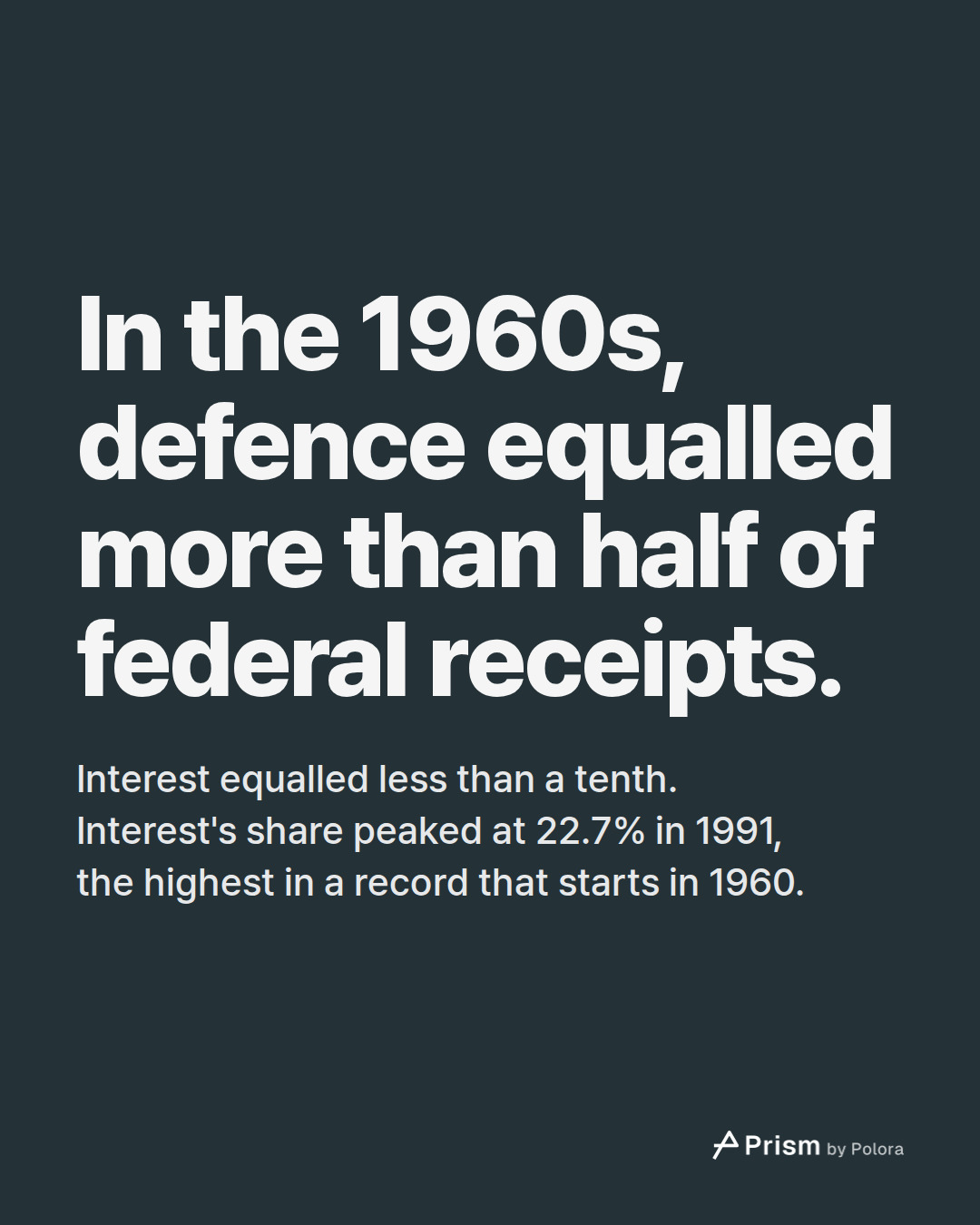
In the 1960s, defence equalled more than half of federal receipts every year, and interest less than a tenth. Interest then climbed through the 1970s and 1980s and peaked at 22.7% of receipts in 1991, the highest in this record. Defence that year was 37.4%. 1991 is also the year the Soviet Union dissolved.
Both shares fell in the 1990s. Defence's share rose again in the 2000s, the decade that began with the September 2001 attacks. By 2015, interest was down to 8.9% of receipts and defence to 21.2%.
Interest's share was 11.5% in 2021. By 2024 it had reached 20.5%, just under defence's 20.8%, and in 2025 it went past.
Why interest's share jumped
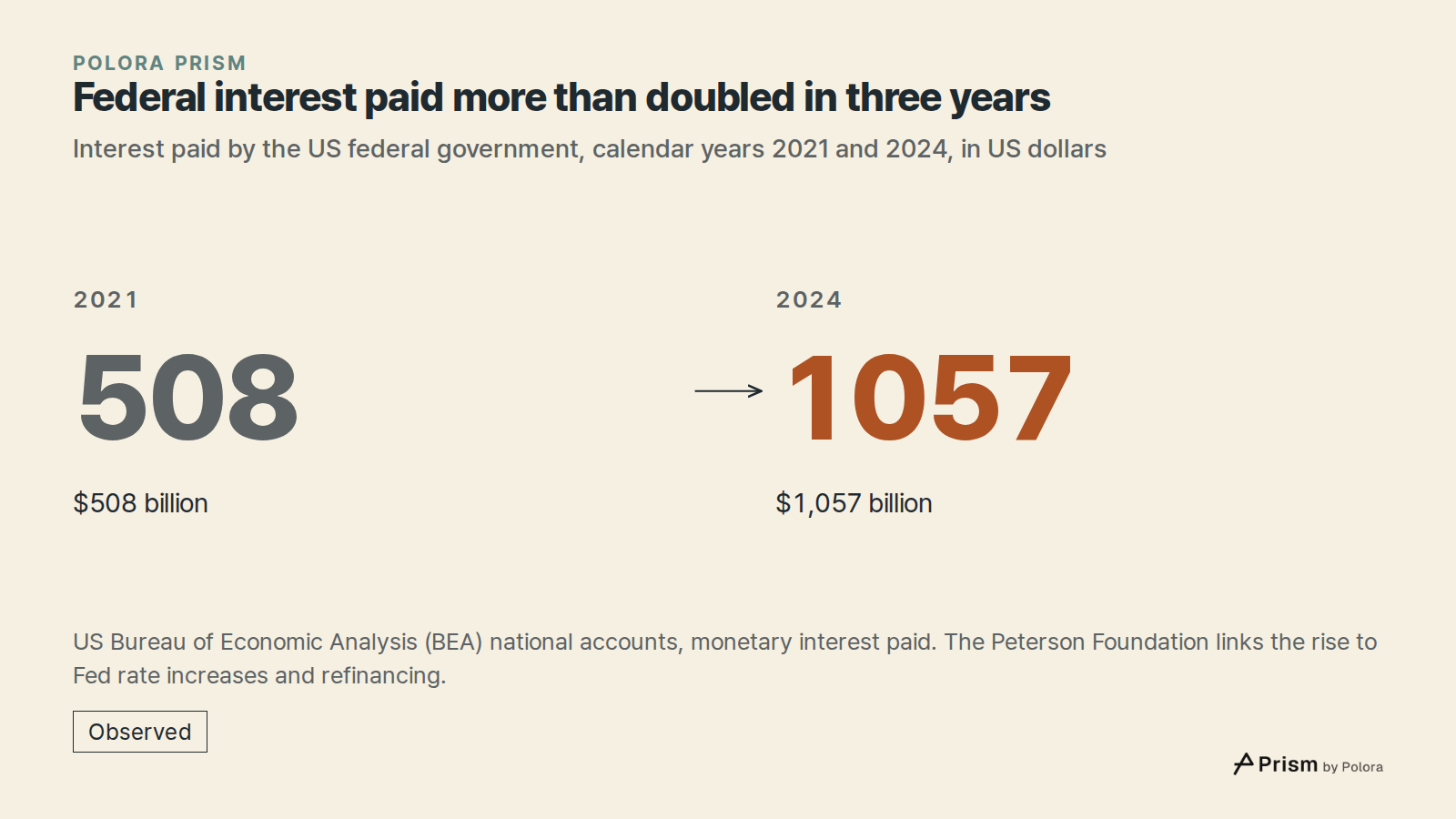
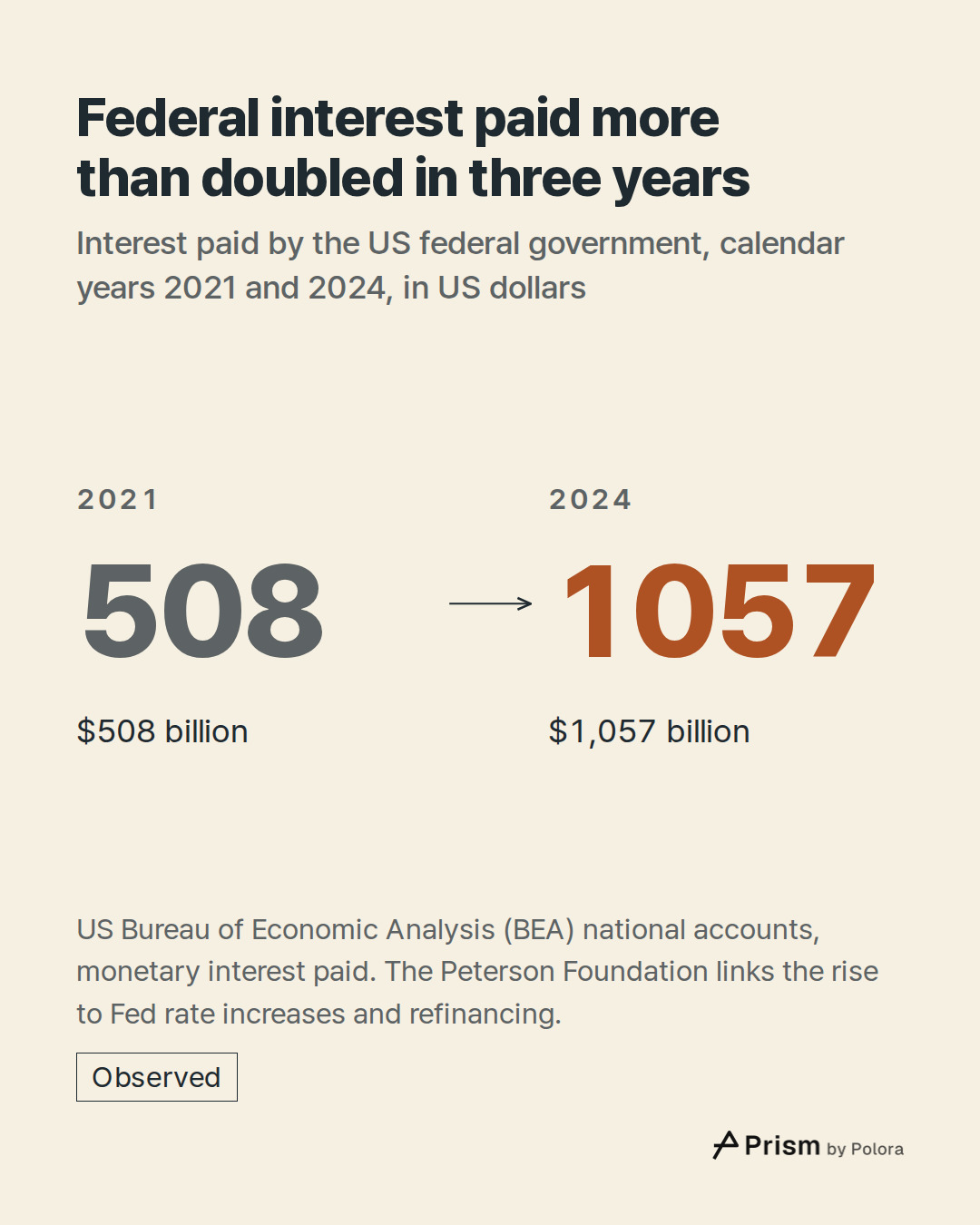
In dollars, interest paid more than doubled, from $508 billion in 2021 to $1,057 billion in 2024. The Peter G. Peterson Foundation, which follows the federal budget, gives its account of why. It says the Federal Reserve's rate increases from March 2022 through July 2023 "led to higher interest rates across the board and significantly boosted payments on federal debt". It adds that as debt matured, it had to be refinanced at the highest rates in over a decade, and that heavy borrowing added to the bill. The Foundation's figures are budget net interest by fiscal year, a different measure from the one here : the years, and what is netted out, differ.
Receipts matter too, because they are the other half of every share. In 2023 federal receipts fell 5.6%, which pushed both shares up and accounts for part of that year's jump in interest's share.
The 2025 crossing came mostly from defence's side. Receipts grew 10.4% that year and defence spending only 4.8%, so defence's share fell by about a point. Interest grew a little faster than receipts, so its share barely moved.
How you count interest decides whether it is ahead
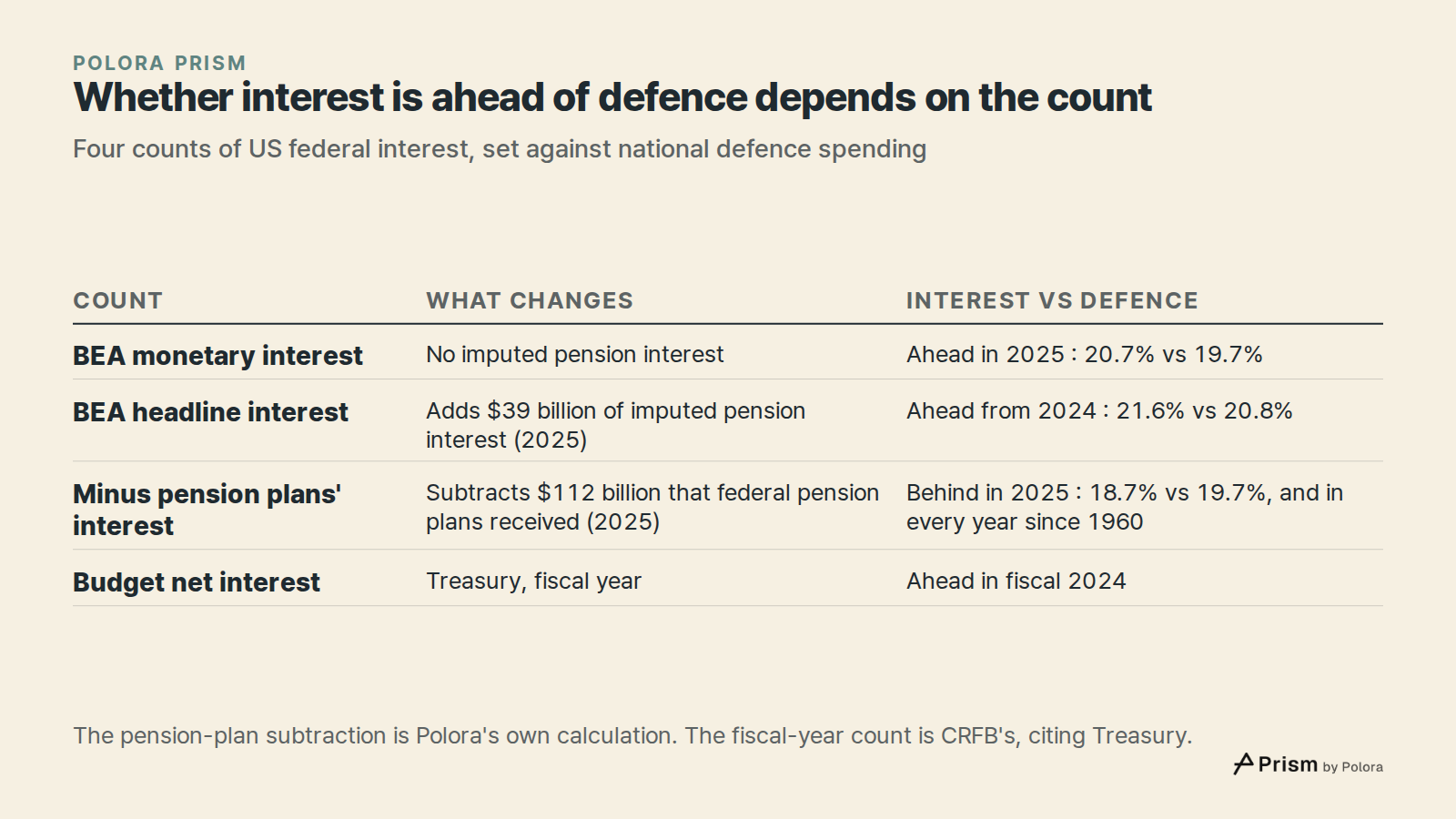
BEA publishes more than one measure of federal interest, and the year interest passes defence depends on which one you use.
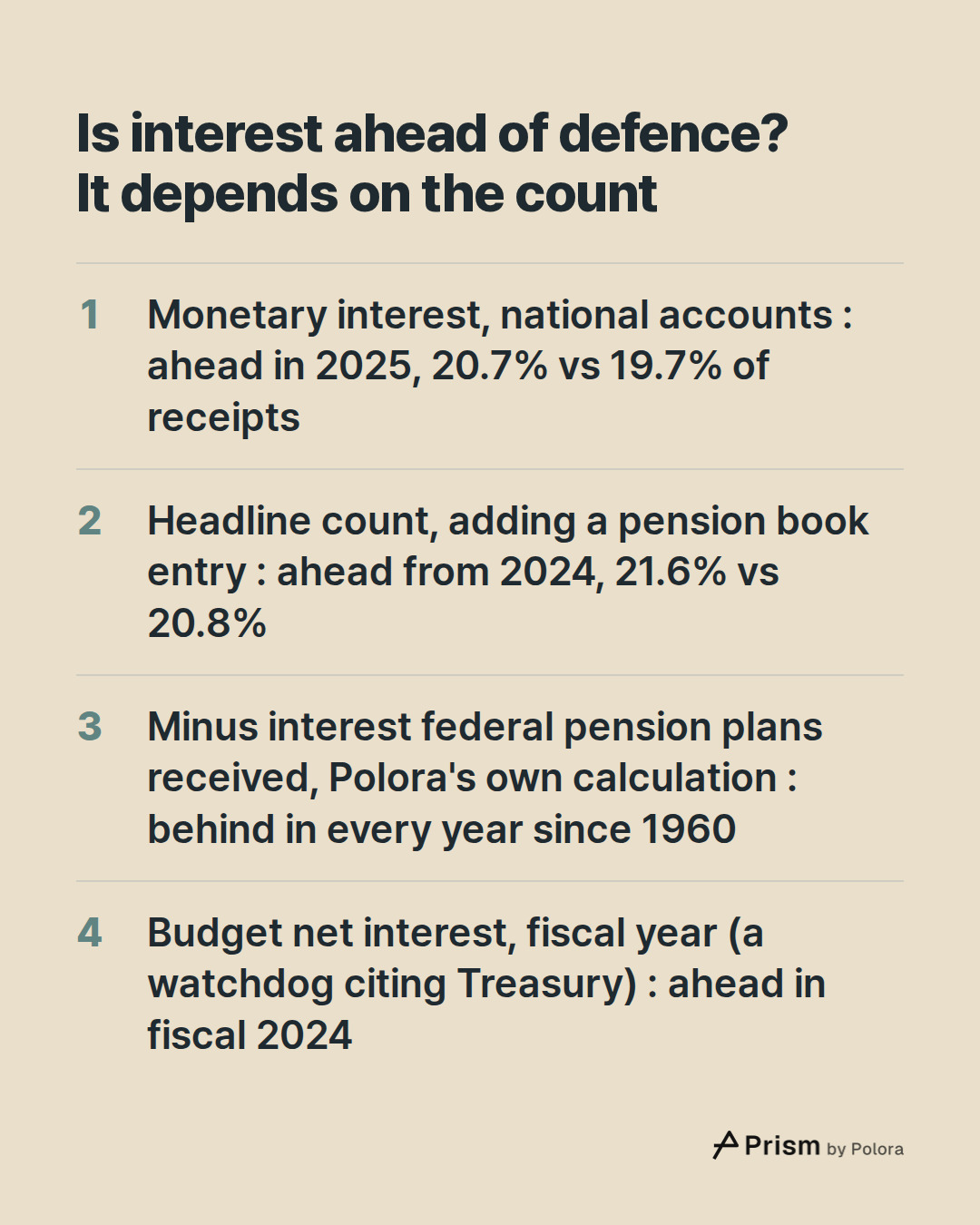
BEA's headline figure for federal interest payments adds interest the agency imputes on the unfunded part of federal employees' pension promises. That is a book entry, not cash anyone receives : $39 billion in 2025. Counted that way, interest was 21.6% of receipts in 2024, already above defence's 20.8%. On that count, interest passed defence a year earlier.
A stricter count goes the other way. Some of the interest the Treasury pays goes to the government's own employee pension funds. By law, the civil-service retirement fund and the military retirement fund invest in US government securities, so interest on those holdings moves from one arm of the government to another. BEA records the interest federal employee pension plans received : $112 billion in 2025, though it does not break down where all of it comes from. Subtract it, as a calculation of our own rather than a measure BEA publishes, and interest falls to 18.7% of receipts in 2025, below defence. On that count, interest has not been above defence in any year since 1960.
The federal budget gives a third count. The Committee for a Responsible Federal Budget, a budget watchdog citing Treasury's final Monthly Treasury Statement, says net interest was higher than national defence spending in fiscal 2024. The budget's fiscal year does not match the calendar year, and it nets interest differently from the national accounts.
So interest is ahead on BEA's monetary-interest measure, on its headline measure and, by the watchdog's account, on Treasury's fiscal-year count. Subtract the interest federal pension plans receive, and it is still behind.
What this does not say
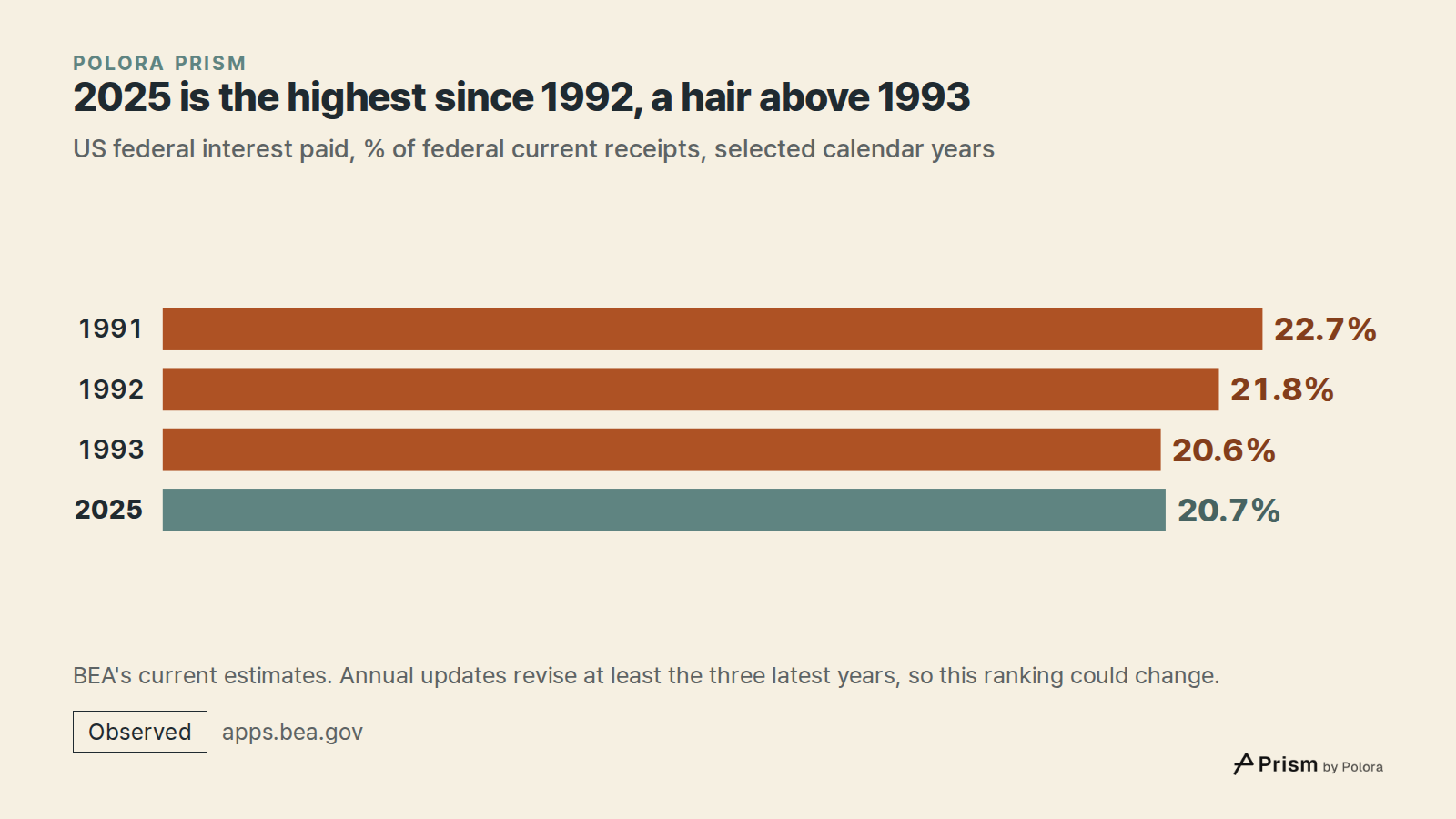
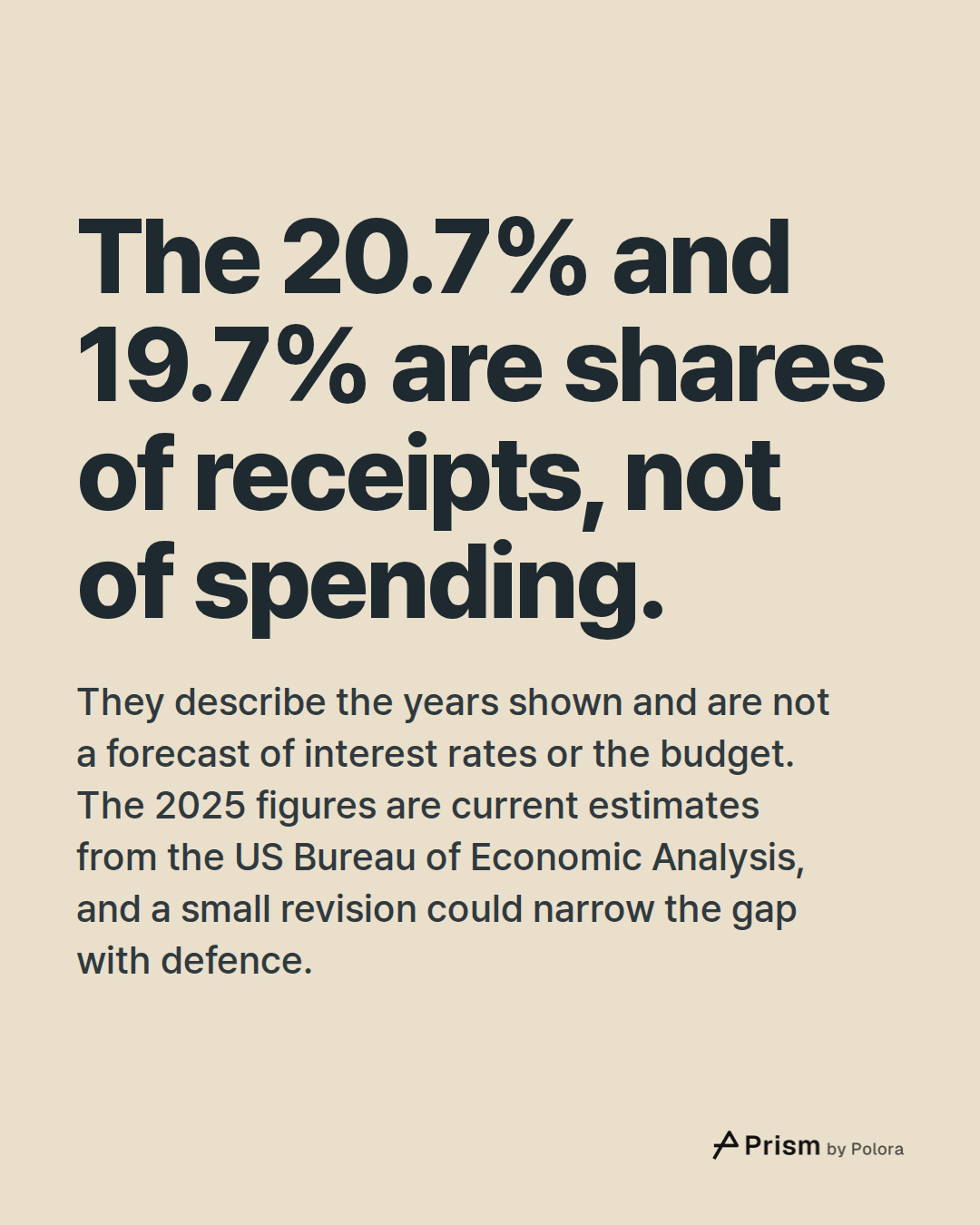
Interest's 20.7% share in 2025 was the highest since 1992, when it was 21.8%. But 1993's share was 20.6%, only a hair lower. These are BEA's current estimates for 2025, and BEA's annual updates revise at least the three most recent calendar years. A small revision could change that ranking, or narrow the gap with defence.
These are shares of receipts, not of spending, and they describe the years shown. They are not a forecast of interest rates, the budget or anything else.
- U.S. Bureau of Economic Analysis, National Income and Product Accounts, annual data file (NipaDataA.txt)]
- FRED, Federal Reserve Bank of St. Louis : Monetary interest paid, federal government (BEA, Y669RC1A027NBEA)]
- FRED : National defense consumption expenditures and gross investment (BEA, A824RC1A027NBEA)]
- FRED : Federal government current receipts (BEA, AFRECPT)]
- FRED : Federal government interest payments, including imputed pension interest (BEA, A091RC1A027NBEA)]
- FRED : Imputed interest on federal pension plans' claims on employers (BEA, Y282RC1A027NBEA)]
- FRED : Monetary interest received by federal government defined benefit pension plans (BEA, Y281RC1A027NBEA)]
- BEA NIPA Table 3.2, footnotes on federal interest payments (EconStats copy)]
![Sources 8 : apps.bea.gov · U.S. Bureau of Economic Analysis, National Income and Product Accounts, annual data file (NipaDataA.txt)], fred.stlouisfed.org · FRED, Federal Reserve Bank of St. Louis : Monetary interest paid, federal government (BEA, Y669RC1A027NBEA)], fred.stlouisfed.org · FRED : Natio](https://media.cdn.polora.ai/picks/2026/11/pickrun_883f4b28bff849b1/ilqxodGs9spEpjx0-slide-07--does-the-us-government.jpg)