What "contracts to deliver" means
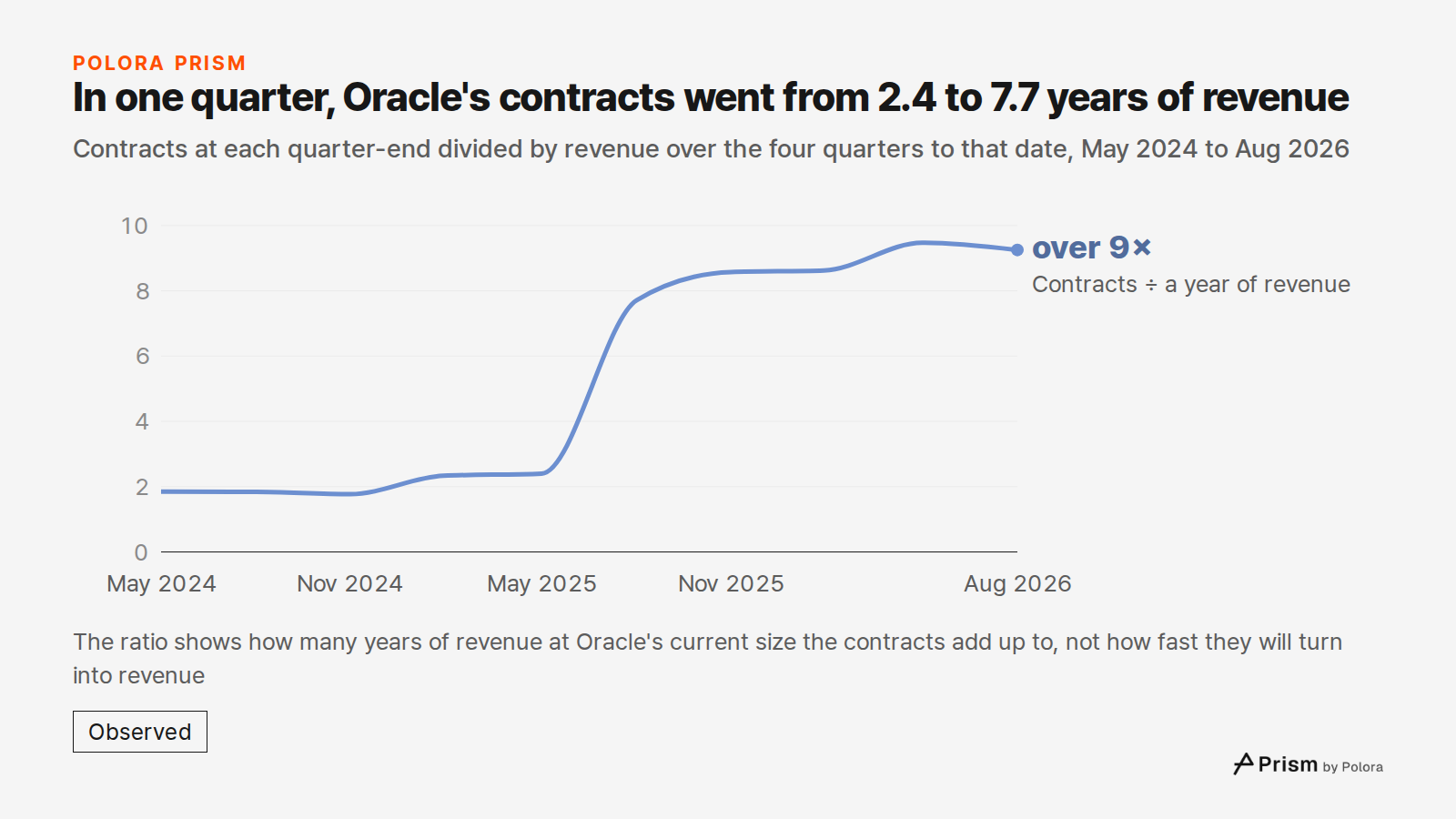
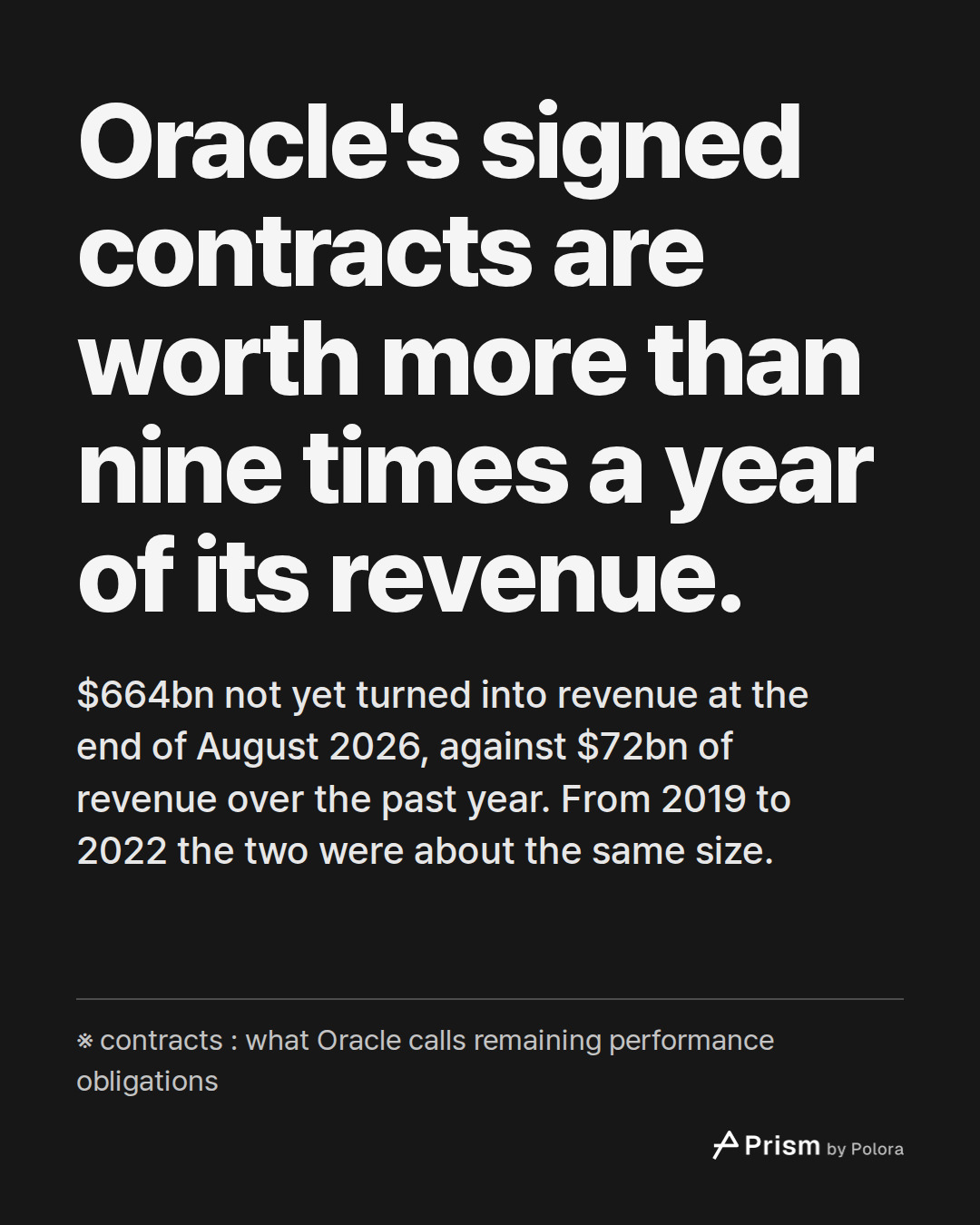
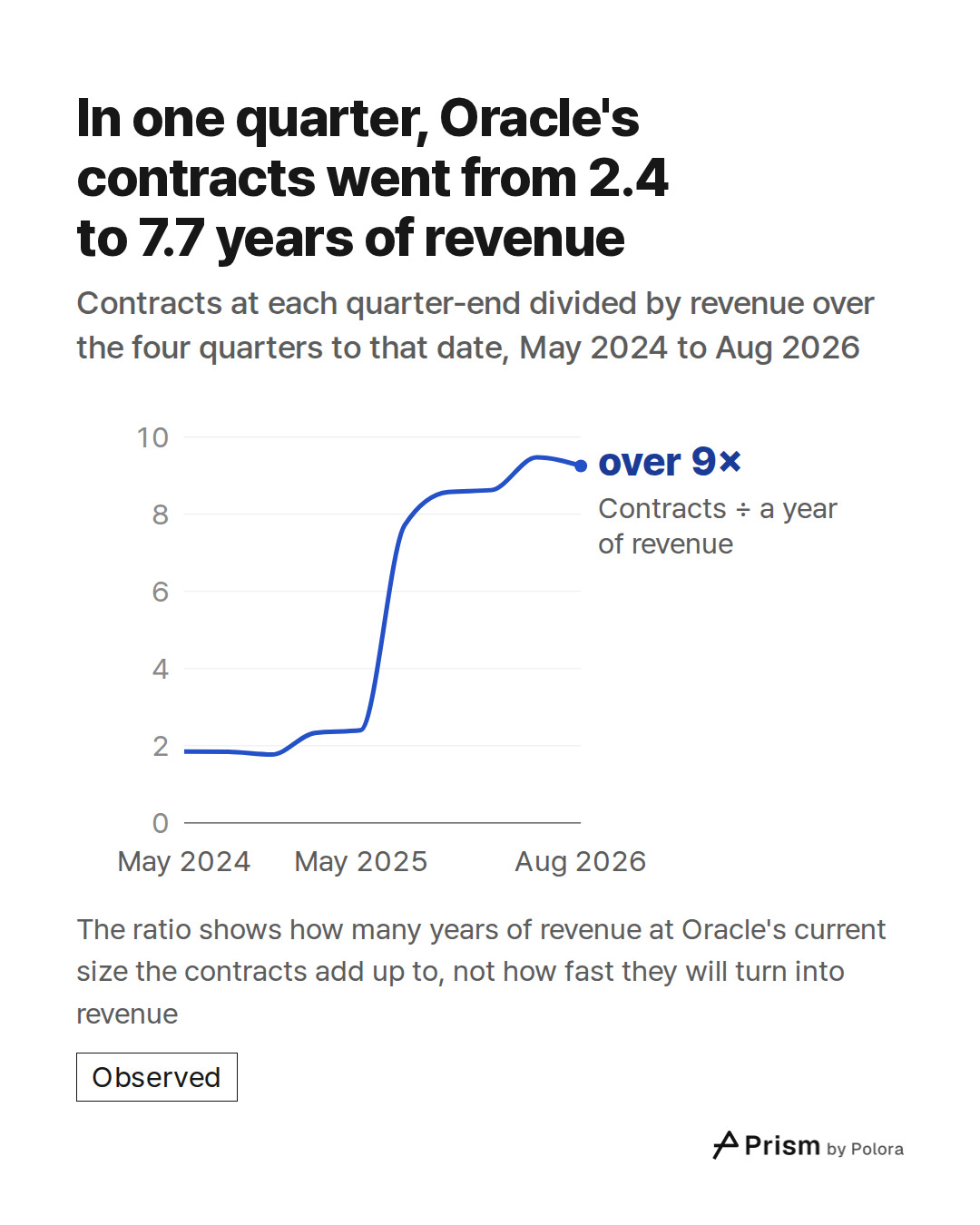
Oracle sells database and business software. More and more, it also rents out computing power in its own data centres, which it calls cloud infrastructure. Every quarter it reports a figure called remaining performance obligations, often called its backlog. In its annual report, Oracle defines this as contracted revenue it has not yet recognised. It includes money customers have already paid in advance, invoices sent but not yet counted as revenue, and amounts it will invoice later. It is a stock of promised future revenue, measured on one day. Revenue is a flow over a period. The comparison used here sets the stock at each quarter-end against the revenue of the four quarters to that date. The result says how many years of revenue, at Oracle's current size, the contracts add up to. It does not say how fast they will turn into revenue.
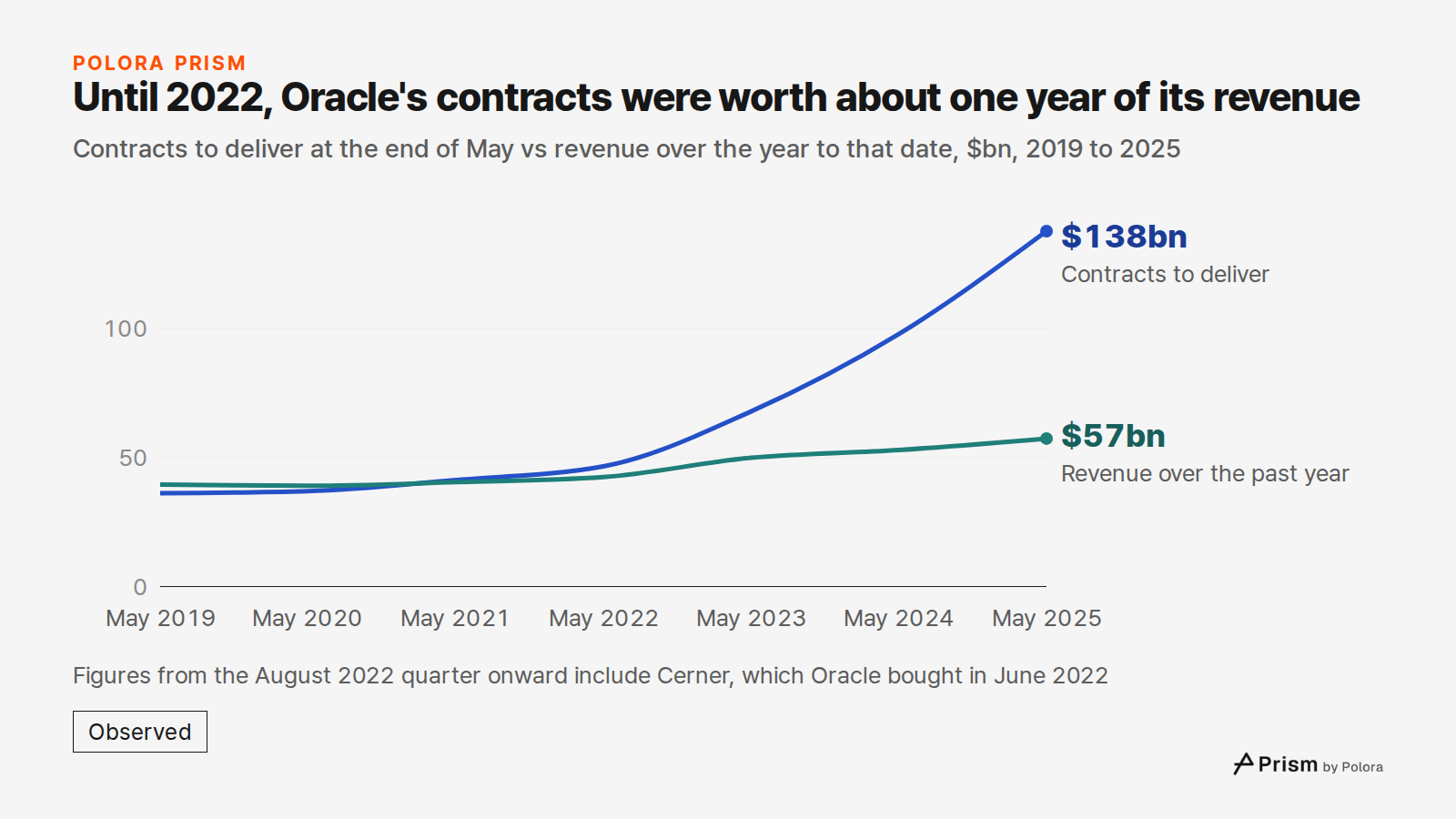
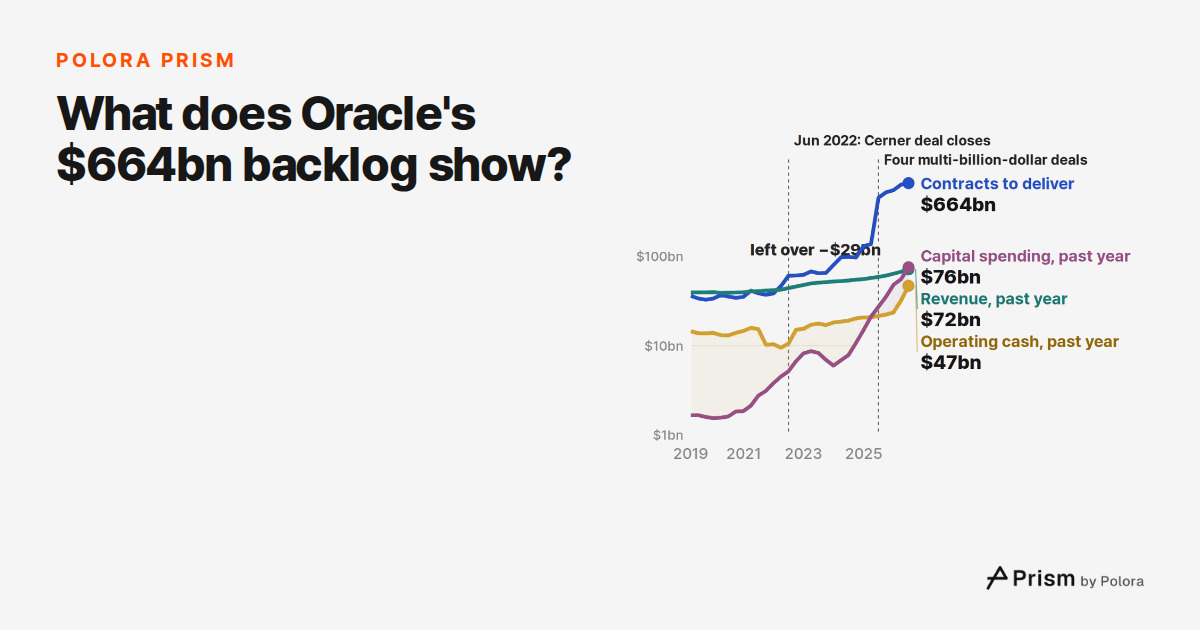
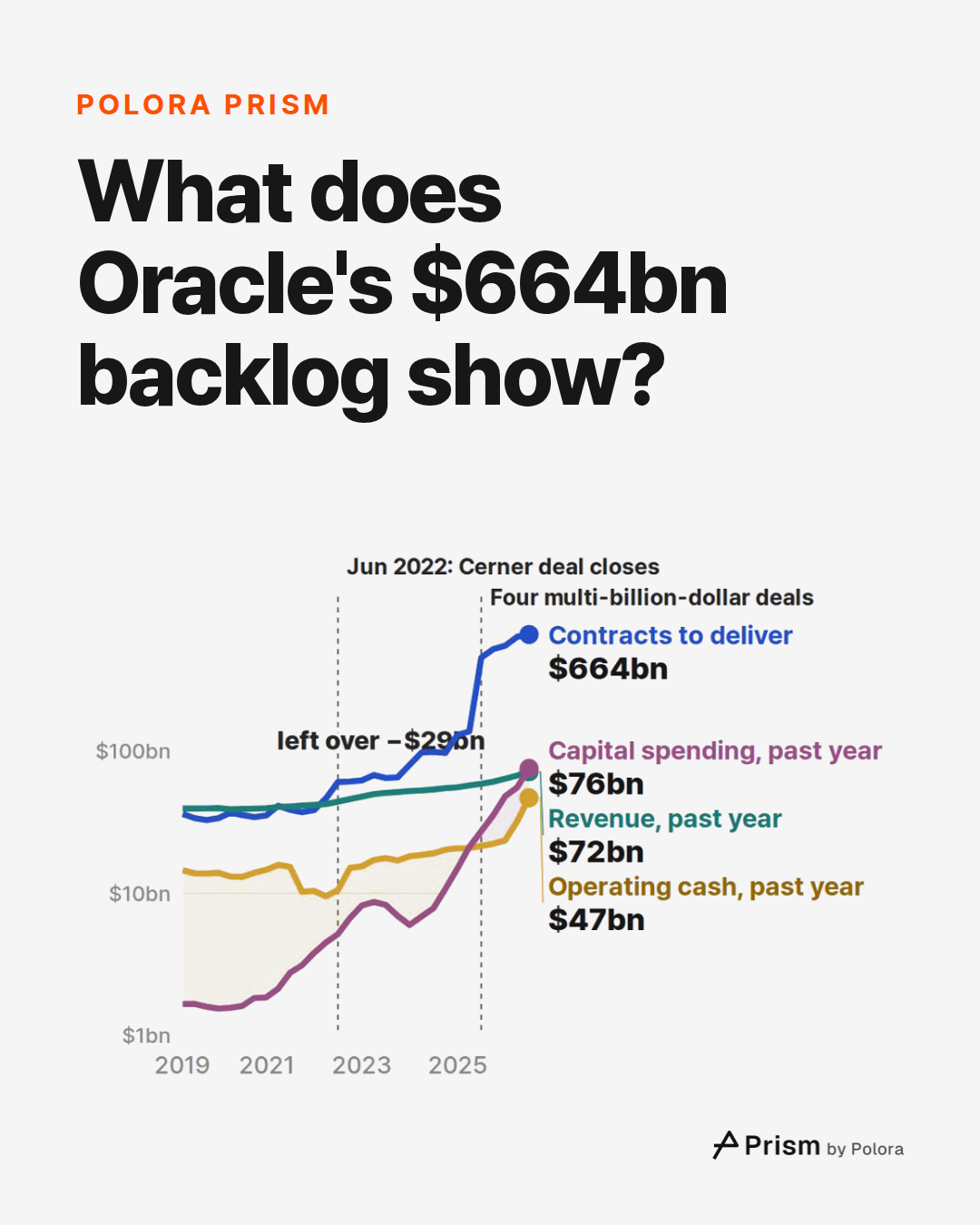
From May 2019 to May 2022 the ratio stayed between 0.8 and 1.1. In May 2019 the contracts came to $36bn, against $40bn of revenue over the past year. In June 2022 Oracle completed its purchase of Cerner, which makes information systems for hospitals, so its figures from the August 2022 quarter onward include Cerner's business. The contracts grew slowly after that, then faster. By May 2025 they reached $138bn, 2.4 times a year of revenue.
The quarter Oracle's contracts tripled
In June to August 2025 the contracts more than tripled, to $455bn, and the ratio went from 2.4 to 7.7. Oracle's chief executive, Safra Catz, explained the jump in that quarter's results release : "We signed four multi-billion-dollar contracts with three different customers in Q1." The filings and releases cited here do not name the customers. The total kept rising after that, to $638bn by May 2026 and $664bn by August, $209bn more than a year earlier. In its latest quarterly report, Oracle attributes that rise "primarily" to "certain significant cloud contracts".
Oracle's revenue from renting computing power is growing too, though from a much smaller base. The filings do not say how much of it comes from these particular contracts. In June to August 2026, cloud infrastructure brought in $7.4bn of Oracle's $19.3bn of revenue, up from $3.3bn a year earlier.
Most of the contracts turn into revenue years from now
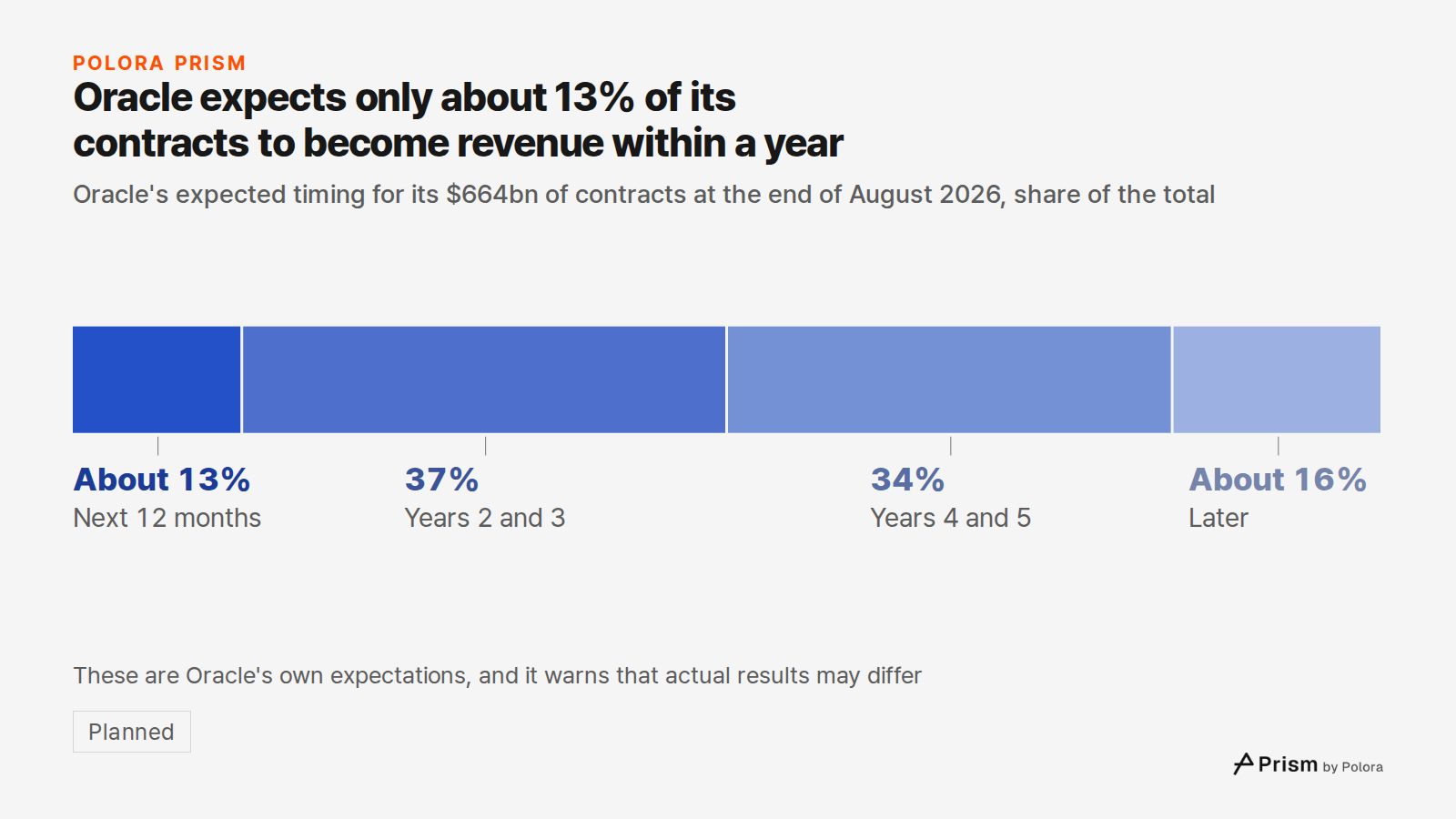
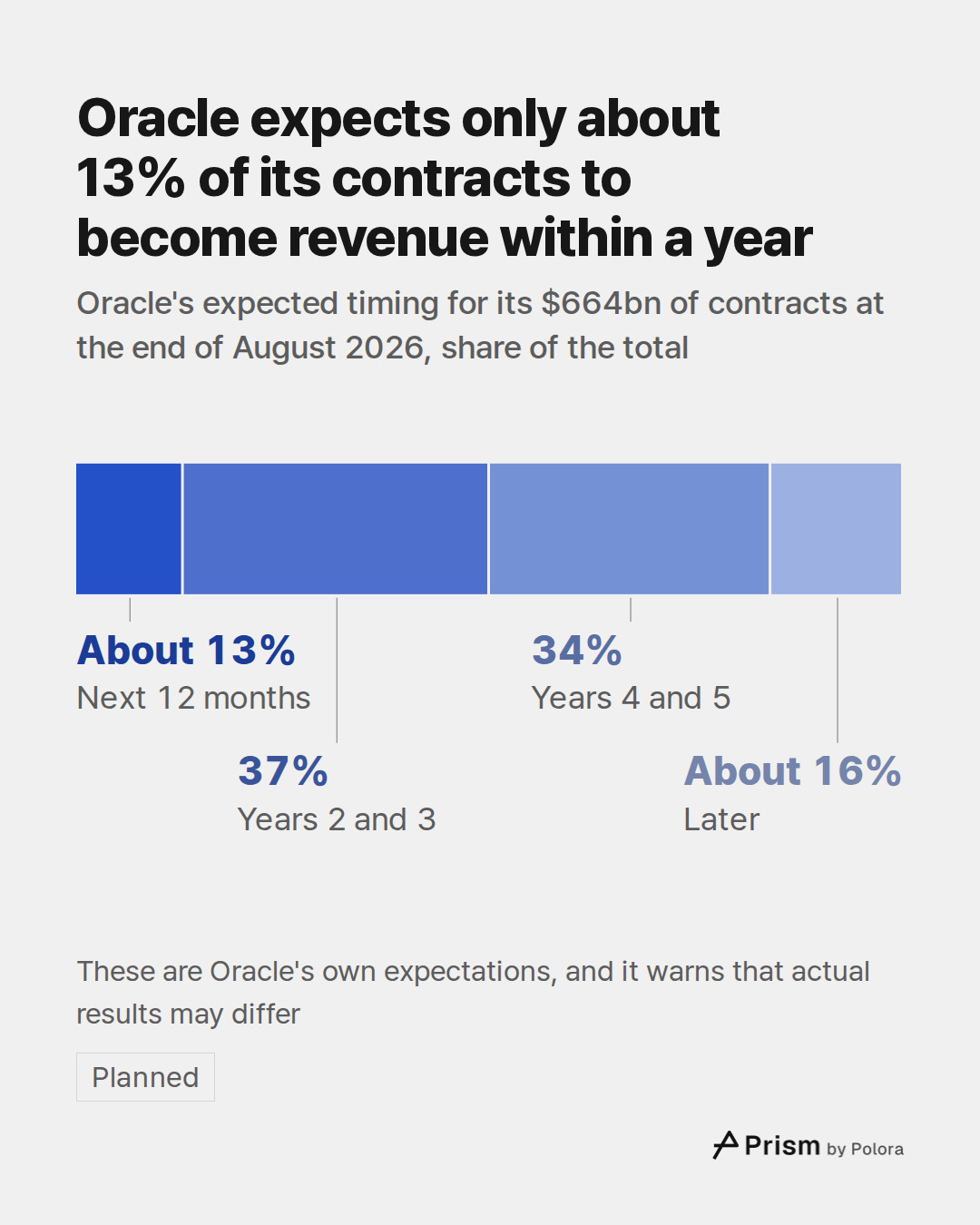
Most of the contracts are for later years. Oracle expected only about 10% of the August 2025 total to become revenue within twelve months. For the August 2026 total, it gives this timing : about 13% in the next twelve months, 37% in the two years after that, 34% in the fourth and fifth years, and the remaining 16% or so later still. These are Oracle's own expectations. Its annual report warns that its judgments about revenue recognition and remaining performance obligations are "subject to uncertainties and actual results may differ". It also says that in some of its cloud infrastructure offerings it is "more concentrated among a number of large customers", and that some customers "may be highly leveraged".
Building before the revenue arrives
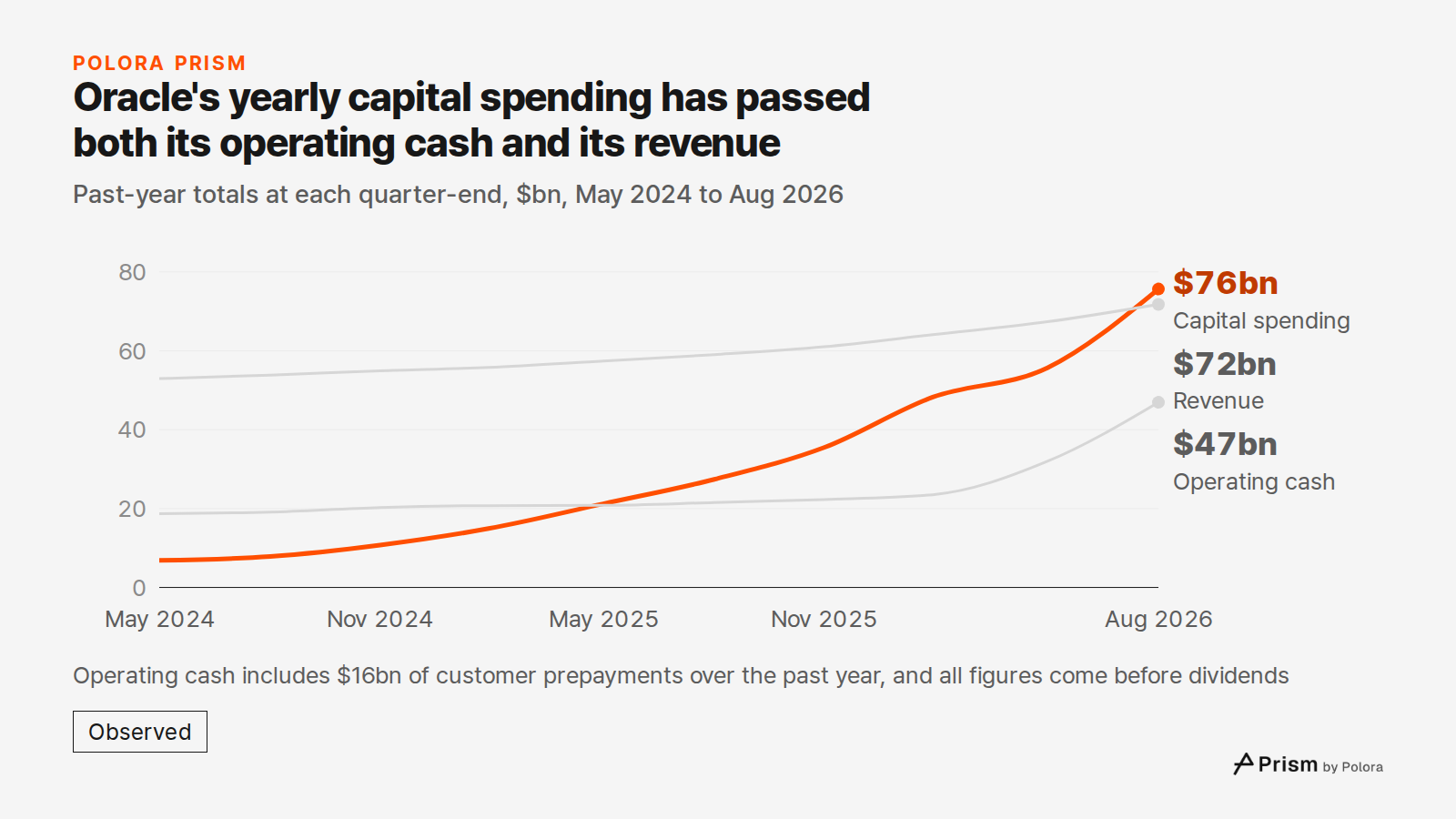
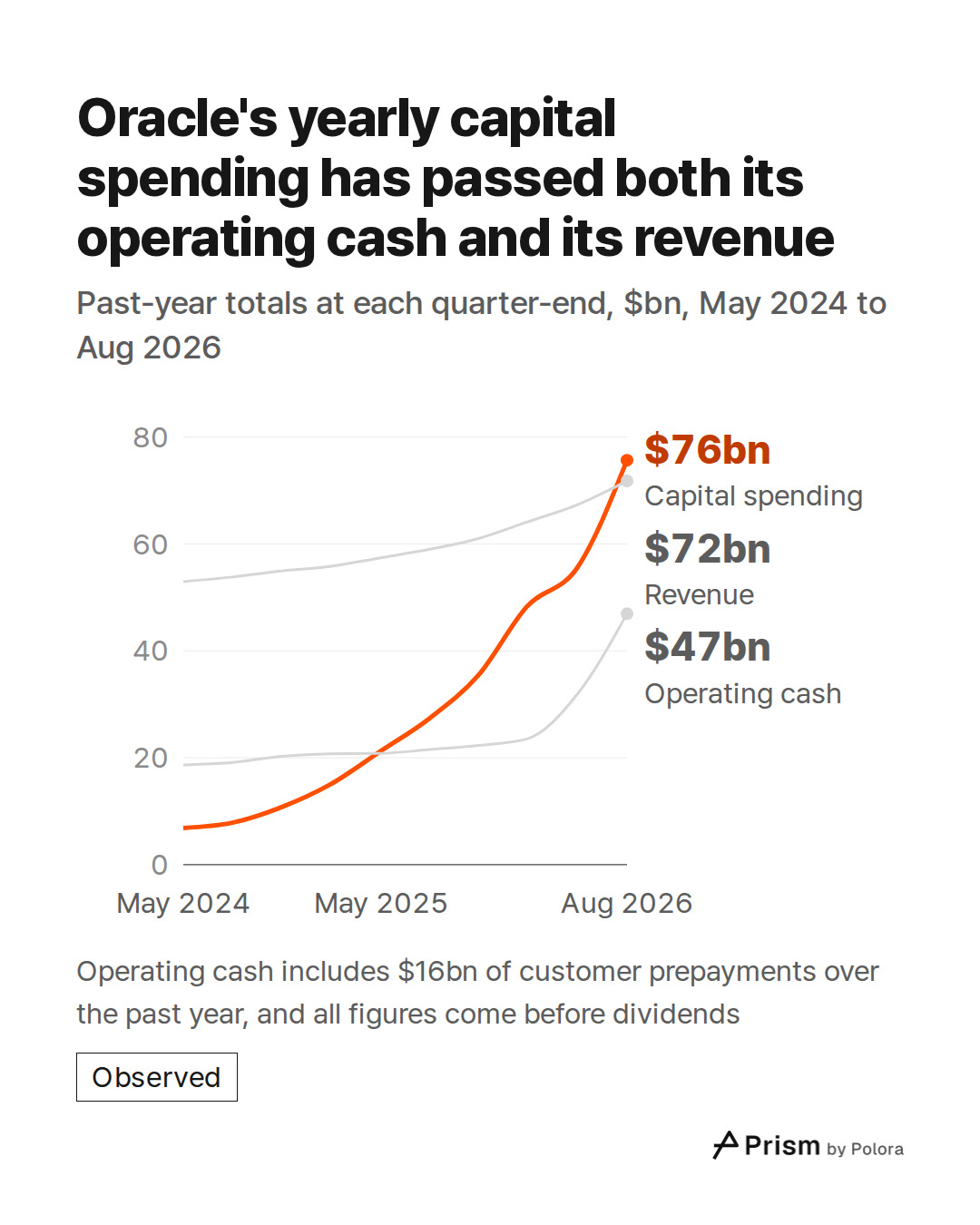
Capital spending here means the cash Oracle paid for property and equipment, as its cash-flow statement reports it. Over the year to May 2019 it was $1.7bn, small next to the $14.6bn of cash its operations brought in. By the year to May 2025, capital spending ($21.2bn) had caught up with operating cash ($20.8bn). Over the year to August 2026 it was $76bn. That is more than the year's operating cash ($47bn) and more than its revenue ($72bn), leaving a shortfall of $29bn after capital spending. In June to August 2026 alone, Oracle spent $28.5bn, against $8.5bn in the same quarter a year earlier. Operating cash that quarter was $23.1bn, so what Oracle calls free cash flow, a measure outside the standard accounts, was minus $5.4bn. Oracle's release puts the negative figure down to "investments to support the growth of its Cloud Infrastructure business". Both shortfalls come before dividends, which took another $1.6bn in the quarter.
Customers paying ahead
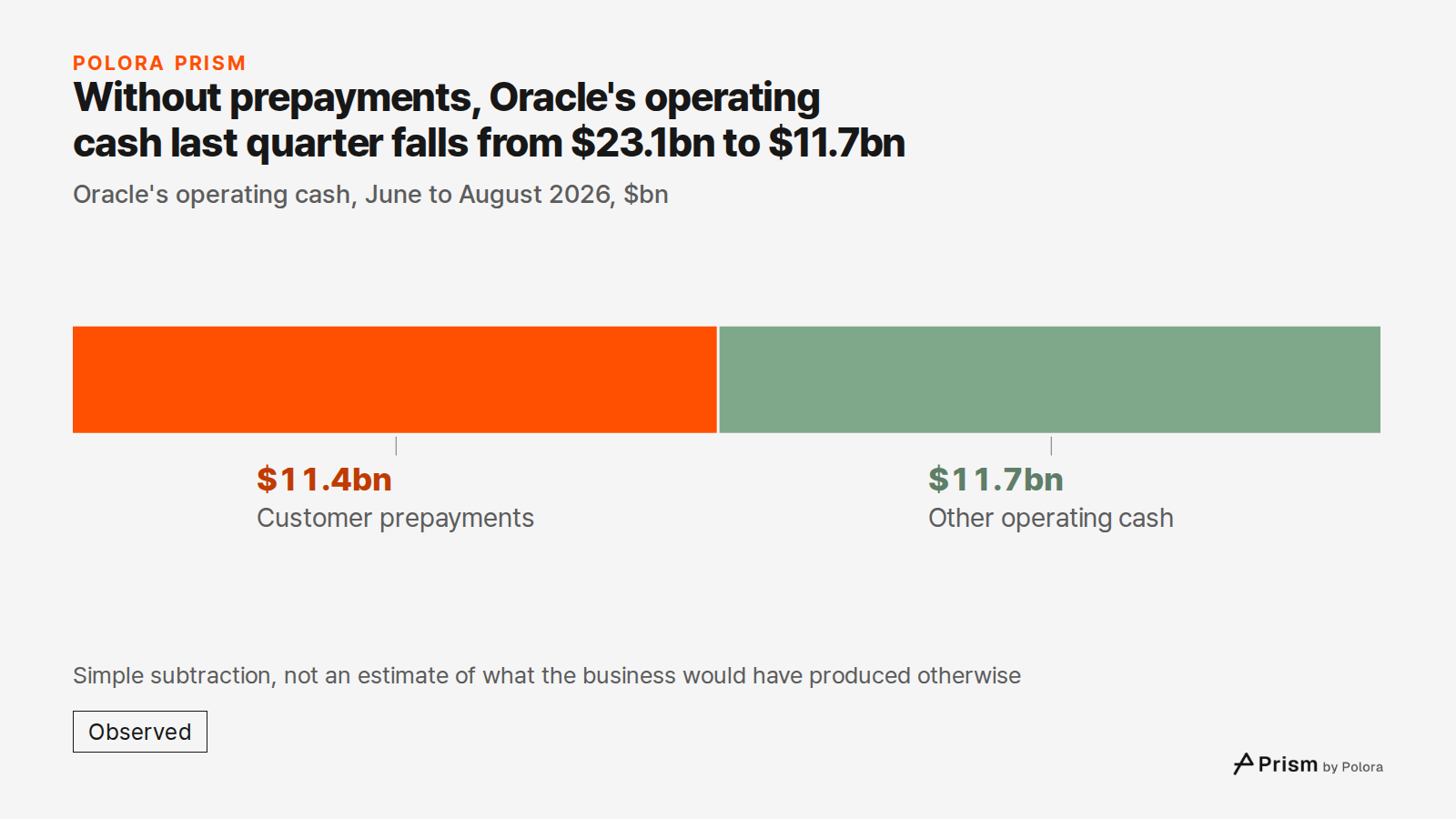
Part of the operating cash is money customers paid in advance. In June to August 2026 Oracle received $11.4bn of prepayments that its quarterly report describes as having "a significant financing component". In accounting terms, the customer paid well before it receives the service, so part of the payment is treated like a loan, and Oracle records interest on it separately from revenue. It also received $4.6bn of these prepayments in March to May 2026 and, according to its filings, none earlier in that fiscal year. Over the past year, $16bn of prepayments came in, about a third of the $47bn of operating cash. Take them out and operating cash for June to August 2026 comes to $11.7bn. That is simple subtraction, not an estimate of what the business would have produced otherwise. Because the prepayments are already counted in operating cash, they do not shrink the $29bn shortfall any further.
In its release, Oracle links these prepayments to its capital spending and publishes its own measure, "net cash outlay for capital expenditures". It subtracts the prepayments and adjusts for short-term financing tied to the spending; this quarter that financing was a repayment, which adds to the outlay. By that measure the quarter's outlay was $18.0bn instead of $28.5bn. The measure is not part of the standard accounts, and Oracle says it is meant to supplement them.
Debt and new shares
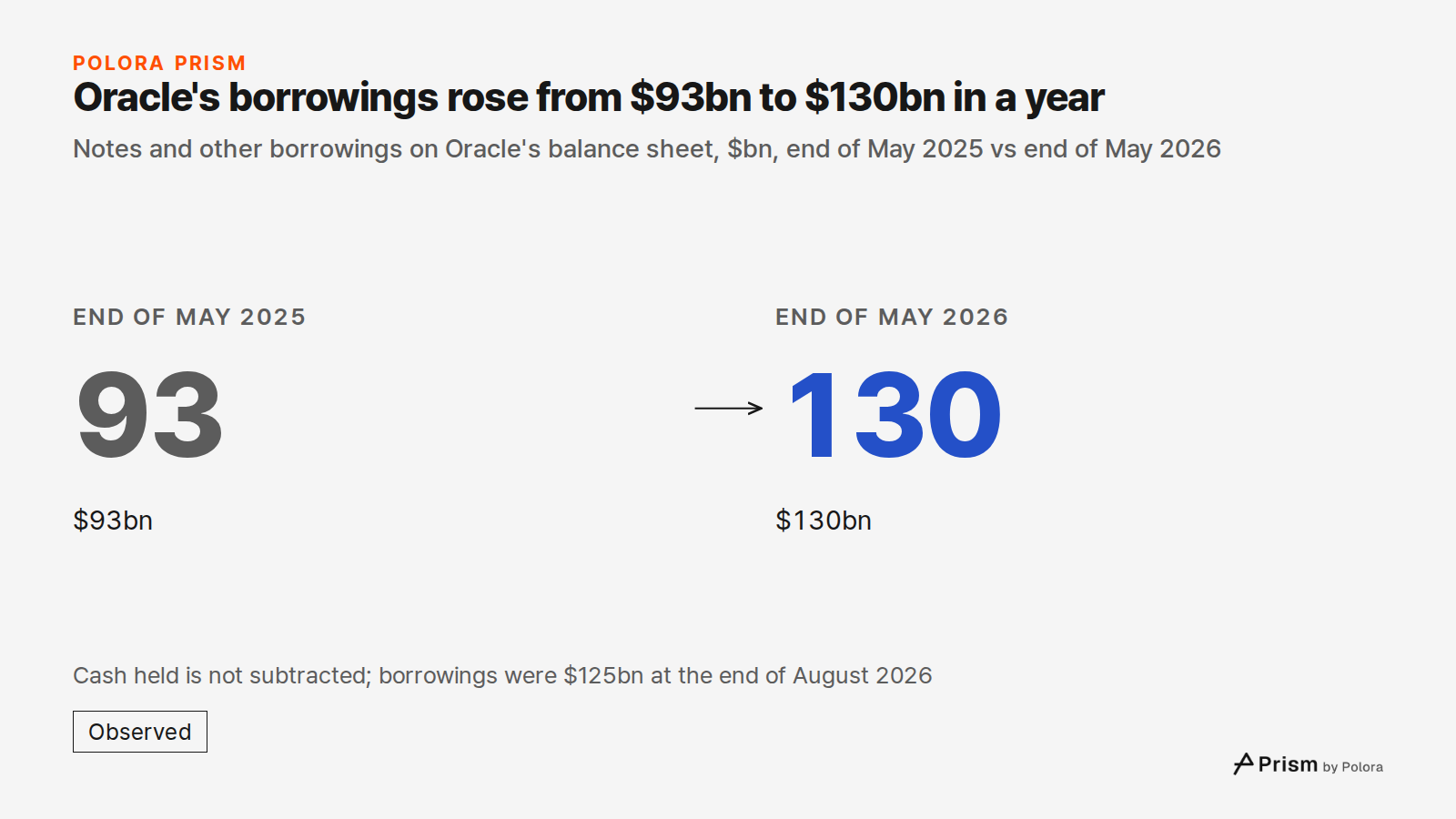
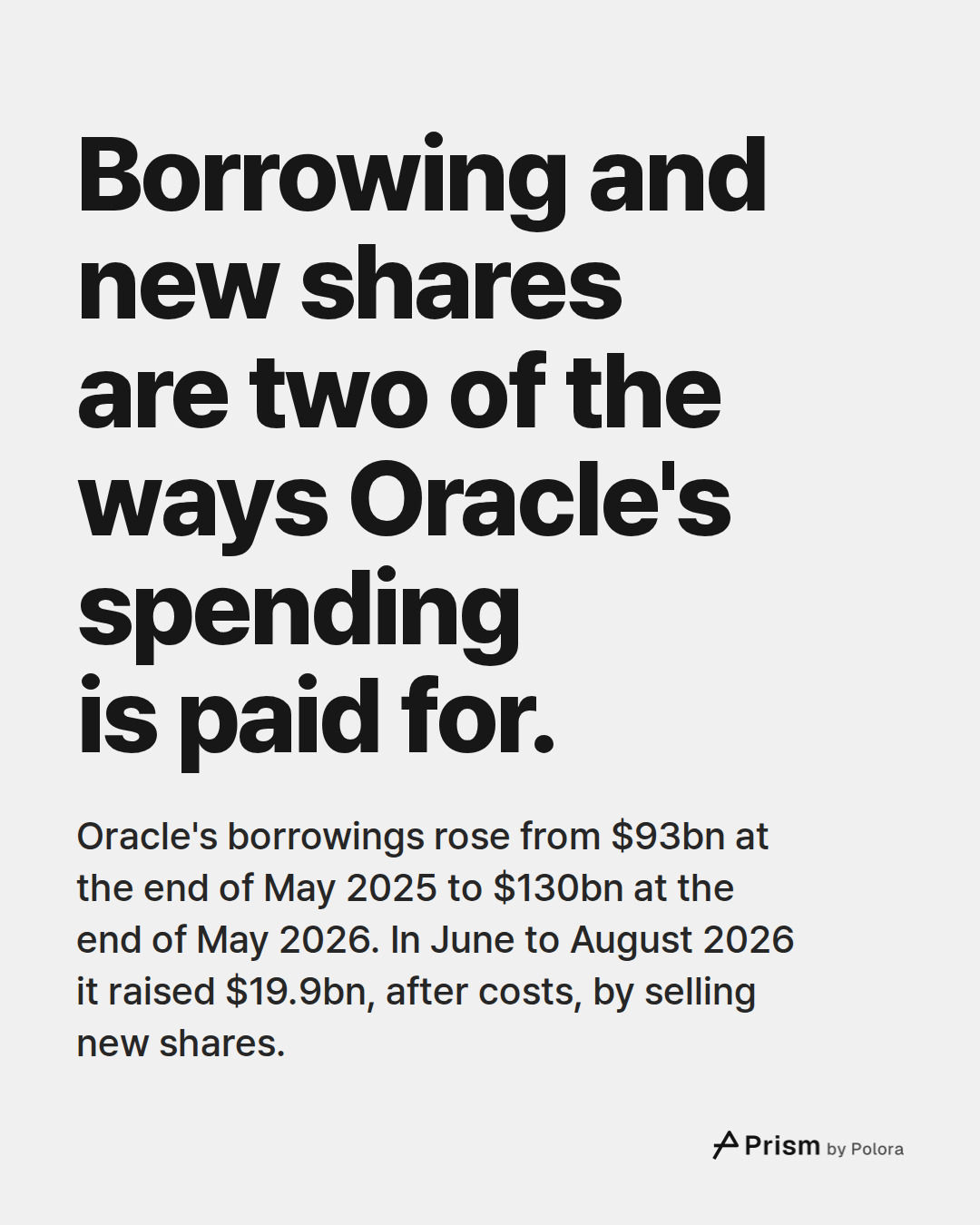
Oracle's borrowings rose from $93bn at the end of May 2025 to $130bn at the end of May 2026. The figure is notes and other borrowings as its balance sheet reports them, without subtracting the cash it holds. By the end of August 2026 they were $125bn, slightly lower. In June to August 2026 Oracle also raised $19.9bn, after costs, by selling new shares on the stock market through what it calls an at-the-market programme. Its release calls this "part of its previously disclosed capital investment program". Borrowing and new shares are two of the ways the spending is paid for. The filings do not trace any particular dollar of debt to any particular data centre.
What the numbers do and do not show
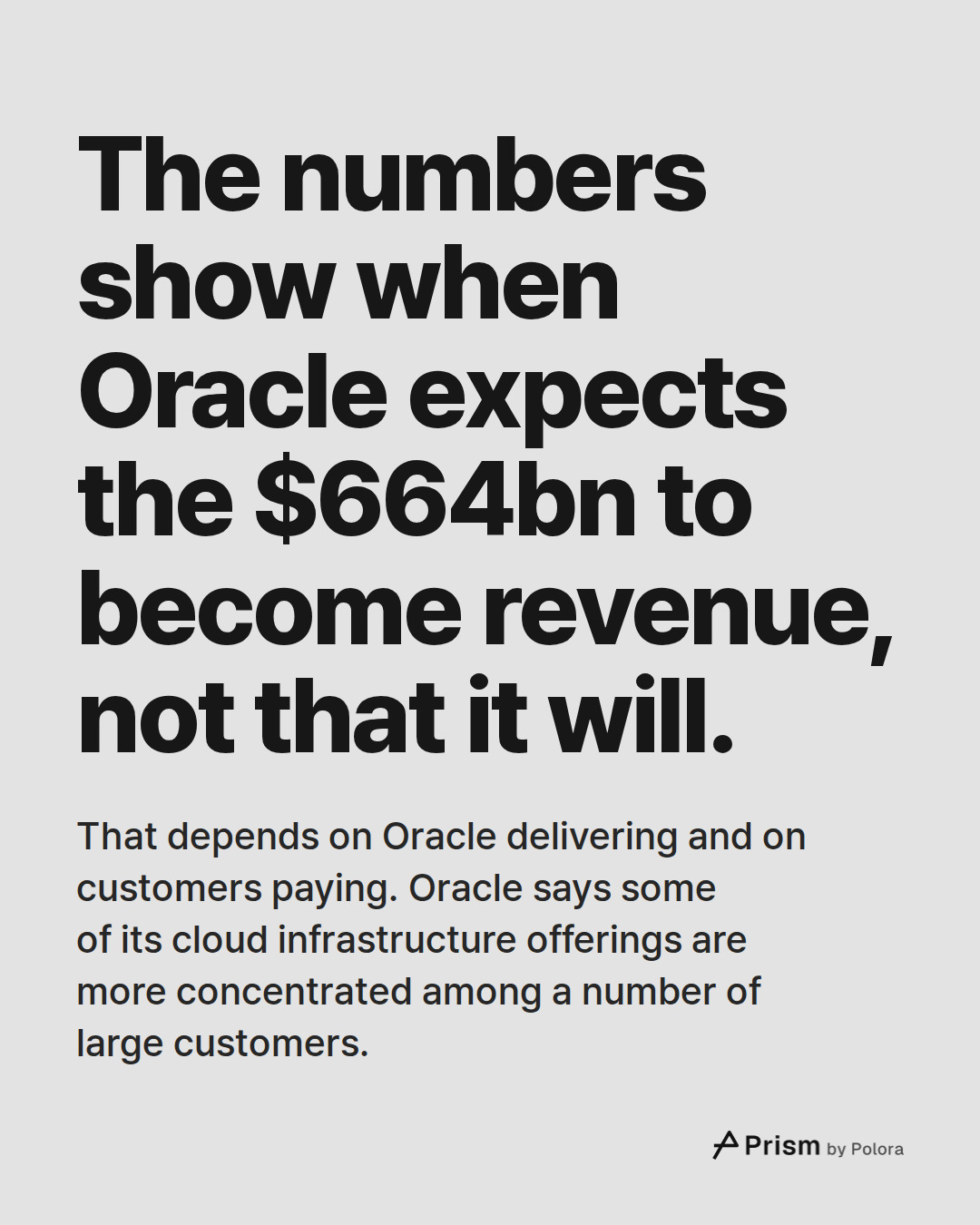
The figures here are Oracle's own, taken from its quarterly and annual reports to the US Securities and Exchange Commission and checked against its earnings releases. They show contracts piling up much faster than revenue. They show a building programme that costs more than the business brings in, even with customers' prepayments counted, with debt and new shares making up part of the difference. They show when Oracle expects the $664bn to turn into revenue, not that it will. That depends on Oracle delivering and on customers paying, and Oracle says some of its cloud infrastructure offerings are more concentrated among a number of large customers. Nor do the numbers say anything about where Oracle's shares are heading.
- Oracle 10-Q for the quarter ended 31 August 2026 (SEC EDGAR)]
- Oracle results release for the quarter ended 31 August 2026, 8-K exhibit 99.1 (SEC EDGAR)]
- Oracle 10-K for the year ended 31 May 2026 (SEC EDGAR)]
- Oracle 10-K for the year ended 31 May 2025 (SEC EDGAR)]
- Oracle results release for the quarter ended 31 August 2025, 8-K exhibit 99.1 (SEC EDGAR)]
- Oracle 10-Q for the quarter ended 31 August 2025 (SEC EDGAR)]
- Oracle 10-Q for the quarter ended 31 August 2022 (SEC EDGAR)]
- Oracle 10-K for the year ended 31 May 2019 (SEC EDGAR)]
![Sources 8 : sec.gov · Oracle 10-Q for the quarter ended 31 August 2026 (SEC EDGAR)], sec.gov · Oracle results release for the quarter ended 31 August 2026, 8-K exhibit 99.1 (SEC EDGAR)], sec.gov · Oracle 10-K for the year ended 31 May 2026 (SEC EDGAR)] + 5](https://media.cdn.polora.ai/picks/2026/11/pickrun_0f6dfd86faea44de/eSeZxlfLHDfrxdXe-slide-08--what-does-oracle-s.jpg)