Two markets on one chart
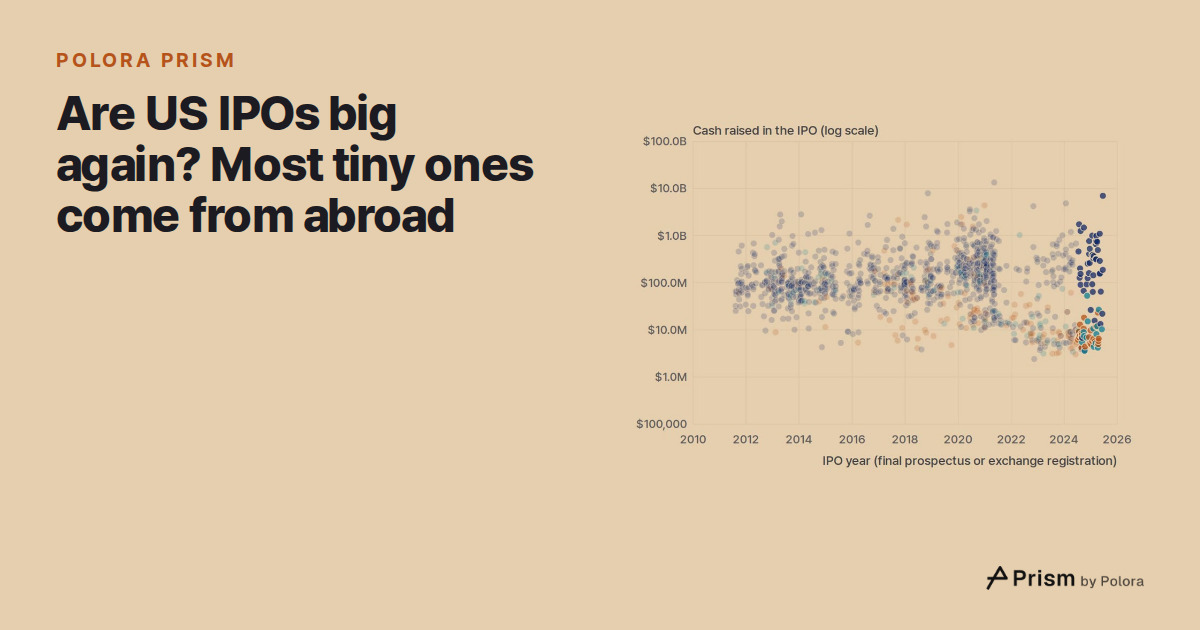
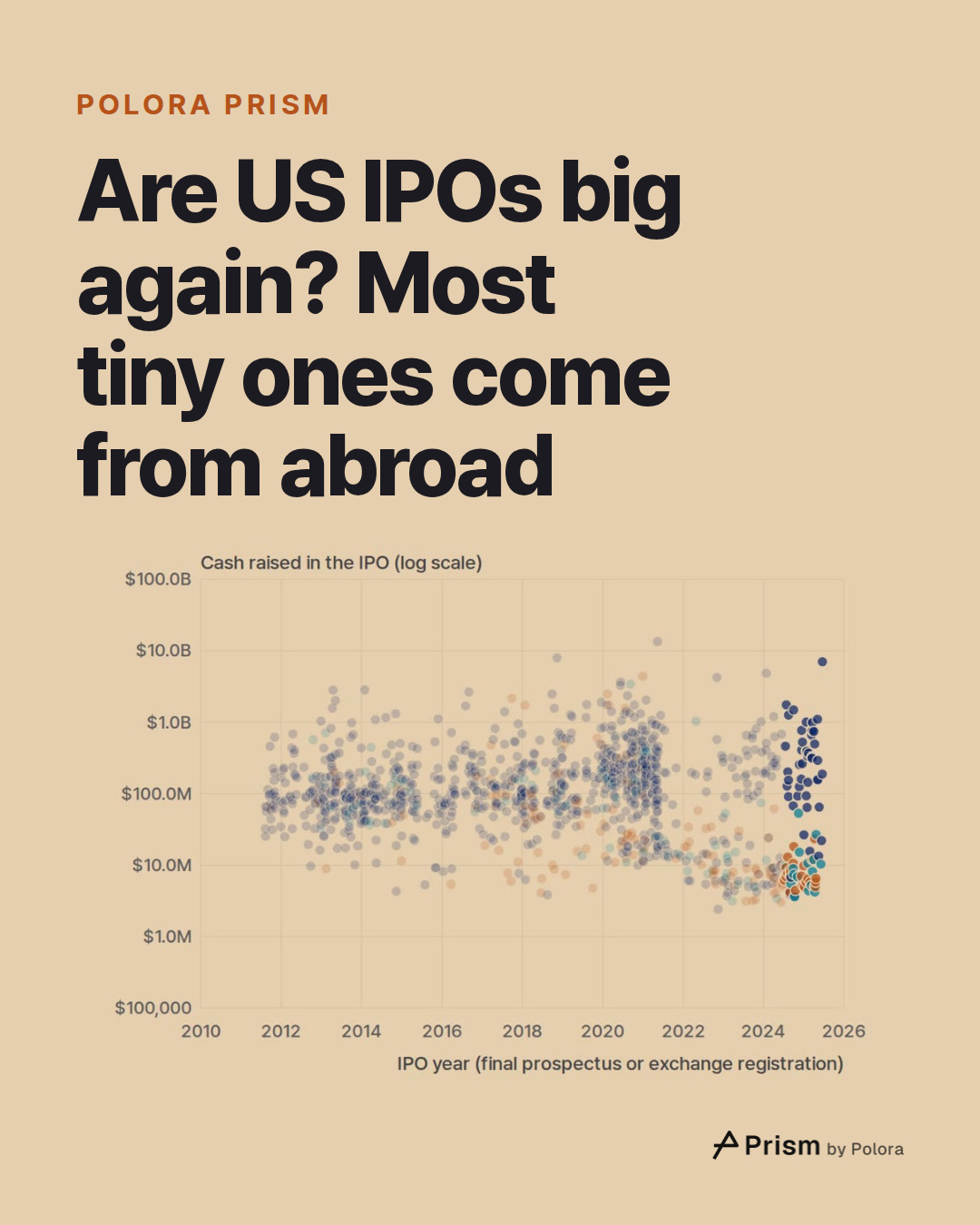
The film puts every IPO in the sample on one picture : one dot per company, placed by the year it went public and by the cash it raised, coloured by where it is based. The cash axis is a log scale, so each step up multiplies the amount by ten. That is how a listing of a few million dollars and Rivian's $13.5 billion, the top dot of 2021, can share a chart.
By 2025 the dots have pulled apart. US companies cluster high, around a few hundred million dollars each. Below them, mostly in orange and teal, sit dozens of listings worth a few million each, most of them from China, Hong Kong and other places outside the US. Taken together, the sample's IPOs look small. Split by where the companies are based, they look like two different markets.
How the IPOs were counted
Every IPO figure here comes from what companies told the US Securities and Exchange Commission. When a company files its financial statements, it tags each line in a standard format, and one of those tags is the cash it took in from its initial public offering. The SEC publishes the values of the companies that used that tag, year by year.
That raw list is noisy, so it was screened before anything was counted. Blank-cheque companies (SPACs), funds and companies whose shares already traded somewhere else were taken out. So were figures that differed by more than 10% from what the company's other filings reported, IPOs sold alongside a private placement (the two are often tagged together), figures under $1 million, and figures far from what the IPO prospectus said the company would receive. That last check is a screen for errors, not an exact match : the prospectus states an expected amount, the filing the cash actually received. Each remaining IPO is dated by its final prospectus, or for a few by the date its shares were registered on an exchange, and assigned a location by the offices that prospectus gives, or by the address the SEC holds where the prospectus did not say.
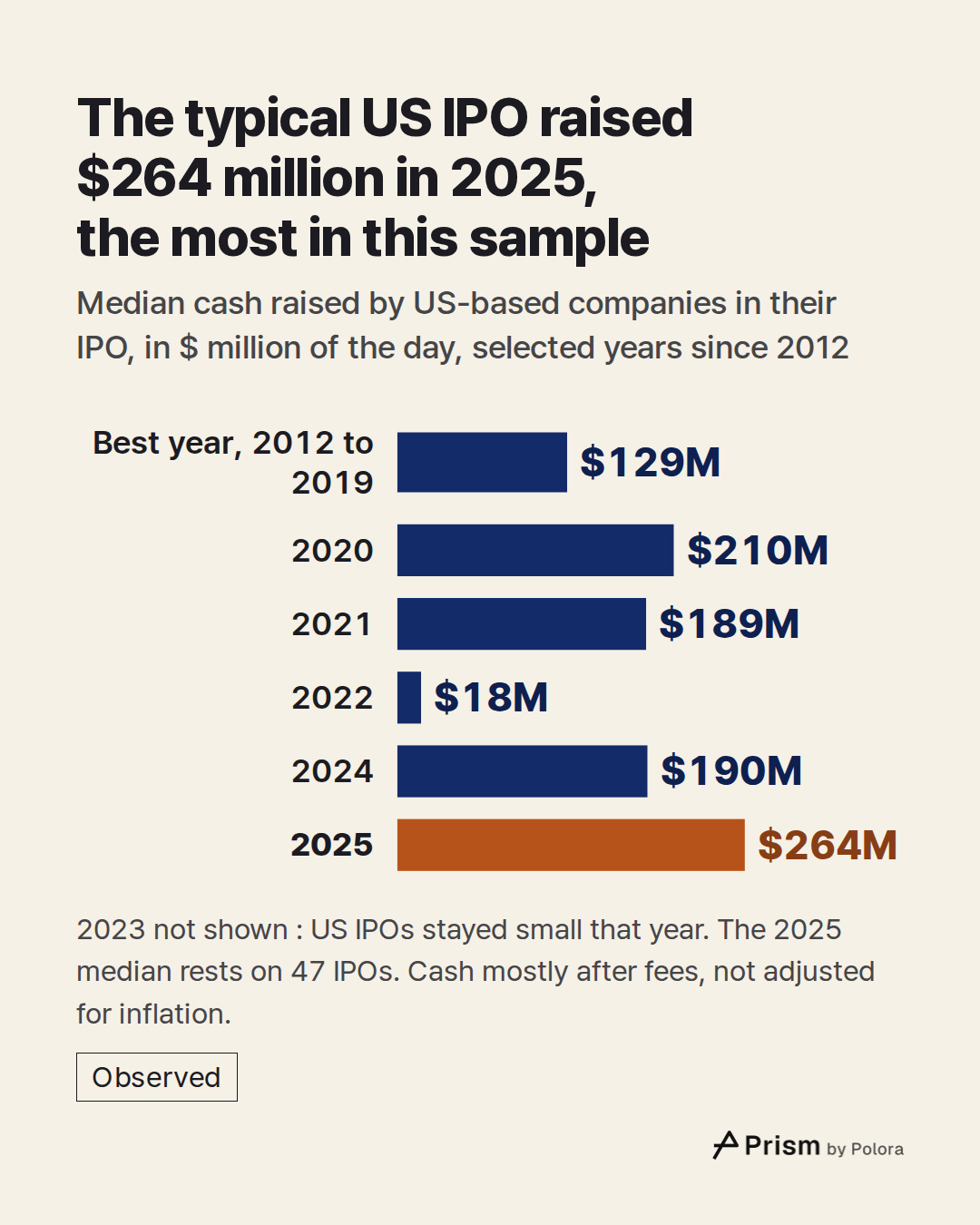
"Typical" means the median : half of a year's IPOs raised more, half raised less. The amount is the cash each company reported receiving, usually after underwriting fees, in dollars of the day, not adjusted for inflation. That usually makes it smaller than the headline deal sizes often quoted in the news.
Boom, bust, and a split
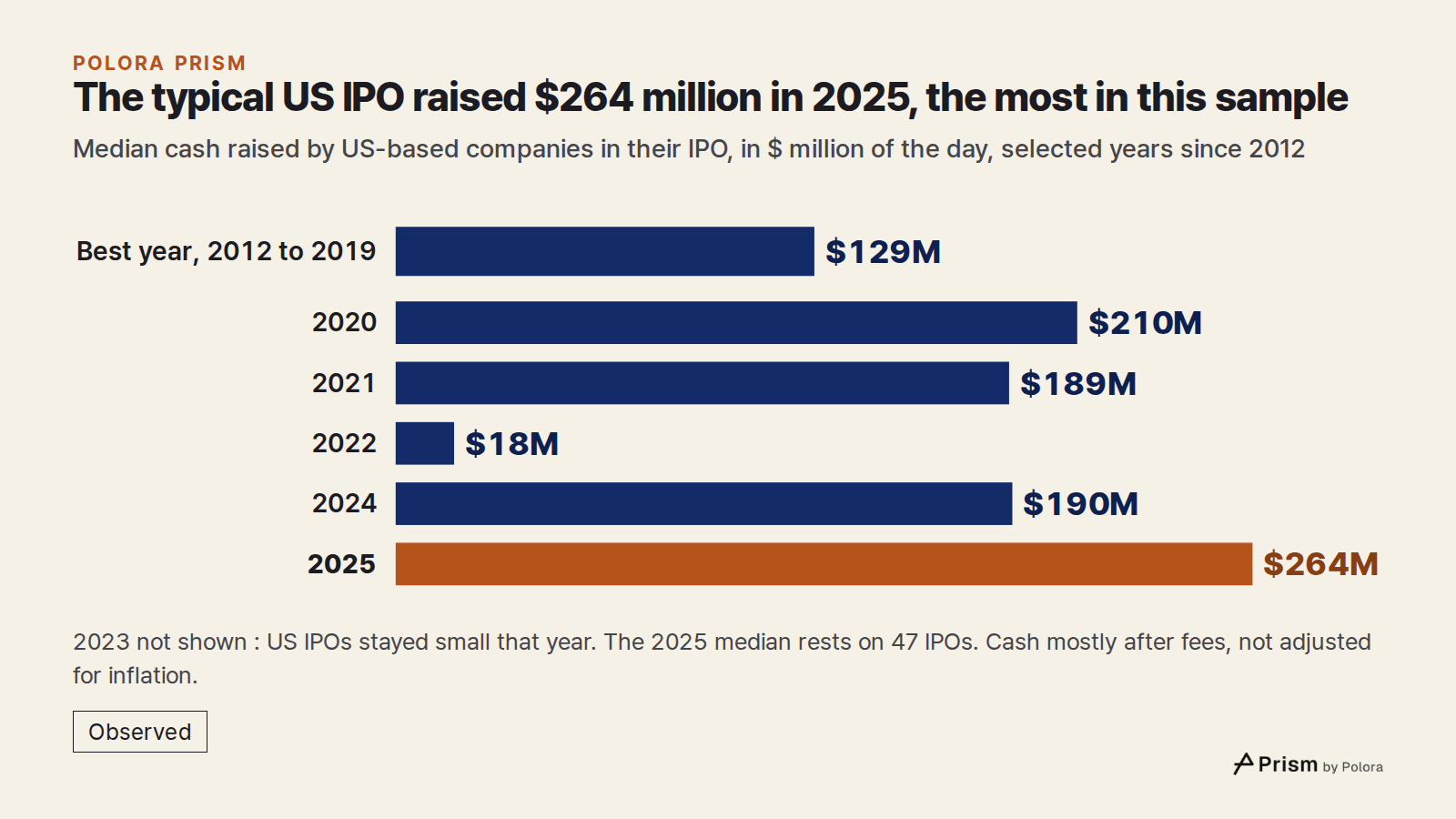
From 2012 to 2019 the sample holds 46 to 106 IPOs a year, and the typical US one raised between $75 million and $129 million.
Then came the boom. The sample has 226 IPOs in 2021, the typical US one raising $189 million. In 2022 IPOs nearly stopped in the sample, and the typical US one raised just $18 million. That drop was not only a story about foreign listings : US companies' IPOs shrank too, and they stayed small through 2023.
In 2024 US companies came back big, with $190 million for the typical one. That is more than in any year from 2012 to 2019, though still below 2020's $210 million. In 2025 the typical US IPO reached $264 million, the highest of any year in the sample, in dollars not adjusted for inflation. That median rests on 47 US IPOs, so a few deals more or fewer would move the exact figure. The screening rules were tightened several times while the film was made, and the 2025 figure moved with them.
Tiny listings, mostly from abroad
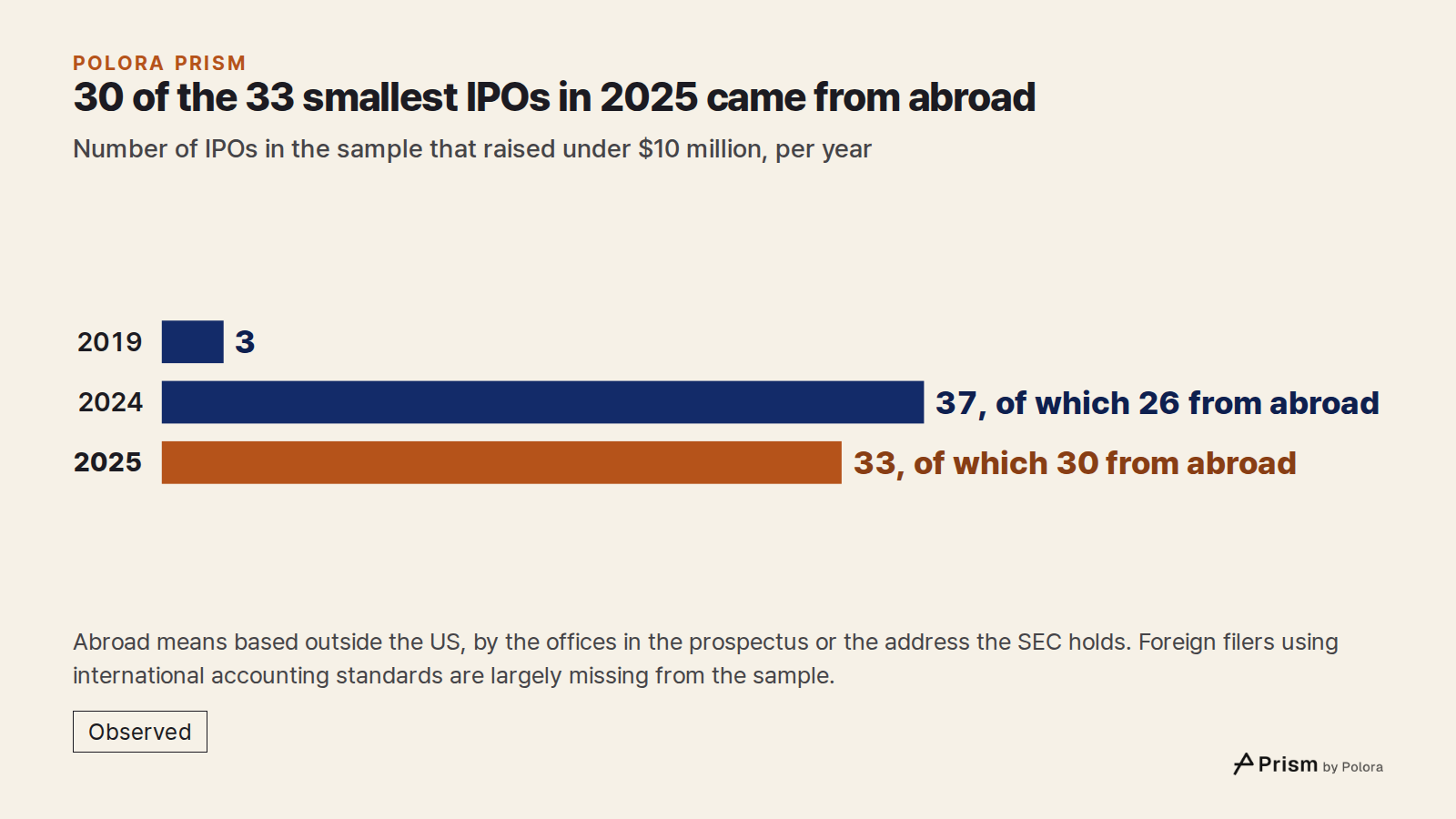
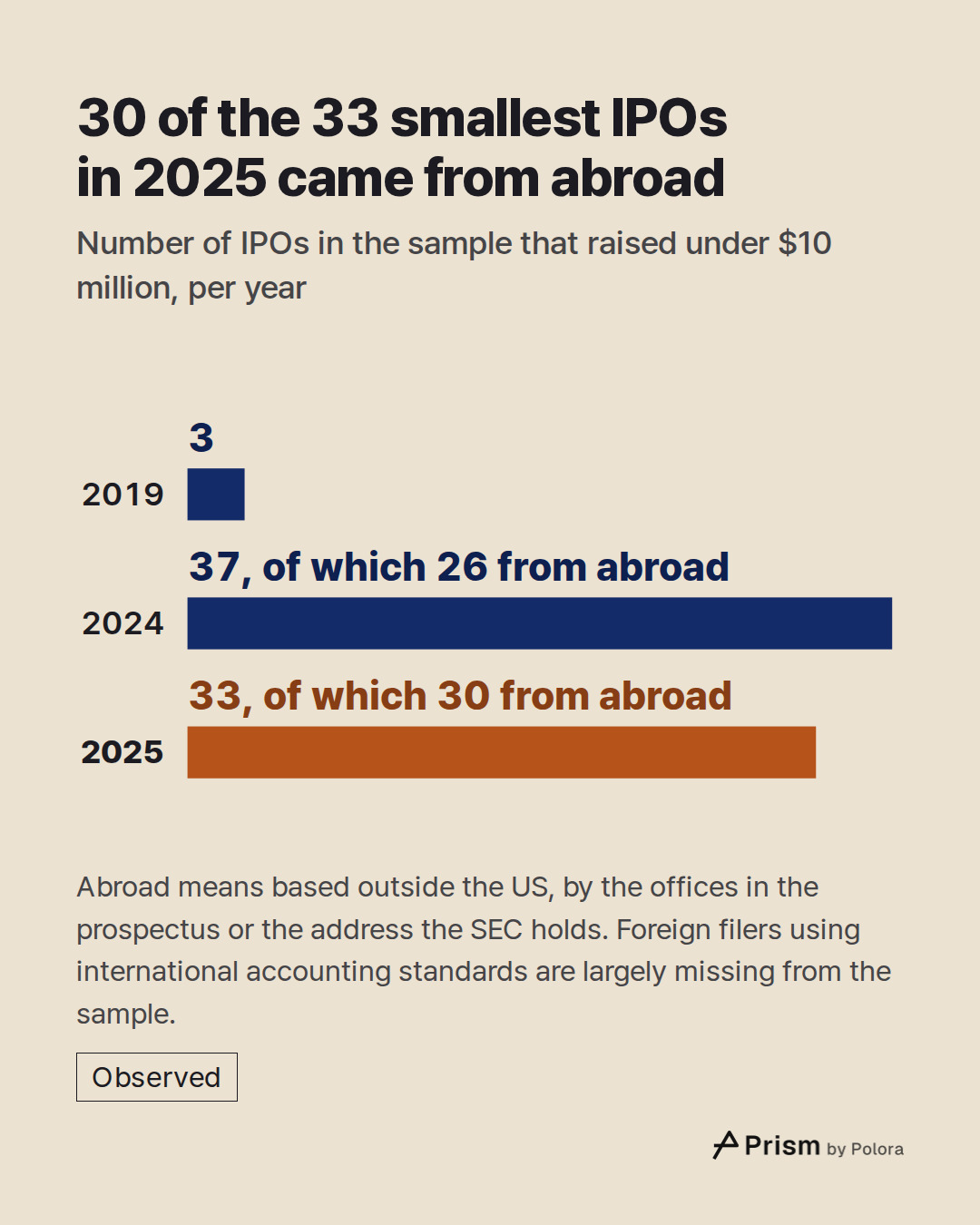
At the bottom of the chart the change is starker. In 2019 only 3 IPOs in the sample raised under $10 million. In 2024 there were 37, and 26 of them came from companies based abroad. In 2025 there were 33, and 30 came from abroad.
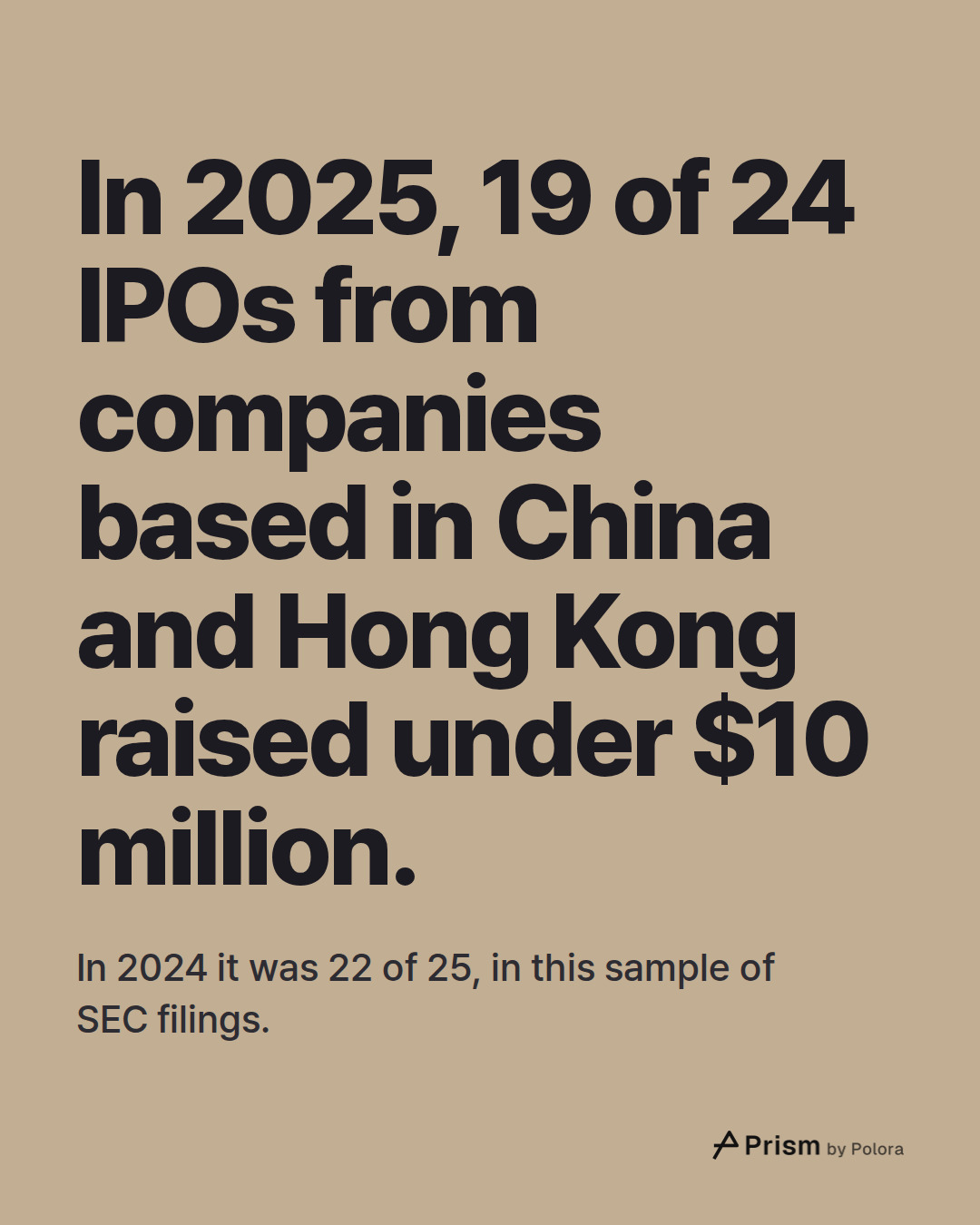
China and Hong Kong account for most of them. Of 25 IPOs from companies based there in 2024, 22 raised under $10 million. In 2025 it was 19 of 24.
Nasdaq sets a floor
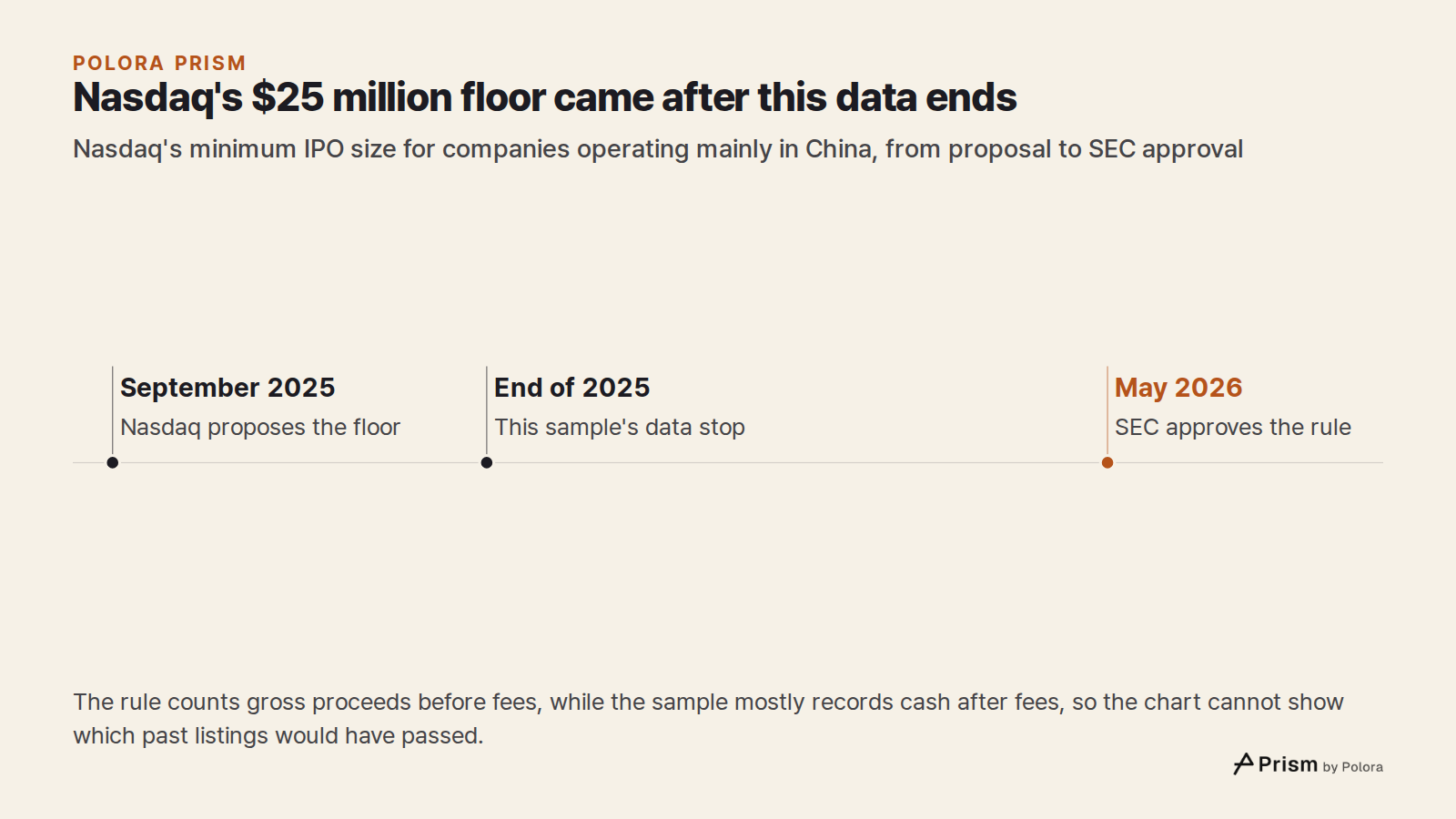
In September 2025 Nasdaq proposed that companies operating mainly in China raise at least $25 million in their IPO to list on the exchange. Nasdaq gave its reasons. According to the law firm K&L Gates, Nasdaq said most of its regulatory referrals since August 2022 involved China-based companies, though they made up only a small share of its listings. That is Nasdaq's account of its own referrals, not a finding that small or China-based listings cause misconduct. CNBC reported Nasdaq's view that Chinese companies listing with offerings below $25 million have a higher rate of compliance concerns.
The SEC approved the rule in May 2026, after three amendments, as the law firm Greenberg Traurig reported in the National Law Review. In the approved rule the $25 million is gross proceeds, before fees. Most dots in this sample are cash after fees, so the chart cannot show which past listings would have passed. The rule's idea of "China-based" also reaches further than the offices this sample uses to place a company. The data stop at the end of 2025, before the rule took effect, so nothing here shows what the rule has done.
What the sample leaves out
This is a sample, not a full list of IPOs. It holds only companies whose filings tag their IPO cash on the standard US accounting line. Foreign companies that report under international accounting standards generally use other tags, so they are largely missing, and some large US IPOs tagged their cash on another line and are missing too. That is why this piece gives the typical size only for US companies, and does not give one for foreign IPOs or for all IPOs together.
A company's location is taken from its prospectus or from the address the SEC holds today, which may not be where it was when it listed.
- Company filings via SEC EDGAR: IPO cash as tagged (ProceedsFromIssuanceInitialPublicOffering), one file per year]
- K&L Gates: Nasdaq Proposes to Raise the Bar for New and Existing Listings, Particularly Impacting Small Chinese IPOs (11 September 2025)]
- CNBC: Nasdaq plans will make it harder for small Chinese firms to list (4 September 2025)]
- National Law Review (Greenberg Traurig): SEC Approves Nasdaq's $25 Million IPO Requirement for China-Based Companies (18 May 2026)]
- SEC: SR-NASDAQ-2025-069, the rule filing and the approval order]
![Sources 5 : data.sec.gov · Company filings via SEC EDGAR: IPO cash as tagged (ProceedsFromIssuanceInitialPublicOffering), one file per year], klgates.com · K&L Gates: Nasdaq Proposes to Raise the Bar for New and Existing Listings, Particularly Impacting Small Chinese IPOs (11 September 2025)], cnbc.](https://media.cdn.polora.ai/picks/2026/11/pickrun_b10d427a666c42aa/zo0aPChWbrxx79Pa-slide-06--are-us-ipos-big.jpg)