What is being counted
When a company sells shares privately in the US under certain exemptions, it has to file a short notice with the Securities and Exchange Commission, called a Form D. The SEC says the notice is required for offerings that rely on certain exemptions in its Regulation D or in the Securities Act itself. Every notice records the company's industry group, chosen by the company, and whether it was incorporated within the last five years, more than five years ago, or is yet to be formed (a handful, left out here). The SEC publishes these notices as structured data, as filed, each quarter.
The count here is companies, not notices or dollars. A company counts once in any twelve-month window if it filed at least one new Form D (not an amendment) for an offering of shares in that window. "Drug developers" are filers that chose pharmaceuticals or biotechnology as their industry. "Young" means the filer ticked the box for incorporation within the last five years ; "older" means more than five years before.
A boom, then a halving
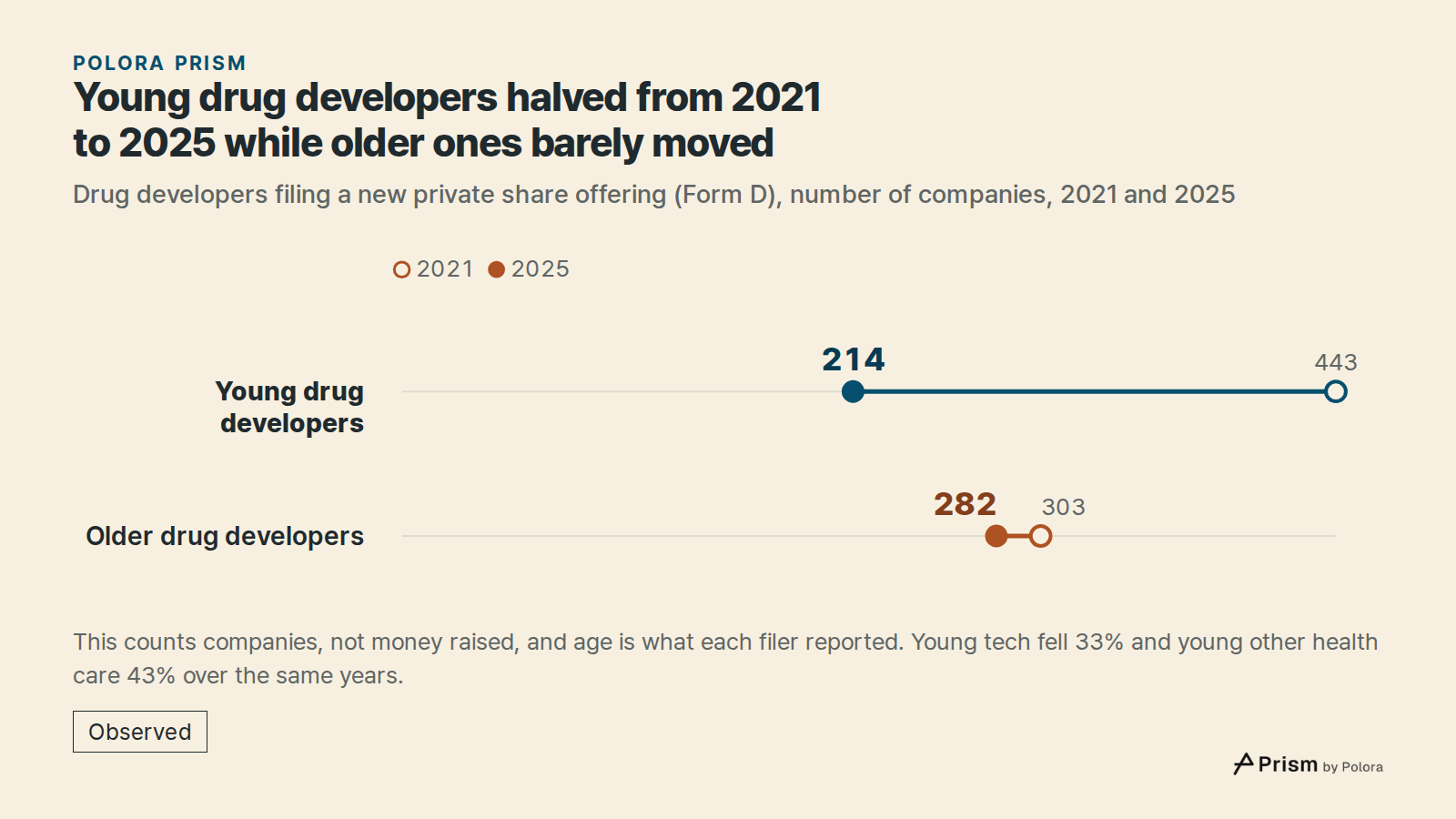
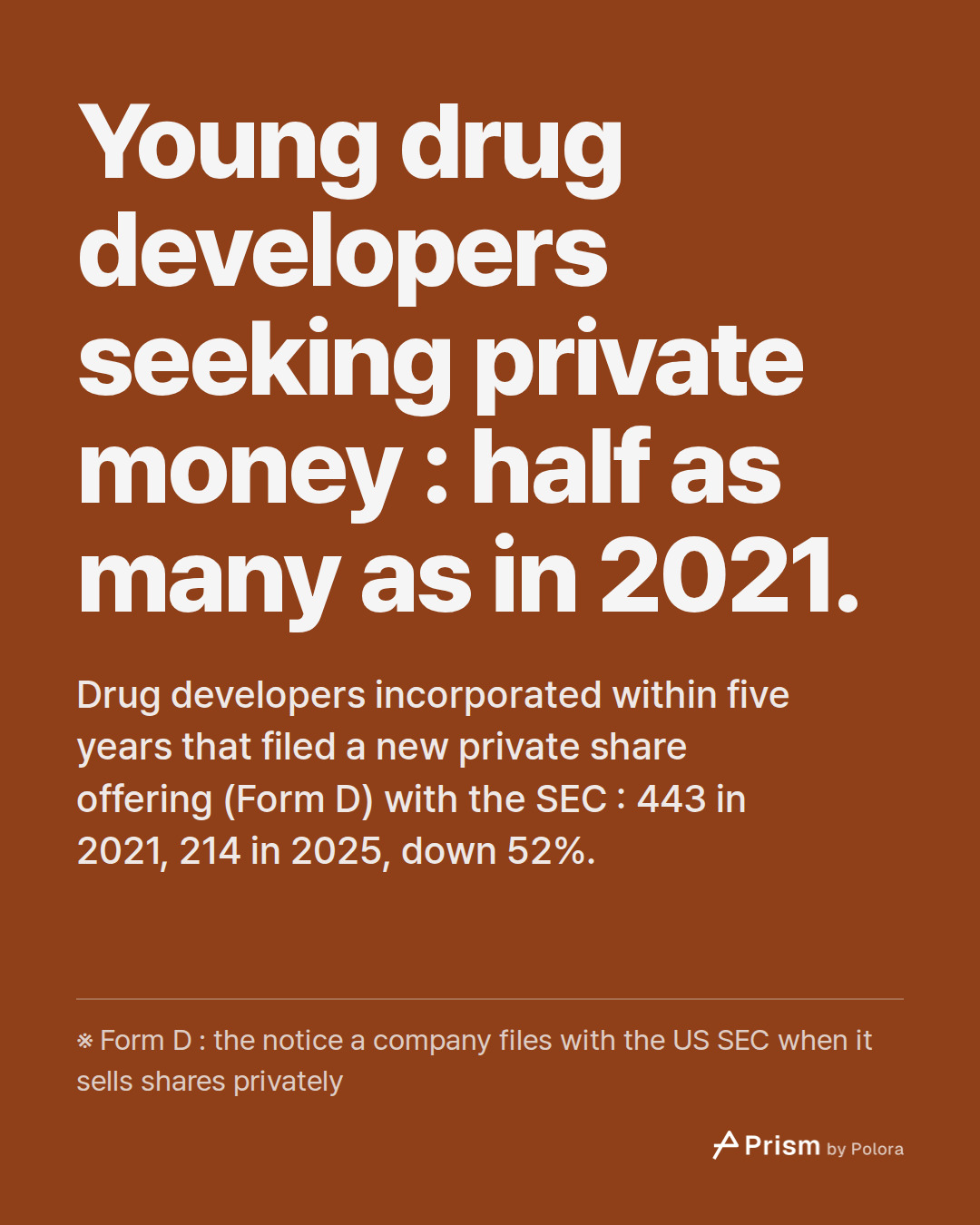
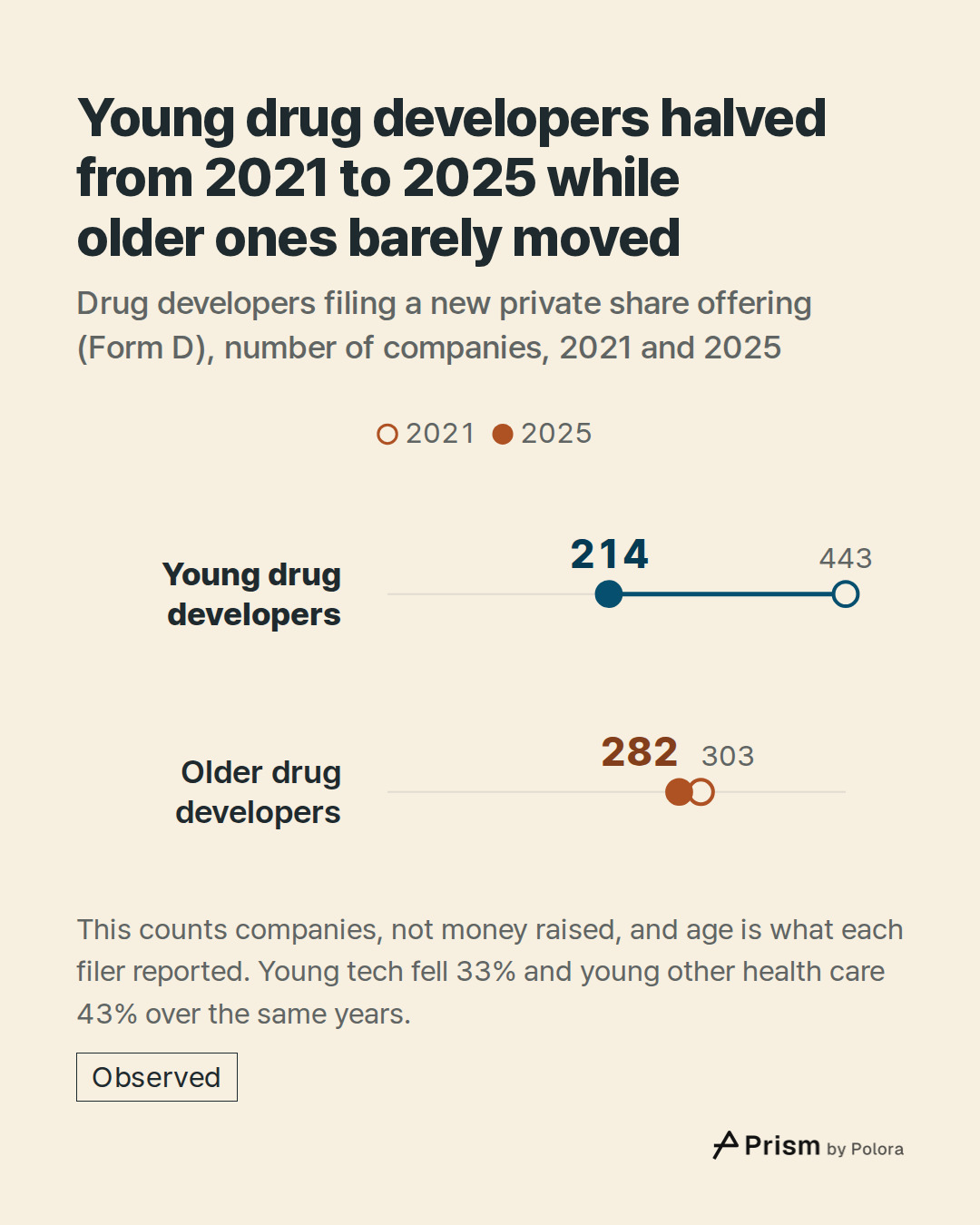
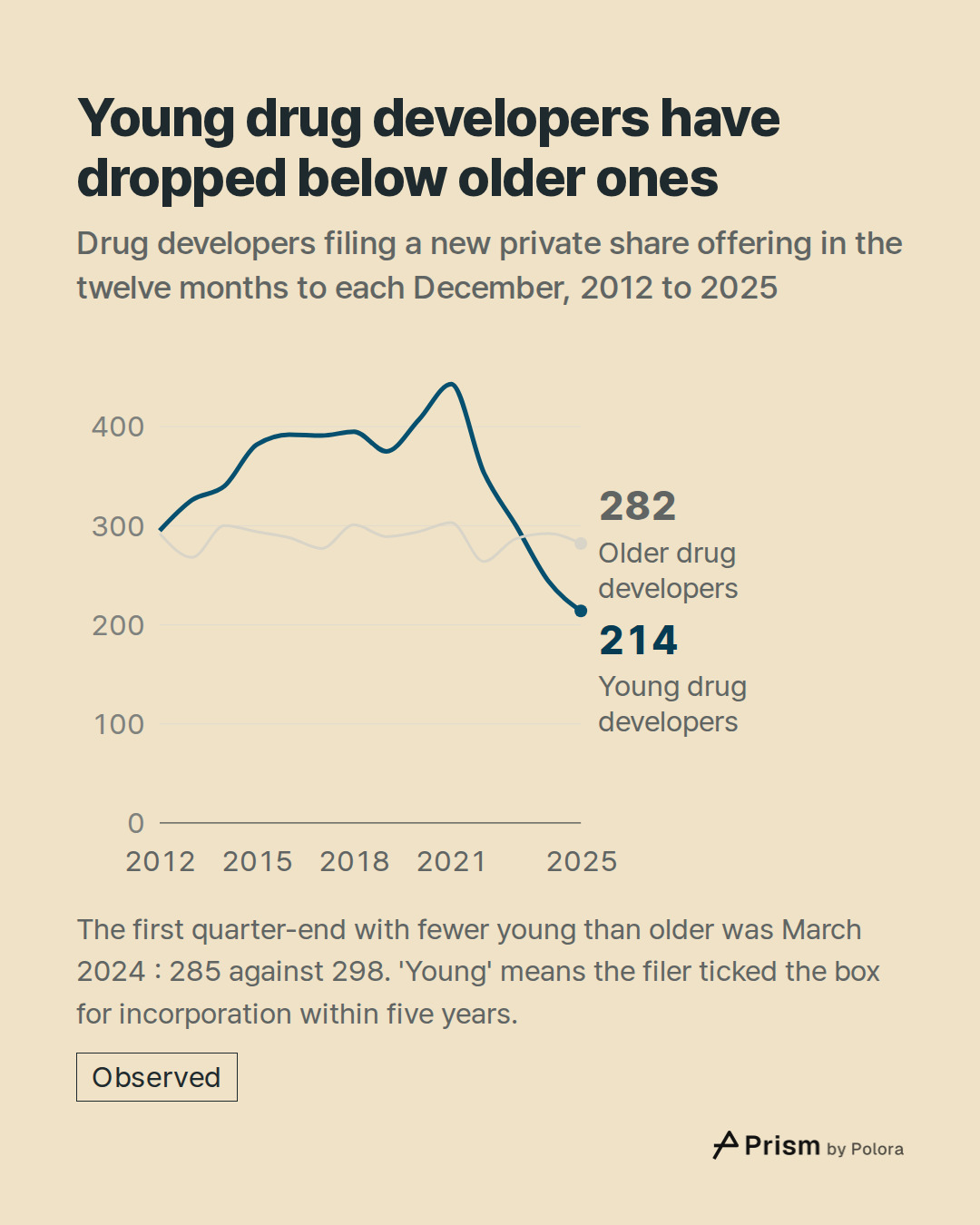
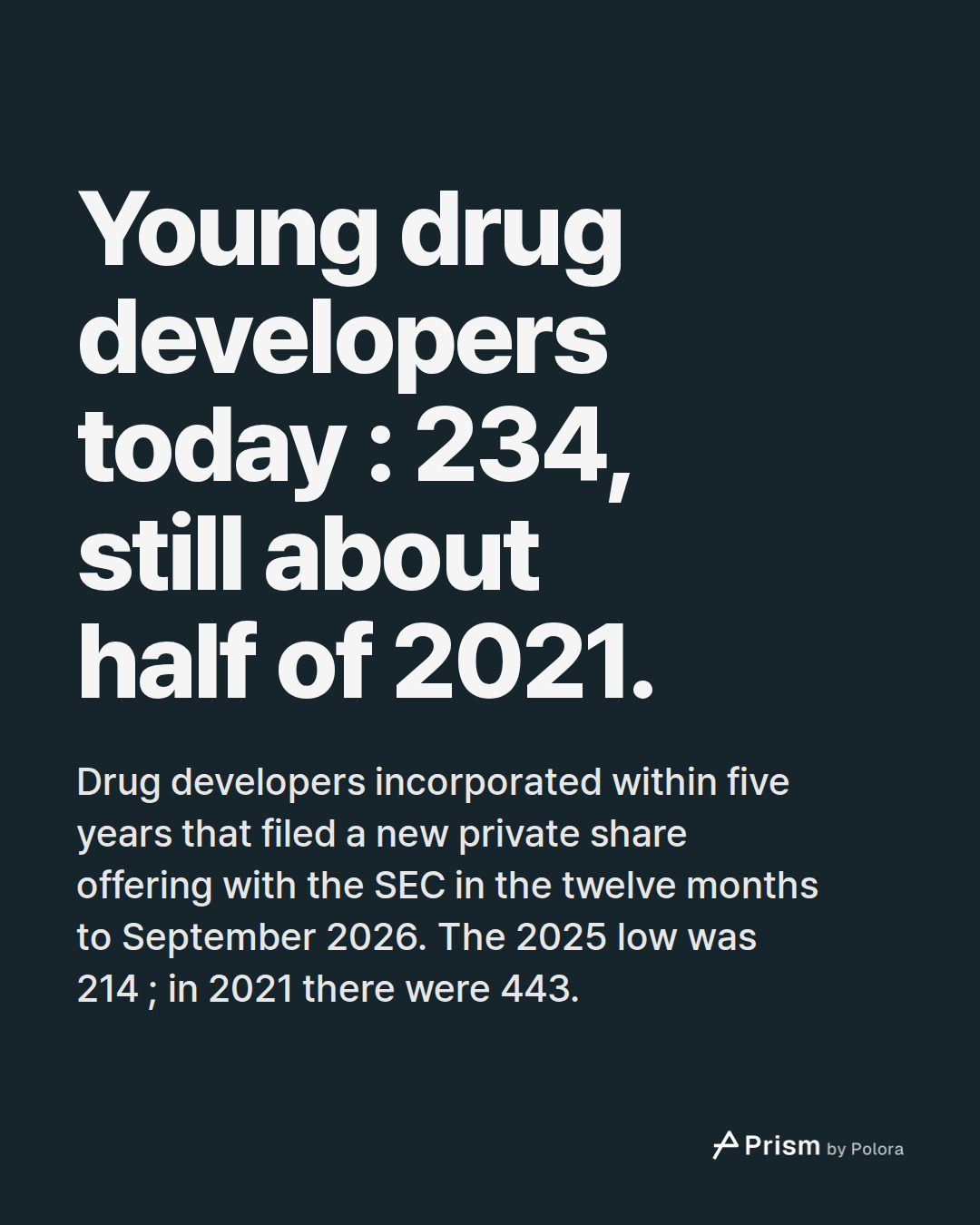
The young drug developers' count was 375 in 2019. It rose to 443 in 2021, a year when all four groups compared here (young drug developers, young tech companies, young companies in other health care and older drug developers) were above their 2019 level. Then it fell year after year, to 214 in 2025, the lowest at any quarter-end in this record, which starts in 2012.
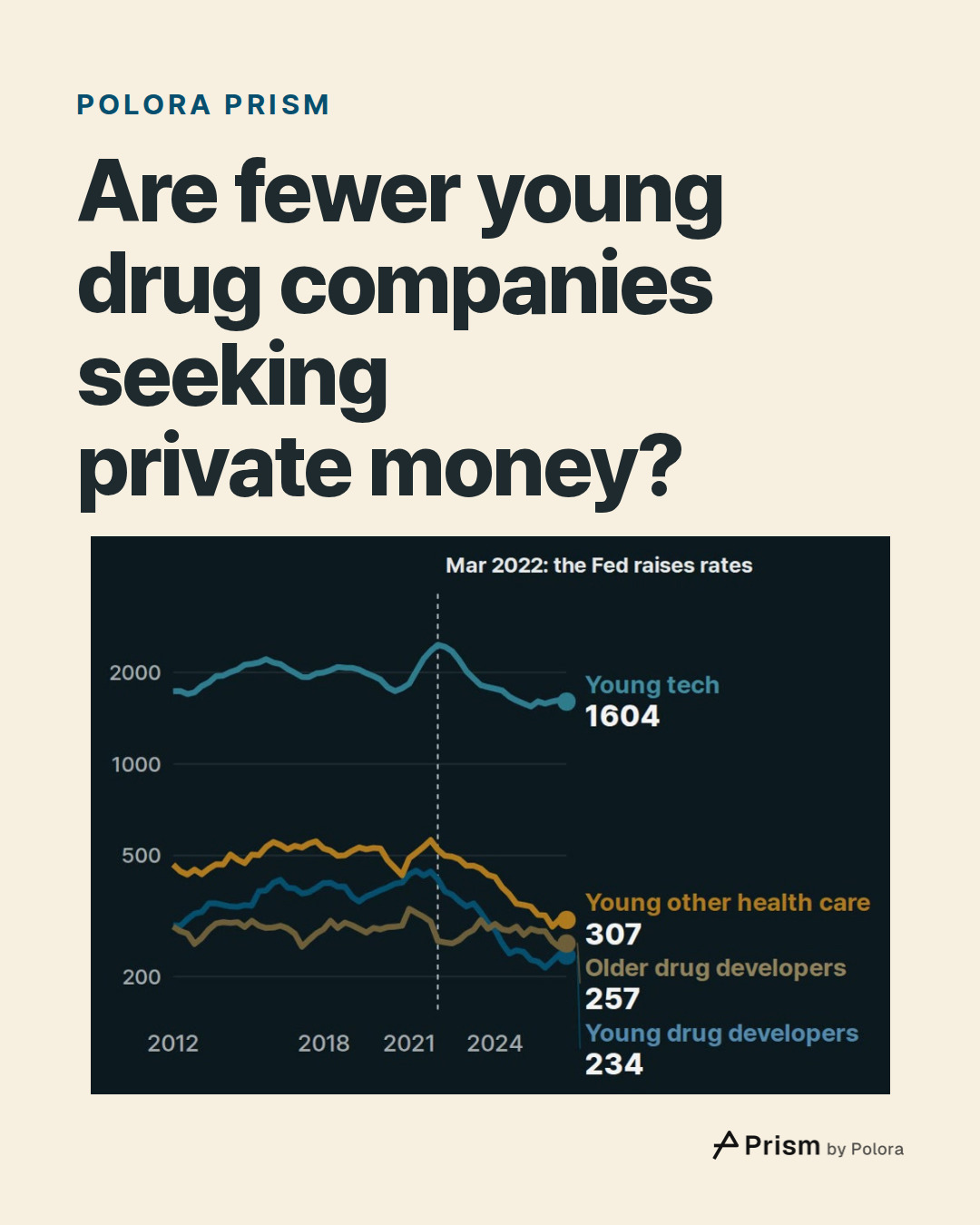
The other groups fell too, but less. From 2021 to 2025, young tech companies went from 2,355 to 1,579, down 33%. Young companies in other health care fell 43%. Drug developers incorporated more than five years earlier fell just 7%, from 303 to 282.
So of the four groups, young drug developers dropped the furthest, and older drug developers barely moved.
Young drug developers now fewer than older ones
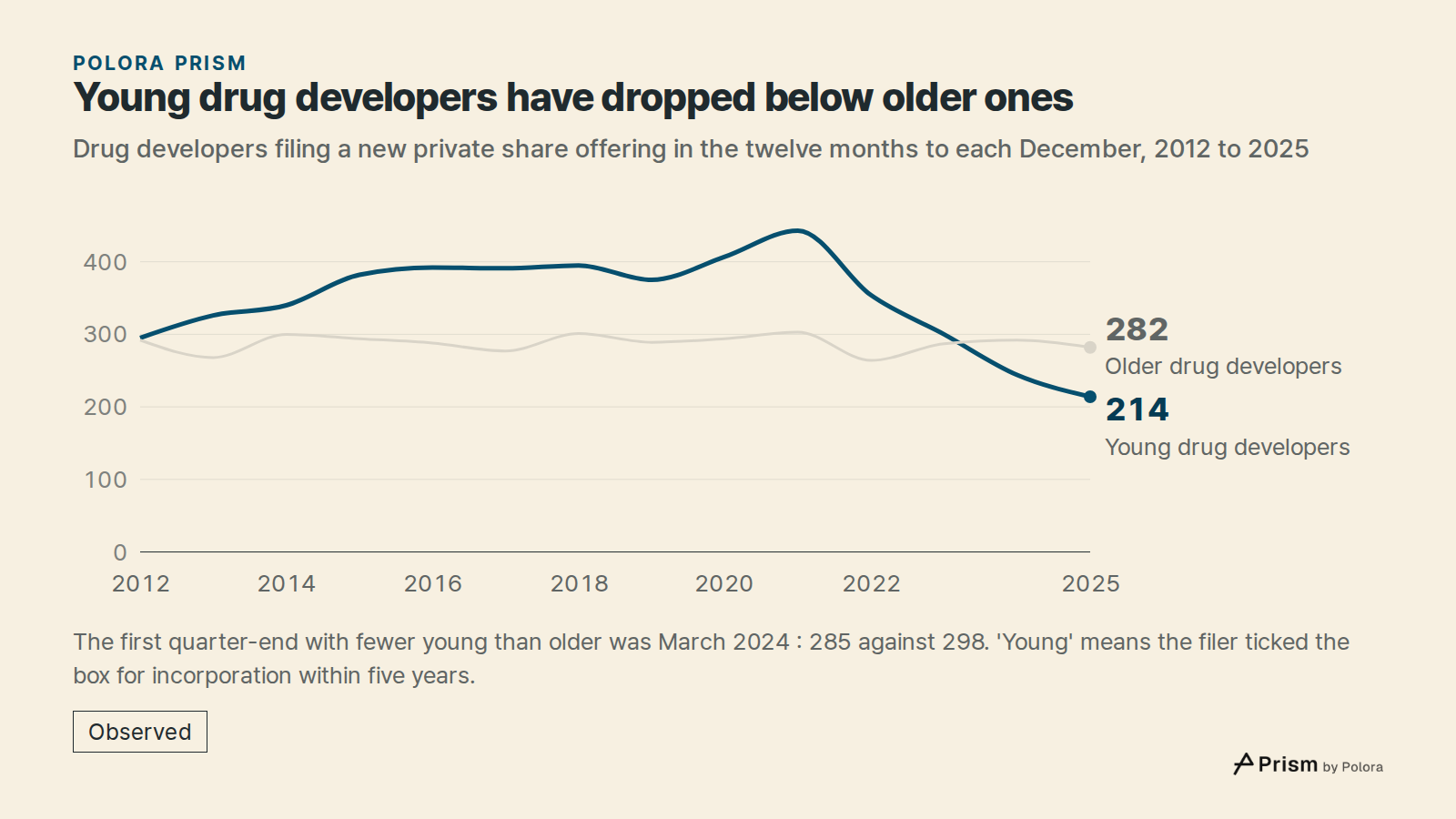
For most of the record, young drug developers outnumbered older ones among these filers. In the twelve months to March 2024 that reversed : 285 young against 298 older, the first time young were fewer at any quarter-end since 2012. Young drug developers have stayed below older ones at every quarter-end since.
Counting only actual sales gives the same drop
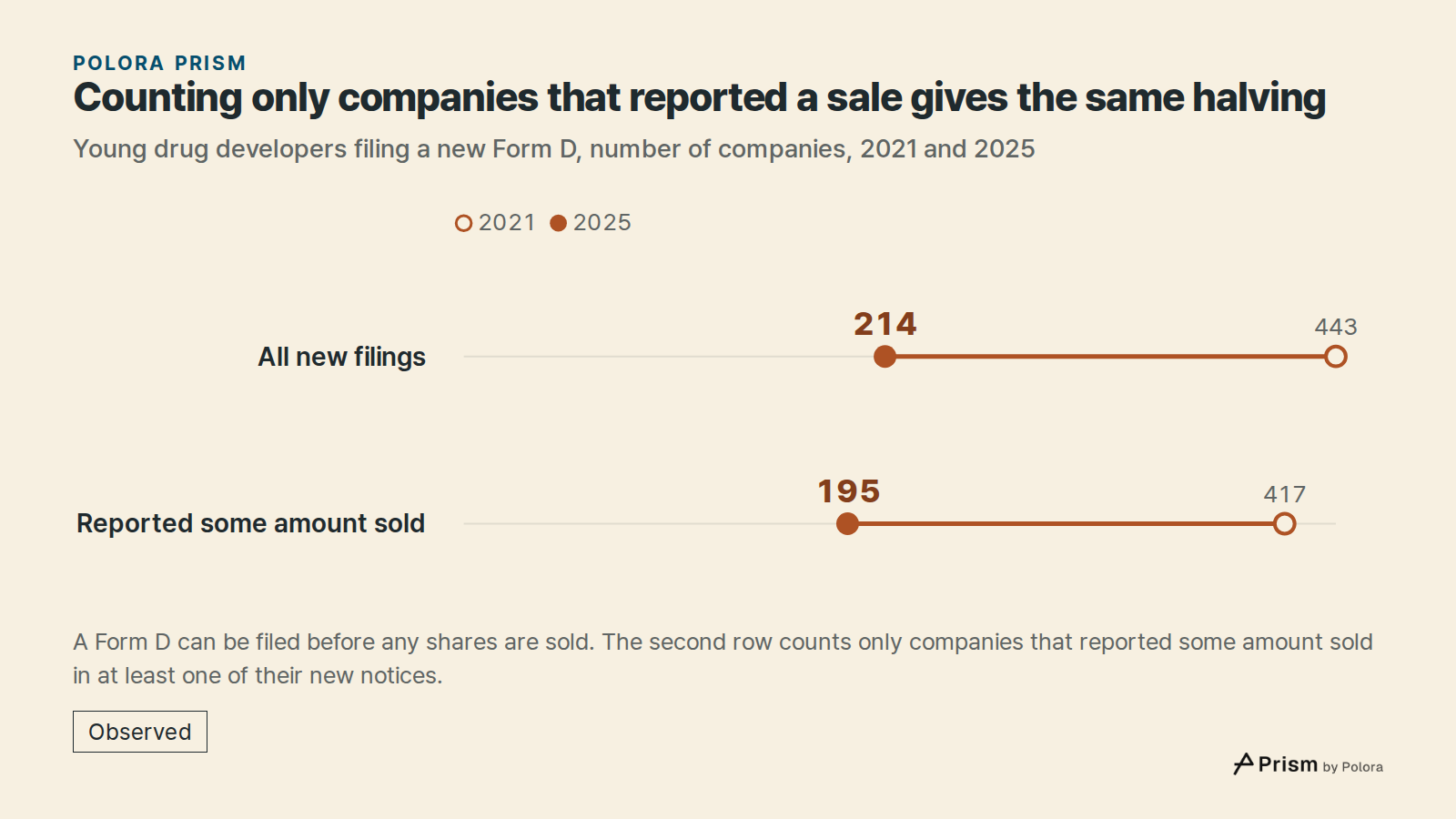
A Form D can be filed before any shares are sold. Counting only the young drug developers that had already reported some amount sold in at least one of their new notices gives the same picture : 417 companies in 2021, 195 in 2025, down 53%.
What happened around the fall
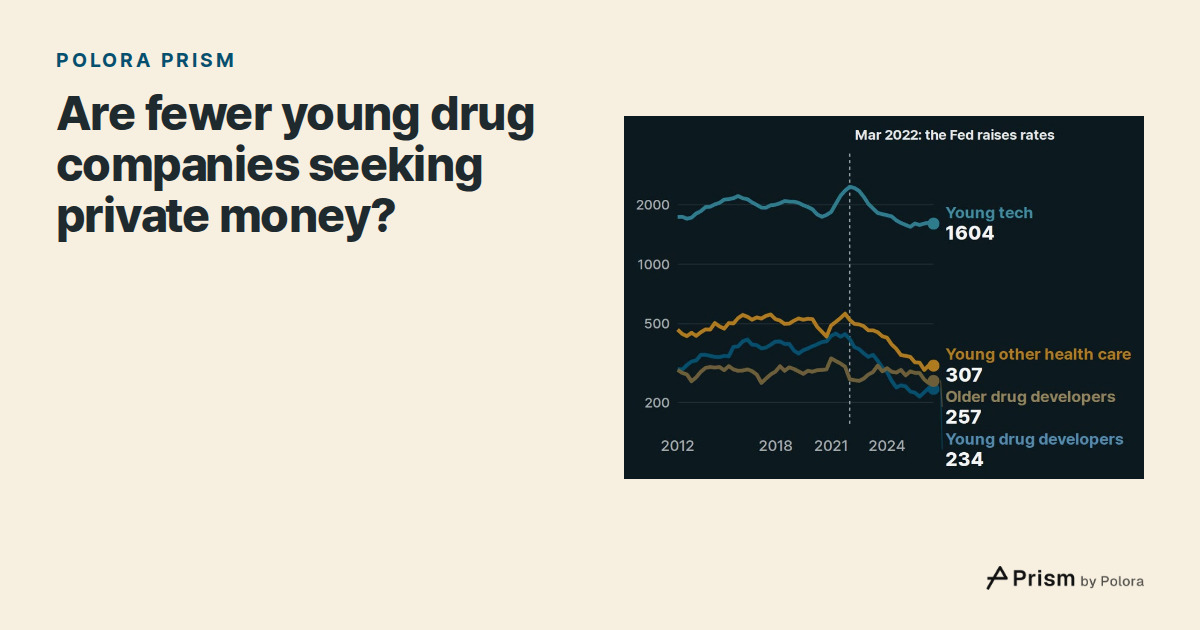
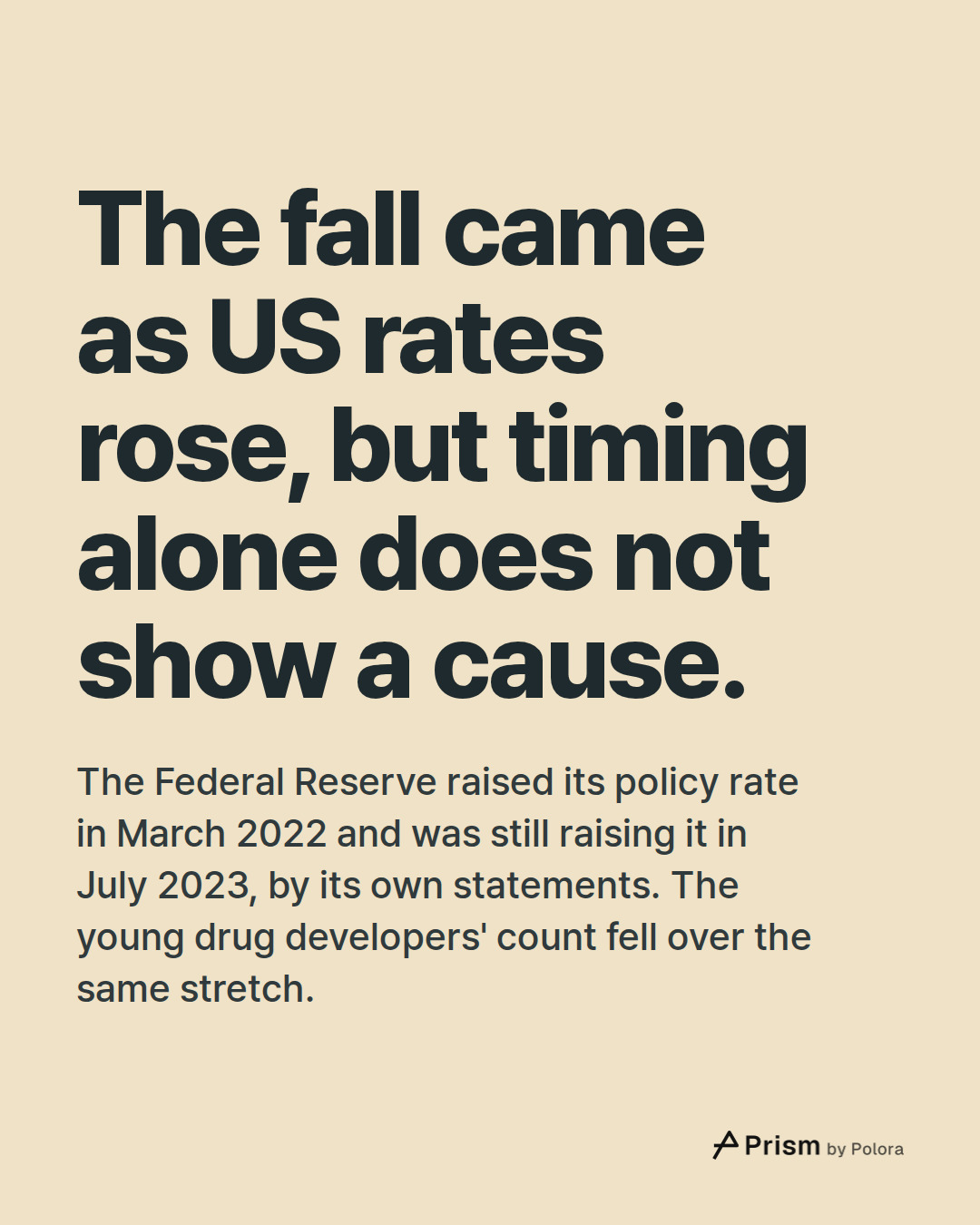
The Federal Reserve raised its policy rate in March 2022, and was still raising it in July 2023, according to its own statements. The young drug developers' count fell over the same stretch. That is a sequence, and these numbers alone do not show that higher rates caused the fall.
A May 2023 review by ICON, a company that runs clinical trials for drugmakers, described the market at that point : interest rates were up and "the once-hot biotech IPO market has crashed", which it said reduced the capital and returns expected by investors in first funding rounds. It reported venture capital funding for biotech at its lowest level since 2019, with investors keeping more money back for companies they already owned. Those are ICON's observations about venture funding and stock market listings, which are measured differently from the private share notices counted here.
Where it stands now
In the twelve months to September 2026, 234 young drug developers filed a new private share offering, a little above the 2025 low and still about half of 2021. Young tech stood at 1,604 and older drug developers at 257.
Why it matters
ICON's review called biotech "the industry's innovation machine" and said large pharmaceutical companies use the biotech market "to augment their pipelines". On that view, how many young drug developers are seeking private money is one window on the early end of the industry. The count says nothing on its own about which drugs reach patients or how any company will fare.
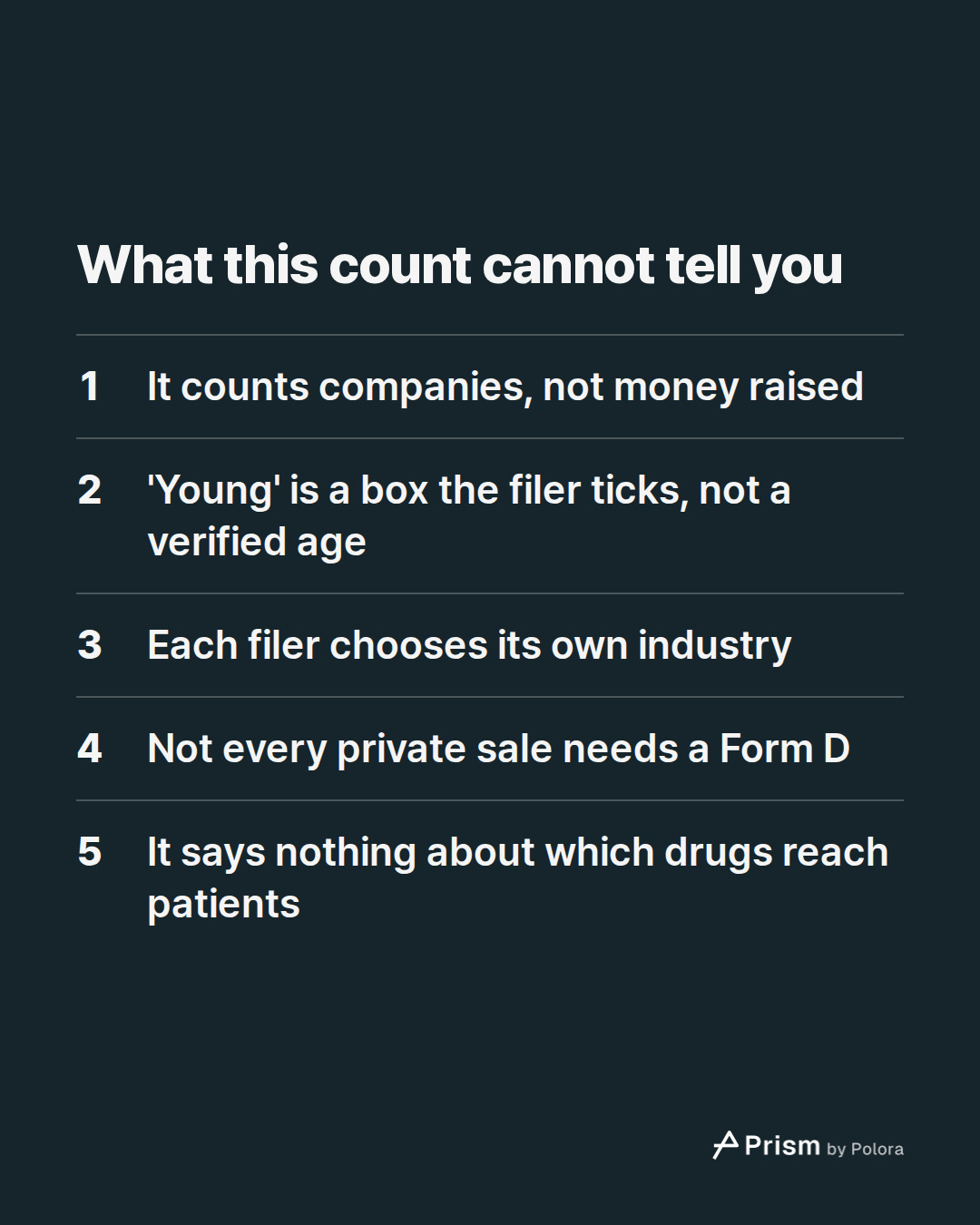
What this count cannot tell you
Industry is the filer's own choice : a young drug company may pick biotechnology, pharmaceuticals or other health care, and the borders between the groups are the filers' to draw.
"Young" is a box the filer ticks about its date of incorporation, not a verified age of the business, so this is not a strict count of start-ups.
Form D is only required for some kinds of private offerings, so not every private sale appears, and this is not a full count of venture funding rounds. The count covers every filer with the SEC, not only US companies.
Finally, the count is of companies, not of money : it does not add up how much was raised, and a company counts the same whether its offering was small or large.
- SEC, Form D data sets (2008 to the third quarter of 2026)]
- SEC EDGAR, the Form D filings themselves (used to check the counts)]
- SEC, Filing and Amending a Form D Notice]
- Federal Reserve, FOMC statement, 16 March 2022]
- Federal Reserve, FOMC statement, 26 July 2023]
- ICON plc, Recent trends in the biotech funding environment (May 2023)]
![Sources 6 : sec.gov · SEC, Form D data sets (2008 to the third quarter of 2026)], sec.gov · SEC EDGAR, the Form D filings themselves (used to check the counts)], sec.gov · SEC, Filing and Amending a Form D Notice] + 3](https://media.cdn.polora.ai/picks/2026/11/pickrun_a7a6f25922eb4cfe/DQm1qhk1ZPqa5FJE-slide-08--are-fewer-young-drug.jpg)