One word, several different businesses
In 2026, two kinds of headline used the same family of words. One said investors in a large private credit fund could take out less than half of the money they had asked for. Another said private equity might come to 401(k) accounts, the workplace retirement savings accounts most Americans use. The first story is about a fund that lends money. The second is about a push to let ordinary savers reach several kinds of private funds at once.
In everyday news, "private equity" has become a word for almost any money managed away from the stock exchange. Underneath it sit businesses that earn money in very different ways, carry different risks and pay their managers on different terms. Strictly, private equity means funds that own shares in companies. "Private funds" or "private capital" is the more accurate name for the whole group.
In Korea the blur is written into the law. Since 21 October 2021, the Capital Markets Act has sorted private funds by who may invest in them rather than by what they do. Institutional funds are open only to institutions. General funds also accept individuals who meet the eligibility conditions, with a minimum investment of 300 million won or 500 million won depending on how much the fund borrows. Before that change, the law kept funds that take control of companies apart from funds that trade. Today the legal label alone does not tell a reader which kind of fund a story is about.
So the useful question is a plain one : what does this fund actually do with the money?
- Apollo private credit fund gives investors only 45% of requested withdrawals (CNBC)
- Executive Order 14330, Democratizing Access to Alternative Assets for 401(k) Investors
- Private fund reform under the Capital Markets Act (Korea Financial Times)
- Financial Investment Services and Capital Markets Act (Korea Law Information Center)
- Financial Services Commission announcement on private fund reform
- Investment Funds 2026 : South Korea (Chambers Practice Guides)
Sort private funds by what they do with the money
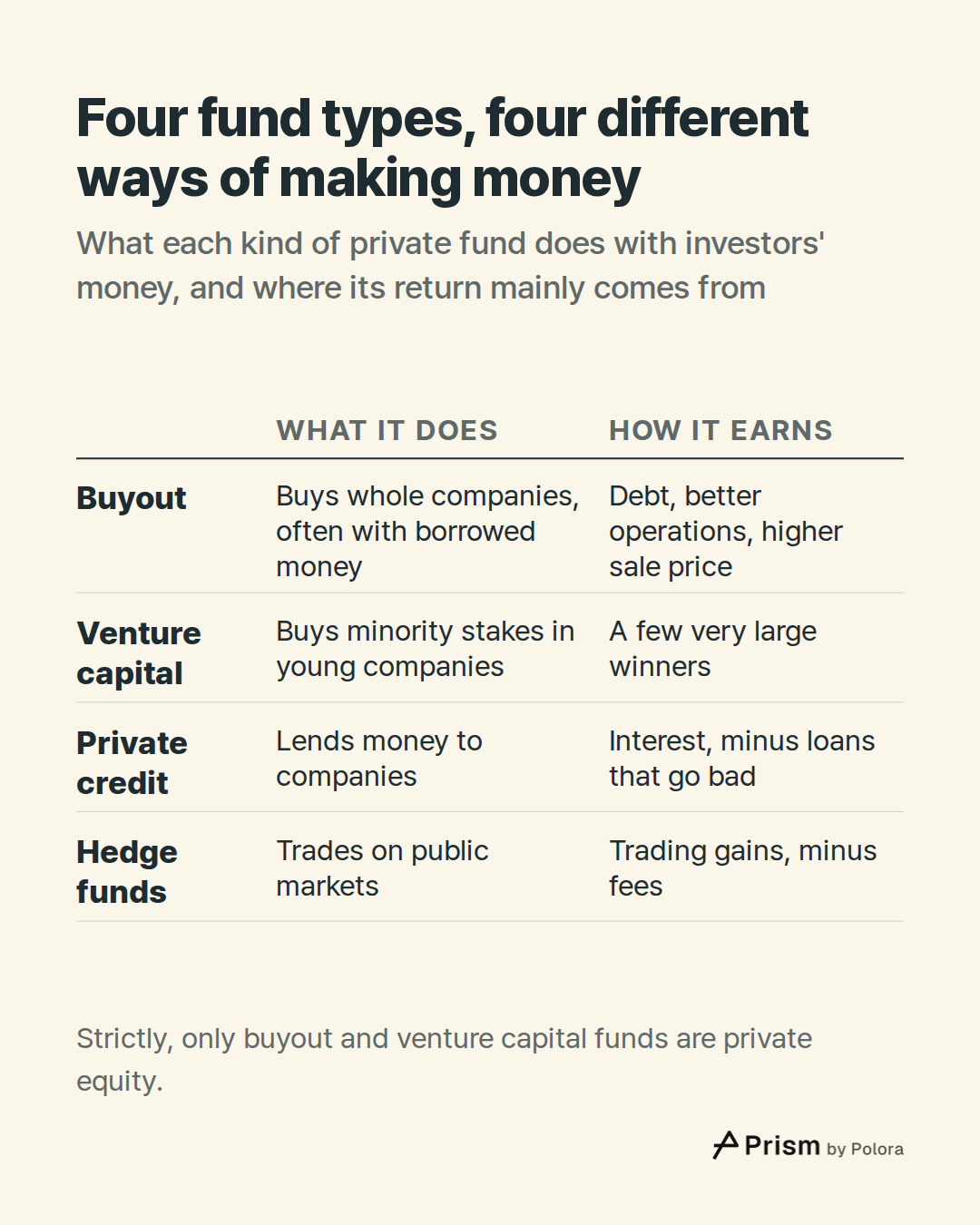
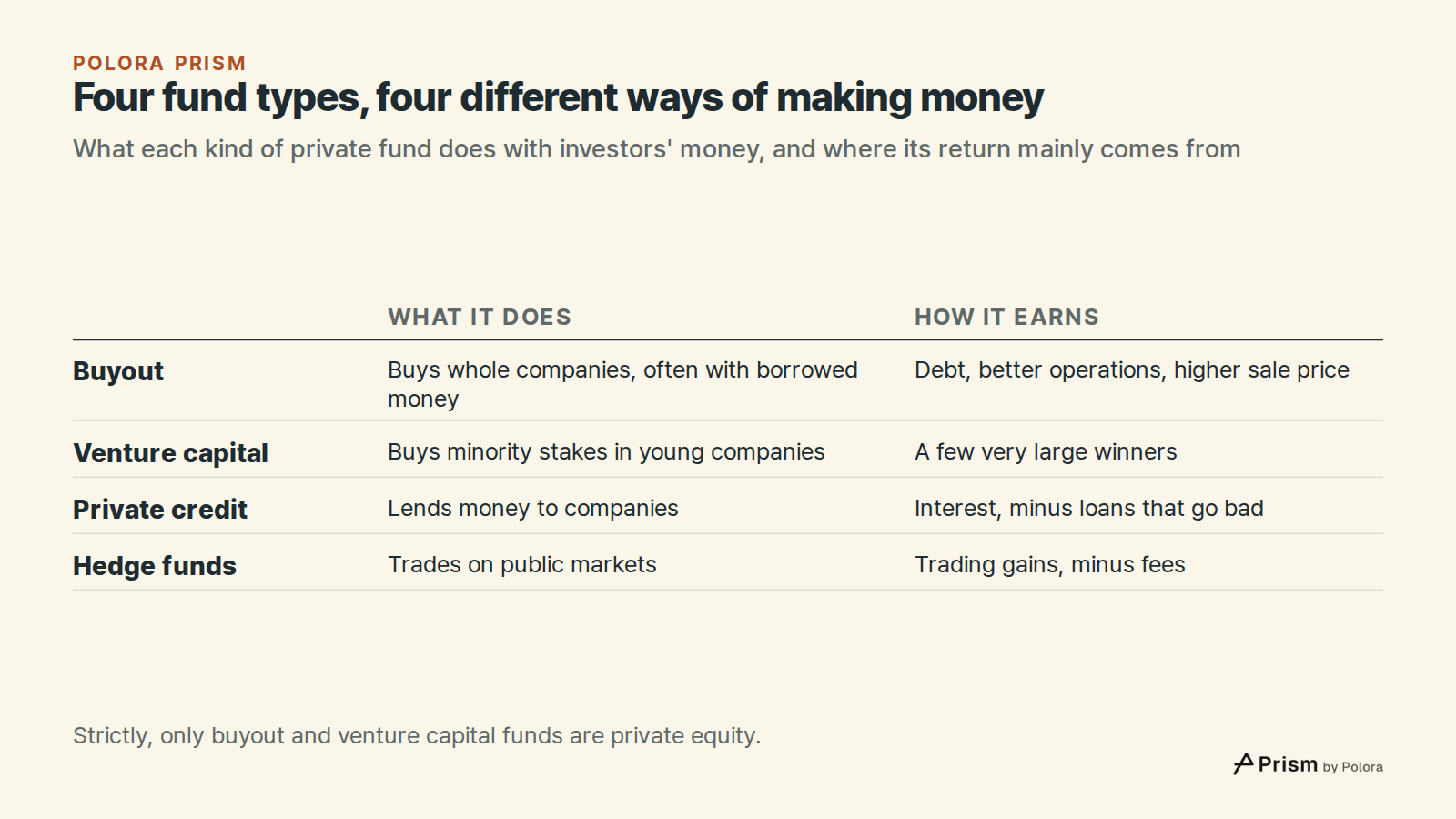
Buyout funds buy control of whole companies, usually paying with a large share of borrowed money, run them for several years and then sell them. This is private equity in the strict sense.
Venture capital and growth equity funds buy minority stakes in young or fast-growing companies. They own a slice, not the whole company, and they rarely borrow to do it.
Private credit funds, also called direct lending funds, lend money to companies instead of owning them. They earn interest, the way a bank does.
Hedge funds mostly buy and sell shares, bonds, currencies and other things that trade every day on public markets. What makes them private is how they are sold, to wealthy and institutional investors, not what they hold. Being sold privately does not make their holdings private equity.
Real estate and infrastructure funds invest in buildings, roads and power networks, and secondaries funds buy existing stakes in other private funds from investors who want to leave early. Strictly, "private equity" covers the first two types. In the news it often covers all of them, and that is the blur worth undoing.
Buyouts : debt, better operations and a better price on the way out
A buyout fund's return has three main engines. Borrowed money magnifies the gain on the fund's own slice when the company does well, and magnifies the loss when it does not. Running the company better raises its profits. And selling at a higher price per unit of profit than the fund paid, which professionals call multiple expansion, adds a gain that has nothing to do with the company itself.
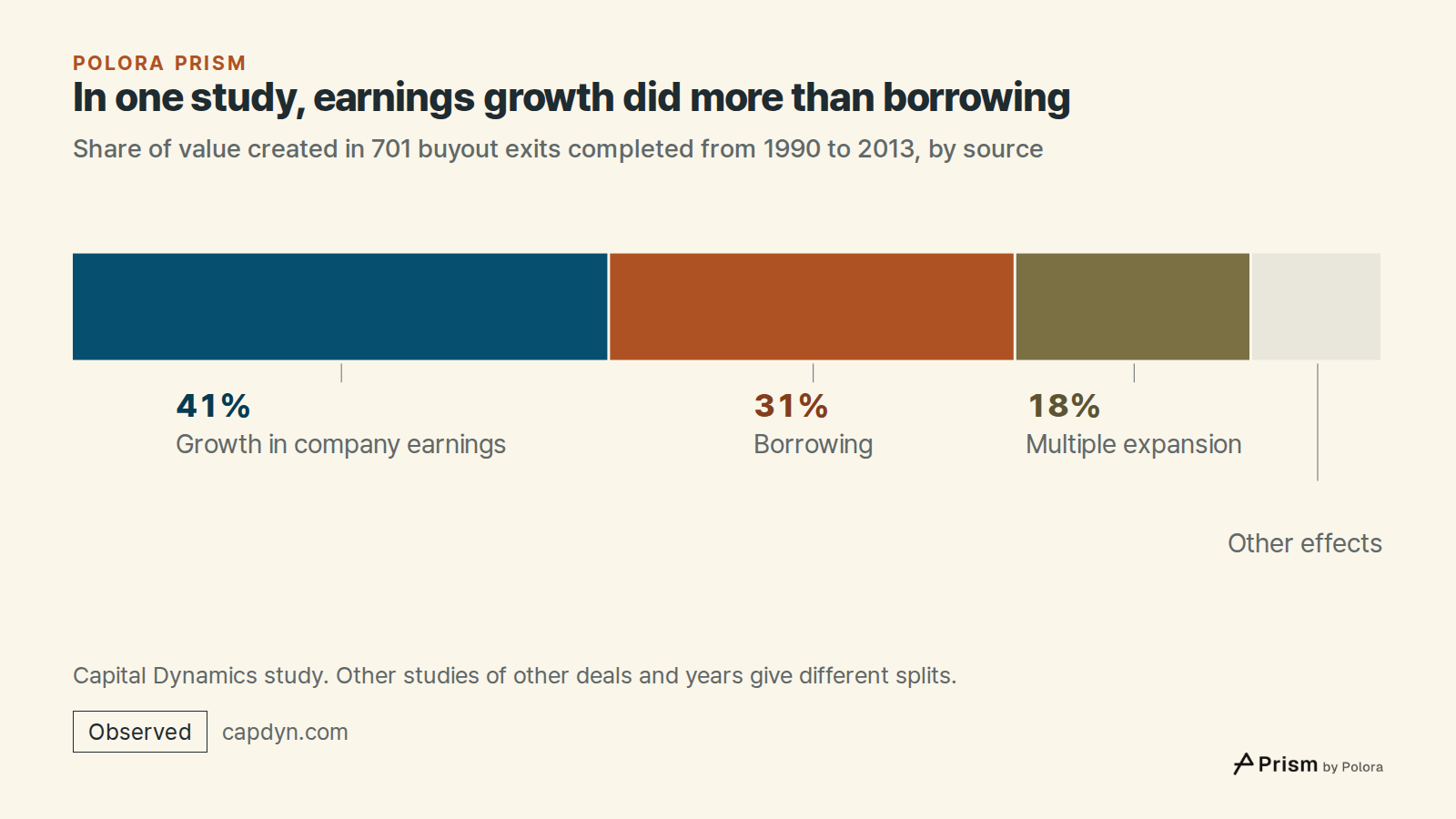
How much each engine contributed depends on which deals and which years a study looks at. Capital Dynamics, working with the Technical University of Munich, first studied 241 buyout exits in 2009 and credited about a third of the value created to borrowing. Its later study of 701 exits completed between 1990 and 2013 credited 31% to borrowing, 41% to growth in the companies' earnings and 18% to multiple expansion, with the remainder from other effects. A 2010 study of 206 European buyouts by Achleitner and co-authors reported a similar picture, with about a third of returns from borrowing.
McKinsey's Global Private Markets Review 2024 looked at 2,512 buyout deals entered in 2010 or later and sold by the end of 2021, a period of falling interest rates and rising market prices. It attributed about two-thirds of their returns to multiple expansion and borrowing together. McKinsey's 2026 report, covering buyout deals between 2010 and 2022, put that share at 59%. The samples and periods differ, so the second figure is not a correction of the first. It shows again how much the answer depends on which deals are counted.
The disagreement is the honest answer. No single split describes how buyouts work. In some eras, cheap debt and rising prices did most of the work. In others, the company's own improvement mattered more.
Venture capital : a few big wins pay for many losses
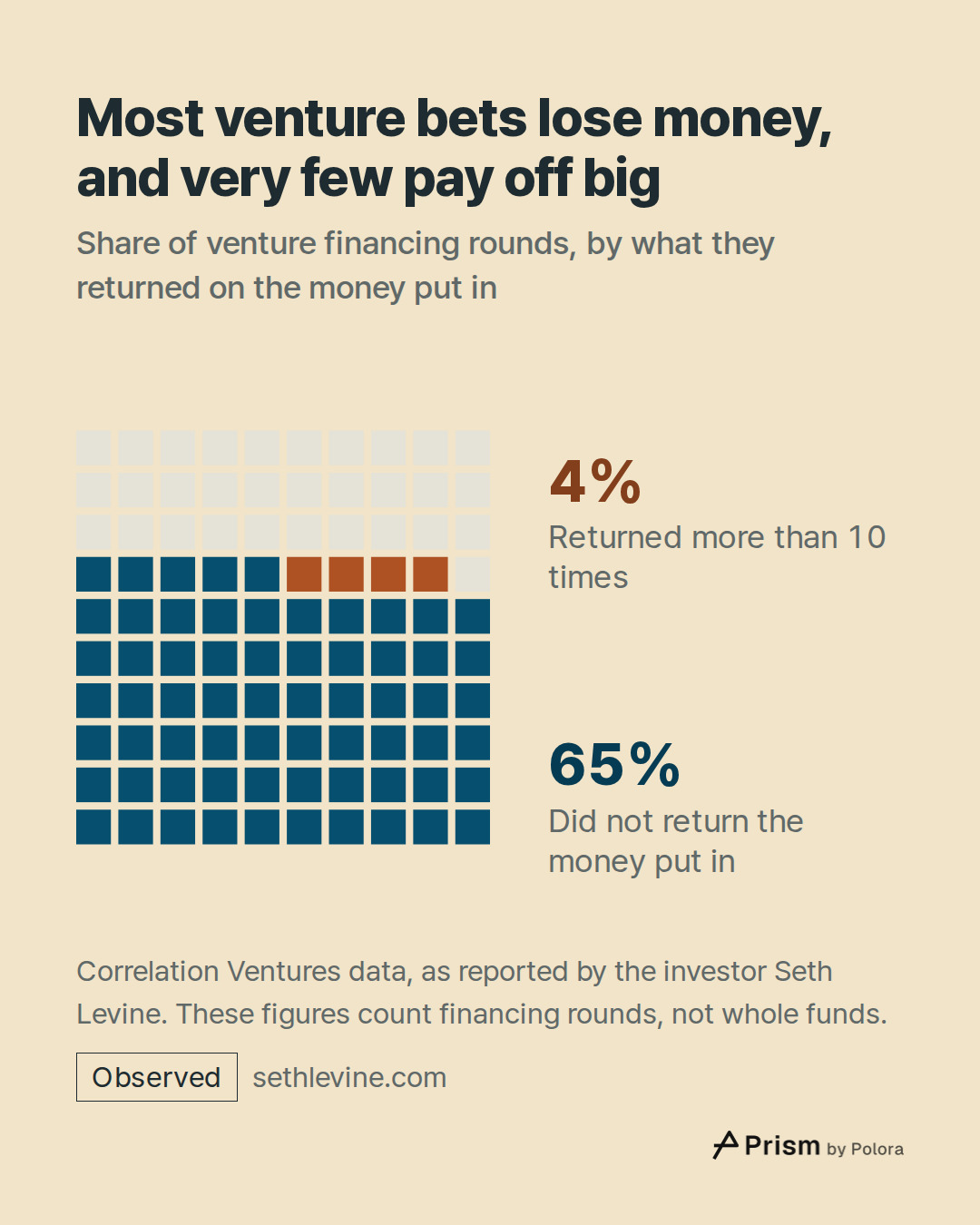
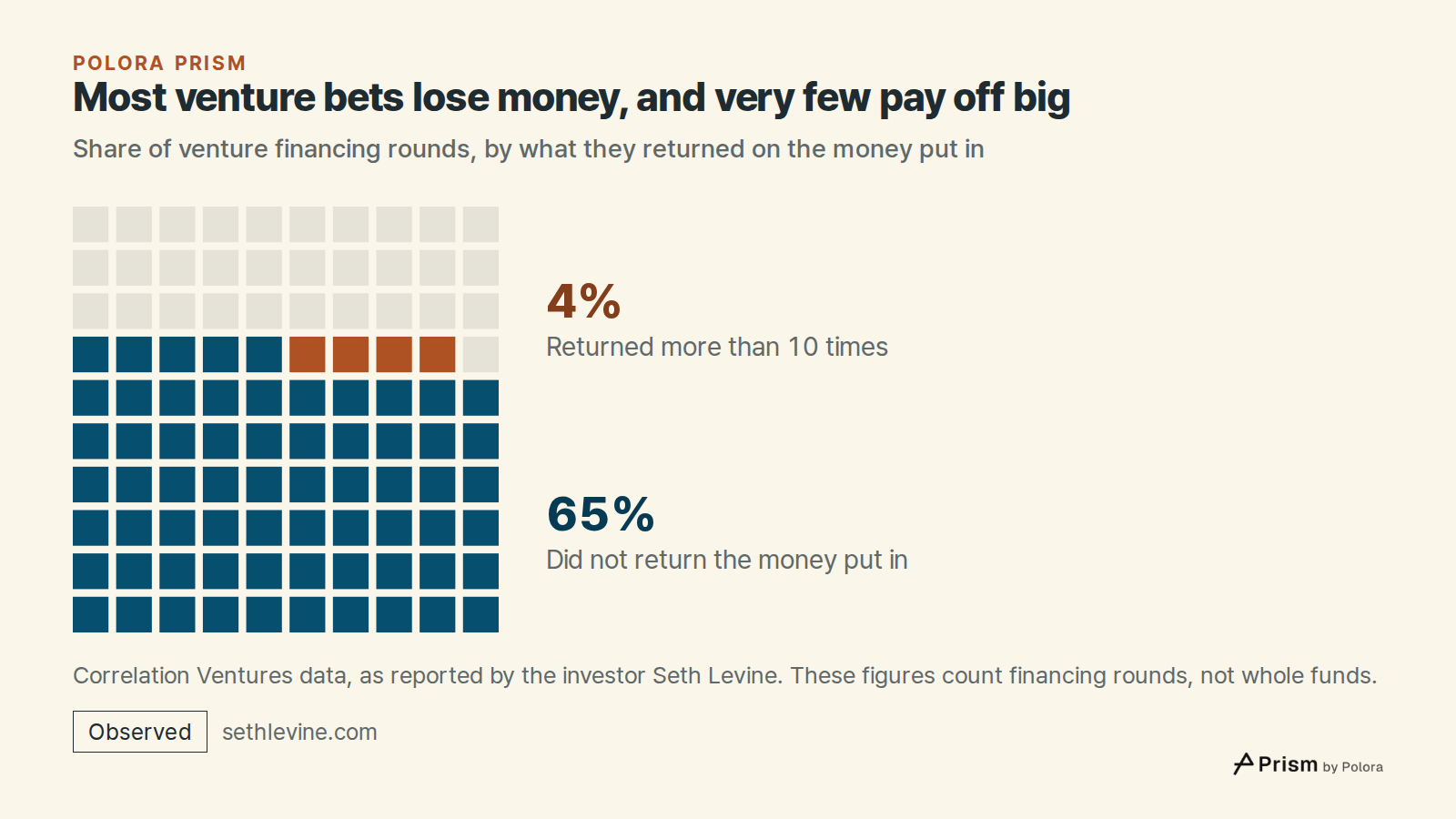
A venture fund backs many young companies knowing most will not work. Data from the venture firm Correlation Ventures, reported by the investor Seth Levine, showed that 65% of venture financing rounds failed to return the money put in, and only 4% returned more than ten times it.
That shape decides the investor's return. A venture fund does not make money by being right on average. It makes money if it holds one or two of the rare companies that grow very large, and a fund without one can lose money even when many of its companies survive. The industry average says little about what any one fund will deliver.
Private credit : interest, fees and the loans that go bad
A private credit fund earns mostly interest. Its loans usually carry a floating rate, a benchmark rate plus a fixed margin, so the income rises and falls with interest rates. Lenders often take an upfront fee as well. Investors also hope for some extra return for lending money that cannot be sold quickly, but that is an expectation, not a payment written into the loan. Part of the income is lost when borrowers fail to pay.
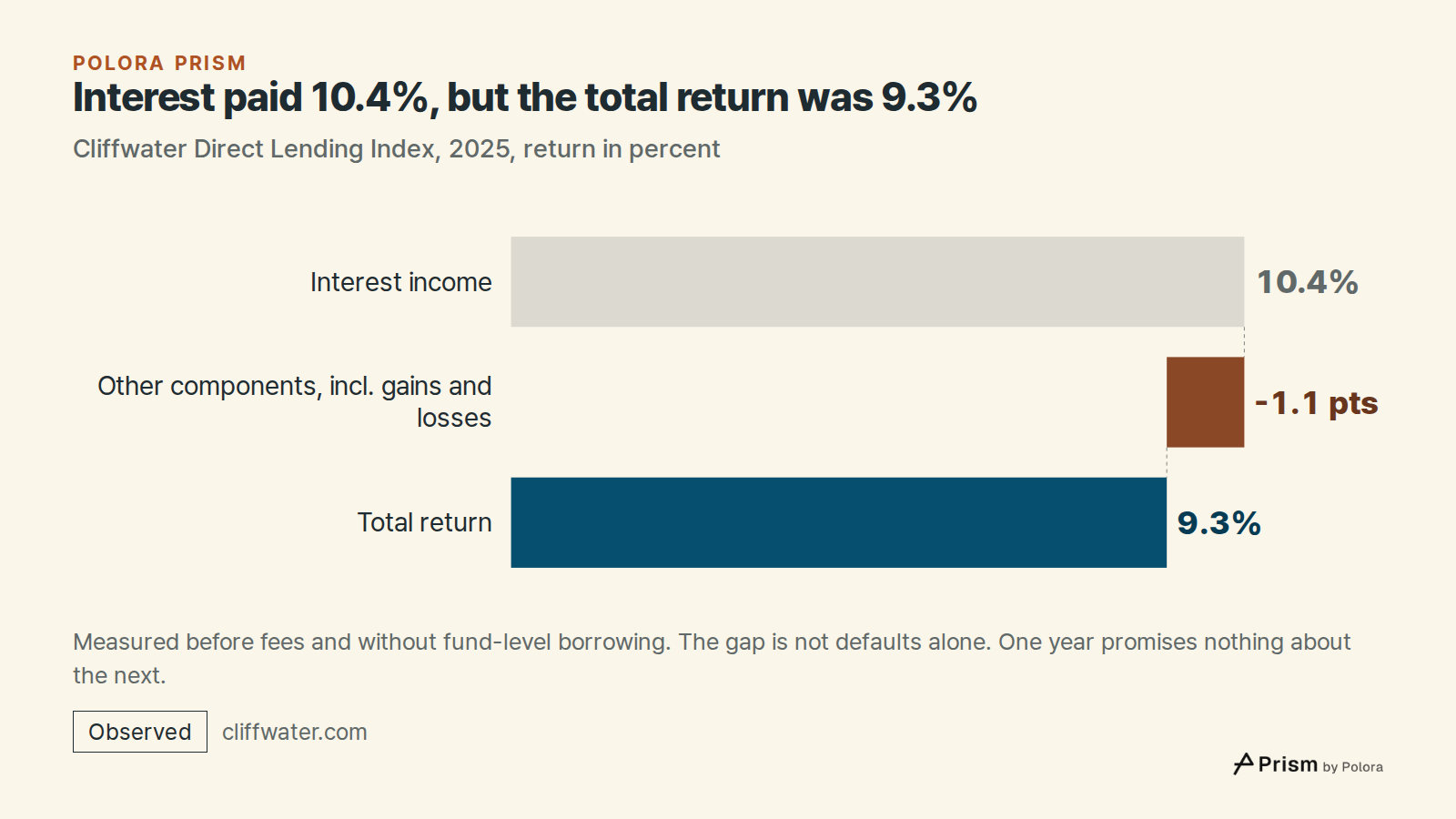
An index shows the pieces. The Cliffwater Direct Lending Index, which tracks about 21,000 loans to midsize US companies worth $549 billion, returned 9.3% in 2025, according to results released on 31 March 2026. Interest income alone was 10.4%. The 1.1-point gap is made up of the index's other return components, which it reports separately, among them realized and unrealized gains and losses. It is not a measure of defaults alone.
The index is measured before fees and without borrowing at the fund level. It is an index of loans, not what any one fund paid its investors after its own fees and costs, and one good year promises nothing about the next.
The same strategy, sold in two different packages
How investors can get their money out depends less on the strategy than on the package it comes in. Pension funds and other institutions usually invest through funds that lock their money up for years and return it as the investments are sold. Individuals increasingly invest through funds with no end date, which let them ask to withdraw each quarter, with withdrawals across all investors usually capped at about 5% of the fund.
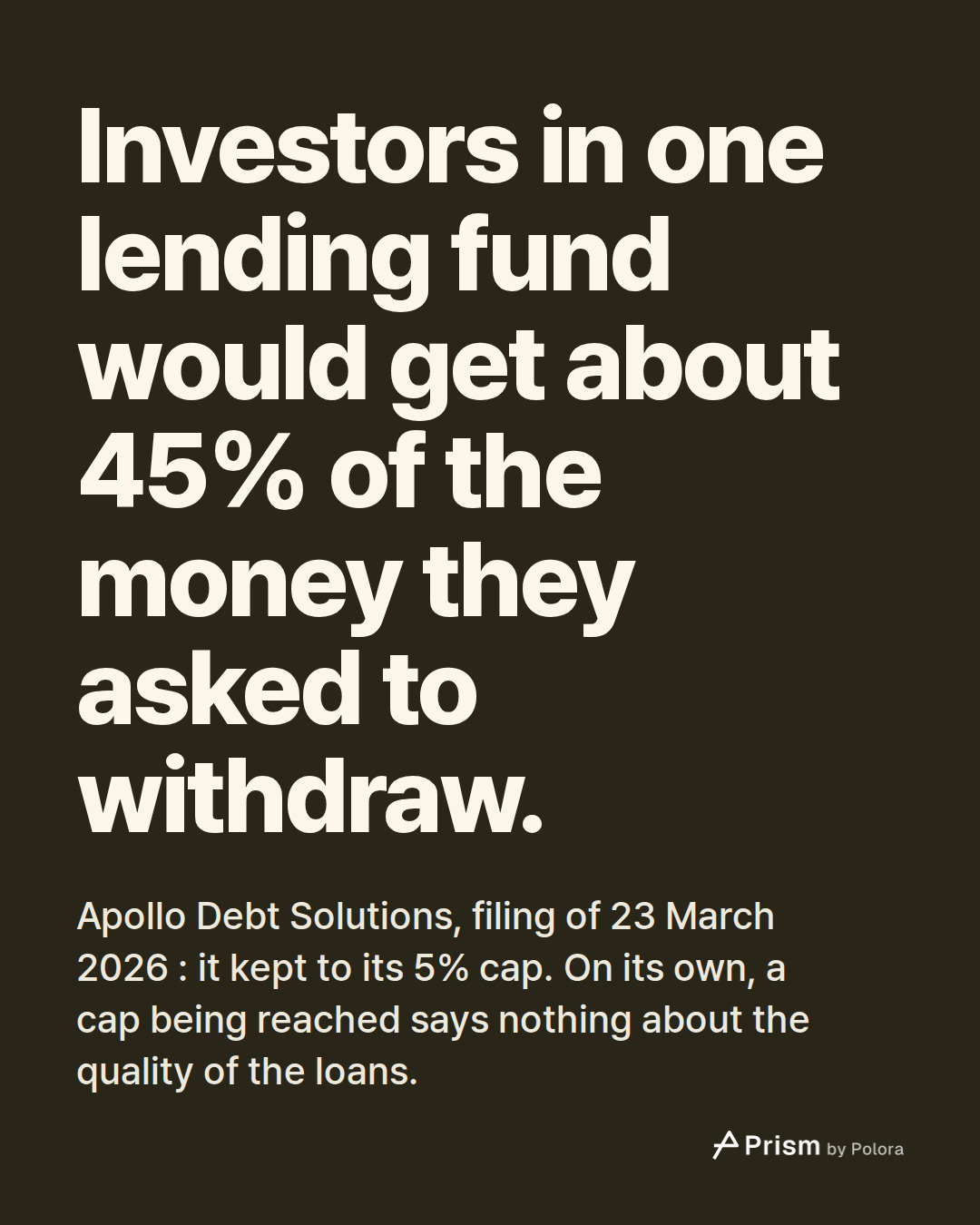
In 2026 that limit was tested. Apollo Debt Solutions, a $15.1 billion private credit fund, said in a filing on 23 March 2026 that holders of about 11.2% of its shares had asked to sell them back. It kept to its 5% limit, so each investor who asked would receive about 45% of the money requested. In the same quarter, according to the trade publication AltsWire, investors in Blackstone's private credit fund BCRED asked to withdraw 7.9%, about $3.8 billion. Blackstone raised its offer to 7% and covered the rest with $400 million from the firm and its employees.
The cap is part of how these funds are designed, written into their documents. "These products are not intended to be totally liquid," Blackstone's head of private credit, Brad Marshall, said. On its own, a cap being reached says nothing about the quality of the loans or where the sector is going. It shows what "withdraw quarterly" means in practice : a fund can pay out only part of what investors ask for.
Hedge funds : trading returns, minus fees
A hedge fund's return comes from its trading strategy : for example, buying some shares while betting against others, or taking positions on interest rates and currencies. The investor receives the strategy's gains or losses, after the fund's expenses and the manager's fees.
Hedge funds managed an estimated $5.22 trillion at the end of the first quarter of 2026, according to the research firm HFR. Because most of their holdings trade every day, their results can be checked against public markets more directly than those of buyout or venture funds.
How the manager gets paid, whatever the result
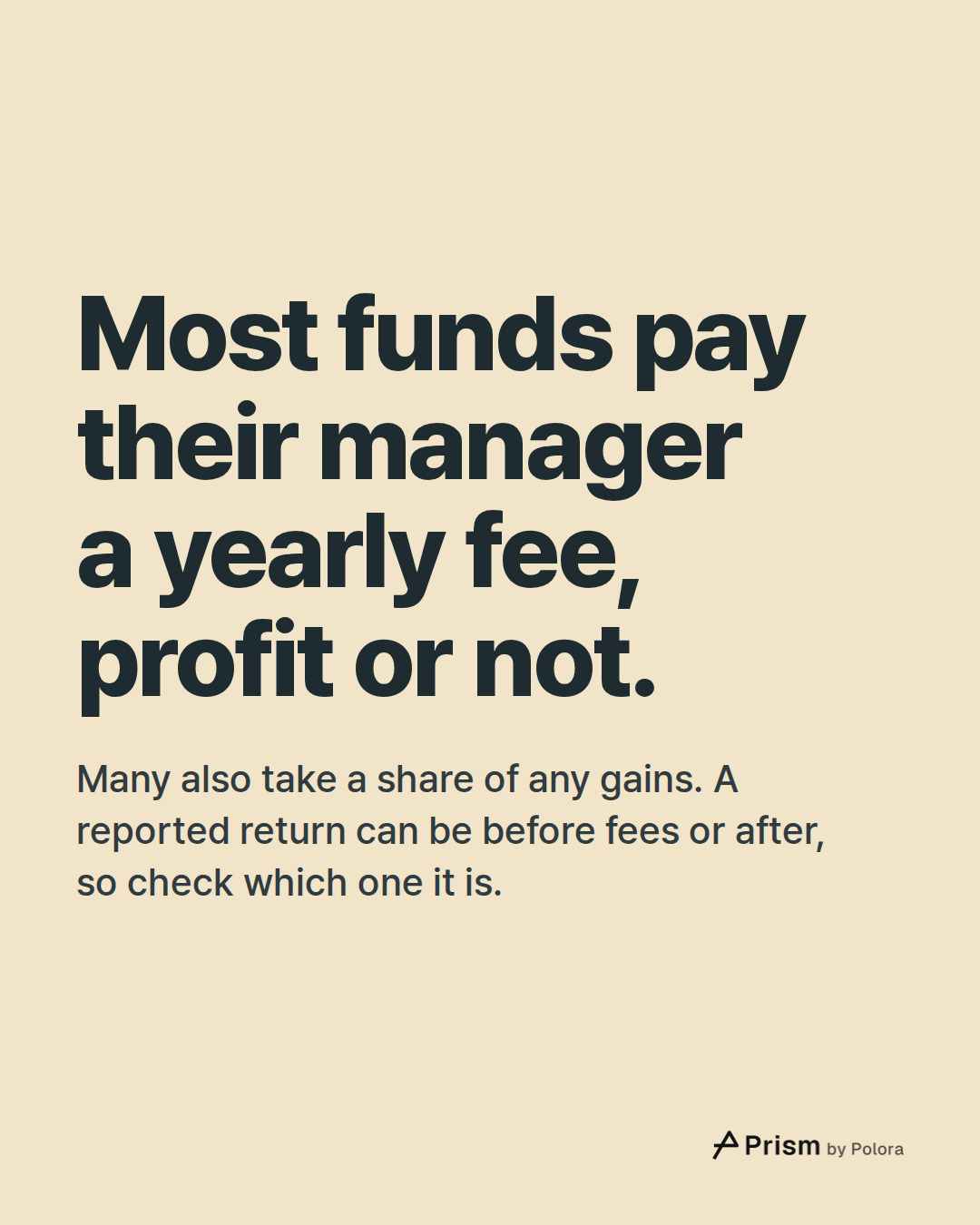
Most of these funds pay their manager in two ways. The first is a yearly management fee, paid whether or not investors make a profit. In private equity it is usually charged on the money investors have committed, the money actually invested, or a mix of the two. The second, in many funds, is a share of the profit when there is one, called carried interest in private equity and an incentive fee in hedge funds. Some buyout managers also charge the companies they own transaction and monitoring fees, though 60 to 100% of those fees is commonly credited back by reducing the management fee.
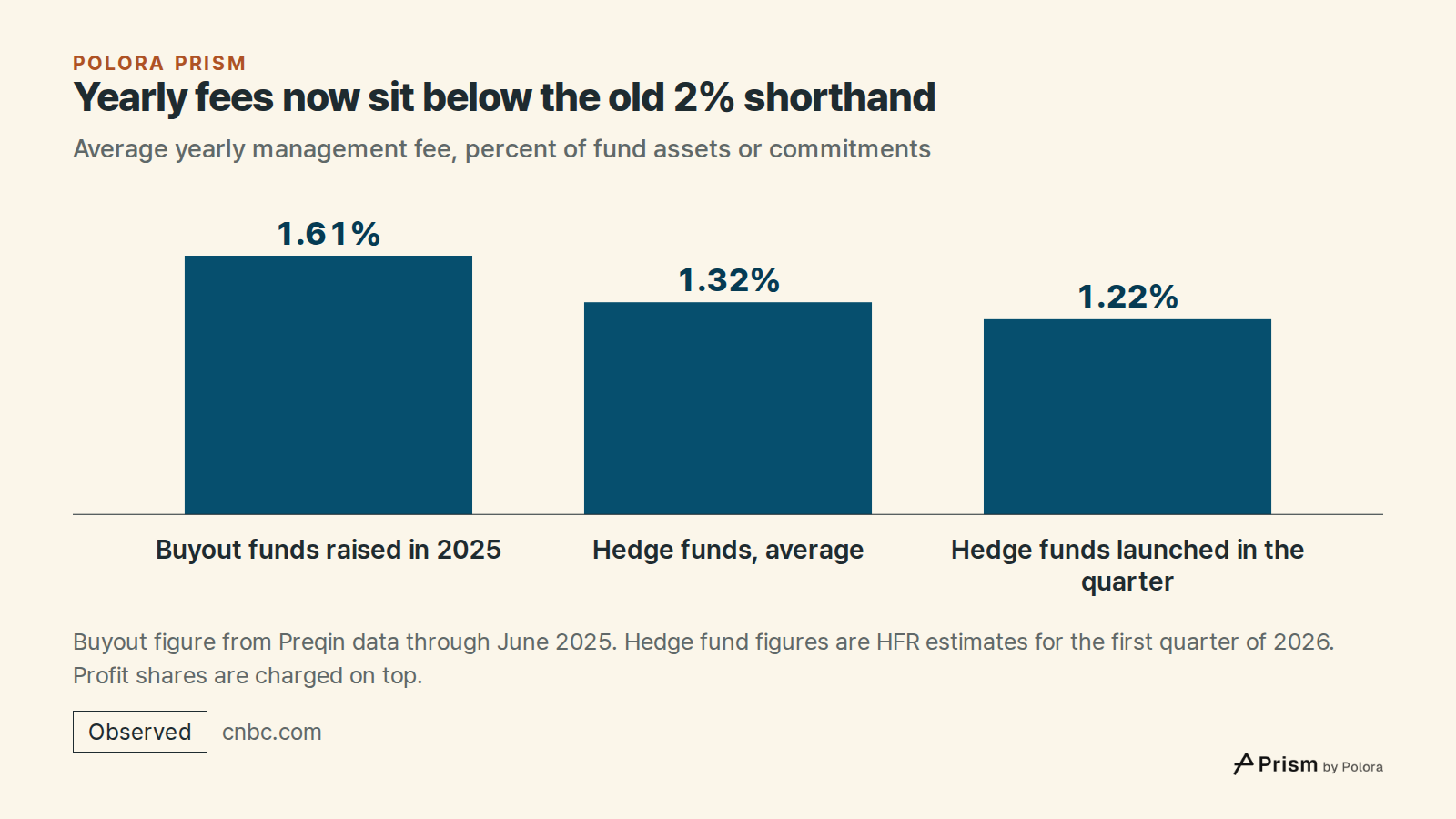
The old shorthand is "2 and 20" : a 2% yearly fee and 20% of the profit. It is a convention, not a rule, and each fund's contract sets its own fee base, profit share and conditions. Current fees are lower. According to Preqin data through June 2025, buyout funds raised in 2025 charged an average management fee of 1.61%, the lowest Preqin has recorded, with larger funds charging less and smaller ones closer to 2%. The profit share in buyouts has traditionally been 20%, often paid only after investors have received their money back plus a minimum return, often 8%. For hedge funds, HFR estimated average fees in the first quarter of 2026 at 1.32% a year plus 15.78% of profits, and funds launched that quarter charged 1.22% and 17.4%.
The fee question is now also in front of US regulators. On 30 September 2026 the SEC, the US securities regulator, proposed letting registered funds sold to ordinary investors pay their managers a performance fee capped at 20% of specified net gains, which could include gains that exist only on paper, under conditions the proposal sets out. It is a proposal, not a rule.
Whatever the levels, fees sit between what a fund earns and what reaches its investors. A reported return can be gross, before the manager is paid, or net, after. The first thing to check in any figure is which one it is.
- Private equity management fees hit a new low (CNBC)
- Hedge fund launches, liquidations rise to begin volatile 2026 (HFR)
- ILPA Principles 3.0
- SEC proposes amendments addressing retailization, modernizing regulated funds and performance-based compensation (Harvard Law School Forum on Corporate Governance)
- SEC proposed rule S7-2026-28
- SEC proposed rule release 33-11443
- Marketing compliance frequently asked questions (SEC Division of Investment Management)
What the reported numbers leave out
Private funds often report an internal rate of return, an annual rate that rewards speed. As an illustration, a fund that doubles investors' money in two years shows about 41% a year. One that doubles it over ten years shows about 7%. Both handed back twice the money, which is why investors also ask for the multiple : how much came back for each dollar put in.
The values private funds report between purchase and sale are appraisals, not prices from a market. Appraisals tend to move slowly and follow the last estimate, so the reported value can look steadier than the business underneath. Smooth numbers are not the same as low risk.
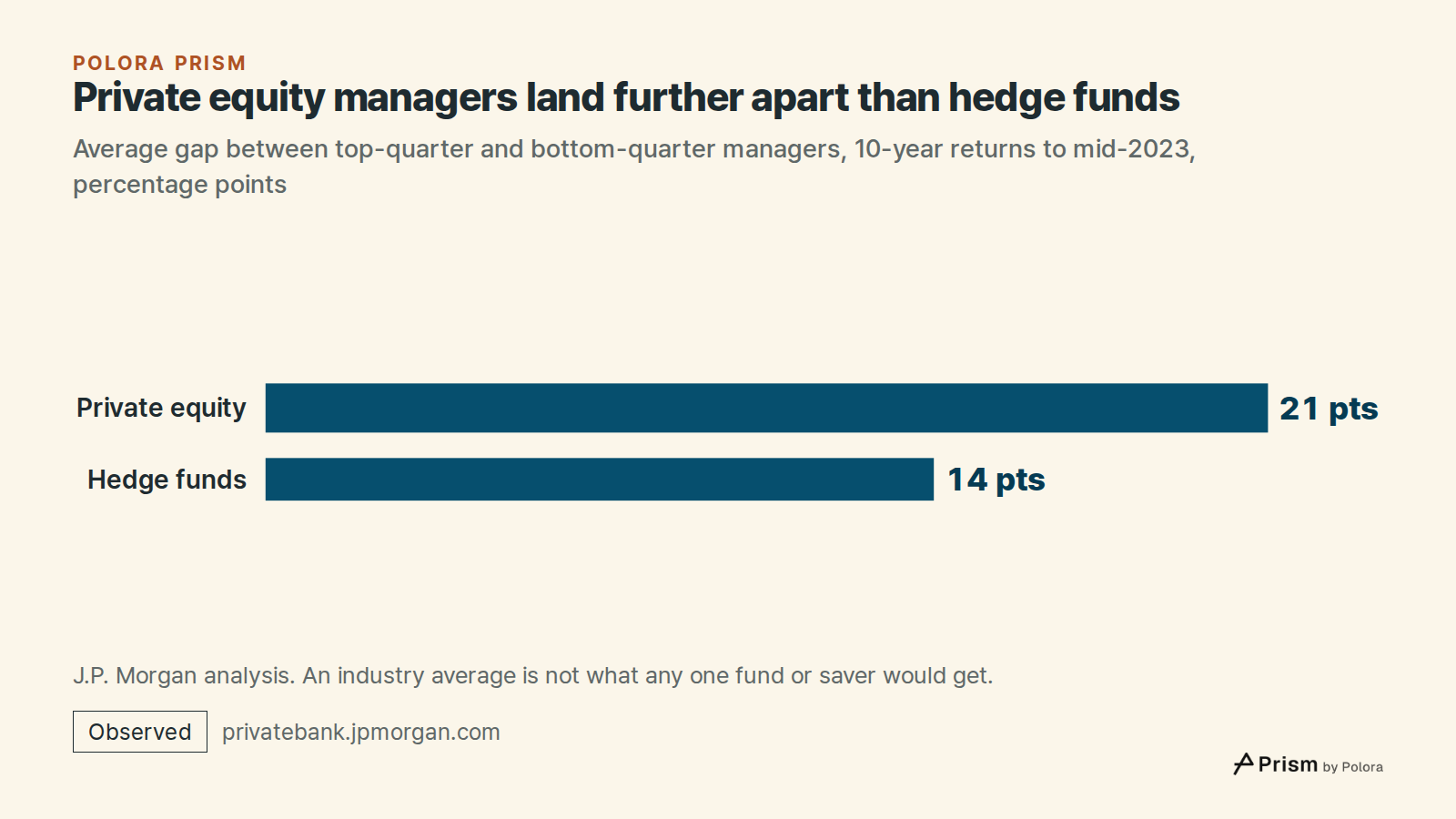
And the average hides how far apart funds land. J.P. Morgan, using 10-year returns to mid-2023, found an average gap of 21 percentage points between top-quarter and bottom-quarter private equity managers, and 14 points for hedge funds. An industry average is not what one fund, or one saver, would get.
Why the label matters now
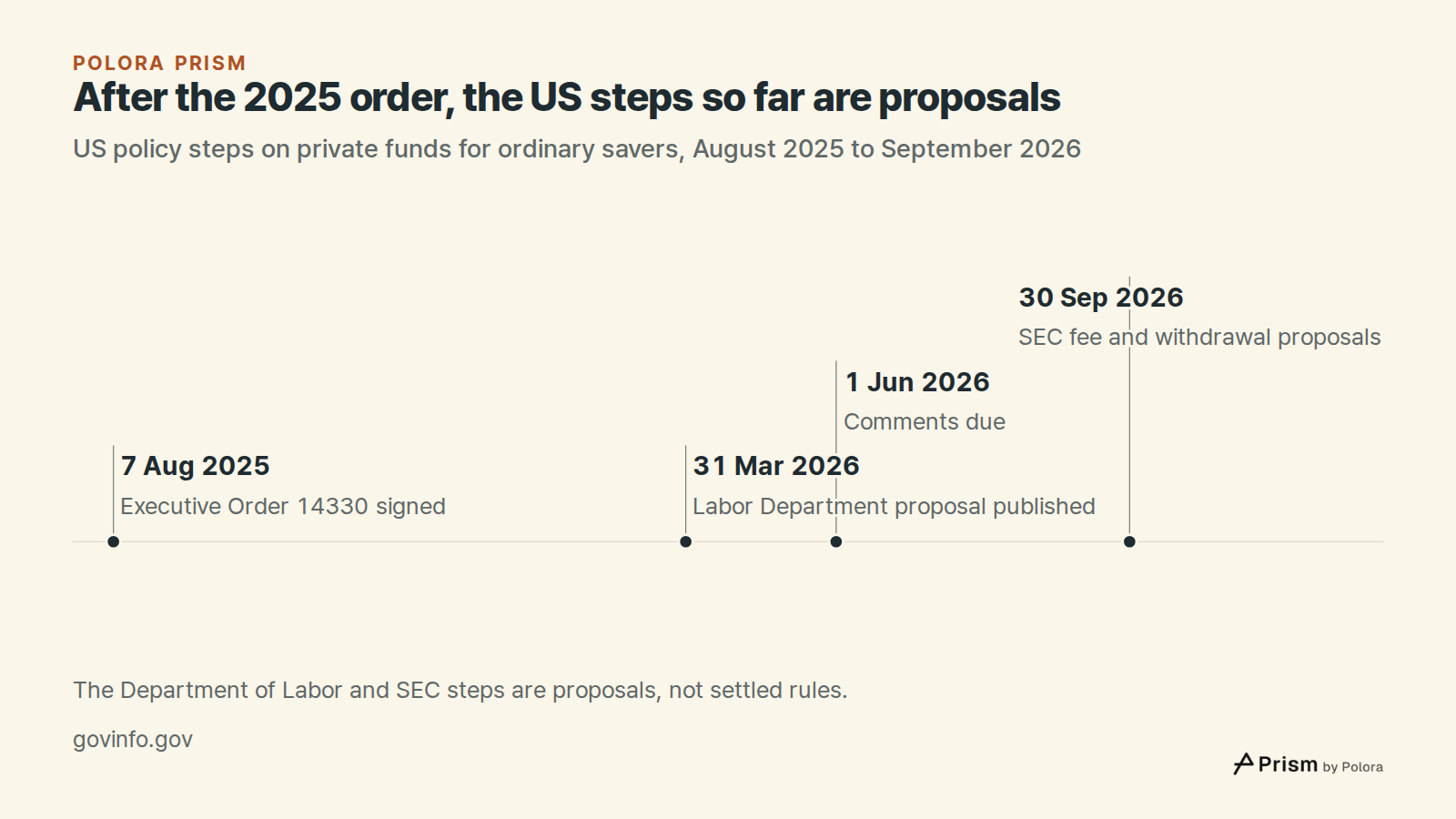
Most of the 2026 news is about packaging these strategies for ordinary savers. Executive Order 14330, signed on 7 August 2025, set the policy that people saving for retirement should have access to funds that include alternative assets, such as private equity and private credit, when the people who pick their plan's investment menu judge it appropriate.
The Department of Labor followed with a proposed rule, released on 30 March 2026 and published on 31 March, with comments due by 1 June 2026. It sets out a process for choosing any investment option for a retirement plan menu, including funds that hold alternative assets, and gives those who follow it legal protection. It does not single out private equity, and it is a proposal, not settled law. A later federal agenda still listed it at the proposed-rule stage. The SEC proposals of 30 September 2026 on performance fees and on funds that allow periodic withdrawals are proposals too. None of them settles what any particular saver would earn or pay.
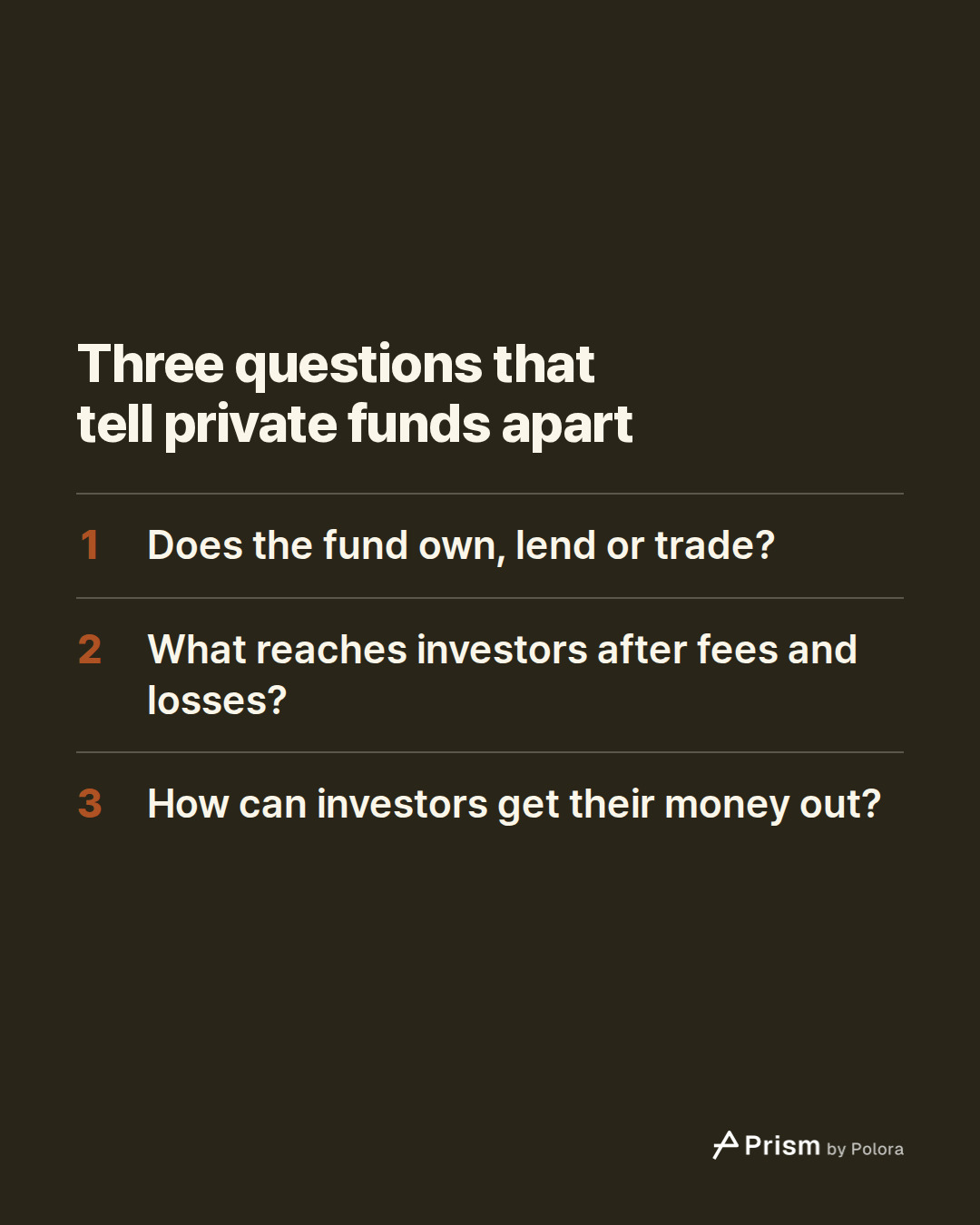
Read the two headlines again with the map in hand. The first was about a lending fund in a quarterly-withdrawal package, paying out what its cap allows. The second was about a proposed process for putting several kinds of private funds on retirement menus. Same words, different businesses. The questions that tell them apart are the same each time : does the fund own, lend or trade, what reaches investors after fees and losses, and how can investors get their money out?
- Executive Order 14330, Democratizing Access to Alternative Assets for 401(k) Investors
- Department of Labor proposed rule, Federal Register, 31 March 2026
- Federal Register, 17 July 2026, regulatory agenda
- SEC proposes amendments addressing retailization, modernizing regulated funds and performance-based compensation (Harvard Law School Forum on Corporate Governance)
- SEC proposed rule S7-2026-28