Most startup bets lose money. So how does the firm get paid?
Many of the young companies a venture capital firm backs never pay back what was put into them. Yet many firms keep raising new funds. The puzzle goes away once you see that a venture firm is paid in two separate ways, and that the two reward different things.
The first is a yearly fee for running the fund. The second is a share of the profit, which arrives only if the fund makes money for the people who put money into it. Those people are called limited partners : mostly pension funds, university endowments, insurers and other large institutions. The firm that picks the startups and runs the fund is the general partner.
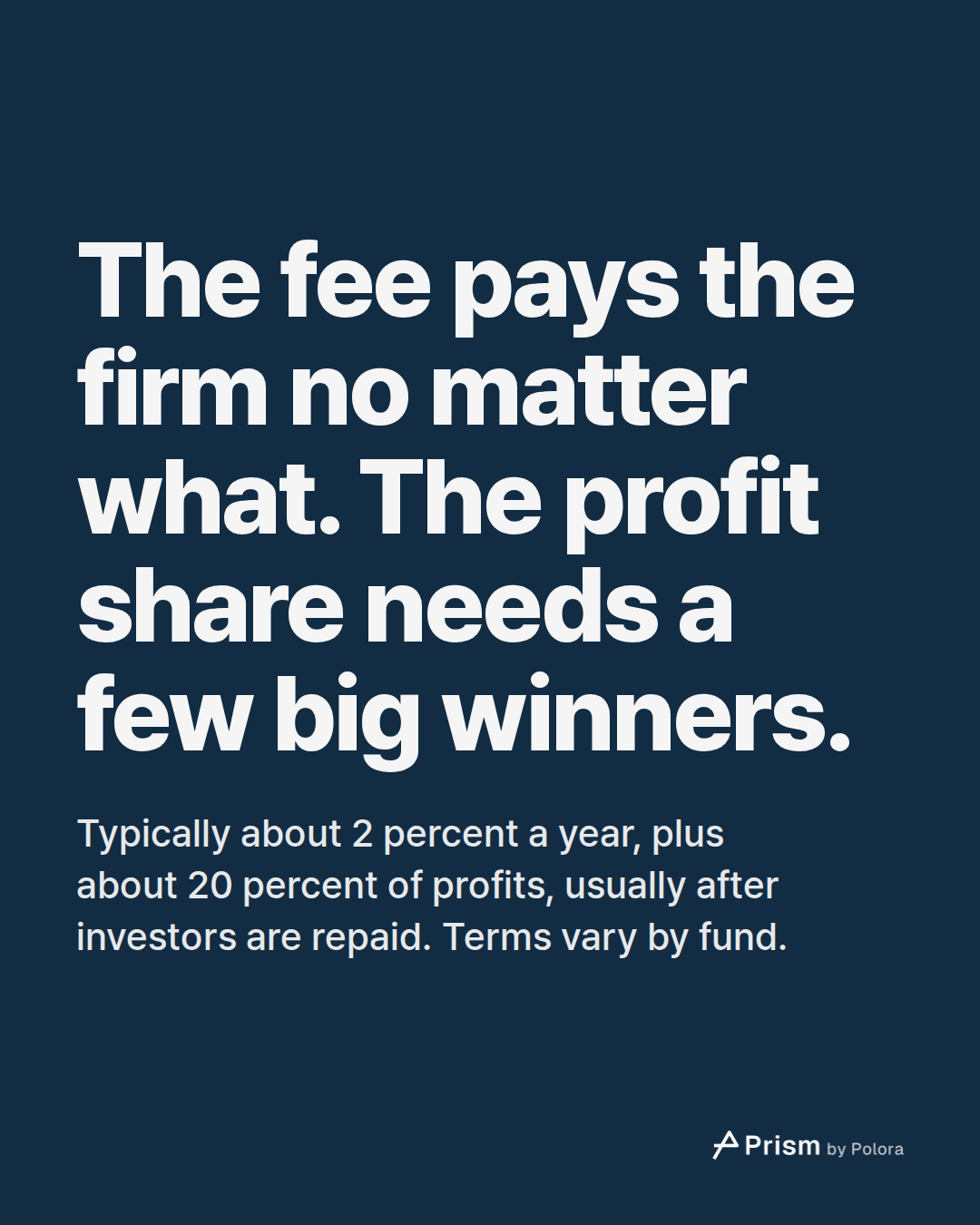
The fee keeps the firm going whatever happens. The profit share depends on a few companies doing extraordinarily well. Seeing which of the two a firm is actually earning tells you a great deal about how a fund is really doing. A firm collecting its fee is not the same thing as its investors making money.
The fee : about 2 percent a year, however the fund does
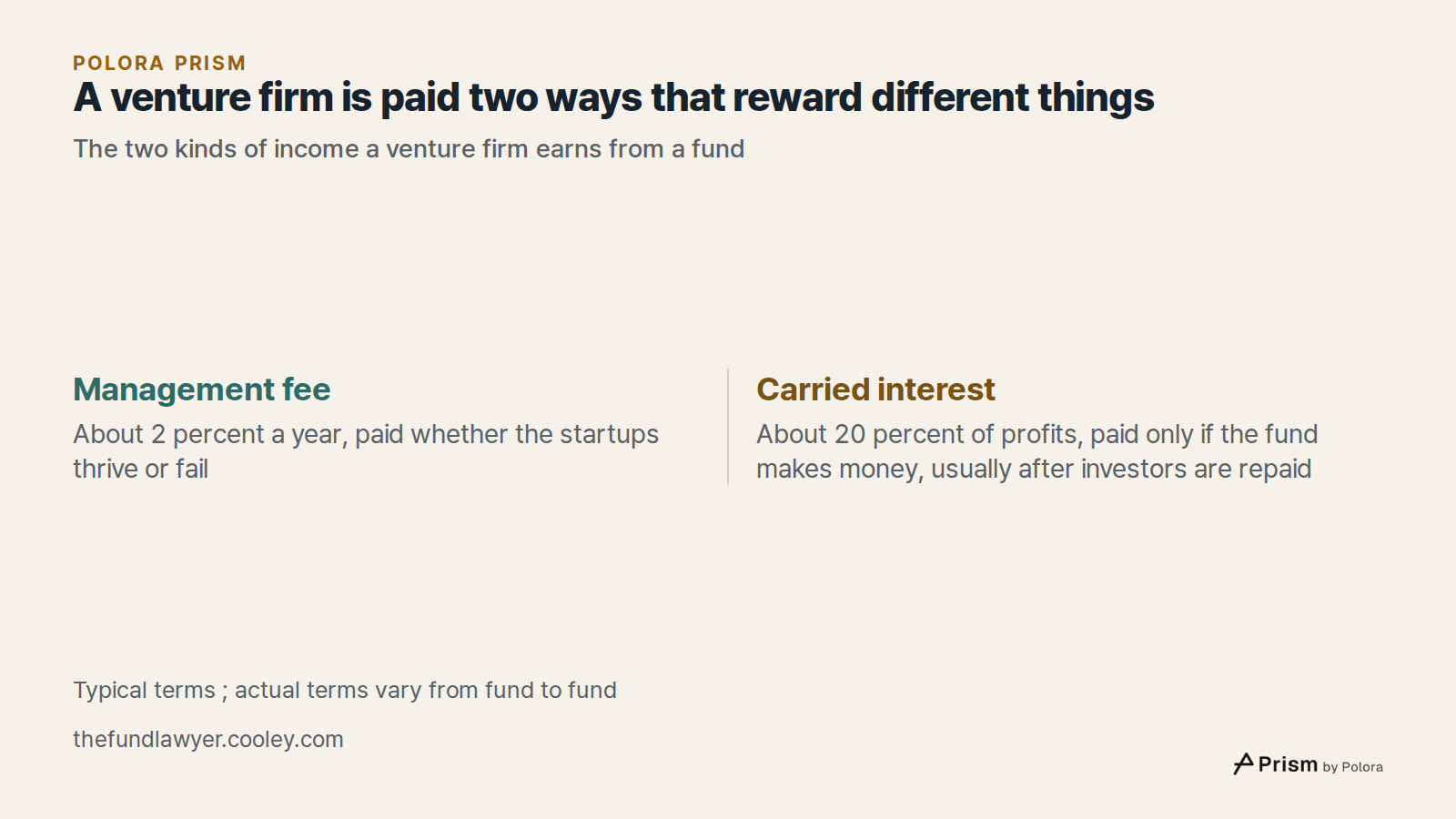
Carta, a company whose software handles the books for private funds, published a Fund Economics Report on 4 December 2025, drawing on about 2,000 of the funds it administers. Across recent venture fund vintages (a vintage is the year a fund starts), the median management fee during the investment period, the first years when a fund is buying stakes in startups, was 2 percent a year.
The fee is set by the fund's agreement, not by how its investments turn out. A fund whose companies are losing value still pays it.
Two percent is the middle, not a rule, and a fund's fee does not necessarily stay the same for its whole life. Carta's figures cover funds administered on Carta, which lean toward smaller funds, not the whole industry.
The fee pays salaries, offices and the work of finding and supporting companies. It is the part of a venture firm's income that does not depend on any startup succeeding.
The profit share : about 20 percent, usually after investors are repaid
The second payment is called carried interest, or carry. Carta puts the median at 20 percent of a fund's profits. Cooley, a law firm that sets up venture funds, calls 20 percent the widely accepted starting point across private equity and venture capital. These are medians and common practice ; actual terms vary from fund to fund.
The order of payment matters. Most funds use what Cooley calls a whole-fund waterfall : limited partners get back all the capital they paid in before the firm takes any carry. About 90 percent of funds in Cooley's 2026 survey did it this way. The alternative, a deal-by-deal waterfall, can pay the firm carry on an early winner before investors have recovered their capital across the whole fund.
Many buyout funds also add a preferred return, a minimum yearly return investors must earn before carry is paid. Early-stage venture funds often have none. If carry is paid early and the fund later disappoints, a clawback clause is meant to make the firm hand back the excess.
So carry is the part of the firm's income that exists only if the fund makes a profit. And in venture, that profit tends to come from very few companies.
A handful of winners pay for everything else
Correlation Ventures, a US venture firm that keeps a database of how individual investments ended, has published two snapshots of US venture-backed companies that exited, whether by sale, listing or shutdown. In 2019 it reported that over the previous decade about half (51 percent) of invested dollars lost money and fewer than 4 percent earned ten times or more. Counted by the number of financings, meaning individual funding rounds, rather than by dollars, almost two thirds lost money.
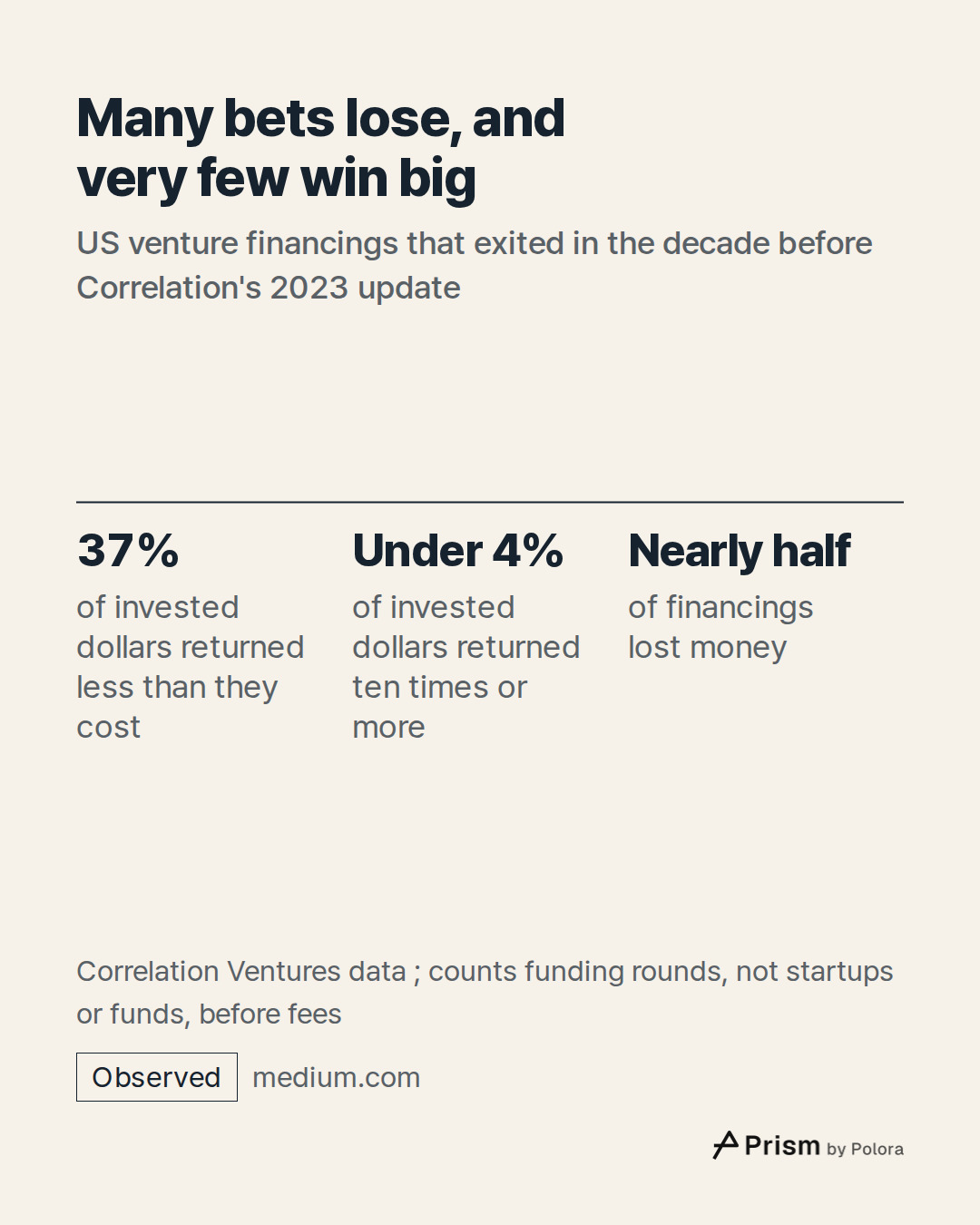
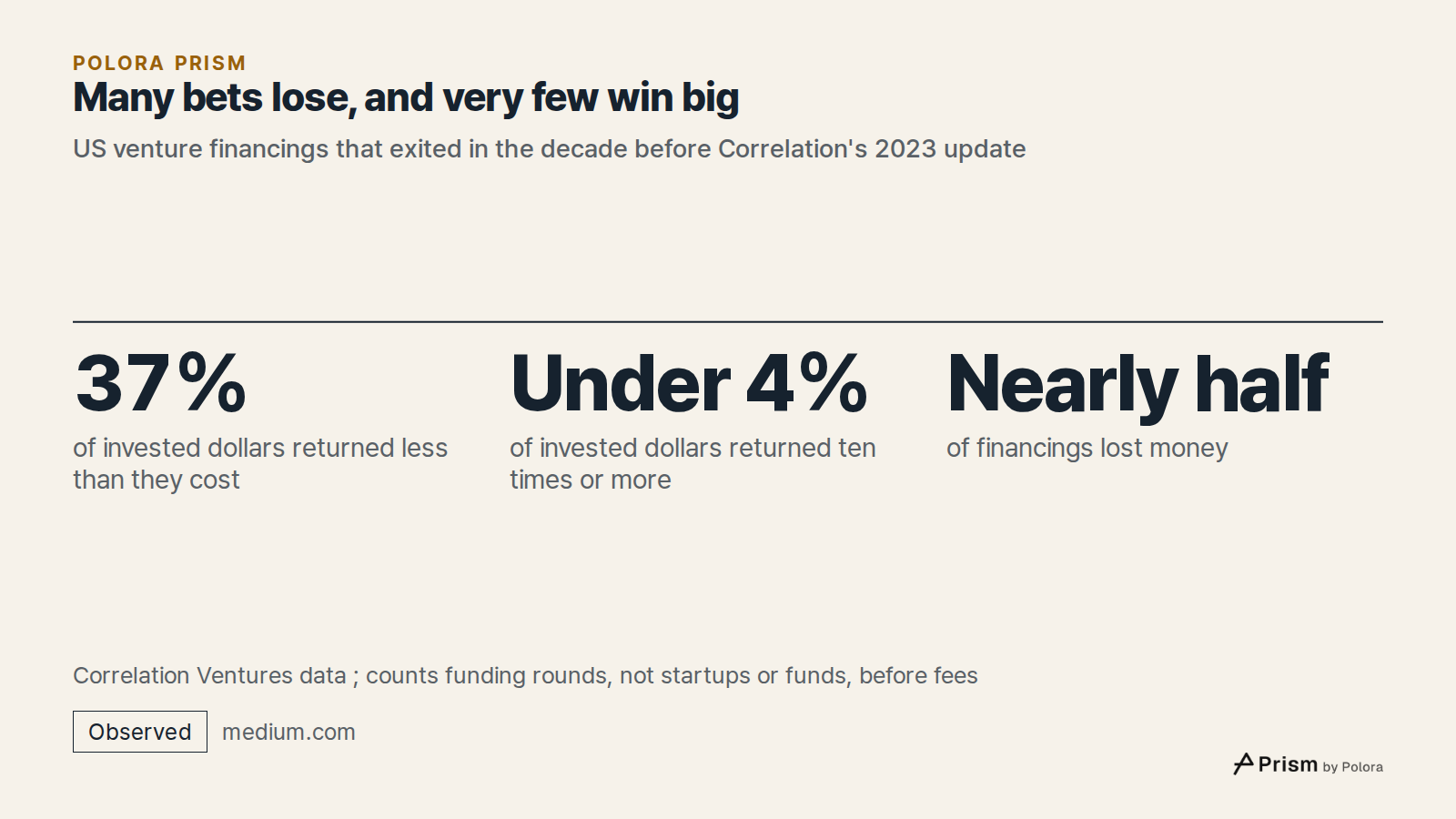
Its 2023 update, again covering exits over the preceding decade, found 37 percent of invested dollars returning less than they cost and fewer than 4 percent returning ten times or more. Nearly half of financings lost money.
Correlation also found that the industry's average realized return in each exit year moved almost exactly with the share of dollars in those ten-times winners, a correlation of 0.98. In plain words : in years with more big winners, the industry's realized returns were higher, and in years with fewer, they were lower.
Some cautions. These figures count funding rounds, not startups or funds, and they are gross results before fees. A company can lose money for its latest investors and still pay off handsomely for its earliest ones. They cover companies that exited in Correlation's data, so they are not the failure rate of all startups, nor a promise that any given fund will find a winner. And they describe past exits, not what will happen next.
What that looks like inside one made-up fund
Take an illustration, not a real fund : $100 million raised and spread across 30 startups, the kind of example the venture investor Seth Levine has used. If the 2 percent fee is charged on the full $100 million, it comes to $2 million a year during the investment period, paid whether the startups thrive or fail.
Levine worked out that, on Correlation's odds, a fund like this should expect fewer than one company returning 10 to 20 times its money. That is why one or two very large winners usually decide whether the fund makes a profit at all.
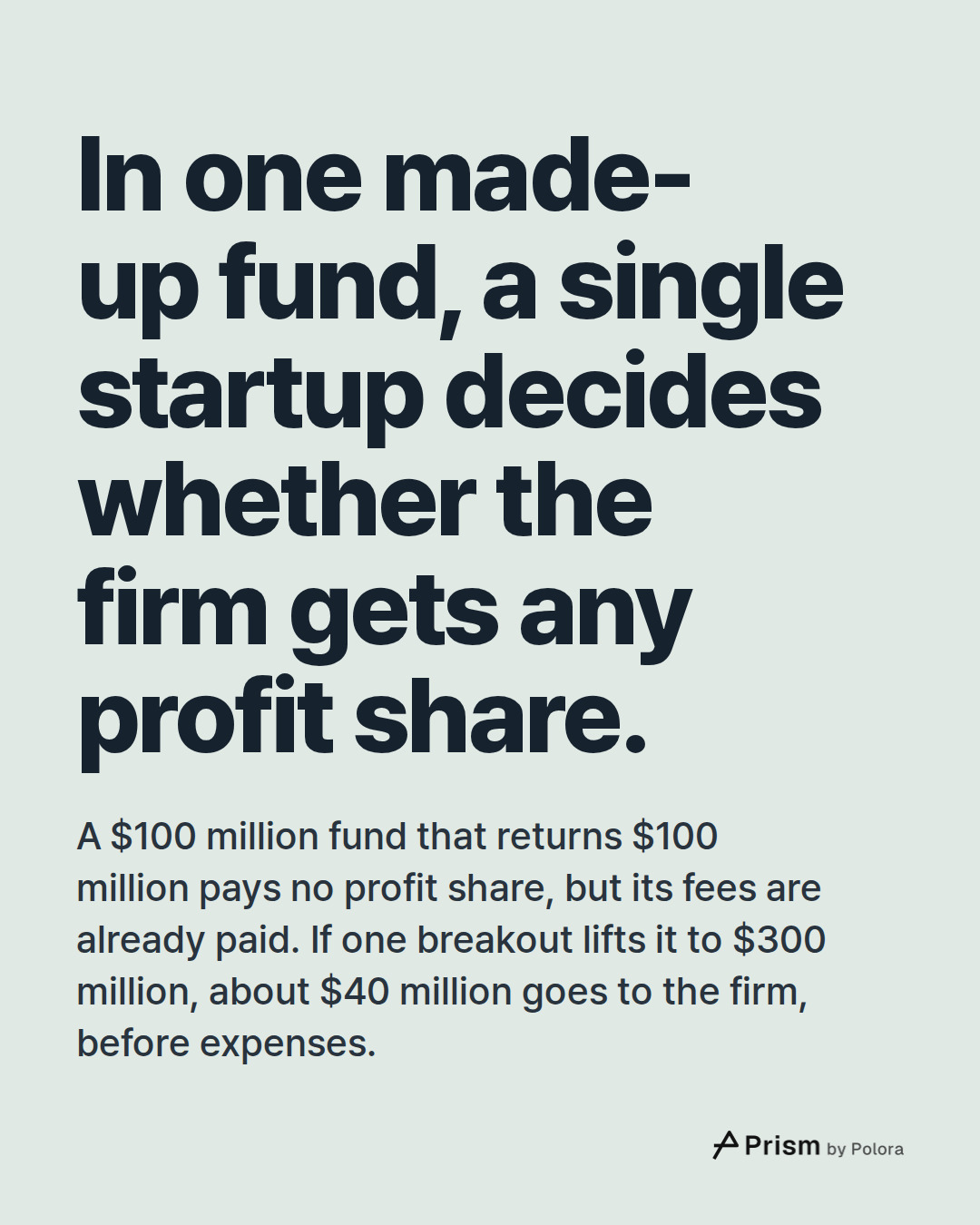
Suppose the fund ends up returning $100 million in total. Investors get their money back, there is no profit, and the firm earns no carry, though it has already collected its fees. Now suppose one breakout company lifts the total to $300 million. Under the common whole-fund arrangement, investors first get their $100 million back, and the $200 million of profit is split : about $40 million to the firm and $160 million to investors.
This is simplified arithmetic. It leaves out fund expenses, the firm's own investment in the fund and the particular terms of a real agreement, so the $40 million is carry before those, not what the partners take home.
Same firm, same fee, very different outcome. The fee was never at risk. The carry depended on a single company.
Paper gains are not cash in hand
Funds report performance in three numbers. TVPI, total value to paid-in, divides total value by the money investors paid in, counting both cash already returned and the estimated value of companies still held. IRR, the internal rate of return, is the yearly rate of return those figures imply. DPI, distributions to paid-in, counts only the cash actually paid back to investors. A markup on a startup raises TVPI and IRR, but only a sale or a stock market listing turns it into DPI.
Carta's VC Fund Performance report for the first quarter of 2026, published on 4 June 2026 and covering 2,775 venture funds on Carta closed from 2017 onward, shows the gap. Median TVPI rose for nearly every recent vintage, which Carta attributes to startup valuations rising again. But for funds started in 2019 and 2020, median DPI was still barely above zero, and fewer than half had returned any cash at all. Even among 2017 and 2018 funds, fewer than 20 percent had paid back everything investors put in.
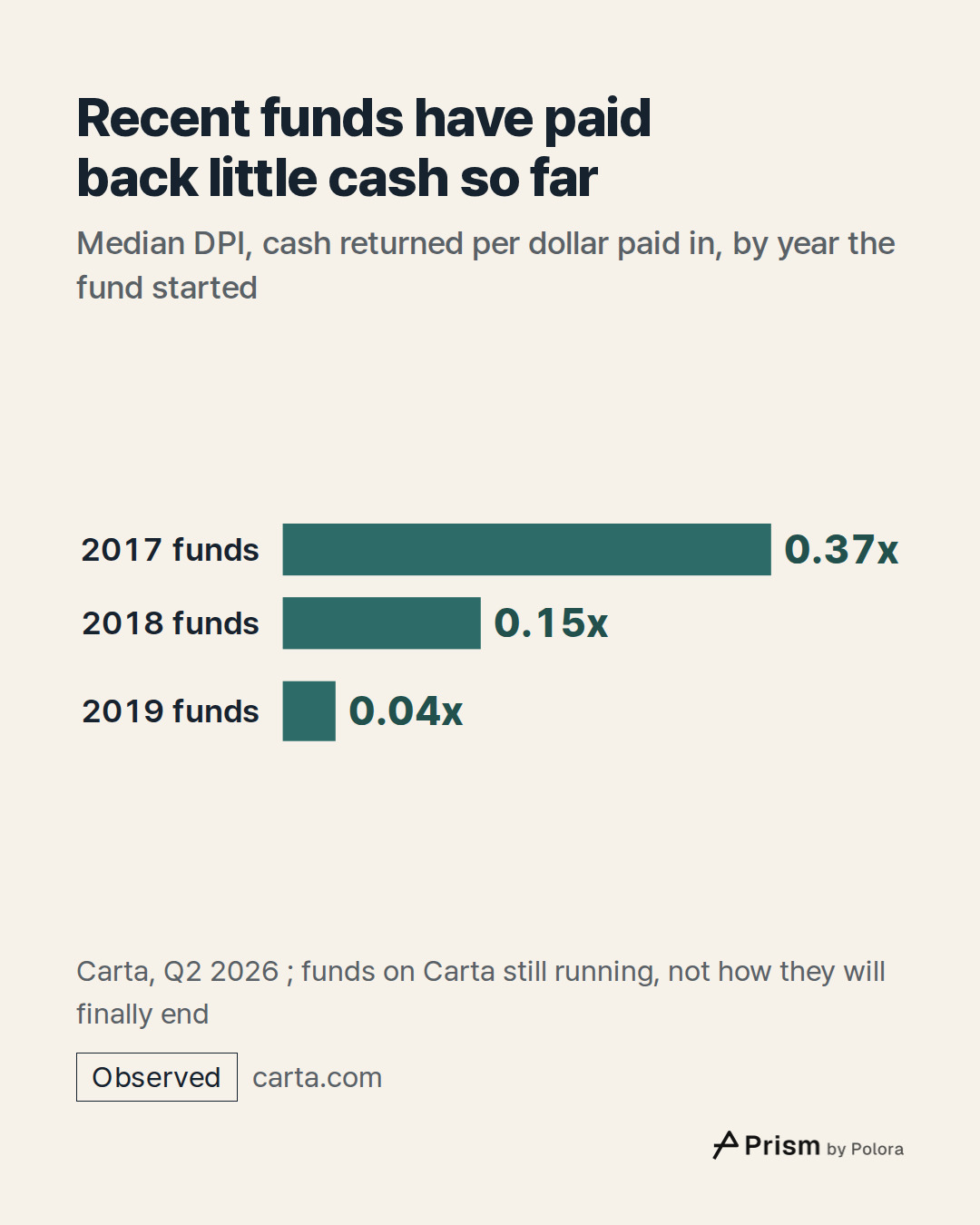
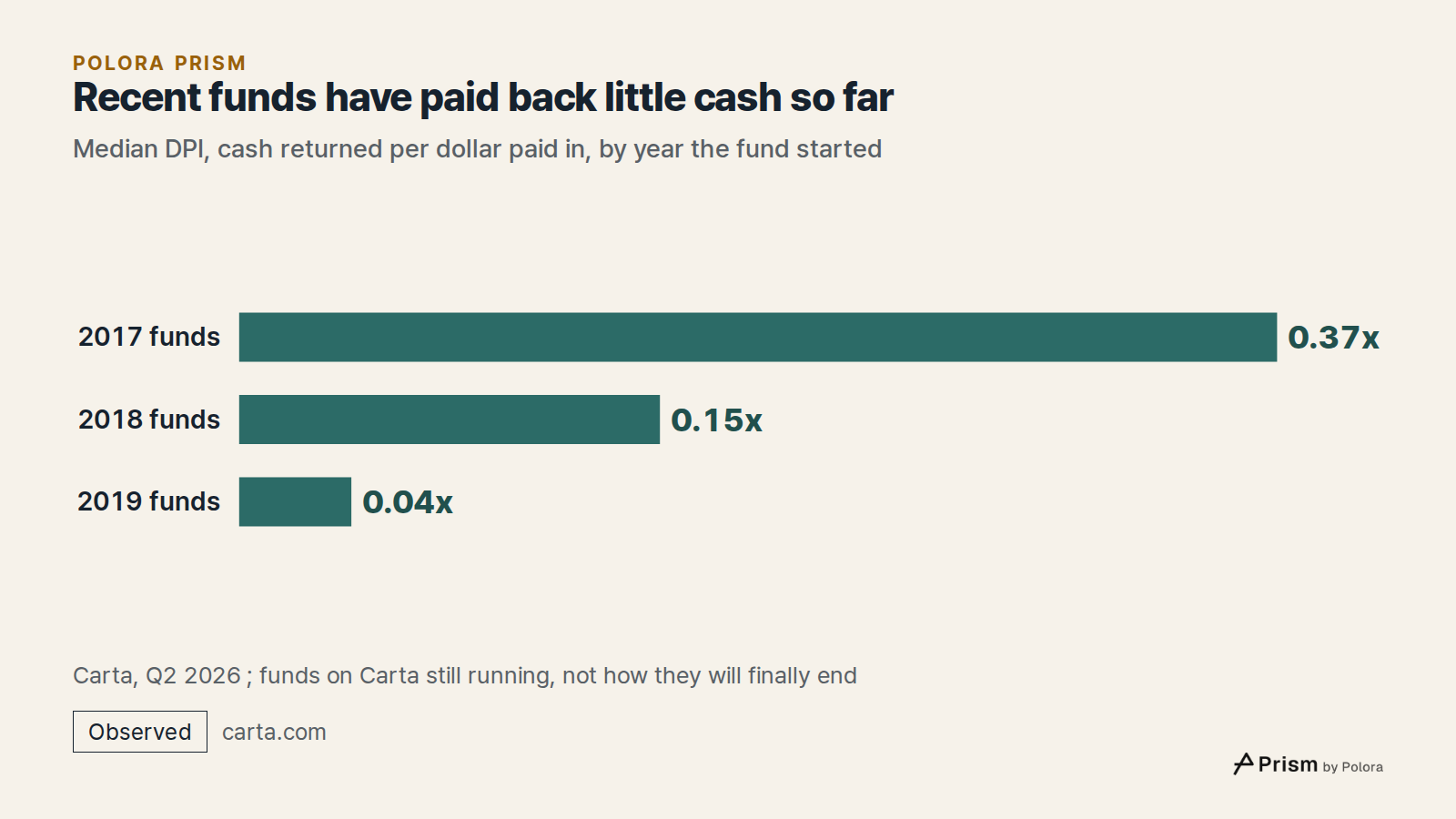
Carta's report for the second quarter of 2026 puts median DPI at 0.37x for 2017 funds, 0.15x for 2018 funds and 0.04x for 2019 funds : 37, 15 and 4 cents of cash back per dollar paid in. These describe funds still running, not how they will finally end.
The spread between funds is wide. For every vintage from 2017 to 2024 except 2021, the top tenth of funds showed net IRRs above 20 percent, yet in none of them did the fund at the 75th percentile, ranked above most of its peers, exceed 15.5 percent. A few funds pull far ahead, and most do not.
Does venture capital beat the stock market after fees?
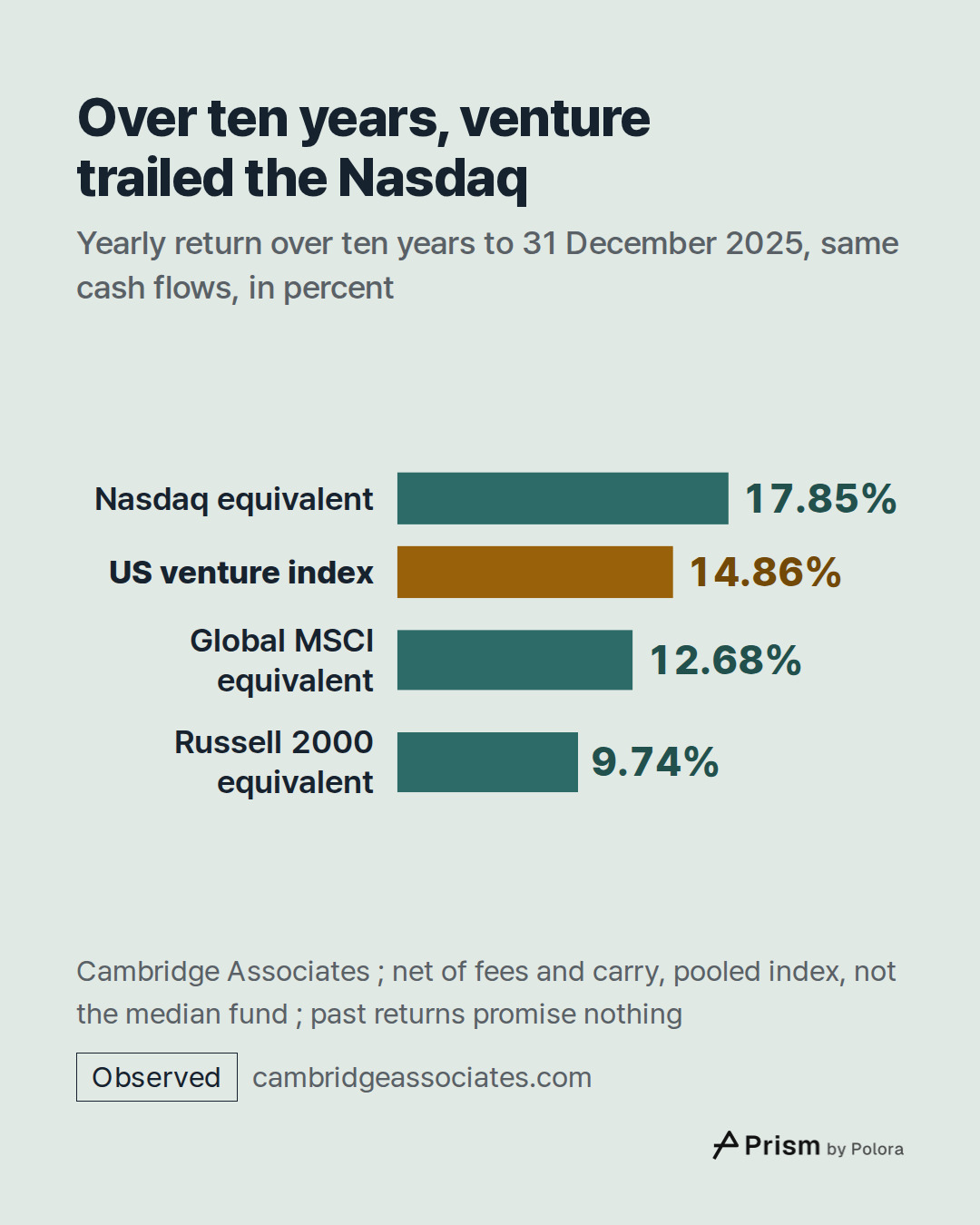
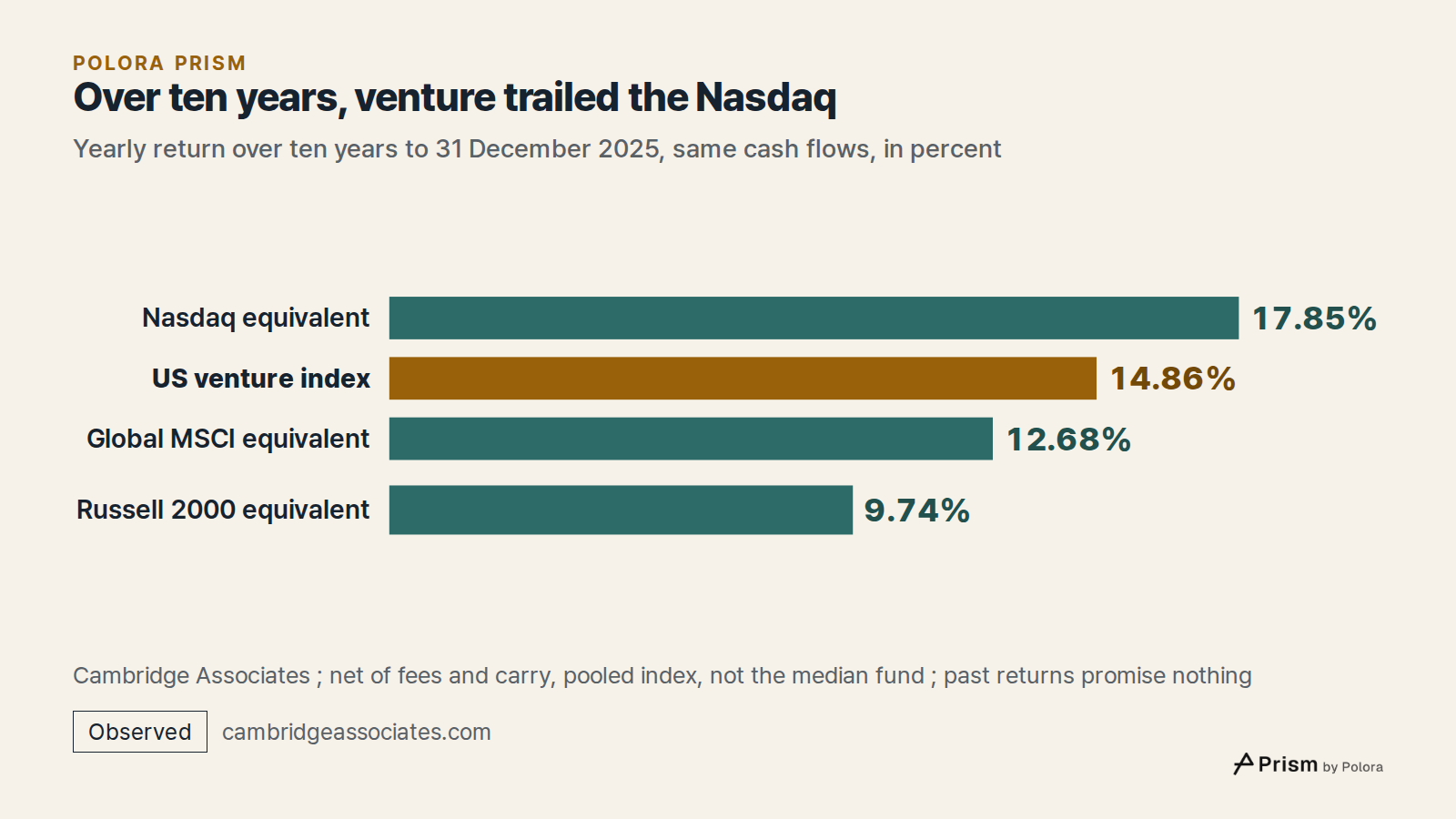
Cambridge Associates, an investment adviser that collects fund managers' financial statements, keeps an index of US venture funds built from 2,816 funds formed between 1981 and 2025. Its returns are net of fees, expenses and carry. To compare them fairly with stocks, it uses a modified public market equivalent : it imagines putting the same cash into a stock index on the same days the funds called and returned money.
As of 31 December 2025, the index returned 14.86 percent a year over ten years. The same cash flows put into the Nasdaq would have earned 17.85 percent, into the Russell 2000 index of smaller US companies 9.74 percent, and into a global MSCI index 12.68 percent. Over 25 years the index returned 8.10 percent a year, against 11.71 percent for the Nasdaq equivalent and 8.81 percent for both the Russell 2000 and the global index.
So over every period the index reports, from one year to 25, venture trailed the Nasdaq equivalent, while against smaller US companies and global stocks it came out ahead over some periods and behind over others.
This index pools all funds, so large funds and big winners weigh heavily. It is not the median fund, and the median fund's own record against public stocks is a separate question this public table does not answer. These are past returns over stated periods and promise nothing about future ones.
Where an ordinary saver meets this money
Most people already touch venture capital without choosing it. Pension funds, university endowments and insurers are typical limited partners, so a pension or an insurance policy can carry a small slice of it. And people meet venture-backed companies when those companies list on a stock exchange. Correlation's method assumes that early investors sell six to nine months after the listing, once their lockup, the period in which they agree not to sell, ends ; that is a working assumption in its analysis, not a measured fact about every investor.
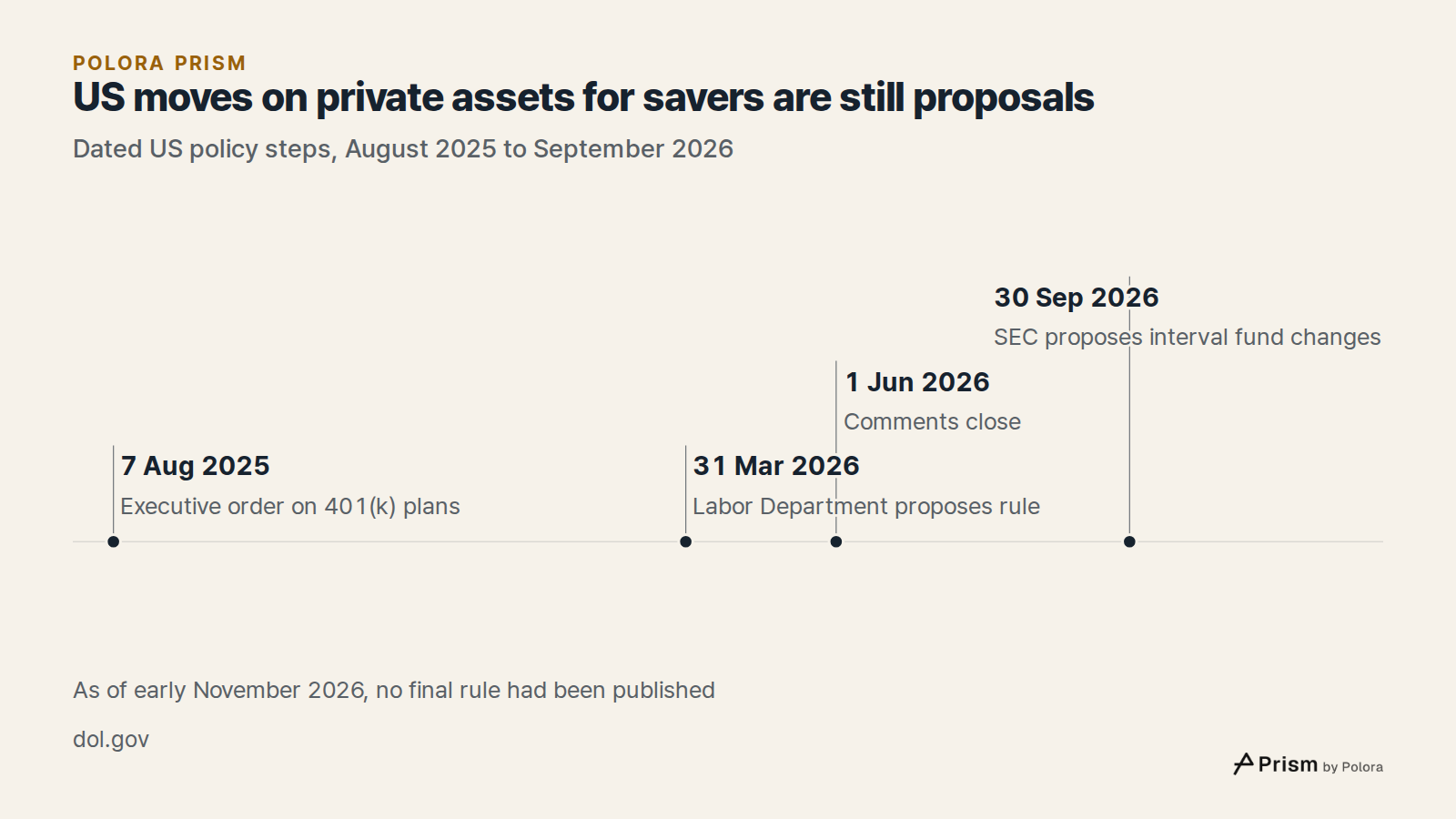
In the United States, a more direct route is being debated. Executive Order 14330, signed on 7 August 2025, told the Department of Labor to re-examine its guidance on alternative assets, such as private equity and venture funds, in 401(k) retirement plans. The department then proposed a rule, published on 31 March 2026, that would offer employers a safe harbor, a legal shelter, for how they choose any investment option in such plans, including mixed funds that hold private assets. Comments closed on 1 June 2026. As of early November 2026, the rule was still a proposal and no final rule had been published.
Separately, on 30 September 2026 the Securities and Exchange Commission proposed changes to interval funds, funds that hold harder-to-sell assets and let investors cash out only at set intervals. The proposal would allow monthly repurchases, among other changes. It is a proposal open for comment, not a final rule.
Whether any of this suits anyone's savings is not a question this piece answers. What it can show is how the money behind it is paid.
- The White House : Democratizing access to alternative assets for 401(k) investors
- Federal Register, 31 March 2026 : Department of Labor proposed rule
- US Department of Labor : EBSA news release, 30 March 2026
- Federal Register public inspection : regulatory agenda entry
- SEC : Proposed rule on interval funds (S7-2026-34)
- SEC : Proposed release 33-11444
- Harvard Law School Forum on Corporate Governance : SEC proposes amendments addressing retailization
- Correlation Ventures : Venture capital? We're still not normal
Fees pay the firm. A few winners pay the investors.
Put it in one sentence : a venture firm earns about 2 percent a year no matter what, and about 20 percent of the profit only if a handful of companies succeed, usually only after investors have been paid back.
That is how a firm can stay in business while many of its startups fail. It does not show that most firms thrive, or that their investors come out ahead : the fee can keep a firm going without any cash reaching the people who paid it. That is why the number to watch is cash returned, not paper value. For many funds started in recent years, that cash has barely begun to arrive.