What is being counted
Funds and companies that sell securities privately under Regulation D, the SEC's main set of exemptions from registration, must file a short notice called a Form D. It is due shortly after the first sale. Funds that file one tick a box saying what kind of fund they are, such as venture capital or private equity. Companies tick boxes for their industry, for whether they were incorporated within the last five years, and for what they are selling, for example shares.
Polora counted new offerings from the SEC's quarterly Form D data sets, through the release that covers the third quarter of 2026. An offering is a first notice together with its later amendments, and it is counted once, in the quarter of that first notice. Three groups are followed : offerings by venture funds, by private-equity funds, and by young technology and health companies selling shares. "Young" means the company ticked the box for incorporated within the last five years. "Technology and health" means it named one of six industries : other technology, computers, telecommunications, biotechnology, pharmaceuticals or other health care.
These are counts of notices, not dollars. A small vehicle set up for a single deal counts the same as a multibillion-dollar fund. A notice shows that an offering exists, not that money has come in : the form lets a filer say the first sale has yet to occur. The forms do report amounts sold, but this piece counts offerings and does not add up money.
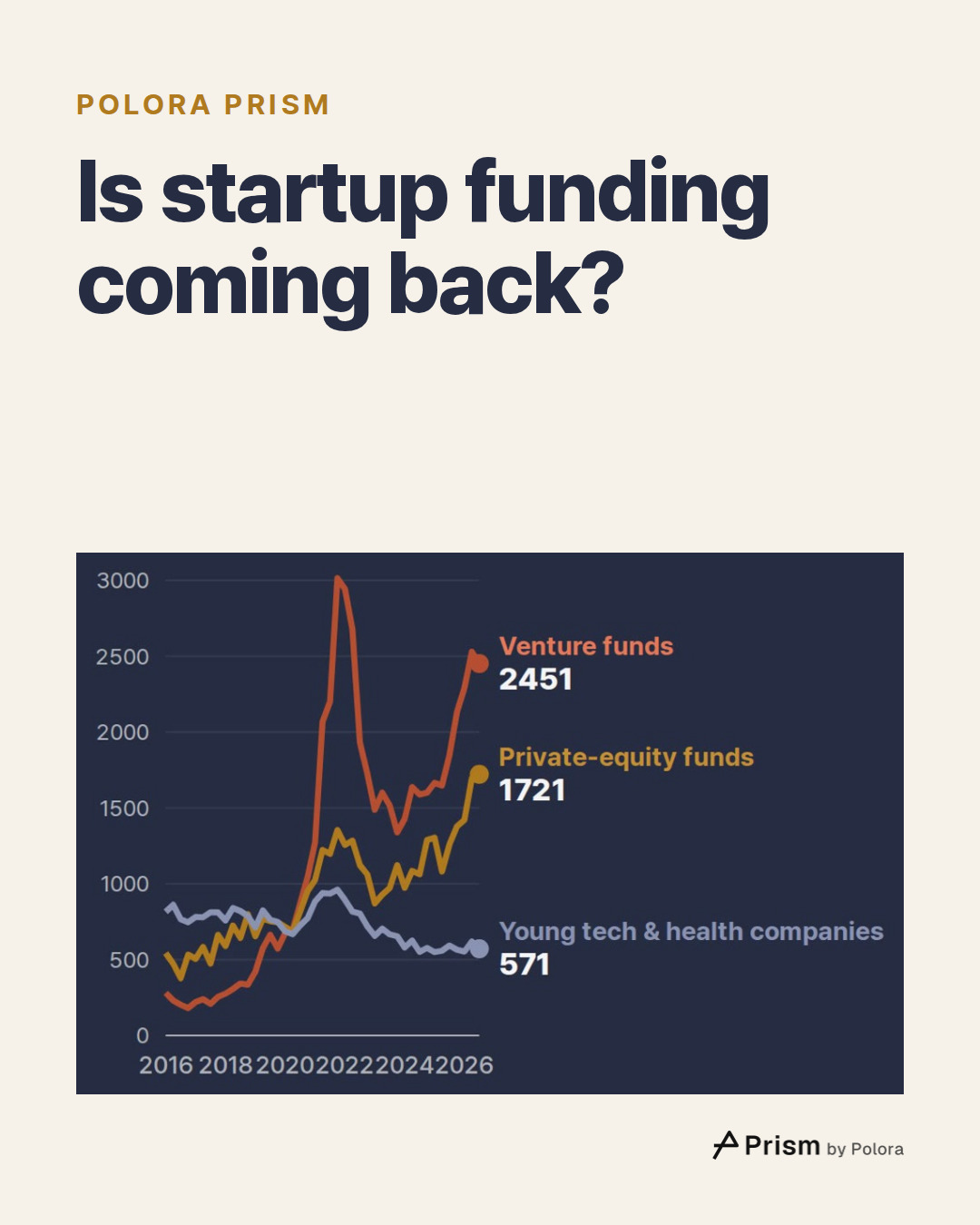
How the three counts moved from 2016 to 2026
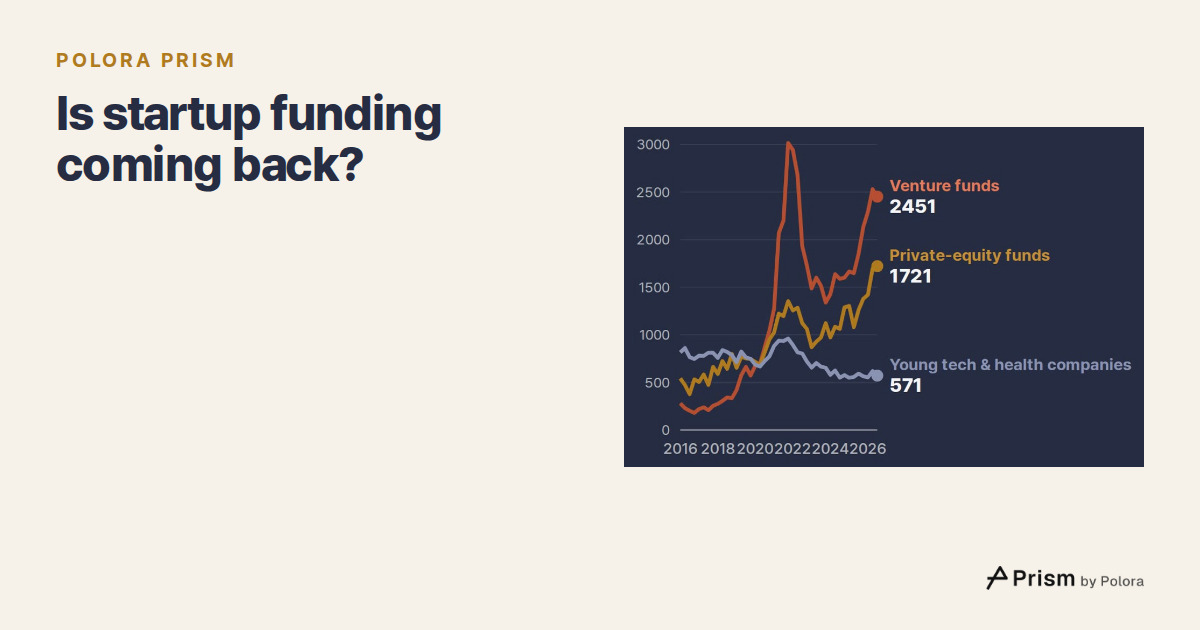
In the first quarter of 2016, young tech and health companies filed 2.9 offerings for every one filed by a venture fund. Venture fund filings then climbed. In the second quarter of 2020 they passed the young companies for the first time, 694 to 668. By the last quarter of 2021 they reached 3,014, the most in any quarter since the count starts in 2016.
From 2022 the count fell. By the last quarter of 2023 venture funds filed 1,339 new offerings, less than half the late-2021 peak. Some of that came back in 2024 and 2025. Young tech and health companies drifted lower over the same years and hit 549 in the first quarter of 2025, their fewest in any quarter since 2016.
2026 so far
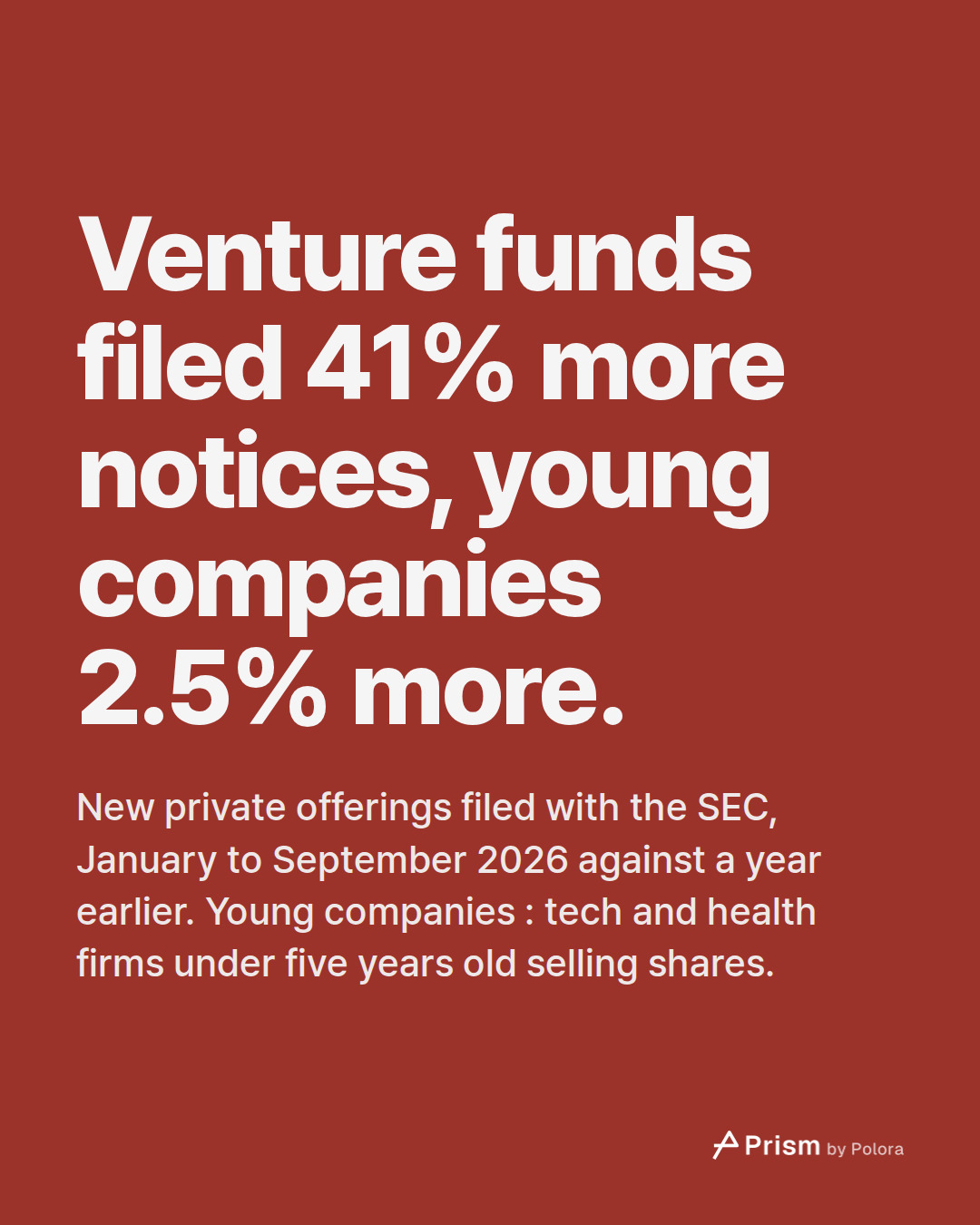
In the first nine months of 2026, venture funds filed 41% more new offerings than in the same months of 2025. Private-equity funds filed 33% more. In the third quarter private-equity funds filed 1,721, their highest quarter since 2016; the highest before 2026 was 1,378. Young tech and health companies selling shares filed 2.5% more.
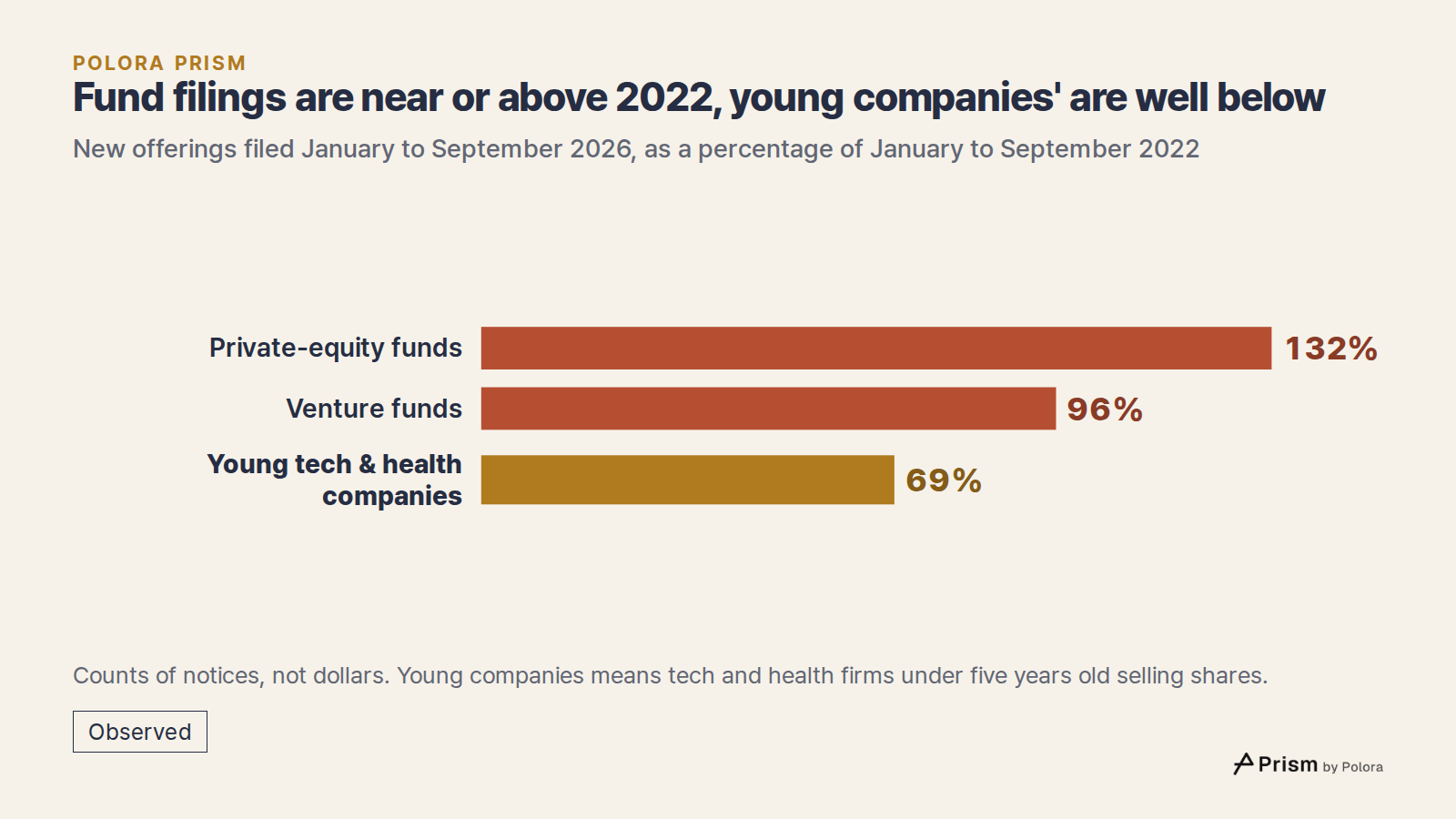
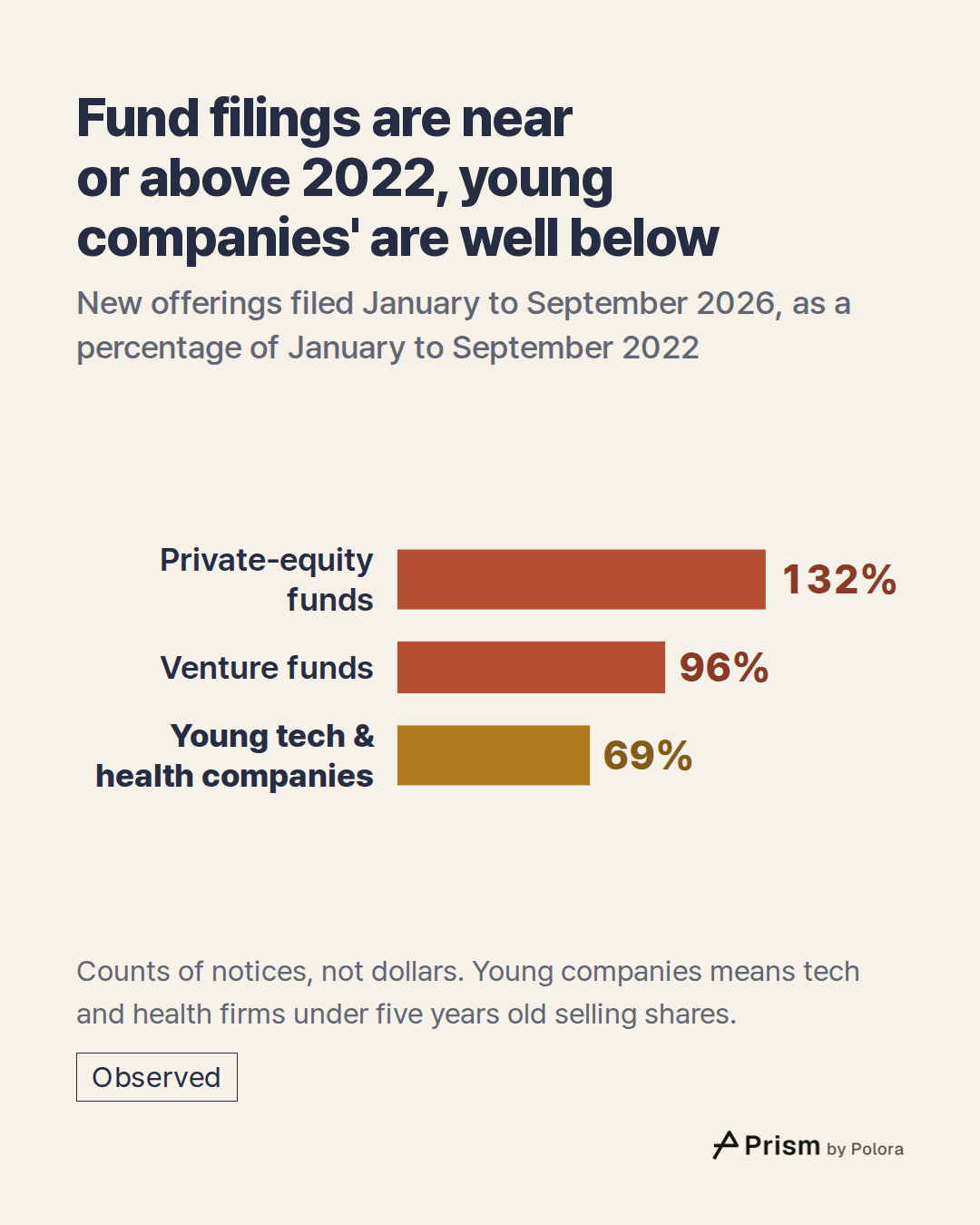
Set against January to September 2022, venture fund filings are at 96% of that year's level and private-equity filings at 132%. The young companies are at 69%.
What a venture fund filing can be
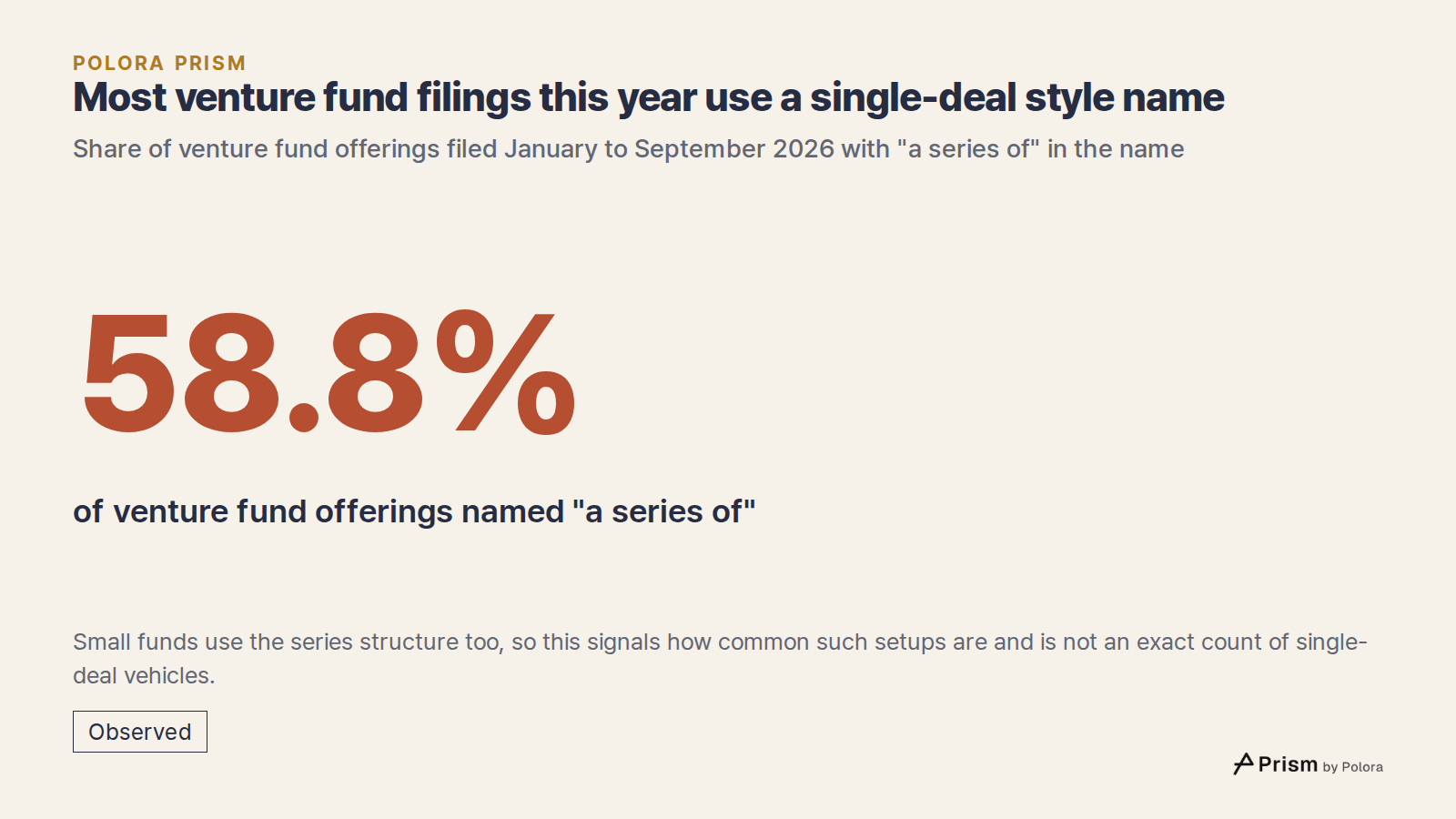
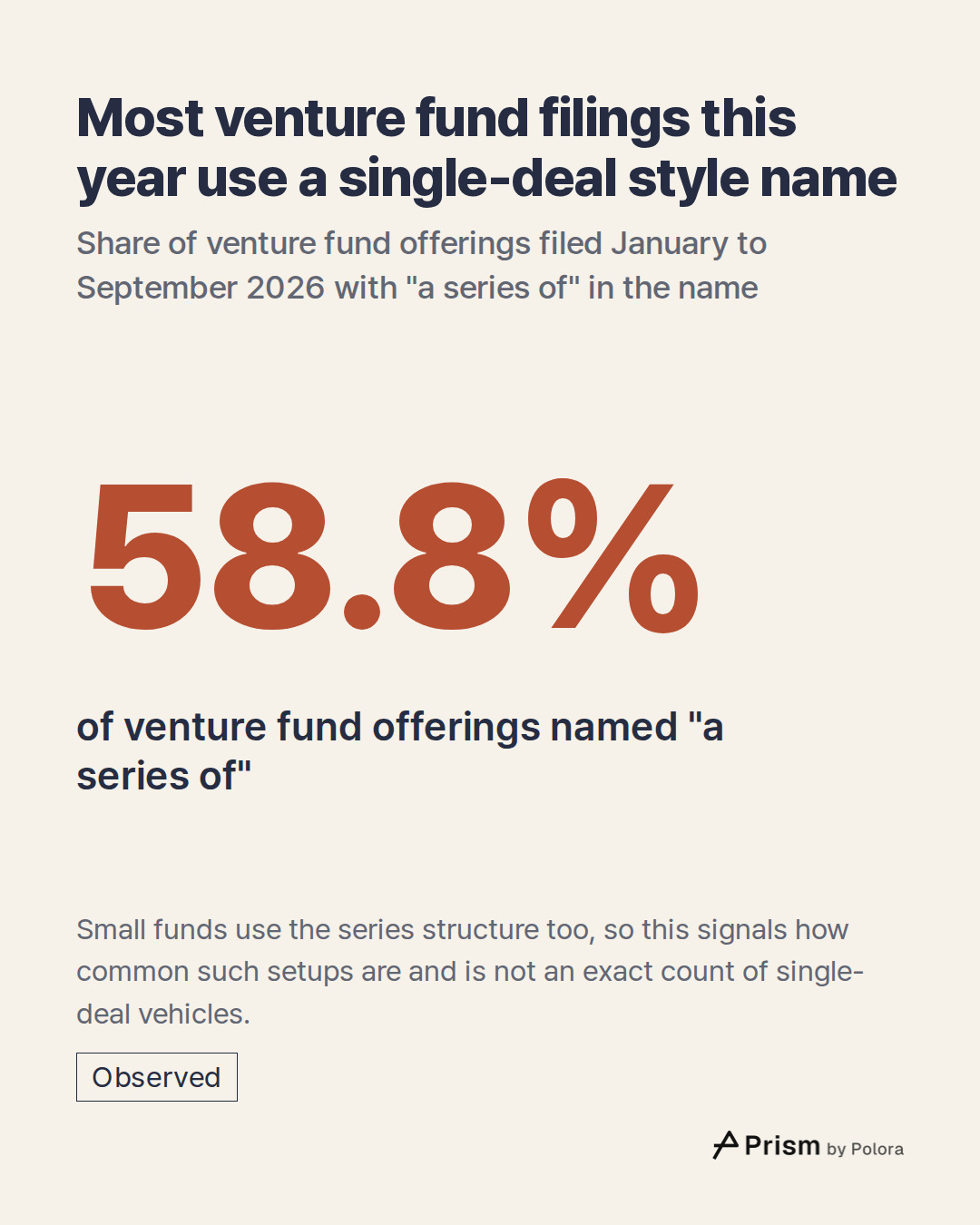
Many of these "funds" are vehicles set up for a single investment. A guide to forming special purpose vehicles from Hemrock, a fund administration firm, describes such a vehicle as an entity that holds one investment. It says AngelList forms each deal as a series of a master Delaware limited partnership and Sydecar as a series of a Delaware series LLC. Polora found "a series of" in the names of 58.8% of the venture fund offerings filed from January to September 2026. Small funds use the series structure too, so that share is a sign of how common these setups are, not an exact count of single-deal vehicles.
Others are not funds in the usual sense of a manager investing across many companies. AngelList's Roll Up Vehicles let a startup gather its own angel investors into one vehicle that invests in that one company, as AngelList's case study of the startup Rootly describes. They are filed as venture funds. In the first nine months of 2026, 473 venture fund offerings had "Roll Up Vehicle" or "RUV" in their name.
So a count of notices and the money behind them can tell different stories. The PitchBook-NVCA Venture Monitor measures something else : money committed to US venture funds that have closed. Covering 2026 through the third quarter, it says that money went mainly to large, established managers, and that the number of first-time funds closing is on pace for its lowest year in a decade. That report counts closed funds in the United States, while Form D counts notices from filers anywhere, many of them small or single-deal vehicles, so the two can move apart without either being wrong. Neither source says why they differ this year.
The young companies, read another way
The young-company line in this piece counts only offerings that ticked the box for equity, meaning shares. Many startups raise their first money on a SAFE, a simple agreement for future equity. Y Combinator, which created it, describes a SAFE as a contract that gives the investor the right to shares later, when the startup raises a priced round. Filers often list a SAFE as an "other" security rather than as equity.
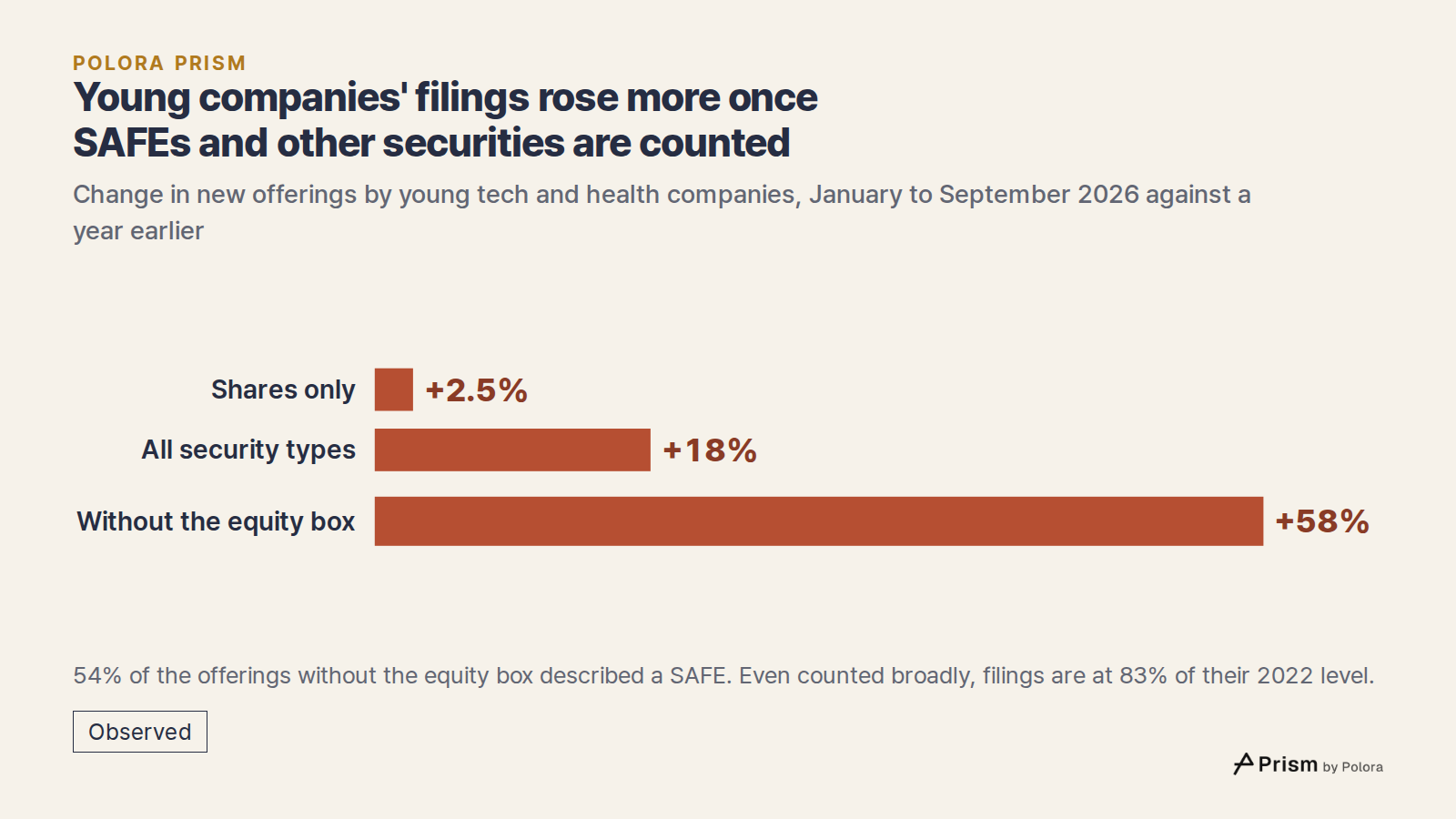
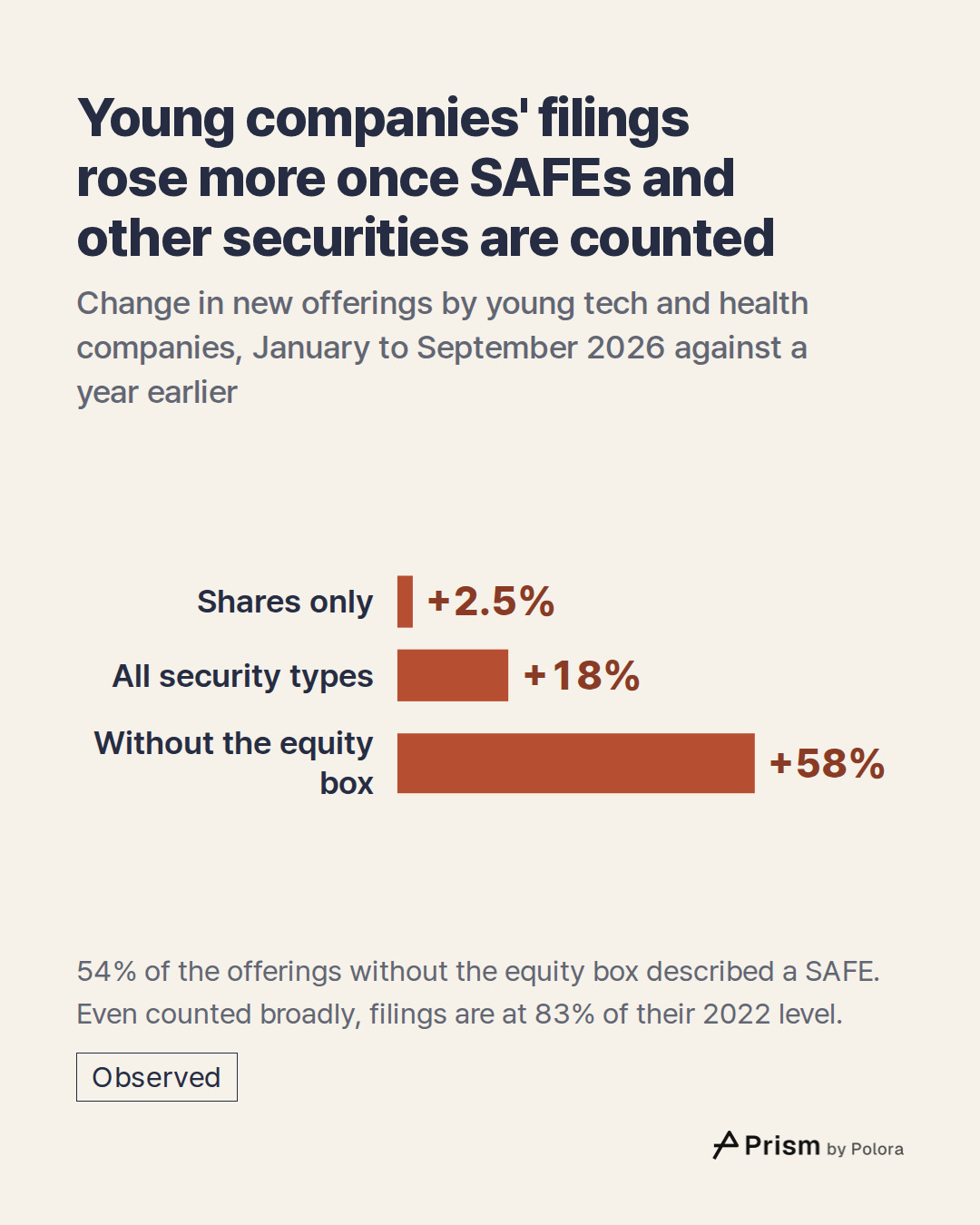
Counting every security type, young tech and health companies filed 18% more new offerings from January to September 2026 than a year earlier. Their offerings without the equity box rose 58%, and 54% of those described what they sold as a SAFE. So these young companies are filing more notices this year than the shares-only line shows. But they still trail venture funds, and even counted this broadly they are at 83% of their 2022 level.
The counts are offerings, not companies : 1,641 different companies were behind the 1,743 young-company share offerings filed from January to September 2026.
What the counts cannot tell you
The data show when each group's filings rose and fell. They do not say why, and no source saved for this piece explains the gap between funds and young companies. Form D is filed by issuers based anywhere, so the counts include companies and funds outside the United States. The SEC says its data sets are taken from what filers submit and that it cannot guarantee their accuracy. Each box, including a company's age, is the filer's own answer. Polora linked each amendment to its original notice by the previous filing number the amendment gives, and also by matching the same issuer reporting the same date of first sale. That second rule is Polora's own method. Every counted first notice was looked up again in EDGAR's full filing index. A few are missing there or dated in another quarter, one or two out of the several hundred filed in a quarter; Polora kept the data set's count.

![Sources 7 : sec.gov · SEC, Form D Data Sets], sec.gov · SEC, Filing a Form D Notice], sec.gov · SEC, EDGAR full index] + 4](https://media.cdn.polora.ai/picks/2026/11/pickrun_8707f5fa32c9487e/1c8uWif4ES8QryvK-slide-08--is-startup-funding-coming.jpg)