Why the tax you skip this year comes back later
Every December the same tip appears : sell your losing stocks before the year ends and cut your tax bill. The idea has a name, tax-loss harvesting. Selling an investment for less than you paid turns a loss on paper into a loss on your tax return, and that loss can be set against gains you made elsewhere. People who want to stay invested buy something similar straight away, so their money stays in the market.
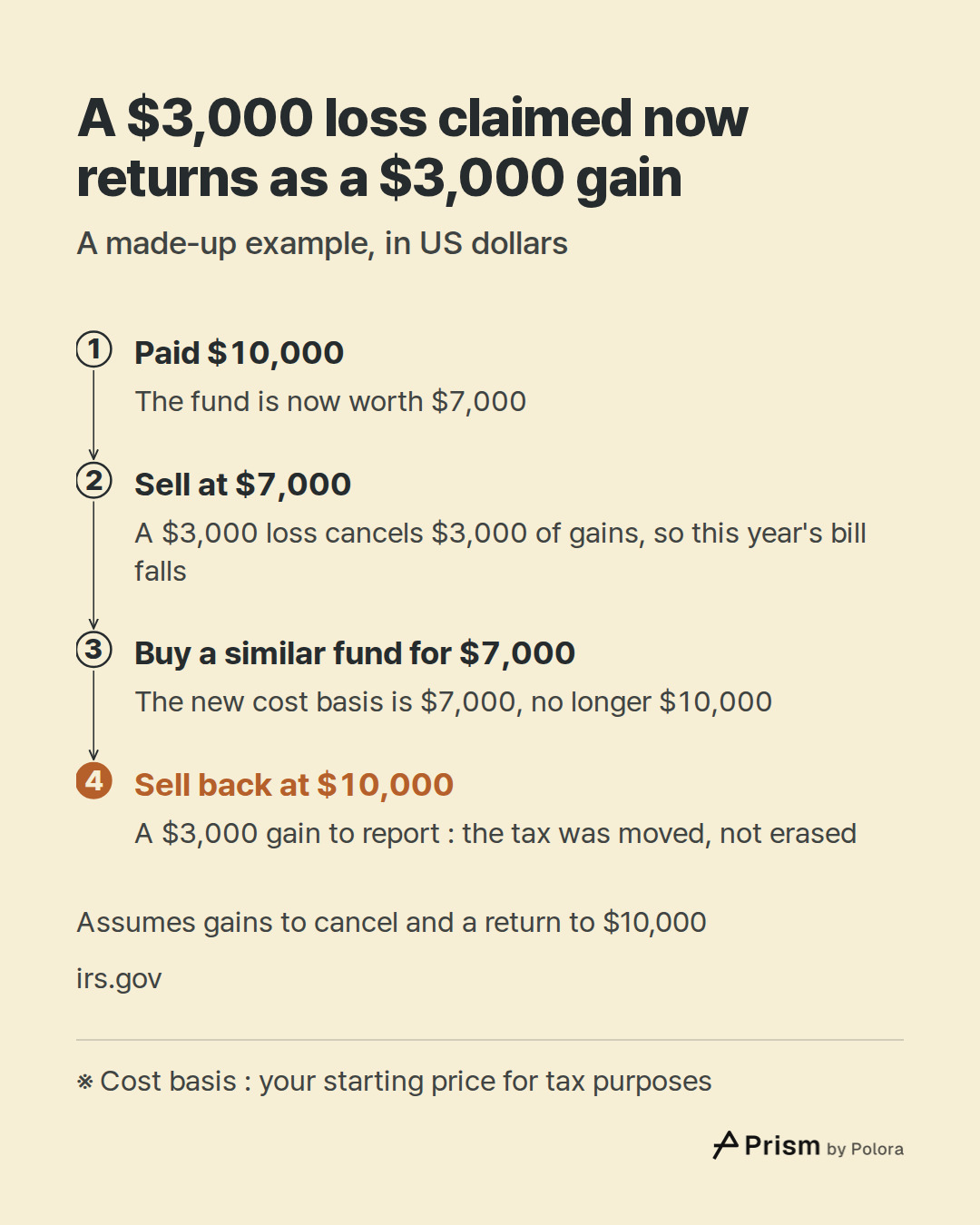
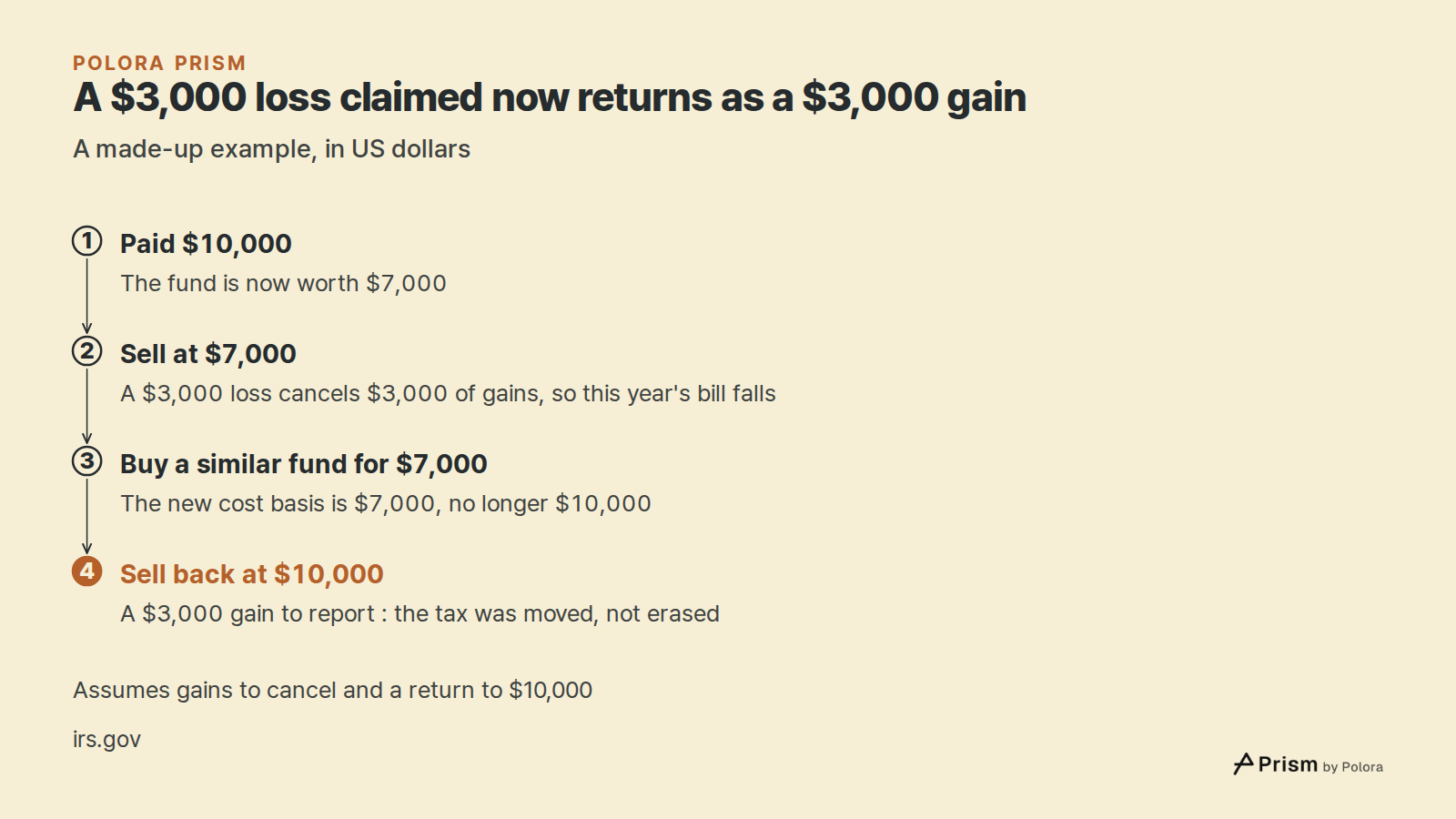
That last step is where the tax goes. Take a made-up example. Suppose you paid $10,000 for a fund that is now worth $7,000. You sell, record a $3,000 loss and use it to cancel $3,000 of gains, so this year's tax bill falls. Then you buy a similar fund for $7,000. For tax purposes your starting price, the cost basis, is now $7,000 and no longer $10,000. If the fund climbs back to $10,000 and you sell, you have a $3,000 gain to report. The tax you avoided was not erased. It was moved into the new position and waits there until you sell.
So the honest question is not whether harvesting lowers this year's bill. It does, as long as there are gains to set the loss against, or in some countries other income within limits. The question is what happens to the tax that comes due later.
When paying tax later becomes paying less tax
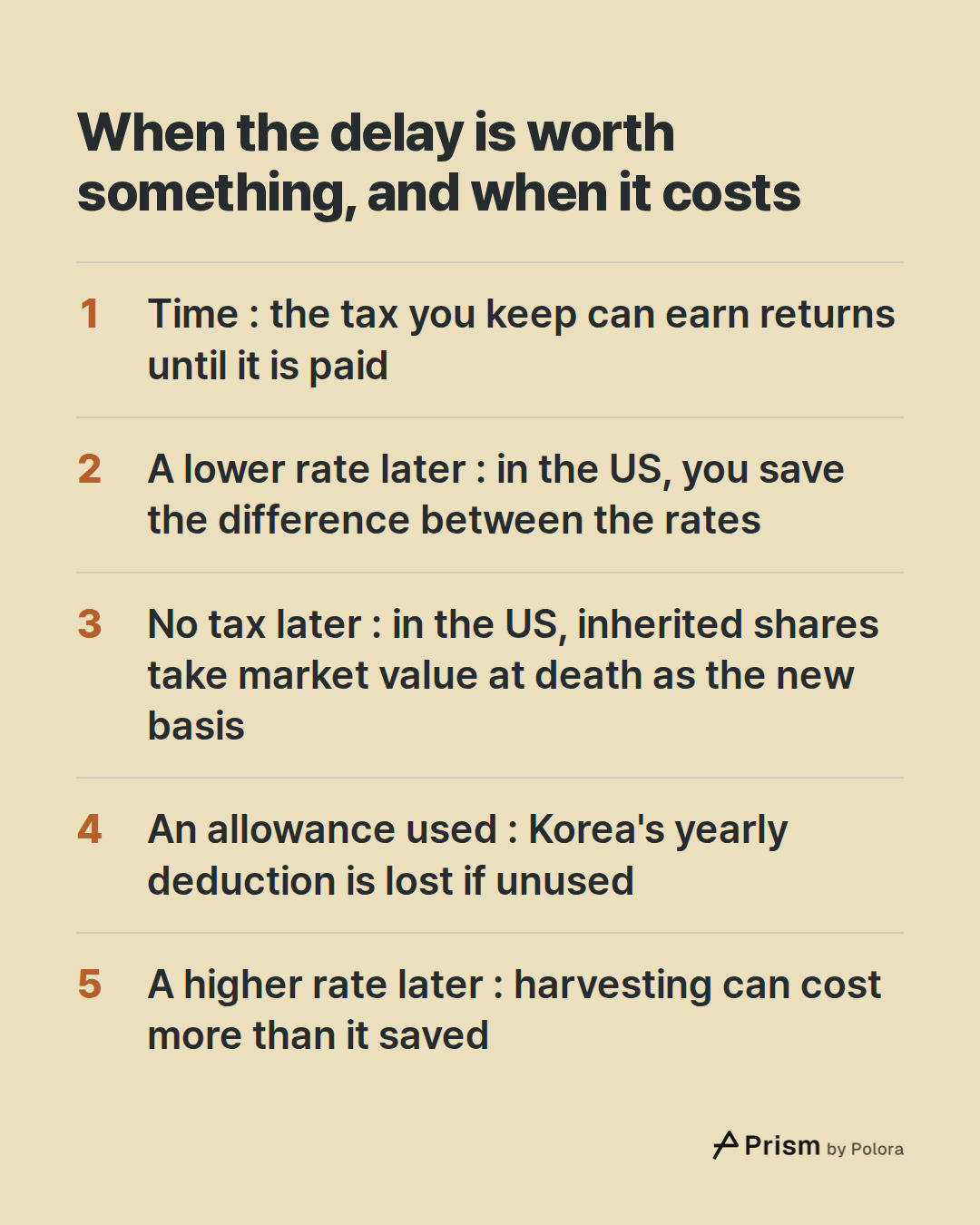
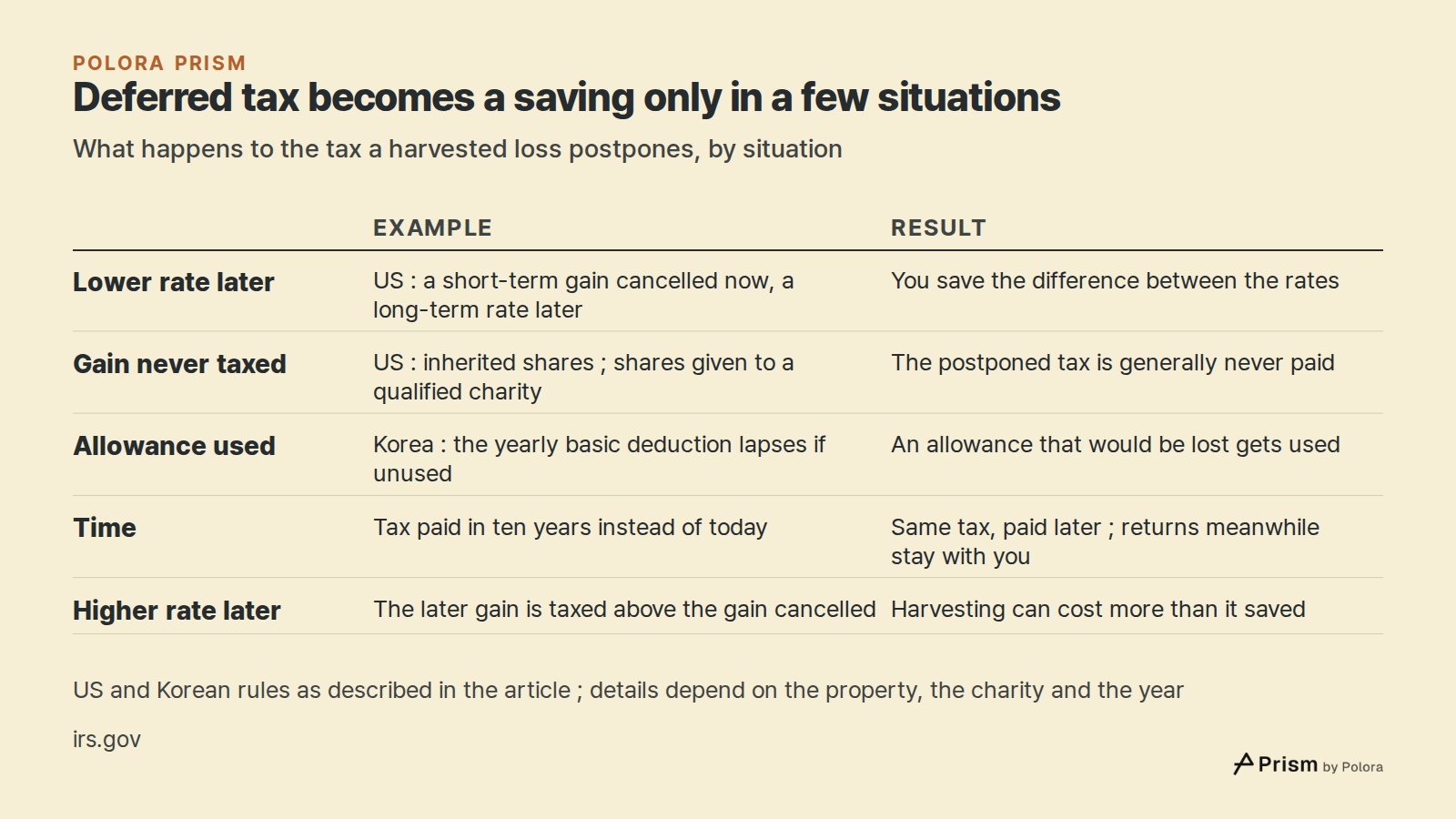
A delay turns into a real saving in a few specific situations.
The later gain is taxed at a lower rate. In the United States, gains on holdings kept for a year or less are taxed like wages, while long-term gains are taxed at 0%, 15% or 20%. If the loss cancels a gain taxed at the higher rate now, and the rebuilt gain is later taxed at a long-term rate, you save the difference between the two. For the 2025 tax year, the 0% rate applied to single filers with taxable income up to $48,350.
The later gain is never taxed. Under US law, someone who inherits shares takes their market value on the date of death as the new basis, so the gain built up during the owner's life is never taxed as income. Giving shares held more than a year to a qualified charity generally earns a deduction at market value, within limits on how much can be deducted, and the built-up gain is generally not taxed. The details depend on the kind of property and the kind of charity.
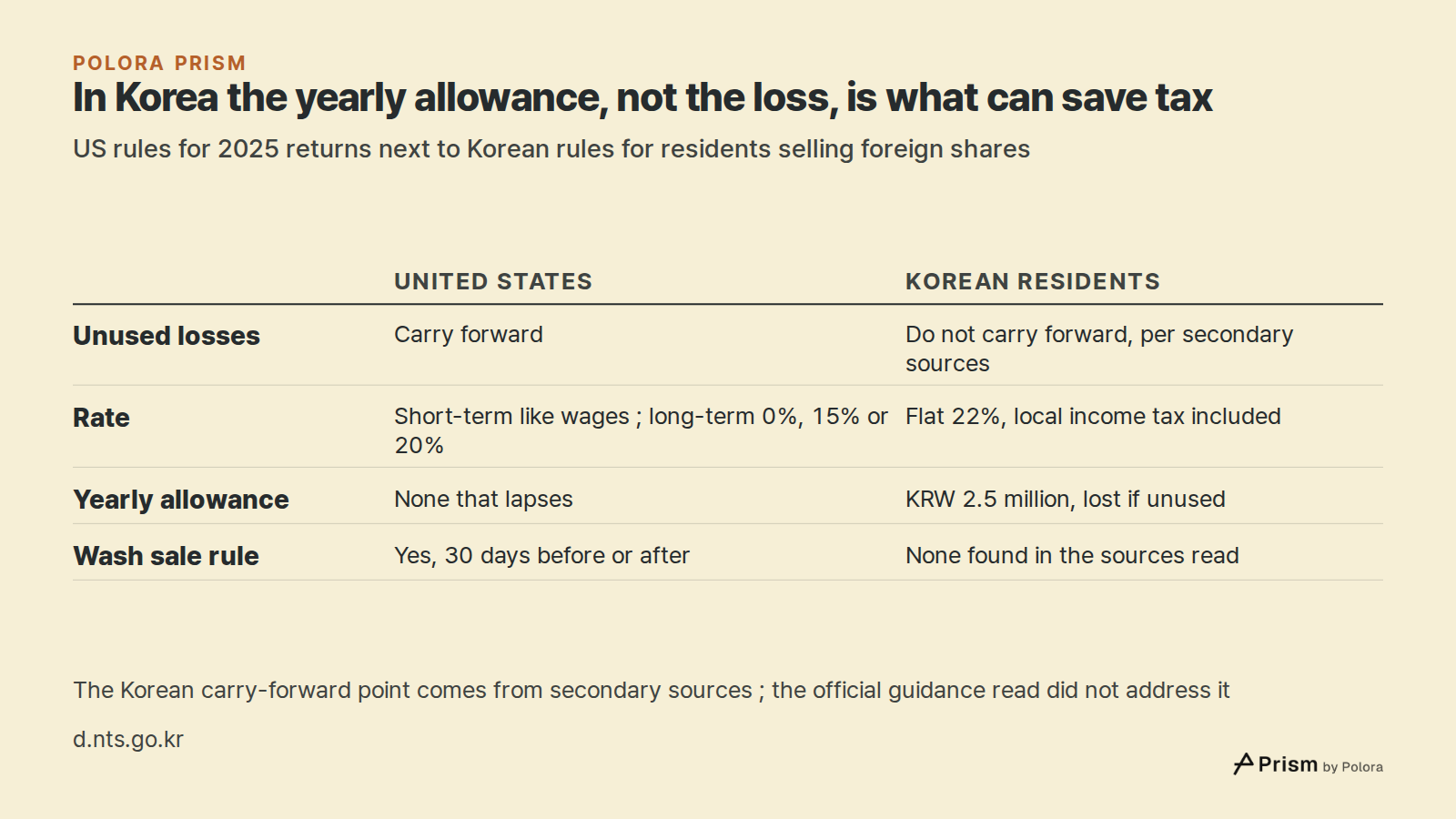
An allowance that would otherwise go unused gets used. Korea gives each resident a yearly basic deduction on gains from foreign shares and taxable domestic shares. Whatever is not used within the calendar year is lost. The US $3,000 deduction against other income is not this kind of allowance, because unused losses there carry forward.
Then there is the value of time. Tax paid in ten years instead of today stays invested in the meantime, and the returns earned on it stay with the investor even after the tax is finally paid. Over a long horizon that can be worth a good deal. It is still the same tax, paid later.
The same logic runs the other way. If the later gain is taxed at a higher rate than the gain the loss cancelled, harvesting can cost more than it saved. Outside these situations, a harvested loss mostly moves the bill to a later year.
How it works in the United States
These figures are from the IRS guidance for 2025 returns. A capital loss first cancels capital gains. If losses are larger than gains, up to $3,000 of the rest can be deducted from other income each year ($1,500 for a married person filing separately). Anything left over carries forward to later years until it is used, so a loss in the US does not expire.
The main limit is the wash sale rule. If you buy substantially identical stock or securities within 30 days before or after the sale, you cannot claim the loss that year. In the ordinary case the loss is not destroyed, though. It is added to the cost basis of the new shares, which shows the same point from another angle : the rule itself treats the loss as something postponed. The exception is a replacement bought inside an IRA or Roth IRA, where that basis adjustment does not apply.
A gift works differently from an inheritance. Under section 1015 of the tax code, someone who receives shares as a gift generally takes over the giver's cost basis, so the gain moves to the new owner and is not erased.
Cryptocurrency held directly has been the exception. The wash sale rule covers stock and securities, and the IRS treats crypto as property, so sources as of September and October 2026 say it can be sold at a loss and bought back at once. Bitcoin funds traded as shares are securities and are covered. That gap may close. According to the committee's own record, the House Ways and Means Committee approved H.R. 10357, the Digital Asset Tax Certainty Act, by 38 votes to 5 on 16 September 2026, and the committee describes the bill as applying wash sale rules to digital assets. A committee vote is an early step. A bill becomes law only after both the House and the Senate pass it and it is signed. One tax software source reports that, as amended, the bill would reach sales after 14 September 2026. That date was not confirmed in the committee material read for this piece, and the bill's status may have changed since.
- IRS Topic no. 409, Capital gains and losses
- IRS Publication 550, Investment Income and Expenses
- 26 U.S. Code § 1015, Basis of property acquired by gifts and transfers in trust
- CoinLedger, Crypto wash sale rule
- EY Tax News, Ways and Means approves digital assets tax bill
- House Ways and Means Committee, markup of H.R. 10357 and other bills
- House Ways and Means Committee, digital asset tax legislation advances
How it works for Korean residents holding foreign stocks
A Korean resident who sells foreign shares adds up all gains and losses for the calendar year, subtracts a basic deduction of KRW 2.5 million and pays tax on the rest. For ordinary foreign shares the National Tax Service lists an income tax rate of 20%. With the 2% local income tax added, the total is 22%. According to National Tax Service guidance, since 1 January 2020 gains and losses on foreign shares can be combined with those on domestic shares that are taxable, but the KRW 2.5 million is deducted only once across both. Domestic shares that are not taxable cannot be combined. Broker guidance read for this piece says the year a sale belongs to is set by its settlement date, not the day you trade, so a sale in the last days of December can count in the next year. That timing was not confirmed in official guidance, and brokers publish their own year-end cutoffs.
Secondary sources read for this piece agree that unused losses do not carry forward, though the official guidance read did not address the point. If that holds, a loss realized in a year with no gains to cancel does nothing, and a loss left unrealized at year end cannot be saved for later. The rate is flat, so there is no gap between a short-term and a long-term rate to gain from. For most Korean residents, harvesting a loss would then be a pure delay, useful only when the year's gains are already above the allowance.
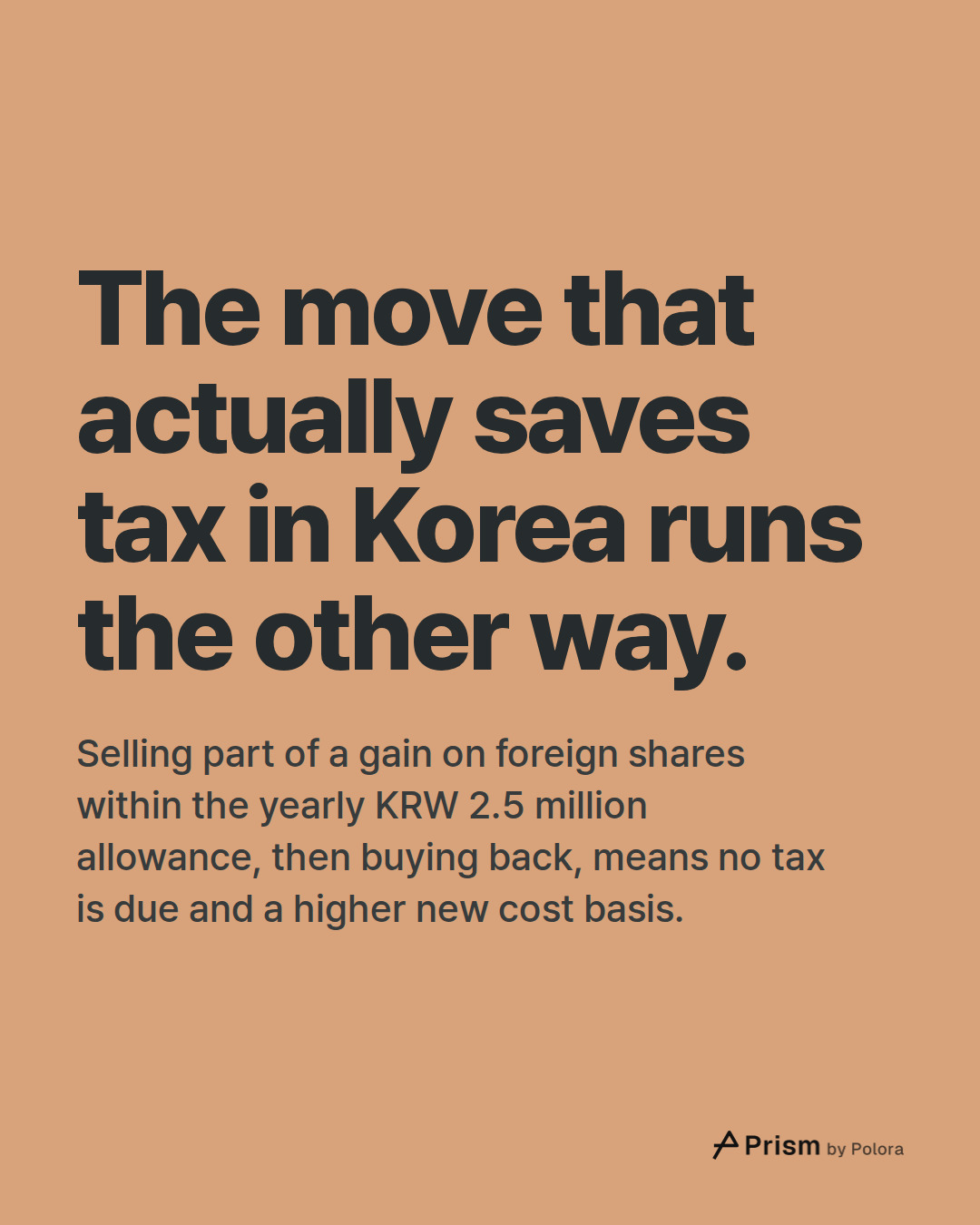
The move that actually saves tax in Korea runs the other way. Someone sitting on an unrealized gain can sell part of it, keep the gain within the KRW 2.5 million, and buy back. No tax is due, and the new cost basis is higher, so that slice of gain will not be taxed again. The allowance lapses each year whether or not it is used, which is exactly the kind of case where a delay becomes a saving.
Gifts carry a time window. National Tax Service guidance describes a one-year rule for shares given on or after 1 January 2025 by a spouse or lineal relative : if the recipient sells within one year of the gift, the gain is taxed on the giver's original cost basis. The statute text read for this piece confirms the one-year period for the spouse case, and the rest of the detail is worth checking against the current rule. In the sources read for this piece, no Korean rule like the US wash sale rule turned up for ordinary market trades. That is an absence in what was read, not a confirmed rule.
The costs that eat into the benefit
Every swap costs money. There are trading fees, and there is the gap between the price you sell at and the price you buy at. For a Korean investor holding US shares, a sale and a repurchase can also mean converting currency twice.
The replacement is another risk. To get around the wash sale rule, people buy something similar but not identical, and similar holdings do not always move together. If the replacement lags the original, the tax saved can be lost in performance.
Then there is the paperwork : cost bases, settlement dates, disallowed losses and any gift dates all have to be tracked, sometimes for decades.
What the 'tax alpha' figures actually measure
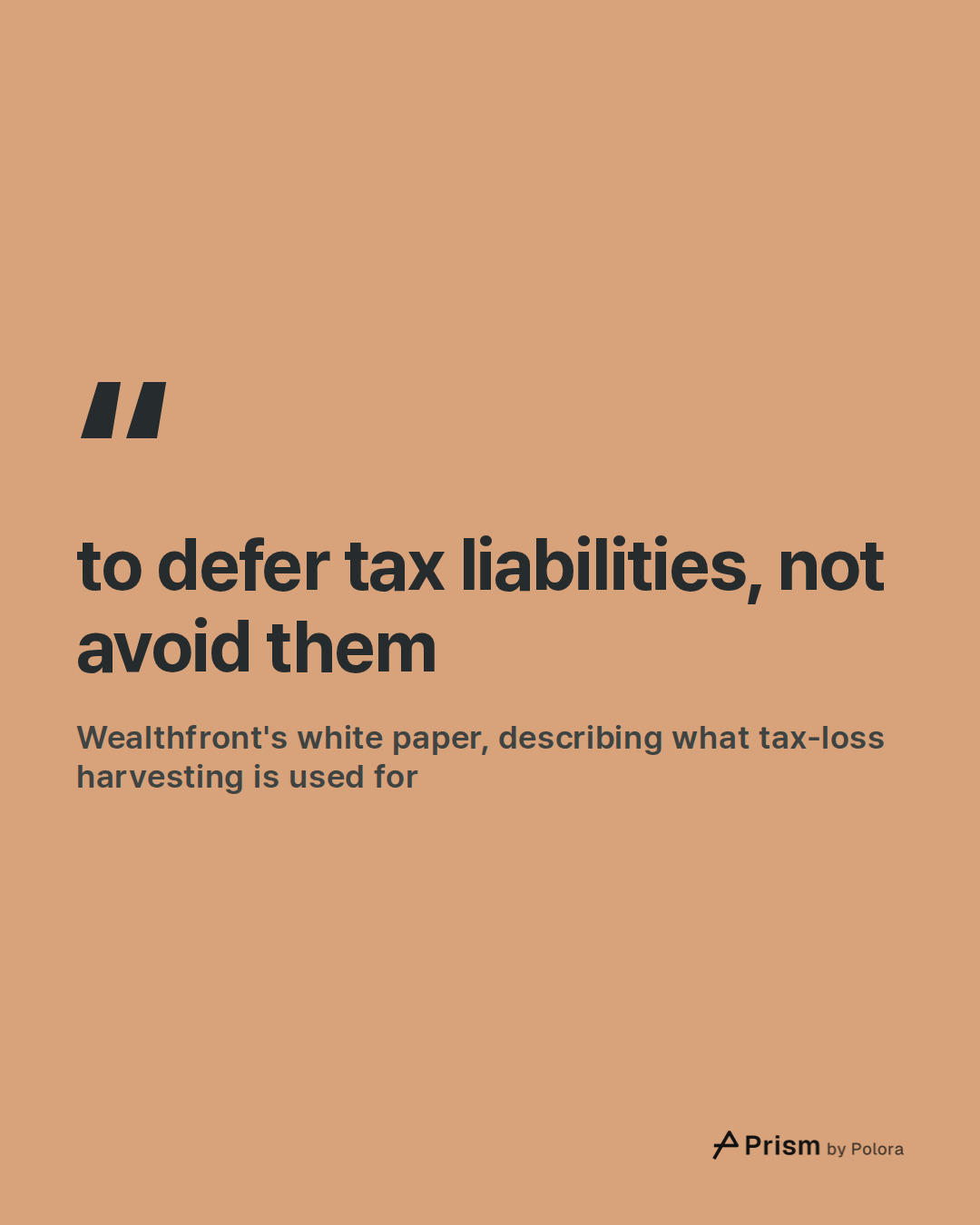
Robo-advisers and direct indexing services, which hold the individual stocks of an index in your own account, harvest losses automatically and advertise the result as 'tax alpha', the extra return that comes from tax savings. Wealthfront's white paper gives a hypothetical gain of 0.78% to 1.38% a year. It assumes a 20-year horizon, set tax rates and selling everything at year 20. The same paper says harvesting is used 'to defer tax liabilities, not avoid them' and has very little value over less than two years. It is a provider's own model, not what a typical investor earns.
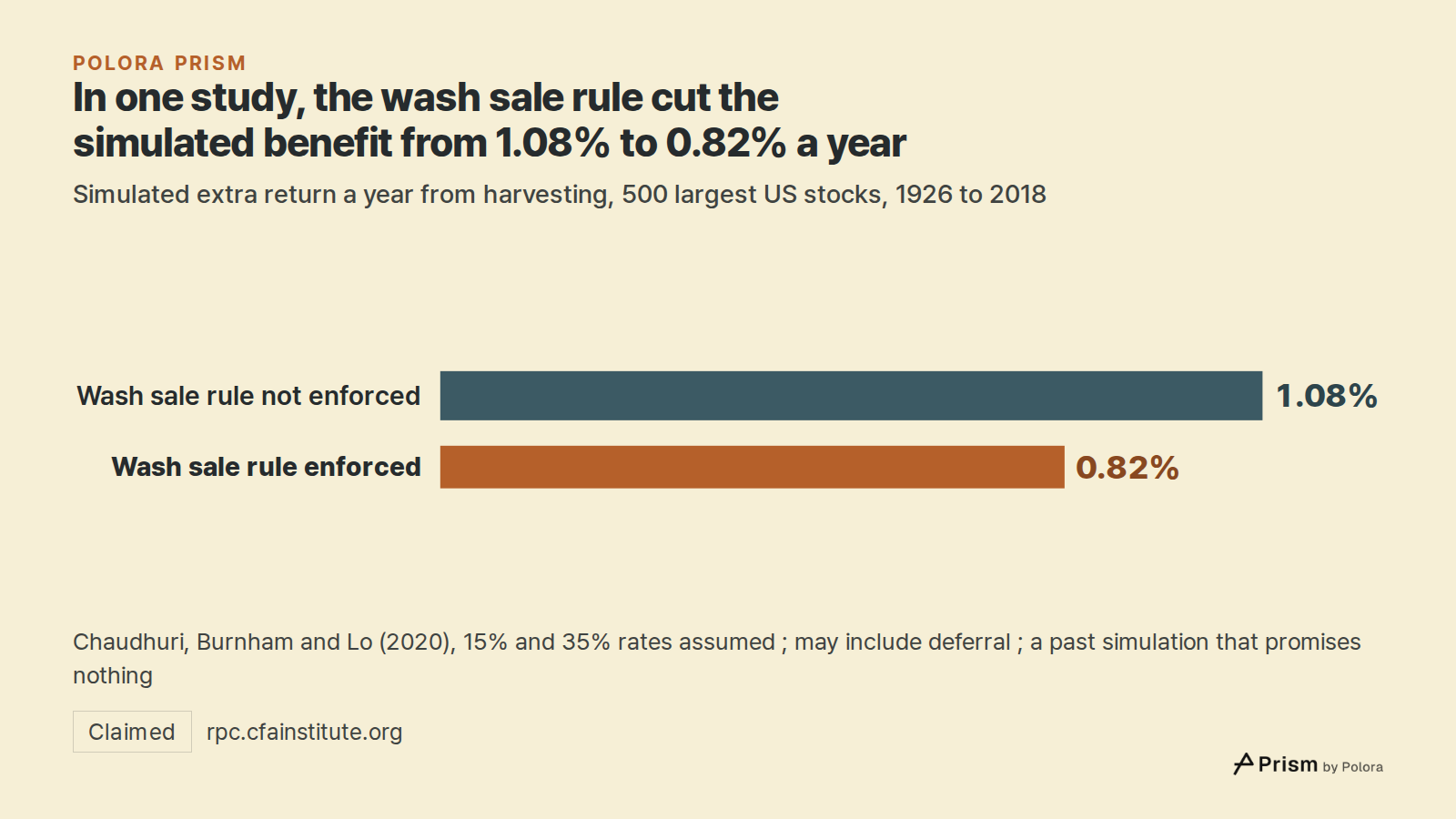
The independent figure most often quoted is from Chaudhuri, Burnham and Lo in the Financial Analysts Journal in 2020. They simulated the 500 largest US stocks from 1926 to 2018, with long-term gains taxed at 15% and short-term gains at 35%, and compared harvesting against simply holding. The published version reports 1.08% a year before trading costs, falling to 0.82% when the wash sale rule was enforced. An earlier draft of the paper gives different figures, 1.10% and 0.85%. The material read for this piece could not confirm whether the published figures already subtract the postponed tax paid when the portfolio is finally sold. So how much of them is deferral and how much is lasting saving is left open here. The assumed gap between the 35% and 15% rates is one of the conditions the result rests on.
The authors report that the result varied strongly across periods, rose with tax rates and depended on how much new money went in. Later work by Israelov and Lu, as summarized by Morningstar, found that losses available to harvest shrink quickly in a portfolio that only holds stocks and receives no new money. The paper itself was not read for this piece. These are past simulations under stated rates and assumptions. They do not say what any one investor will get, and they promise nothing about the future.
- Wealthfront, Tax-Loss Harvesting white paper
- Chaudhuri, Burnham and Lo, Financial Analysts Journal (2020)
- Chaudhuri, Burnham and Lo, published study record (IDEAS/RePEc)
- Chaudhuri, Burnham and Lo, SSRN working paper
- Chaudhuri, Burnham and Lo, SSRN draft PDF
- Morningstar, Taking tax-loss harvesting to the next level
A loan from the tax office, sometimes forgiven
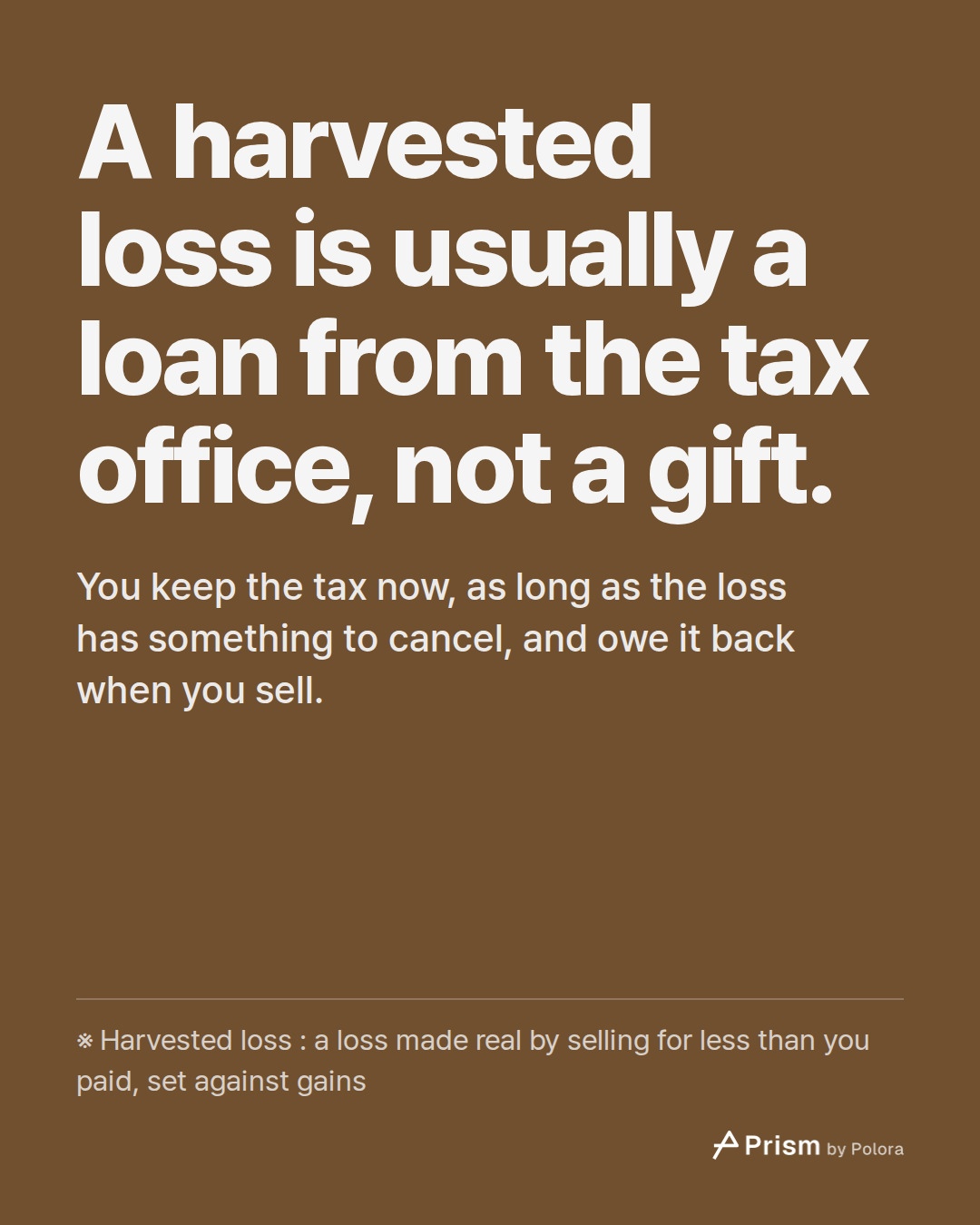
The sentence to remember : a harvested loss is usually a loan from the tax office, not a gift. You keep the tax now, as long as the loss has something to cancel, and owe it back when you sell. Even as a loan it is worth something, because the money kept can earn returns until the tax is paid. The loan is forgiven only if your future rate is lower, if your country's rules erase the gain, as US inheritance does, or if the sale uses an allowance that would have expired anyway. If your future rate is higher, it can cost more than it saved.
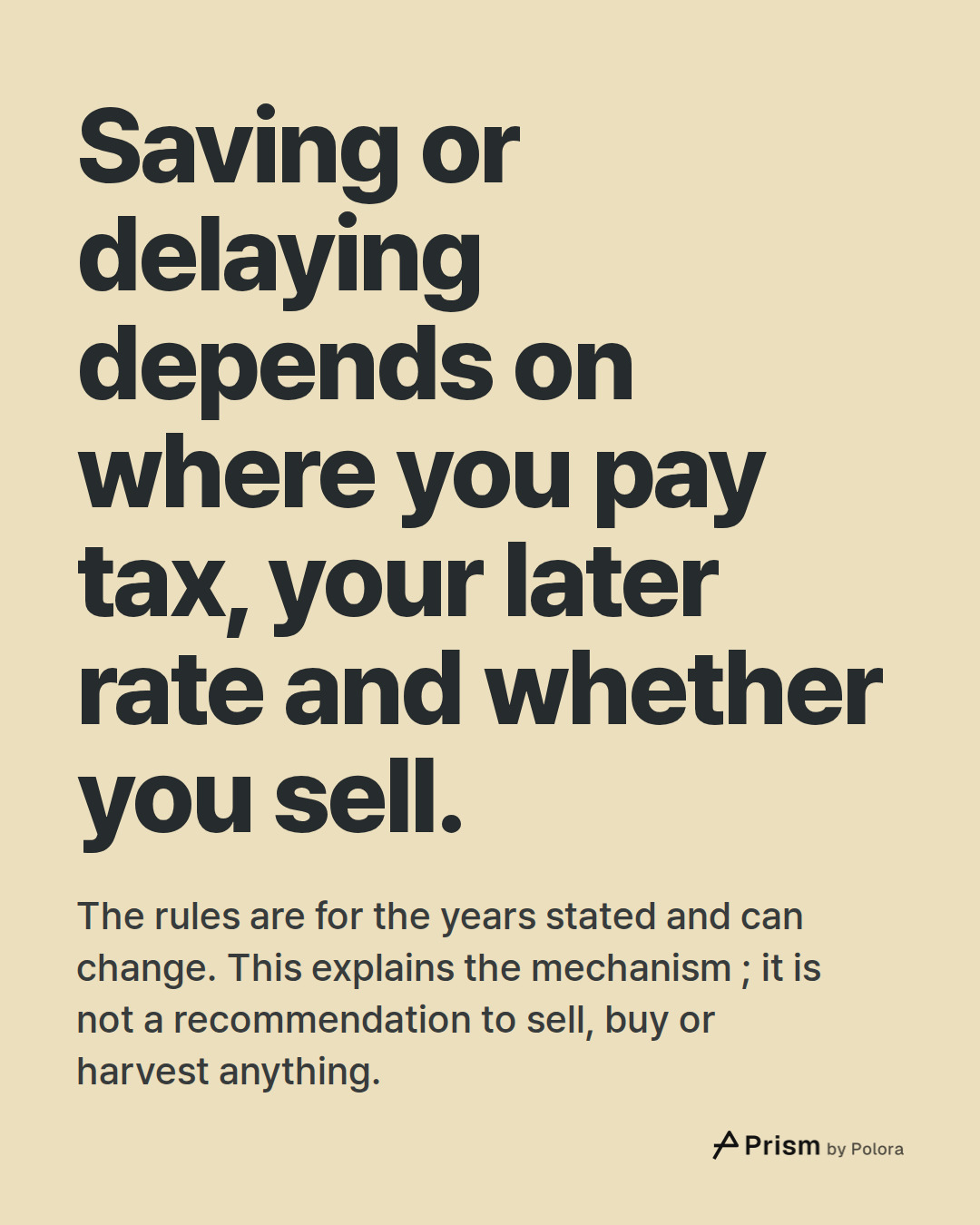
Which of these applies depends on where you pay tax, what rate you will pay later, and whether you ever sell. The rules above are for the years stated and can change. This piece explains how the mechanism works. It is not a recommendation to sell, buy or harvest anything.