You paid nothing to trade, so who paid Robinhood $4.47 billion?
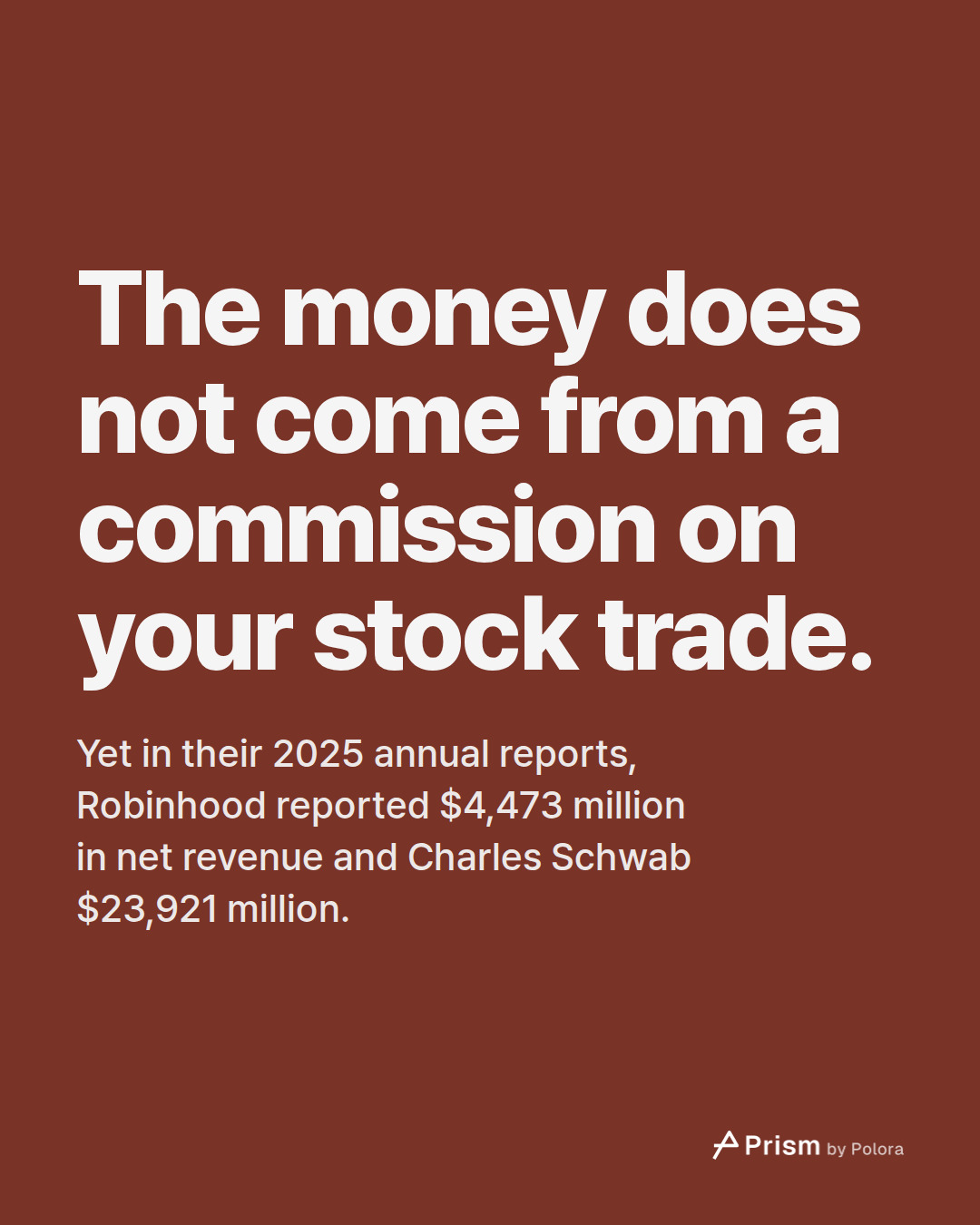
You open a trading app, buy a share, and the fee line says zero. Yet Robinhood, the US app best known for commission-free trading, reported $4,473 million in net revenue for 2025 in its annual report to the US Securities and Exchange Commission. Charles Schwab, a much larger US broker that also charges no commission on online US stock trades, reported $23,921 million.
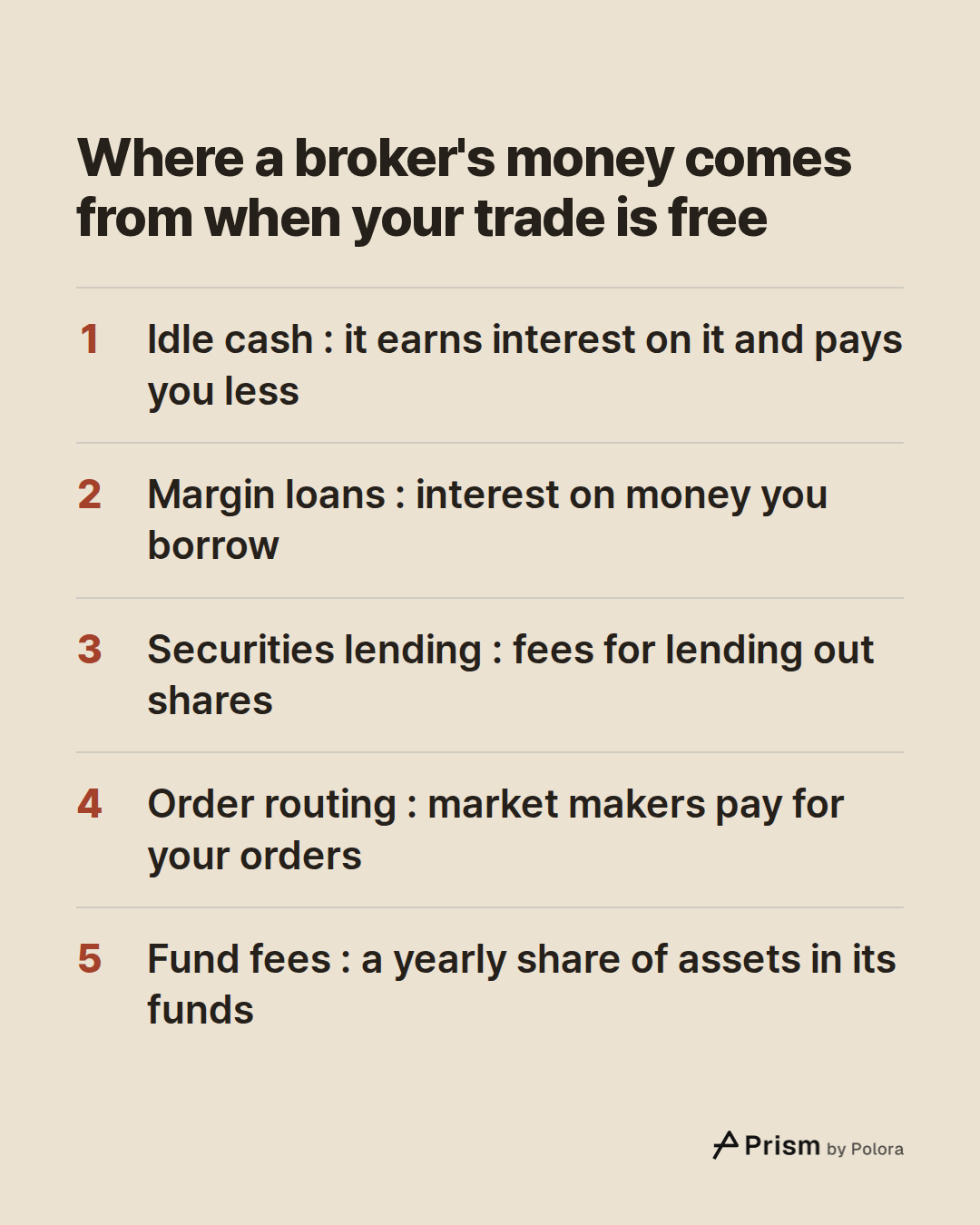
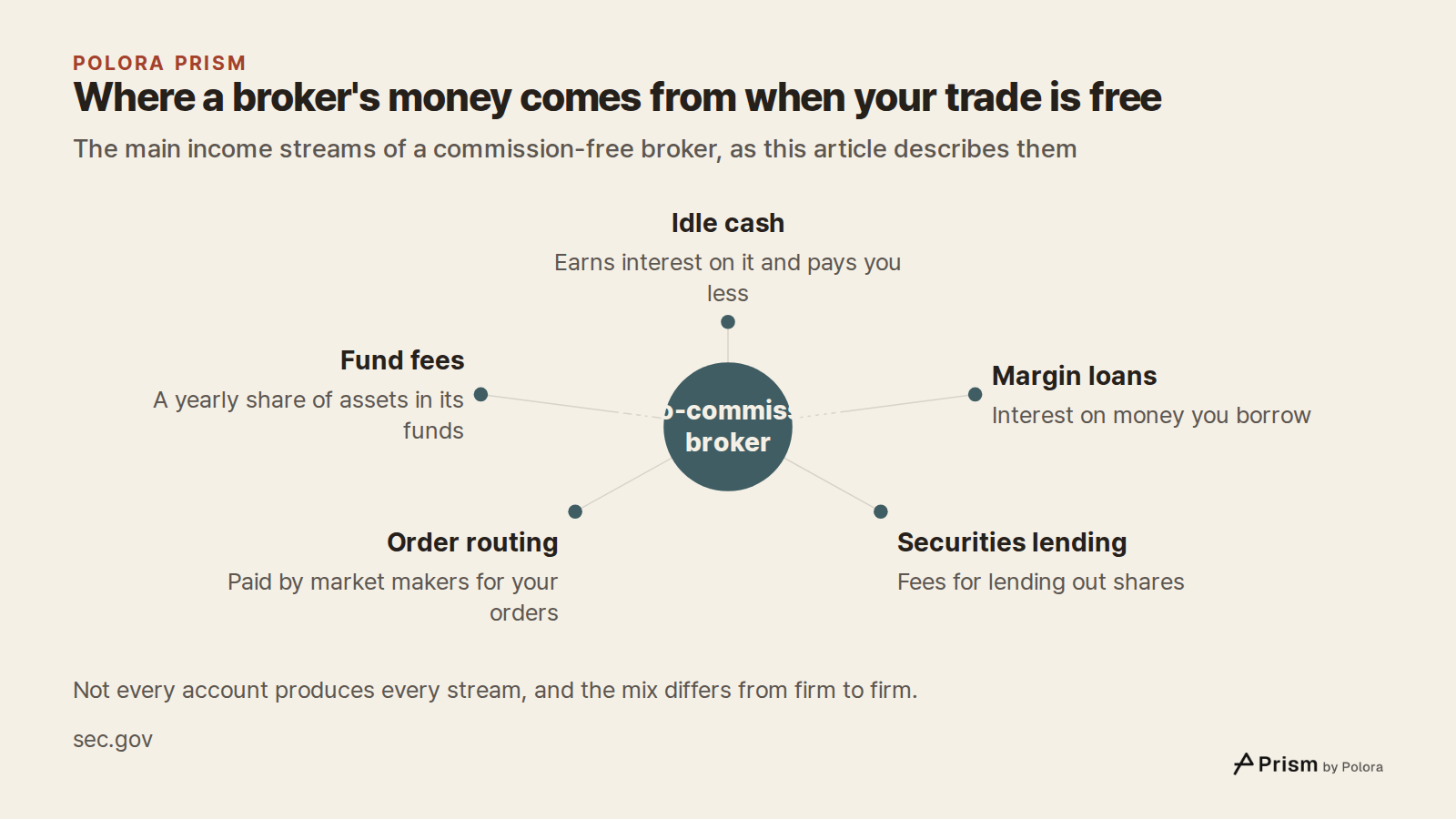
The money is real, and it comes from somewhere. When a stock trade costs nothing, the short answer is that the money does not come from a commission on that trade. That does not mean trading earns the broker nothing. At Robinhood, $2,628 million of 2025 net revenue, about 59%, was transaction-based revenue, most of it from options and crypto orders rather than from any charge on a stock purchase. At Schwab, the largest part came from the cash customers leave in their accounts. The rest comes from the money customers borrow, the shares the firm lends out, and fees on funds. Following that money one stream at a time also shows what each part of a brokerage does, and why no single firm's mix is a rule for all of them.
The cash you leave sitting in your account earns money for the broker
Almost every brokerage account holds some cash that has not been invested yet. The broker does not leave that cash idle. It puts it in a bank, often its own, or invests it in loans and bonds, earns interest on it, and pays the customer a lower rate. The gap between the two is called net interest revenue.
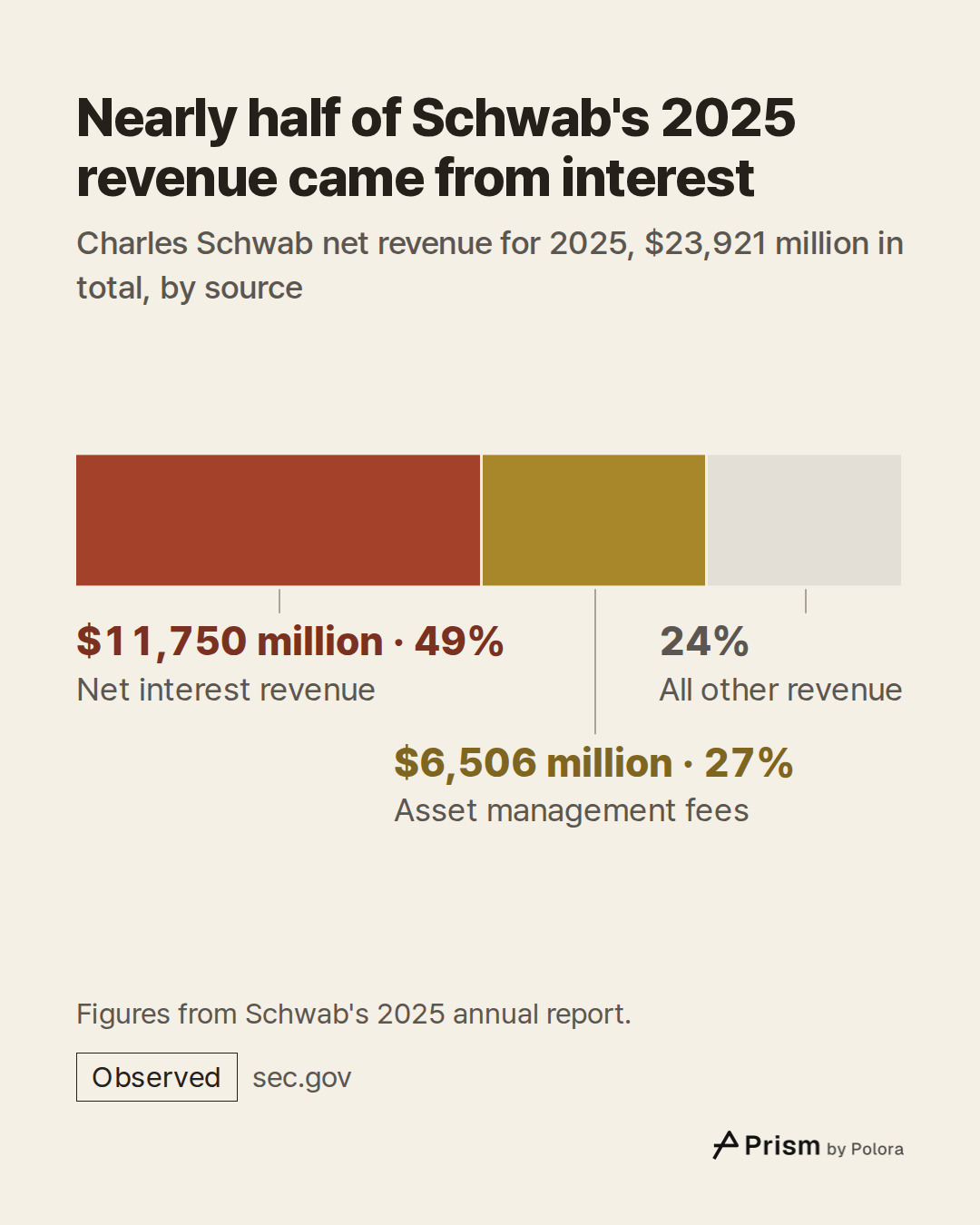
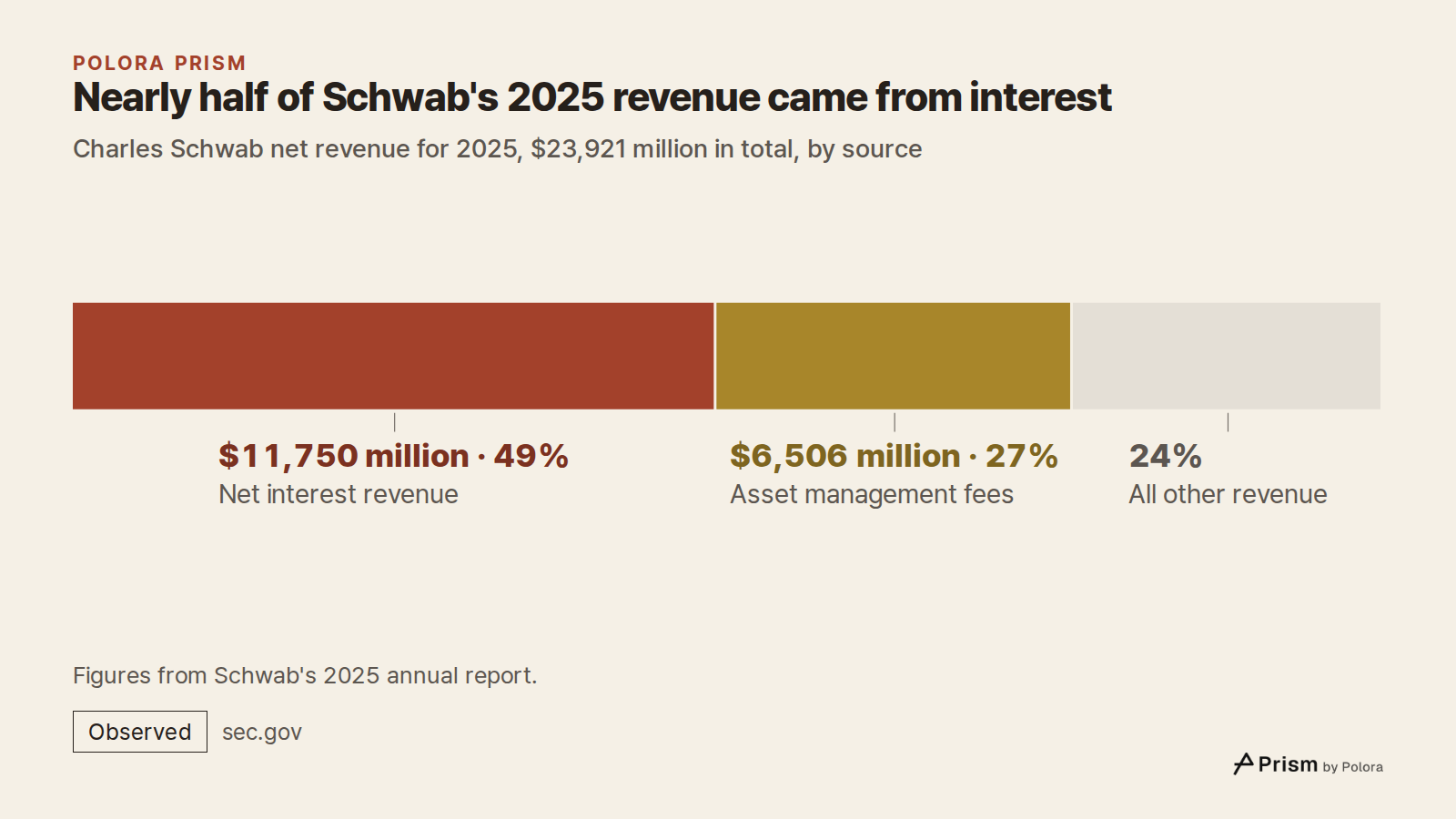
At Schwab this is the single largest source of income. Of its $23,921 million in 2025 net revenue, $11,750 million, about 49%, was net interest revenue, according to its 2025 annual report. The same report gives a sense of the gap. Schwab's interest-earning assets yielded 3.47% on average in 2025, while it paid an average of 0.23% on its money market and other savings deposits. Those two figures sit on different bases, so the difference between them is not the firm's overall margin. The report puts its net yield on interest-earning assets at 2.74% for 2025.
Robinhood works the same way on a smaller scale. Its 2025 annual report shows $229 million from its cash sweep program, where uninvested customer cash is moved to partner banks and Robinhood keeps the difference between what the banks pay and what it passes on to the customer, plus $319 million of interest on customer cash and securities it holds separately under the rules.
Why that income rises and falls with interest rates
Because so much of this money is interest, a broker's income is tied to interest rates. Schwab's annual report says it expects to adjust the rates it pays clients 'at some fraction of any movement in short-term rates'. In plain terms, when market rates go up, what the firm earns tends to rise faster than what it pays out, and when rates fall the gap tends to narrow. That is a tendency, not a rule.
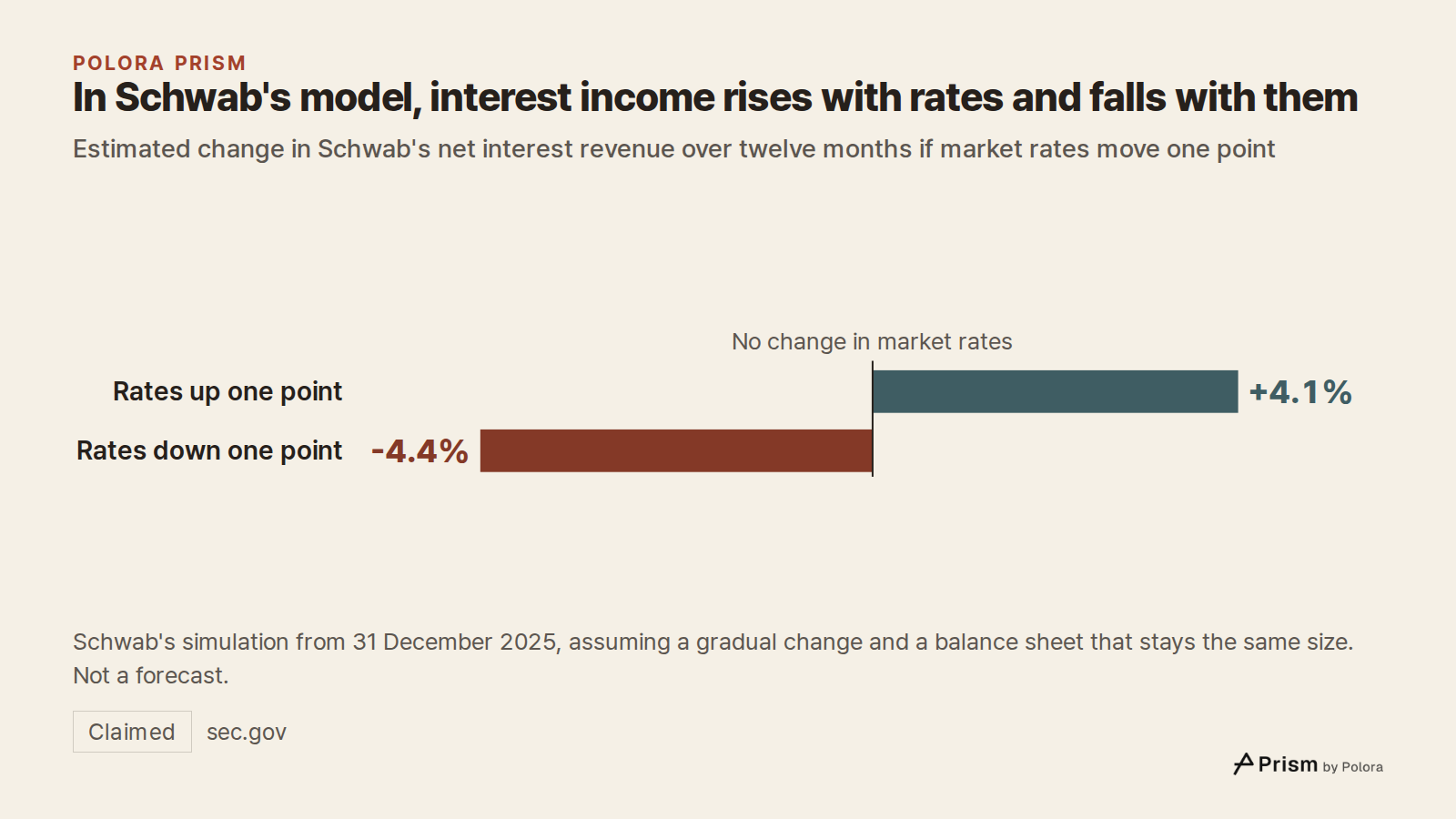
Schwab puts a number on this. Its 2025 annual report simulates the next twelve months from 31 December 2025 and estimates that a gradual rise of one percentage point in market rates would raise its net interest revenue by 4.1%, and a fall of one point would cut it by 4.4%. That is a model with stated assumptions, such as a balance sheet that stays the same size, not a forecast.
One year's change can still have other causes. Schwab's net interest revenue grew 28% in 2025, from $9,144 million to $11,750 million, while market rates were falling. The report explains that the growth came mainly from paying back expensive borrowing and paying lower rates on its funding ; its interest expense fell from $6,393 million in 2024 to $3,754 million. Customers also move cash out of low-paying sweep accounts into money market funds when those pay more, which the report names as one of the forces acting on these balances.
Lending to you, and lending your shares to others
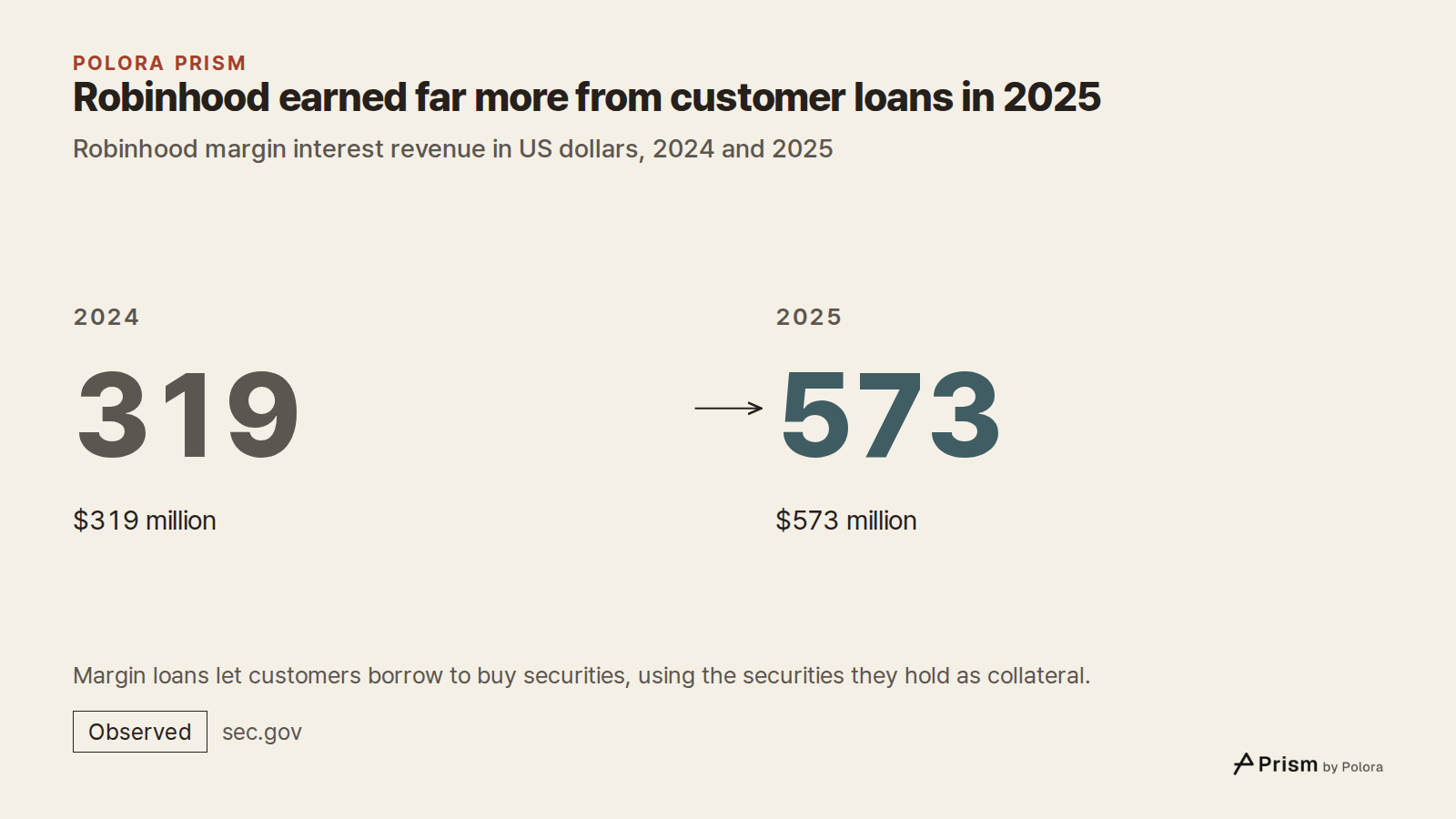
The second stream is lending. A margin loan lets a customer borrow from the broker to buy more securities, with the securities they hold as collateral. The broker charges interest on it. Robinhood earned $573 million in margin interest in 2025, up from $319 million in 2024, and its report puts the average yield on its margin book at 5.01%. At Schwab, receivables from brokerage clients, which are mainly margin loans, averaged $87.3 billion in 2025 and brought in $5,700 million of interest.
Securities lending is quieter. Investors who want to bet against a stock, by selling it short, have to borrow the shares first. A broker can lend out shares held in customer accounts, under the account terms, and collect a fee. Robinhood reported $190 million in net securities lending revenue in 2025, double the year before, and Schwab reported $437 million.
Payment for order flow : the broker is paid for where it sends your order
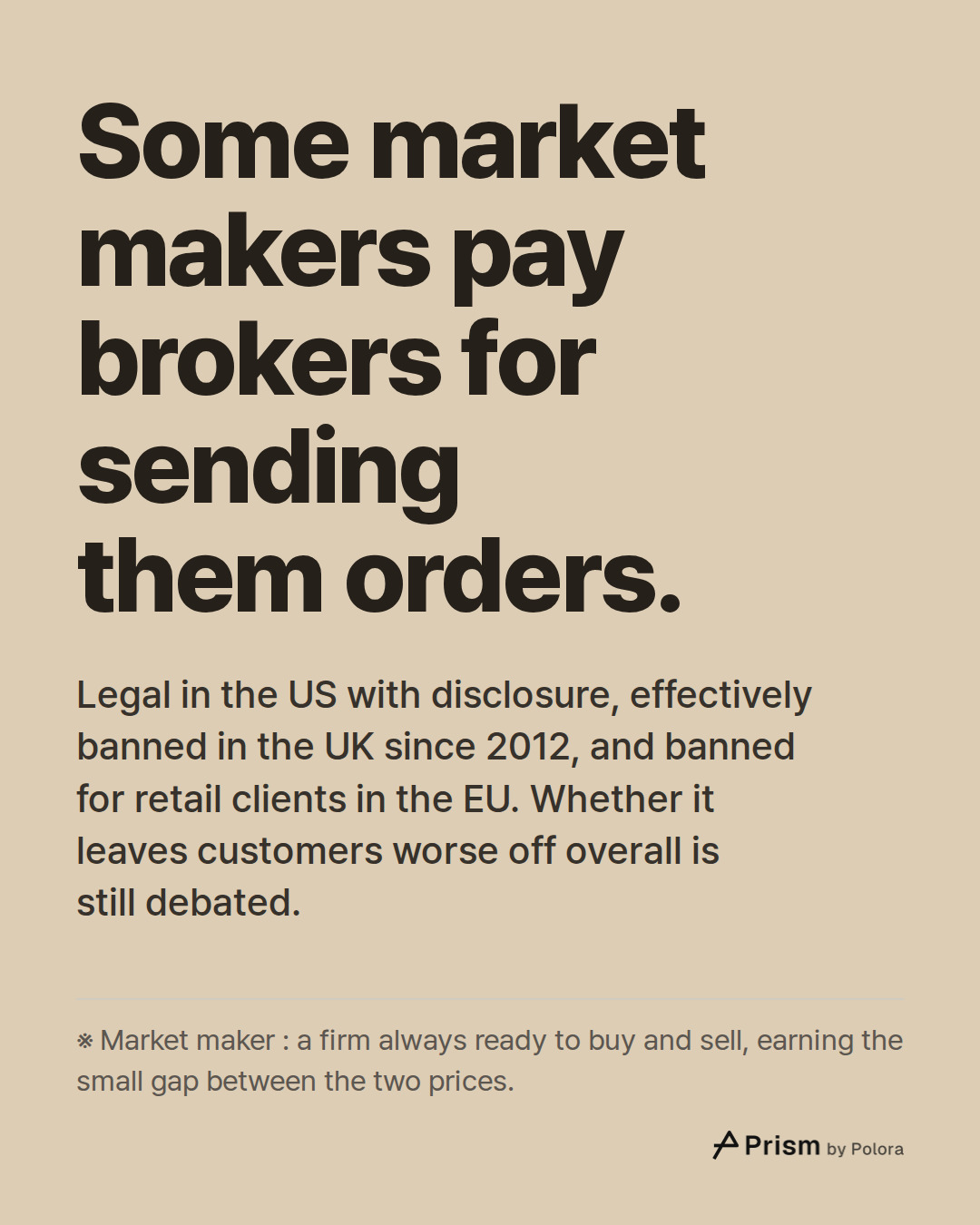
When you press buy, the broker usually does not trade with you itself. In the US it can send your order to a market maker, a firm that is always ready to buy and sell and earns the small gap between the two prices. Some market makers pay brokers for sending them orders. This is called payment for order flow.
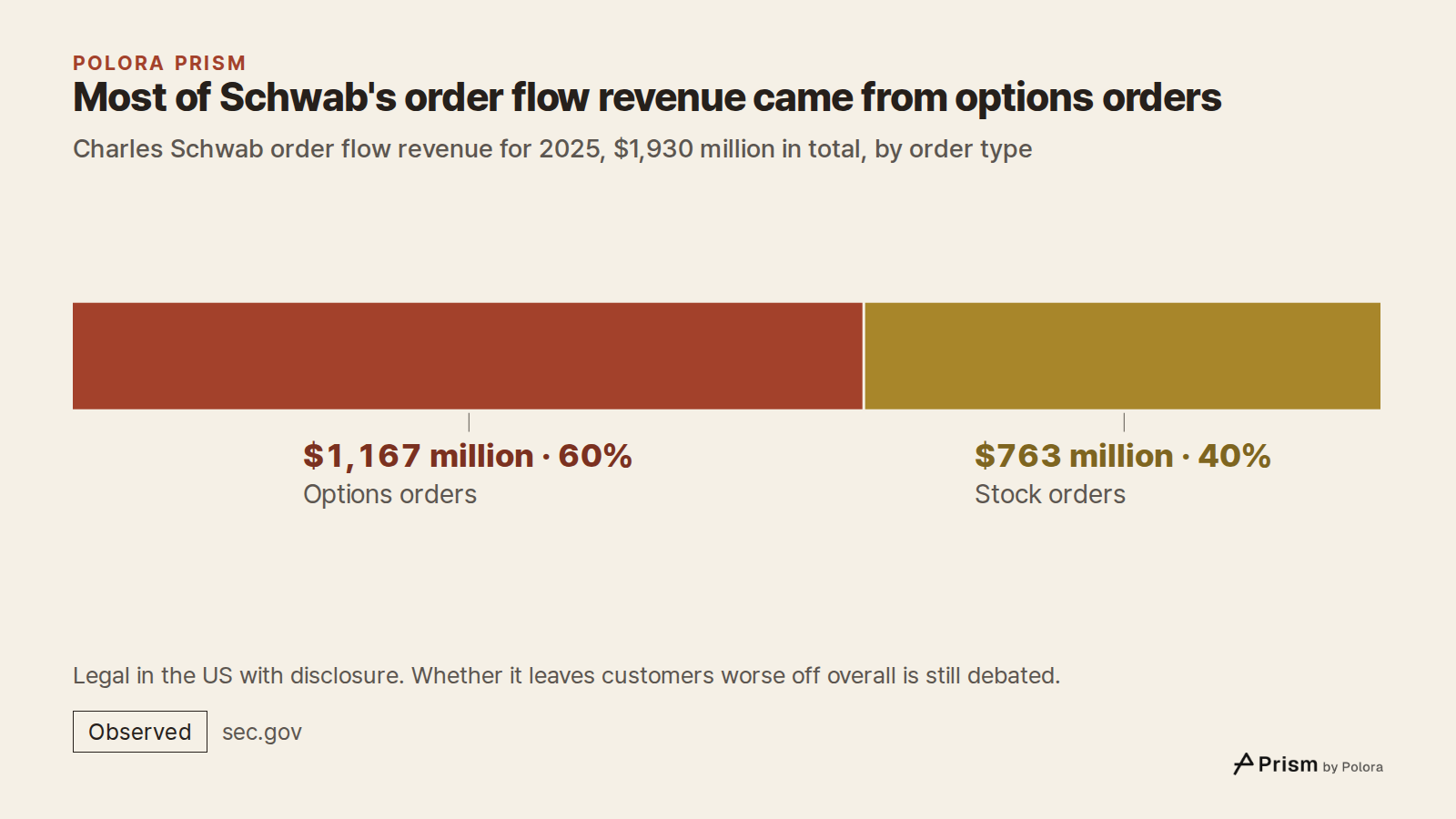
It is legal in the US and it shows up in the filings. Schwab reported $1,930 million of order flow revenue in 2025, $1,167 million from options orders and $763 million from stock orders. Robinhood says in its annual report that it receives payment for routing customers' stock, options and crypto orders to market makers and other liquidity providers, and that this income depends on trading volume. Its filing says $2,326 million of its 2025 transaction revenue came from routing orders to market makers.
What regulators argue about is execution quality, meaning how good a price the customer's order actually gets. A broker paid for routing has a reason to care about the payment, while the customer's interest is getting the best price, which brokers are required to seek. US rules allow the practice with disclosure. The UK's financial regulator decided in 2012 that the conflict could not be managed and effectively banned it. An analysis published on a CFA Institute blog reported that the share of retail-sized UK trades executed at the best quoted price rose from about 65% in 2010 to over 90% in 2014, while noting that other changes in the market happened at the same time, so the ban cannot be credited with the whole change. Whether payment for order flow makes customers worse off overall is still debated.
Why options and crypto earn a broker more than stocks do
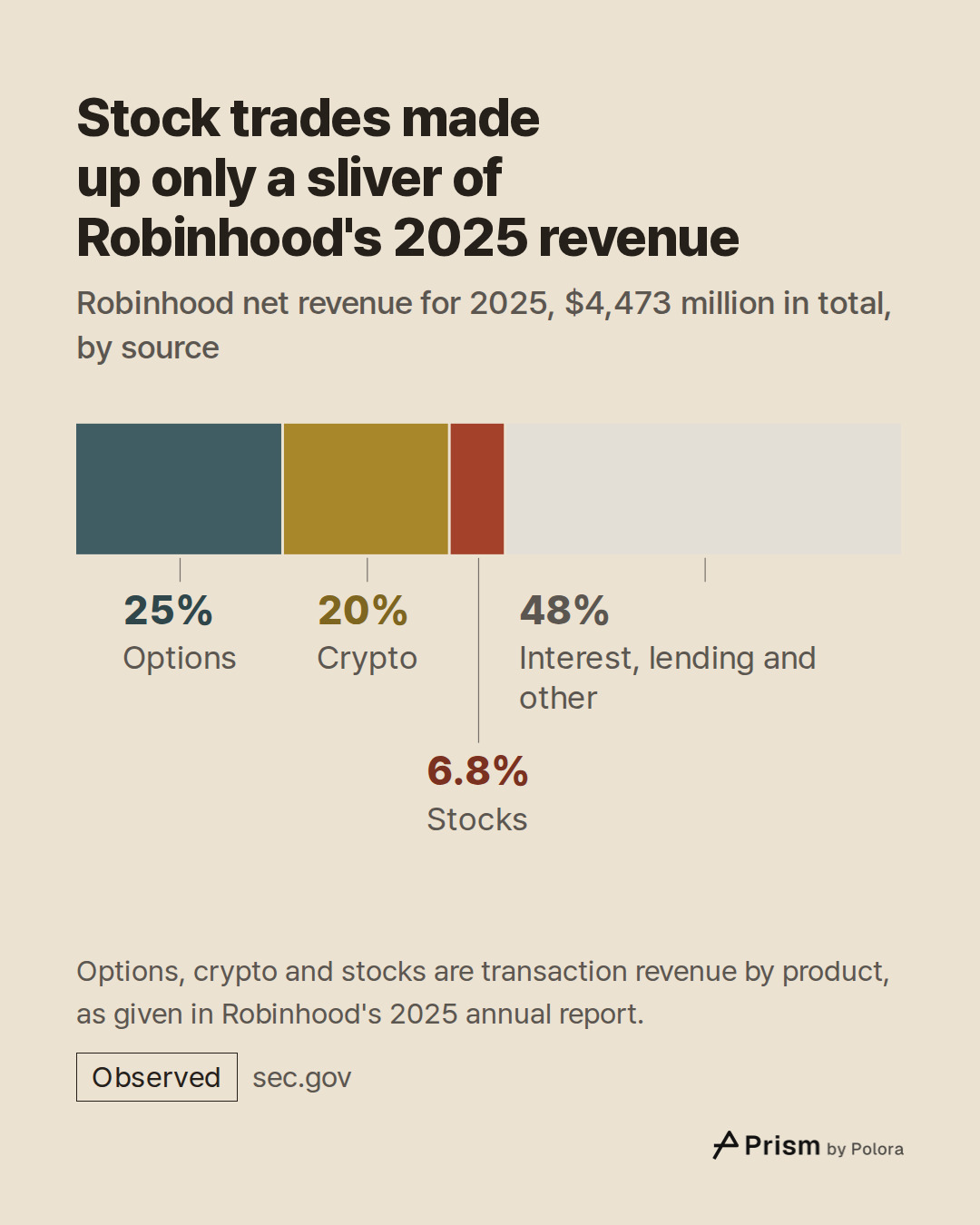
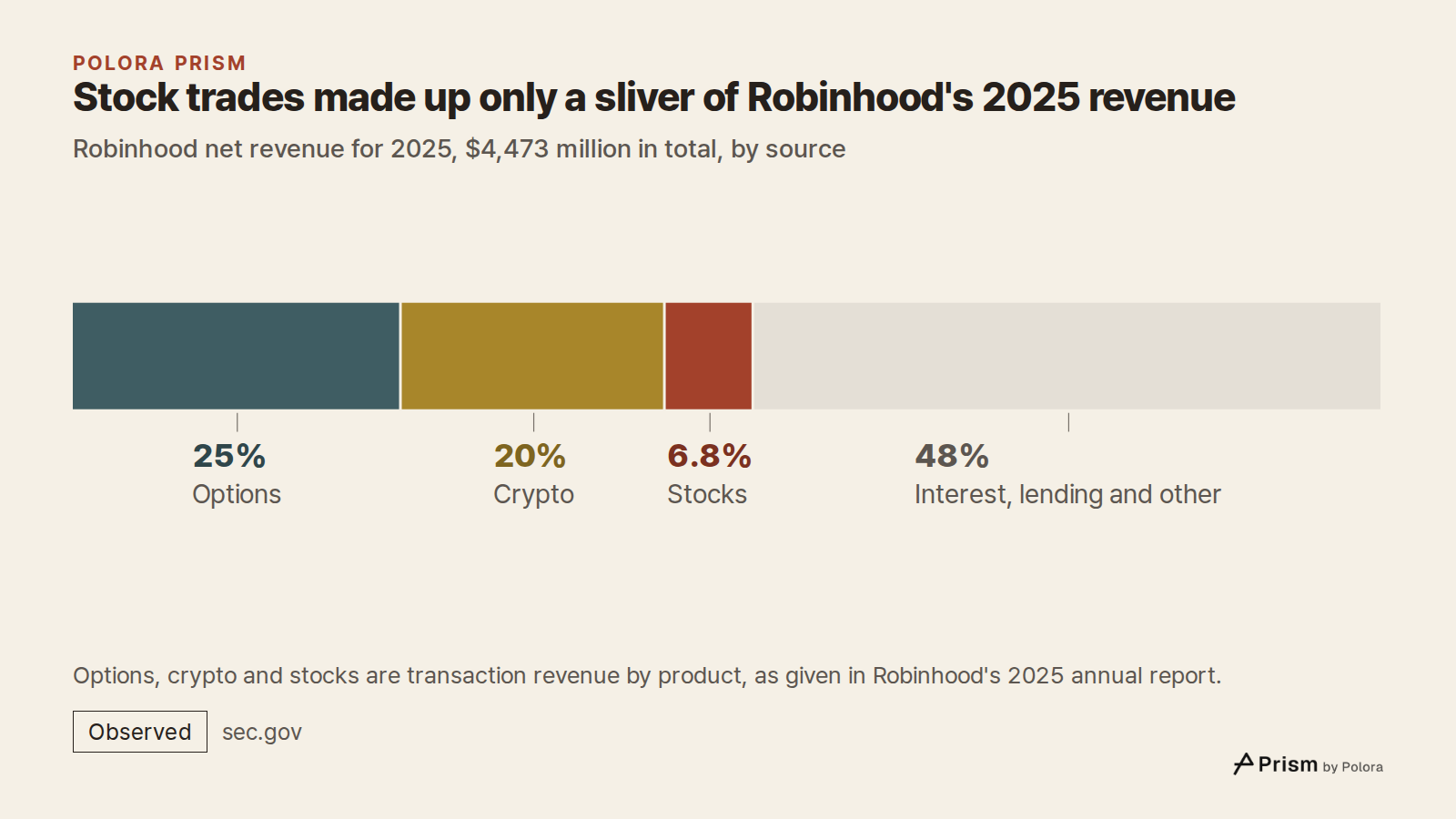
Not all trades pay the same. Robinhood's 2025 annual report splits its $2,628 million of transaction revenue by product. Options, contracts that give the right to buy or sell a stock at a set price by a set date, brought in $1,123 million, crypto $901 million, and stocks $302 million. Stocks, the thing most people picture when they think of a trading app, came to about 7% of Robinhood's total net revenue for the year.
Each product's payment is also worked out differently. Robinhood's filing says the payment for a stock order is based on the quoted gap between buying and selling prices, options pay a fee per contract, and crypto rebates are based on the value of the order. Its report also says its options revenue rose partly because different stocks' options pay different rebate rates. So a broker's income depends not only on how much its customers trade, but on what they trade.
Fees on what you own : wealth and asset management
A large part of a big broker's income does not depend on trading at all. Wealth management means advising clients or managing their portfolios for a fee, usually a percentage of the assets. Asset management means running funds, such as money market funds and exchange-traded funds, and taking a yearly fee from them.
Schwab earned $6,506 million in asset management and administration fees in 2025, about 27% of its net revenue, mainly from money market funds, mutual funds, exchange-traded funds and managed portfolios, its annual report says. Because the fee is a share of assets, this income grows when markets rise and clients bring in money, and shrinks when markets fall.
Investment banking : helping companies raise money
Many securities firms, especially full-service ones, also work for companies rather than individuals. When a company sells shares to the public for the first time or issues bonds, an investment bank arranges the sale and takes a fee for it ; this is called underwriting. It also advises on mergers and acquisitions for a fee. This income rises in years when many companies are raising money or buying each other, and drops when they are not.
In Korea, real estate project finance, lending to or arranging money for property developments, was a significant fee source for securities firms. With the property downturn it also became a material risk, and in 2023 Korea's Financial Services Commission announced measures to deal with securities firms' exposure to it. How far this changed each firm's business differs from firm to firm.
Trading desks, research and the back office
A trading desk buys and sells securities for the firm and for large clients. Some of it is market making, earning the gap between buying and selling prices ; some of it is the firm investing its own money, which can bring gains or losses. At Mirae Asset Securities, one of Korea's largest brokers, trading and other financial income came to 1.2657 trillion won in 2025, more than its brokerage commissions, according to press coverage of its results.
Research, the reports analysts write on companies, rarely pays for itself. Traditionally it has been paid for indirectly, through the trading and banking business it helps a firm win. In Europe, rules introduced in 2018 required firms to price research separately from trading.
The back office is the part that makes sure a trade actually happens. Clearing and settlement move the money and the shares between buyer and seller ; custody keeps the securities safe ; risk management and compliance watch the loans and the rules. It earns little directly and costs a great deal, but it is also where customer cash is held, which links it back to the interest income above.
'Free' trading looks different in each country
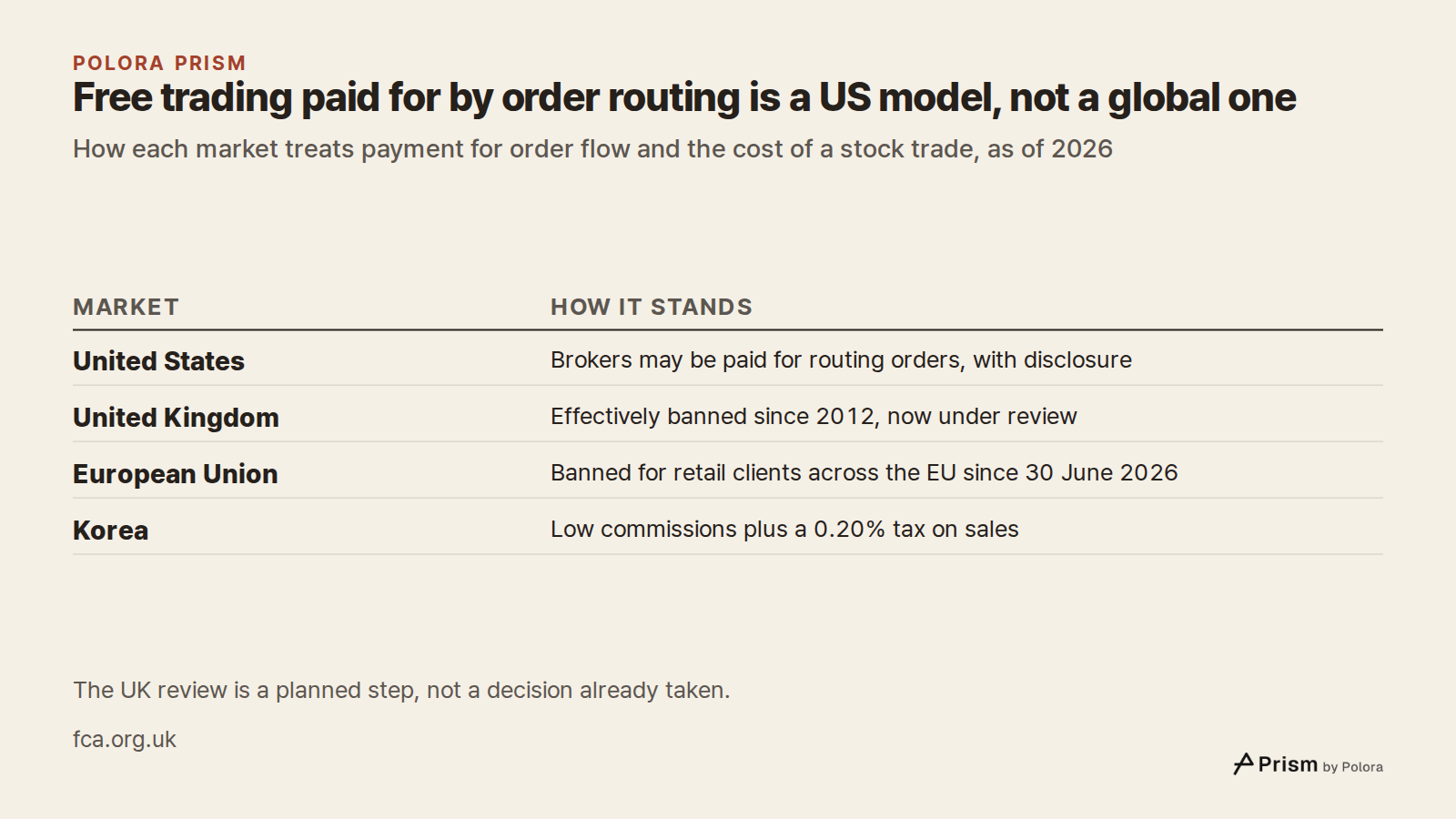
The US model is not universal. The UK has effectively banned payment for order flow since 2012. Its regulator said in 2026 that it is reviewing that position and plans to set out where it stands by the end of the year ; that is a planned step, not a decision already taken. In the EU, Article 39a of the Markets in Financial Instruments Regulation bans it for firms acting for retail clients. Germany, the only EU country that used a transitional exemption, could allow it only until 30 June 2026, so the ban now applies across the EU.
In Korea, stock trading is not free. Brokers charge low commissions, and sellers pay tax on the sale. From 2026 that tax totals 0.20% of the sale amount on both main markets. On the KOSPI that is a 0.05% transaction tax plus a 0.15% rural development surtax ; on the KOSDAQ it is a 0.20% transaction tax. Commissions remain a central business. Mirae Asset Securities reported 1.011 trillion won in brokerage commissions in 2025, up 43%, according to press coverage of its results. At Kiwoom Securities, a broker focused on individual investors, brokerage commissions were about half of its net operating revenue in the first quarter of 2026, in a quarter when average daily trading value more than tripled from a year earlier, according to press reports.
- FCA, FG12/13 Payment for order flow
- FCA, Regulatory Initiatives Grid, May 2026
- FCA, Regulatory priorities, wholesale markets 2026
- The TRADE, FCA eyes potential payment for order flow shake-up
- Regulation (EU) 2024/791, Article 39a
- PwC Legal, Germany's PFOF ban is now fully in force
- Simmons & Simmons, The PFOF ban bites
- PwC Worldwide Tax Summaries, Korea, other taxes
A snapshot, and a way to read any broker
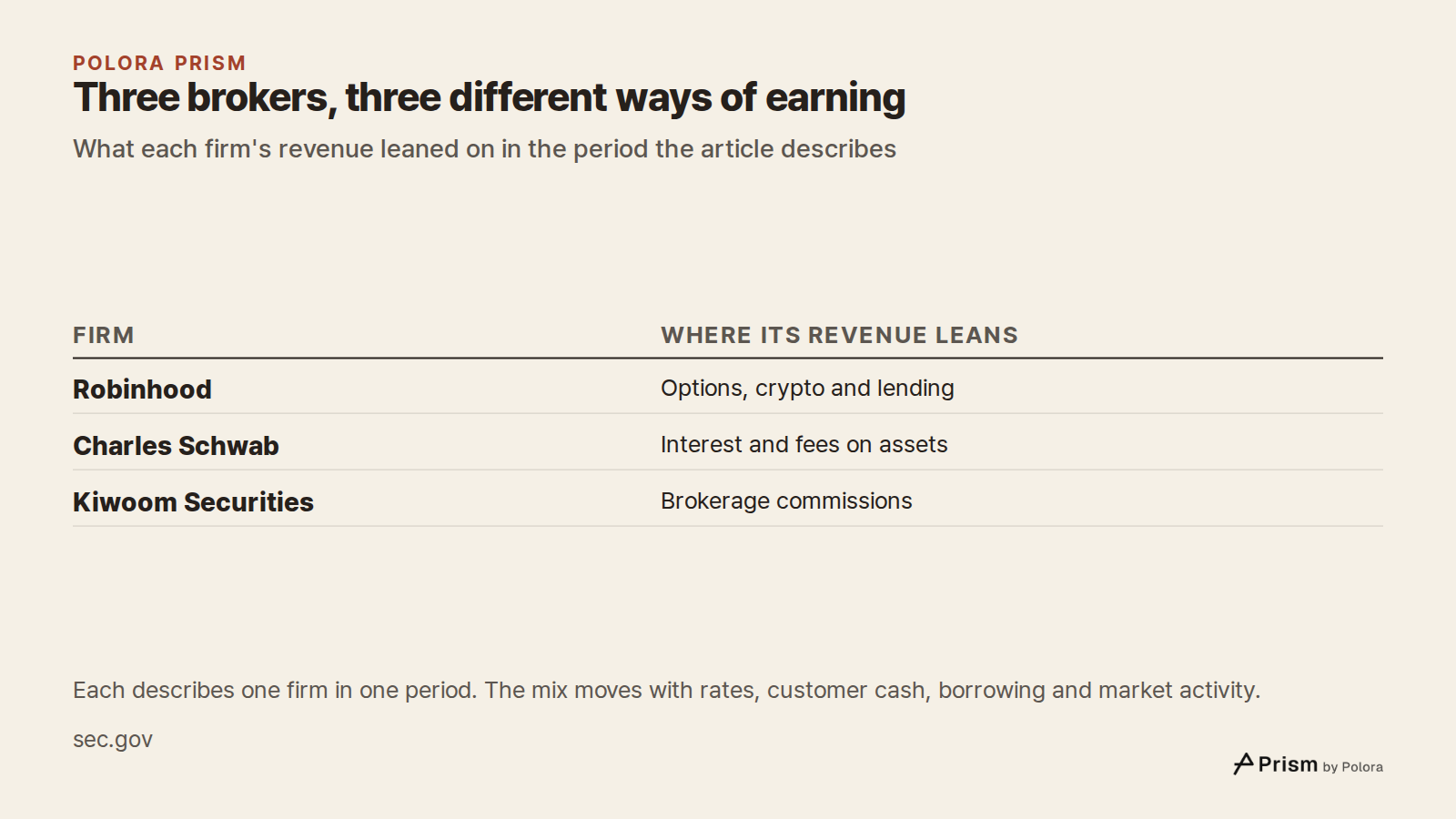
Every number here describes one firm in one period. Robinhood's mix leans on options, crypto and lending ; Schwab's on interest and fees on assets ; Kiwoom's on commissions. Next year each will look different, because the mix moves with interest rates, customer cash, borrowing and how busy the markets are. Not every account produces every one of these streams, and none of it says where a firm's revenue or share price is going.
What carries over is the question to ask. 'No commission on a stock trade' is not the same as 'no revenue from your trading', and 'free' alone does not tell you whether you got a good price on your order or a fair rate on your cash. Look at which lines a broker's income comes from, interest, lending, order flow, fees on assets or commissions, and you can see which way its business leans and what would move it.